coolant Hyundai Accent 2016 User Guide
[x] Cancel search | Manufacturer: HYUNDAI, Model Year: 2016, Model line: Accent, Model: Hyundai Accent 2016Pages: 456, PDF Size: 16.41 MB
Page 360 of 456
Maintenance
27
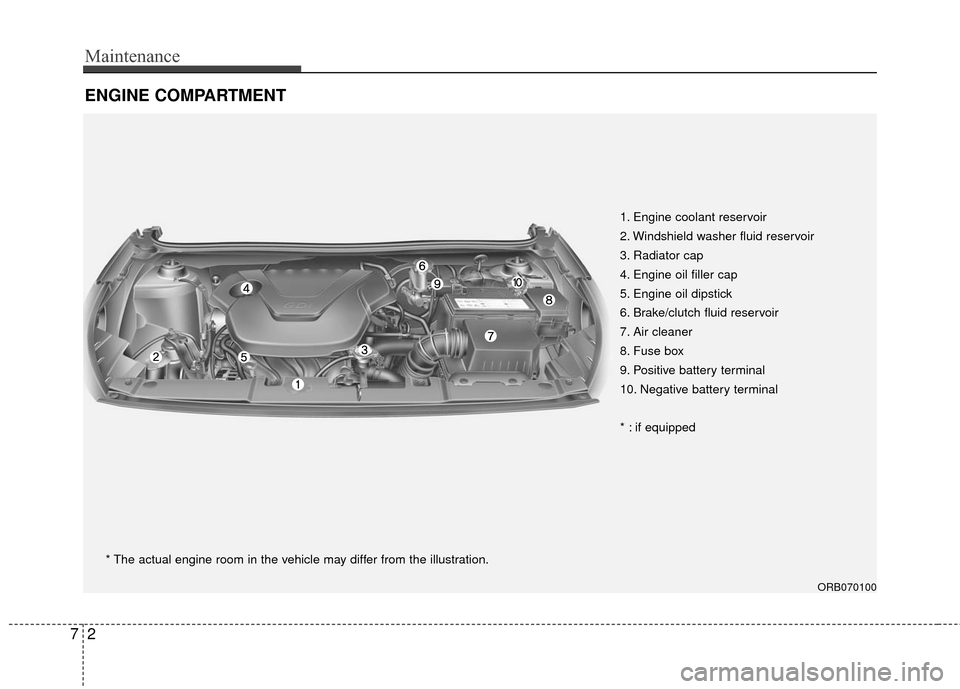
ENGINE COMPARTMENT
ORB070100
* The actual engine room in the vehicle may differ from the illustration.1. Engine coolant reservoir
2. Windshield washer fluid reservoir
3. Radiator cap
4. Engine oil filler cap
5. Engine oil dipstick
6. Brake/clutch fluid reservoir
7. Air cleaner
8. Fuse box
9. Positive battery terminal
10. Negative battery terminal
* : if equipped
Page 362 of 456
Maintenance
47
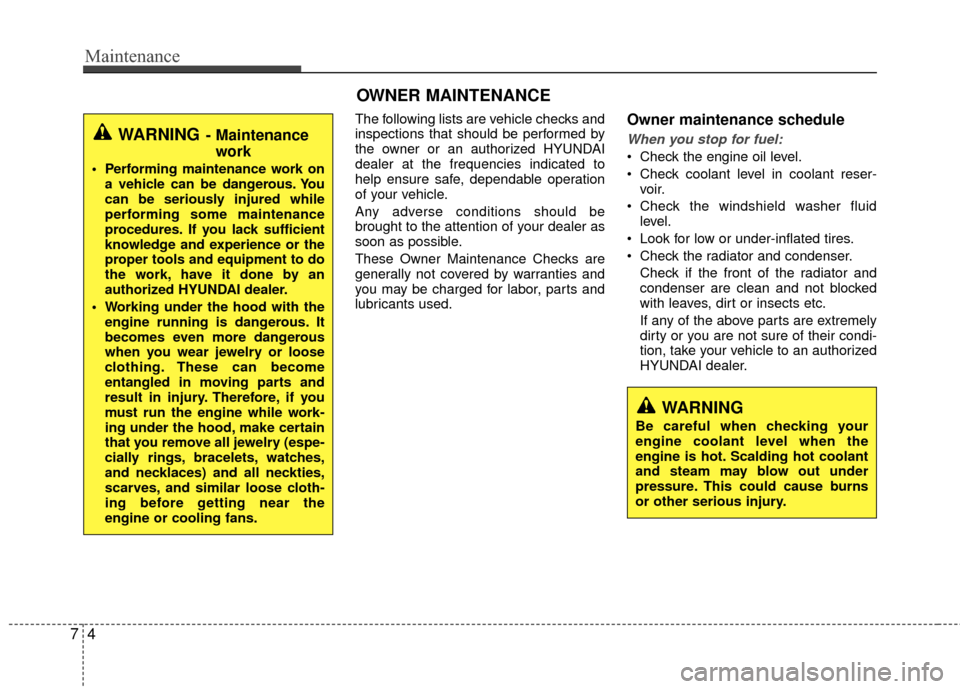
The following lists are vehicle checks and
inspections that should be performed by
the owner or an authorized HYUNDAI
dealer at the frequencies indicated to
help ensure safe, dependable operation
of your vehicle.
Any adverse conditions should be
brought to the attention of your dealer as
soon as possible.
These Owner Maintenance Checks are
generally not covered by warranties and
you may be charged for labor, parts and
lubricants used.Owner maintenance schedule
When you stop for fuel:
Check the engine oil level.
Check coolant level in coolant reser-voir.
Check the windshield washer fluid level.
Look for low or under-inflated tires.
Check the radiator and condenser. Check if the front of the radiator and
condenser are clean and not blocked
with leaves, dirt or insects etc.
If any of the above parts are extremely
dirty or you are not sure of their condi-
tion, take your vehicle to an authorized
HYUNDAI dealer.
WARNING- Maintenancework
Performing maintenance work on
a vehicle can be dangerous. You
can be seriously injured while
performing some maintenance
procedures. If you lack sufficient
knowledge and experience or the
proper tools and equipment to do
the work, have it done by an
authorized HYUNDAI dealer.
Working under the hood with the engine running is dangerous. It
becomes even more dangerous
when you wear jewelry or loose
clothing. These can become
entangled in moving parts and
result in injury. Therefore, if you
must run the engine while work-
ing under the hood, make certain
that you remove all jewelry (espe-
cially rings, bracelets, watches,
and necklaces) and all neckties,
scarves, and similar loose cloth-
ing before getting near the
engine or cooling fans.
OWNER MAINTENANCE
WARNING
Be careful when checking your
engine coolant level when the
engine is hot. Scalding hot coolant
and steam may blow out under
pressure. This could cause burns
or other serious injury.
Page 363 of 456
75
Maintenance
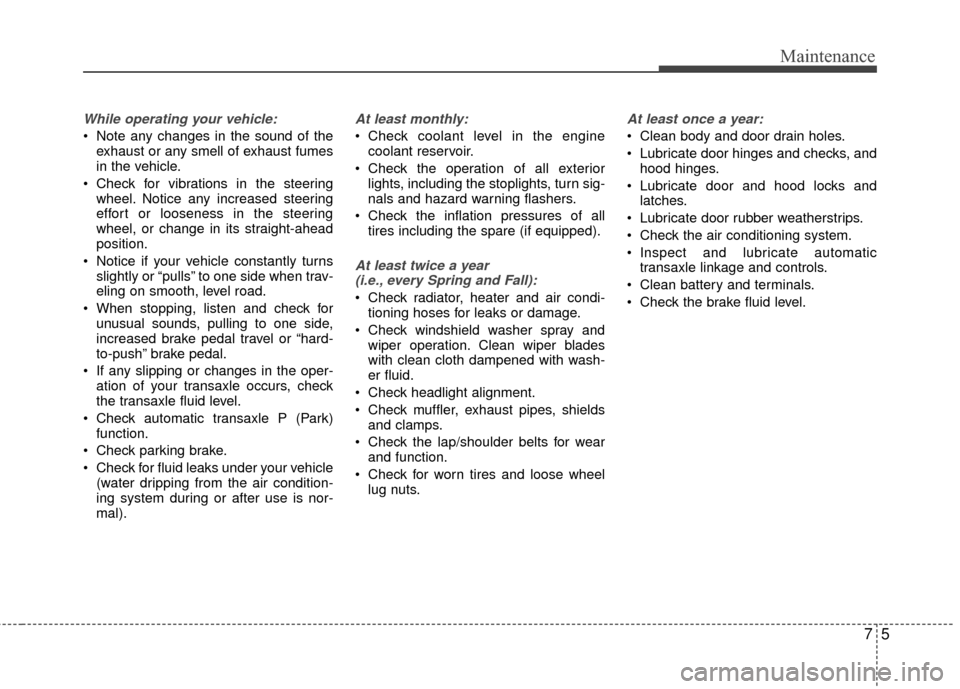
While operating your vehicle:
Note any changes in the sound of theexhaust or any smell of exhaust fumes
in the vehicle.
Check for vibrations in the steering wheel. Notice any increased steering
effort or looseness in the steering
wheel, or change in its straight-ahead
position.
Notice if your vehicle constantly turns slightly or “pulls” to one side when trav-
eling on smooth, level road.
When stopping, listen and check for unusual sounds, pulling to one side,
increased brake pedal travel or “hard-
to-push” brake pedal.
If any slipping or changes in the oper- ation of your transaxle occurs, check
the transaxle fluid level.
Check automatic transaxle P (Park) function.
Check parking brake.
Check for fluid leaks under your vehicle (water dripping from the air condition-
ing system during or after use is nor-
mal).
At least monthly:
Check coolant level in the enginecoolant reservoir.
Check the operation of all exterior lights, including the stoplights, turn sig-
nals and hazard warning flashers.
Check the inflation pressures of all tires including the spare (if equipped).
At least twice a year (i.e., every Spring and Fall):
Check radiator, heater and air condi- tioning hoses for leaks or damage.
Check windshield washer spray and wiper operation. Clean wiper blades
with clean cloth dampened with wash-
er fluid.
Check headlight alignment.
Check muffler, exhaust pipes, shields and clamps.
Check the lap/shoulder belts for wear and function.
Check for worn tires and loose wheel lug nuts.
At least once a year:
Clean body and door drain holes.
Lubricate door hinges and checks, andhood hinges.
Lubricate door and hood locks and latches.
Lubricate door rubber weatherstrips.
Check the air conditioning system.
Inspect and lubricate automatic transaxle linkage and controls.
Clean battery and terminals.
Check the brake fluid level.
Page 372 of 456
Maintenance
7
(Continued)
❑Inspect fuel lines, fuel hoses and connections
❑Inspect fuel tank air filter (if equipped) *2
❑Inspect parking brake
❑Inspect vapor hose and fuel filler cap
❑Inspect drive belts *3
(First, 60,000 miles (96,000 km) or 72 months
after every 15,000 miles (24,000 km) or 24 months)
❑ Inspect valve clearance
(Every 60,000 miles (96,000 km) or 72 months)
❑ Replace climate control air filter (for evaporator and blower unit)
❑Replace air cleaner filter
❑Replace engine oil and filter
(120,000 miles (192,000 km) or 192 months)
❑Replace coolant (First, 120,000 miles (192,000 km) or 120 months
after every 30,000 miles (48,000 km) or 24 months)
❑Add fuel additive *1 (120,000 miles (192,000 km) or 192 months)
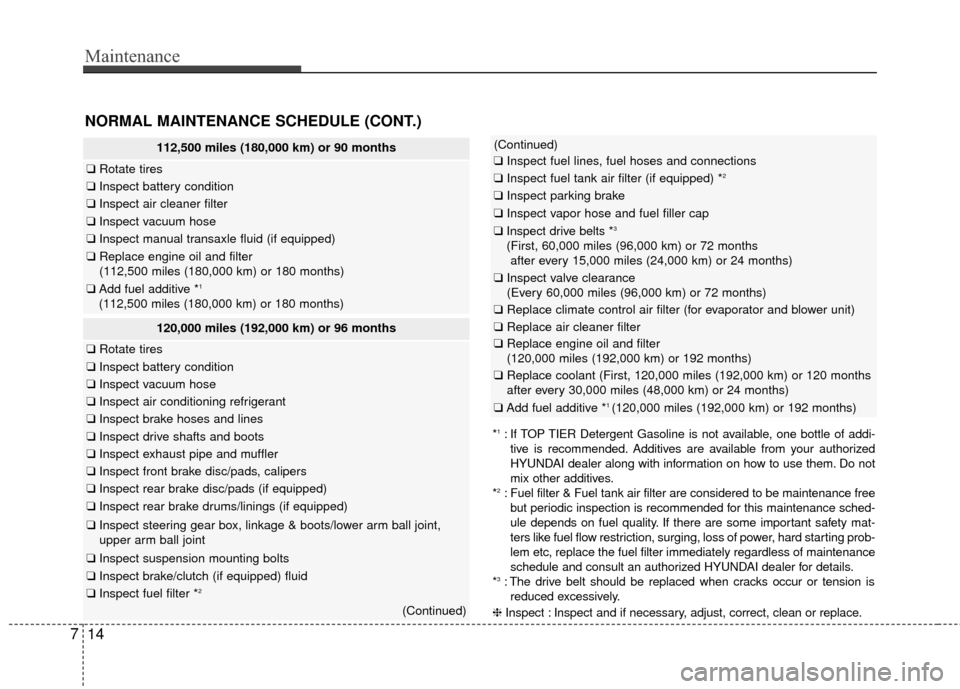
NORMAL MAINTENANCE SCHEDULE (CONT.)
112,500 miles (180,000 km) or 90 months
❑ Rotate tires
❑Inspect battery condition
❑Inspect air cleaner filter
❑Inspect vacuum hose
❑Inspect manual transaxle fluid (if equipped)
❑Replace engine oil and filter
(112,500 miles (180,000 km) or 180 months)
❑Add fuel additive *1
(112,500 miles (180,000 km) or 180 months)
120,000 miles (192,000 km) or 96 months
❑ Rotate tires
❑Inspect battery condition
❑Inspect vacuum hose
❑Inspect air conditioning refrigerant
❑Inspect brake hoses and lines
❑Inspect drive shafts and boots
❑Inspect exhaust pipe and muffler
❑Inspect front brake disc/pads, calipers
❑Inspect rear brake disc/pads (if equipped)
❑Inspect rear brake drums/linings (if equipped)
❑Inspect steering gear box, linkage & boots/lower arm ball joint,
upper arm ball joint
❑ Inspect suspension mounting bolts
❑Inspect brake/clutch (if equipped) fluid
❑Inspect fuel filter *2
(Continued)
*1: If TOP TIER Detergent Gasoline is not available, one bottle of addi-
tive is recommended. Additives are available from your authorized
HYUNDAI dealer along with information on how to use them. Do not
mix other additives.
*
2: Fuel filter & Fuel tank air filter are considered to be maintenance free\
but periodic inspection is recommended for this maintenance sched-
ule depends on fuel quality. If there are some important safety mat-
ters like fuel flow restriction, surging, loss of power, hard starting prob-
lem etc, replace the fuel filter immediately regardless of maintenance
schedule and consult an authorized HYUNDAI dealer for details.
*
3: The drive belt should be replaced when cracks occur or tension is reduced excessively.
❈ Inspect : Inspect and if necessary, adjust, correct, clean or replace.
14
Page 374 of 456
Maintenance
16
7
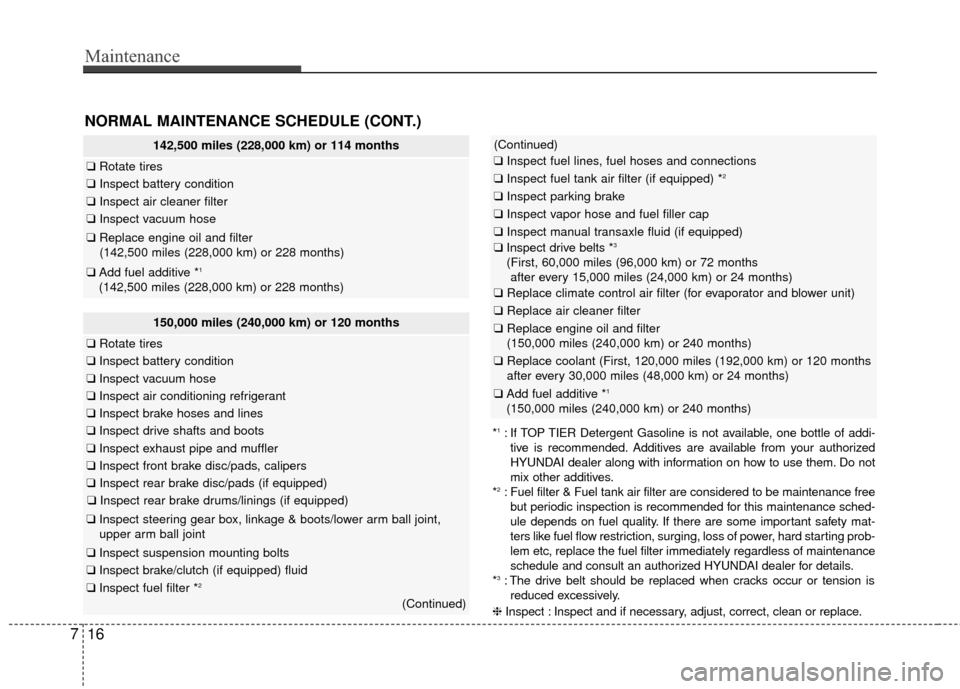
150,000 miles (240,000 km) or 120 months
❑ Rotate tires
❑Inspect battery condition
❑Inspect vacuum hose
❑Inspect air conditioning refrigerant
❑Inspect brake hoses and lines
❑Inspect drive shafts and boots
❑Inspect exhaust pipe and muffler
❑Inspect front brake disc/pads, calipers
❑Inspect rear brake disc/pads (if equipped)
❑Inspect rear brake drums/linings (if equipped)
❑Inspect steering gear box, linkage & boots/lower arm ball joint,
upper arm ball joint
❑ Inspect suspension mounting bolts
❑Inspect brake/clutch (if equipped) fluid
❑Inspect fuel filter *2
(Continued)
(Continued)
❑Inspect fuel lines, fuel hoses and connections
❑Inspect fuel tank air filter (if equipped) *2
❑Inspect parking brake
❑Inspect vapor hose and fuel filler cap
❑Inspect manual transaxle fluid (if equipped)
❑Inspect drive belts *3
(First, 60,000 miles (96,000 km) or 72 months
after every 15,000 miles (24,000 km) or 24 months)
❑ Replace climate control air filter (for evaporator and blower unit)
❑Replace air cleaner filter
❑Replace engine oil and filter
(150,000 miles (240,000 km) or 240 months)
❑Replace coolant (First, 120,000 miles (192,000 km) or 120 months
after every 30,000 miles (48,000 km) or 24 months)
❑Add fuel additive *1
(150,000 miles (240,000 km) or 240 months)
NORMAL MAINTENANCE SCHEDULE (CONT.)
142,500 miles (228,000 km) or 114 months
❑ Rotate tires
❑Inspect battery condition
❑Inspect air cleaner filter
❑Inspect vacuum hose
❑Replace engine oil and filter
(142,500 miles (228,000 km) or 228 months)
❑Add fuel additive *1
(142,500 miles (228,000 km) or 228 months)
*1: If TOP TIER Detergent Gasoline is not available, one bottle of addi-
tive is recommended. Additives are available from your authorized
HYUNDAI dealer along with information on how to use them. Do not
mix other additives.
*
2: Fuel filter & Fuel tank air filter are considered to be maintenance free\
but periodic inspection is recommended for this maintenance sched-
ule depends on fuel quality. If there are some important safety mat-
ters like fuel flow restriction, surging, loss of power, hard starting prob-
lem etc, replace the fuel filter immediately regardless of maintenance
schedule and consult an authorized HYUNDAI dealer for details.
*
3: The drive belt should be replaced when cracks occur or tension is reduced excessively.
❈ Inspect : Inspect and if necessary, adjust, correct, clean or replace.
Page 377 of 456
719
Maintenance
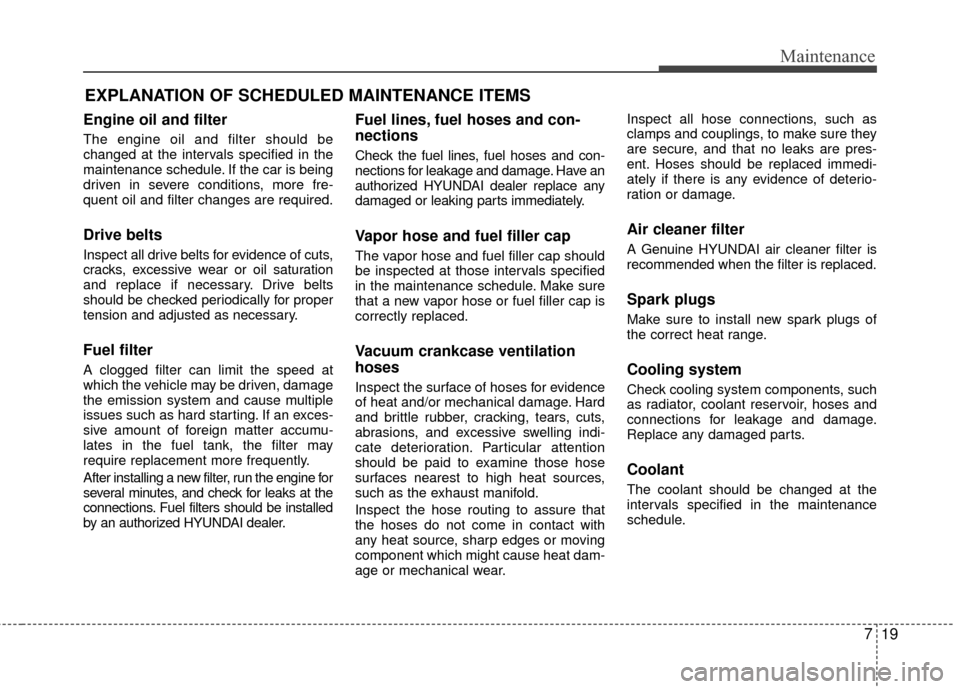
EXPLANATION OF SCHEDULED MAINTENANCE ITEMS
Engine oil and filter
The engine oil and filter should be
changed at the intervals specified in the
maintenance schedule. If the car is being
driven in severe conditions, more fre-
quent oil and filter changes are required.
Drive belts
Inspect all drive belts for evidence of cuts,
cracks, excessive wear or oil saturation
and replace if necessary. Drive belts
should be checked periodically for proper
tension and adjusted as necessary.
Fuel filter
A clogged filter can limit the speed at
which the vehicle may be driven, damage
the emission system and cause multiple
issues such as hard starting. If an exces-
sive amount of foreign matter accumu-
lates in the fuel tank, the filter may
require replacement more frequently.
After installing a new filter, run the engine for
several minutes, and check for leaks at the
connections. Fuel filters should be installed
by an authorized HYUNDAI dealer.
Fuel lines, fuel hoses and con-
nections
Check the fuel lines, fuel hoses and con-
nections for leakage and damage. Have an
authorized HYUNDAI dealer replace any
damaged or leaking parts immediately.
Vapor hose and fuel filler cap
The vapor hose and fuel filler cap should
be inspected at those intervals specified
in the maintenance schedule. Make sure
that a new vapor hose or fuel filler cap is
correctly replaced.
Vacuum crankcase ventilation
hoses
Inspect the surface of hoses for evidence
of heat and/or mechanical damage. Hard
and brittle rubber, cracking, tears, cuts,
abrasions, and excessive swelling indi-
cate deterioration. Particular attention
should be paid to examine those hose
surfaces nearest to high heat sources,
such as the exhaust manifold.
Inspect the hose routing to assure that
the hoses do not come in contact with
any heat source, sharp edges or moving
component which might cause heat dam-
age or mechanical wear.Inspect all hose connections, such as
clamps and couplings, to make sure they
are secure, and that no leaks are pres-
ent. Hoses should be replaced immedi-
ately if there is any evidence of deterio-
ration or damage.
Air cleaner filter
A Genuine HYUNDAI air cleaner filter is
recommended when the filter is replaced.
Spark plugs
Make sure to install new spark plugs of
the correct heat range.
Cooling system
Check cooling system components, such
as radiator, coolant reservoir, hoses and
connections for leakage and damage.
Replace any damaged parts.
Coolant
The coolant should be changed at the
intervals specified in the maintenance
schedule.
Page 381 of 456
723
Maintenance
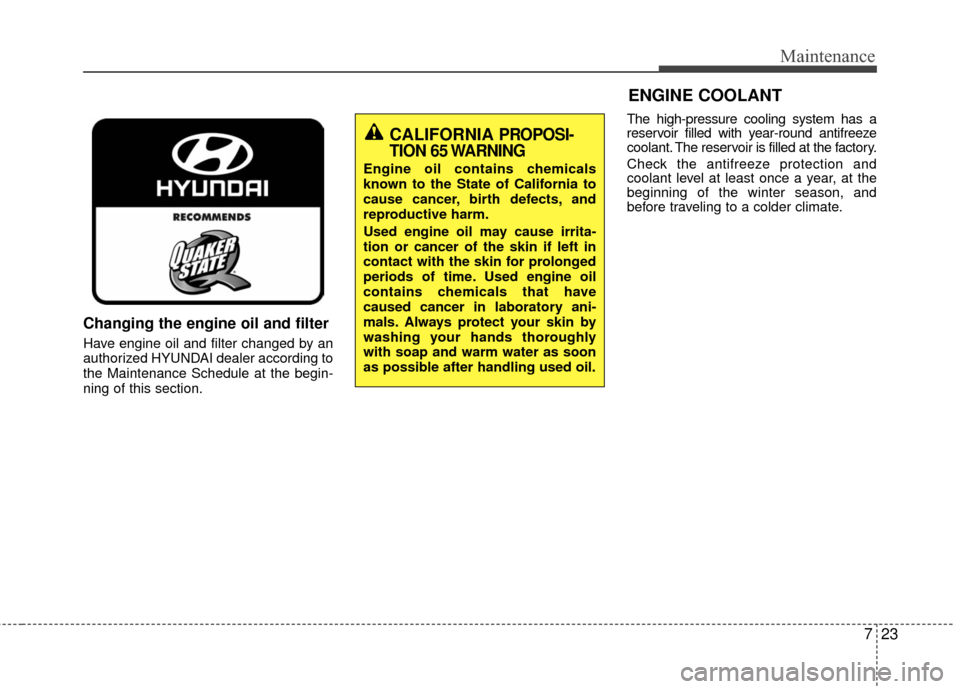
Changing the engine oil and filter
Have engine oil and filter changed by an
authorized HYUNDAI dealer according to
the Maintenance Schedule at the begin-
ning of this section.The high-pressure cooling system has a
reservoir filled with year-round antifreeze
coolant. The reservoir is filled at the factory.
Check the antifreeze protection and
coolant level at least once a year, at the
beginning of the winter season, and
before traveling to a colder climate.
ENGINE COOLANT
CALIFORNIA PROPOSI-
TION 65 WARNING
Engine oil contains chemicals
known to the State of California to
cause cancer, birth defects, and
reproductive harm.
Used engine oil may cause irrita-
tion or cancer of the skin if left in
contact with the skin for prolonged
periods of time. Used engine oil
contains chemicals that have
caused cancer in laboratory ani-
mals. Always protect your skin by
washing your hands thoroughly
with soap and warm water as soon
as possible after handling used oil.
Page 382 of 456
Maintenance
24
7
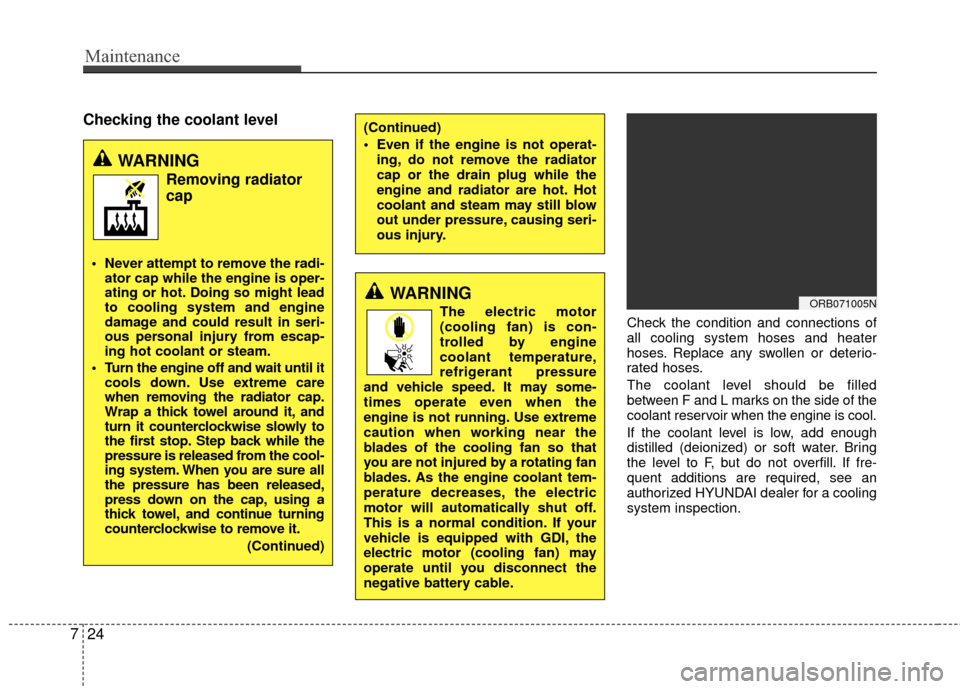
Checking the coolant level
Check the condition and connections of
all cooling system hoses and heater
hoses. Replace any swollen or deterio-
rated hoses.
The coolant level should be filled
between F and L marks on the side of the
coolant reservoir when the engine is cool.
If the coolant level is low, add enough
distilled (deionized) or soft water. Bring
the level to F, but do not overfill. If fre-
quent additions are required, see an
authorized HYUNDAI dealer for a cooling
system inspection.
ORB071005N
(Continued)
Even if the engine is not operat-
ing, do not remove the radiator
cap or the drain plug while the
engine and radiator are hot. Hot
coolant and steam may still blow
out under pressure, causing seri-
ous injury.
WARNING
Removing radiator
cap
Never attempt to remove the radi-ator cap while the engine is oper-
ating or hot. Doing so might lead
to cooling system and engine
damage and could result in seri-
ous personal injury from escap-
ing hot coolant or steam.
Turn the engine off and wait until it cools down. Use extreme care
when removing the radiator cap.
Wrap a thick towel around it, and
turn it counterclockwise slowly to
the first stop. Step back while the
pressure is released from the cool-
ing system. When you are sure all
the pressure has been released,
press down on the cap, using a
thick towel, and continue turning
counterclockwise to remove it.
(Continued)
WARNING
The electric motor
(cooling fan) is con-
trolled by engine
coolant temperature,
refrigerant pressure
and vehicle speed. It may some-
times operate even when the
engine is not running. Use extreme
caution when working near the
blades of the cooling fan so that
you are not injured by a rotating fan
blades. As the engine coolant tem-
perature decreases, the electric
motor will automatically shut off.
This is a normal condition. If your
vehicle is equipped with GDI, the
electric motor (cooling fan) may
operate until you disconnect the
negative battery cable.
Page 383 of 456
725
Maintenance
Recommended engine coolant
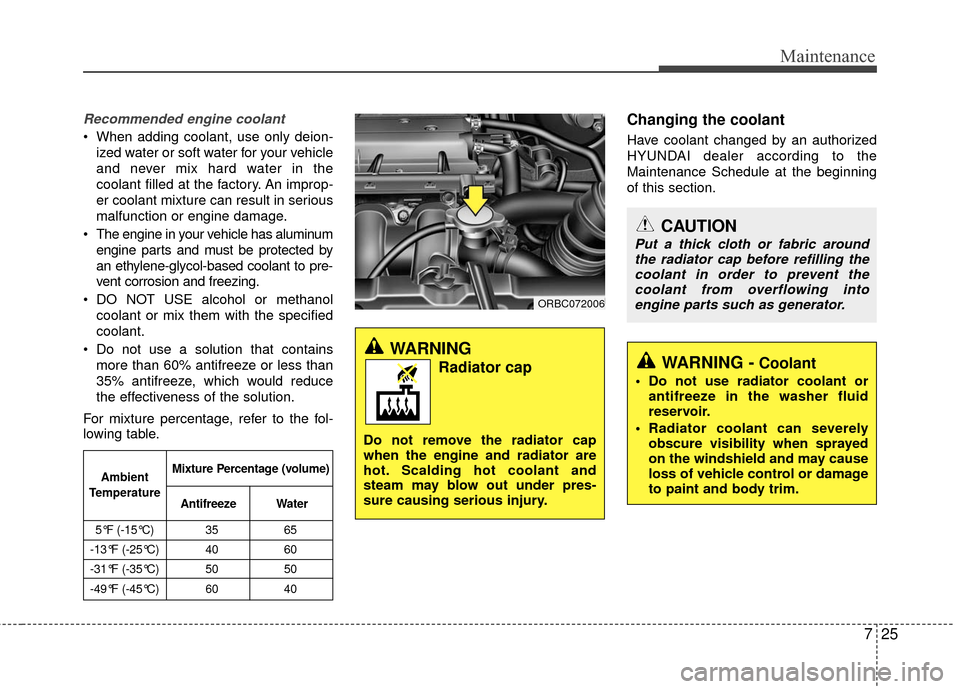
When adding coolant, use only deion-ized water or soft water for your vehicle
and never mix hard water in the
coolant filled at the factory. An improp-
er coolant mixture can result in serious
malfunction or engine damage.
The engine in your vehicle has aluminum engine parts and must be protected by
an ethylene-glycol-based coolant to pre-
vent corrosion and freezing.
DO NOT USE alcohol or methanol coolant or mix them with the specified
coolant.
Do not use a solution that contains more than 60% antifreeze or less than
35% antifreeze, which would reduce
the effectiveness of the solution.
For mixture percentage, refer to the fol-
lowing table.
Changing the coolant
Have coolant changed by an authorized
HYUNDAI dealer according to the
Maintenance Schedule at the beginning
of this section.
WARNING -Coolant
Do not use radiator coolant or antifreeze in the washer fluid
reservoir.
Radiator coolant can severely obscure visibility when sprayed
on the windshield and may cause
loss of vehicle control or damage
to paint and body trim.
CAUTION
Put a thick cloth or fabric aroundthe radiator cap before refilling thecoolant in order to prevent the coolant from overflowing intoengine parts such as generator.
WARNING
Radiator cap
Do not remove the radiator cap
when the engine and radiator are
hot. Scalding hot coolant and
steam may blow out under pres-
sure causing serious injury.
ORBC072006
5°F (-15°C) 35 65
-13°F (-25°C) 40 60
-31°F (-35°C) 50 50
-49°F (-45°C) 60 40
Ambient
Temperature Mixture Percentage (volume)
Antifreeze Water
Page 385 of 456
727
Maintenance
WASHER FLUID
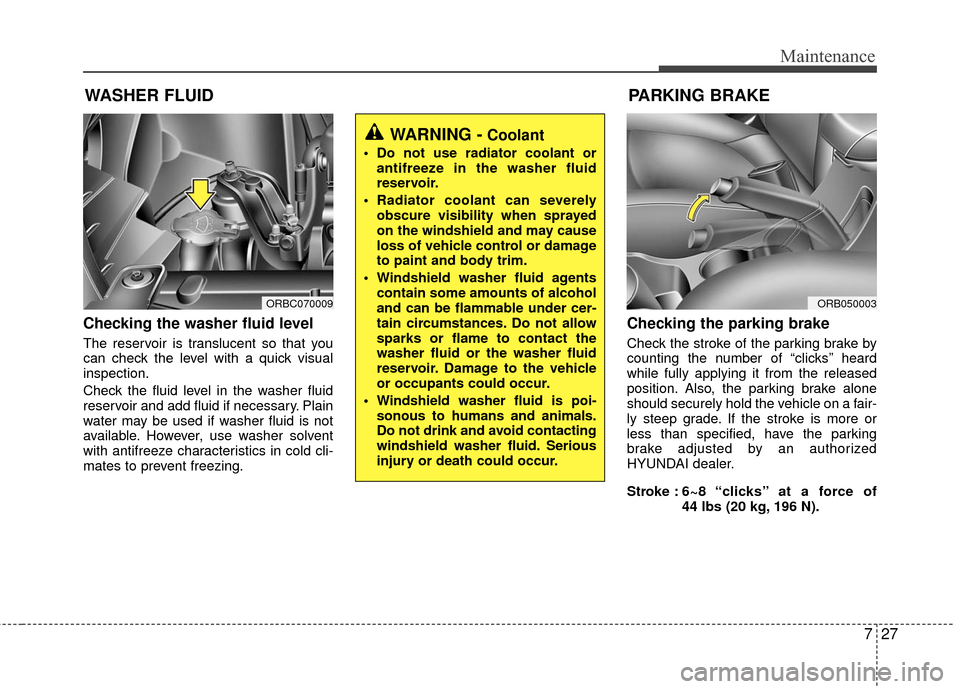
Checking the washer fluid level
The reservoir is translucent so that you
can check the level with a quick visual
inspection.
Check the fluid level in the washer fluid
reservoir and add fluid if necessary. Plain
water may be used if washer fluid is not
available. However, use washer solvent
with antifreeze characteristics in cold cli-
mates to prevent freezing.
Checking the parking brake
Check the stroke of the parking brake by
counting the number of “clicks’’ heard
while fully applying it from the released
position. Also, the parking brake alone
should securely hold the vehicle on a fair-
ly steep grade. If the stroke is more or
less than specified, have the parking
brake adjusted by an authorized
HYUNDAI dealer.
Stroke :6~8 “clicks’’ at a force of
44 lbs (20 kg, 196 N).
WARNING -Coolant
Do not use radiator coolant or
antifreeze in the washer fluid
reservoir.
Radiator coolant can severely obscure visibility when sprayed
on the windshield and may cause
loss of vehicle control or damage
to paint and body trim.
Windshield washer fluid agents contain some amounts of alcohol
and can be flammable under cer-
tain circumstances. Do not allow
sparks or flame to contact the
washer fluid or the washer fluid
reservoir. Damage to the vehicle
or occupants could occur.
Windshield washer fluid is poi- sonous to humans and animals.
Do not drink and avoid contacting
windshield washer fluid. Serious
injury or death could occur.
ORBC070009ORB050003
PARKING BRAKE