height Hyundai Accent 2016 User Guide
[x] Cancel search | Manufacturer: HYUNDAI, Model Year: 2016, Model line: Accent, Model: Hyundai Accent 2016Pages: 456, PDF Size: 16.41 MB
Page 48 of 456
331
Safety features of your vehicle
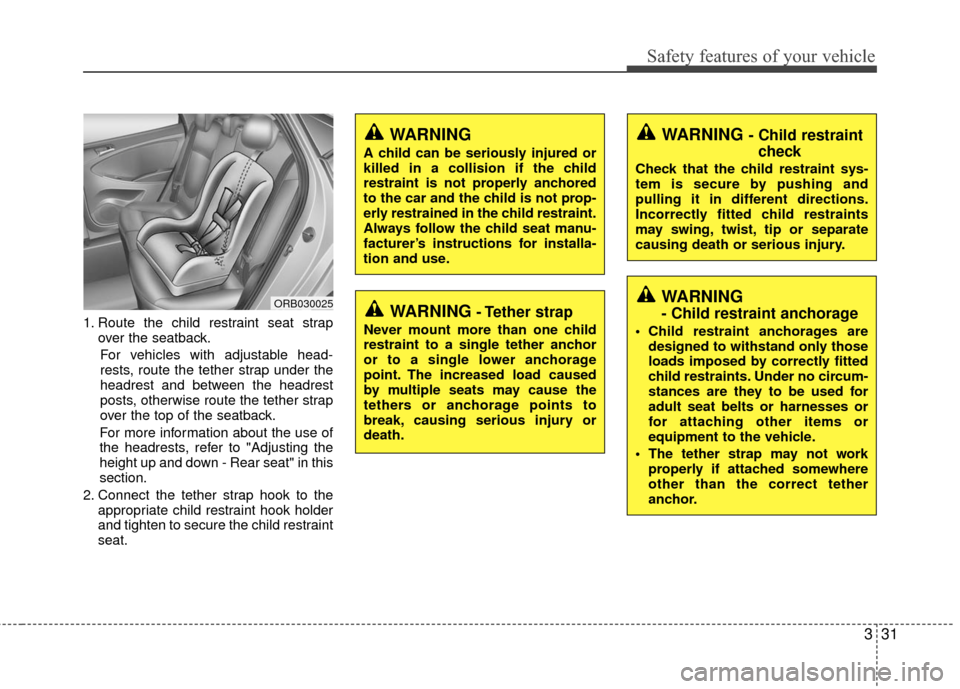
1. Route the child restraint seat strapover the seatback.
For vehicles with adjustable head-
rests, route the tether strap under the
headrest and between the headrest
posts, otherwise route the tether strap
over the top of the seatback.
For more information about the use of
the headrests, refer to "Adjusting the
height up and down - Rear seat" in this
section.
2. Connect the tether strap hook to the appropriate child restraint hook holder
and tighten to secure the child restraint
seat.
ORB030025
WARNING - Child restraintcheck
Check that the child restraint sys-
tem is secure by pushing and
pulling it in different directions.
Incorrectly fitted child restraints
may swing, twist, tip or separate
causing death or serious injury.
WARNING- Tether strap
Never mount more than one child
restraint to a single tether anchor
or to a single lower anchorage
point. The increased load caused
by multiple seats may cause the
tethers or anchorage points to
break, causing serious injury or
death.
WARNING
A child can be seriously injured or
killed in a collision if the child
restraint is not properly anchored
to the car and the child is not prop-
erly restrained in the child restraint.
Always follow the child seat manu-
facturer’s instructions for installa-
tion and use.
WARNING
- Child restraint anchorage
Child restraint anchorages are
designed to withstand only those
loads imposed by correctly fitted
child restraints. Under no circum-
stances are they to be used for
adult seat belts or harnesses or
for attaching other items or
equipment to the vehicle.
The tether strap may not work properly if attached somewhere
other than the correct tether
anchor.
Page 76 of 456
359
Safety features of your vehicle
Additional safety precautions
Never let passengers ride in the
cargo area or on top of a folded-
down back seat. All occupants should
sit upright, fully back in their seats with
their seat belts on and their feet on the
floor.
Passengers should not move out of
or change seats while the vehicle is
moving. A passenger who is not wear-
ing a seat belt during a crash or emer-
gency stop can be thrown against the
inside of the vehicle, against other
occupants, or out of the vehicle.
Each seat belt is designed to
restrain one occupant. If more than
one person uses the same seat belt,
they could be seriously injured or killed
in a collision.
Do not use any accessories on seat
belts. Devices claiming to improve
occupant comfort or reposition the seat
belt can reduce the protection provided
by the seat belt and increase the
chance of serious injury in a crash.
Passengers should not place hard
or sharp objects between them-
selves and the air bags. Carrying
hard or sharp objects on your lap or in
your mouth can result in injuries if an
air bag inflates.
Keep occupants away from the air
bag covers. All occupants should sit
upright, fully back in their seats with
their seat belts on and their feet on the
floor. If occupants are too close to the
air bag covers, they could be injured if
the air bags inflate.
Do not attach or place objects on or
near the air bag covers. Any object
attached to or placed on the front or
side air bag covers could interfere with
the proper operation of the air bags.
Do not modify the front seats.
Modification of the front seats could
interfere with the operation of the sup-
plemental restraint system sensing
components or side air bags.
Do not place items under the front
seats. Placing items under the front
seats could interfere with the operation
of the supplemental restraint system
sensing components and wiring har-
nesses.
Never hold an infant or child on your
lap. The infant or child could be seri-
ously injured or killed in the event of a
crash. All infants and children should
be properly restrained in appropriate
child safety seats or seat belts in the
rear seat.
Adding equipment to or modifying
your air bag-equipped vehicle
If you modify your vehicle by changing
your vehicle's frame, bumper system,
front end or side sheet metal or ride
height, this may affect the operation of
your vehicle's air bag system.
WARNING
Sitting improperly or out of posi- tion can cause occupants to be
shifted too close to a deploying
air bag, strike the interior struc-
ture or be thrown from the vehicle
resulting in serious injury or
death.
Always sit upright with the seat- back in an upright position, cen-
tered on the seat cushion with
your seat belt on, legs comfort-
ably extended and your feet on
the floor.
Be careful not to cause impact to the doors when the ignition is
ON. The air bags may inflate.
Page 108 of 456
431
Features of your vehicle
(Continued)
• When you operate the steering wheelin low temperature, abnormal noise
could occur. If temperature rises, the
noise will disappear. This is a normal
condition.
• When the charging system warning light comes on or the voltage is low
(When the alternator (or battery) does
not operate normally or it malfunc-
tions), the steering wheel may get
heavy and become difficult to operate
due to increased steering effort.Tilt and telescopic steering
(if equipped)
Tilt and telescopic steering allows you to
adjust the steering wheel before you
drive. You can also raise it to give your
legs more room when you exit and enter
the vehicle.
The steering wheel should be positioned
so that it is comfortable for you to drive,
while permitting you to see the instru-
ment panel warning lights and gauges.
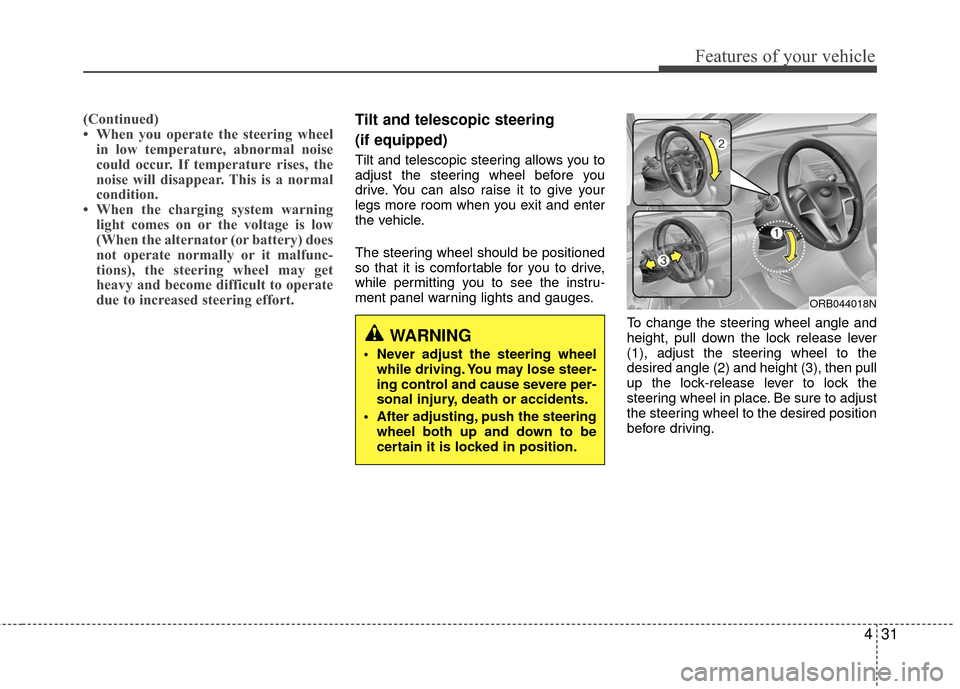
To change the steering wheel angle and
height, pull down the lock release lever
(1), adjust the steering wheel to the
desired angle (2) and height (3), then pull
up the lock-release lever to lock the
steering wheel in place. Be sure to adjust
the steering wheel to the desired position
before driving.
ORB044018N
WARNING
Never adjust the steering wheelwhile driving. You may lose steer-
ing control and cause severe per-
sonal injury, death or accidents.
After adjusting, push the steering wheel both up and down to be
certain it is locked in position.
Page 174 of 456
497
Features of your vehicle
✽
✽NOTICE
If you install an after market HID (high
intensity discharge) head lamp, your
vehicle's audio and electronic device
may malfunction.
Antenna
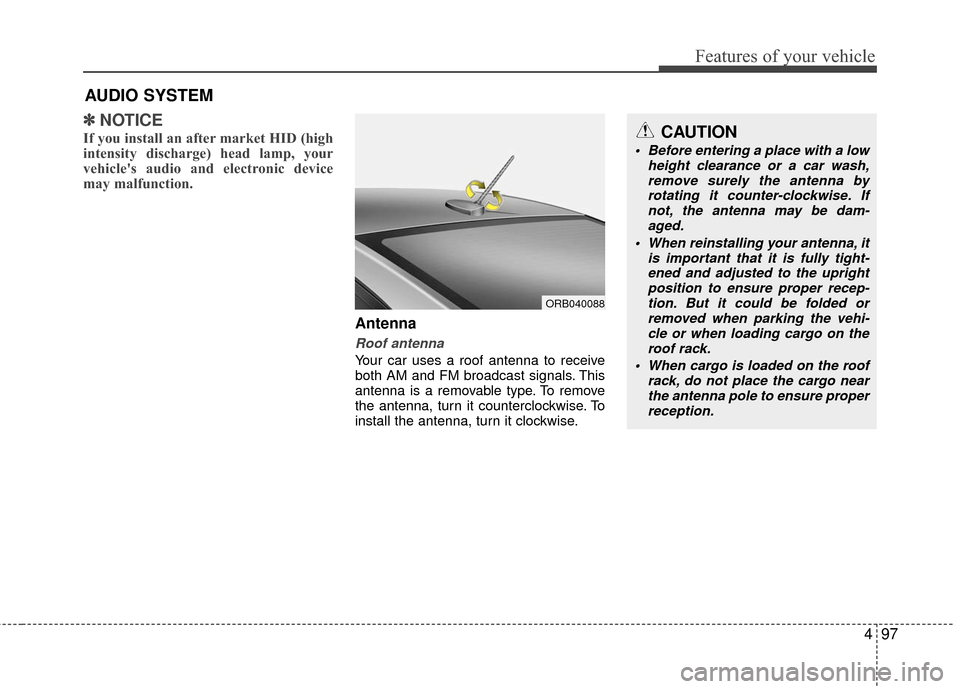
Roof antenna
Your car uses a roof antenna to receive
both AM and FM broadcast signals. This
antenna is a removable type. To remove
the antenna, turn it counterclockwise. To
install the antenna, turn it clockwise.
AUDIO SYSTEM
CAUTION
Before entering a place with a low
height clearance or a car wash,remove surely the antenna by rotating it counter-clockwise. Ifnot, the antenna may be dam-aged.
When reinstalling your antenna, it is important that it is fully tight-ened and adjusted to the upright position to ensure proper recep-tion. But it could be folded or removed when parking the vehi-cle or when loading cargo on the roof rack.
When cargo is loaded on the roof rack, do not place the cargo nearthe antenna pole to ensure properreception.
ORB040088
Page 293 of 456
519
Driving your vehicle
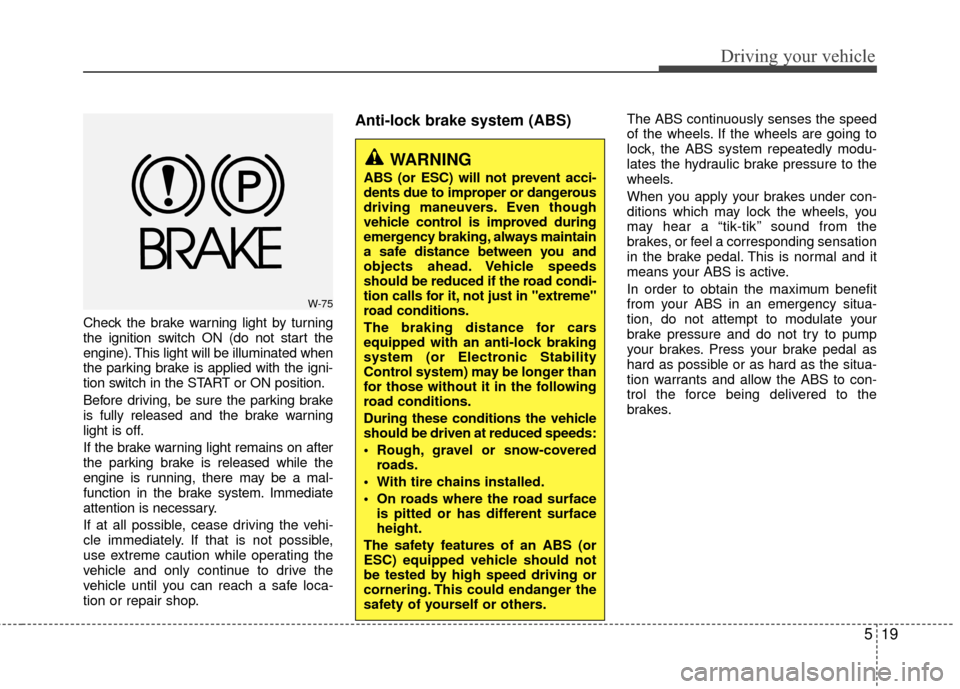
Check the brake warning light by turning
the ignition switch ON (do not start the
engine). This light will be illuminated when
the parking brake is applied with the igni-
tion switch in the START or ON position.
Before driving, be sure the parking brake
is fully released and the brake warning
light is off.
If the brake warning light remains on after
the parking brake is released while the
engine is running, there may be a mal-
function in the brake system. Immediate
attention is necessary.
If at all possible, cease driving the vehi-
cle immediately. If that is not possible,
use extreme caution while operating the
vehicle and only continue to drive the
vehicle until you can reach a safe loca-
tion or repair shop.
Anti-lock brake system (ABS)The ABS continuously senses the speed
of the wheels. If the wheels are going to
lock, the ABS system repeatedly modu-
lates the hydraulic brake pressure to the
wheels.
When you apply your brakes under con-
ditions which may lock the wheels, you
may hear a “tik-tik’’ sound from the
brakes, or feel a corresponding sensation
in the brake pedal. This is normal and it
means your ABS is active.
In order to obtain the maximum benefit
from your ABS in an emergency situa-
tion, do not attempt to modulate your
brake pressure and do not try to pump
your brakes. Press your brake pedal as
hard as possible or as hard as the situa-
tion warrants and allow the ABS to con-
trol the force being delivered to the
brakes.
WARNING
ABS (or ESC) will not prevent acci-
dents due to improper or dangerous
driving maneuvers. Even though
vehicle control is improved during
emergency braking, always maintain
a safe distance between you and
objects ahead. Vehicle speeds
should be reduced if the road condi-
tion calls for it, not just in "extreme"
road conditions.
The braking distance for cars
equipped with an anti-lock braking
system (or Electronic Stability
Control system) may be longer than
for those without it in the following
road conditions.
During these conditions the vehicle
should be driven at reduced speeds:
Rough, gravel or snow-coveredroads.
With tire chains installed.
On roads where the road surface is pitted or has different surface
height.
The safety features of an ABS (or
ESC) equipped vehicle should not
be tested by high speed driving or
cornering. This could endanger the
safety of yourself or others.
W-75
Page 400 of 456
Maintenance
42
7
Compact spare tire replacement
(if equipped)
A compact spare tire has a shorter
tread life than a regular size tire.
Replace it when you can see the
tread wear indicator bars on the tire.
The replacement compact spare tire
should be the same size and design
tire as the one provided with your
new vehicle and should be mounted
on the same compact spare tire
wheel. The compact spare tire is not
designed to be mounted on a regular
size wheel, and the compact spare
tire wheel is not designed for mount-
ing a regular size tire. Wheel replacement
When replacing the metal wheels for
any reason, make sure the new
wheels are equivalent to the original
factory units in diameter, rim width
and offset.
Tire traction
Tire traction can be reduced if you
drive on worn tires, tires that are
improperly inflated or on slippery
road surfaces. Tires should be
replaced when tread wear indicators
appear. To reduce the possibility of
losing control, slow down whenever
there is rain, snow or ice on the road.
Tire maintenance
In addition to proper inflation, correct
wheel alignment helps to decrease
tire wear. If you find a tire is worn
unevenly, have your dealer check the
wheel alignment.
When you have new tires installed,
make sure they are balanced. This
will increase vehicle ride comfort and
tire life. Additionally, a tire should
always be rebalanced if it is removed
from the wheel.
WARNING
A wheel that is not the correct
size may adversely affect wheel
and bearing life, braking and
stopping abilities, handling char-
acteristics, ground clearance,
body-to-tire clearance, snow
chain clearance, speedometer
and odometer calibration, head-
light aim and bumper height.
Page 401 of 456
743
Maintenance
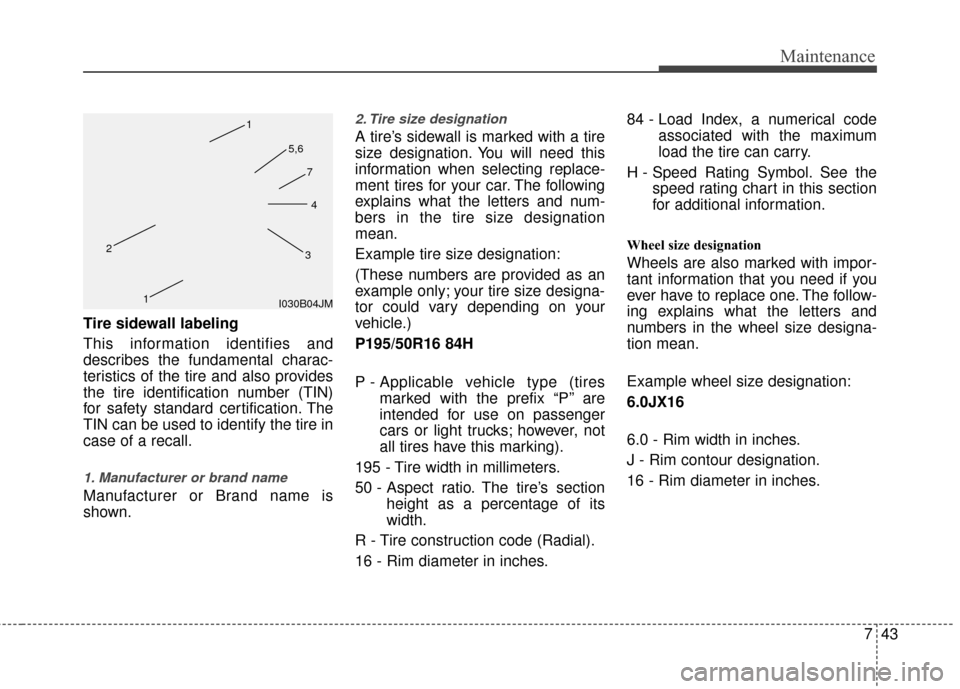
Tire sidewall labeling
This information identifies and
describes the fundamental charac-
teristics of the tire and also provides
the tire identification number (TIN)
for safety standard certification. The
TIN can be used to identify the tire in
case of a recall.
1. Manufacturer or brand name
Manufacturer or Brand name is
shown.
2. Tire size designation
A tire’s sidewall is marked with a tire
size designation. You will need this
information when selecting replace-
ment tires for your car. The following
explains what the letters and num-
bers in the tire size designation
mean.
Example tire size designation:
(These numbers are provided as an
example only; your tire size designa-
tor could vary depending on your
vehicle.)
P195/50R16 84H
P - Applicable vehicle type (tiresmarked with the prefix “P’’ are
intended for use on passenger
cars or light trucks; however, not
all tires have this marking).
195 - Tire width in millimeters.
50 - Aspect ratio. The tire’s section height as a percentage of its
width.
R - Tire construction code (Radial).
16 - Rim diameter in inches. 84 - Load Index, a numerical code
associated with the maximum
load the tire can carry.
H - Speed Rating Symbol. See the speed rating chart in this section
for additional information.
Wheel size designation
Wheels are also marked with impor-
tant information that you need if you
ever have to replace one. The follow-
ing explains what the letters and
numbers in the wheel size designa-
tion mean.
Example wheel size designation:
6.0JX16
6.0 - Rim width in inches.
J - Rim contour designation.
16 - Rim diameter in inches.
I030B04JM
1
1
2
34
5,6
7
Page 405 of 456
747
Maintenance
Tire terminology and definitions
Air Pressure: The amount of air
inside the tire pressing outward on
the tire. Air pressure is expressed in
pounds per square inch (psi) or kilo-
pascal (kPa).
Accessory Weight: This means the
combined weight of optional acces-
sories. Some examples of optional
accessories are, automatic
transaxle, power seats, and air con-
ditioning.
Aspect Ratio : The relationship of a
tire's height to its width.
Belt: A rubber coated layer of cords
that is located between the plies and
the tread. Cords may be made from
steel or other reinforcing materials.
Bead: The tire bead contains steel
wires wrapped by steel cords that
hold the tire onto the rim.
Bias Ply Tire : A pneumatic tire in
which the plies are laid at alternate
angles less than 90 degrees to the
centerline of the tread. Cold Tire Pressure: The amount of
air pressure in a tire, measured in
pounds per square inch (psi) or kilo-
pascals (kPa) before a tire has built
up heat from driving.
Curb Weight: This means the weight
of a motor vehicle with standard and
optional equipment including the
maximum capacity of fuel, oil and
coolant, but without passengers and
cargo.
DOT Markings: A code molded into
the sidewall of a tire signifying that
the tire is in compliance with the U.S.
Department of Transportation motor
vehicle safety standards. The DOT
code includes the Tire Identification
Number (TIN), an alphanumeric des-
ignator which can also identify the
tire manufacturer, production plant,
brand and date of production.
GVWR: Gross Vehicle Weight Rating
GAWR FRT: Gross Axle Weight
Rating for the Front Axle.
GAWR RR: Gross Axle Weight
Rating for the Rear axle.(Continued)
If the tire is impacted, inspect the tire condition or contact anauthorized HYUNDAI dealer.
To prevent damage to the tire, inspect the tire condition andpressure every 1,800miles(3,000km).
CAUTION
It is not easy to recognize the tire damage with your owneyes. But if there is the slight-est hint of tire damage, eventhough you cannot see the tiredamage with your own eyes,have the tire checked orreplaced because the tiredamage may cause air leak-age from the tire.
If the tire is damaged by driv- ing on a rough road, off road,pothole, manhole, or curbstone, it will not be covered bythe warranty.
You can find out the tire infor- mation on the tire sidewall.
Page 440 of 456
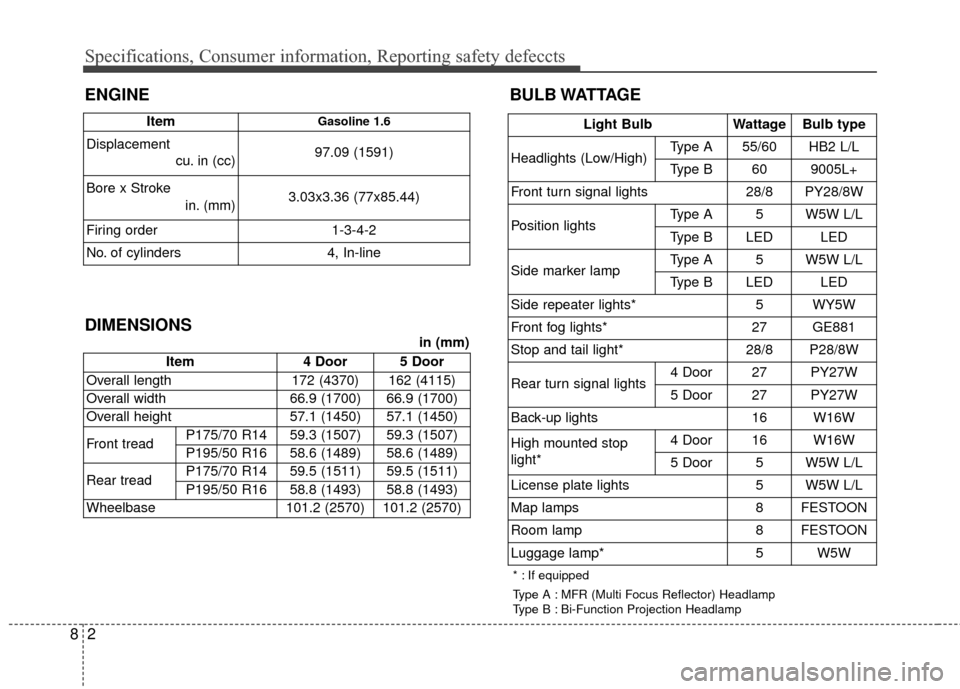
Specifications, Consumer information, Reporting safety defeccts
28
ENGINEBULB WATTAGE
Item4 Door5 Door
Overall length 172 (4370)
162 (4115)
Overall width 66.9 (1700)
66.9 (1700)
Overall height 57.1 (1450)
57.1 (1450)
Front tread P175/70 R14 59.3 (1507)
59.3 (1507)
P195/50 R16 58.6 (1489)
58.6 (1489)
Rear tread P175/70 R14 59.5 (1511)
59.5 (1511)
P195/50 R16 58.8 (1493)
58.8 (1493)
Wheelbase 101.2 (2570)
101.2 (2570)
ItemGasoline 1.6
Displacement
cu. in (cc) 97.09 (1591)
Bore x Stroke in. (mm) 3.03x3.36 (77x85.44)
Firing order 1-3-4-2
No. of cylinders 4, In-line
DIMENSIONS
in (mm)
* : If equipped
Type A : MFR (Multi Focus Reflector) Headlamp
Type B : Bi-Function Projection Headlamp
Light BulbWattageBulb type
Headlights (Low/High)Type A55/60HB2 L/L
Type B609005L+
Front turn signal lights28/8PY28/8W
Position lightsType A5W5W L/L
Type BLEDLED
Side marker lampType A5W5W L/L
Type BLEDLED
Side repeater lights* 5WY5W
Front fog lights*27GE881
Stop and tail light*28/8P28/8W
Rear turn signal lights 4 Door27PY27W
5 Door27PY27W
Back-up lights16W16W
High mounted stop
light*4 Door16W16W
5 Door5W5W L/L
License plate lights5W5W L/L
Map lamps8FESTOON
Room lamp8FESTOON
Luggage lamp*5W5W
Page 452 of 456

I5
Index
Hazard warning flasher··················\
··················\
·4-53
Hazardous driving conditions ··················\
············5-35
Headrest(front) ··················\
··················\
············3-6
Headrest(rear) ··················\
··················\
··············3-9
Height adjustment ··················\
··················\
······ ·3-16
Highway driving ··················\
··················\
·········5-38
Hill-start assist control ··················\
··················\
· ·5-27
Hood ··················\
··················\
··················\
···· ·4-21
Horn ··················\
··················\
··················\
···· ·4-32
How to use this manual ··················\
··················\
··1-2
Indicators and warnings ··················\
················· ·4-44
Inside rearview mirror ··················\
··················\
· ·4-32
Instrument cluster ··················\
··················\
······· ·4-36
Engine temperature gauge ··················\
············4-38
Fuel gauge ··················\
··················\
············ ·4-39
Instrument panel illumination ··················\
········4-37
Odometer ··················\
··················\
··············4-40
Speedometer ··················\
··················\
········· ·4-37
Tachometer ··················\
··················\
··········· ·4-37
Trip computer ··················\
··················\
·········4-39
Warning and indicators ··················\
··············· ·4-44
Instrument panel fuse ··················\
··················\
·· ·7-52
Instrument panel illumination ··················\
············4-37Instrument panel overview
··················\
················ ·2-3
Interior care ··················\
··················\
·············· ·7-74
Interior features ··················\
··················\
········· ·4-88
Aux, USB and iPod®port ··················\
············ ·4-94
Cargo area cover ··················\
··················\
···· ·4-93
Clothes hanger ··················\
··················\
······· ·4-92
Cup holder ··················\
··················\
············ ·4-90
Digital clock ··················\
··················\
········· ·4-92
Floor mat anchor(s) ··················\
··················\
· ·4-93
Power outlet ··················\
··················\
·········· ·4-91
Sunvisor ··················\
··················\
·············· ·4-90
Interior light ··················\
··················\
··············4-63
Interior overview ··················\
··················\
········· ·2-2
Jack and tools ··················\
··················\
··········· ·6-17
Jump starting ··················\
··················\
·············· ·6-4
Key ··················\
··················\
··················\
······· ·5-5
Keys ··················\
··················\
··················\
·······4-3
I
H
J
K