Ac system Hyundai Accent 2016 Owner's Manual
[x] Cancel search | Manufacturer: HYUNDAI, Model Year: 2016, Model line: Accent, Model: Hyundai Accent 2016Pages: 456, PDF Size: 16.41 MB
Page 2 of 456
F2
Your Hyundai should not be modified in any way. Such modifications may adversely affect the per-
formance, safety or durability of your Hyundai and may, in addition, violate conditions of the limited
warranties covering the vehicle. Certain modifications may also be in violation of regulations estab-
lished by the U.S. Department of Transportation and other federal or state agencies.
Your vehicle is equipped with electronic fuel injection and other electronic c\
omponents. It is possible
for an improperly installed/adjusted two-way radio or cellular telephone to adversely affect electronic
systems. For this reason, we recommend that you carefully follow the radio manufacturer's instruc-
tions or consult your Hyundai dealer for precautionary measures or special instructions if you choose
to install one of these devices.
CAUTION: MODIFICATIONS TO YOUR HYUNDAI
TWO-WAY RADIO OR CELLULAR TELEPHONE INSTALLATION
Page 4 of 456
F4FOREWORD
Thank you for choosing Hyundai. We are pleased to welcome you to the growing number of discerning people who drive Hyundais.
The advanced engineering and high-quality construction of each Hyundai we build is something of which we're very proud.
Your Owner's Manual will introduce you to the features and operation of your new Hyundai. It is suggested that you read it care-
fully because the information it contains can contribute greatly to the satisfaction you receive from your new car.
The manufacturer also recommends that all service and maintenance on your car be performed by an authorized Hyundai deal-
er. Hyundai dealers are prepared to provide high-quality service, maintenance and any other assistance that may be required.
HYUNDAI MOTOR AMERICA
Note
: Because future owners will also need the information included in this manual, if you sell this Hyundai, please leave the man-
ual in the vehicle for their use. Thank you.
Copyright 2015 Hyundai Motor America. All rights reserved. No part of this publication may be reproduced, stored in any retrieva l
system or transmitted in any form or by any means without the prior written permission of Hyundai Motor America.
CAUTION
Severe engine and transaxle damage may result from the use of poor quality fuels and lubricants that do not meet Hyundai\
specifications. You must always use high quality fuels and lubricants that meet the specifications li\
sted on Page 8-4 in theVehicle Specifications and consumer information section of the Owner's Manual.
Page 10 of 456
13
Introduction
Your new vehicle is designed to use only
unleaded fuel having a pump octane
number ((R+M)/2) of 87 (Research
Octane Number 91) or higher. (Do not
use methanol blended fuels.)
Your new vehicle is designed to obtain
maximum performance with UNLEADED
FUEL, as well as minimize exhaust emis-
sions and spark plug fouling.Gasoline containing alcohol andmethanol
Gasohol, a mixture of gasoline and
ethanol (also known as grain alcohol),
and gasoline or gasohol containing
methanol (also known as wood alcohol)
are being marketed along with or instead
of leaded or unleaded gasoline.
Do not use gasohol containing more than
10% ethanol, and do not use gasoline or
gasohol containing any methanol. Either
of these fuels may cause drivability prob-
lems and damage to the fuel system,
engine control system and emission con-
trol system.
Discontinue using gasohol of any kind if
drivability problems occur.
Vehicle damage or drivability problems
may not be covered by the manufacturer’s
warranty if they result from the use of:
1. Gasohol containing more than 10% ethanol.
2. Gasoline or gasohol containing methanol.
3. Leaded fuel or leaded gasohol. "E85" fuel is an alternative fuel com-
prised of 85 percent ethanol and 15 per-
cent gasoline, and is manufactured
exclusively for use in Flexible Fuel
Vehicles. “E85” is not compatible with
your vehicle. Use of “E85” may result in
poor engine performance and damage to
your vehicle's engine and fuel system.
HYUNDAI recommends that customers
do not use fuel with an ethanol content
exceeding 10 percent.
FUEL REQUIREMENTS
CAUTION
Never add any fuel system cleaning
agents to the fuel tank other thanwhat has been specified. (Consultan authorized HYUNDAI dealer fordetails.)
WARNING
• Do not "top off" after the nozzle automatically shuts off when
refueling.
Tighten the cap fully clockwise until it clicks one time and stops
turning, otherwise the fuel cap
open warning light " " will illu-
minate. (if equipped)
Always check that the fuel cap is installed securely to prevent fuel
spillage in the event of an acci-
dent.CAUTION
Never use gasohol which contains
methanol. Discontinue use of any gasohol product which impairs dri-vability.
CAUTION
Your New Vehicle Limited Warrantydoes not cover damage to the fuel system or any performance prob-lems caused by the use of “E85” fuel.
Page 11 of 456
Introduction
41
Other fuels
Using fuels such as;- Silicone (Si) contained fuel,
- Ferrocene (Fe) contained fuel, and
- Other metallic additives containedfuels,
may cause vehicle and engine damage
or cause plugging, misfiring, poor accel-
eration, engine stalling, catalyst melting,
abnormal corrosion, life cycle reduction,
etc.
Also, the Malfunction Indicator Lamp
(MIL) may illuminate.
✽ ✽ NOTICE
Damage to the fuel system or perform-
ance problem caused by the use of these
fuels may not be covered by your New
Vehicle Limited Warranty.
Gasoline containing MMT
Some gasoline contains harmful man-
ganese-based fuel additives such as MMT
(Methylcyclopentadienyl Manganese
Tricarbonyl).
HYUNDAI does not recommend the use
of gasoline containing MMT.
This type of fuel can reduce vehicle per-
formance and affect your emission con-
trol system.
The malfunction indicator lamp on the
cluster may come on.
Do not use methanol
Fuels containing methanol (wood alco-
hol) should not be used in your vehicle.
This type of fuel can reduce vehicle per-
formance and damage components of
the fuel system, engine control system
and emission control system.
Fuel Additives
HYUNDAI recommends that you use good
quality gasolines treated with detergent
additives such as TOP TIER Detergent
Gasoline, which help prevent deposit for-
mation in the engine. These gasolines will
help the engine run cleaner and enhance
performance of the Emission Control
System. For more information on TOP
TIER Detergent Gasoline, please go to the
website (www.toptiergas.com).
For customers who do not use TOP Tier
Detergent Gasoline regularly, and have
problems starting or the engine does not
run smoothly, additives that you can buy
separately may be added to the gasoline.
If TOP TIER Detergent Gasoline is not
available, one bottle of additive added to
the fuel tank at every 7,500mile or every
engine oil change is recommended.
Additives are available from your author-
ized HYUNDAI dealer along with informa-
tion on how to use them. Do not mix other
additives.
Operation in foreign countries
If you are going to drive your vehicle in
another country, be sure to:
Observe all regulations regarding reg-
istration and insurance.
Determine that acceptable fuel is avail- able.
CAUTION
Your New Vehicle Limited Warrantymay not cover damage to the fuelsystem and any performance prob-lems that are caused by the use offuels containing methanol.
Page 13 of 456
Introduction
61
This vehicle is equipped with an event
data recorder (EDR). The main pur-
pose of an EDR is to record, in certain
crash or near crash-like situations,
such as an air bag deployment or hit-
ting a road obstacle, data that will
assist in understanding how a vehi-
cle's systems performed. The EDR is
designed to record data related to
vehicle dynamics and safety systems
for a short period of time, typically 30
seconds or less. The EDR in this vehi-
cle is designed to record such data as:
were operating;
senger safety belts were buckled/
fastened;
depressing the accelerator and/or
brake pedal; and,
These data can help provide a better
understanding of the circumstances
in which crashes and injuries occur.
NOTE: EDR data are recorded by your
vehicle only if a non-trivial crash situ-
ation occurs; no data are recorded by
the EDR under normal driving condi-
tions and no personal data (e.g.,
name, gender, age, and crash loca-
tion) are recorded. However, other
parties, such as law enforcement,
could combine the EDR data with the
type of personally identifying data
routinely acquired during a crash
investigation.
To read data recorded by an EDR, spe-
cial equipment is required, and
access to the vehicle or the EDR is
needed. In addition to the vehicle
manufacturer, other parties, such as
law enforcement, that have the special
equipment, can read the information if
they have access to the vehicle or the
EDR.
VEHICLE DATA COLLECTION AND EVENT DATA RECORDERS
Page 16 of 456
23
Your vehicle at a glance
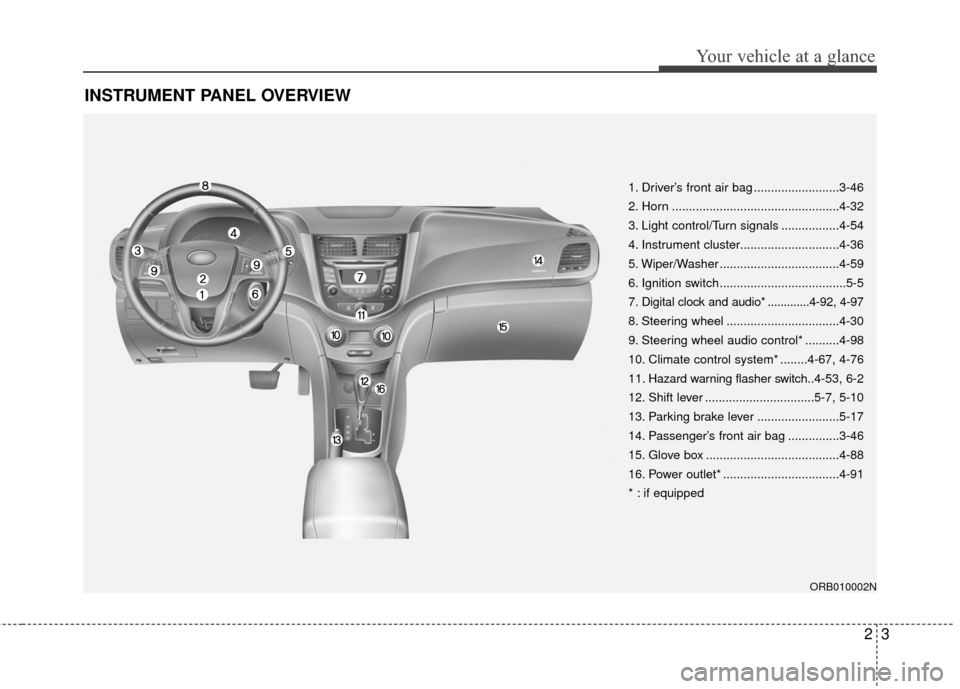
INSTRUMENT PANEL OVERVIEW
1. Driver’s front air bag .........................3-46
2. Horn .................................................4-32
3. Light control/Turn signals .................4-54
4. Instrument cluster.............................4-36
5. Wiper/Washer ...................................4-59
6. Ignition switch .....................................5-5
7. Digital clock and audio* .............4-92, 4-97
8. Steering wheel .................................4-30
9. Steering wheel audio control* ..........4-98
10. Climate control system* ........4-67, 4-76
11. Hazard warning flasher switch..4-53, 6-2
12. Shift lever ................................5-7, 5-10
13. Parking brake lever ........................5-17
14. Passenger’s front air bag ...............3-46
15. Glove box .......................................4-88
16. Power outlet* ..................................4-91
* : if equipped
ORB010002N
Page 18 of 456
3
Seats / 3-2
Seat belts / 3-14
Child restraint system / 3-26
Air bag - advanced supplemental restraint system / 3-34
Safety features of your vehicle
Page 26 of 456
39
Safety features of your vehicle
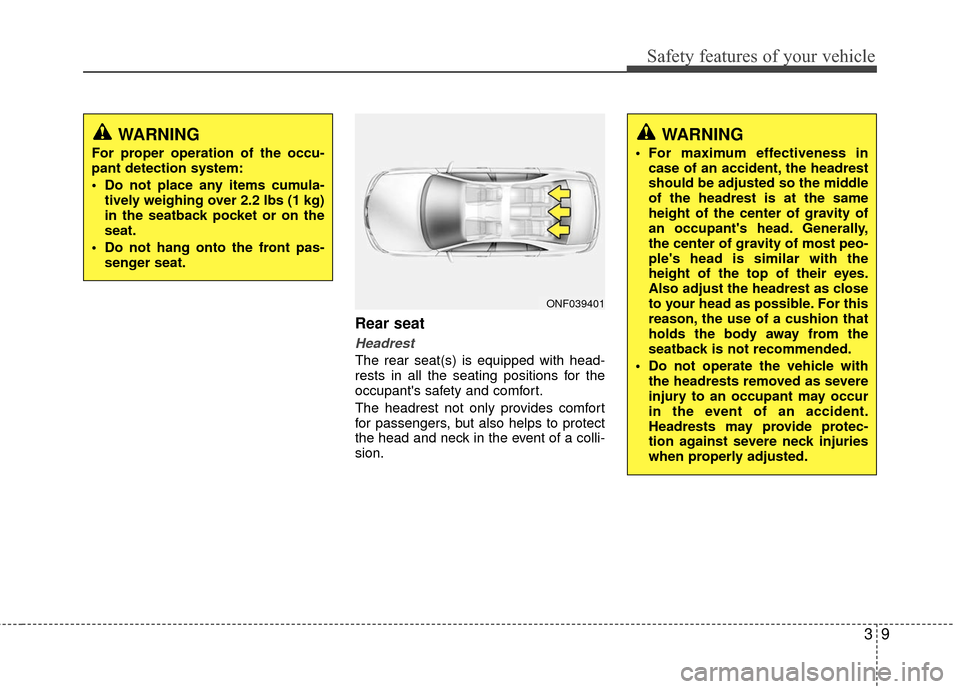
Rear seat
Headrest
The rear seat(s) is equipped with head-
rests in all the seating positions for the
occupant's safety and comfort.
The headrest not only provides comfort
for passengers, but also helps to protect
the head and neck in the event of a colli-
sion.
WARNING
For proper operation of the occu-
pant detection system:
Do not place any items cumula-tively weighing over 2.2 lbs (1 kg)
in the seatback pocket or on the
seat.
Do not hang onto the front pas- senger seat.
ONF039401
WARNING
For maximum effectiveness incase of an accident, the headrest
should be adjusted so the middle
of the headrest is at the same
height of the center of gravity of
an occupant's head. Generally,
the center of gravity of most peo-
ple's head is similar with the
height of the top of their eyes.
Also adjust the headrest as close
to your head as possible. For this
reason, the use of a cushion that
holds the body away from the
seatback is not recommended.
Do not operate the vehicle with the headrests removed as severe
injury to an occupant may occur
in the event of an accident.
Headrests may provide protec-
tion against severe neck injuries
when properly adjusted.
Page 31 of 456
Safety features of your vehicle
14
3
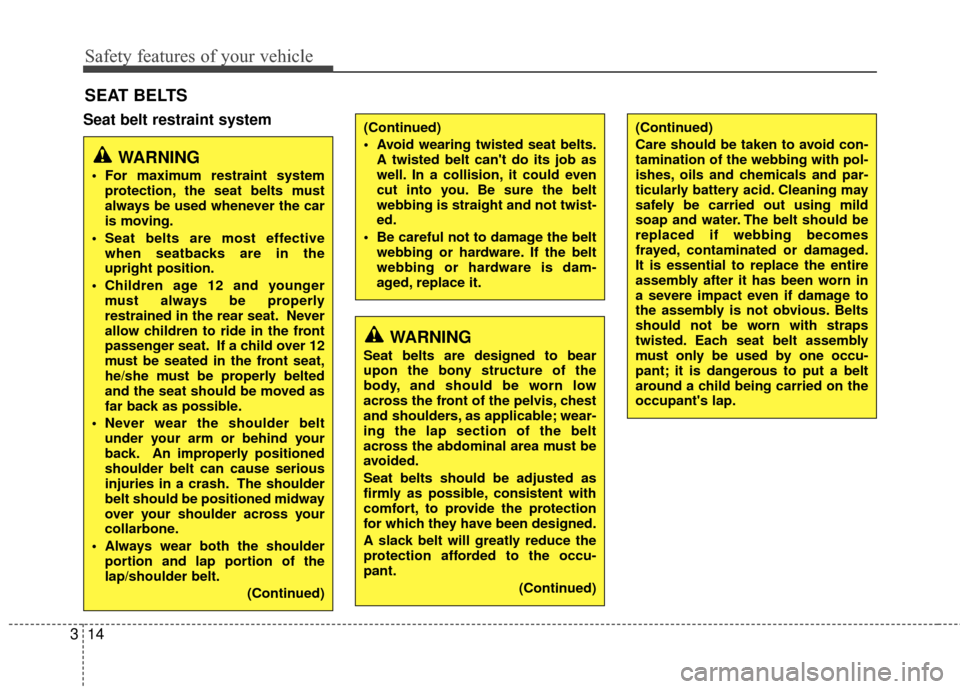
Seat belt restraint system
SEAT BELTS
WARNING
Seat belts are designed to bear
upon the bony structure of the
body, and should be worn low
across the front of the pelvis, chest
and shoulders, as applicable; wear-
ing the lap section of the belt
across the abdominal area must be
avoided.
Seat belts should be adjusted as
firmly as possible, consistent with
comfort, to provide the protection
for which they have been designed.
A slack belt will greatly reduce the
protection afforded to the occu-
pant.
(Continued)
(Continued)
Care should be taken to avoid con-
tamination of the webbing with pol-
ishes, oils and chemicals and par-
ticularly battery acid. Cleaning may
safely be carried out using mild
soap and water. The belt should be
replaced if webbing becomes
frayed, contaminated or damaged.
It is essential to replace the entire
assembly after it has been worn in
a severe impact even if damage to
the assembly is not obvious. Belts
should not be worn with straps
twisted. Each seat belt assembly
must only be used by one occu-
pant; it is dangerous to put a belt
around a child being carried on the
occupant's lap.(Continued)
Avoid wearing twisted seat belts.A twisted belt can't do its job as
well. In a collision, it could even
cut into you. Be sure the belt
webbing is straight and not twist-
ed.
Be careful not to damage the belt webbing or hardware. If the belt
webbing or hardware is dam-
aged, replace it.
WARNING
For maximum restraint systemprotection, the seat belts must
always be used whenever the car
is moving.
Seat belts are most effective when seatbacks are in the
upright position.
Children age 12 and younger must always be properly
restrained in the rear seat. Never
allow children to ride in the front
passenger seat. If a child over 12
must be seated in the front seat,
he/she must be properly belted
and the seat should be moved as
far back as possible.
Never wear the shoulder belt under your arm or behind your
back. An improperly positioned
shoulder belt can cause serious
injuries in a crash. The shoulder
belt should be positioned midway
over your shoulder across your
collarbone.
Always wear both the shoulder portion and lap portion of the
lap/shoulder belt.
(Continued)
Page 33 of 456
Safety features of your vehicle
16
3
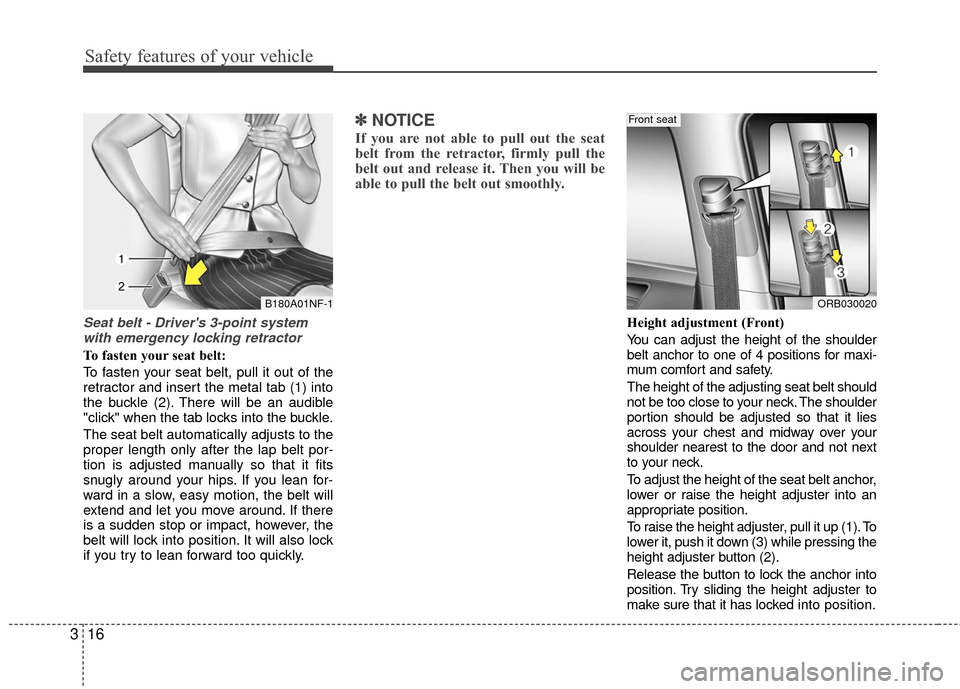
Seat belt - Driver's 3-point system
with emergency locking retractor
To fasten your seat belt:
To fasten your seat belt, pull it out of the
retractor and insert the metal tab (1) into
the buckle (2). There will be an audible
"click" when the tab locks into the buckle.
The seat belt automatically adjusts to the
proper length only after the lap belt por-
tion is adjusted manually so that it fits
snugly around your hips. If you lean for-
ward in a slow, easy motion, the belt will
extend and let you move around. If there
is a sudden stop or impact, however, the
belt will lock into position. It will also lock
if you try to lean forward too quickly.
✽ ✽ NOTICE
If you are not able to pull out the seat
belt from the retractor, firmly pull the
belt out and release it. Then you will be
able to pull the belt out smoothly.
Height adjustment (Front)
You can adjust the height of the shoulder
belt anchor to one of 4 positions for maxi-
mum comfort and safety.
The height of the adjusting seat belt should
not be too close to your neck. The shoulder
portion should be adjusted so that it lies
across your chest and midway over your
shoulder nearest to the door and not next
to your neck.
To adjust the height of the seat belt anchor,
lower or raise the height adjuster into an
appropriate position.
To raise the height adjuster, pull it up (1). To
lower it, push it down (3) while pressing the
height adjuster button (2).
Release the button to lock the anchor into
position. Try sliding the height adjuster to
make sure that it has locked into position.
B180A01NF-1ORB030020
Front seat