battery replacement Hyundai Accent 2016 Owner's Manual
[x] Cancel search | Manufacturer: HYUNDAI, Model Year: 2016, Model line: Accent, Model: Hyundai Accent 2016Pages: 456, PDF Size: 16.41 MB
Page 83 of 456
Features of your vehicle
64
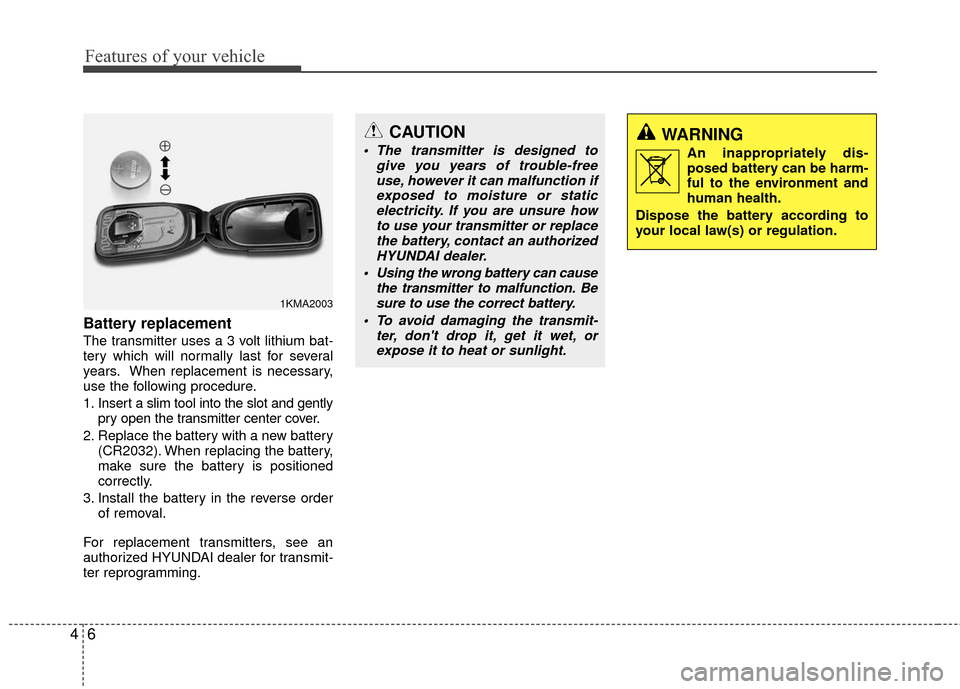
Battery replacement
The transmitter uses a 3 volt lithium bat-
tery which will normally last for several
years. When replacement is necessary,
use the following procedure.
1. Insert a slim tool into the slot and gentlypry open the transmitter center cover.
2. Replace the battery with a new battery (CR2032). When replacing the battery,
make sure the battery is positioned
correctly.
3. Install the battery in the reverse order of removal.
For replacement transmitters, see an
authorized HYUNDAI dealer for transmit-
ter reprogramming.
CAUTION
The transmitter is designed to give you years of trouble-freeuse, however it can malfunction ifexposed to moisture or staticelectricity. If you are unsure how to use your transmitter or replacethe battery, contact an authorizedHYUNDAI dealer.
Using the wrong battery can cause the transmitter to malfunction. Besure to use the correct battery.
To avoid damaging the transmit- ter, don't drop it, get it wet, orexpose it to heat or sunlight.WARNING
An inappropriately dis-
posed battery can be harm-
ful to the environment and
human health.
Dispose the battery according to
your local law(s) or regulation.
1KMA2003
Page 409 of 456
751
Maintenance
A vehicle’s electrical system is protected
from electrical overload damage by fuses.
This vehicle has 2 fuse panels, one locat-
ed in the driver’s side panel bolster, the
other in the engine compartment.If any of your vehicle’s lights, accessories,
or controls do not work, check the appro-
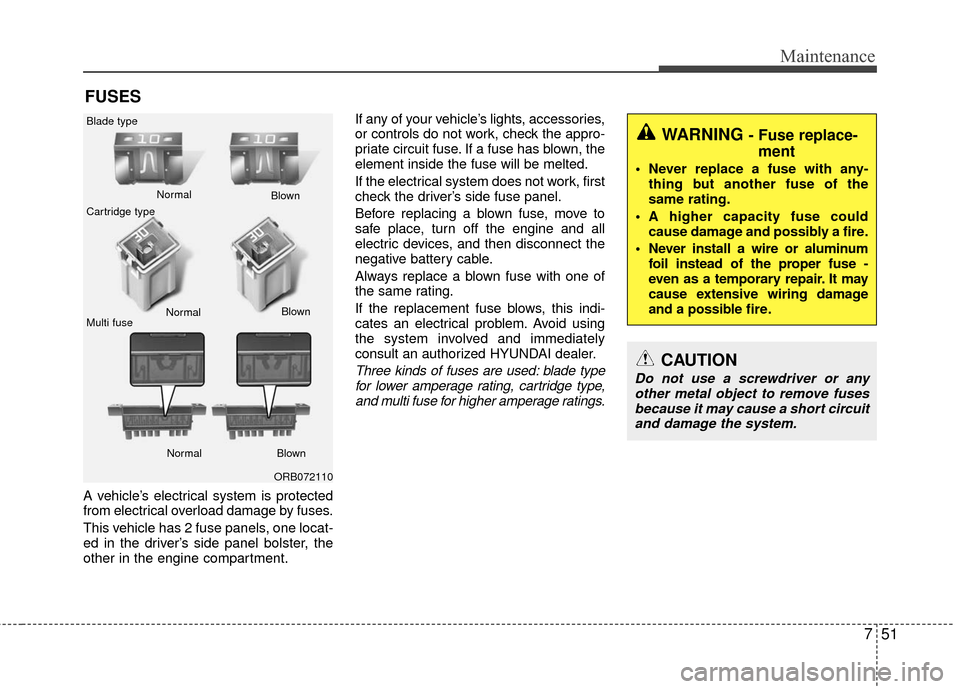
priate circuit fuse. If a fuse has blown, the
element inside the fuse will be melted.
If the electrical system does not work, first
check the driver’s side fuse panel.
Before replacing a blown fuse, move to
safe place, turn off the engine and all
electric devices, and then disconnect the
negative battery cable.
Always replace a blown fuse with one of
the same rating.
If the replacement fuse blows, this indi-
cates an electrical problem. Avoid using
the system involved and immediately
consult an authorized HYUNDAI dealer.
Three kinds of fuses are used: blade type
for lower amperage rating, cartridge type,and multi fuse for higher amperage ratings.
WARNING - Fuse replace- ment
Never replace a fuse with any-
thing but another fuse of the
same rating.
A higher capacity fuse could cause damage and possibly a fire.
Never install a wire or aluminum foil instead of the proper fuse -
even as a temporary repair. It may
cause extensive wiring damage
and a possible fire.
CAUTION
Do not use a screwdriver or anyother metal object to remove fuses because it may cause a short circuitand damage the system.
ORB072110
Normal
Normal
Blade type
Cartridge type
Multi fuse Blown
Blown
Normal Blown
FUSES
Page 411 of 456
753
Maintenance
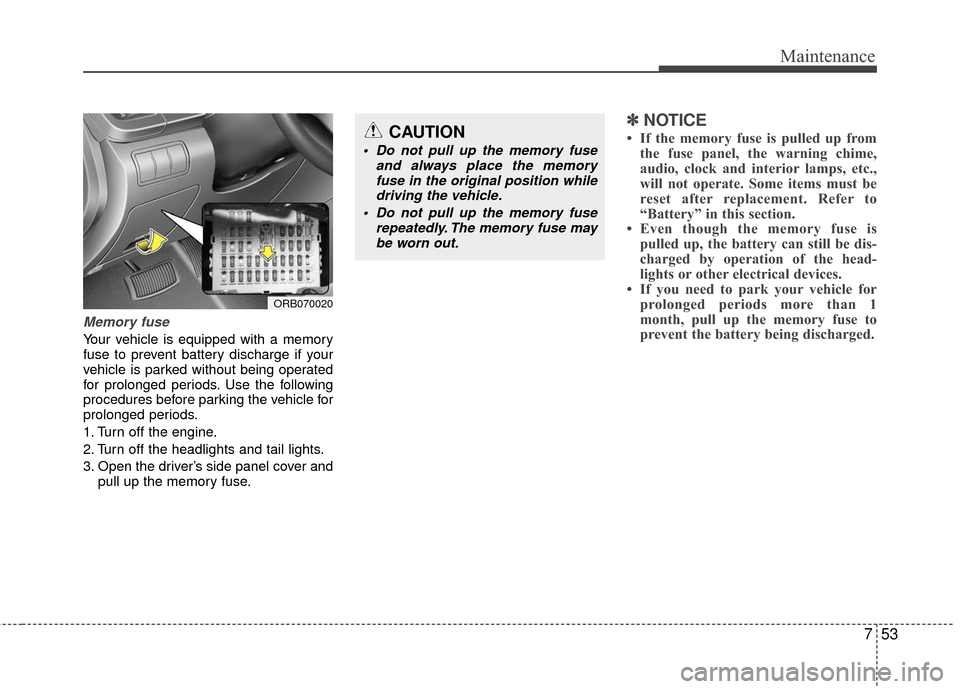
Memory fuse
Your vehicle is equipped with a memory
fuse to prevent battery discharge if your
vehicle is parked without being operated
for prolonged periods. Use the following
procedures before parking the vehicle for
prolonged periods.
1. Turn off the engine.
2. Turn off the headlights and tail lights.
3. Open the driver’s side panel cover andpull up the memory fuse.
✽ ✽NOTICE
• If the memory fuse is pulled up from
the fuse panel, the warning chime,
audio, clock and interior lamps, etc.,
will not operate. Some items must be
reset after replacement. Refer to
“Battery” in this section.
• Even though the memory fuse is pulled up, the battery can still be dis-
charged by operation of the head-
lights or other electrical devices.
• If you need to park your vehicle for prolonged periods more than 1
month, pull up the memory fuse to
prevent the battery being discharged.
ORB070020
CAUTION
Do not pull up the memory fuse
and always place the memoryfuse in the original position whiledriving the vehicle.
Do not pull up the memory fuse repeatedly. The memory fuse maybe worn out.
Page 449 of 456

Index
2I
Active ECO system··················\
··················\
···· ·5-32
Air bag warning label ··················\
··················\
·· ·3-60
Air bag warning light ··················\
··················\
·· ·3-37
Air bags ··················\
··················\
··················\
·3-34
Air bag warning label ··················\
················· ·3-60
Air bag warning light ··················\
················· ·3-37
Curtain air bag ··················\
··················\
······· ·3-51
Driver's and passenger's front air bag ·················3-46
Occupant detection system ··················\
············3-40
Side impact air bag ··················\
··················\
·· ·3-50
SRS components and functions ··················\
······3-37
Air cleaner ··················\
··················\
··············· ·7-28
Antenna (Roof) ··················\
··················\
········· ·4-97
Anti-lock brake system (ABS) ··················\
···········5-19
Appearance care ··················\
··················\
·········7-70
Exterior care ··················\
··················\
········· ·7-70
Interior care ··················\
··················\
·········· ·7-74
Armrest(front) ··················\
··················\
·············3-6
Audio system ··················\
··················\
············ ·4-97
Roof antenna ··················\
··················\
········· ·4-97
Steering wheel audio control ··················\
·········4-98
Automatic climate control system ··················\
·······4-76
Air conditioning ··················\
··················\
····· ·4-82
Automatic heating and air conditioning ···············4-77
Manual heating and air conditioning ··················4-78
Automatic transaxle Manual shift mode ·················5-12
Automatic transaxle ··················\
··················\
···· ·5-10Aux, USB and iPod
®port
··················\
··············· ·4-94
Base curb weight··················\
··················\
·········5-48
Battery ··················\
··················\
··················\
·· ·7-34
Battery saver function ··················\
··················\
·· ·4-53
Before driving ··················\
··················\
············ ·5-3
Bottle holders, see cup holders ··················\
··········4-90
Brake system ··················\
··················\
············ ·5-16
Anti-lock brake system (ABS) ··················\
·······5-19
Electronic stability control (ESC) ··················\
····5-21
Hill-start assist control ··················\
················ ·5-27
Parking brake ··················\
··················\
·········5-17
Power brakes ··················\
··················\
········· ·5-16
Vehicle stability management ··················\
········5-26
Brakes/clutch fluid ··················\
··················\
····· ·7-26
Bulb replacement ··················\
··················\
······· ·7-61
Bulb wattage ··················\
··················\
·············· ·8-2
California perchlorate notice ··················\
·············7-79
Capacities (Lubricants) ··················\
··················\
·· ·8-4
Care Exterior care ··················\
··················\
········· ·7-71
Interior care ··················\
··················\
·········· ·7-75
Tire care ··················\
··················\
·············· ·7-37A
B
C