heating Hyundai Accent 2017 User Guide
[x] Cancel search | Manufacturer: HYUNDAI, Model Year: 2017, Model line: Accent, Model: Hyundai Accent 2017Pages: 380, PDF Size: 12.45 MB
Page 144 of 380
Features of your vehicle
4-70
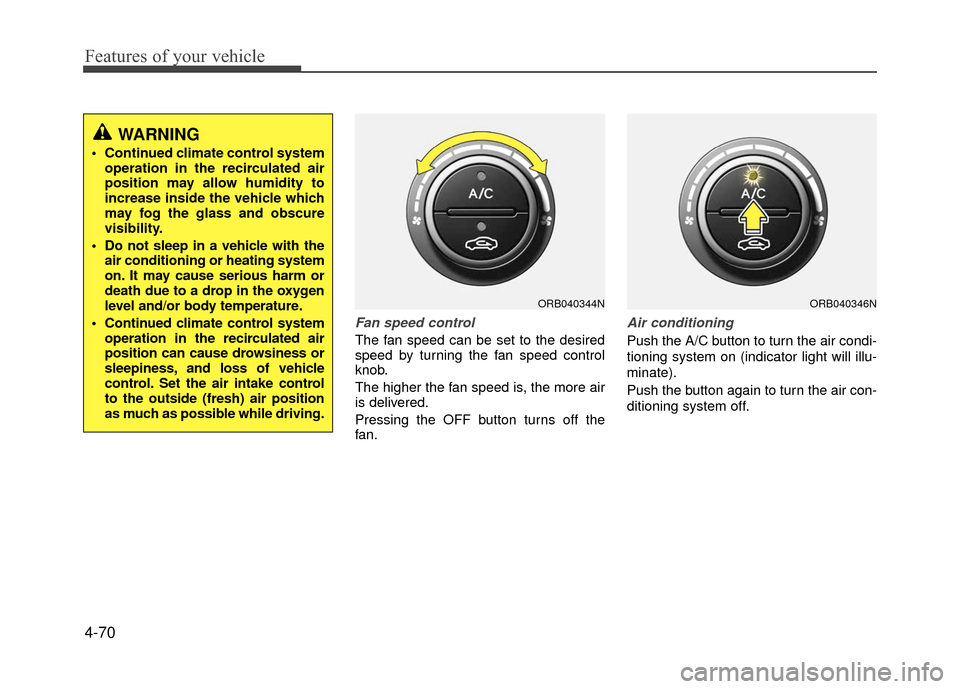
Fan speed control
The fan speed can be set to the desired
speed by turning the fan speed control
knob.
The higher the fan speed is, the more air
is delivered.
Pressing the OFF button turns off the
fan.
Air conditioning
Push the A/C button to turn the air condi-
tioning system on (indicator light will illu-
minate).
Push the button again to turn the air con-
ditioning system off.
WARNING
Continued climate control systemoperation in the recirculated air
position may allow humidity to
increase inside the vehicle which
may fog the glass and obscure
visibility.
Do not sleep in a vehicle with the air conditioning or heating system
on. It may cause serious harm or
death due to a drop in the oxygen
level and/or body temperature.
Continued climate control system operation in the recirculated air
position can cause drowsiness or
sleepiness, and loss of vehicle
control. Set the air intake control
to the outside (fresh) air position
as much as possible while driving.
ORB040344NORB040346N
Page 145 of 380
4-71
Features of your vehicle
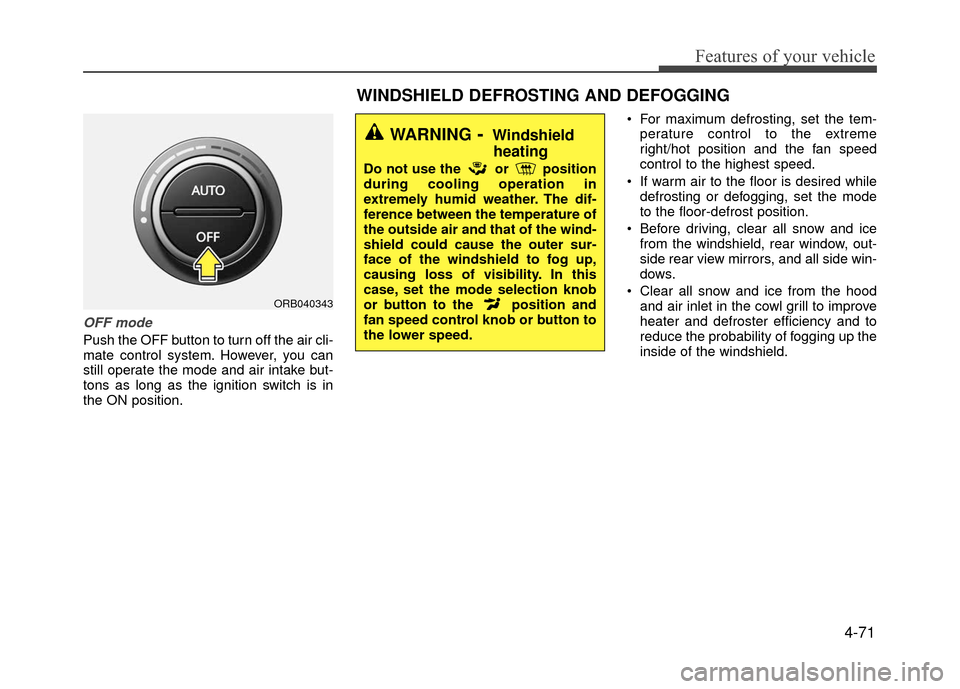
OFF mode
Push the OFF button to turn off the air cli-
mate control system. However, you can
still operate the mode and air intake but-
tons as long as the ignition switch is in
the ON position. For maximum defrosting, set the tem-
perature control to the extreme
right/hot position and the fan speed
control to the highest speed.
If warm air to the floor is desired while defrosting or defogging, set the mode
to the floor-defrost position.
Before driving, clear all snow and ice from the windshield, rear window, out-
side rear view mirrors, and all side win-
dows.
Clear all snow and ice from the hood and air inlet in the cowl grill to improve
heater and defroster efficiency and to
reduce the probability of fogging up the
inside of the windshield.
ORB040343
WINDSHIELD DEFROSTING AND DEFOGGING
WARNING- Windshieldheating
Do not use the or position
during cooling operation in
extremely humid weather. The dif-
ference between the temperature of
the outside air and that of the wind-
shield could cause the outer sur-
face of the windshield to fog up,
causing loss of visibility. In this
case, set the mode selection knob
or button to the position and
fan speed control knob or button to
the lower speed.
Page 217 of 380
Driving your vehicle
5-14
Always use the parking brake. Do notdepend on placing the transaxle in P
(Park) to keep the car from moving.
Exercise extreme caution when driving on a slippery surface. Be especially
careful when braking, accelerating or
shifting gears. On a slippery surface,
an abrupt change in vehicle speed can
cause the drive wheels to lose traction
and the vehicle to go out of control.
Optimum vehicle performance and economy is obtained by smoothly
depressing and releasing the accelera-
tor pedal.
Moving up a steep grade from astanding start
To move up a steep grade from a stand-
ing start, depress the brake pedal, shift
the shift lever to D (Drive). Depress the
accelerator gradually while releasing the
service brakes.
WARNING
Always buckle-up! In a collision, an unbelted occupant is signifi-
cantly more likely to be seriously
injured or killed than a properly
belted occupant.
Avoid high speeds when corner- ing or turning.
Do not make quick steering wheel movements, such as sharp
lane changes or fast, sharp turns.
The risk of rollover is greatly increased if you lose control of
your vehicle at highway speeds.
Loss of control often occurs if two or more wheels drop off the
roadway and the driver over-
steers to reenter the roadway.
In the event your vehicle leaves the roadway, do not steer sharply.
Instead, slow down before pulling
back into the travel lanes.
Never exceed posted speed lim- its.
WARNING
If your vehicle becomes stuck in
snow, mud, sand, etc., then you
may attempt to rock the vehicle free
by moving it forward and backward.
Do not attempt this procedure if
people or objects are anywhere
near the vehicle. During the rocking
operation the vehicle may suddenly
move forward or backward as it
becomes unstuck, causing injury
or damage to nearby people or
objects.
Do not rev up the engine. This may
cause engine over-heating,
transaxle damage or failure, and
tire damage.
Page 226 of 380
5-23
Driving your vehicle
ESC OFF usage
When driving
ESC should remain on for daily drivingwhenever possible.
To turn ESC off while driving, press the ESC OFF button while driving on a flat
road surface.
✽ ✽ NOTICE
• When operating the vehicle on a
dynamometer, ensure that the ESC is
turned off (ESC OFF light illuminat-
ed).
• Turning the ESC off does not affect ABS or brake system operation.
Good braking practices
After parking the vehicle, check to be
sure the parking brake is not engaged
and that the parking brake indicator
light is out before driving away.
Driving through water may get the brakes wet. They can also get wet when
the car is washed. Wet brakes can be
dangerous! Your car will not stop as
quickly if the brakes are wet. Wet brakes
may cause the car to pull to one side. To dry the brakes, apply the brakes light-
ly until the braking action returns to nor-
mal, taking care to keep the car under
control at all times. If the braking action
does not return to normal, stop as soon
as it is safe to do so and call an author-
ized HYUNDAI dealer for assistance.
Do not coast down hills with the car out of gear. This is extremely hazardous.
Keep the car in gear at all times, use
the brakes to slow down, then shift to a
lower gear so that engine braking will
help you maintain a safe speed.
Do not "ride" the brake pedal. Resting your foot on the brake pedal while driv-
ing can be dangerous because it can
result in the brakes overheating and los-
ing their effectiveness. It also increases
the wear of the brake components.
If a tire goes flat while you are driving, apply the brakes gently and keep the
car pointed straight ahead while you
slow down. When you are moving slow-
ly enough for it to be safe to do so, pull
off the road and stop in a safe place.
If your vehicle is equipped with an auto- matic transaxle, do not let your vehicle
creep forward. To avoid creeping for-
ward, keep your foot firmly on the brake
pedal when the vehicle is stopped.
WARNING
Never press the ESC OFF button
while ESC is operating (ESC indica-
tor light blinks).
If ESC is turned off while ESC is
operating, the vehicle may slip out
of control and cause an accident.
WARNING
Whenever you leave or park yourvehicle, always set the parking
brake as far as possible and fully
engage the vehicle's transaxle
into the P (Park) position. If the
parking brake is not fully
engaged, the vehicle may move
inadvertently and injure yourself
and others.
All vehicles should always have the parking brake fully engaged
when parking to avoid inadver-
tent movement of the vehicle
which can injure occupants or
pedestrians.
Page 235 of 380
Driving your vehicle
5-32
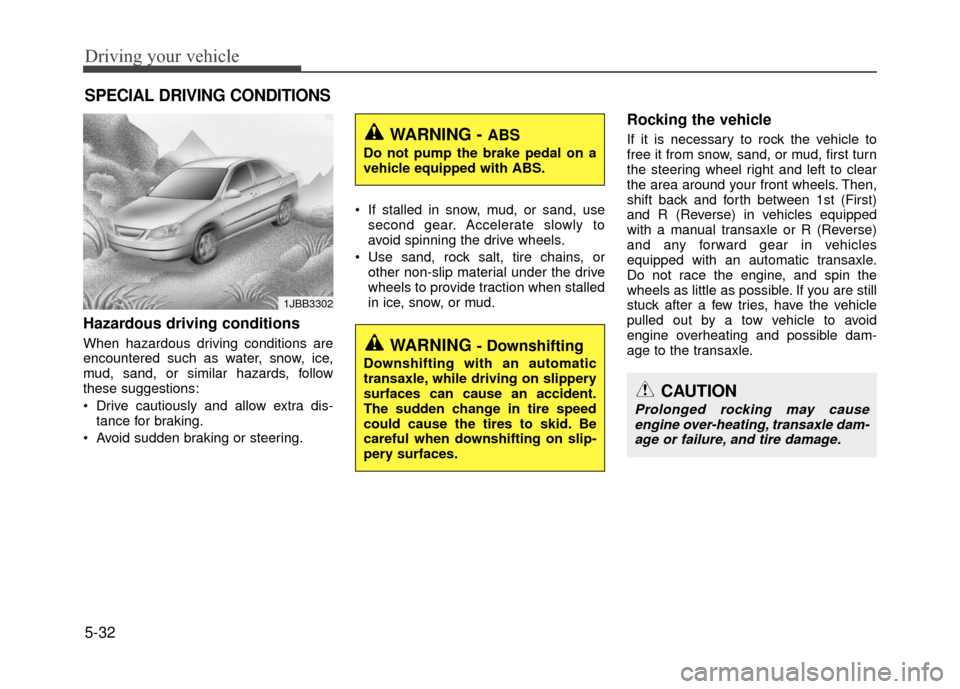
Hazardous driving conditions
When hazardous driving conditions are
encountered such as water, snow, ice,
mud, sand, or similar hazards, follow
these suggestions:
Drive cautiously and allow extra dis-tance for braking.
Avoid sudden braking or steering. If stalled in snow, mud, or sand, use
second gear. Accelerate slowly to
avoid spinning the drive wheels.
Use sand, rock salt, tire chains, or other non-slip material under the drive
wheels to provide traction when stalled
in ice, snow, or mud.
Rocking the vehicle
If it is necessary to rock the vehicle to
free it from snow, sand, or mud, first turn
the steering wheel right and left to clear
the area around your front wheels. Then,
shift back and forth between 1st (First)
and R (Reverse) in vehicles equipped
with a manual transaxle or R (Reverse)
and any forward gear in vehicles
equipped with an automatic transaxle.
Do not race the engine, and spin the
wheels as little as possible. If you are still
stuck after a few tries, have the vehicle
pulled out by a tow vehicle to avoid
engine overheating and possible dam-
age to the transaxle.
SPECIAL DRIVING CONDITIONS
1JBB3302
WARNING - ABS
Do not pump the brake pedal on a
vehicle equipped with ABS.
WARNING - Downshifting
Downshifting with an automatic
transaxle, while driving on slippery
surfaces can cause an accident.
The sudden change in tire speed
could cause the tires to skid. Be
careful when downshifting on slip-
pery surfaces.
CAUTION
Prolonged rocking may causeengine over-heating, transaxle dam-age or failure, and tire damage.
Page 238 of 380
5-35
Driving your vehicle
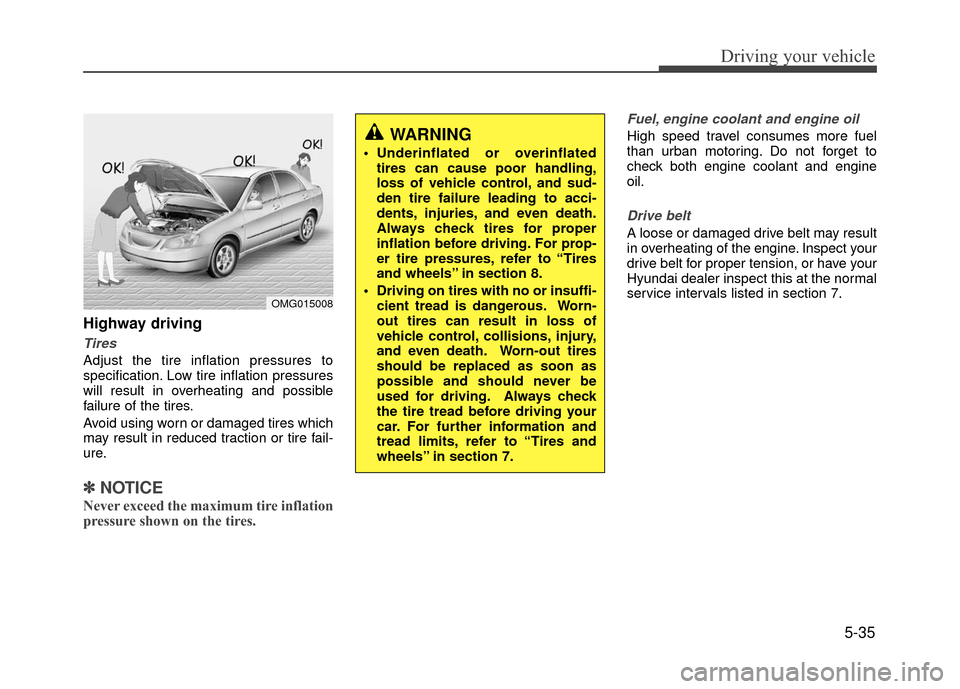
Highway driving
Tires
Adjust the tire inflation pressures to
specification. Low tire inflation pressures
will result in overheating and possible
failure of the tires.
Avoid using worn or damaged tires which
may result in reduced traction or tire fail-
ure.
✽ ✽NOTICE
Never exceed the maximum tire inflation
pressure shown on the tires.
Fuel, engine coolant and engine oil
High speed travel consumes more fuel
than urban motoring. Do not forget to
check both engine coolant and engine
oil.
Drive belt
A loose or damaged drive belt may result
in overheating of the engine. Inspect your
drive belt for proper tension, or have your
Hyundai dealer inspect this at the normal
service intervals listed in section 7.
WARNING
Underinflated or overinflated
tires can cause poor handling,
loss of vehicle control, and sud-
den tire failure leading to acci-
dents, injuries, and even death.
Always check tires for proper
inflation before driving. For prop-
er tire pressures, refer to “Tires
and wheels” in section 8.
Driving on tires with no or insuffi- cient tread is dangerous. Worn-
out tires can result in loss of
vehicle control, collisions, injury,
and even death. Worn-out tires
should be replaced as soon as
possible and should never be
used for driving. Always check
the tire tread before driving your
car. For further information and
tread limits, refer to “Tires and
wheels” in section 7.
OMG015008
Page 254 of 380
What to do in an emergency
6-6
IF THE ENGINE OVERHEATS
If your temperature gauge indicates over-
heating, you experience a loss of power,
or hear loud pinging or knocking, the
engine is probably too hot. If this hap-
pens, you should:
1. Pull off the road and stop as soon asit is safe to do so.
2. Place the shift lever in P (automatic transaxle) or neutral (manual
transaxle) and set the parking brake. If
the air conditioning is on, turn it off.
3. If engine coolant is running out under the car or steam is coming out from
the hood, stop the engine. Do not
open the hood until the coolant has
stopped running or the steaming has
stopped. If there is no visible loss of
engine coolant and no steam, leave
the engine running and check to be
sure the engine cooling fan is operat-
ing. If the fan is not running, turn the
engine off. 4. Check to see if the water pump drive
belt is missing. If it is not missing,
check to see that it is tight. If the drive
belt seems to be satisfactory, check
for coolant leaking from the radiator,
hoses or under the car. (If the air con-
ditioning had been in use, it is normal
for cold water to be draining from it
when you stop.)
5. If the water pump drive belt is broken or engine coolant is leaking out, stop
the engine immediately and call the
nearest authorized HYUNDAI dealer
for assistance. 6. If you cannot find the cause of the
overheating, wait until the engine tem-
perature has returned to normal.
Then, if coolant has been lost, careful-
ly add coolant to the reservoir to bring
the fluid level in the reservoir up to the
halfway mark.
7. Proceed with caution, keeping alert for further signs of overheating. If over-
heating happens again, call an author-
ized HYUNDAI dealer for assistance.
WARNING
While the engine is running, keep
hair, hands and clothing away from
moving parts such as the fan and
drive belts to prevent injury.CAUTION
Serious loss of coolant indicates
there is a leak in the cooling systemand this should be checked as soonas possible by an authorizedHYUNDAI dealer.
WARNING
Do not remove the radiator cap
when the engine is hot. This may
result in coolant being blown out of
the opening and cause serious
burns.
Page 373 of 380

Index
2I
Active ECO system··················\
··················\
···· ·5-30
Air bag warning label ··················\
··················\
·· ·3-58
Air bag warning light ··················\
··················\
·· ·3-36
Air bags ··················\
··················\
··················\
·3-33
Air bag warning label ··················\
················· ·3-58
Air bag warning light ··················\
················· ·3-36
Curtain air bag ··················\
··················\
······· ·3-50
Driver's and passenger's front air bag ·················3-45
Occupant detection system ··················\
············3-39
Side impact air bag ··················\
··················\
·· ·3-49
SRS components and functions ··················\
······3-36
Air cleaner ··················\
··················\
··············· ·7-27
Antenna (Roof) ··················\
··················\
········· ·4-84
Anti-lock brake system (ABS) ··················\
···········5-18
Appearance care ··················\
··················\
·········7-70
Exterior care ··················\
··················\
········· ·7-70
Interior care ··················\
··················\
·········· ·7-74
Armrest(front) ··················\
··················\
·············3-6
Audio system ··················\
··················\
············ ·4-84
Roof antenna ··················\
··················\
········· ·4-84
Steering wheel audio control ··················\
·········4-85
Automatic climate control system ··················\
·······4-65
Air conditioning ··················\
··················\
····· ·4-70
Automatic heating and air conditioning ···············4-66
Manual heating and air conditioning ··················4-67
Automatic transaxle Manual shift mode ·················5-12
Automatic transaxle ··················\
··················\
···· ·5-10Aux, USB and iPod
®port
··················\
··············· ·4-82
Base curb weight··················\
··················\
·········5-45
Battery ··················\
··················\
··················\
·· ·7-33
Battery saver function ··················\
··················\
·· ·4-44
Before driving ··················\
··················\
············ ·5-3
Bottle holders, see cup holders ··················\
··········4-78
Brake system ··················\
··················\
············ ·5-15
Anti-lock brake system (ABS) ··················\
·······5-18
Electronic stability control (ESC) ··················\
····5-20
Hill-start assist control ··················\
················ ·5-25
Parking brake ··················\
··················\
·········5-16
Power brakes ··················\
··················\
········· ·5-15
Vehicle stability management ··················\
········5-24
Brakes/clutch fluid ··················\
··················\
····· ·7-25
Bulb replacement ··················\
··················\
······· ·7-61
Bulb wattage ··················\
··················\
·············· ·8-2
California perchlorate notice ··················\
·············7-78
Capacities (Lubricants) ··················\
··················\
·· ·8-4
Care Exterior care ··················\
··················\
········· ·7-70
Interior care ··················\
··················\
·········· ·7-74
Tire care ··················\
··················\
·············· ·7-36A
B
C
Page 377 of 380

Index
6I
LabelAir bag warning label ··················\
················· ·3-58
Refrigerant label ··················\
··················\
·······8-8
Tire sidewall labeling ··················\
················· ·7-42
Tire specification and pressure label ··················\
··8-8
Vehicle certification label ··················\
···············8-7
Light bulbs ··················\
··················\
··············· ·7-60
Lighting ··················\
··················\
··················\
·4-44
Battery saver function ··················\
················ ·4-44
Lower anchor ··················\
··················\
············ ·3-31
Lubricants and capacities ··················\
··················\
8-4
Luggage net ··················\
··················\
··············4-77
Maintenance Explanation of scheduled maintenance items ········7-19
Maintenance services ··················\
··················\
··7-3
Maintenance under severe usage conditions ·········7-18
Normal maintenance schedule ··················\
·········7-7
Owner maintenance ··················\
··················\
···7-4
Scheduled maintenance service ··················\
········7-6
Tire maintenance ··················\
··················\
···· ·7-41Maintenance schedule
··················\
··················\
··· ·7-6
Maintenance under severe usage conditions ·········7-18
Normal maintenance schedule ··················\
·········7-7
Maintenance services ··················\
··················\
···· ·7-3
Manual climate control system ··················\
··········4-56
Air conditioning ··················\
··················\
····· ·4-61
Climate control air filter ··················\
···············4-64
Heating and air conditioning ··················\
·········4-57
Manual shift mode ··················\
··················\
······ ·5-12
Manual transaxle ··················\
··················\
········· ·5-7
Memory fuse ··················\
··················\
············ ·7-52
Mirrors ··················\
··················\
··················\
· ·4-26
Day/night rearview mirror ··················\
············4-26
Inside rearview mirror ··················\
················ ·4-26
Side view mirrors ··················\
··················\
··· ·4-27
Multi fuse ··················\
··················\
·················7-53
Occupant detection system ··················\
···············3-39
Odometer ··················\
··················\
················ ·4-33
Oil (Engine) ··················\
··················\
··············7-21
Overheats ··················\
··················\
··················\
·6-6
Owner maintenance ··················\
··················\
······ ·7-4
L
O
M