part number Hyundai Accent 2017 Owner's Manual
[x] Cancel search | Manufacturer: HYUNDAI, Model Year: 2017, Model line: Accent, Model: Hyundai Accent 2017Pages: 380, PDF Size: 12.45 MB
Page 4 of 380
F-4FOREWORD
Thank you for choosing HYUNDAI. We are pleased to welcome you to the growing number of discerning people who drive
HYUNDAIS. The advanced engineering and high-quality construction of each HYUNDAI we build is something of which we're very
proud.
Your Owner's Manual will introduce you to the features and operation of your new HYUNDAI. It is suggested that you read it care-
fully because the information it contains can contribute greatly to the satisfaction you receive from your new car.
The manufacturer also recommends that all service and maintenance on your car be performed by an authorized HYUNDAI deal-
er. HYUNDAI dealers are prepared to provide high-quality service, maintenance and any other assistance that may be required.
HYUNDAI MOTOR AMERICA
Note
: Because future owners will also need the information included in this manual, if you sell this HYUNDAI, please leave the
manual in the vehicle for their use. Thank you.
Copyright 2017 HYUNDAI Motor America. All rights reserved. No part of this publication may be reproduced, stored in any retrieva l
system or transmitted in any form or by any means without the prior written permission of HYUNDAI Motor America.
CAUTION
Severe engine and transaxle damage may result from the use of poor quality fuels and lubricants that do not meet HYUNDAI specifications. You must always use high quality fuels and lubricants that meet the specifications li\
sted on Page 8-4 in theVehicle Specifications and consumer information section of the Owner's Manual.
Page 50 of 380
Safety features of your vehicle
3-34
How does the air bag system
operate
Air bags are activated (able to inflate ifnecessary) only when the ignition
switch is turned to the ON or START
position.
Air bags inflate instantly in the event of serious frontal or side collision in order
to help protect the occupants from seri-
ous physical injury.
There is no single speed at which the air bags will inflate.
Generally, air bags are designed to
inflate by the severity of a collision and
its direction. These two factors deter-
mine whether the sensors send out an
electronic deployment/ inflation signal.
Air bag deployment depends on a number of factors including vehicle
speed, angles of impact and the densi-
ty and stiffness of the vehicles or
objects which your vehicle hits in the
collision. Though, factors are not limit-
ed to those mentioned above.
The front air bags will completely inflate and deflate in an instant.
It is virtually impossible for you to see
the air bags inflate during an accident.
It is much more likely that you will sim-
ply see the deflated air bags hanging
out of their storage compartments after
the collision. In addition to inflating in certain side
collisions, vehicles equipped with a
rollover sensor, side impact air bags
and curtain air bags will inflate if the
sensing system detects a rollover.
When a rollover is detected, side
impact air bags and curtain air bags
will remain inflated longer to help pro-
vide protection from ejection, especial-
ly when used in conjunction with the
seat belts.
In order to help provide protection in a severe collision, the air bags must
inflate rapidly. The speed of air bag
inflation is a consequence of the
extremely short time in which a collision
occurs and the need to get the air bag
between the occupant and the vehicle
structures before the occupant impacts
those structures. This speed of inflation
reduces the risk of serious or life-
threatening injuries in a severe collision
and is thus a necessary part of air bag
design.
However, air bag inflation can also
cause injuries which normally can
include facial abrasions, bruises and
broken bones because the inflation
speed also causes the air bags to
expand with a great deal of force. There are even circumstances
under which contact with the air bag
can cause fatal injuries, especially if
the occupant is positioned exces-
sively close to the air bag.
WARNING
To avoid severe personal injuryor death caused by deploying air
bags in a collision, the driver
should sit as far back from the
steering wheel air bag as possi-
ble (at least 10 inches (250 mm)
away). The front passengers
should always move their seats
as far back as possible and sit
back in their seat.
Air bags inflate instantly in the event of collision, and passen-
gers may be injured by the air bag
expansion force if they are not in
proper position.
Air bag inflation may cause injuries which normally include
facial or bodily abrasions,
injuries from broken glasses or
burns by the air bag inflation
gasses.
Page 77 of 380
4-3
Features of your vehicle
Record your key number
The key code number
is stamped or printed
on the key code tag
attached to the key
set. Should you lose
your keys, this number will enable an
authorized HYUNDAI dealer to duplicate
the keys easily. Remove the key code tag
and store it in a safe place. Also, record
the key code number and keep it in a
safe and handy place, but not in the vehi-
cle.
Key operations
Used to start the engine, lock and unlock
the doors.
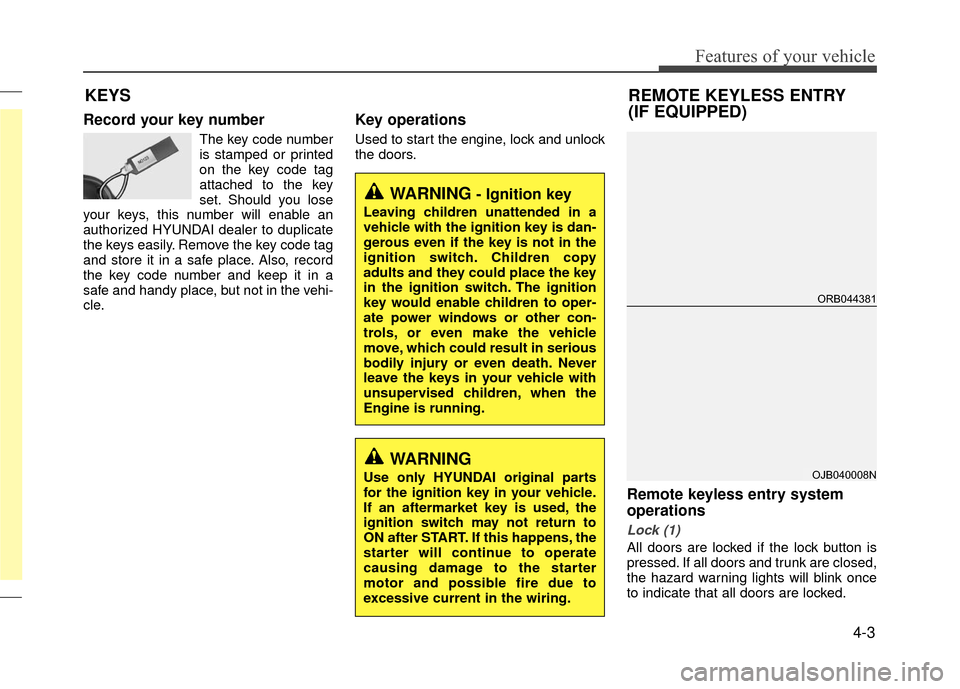
Remote keyless entry system
operations
Lock (1)
All doors are locked if the lock button is
pressed. If all doors and trunk are closed,
the hazard warning lights will blink once
to indicate that all doors are locked.
KEYS
WARNING- Ignition key
Leaving children unattended in a
vehicle with the ignition key is dan-
gerous even if the key is not in the
ignition switch. Children copy
adults and they could place the key
in the ignition switch. The ignition
key would enable children to oper-
ate power windows or other con-
trols, or even make the vehicle
move, which could result in serious
bodily injury or even death. Never
leave the keys in your vehicle with
unsupervised children, when the
Engine is running.
WARNING
Use only HYUNDAI original parts
for the ignition key in your vehicle.
If an aftermarket key is used, the
ignition switch may not return to
ON after START. If this happens, the
starter will continue to operate
causing damage to the starter
motor and possible fire due to
excessive current in the wiring.
REMOTE KEYLESS ENTRY
(IF EQUIPPED)
ORB044381
OJB040008N
Page 104 of 380
Features of your vehicle
4-30
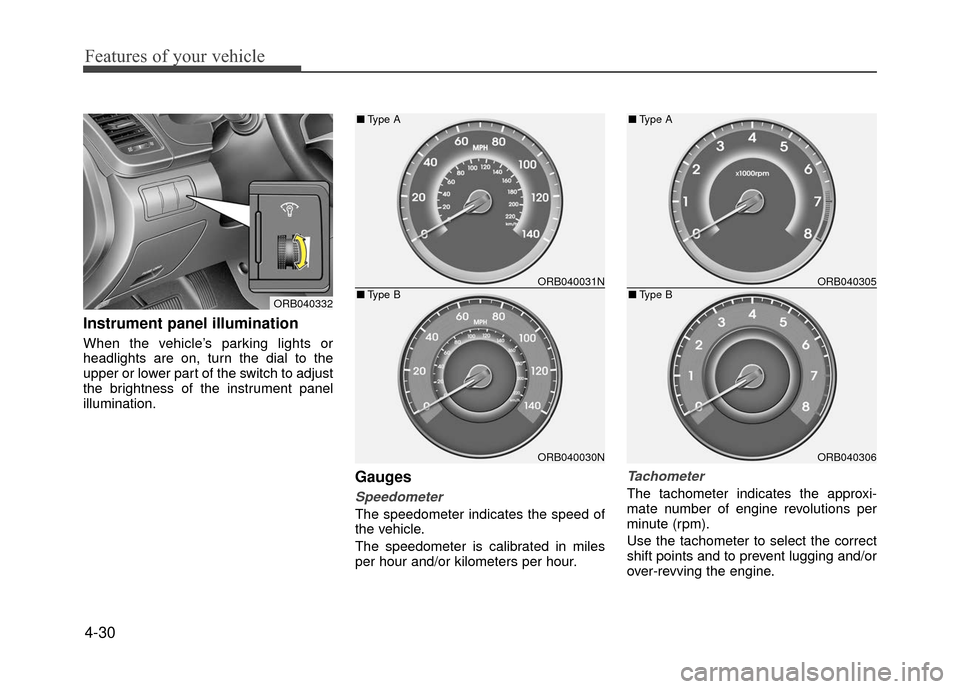
Instrument panel illumination
When the vehicle’s parking lights or
headlights are on, turn the dial to the
upper or lower part of the switch to adjust
the brightness of the instrument panel
illumination.
Gauges
Speedometer
The speedometer indicates the speed of
the vehicle.
The speedometer is calibrated in miles
per hour and/or kilometers per hour.
Tachometer
The tachometer indicates the approxi-
mate number of engine revolutions per
minute (rpm).
Use the tachometer to select the correct
shift points and to prevent lugging and/or
over-revving the engine.
ORB040332
ORB040031N
ORB040030N
■Type A
■Type BORB040305
ORB040306
■Type A
■Type B
Page 192 of 380
Features of your vehicle
4-118
USING Bluetooth®Wireless
Technology
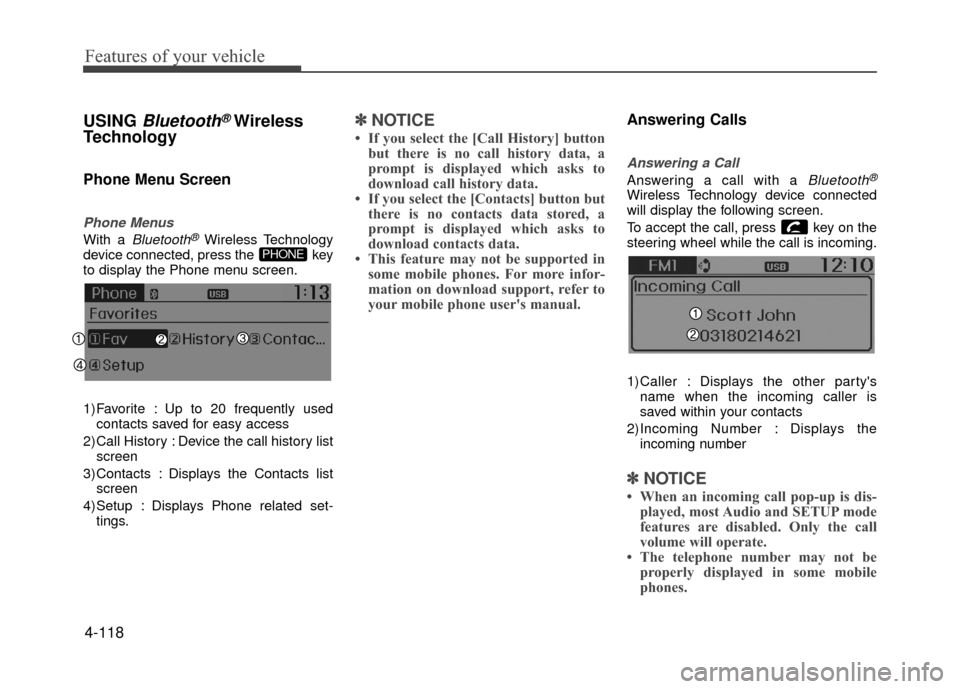
Phone Menu Screen
Phone Menus
With a Bluetooth®Wireless Technology
device connected, press the key
to display the Phone menu screen.
1) Favorite : Up to 20 frequently used contacts saved for easy access
2) Call History : Device the call history list screen
3) Contacts : Displays the Contacts list screen
4) Setup : Displays Phone related set- tings.
✽ ✽ NOTICE
• If you select the [Call History] button
but there is no call history data, a
prompt is displayed which asks to
download call history data.
• If you select the [Contacts] button but there is no contacts data stored, a
prompt is displayed which asks to
download contacts data.
• This feature may not be supported in some mobile phones. For more infor-
mation on download support, refer to
your mobile phone user's manual.
Answering Calls
Answering a Call
Answering a call with a Bluetooth®
Wireless Technology device connected
will display the following screen.
To accept the call, press key on the
steering wheel while the call is incoming.
1)Caller : Displays the other party's
name when the incoming caller is
saved within your contacts
2)Incoming Number : Displays the incoming number
✽ ✽ NOTICE
• When an incoming call pop-up is dis-
played, most Audio and SETUP mode
features are disabled. Only the call
volume will operate.
• The telephone number may not be properly displayed in some mobile
phones.
PHONE
Page 326 of 380
7-43
Maintenance
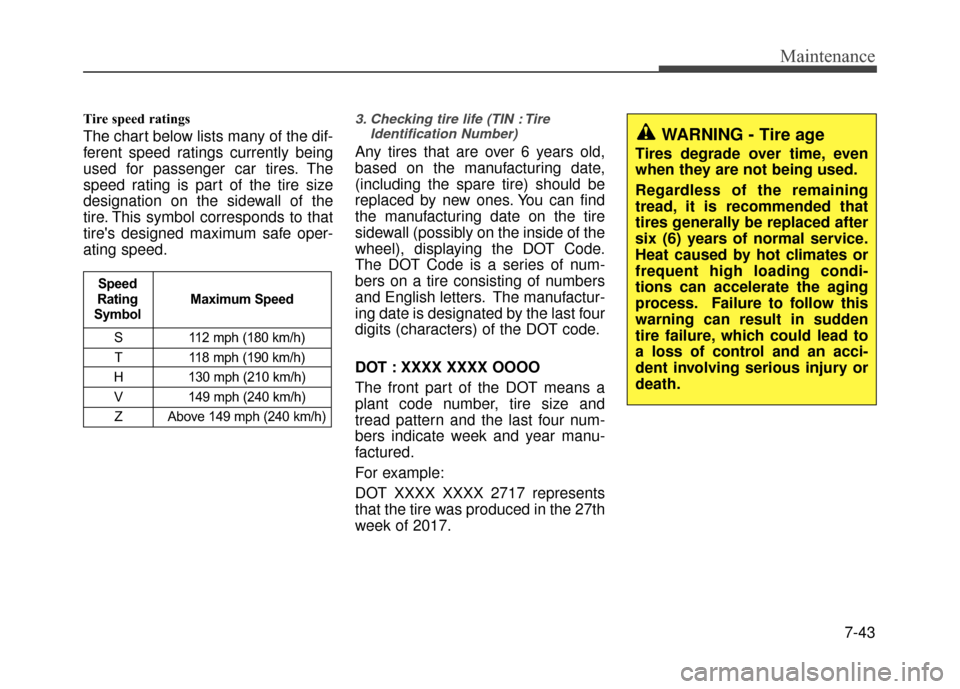
Tire speed ratings
The chart below lists many of the dif-
ferent speed ratings currently being
used for passenger car tires. The
speed rating is part of the tire size
designation on the sidewall of the
tire. This symbol corresponds to that
tire's designed maximum safe oper-
ating speed.
3. Checking tire life (TIN : TireIdentification Number)
Any tires that are over 6 years old,
based on the manufacturing date,
(including the spare tire) should be
replaced by new ones. You can find
the manufacturing date on the tire
sidewall (possibly on the inside of the
wheel), displaying the DOT Code.
The DOT Code is a series of num-
bers on a tire consisting of numbers
and English letters. The manufactur-
ing date is designated by the last four
digits (characters) of the DOT code.
DOT : XXXX XXXX OOOO
The front part of the DOT means a
plant code number, tire size and
tread pattern and the last four num-
bers indicate week and year manu-
factured.
For example:
DOT XXXX XXXX 2717 represents
that the tire was produced in the 27th
week of 2017.
S 112 mph (180 km/h)
T 118 mph (190 km/h)
H 130 mph (210 km/h) V 149 mph (240 km/h)Z Above 149 mph (240 km/h)
Maximum Speed
Speed
Rating
Symbol
WARNING - Tire age
Tires degrade over time, even
when they are not being used.
Regardless of the remaining
tread, it is recommended that
tires generally be replaced after
six (6) years of normal service.
Heat caused by hot climates or
frequent high loading condi-
tions can accelerate the aging
process. Failure to follow this
warning can result in sudden
tire failure, which could lead to
a loss of control and an acci-
dent involving serious injury or
death.
Page 327 of 380
Maintenance
7-44
4. Tire ply composition and material
The number of layers or plies of rub-
ber-coated fabric in the tire. Tire man-
ufacturers also must indicate the
materials in the tire, which include
steel, nylon, polyester, and others. The
letter "R" means radial ply construc-
tion; the letter "D" means diagonal or
bias ply construction; and the letter "B"
means belted-bias ply construction.
5. Maximum permissible inflationpressure
This number is the greatest amount
of air pressure that should be put in
the tire. Do not exceed the maximum
permissible inflation pressure. Refer
to the Tire and Loading Information
label for recommended inflation
pressure.
6. Maximum load rating
This number indicates the maximum
load in kilograms and pounds that can
be carried by the tire. When replacing
the tires on the vehicle, always use a
tire that has the same load rating as
the factory installed tire.
7. Uniform tire quality grading
Quality grades can be found where
applicable on the tire sidewall
between tread shoulder and maxi-
mum section width.
For example: TREAD wear 200
TRACTION AA
TEMPERATURE A
Tread wear
The tread wear grade is a compara-
tive rating based on the wear rate of
the tire when tested under controlled
conditions on a specified govern-
ment test course. For example, a tire
graded 150 would wear one-and-a-
half times (1½) as well on the gov-
ernment course as a tire graded 100.
The relative performance of tires
depends upon the actual conditions
of their use, however, and may
depart significantly from the norm
due to variations in driving habits,
service practices and differences in
road characteristics and climate.
These grades are molded on the
side-walls of passenger vehicle tires.
The tires available as standard or
optional equipment on your vehicle
may vary with respect to grade.
Traction - AA, A, B & C
The traction grades, from highest to
lowest, are AA, A, B and C. Those
grades represent the tire’s ability to
stop on wet pavement as measured
under controlled conditions on speci-
fied government test surfaces of
asphalt and concrete. A tire marked C
may have poor traction performance.
WARNING
The traction grade assigned to
this tire is based on straight-
ahead braking traction tests,
and does not include accelera-
tion, cornering, hydroplaning,
or peak traction characteristics.
Page 329 of 380
Maintenance
7-46
Tire terminology and definitions
Air Pressure: The amount of air
inside the tire pressing outward on
the tire. Air pressure is expressed in
pounds per square inch (psi) or kilo-
pascal (kPa).
Accessory Weight: This means the
combined weight of optional acces-
sories. Some examples of optional
accessories are, automatic
transaxle, power seats, and air con-
ditioning.
Aspect Ratio : The relationship of a
tire's height to its width.
Belt: A rubber coated layer of cords
that is located between the plies and
the tread. Cords may be made from
steel or other reinforcing materials.
Bead: The tire bead contains steel
wires wrapped by steel cords that
hold the tire onto the rim.
Bias Ply Tire : A pneumatic tire in
which the plies are laid at alternate
angles less than 90 degrees to the
centerline of the tread. Cold Tire Pressure: The amount of
air pressure in a tire, measured in
pounds per square inch (psi) or kilo-
pascals (kPa) before a tire has built
up heat from driving.
Curb Weight: This means the weight
of a motor vehicle with standard and
optional equipment including the
maximum capacity of fuel, oil and
coolant, but without passengers and
cargo.
DOT Markings: A code molded into
the sidewall of a tire signifying that
the tire is in compliance with the U.S.
Department of Transportation motor
vehicle safety standards. The DOT
code includes the Tire Identification
Number (TIN), an alphanumeric des-
ignator which can also identify the
tire manufacturer, production plant,
brand and date of production.
GVWR: Gross Vehicle Weight Rating
GAWR FRT: Gross Axle Weight
Rating for the Front Axle.
GAWR RR: Gross Axle Weight
Rating for the Rear axle.(Continued)
If the tire is impacted, inspect the tire condition or contact anauthorized HYUNDAI dealer.
To prevent damage to the tire, inspect the tire condition andpressure every 1,800miles(3,000km).
CAUTION
It is not easy to recognize the tire damage with your owneyes. But if there is the slight-est hint of tire damage, eventhough you cannot see the tiredamage with your own eyes,have the tire checked orreplaced because the tiredamage may cause air leak-age from the tire.
If the tire is damaged by driv- ing on a rough road, off road,pothole, manhole, or curbstone, it will not be covered bythe warranty.
You can find out the tire infor- mation on the tire sidewall.
Page 375 of 380

Index
4I
Emergency starting··················\
··················\
········6-4
Jump starting ··················\
··················\
···········6-4
Push starting ··················\
··················\
············6-5
Emergency while driving ··················\
··················\
6-2
Emission control system ··················\
················· ·7-76
Crankcase emission control system ··················\
··7-76
Evaporative emission control System ·················7-76
Exhaust emission control system · · · · · · · ···············7-77
Engine ··················\
··················\
··················\
····8-2
Engine compartment ··················\
··················\
······2-4
Engine coolant ··················\
··················\
·········· ·7-22
Engine number ··················\
··················\
············8-8
Engine oil ··················\
··················\
·················7-21
Engine overheats ··················\
··················\
··········6-6
Engine temperature gauge ··················\
··············· ·4-30
Engine will not start ··················\
··················\
······6-3
Evaporative emission control system ··················\
···7-75
Exhaust emission control system ··················\
········7-76
Explanation of scheduled maintenance items ···········7-19
Exterior care ··················\
··················\
··············7-70
Flat tire (with spare tire) ··················\
················· ·6-17
Jack and tools ··················\
··················\
·········6-17
Changing tires ··················\
··················\
······· ·6-18
Compact spare tire ··················\
··················\
·· ·6-22
Removing and storing the spare tire ··················\
·6-18Flat tire (with tire mobility kit)
··················\
··········6-25
Floor mat anchor(s) ··················\
··················\
···· ·4-81
Fluid Brakes/clutch fluid ··················\
··················\
·· ·7-25
Washer fluid ··················\
··················\
·········· ·7-26
Folding the rear seat ··················\
··················\
·····3-11
Front passenger and rear seat belt ··················\
·······3-15
Front seat adjustment ··················\
··················\
···· ·3-5
Fuel filler lid··················\
··················\
··············4-18
Fuel gauge ··················\
··················\
··············· ·4-32
Fuel requirements ··················\
··················\
·········1-2
Fuses ··················\
··················\
··················\
···· ·7-51
Fuse/relay panel description ··················\
··········7-54
Instrument panel fuse ··················\
················· ·7-51
Memory fuse ··················\
··················\
········· ·7-52
Multi fuse ··················\
··················\
··············7-53
Gauge Engine temperature gauge ··················\
············4-31
Fuel gauge ··················\
··················\
············ ·4-32
GA
W (Gross axle weight) ··················\
··············· ·5-45
GAWR (Gross axle weight rating) ··················\
······5-45
Glove box ··················\
··················\
·················4-76
GVW (Gross vehicle weight) ··················\
············5-45
GVWR (Gross vehicle weight rating) ··················\
··5-45
F
G