engine Hyundai Accent 2018 Owner's Manual
[x] Cancel search | Manufacturer: HYUNDAI, Model Year: 2018, Model line: Accent, Model: Hyundai Accent 2018Pages: 442, PDF Size: 13.99 MB
Page 423 of 442
888
Specifications & Consumer information
8
Specifications, Consumer information and Reporting safety defects
8
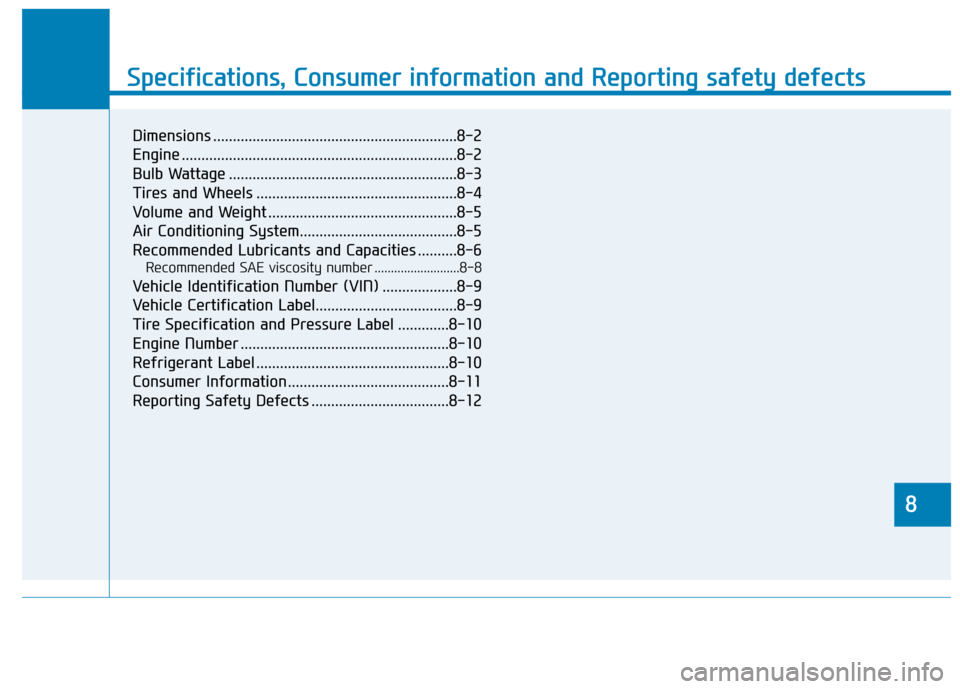
Dimensions ..............................................................8-2
Engine ......................................................................8-\
2
Bulb Wattage ..........................................................8-3
Tires and Wheels ...................................................8-4
Volume and Weight ................................................8-5
Air Conditioning System........................................8-5
Recommended Lubricants and Capacities ..........8-6
Recommended SAE viscosity number ..........................8-8
Vehicle Identification Number (VIN) ...................8-9
Vehicle Certification Label....................................8-9
Tire Specification and Pressure Label .............8-10
Engine Number .....................................................8-10
Refrigerant Label .................................................8-10
Consumer Information .........................................8-11
Reporting Safety Defects ...................................8-12
Page 428 of 442
8-6
Specifications, Consumer information and Reporting safety defects
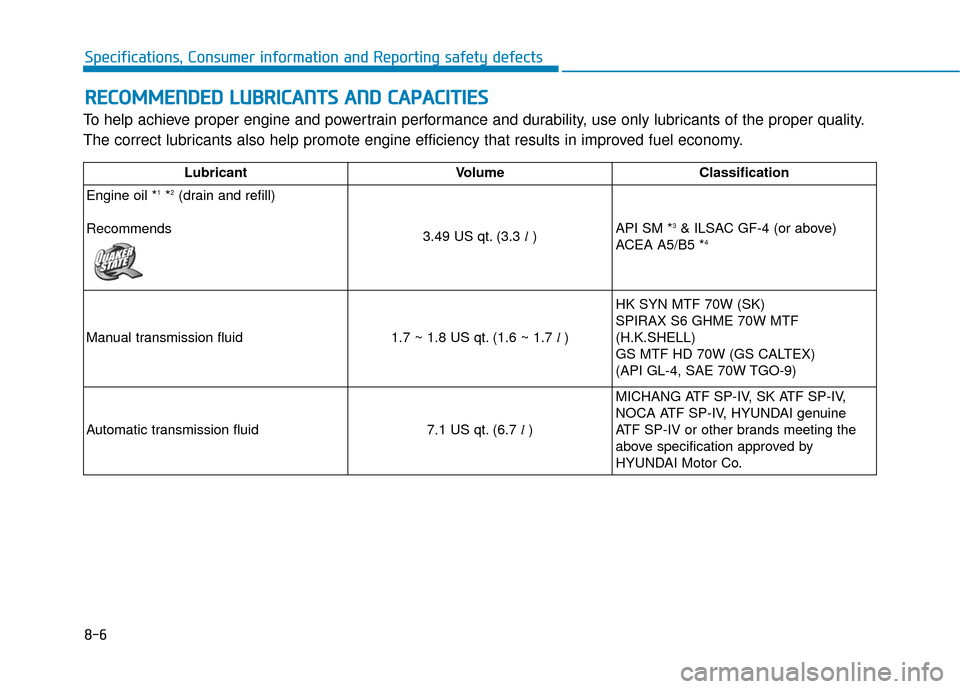
To help achieve proper engine and powertrain performance and durability, use only lubricants of the proper quality.
The correct lubricants also help promote engine efficiency that results in improved fuel economy.
R R E
EC
CO
O M
M M
ME
EN
N D
DE
ED
D
L
L U
U B
BR
RI
IC
C A
A N
N T
TS
S
A
A N
N D
D
C
C A
A P
PA
A C
CI
IT
T I
IE
E S
S
LubricantVolume Classification
Engine oil *
1*2(drain and refill)
Recommends
3.49 US qt. (3.3 l) API SM *3& ILSAC GF-4 (or above)
ACEA A5/B5 *4
Manual transmission fluid1.7 ~ 1.8 US qt. (1.6 ~ 1.7 l )HK SYN MTF 70W (SK)
SPIRAX S6 GHME 70W MTF
(H.K.SHELL)
GS MTF HD 70W (GS CALTEX)
(API GL-4, SAE 70W TGO-9)
Automatic transmission fluid7.1 US qt. (6.7
l )
MICHANG ATF SP-IV, SK ATF SP-IV,
NOCA ATF SP-IV, HYUNDAI genuine
ATF SP-IV or other brands meeting the
above specification approved by
HYUNDAI Motor Co.
Page 429 of 442
8-7
88
Specifications, Consumer information and Reporting safety defects
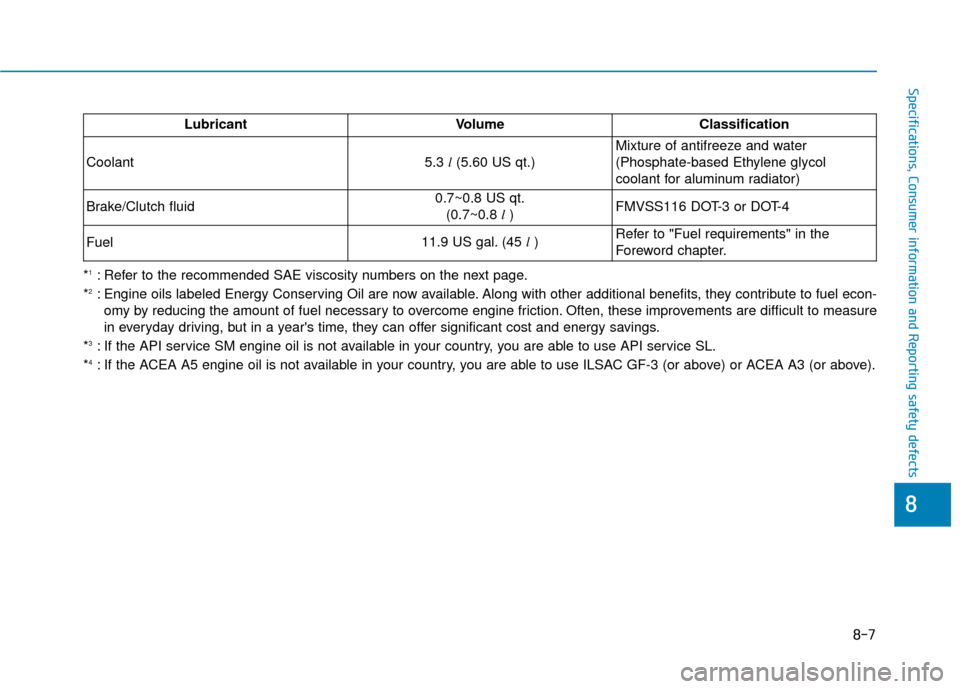
*1: Refer to the recommended SAE viscosity numbers on the next page.
*2: Engine oils labeled Energy Conserving Oil are now available. Along with other additional benefits, they contribute to fuel econ -
omy by reducing the amount of fuel necessary to overcome engine friction. Often, these improvements are difficult to measure
in everyday driving, but in a year's time, they can offer significant cost and energy savings.
*
3: If the API service SM engine oil is not available in your country, you are able to use API service SL.
*4: If the ACEA A5 engine oil is not available in your country, you are able to use ILSAC GF-3 (or above) or ACEA A3 (or above). Lubricant
Volume
Classification
Coolant
5.3 l(5.60 US qt.) Mixture of antifreeze and water
(Phosphate-based Ethylene glycol
coolant for aluminum radiator)
Brake/Clutch fluid
0.7~0.8 US qt. (0.7~0.8 l) FMVSS116 DOT-3 or DOT-4
Fuel11.9 US gal. (45 l
)Refer to "Fuel requirements" in the
Foreword chapter.
Page 430 of 442
8-8
Specifications, Consumer information and Reporting safety defects
Recommended SAE viscosity
number
Always be sure to clean the area
around any filler plug, drain
plug, or dipstick before check-
ing or draining any lubricant.
This is especially important in
dusty or sandy areas and when
the vehicle is used on unpaved
roads. Cleaning the plug and
dipstick areas will prevent dirt
and grit from entering the
engine and other mechanisms
that could be damaged.
CAUTION
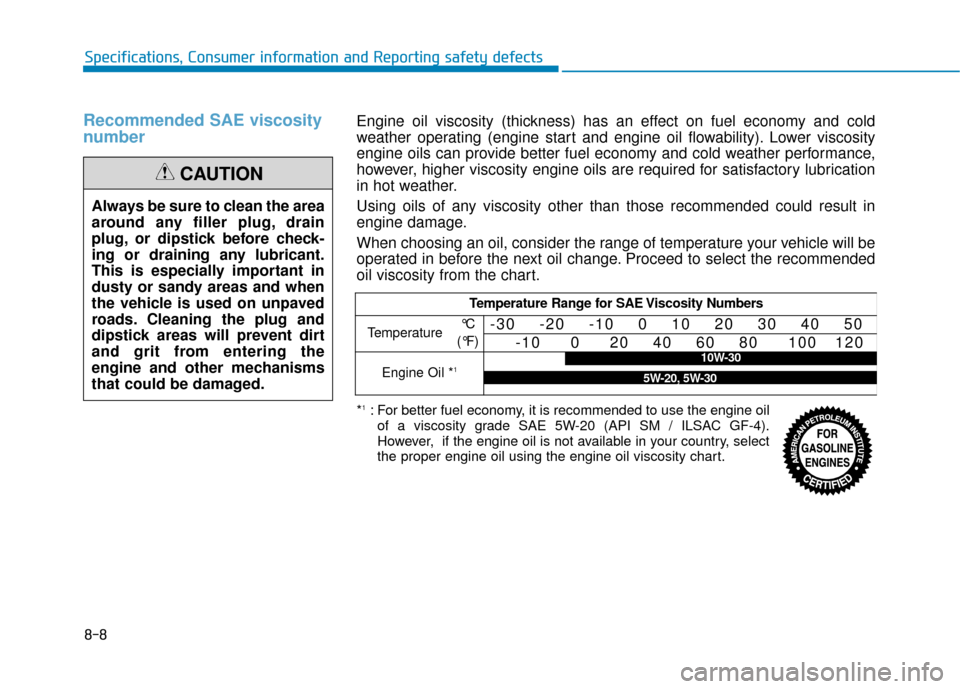
*1: For better fuel economy, it is recommended to use the engine oilof a viscosity grade SAE 5W-20 (API SM / ILSAC GF-4).
However, if the engine oil is not available in your country, select
the proper engine oil using the engine oil viscosity chart.
Engine oil viscosity (thickness) has an effect on fuel economy and cold
weather operating (engine start and engine oil flowability). Lower viscosity
engine oils can provide better fuel economy and cold weather performance,
however, higher viscosity engine oils are required for satisfactory lubrication
in hot weather.
Using oils of any viscosity other than those recommended could result in
engine damage.
When choosing an oil, consider the range of temperature your vehicle will be
operated in before the next oil change. Proceed to select the recommended
oil viscosity from the chart.
Temperature Range for SAE Viscosity Numbers
Temperature -30 -20 -10 0 10 20 30 40 50
-10 0 20 40 60 80 100 120
Engine Oil *110W-30
5W-20, 5W-30
°C
(°F)
Page 432 of 442
8-10
Specifications, Consumer information and Reporting safety defects
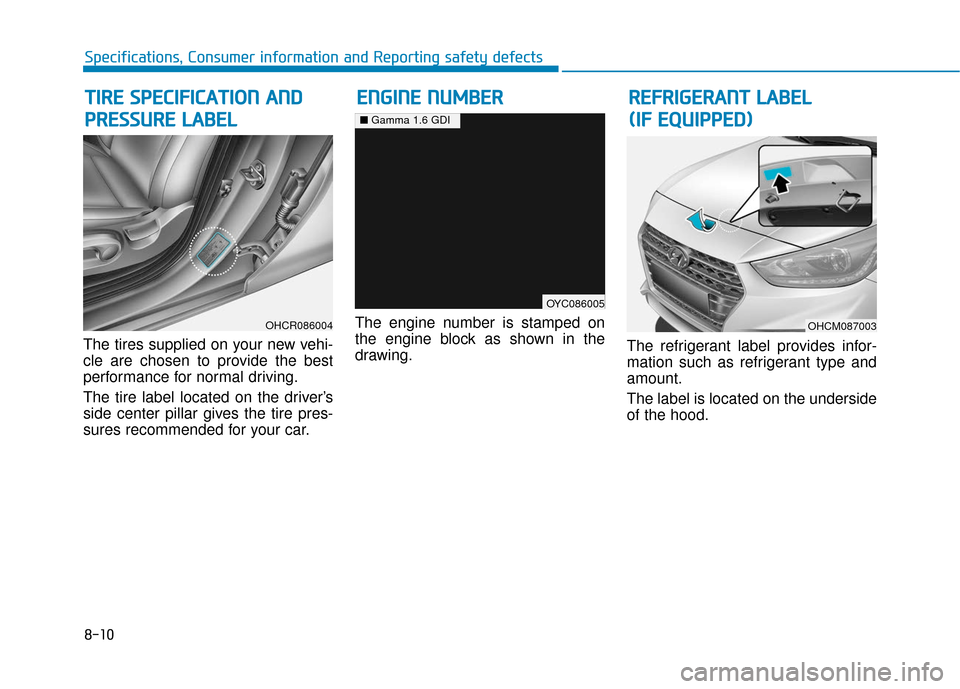
The tires supplied on your new vehi-
cle are chosen to provide the best
performance for normal driving.
The tire label located on the driver’s
side center pillar gives the tire pres-
sures recommended for your car. The engine number is stamped on
the engine block as shown in the
drawing.
The refrigerant label provides infor-
mation such as refrigerant type and
amount.
The label is located on the underside
of the hood.
E E
N
N G
GI
IN
N E
E
N
N U
U M
M B
BE
ER
R R
RE
EF
FR
R I
IG
G E
ER
R A
A N
N T
T
L
L A
A B
BE
EL
L
(
( I
IF
F
E
E Q
Q U
UI
IP
P P
PE
ED
D )
)
T
T
I
IR
R E
E
S
S P
P E
EC
CI
IF
F I
IC
C A
A T
TI
IO
O N
N
A
A N
N D
D
P
P R
R E
ES
SS
SU
U R
RE
E
L
L A
A B
BE
EL
L
OHCR086004OHCM087003
OYC086005
■ Gamma 1.6 GDI
Page 437 of 442
I-3
Brake/clutch fluid ...........................................................7-21Checking the Brake/Clutch Fluid Level.....................7-21
Braking system ...............................................................5-24 Anti-lock Brake System (ABS)..................................5-27
Disc Brakes Wear Indicator........................................5-25
Electronic Stability Control (ESC).............................5-28
Good Braking Practices..............................................5-33
Hill-Start Assist Control (HAC) .................................5-32
Parking Brake .............................................................5-25
Power Brakes..............................................................5-24
Vehicle Stability Management (VSM) .......................5-31
Bulb Wattage .....................................................................8-3\
California perchlorate notice ..........................................7-83
Child restraint system (CRS) ..........................................2-28 Children Always in the Rear ......................................2-28
Installing a Child Restraint System (CRS) ................2-31
Selecting a Child Restraint System (CRS).................2-29
Climate control air filter .................................................7-24 Filter Inspection..........................................................7-24
Consumer Information ....................................................8-11
Cruise control..................................................................5-46 Cruise Control operation ............................................5-46 Dimensions .......................................................................8\
-2
Door Locks .....................................................................3-1\
2
Auto Door Lock/Unlock Features ..............................3-16
Child-Protector Rear Door Locks ..............................3-16
Operating door locks from inside the vehicle ............3-13
Operating Door Locks from Outside the Vehicle ......3-12
Drive mode integrated control system ............................5-34
Driver Assist System.......................................................3-94 Rear View Monitor .....................................................3-94
Emission control system .................................................7-79 Crankcase Emission Control System .........................7-79
Evaporative Emission Control System Including Onboard Refueling Vapor Recovery (ORVR) ........7-79
Exhaust Emission Control System .............................7-80
Engine ........................................................................\
.......8-2
Engine Compartment.................................................1-6, 7-3
Engine coolant ................................................................7-18 Changing Engine Coolant ..........................................7-20
Checking the Engine Coolant Level ..........................7-18
Engine Number ...............................................................8-10
Engine oil ........................................................................\
7-16 Checking the Engine Oil and Filter ...........................7-17
Checking the Engine Oil Level ..................................7-16
I
Index
C
D
E
Page 438 of 442
I-4
Explanation of scheduled maintenance items.................7-13
Exterior Features .............................................................3-41Fuel Filler Door ..........................................................3-48
Hood ........................................................................\
...3-41
Smart Trunk ................................................................3-44
Trunk ........................................................................\
..3-42
Exterior Overview.............................................................1-2
Forward Collision-avoidance Assist (FCA) system-Radar Type ......................................................5-35
FCA Sensor ................................................................5-39
FCA Warning Message and System Control..............5-37
Limitations of the System ..........................................5-42
System Malfunction ...................................................5-40
System Setting and Activation ...................................5-35
Fuses ........................................................................\
.......7-46 Fuse/Relay Panel Description ....................................7-50
Instrument Panel Fuse Replacement ..........................7-47
Hazard Warning Flasher ...................................................6-2 If the Engine Overheats ....................................................6-6
If the Engine Will Not Start ..............................................6-3
If the Engine Doesn't Turn Over or Turns Over Slowly ....................................................6-3
If the Engine Turns Over Normally but Doesn't Start ..............................................................6-3
If You Have a Flat Tire ...................................................6-14 Changing Tires ...........................................................6-15
Jack and Tools ............................................................6-14
Ignition switch ..................................................................5-5 Engine Start/Stop Button ..............................................5-8
Key Ignition Switch .....................................................5-5
Important safety precautions.............................................2-2 Air Bag Hazards ...........................................................2-2
Always Wear Your Seat Belt ........................................2-2
Control Your Speed ......................................................2-2
Driver Distraction.........................................................2-2
Keep Your Vehicle in Safe Condition ..........................2-2
Restrain All Children....................................................2-2
In Case of an Emergency While Driving .........................6-2 If the Engine Stalls at a Crossroad or Crossing ...........6-2
If the Engine Stalls While Driving...............................6-2
If you Have a Flat Tire While Driving.........................6-3
Index
F
I
H