tire Hyundai Accent 2018 Repair Manual
[x] Cancel search | Manufacturer: HYUNDAI, Model Year: 2018, Model line: Accent, Model: Hyundai Accent 2018Pages: 442, PDF Size: 13.99 MB
Page 382 of 442
7-43
7
Maintenance
Traction
The friction between the tire and the
road surface. The amount of grip pro-
vided.
Tread
The portion of a tire that comes into
contact with the road.
Treadwear Indicators
Narrow bands, sometimes called
"wear bars", that show across the
tread of a tire when only 1/16 inch of
tread remains.
UTQGS
Uniform Tire Quality Grading
Standards is a tire information sys-
tem that provides consumers with
ratings for a tire's traction, tempera-
ture and treadwear. Ratings are
determined by tire manufacturers
using government testing proce-
dures. The ratings are molded into
the sidewall of the tire.
Vehicle Capacity Weight
The number of designated seating
positions multiplied by 150 lbs. (68
kg) plus the rated cargo and luggage
load.
Vehicle Maximum Load on theTire
Load on an individual tire due to curb
and accessory weight plus maximum
occupant and cargo weight.
Vehicle Normal Load on the Tire
Load on an individual tire that is
determined by distributing to each
axle its share of the curb weight,
accessory weight, and normal occu-
pant weight and dividing by 2.
Vehicle Placard
A label permanently attached to a
vehicle showing the original equip-
ment tire size and recommended
inflation pressure.
All Season Tires
HYUNDAI specifies all season tires
on some models to provide good
performance for use all year round,
including snowy and icy road condi-
tions. All season tires are identified
by ALL SEASON and/or M+S (Mud
and Snow) on the tire sidewall. Snow
tires have better snow traction than
all season tires and may be more
appropriate in some areas.
Summer Tires
HYUNDAI specifies summer tires on
some models to provide superior
performance on dry roads. Summer
tire performance is substantially
reduced in snow and ice. Summer
tires do not have the tire traction rat-
ing M+S (Mud and Snow) on the tire
side wall. If you plan to operate your
vehicle in snowy or icy conditions,
HYUNDAI recommends the use of
snow tires or all season tires on all
four wheels.
Page 383 of 442
7-44
Maintenance
Snow Tires
If you equip your car with snow tires,
they should be the same size and
have the same load capacity as the
original tires. Snow tires should be
installed on all four wheels; other-
wise, poor handling may result. Snow
tires should carry 4 psi (28 kPa)
more air pressure than the pressure
recommended for the standard tires
on the tire label on the driver’s side of
the center pillar, or up to the maxi-
mum pressure shown on the tire
sidewall, whichever is less. Do not
drive faster than 75 mph (120 km/h)
when your vehicle is equipped with
snow tires.
Radial-Ply Tires
Radial-ply tires provide improved
tread life, road hazard resistance and
smoother high speed ride. The radi-
al-ply tires used on this vehicle are of
belted construction, and are selected
to complement the ride and handling
characteristics of your vehicle.Radial-ply tires have the same load
carrying capacity, as bias-ply or bias
belted tires of the same size, and use
the same recommended inflation
pressure. Mixing of radial-ply tires
with bias-ply or bias belted tires is
not recommended. Any combina-
tions of radial-ply and bias-ply or bias
belted tires when used on the same
vehicle will seriously deteriorate
vehicle handling. The best rule to fol-
low is: Identical pairs of radial-ply
tires should always be used as a set
for the front tires and a set for the
rear tires.
Longer wearing tires can be more
susceptible to irregular tread wear. It
is very important to follow the tire
rotation interval in this chapter to
achieve the tread life potential of
these tires. Cuts and punctures in
radial-ply tires are repairable only in
the tread area, because of sidewall
flexing. Consult your tire dealer for
radial-ply tire repairs.
Low Aspect Ratio Tires
The aspect ratio is lower than 50 on
low aspect ratio tires.
Because low aspect ratio tires are
optimized for handling and braking,
their sidewall is a little stiffer than a
standard tire. Also low aspect ratio
tires tend to be wider and conse-
quently have a greater contact patch
with the road surface. In some
instances they may generate more
road noise compared with standard
tires.
Do not mix bias ply and radial
ply tires under any circum-
stances. This may cause unusu-
al handling characteristics that
may cause loss of vehicle con-
trol resulting in an accident.
WARNING
Page 384 of 442
7-45
7
Maintenance
Because the sidewall of a low
aspect ratio tire is shorter than
a standard tire, the rim of the
wheel and the tire itself is more
easily susceptible to damage.
Use caution when driving and
follow the guidelines below to
help minimize damage to the
wheel and tire:
- When driving on a rough roador off road, drive cautiously
because tires and wheels may
be damaged. And after driving,
inspect tires and wheels.
- When passing over a pothole, speed bump, manhole, or curb
stone, drive slowly so that the
tires and wheels are not dam-
aged.
- If the tire is subjected to a severe impact, have the tire
and wheel inspected by an
authorized HYUNDAI dealer.
- Inspect the tire condition and pressure every 1,800 miles
(3,000km).
CAUTION
It is not easy to recognize tire
damage with your own eyes.
But if there is the slightest
hint of tire damage, have the
tire checked or replaced
because the tire damage may
cause air leakage from the
tire.
If the tire is damaged by driv-
ing on a rough road, off road,
pothole, manhole, or curb
stone, it will not be covered by
the warranty.
CAUTION
Page 423 of 442
888
Specifications & Consumer information
8
Specifications, Consumer information and Reporting safety defects
8
Dimensions ..............................................................8-2
Engine ......................................................................8-\
2
Bulb Wattage ..........................................................8-3
Tires and Wheels ...................................................8-4
Volume and Weight ................................................8-5
Air Conditioning System........................................8-5
Recommended Lubricants and Capacities ..........8-6
Recommended SAE viscosity number ..........................8-8
Vehicle Identification Number (VIN) ...................8-9
Vehicle Certification Label....................................8-9
Tire Specification and Pressure Label .............8-10
Engine Number .....................................................8-10
Refrigerant Label .................................................8-10
Consumer Information .........................................8-11
Reporting Safety Defects ...................................8-12
Page 426 of 442
8-4
Specifications, Consumer information and Reporting safety defects
T
TI
IR
R E
ES
S
A
A N
N D
D
W
W H
HE
EE
EL
LS
S
When replacing tires, use the same size originally supplied with the vehicle.
Using tires of a different size can damage the related parts or not work properly.
CAUTION
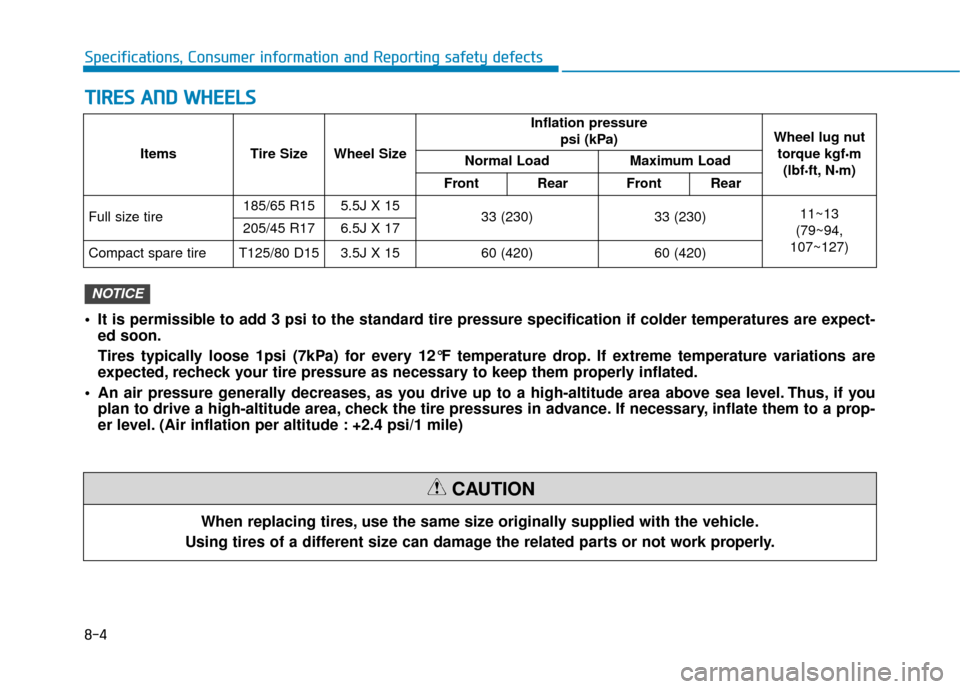
Items Tire SizeWheel Size
Inflation pressure psi (kPa)Wheel lug nuttorque kgf
•m
(lbf
ft, Nm)Normal LoadMaximum Load
FrontRearFrontRear
Full size tire185/65 R155.5J X 1533 (230)33 (230)11~13
(79~94,
107~127)205/45 R176.5J X 17
Compact spare tireT125/80 D15 3.5J X 1560 (420)60 (420)
It is permissible to add 3 psi to the standard tire pressure specification if colder temperatures are expect- ed soon.
Tires typically loose 1psi (7kPa) for every 12°F temperature drop. If extreme temperature variations are
expected, recheck your tire pressure as necessary to keep them properly inflated.
An air pressure generally decreases, as you drive up to a high-altitude area above sea level. Thus, if you plan to drive a high-altitude area, check the tire pressures in advance. If necessary, inflate them to a prop-
er level. (Air inflation per altitude : +2.4 psi/1 mile)
NOTICE
Page 432 of 442
8-10
Specifications, Consumer information and Reporting safety defects
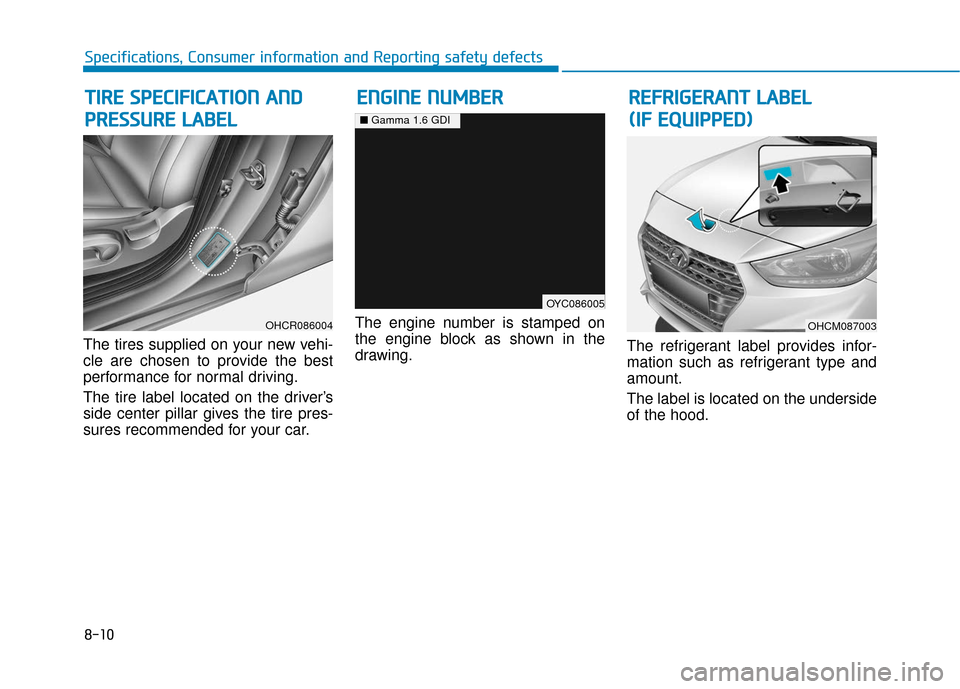
The tires supplied on your new vehi-
cle are chosen to provide the best
performance for normal driving.
The tire label located on the driver’s
side center pillar gives the tire pres-
sures recommended for your car. The engine number is stamped on
the engine block as shown in the
drawing.
The refrigerant label provides infor-
mation such as refrigerant type and
amount.
The label is located on the underside
of the hood.
E E
N
N G
GI
IN
N E
E
N
N U
U M
M B
BE
ER
R R
RE
EF
FR
R I
IG
G E
ER
R A
A N
N T
T
L
L A
A B
BE
EL
L
(
( I
IF
F
E
E Q
Q U
UI
IP
P P
PE
ED
D )
)
T
T
I
IR
R E
E
S
S P
P E
EC
CI
IF
F I
IC
C A
A T
TI
IO
O N
N
A
A N
N D
D
P
P R
R E
ES
SS
SU
U R
RE
E
L
L A
A B
BE
EL
L
OHCR086004OHCM087003
OYC086005
■ Gamma 1.6 GDI
Page 438 of 442
I-4
Explanation of scheduled maintenance items.................7-13
Exterior Features .............................................................3-41Fuel Filler Door ..........................................................3-48
Hood ........................................................................\
...3-41
Smart Trunk ................................................................3-44
Trunk ........................................................................\
..3-42
Exterior Overview.............................................................1-2
Forward Collision-avoidance Assist (FCA) system-Radar Type ......................................................5-35
FCA Sensor ................................................................5-39
FCA Warning Message and System Control..............5-37
Limitations of the System ..........................................5-42
System Malfunction ...................................................5-40
System Setting and Activation ...................................5-35
Fuses ........................................................................\
.......7-46 Fuse/Relay Panel Description ....................................7-50
Instrument Panel Fuse Replacement ..........................7-47
Hazard Warning Flasher ...................................................6-2 If the Engine Overheats ....................................................6-6
If the Engine Will Not Start ..............................................6-3
If the Engine Doesn't Turn Over or Turns Over Slowly ....................................................6-3
If the Engine Turns Over Normally but Doesn't Start ..............................................................6-3
If You Have a Flat Tire ...................................................6-14 Changing Tires ...........................................................6-15
Jack and Tools ............................................................6-14
Ignition switch ..................................................................5-5 Engine Start/Stop Button ..............................................5-8
Key Ignition Switch .....................................................5-5
Important safety precautions.............................................2-2 Air Bag Hazards ...........................................................2-2
Always Wear Your Seat Belt ........................................2-2
Control Your Speed ......................................................2-2
Driver Distraction.........................................................2-2
Keep Your Vehicle in Safe Condition ..........................2-2
Restrain All Children....................................................2-2
In Case of an Emergency While Driving .........................6-2 If the Engine Stalls at a Crossroad or Crossing ...........6-2
If the Engine Stalls While Driving...............................6-2
If you Have a Flat Tire While Driving.........................6-3
Index
F
I
H
Page 441 of 442
I-7
Special driving conditions ..............................................5-51Driving at Night .........................................................5-52
Driving in Flooded Areas ...........................................5-53
Driving in the Rain .....................................................5-52
Hazardous Driving Conditions ...................................5-51
Highway Driving ........................................................5-53
Rocking the Vehicle ...................................................5-51
Smooth Cornering ......................................................5-52
Steering Wheel ................................................................3-17 Electric Power Steering (EPS) ...................................3-17
Heated steering wheel ................................................3-19
Horn ........................................................................\
....3-19
Tilt Steering / Telescope Steering ..............................3-18
Storage Compartment ...................................................3-120 Center Console Storage ............................................3-120
Glove Box ................................................................3-121
Multi Box .................................................................3-122
Sliding Armrest ........................................................3-120
Sunglass Holder........................................................3-121
Sunroof........................................................................\
....3-36 Resetting the sunroof..................................................3-38
Sliding the sunroof .....................................................3-37
Sunroof opening and closing......................................3-37
Sunshade.....................................................................3-3\
8
Tilting the sunroof ......................................................3-37 Theft-Alarm System .......................................................3-17
Tire Pressure Monitoring System (TPMS) .......................6-8
Changing a Tire with TPMS ......................................6-12
Check Tire Pressure......................................................6-8
Low Tire Pressure LCD Display with Position Indicator ....................................................6-10
Low Tire Pressure Telltale..........................................6-10
Tire Pressure Monitoring System.................................6-9
TPMS Malfunction Indicator .....................................6-11
Tire Specification and Pressure Label ............................8-10
Tires and wheels ......................................................7-31, 8-4 All Season Tires .........................................................7-43
Check Tire Inflation Pressure .....................................7-33
Low Aspect Ratio Tires ..............................................7-44
Radial-Ply Tires ..........................................................7-44
Recommended Cold Tire Inflation Pressures.............7-32
Snow Tires ..................................................................7-44
Summer Tires .............................................................7-43
Tire Care .....................................................................7-3\
1
Tire Maintenance ........................................................7-36
Tire Replacement........................................................7\
-35
Tire Rotation...............................................................7-33
Tire Sidewall Labeling ...............................................7-36
I
Index
T
Page 442 of 442
I-8
Tire Terminology and Definitions ..............................7-40
Tire Traction ...............................................................7-36
Wheel Alignment and Tire Balance ...........................7-34
Wheel Replacement....................................................7-36
Towing ........................................................................\
....6-21 Emergency Towing.....................................................6-23
Removable Towing Hook...........................................6-22
Tie-down Hook...........................................................6-24
Towing Service ...........................................................6-21
Trailer Towing.................................................................5-63
Trip Computer .................................................................3-77 Type A ........................................................................\
3-77
Type B ........................................................................\
3-81
Vehicle Certification Label ...............................................8-9
Vehicle Identification Number (VIN) ...............................8-9
Vehicle load limit ............................................................5-58 Tire Loading Information Label.................................5-59
Volume and Weight ...........................................................8-5 Washer fluid ....................................................................7-22\
Checking the Washer Fluid Level ..............................7-22
Windows ........................................................................\
.3-32 Manual windows ........................................................3-35
Power Windows..........................................................3-32
Windshield Defrosting and Defogging .........................3-115 Auto Defogging System (Only for Automatic Climate Control System) .....3-118
Rear Window Defroster ............................................3-119
Winter driving .................................................................5-54 Snow or Icy Conditions..............................................5-54
Winter Precautions .....................................................5-56
Wiper blades ...................................................................7-26 Blade Inspection .........................................................7-26
Blade Replacement .....................................................7-26
Wipers and Washers ........................................................3-92 Windshield Washers ...................................................3-93
Windshield Wipers .....................................................3-92
Index
V
W