Seat Hyundai Accent 2018 Manual Online
[x] Cancel search | Manufacturer: HYUNDAI, Model Year: 2018, Model line: Accent, Model: Hyundai Accent 2018Pages: 442, PDF Size: 13.99 MB
Page 382 of 442
7-43
7
Maintenance
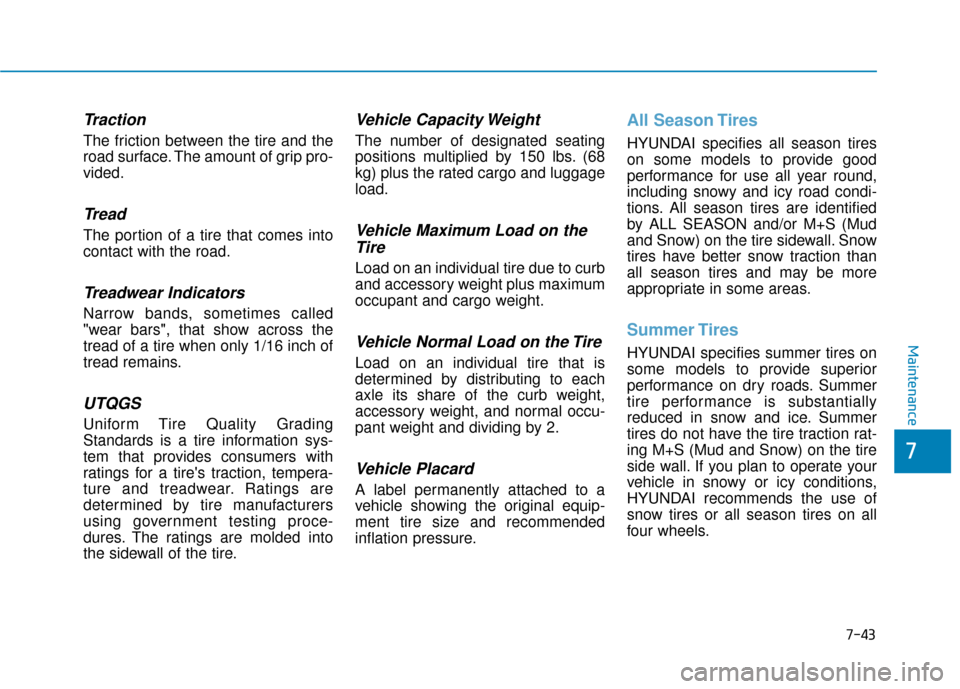
Traction
The friction between the tire and the
road surface. The amount of grip pro-
vided.
Tread
The portion of a tire that comes into
contact with the road.
Treadwear Indicators
Narrow bands, sometimes called
"wear bars", that show across the
tread of a tire when only 1/16 inch of
tread remains.
UTQGS
Uniform Tire Quality Grading
Standards is a tire information sys-
tem that provides consumers with
ratings for a tire's traction, tempera-
ture and treadwear. Ratings are
determined by tire manufacturers
using government testing proce-
dures. The ratings are molded into
the sidewall of the tire.
Vehicle Capacity Weight
The number of designated seating
positions multiplied by 150 lbs. (68
kg) plus the rated cargo and luggage
load.
Vehicle Maximum Load on theTire
Load on an individual tire due to curb
and accessory weight plus maximum
occupant and cargo weight.
Vehicle Normal Load on the Tire
Load on an individual tire that is
determined by distributing to each
axle its share of the curb weight,
accessory weight, and normal occu-
pant weight and dividing by 2.
Vehicle Placard
A label permanently attached to a
vehicle showing the original equip-
ment tire size and recommended
inflation pressure.
All Season Tires
HYUNDAI specifies all season tires
on some models to provide good
performance for use all year round,
including snowy and icy road condi-
tions. All season tires are identified
by ALL SEASON and/or M+S (Mud
and Snow) on the tire sidewall. Snow
tires have better snow traction than
all season tires and may be more
appropriate in some areas.
Summer Tires
HYUNDAI specifies summer tires on
some models to provide superior
performance on dry roads. Summer
tire performance is substantially
reduced in snow and ice. Summer
tires do not have the tire traction rat-
ing M+S (Mud and Snow) on the tire
side wall. If you plan to operate your
vehicle in snowy or icy conditions,
HYUNDAI recommends the use of
snow tires or all season tires on all
four wheels.
Page 390 of 442
7-51
7
Maintenance
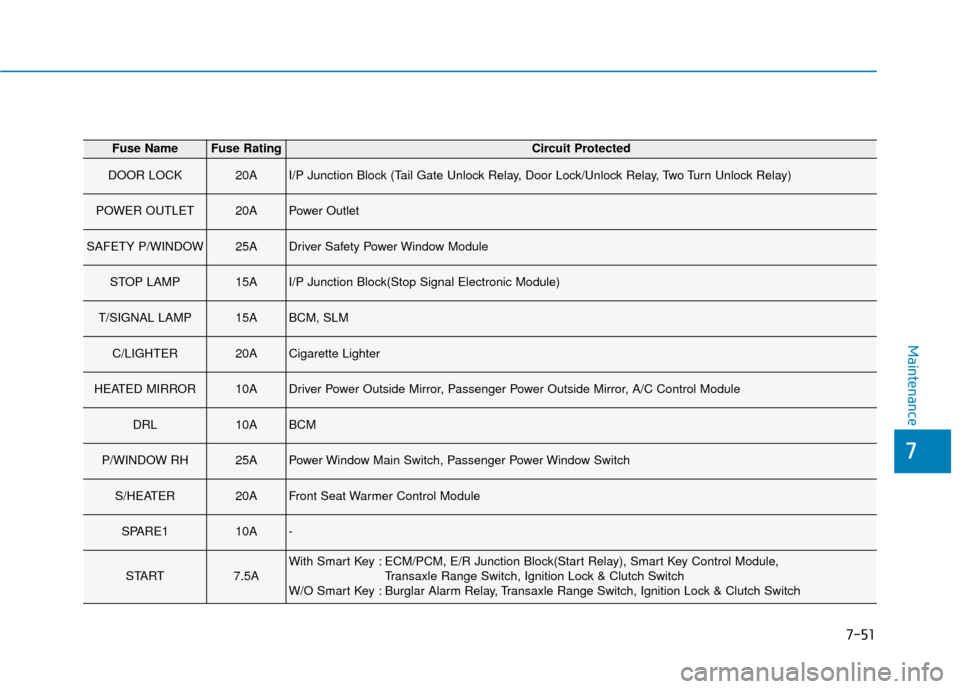
Fuse NameFuse RatingCircuit Protected
DOOR LOCK20AI/P Junction Block (Tail Gate Unlock Relay, Door Lock/Unlock Relay, Two Turn Unlock Relay)
POWER OUTLET20APower Outlet
SAFETY P/WINDOW25ADriver Safety Power Window Module
STOP LAMP15AI/P Junction Block(Stop Signal Electronic Module)
T/SIGNAL LAMP15ABCM, SLM
C/LIGHTER20ACigarette Lighter
HEATED MIRROR10ADriver Power Outside Mirror, Passenger Power Outside Mirror, A/C Control Module
DRL10ABCM
P/WINDOW RH25APower Window Main Switch, Passenger Power Window Switch
S/HEATER20AFront Seat Warmer Control Module
SPARE110A-
START7.5AWith Smart Key : ECM/PCM, E/R Junction Block(Start Relay), Smart Key Control Module, Transaxle Range Switch, Ignition Lock & Clutch Switch
W/O Smart Key : Burglar Alarm Relay, Transaxle Range Switch, Ignition Lock & Clutch Switch
Page 391 of 442
7-52
Maintenance
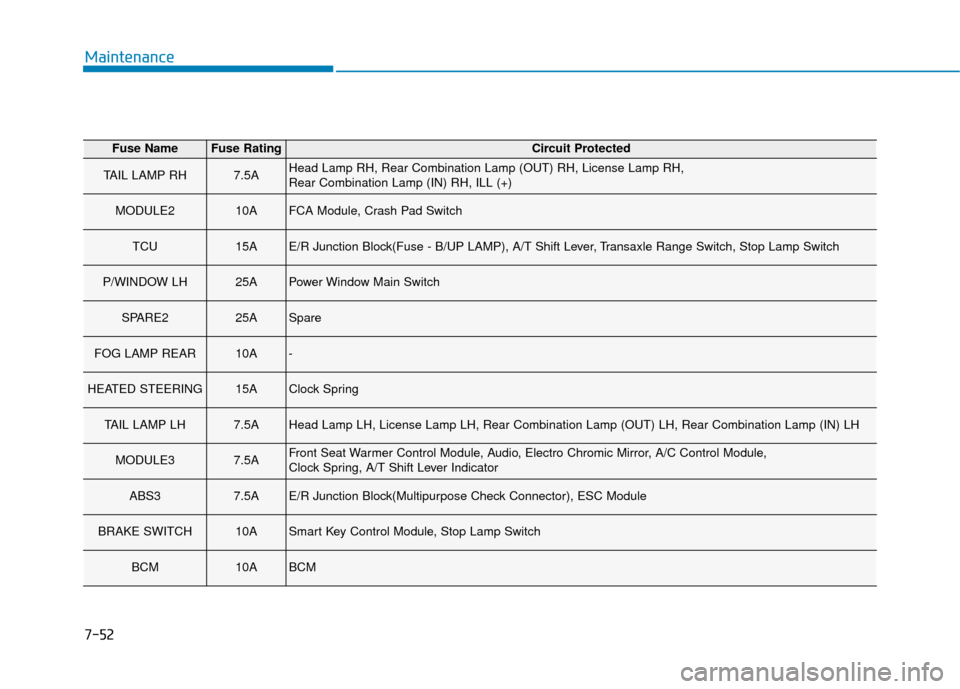
Fuse NameFuse RatingCircuit Protected
TAIL LAMP RH7.5AHead Lamp RH, Rear Combination Lamp (OUT) RH, License Lamp RH,
Rear Combination Lamp (IN) RH, ILL (+)
MODULE210AFCA Module, Crash Pad Switch
TCU15AE/R Junction Block(Fuse - B/UP LAMP), A/T Shift Lever, Transaxle Range Switch, Stop Lamp Switch
P/WINDOW LH25APower Window Main Switch
SPARE225ASpare
FOG LAMP REAR10A-
HEATED STEERING15AClock Spring
TAIL LAMP LH7.5AHead Lamp LH, License Lamp LH, Rear Combination Lamp (OUT) LH, Rear Co\
mbination Lamp (IN) LH
MODULE37.5AFront Seat Warmer Control Module, Audio, Electro Chromic Mirror, A/C Control Module,
Clock Spring, A/T Shift Lever Indicator
ABS37.5AE/R Junction Block(Multipurpose Check Connector), ESC Module
BRAKE SWITCH10ASmart Key Control Module, Stop Lamp Switch
BCM10ABCM
Page 392 of 442

7-53
7
Maintenance
Fuse NameFuse RatingCircuit Protected
FOG LAMP FRONT15AI/P Junction Block(Front Fog Lamp Relay)
A/C17.5AE/R Junction Block(Blower Relay), A/C Control Module
MODULE510ASunroof Motor, Front Seat Warmer Control Module
MODULE710ATPMS Unit
ECU10AECM/PCM, Immobilizer Module, Smart Key Control Module
SUNROOF15ASunroof Motor
IMMO.10AImmobilizer Module
MODULE610AKey Solenoid
SPARE410ASpare
MODULE47.5ASLM, BCM, Smart Key Control Module
SPARE510ASpare
AIR BAG10ASRS Control Module, Occupant Detection Sensor
Page 415 of 442
7-76
Maintenance
vehicle, pay particular attention to
the components under the fenders
and other areas that are hidden
from view. Do a thorough job; just
dampening the accumulated mud
rather than washing it away will
accelerate corrosion rather than
prevent it. Water under high pres-
sure and steam are particularly
effective in removing accumulated
mud and corrosive materials.
When cleaning lower door panels, rocker panels and frame members,
be sure that drain holes are kept
open so that moisture can escape
and not be trapped inside to accel-
erate corrosion.
Keep your garage dry
Don't park your vehicle in a damp,
poorly ventilated garage. This cre-
ates a favorable environment for cor-
rosion. This is particularly true if you
wash your vehicle in the garage or
drive it into the garage when it is still
wet or covered with snow, ice or
mud. Even a heated garage can con-
tribute to corrosion unless it is well
ventilated so moisture is dispersed.
Keep paint and trim in good condition
Scratches or chips in the finish
should be covered with "touch-up"
paint as soon as possible to reduce
the possibility of corrosion. If bare
metal is showing through, the atten-
tion of a qualified body and paint
shop is recommended.
Bird droppings are highly corrosive
and may damage painted surfaces in
just a few hours. Always remove bird
droppings as soon as possible.
Interior Care
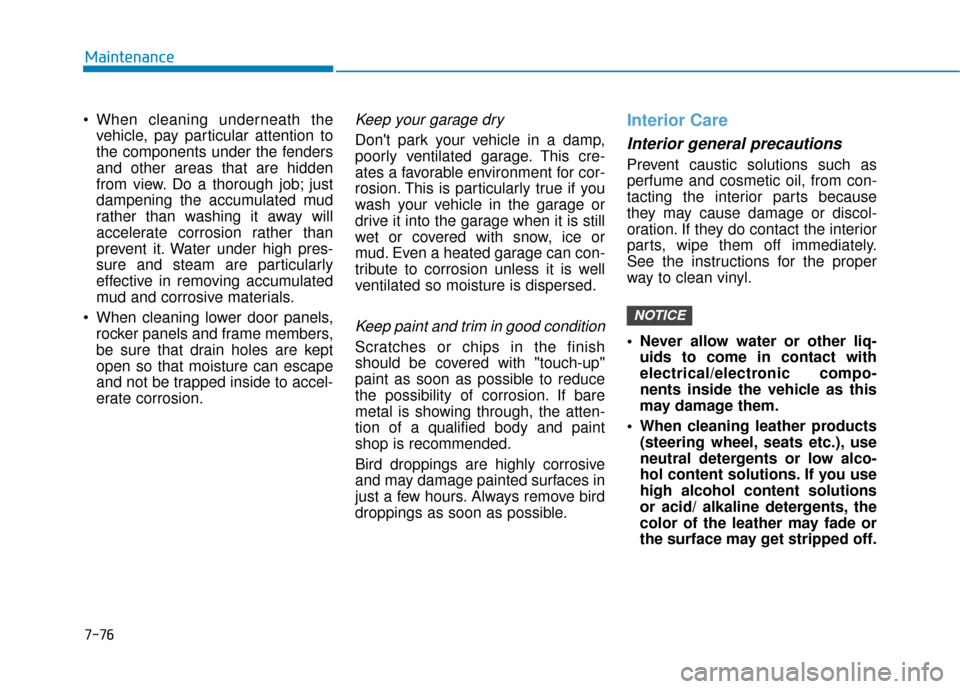
Interior general precautions
Prevent caustic solutions such as
perfume and cosmetic oil, from con-
tacting the interior parts because
they may cause damage or discol-
oration. If they do contact the interior
parts, wipe them off immediately.
See the instructions for the proper
way to clean vinyl.
Never allow water or other liq-uids to come in contact with
electrical/electronic compo-
nents inside the vehicle as this
may damage them.
When cleaning leather products (steering wheel, seats etc.), use
neutral detergents or low alco-
hol content solutions. If you use
high alcohol content solutions
or acid/ alkaline detergents, the
color of the leather may fade or
the surface may get stripped off.
NOTICE
Page 416 of 442
7-77
7
Maintenance
Cleaning the upholstery andinterior trim
Vinyl (if equipped)
Remove dust and loose dirt from
vinyl with a whisk broom or vacuum
cleaner. Clean vinyl surfaces with a
vinyl cleaner.
Fabric (if equipped)
Remove dust and loose dirt from fab-
ric with a whisk broom or vacuum
cleaner. Clean with a mild soap solu-
tion recommended for upholstery or
carpets. Remove fresh spots imme-
diately with a fabric spot cleaner. If
fresh spots do not receive immediate
attention, the fabric can be stained
and its color can be affected. Also, its
fire-resistant properties can be
reduced if the material is not proper-
ly maintained.
Using anything but recommended
cleaners and procedures may
affect the fabric's appearance and
fire-resistant properties.
Leather (if equipped)
Features of seat leather
- Leather is made from the outerskin of an animal, which goes
through a special process to be
available for use. Since it is a nat-
ural product, each part differs in
thickness or density.
Wrinkles may appear as a natural result of stretching and shrinking
depending on the temperature
and humidity.
- The seat is made of stretchable fabric to improve comfort.
- The parts contacting the body are curved and the side supporting
area is high which provides driv-
ing comfort and stability.
- Wrinkles may appear naturally from usage. It is not a fault of the
products.
NOTICE
Wrinkles or abrasions which
appear naturally from usage
are not covered by warranty.
Belts with metallic acces-
sories, zippers or keys inside
the back pocket may damage
the seat fabric.
Make sure not to wet the seat.
It may change the nature of
natural leather.
Jeans or clothes which could
bleach may contaminate the
surface of the seat covering
fabric.
CAUTION
Page 417 of 442
7-78
Maintenance
Caring for the leather seats - Vacuum the seat periodically toremove dust and sand on the seat.
It will prevent abrasion or damage
of the leather and maintain its qual-
ity.
- Wipe the natural leather seat cover often with dry or soft cloth.
- Use of proper leather protector may prevent abrasion of the cover
and helps maintain the color. Be
sure to read the instructions and
consult a specialist when using
leather coating or protective agent.
- Light colored (beige, cream beige) leather is easily contaminated and
the stain is noticeable. Clean the
seats frequently.
- Avoid wiping with wet cloth. It may cause the surface to crack. Cleaning the leather seats
- Remove all contaminations instant-ly. Refer to instructions below for
removal of each contaminant.
- Cosmetic products (sunscreen, foundation, etc.)
Apply cleansing cream on a cloth
and wipe the contaminated spot.
Wipe off the cream with a wet cloth
and remove water with a dry cloth.
- Beverages (coffee, soft drink, etc.) Apply a small amount of neutral
detergent and wipe until contami-
nations do not smear.
- Oil Remove oil instantly with
absorbable cloth and wipe with
stain remover used only for natural
leather.
- Chewing gum Harden the gum with ice and
remove gradually.
Cleaning the seat belt webbing
Clean the belt webbing with any mild
soap solution recommended for
cleaning upholstery or carpet. Follow
the instructions provided with the
soap. Do not bleach or re-dye the
webbing because this may weaken
the seat belt.
Cleaning the interior windowglass
If the interior glass surfaces of the
vehicle become fogged (that is, cov-
ered with an oily, greasy or waxy
film), they should be cleaned with
glass cleaner. Follow the directions
on the glass cleaner container.
Do not scrape or scratch the
inside of the rear window. This
may result in damage to the rear
window defroster grid.
NOTICE
Page 422 of 442
7-83
7
Maintenance
C
CA
A L
LI
IF
F O
O R
RN
N I
IA
A
P
P E
ER
R C
CH
H L
LO
O R
RA
A T
TE
E
N
N O
O T
TI
IC
C E
E
Perchlorate Material-special handling may apply, See: www.dtsc.ca.gov/hazardouswaste/perchlorate.
Notice to California Vehicle Dismantlers:
Perchlorate containing materials, such as air bag inflators, seatbelt pretensioners and keyless remote entry batteries,
must be disposed of according to Title 22 California Code of Regulations Section 67384.10 (a).
Page 431 of 442
8-9
88
Specifications, Consumer information and Reporting safety defects
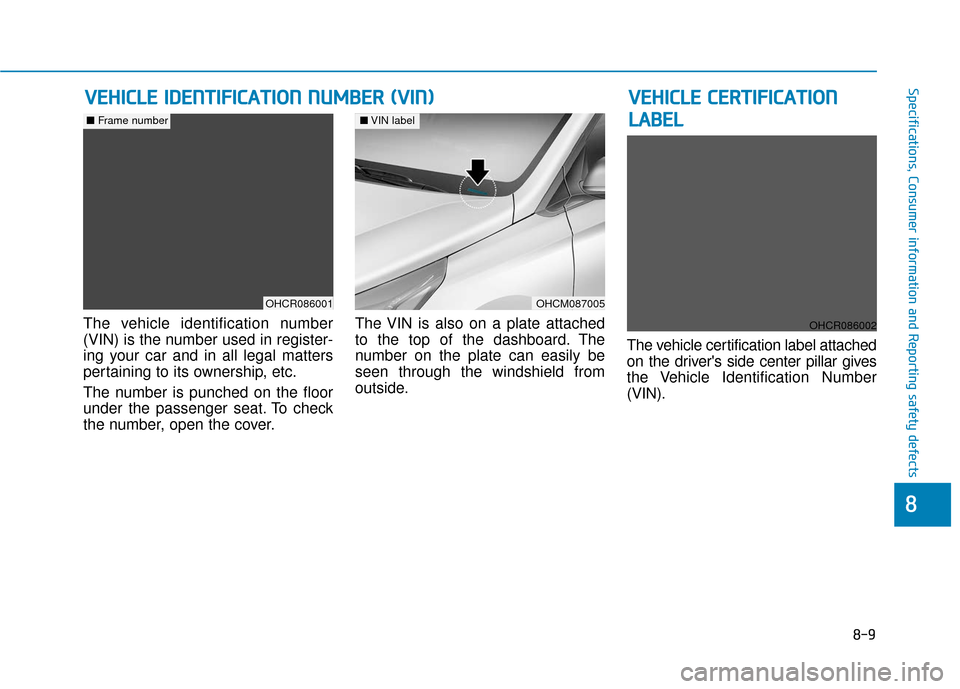
The vehicle identification number
(VIN) is the number used in register-
ing your car and in all legal matters
pertaining to its ownership, etc.
The number is punched on the floor
under the passenger seat. To check
the number, open the cover.The VIN is also on a plate attached
to the top of the dashboard. The
number on the plate can easily be
seen through the windshield from
outside.
The vehicle certification label attached
on the driver's side center pillar gives
the Vehicle Identification Number
(VIN).
V V
E
EH
H I
IC
C L
LE
E
I
ID
D E
EN
N T
TI
IF
F I
IC
C A
A T
TI
IO
O N
N
N
N U
U M
M B
BE
ER
R
(
( V
V I
IN
N )
)
OHCM087005
■ VIN label
OHCR086001
■ Frame number
OHCR086002
V
VE
EH
H I
IC
C L
LE
E
C
C E
E R
R T
TI
IF
F I
IC
C A
A T
TI
IO
O N
N
L
L A
A B
BE
EL
L
Page 438 of 442
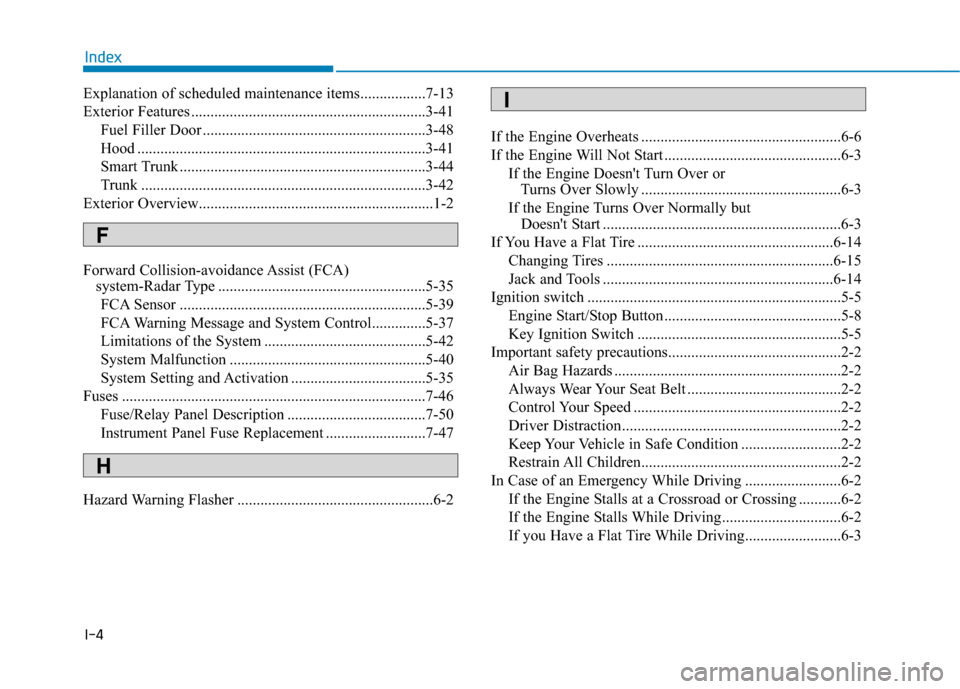
I-4
Explanation of scheduled maintenance items.................7-13
Exterior Features .............................................................3-41Fuel Filler Door ..........................................................3-48
Hood ........................................................................\
...3-41
Smart Trunk ................................................................3-44
Trunk ........................................................................\
..3-42
Exterior Overview.............................................................1-2
Forward Collision-avoidance Assist (FCA) system-Radar Type ......................................................5-35
FCA Sensor ................................................................5-39
FCA Warning Message and System Control..............5-37
Limitations of the System ..........................................5-42
System Malfunction ...................................................5-40
System Setting and Activation ...................................5-35
Fuses ........................................................................\
.......7-46 Fuse/Relay Panel Description ....................................7-50
Instrument Panel Fuse Replacement ..........................7-47
Hazard Warning Flasher ...................................................6-2 If the Engine Overheats ....................................................6-6
If the Engine Will Not Start ..............................................6-3
If the Engine Doesn't Turn Over or Turns Over Slowly ....................................................6-3
If the Engine Turns Over Normally but Doesn't Start ..............................................................6-3
If You Have a Flat Tire ...................................................6-14 Changing Tires ...........................................................6-15
Jack and Tools ............................................................6-14
Ignition switch ..................................................................5-5 Engine Start/Stop Button ..............................................5-8
Key Ignition Switch .....................................................5-5
Important safety precautions.............................................2-2 Air Bag Hazards ...........................................................2-2
Always Wear Your Seat Belt ........................................2-2
Control Your Speed ......................................................2-2
Driver Distraction.........................................................2-2
Keep Your Vehicle in Safe Condition ..........................2-2
Restrain All Children....................................................2-2
In Case of an Emergency While Driving .........................6-2 If the Engine Stalls at a Crossroad or Crossing ...........6-2
If the Engine Stalls While Driving...............................6-2
If you Have a Flat Tire While Driving.........................6-3
Index
F
I
H