height Hyundai Atos 2002 User Guide
[x] Cancel search | Manufacturer: HYUNDAI, Model Year: 2002, Model line: Atos, Model: Hyundai Atos 2002Pages: 249, PDF Size: 3.11 MB
Page 189 of 249
FEATURES OF YOUR HYUNDAI
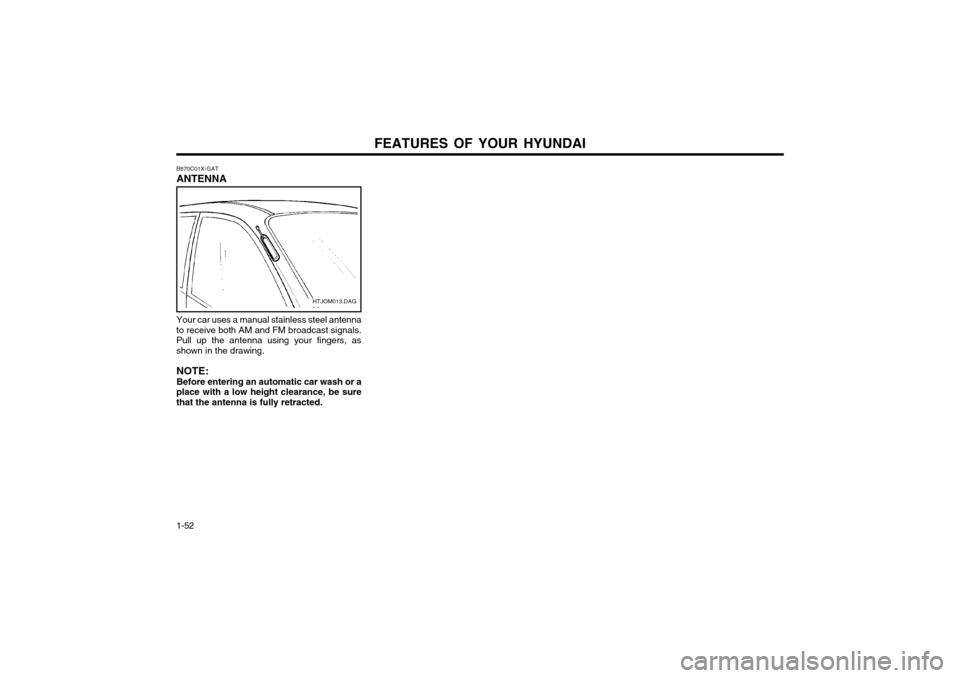
1-52 B870C01X-GAT ANTENNA
Your car uses a manual stainless steel antenna
to receive both AM and FM broadcast signals. Pull up the antenna using your fingers, as
shown in the drawing.
NOTE: Before entering an automatic car wash or a
place with a low height clearance, be sure that the antenna is fully retracted.
HTJOM013.DAG
Page 197 of 249
DRIVING YOUR HYUNDAI
2- 8 in emergency situations or on slick roads, ABS will increase vehicle control during braking. NOTE: During ABS operation, a slight pulsation may be felt in the brake pedal when thebrakes are applied. Also, a noise may beheard in the engine compartment while brak-ing. These conditions are normal and indi-cate that the anti-lock brake system is func-tioning properly. WARNING: Your ABS will not prevent accidents due to improper or dangerous driving maneuvers.Even though vehicle control is improvedduring emergency braking, always maintaina safe distance between you and objectsahead. Vehicle speeds should always bereduced during extreme road conditions.The braking distance for cars equipped withan anti-lock braking system may be longerthan for those without it in the followingroad conditions.
o Driving on rough, gravel or snow-cov- ered roads.
o Driving with tire chains installed.
o Driving on roads where the road surface is pitted or has different surface height.
These roads should be driven at reduced speeds. The safety features of an ABSequipped vehicle should not be tested by high speed driving or cornering. This couldendanger the safety of yourself or others.
unnecessary tire wear. Check the tire pres-sures at least once a month.
o Be sure that the wheels are aligned cor- rectly. Improper alignment can result fromhitting curbs or driving too fast over irregularsurfaces. Poor alignment causes faster tirewear and may also result in other problemsas well as greater fuel consumption.
o Keep your car in good condition. For better fuel economy and reduced maintenancecosts, maintain your car in accordance withthe maintenance schedule in Section 5. Ifyou drive your car in severe conditions,more frequent maintenance is required (seeSection 5 for details).
o Keep your car clean. For maximum service, your car should be kept clean and free ofcorrosive materials. It is especially impor-tant that mud, dirt, ice, etc. not be allowed toaccumulate on the underside of the car. Thisextra weight can result in increased fuelconsumption and also contribute to corro-sion.
o Travel lightly. Don’t carry unnecessary weight in your car. Weight is an enemy of good fueleconomy.
o Don’t let the engine idle longer than neces- sary. If you are waiting (and not in traffic),turn off your engine and restart only whenyou’re ready to go.
o Remember, your car does not require ex- tended warm-up. As soon as the engine isrunning smoothly, you can drive away. Invery cold weather, however, give your en-gine a slightly longer warm-up period.
SC150A1-F
DRIVING FOR ECONOMY You can save fuel and get more miles from yourcar if you follow these suggestions:
o Drive smoothly. Accelerate at a moderate rate. Don’t make "jack-rabbit" starts or full-throttle shifts and maintain a steady cruisingspeed. Don’t race between stoplights. Try toadjust your speed to that of the other trafficso you don’t have to change speeds unnec-essarily. Avoid heavy traffic whenever possible. Al- ways maintain a safe distance from othervehicles so you can avoid unnecessary brak-ing. This also reduces brake wear.
o Drive at a moderate speed. The faster you drive, the more fuel your car uses. Driving ata moderate speed, especially on the high-way, is one of the most effective ways toreduce fuel consumption.
o Don’t "ride" the brake or clutch pedal. This can increase fuel consumption and alsoincrease wear on these components. In ad-dition, driving with your foot resting on thebrake pedal may cause the brakes to over-heat, which reduces their effectiveness andmay lead to more serious consequences.
o Take care of your tires. Keep them inflated to the recommended pressure. Incorrect infla-tion, either too much or too little, results in
Page 244 of 249
VEHICLE SPECIFICATIONS 9-1
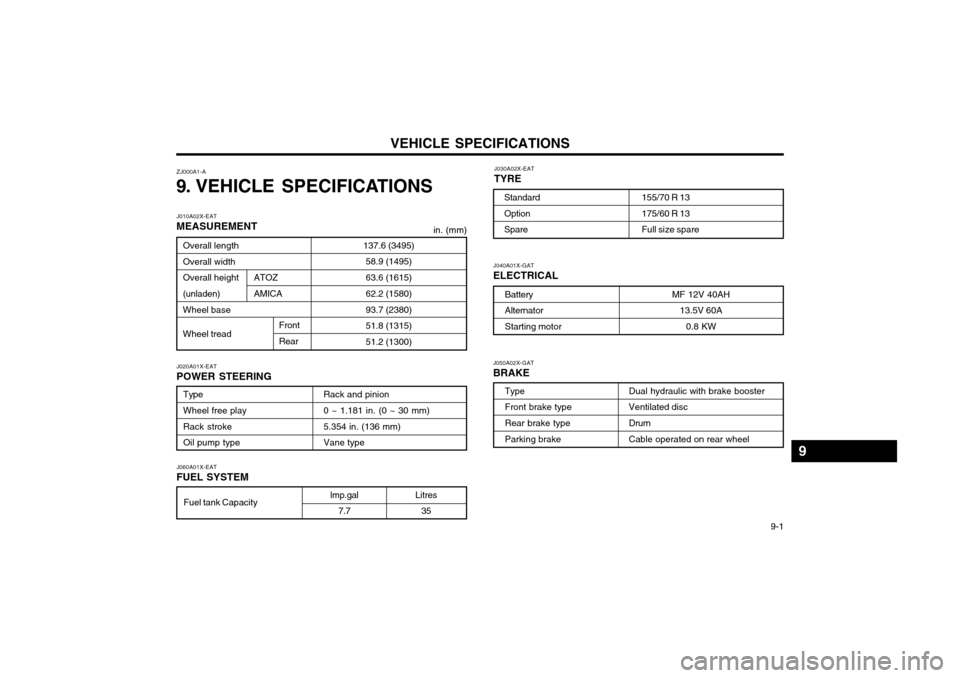
Litres
35 J040A01X-GAT ELECTRICAL
Battery Alternator Starting motor
MF 12V 40AH
13.5V 60A
0.8 KW
J050A02X-GAT BRAKE
Dual hydraulic with brake booster Ventilated disc Drum Cable operated on rear wheel
J060A01X-EAT FUEL SYSTEM
lmp.gal 7.7
J020A01X-EAT POWER STEERING
Type Wheel free play Rack stroke Oil pump type Rack and pinion0 ~ 1.181 in. (0 ~ 30 mm) 5.354 in. (136 mm) Vane type
ZJ000A1-A
9. VEHICLE SPECIFICATIONS J030A02X-EAT TYRE
155/70 R 13 175/60 R 13 Full size spare
Standard Option Spare
J010A02X-EAT MEASUREMENT
137.6 (3495)58.9 (1495) 63.6 (1615) 62.2 (1580) 93.7 (2380) 51.8 (1315) 51.2 (1300)Overall length Overall width Overall height (unladen) Wheel base Wheel tread
in. (mm)
ATOZ AMICA
Front Rear
Fuel tank Capacity Type Front brake type Rear brake type Parking brake
9