brake fluid Hyundai Atos 2002 Owner's Manual
[x] Cancel search | Manufacturer: HYUNDAI, Model Year: 2002, Model line: Atos, Model: Hyundai Atos 2002Pages: 249, PDF Size: 3.11 MB
Page 28 of 249
FEATURES OF YOUR HYUNDAI
FEATURES OF YOUR HYUNDAI FEATURES OF YOUR HYUNDAI
FEATURES OF YOUR HYUNDAI
FEATURES OF YOUR HYUNDAI
1- 19
B260B01X-GAT
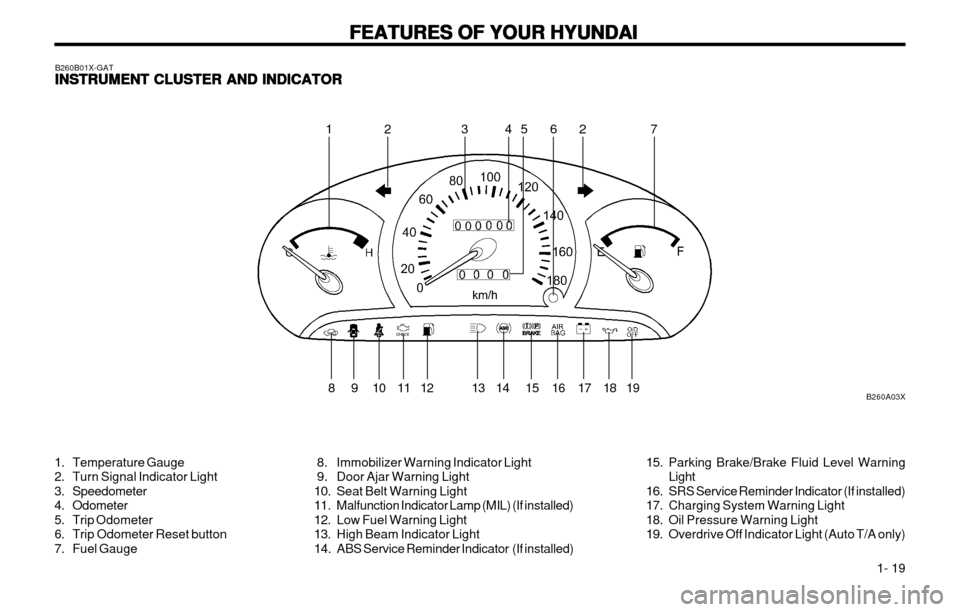
INSTRUMENT CLUSTER AND INDICATOR
INSTRUMENT CLUSTER AND INDICATOR INSTRUMENT CLUSTER AND INDICATOR
INSTRUMENT CLUSTER AND INDICATOR
INSTRUMENT CLUSTER AND INDICATOR
1. Temperature Gauge
2. Turn Signal Indicator Light
3. Speedometer
4. Odometer
5. Trip Odometer
6. Trip Odometer Reset button
7. Fuel Gauge 8. Immobilizer Warning Indicator Light
9. Door Ajar Warning Light
10. Seat Belt Warning Light
11. Malfunction Indicator Lamp (MIL) (If installed)
12. Low Fuel Warning Light
13. High Beam Indicator Light
14. ABS Service Reminder Indicator (If installed) 15. Parking Brake/Brake Fluid Level Warning
Light
16. SRS Service Reminder Indicator (If installed)
17. Charging System Warning Light
18. Oil Pressure Warning Light
19. Overdrive Off Indicator Light (Auto T/A only)
13 56
981011 12 13B260A03X
2427
141516171819
Page 29 of 249
FEATURES OF YOUR HYUNDAI
FEATURES OF YOUR HYUNDAI FEATURES OF YOUR HYUNDAI
FEATURES OF YOUR HYUNDAI
FEATURES OF YOUR HYUNDAI
1- 20
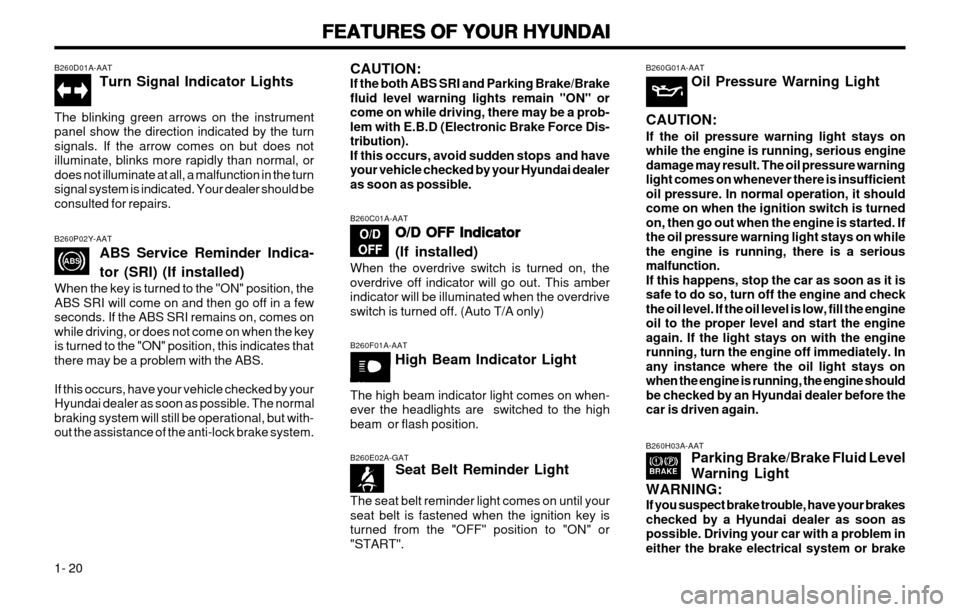
B260P02Y-AAT ABS Service Reminder Indica- tor (SRI) (If installed)
When the key is turned to the "ON" position, the ABS SRI will come on and then go off in a fewseconds. If the ABS SRI remains on, comes onwhile driving, or does not come on when the keyis turned to the "ON" position, this indicates thatthere may be a problem with the ABS. If this occurs, have your vehicle checked by your Hyundai dealer as soon as possible. The normalbraking system will still be operational, but with-out the assistance of the anti-lock brake system.
B260D01A-AAT
Turn Signal Indicator Lights
The blinking green arrows on the instrumentpanel show the direction indicated by the turnsignals. If the arrow comes on but does notilluminate, blinks more rapidly than normal, ordoes not illuminate at all, a malfunction in the turnsignal system is indicated. Your dealer should beconsulted for repairs. B260G01A-AAT
Oil Pressure Warning Light
CAUTION: If the oil pressure warning light stays on while the engine is running, serious enginedamage may result. The oil pressure warninglight comes on whenever there is insufficientoil pressure. In normal operation, it shouldcome on when the ignition switch is turnedon, then go out when the engine is started. Ifthe oil pressure warning light stays on whilethe engine is running, there is a seriousmalfunction.If this happens, stop the car as soon as it issafe to do so, turn off the engine and checkthe oil level. If the oil level is low, fill the engineoil to the proper level and start the engineagain. If the light stays on with the enginerunning, turn the engine off immediately. Inany instance where the oil light stays onwhen the engine is running, the engine shouldbe checked by an Hyundai dealer before thecar is driven again.
B260E02A-GAT Seat Belt Reminder Light
The seat belt reminder light comes on until your seat belt is fastened when the ignition key isturned from the "OFF" position to "ON" or"START".B260H03A-AAT Parking Brake/Brake Fluid Level Warning Light
WARNING: If you suspect brake trouble, have your brakes checked by a Hyundai dealer as soon aspossible. Driving your car with a problem ineither the brake electrical system or brake
B260F01A-AAT High Beam Indicator Light
The high beam indicator light comes on when- ever the headlights are switched to the highbeam or flash position.
B260C01A-AAT O/D OFF Indicator
O/D OFF Indicator O/D OFF Indicator
O/D OFF Indicator
O/D OFF Indicator (If installed)
When the overdrive switch is turned on, the overdrive off indicator will go out. This amberindicator will be illuminated when the overdriveswitch is turned off. (Auto T/A only)
CAUTION: If the both ABS SRI and Parking Brake/Brakefluid level warning lights remain "ON" orcome on while driving, there may be a prob-lem with E.B.D (Electronic Brake Force Dis-tribution).If this occurs, avoid sudden stops and haveyour vehicle checked by your Hyundai dealeras soon as possible.
Page 30 of 249
FEATURES OF YOUR HYUNDAI
FEATURES OF YOUR HYUNDAI FEATURES OF YOUR HYUNDAI
FEATURES OF YOUR HYUNDAI
FEATURES OF YOUR HYUNDAI
1- 21
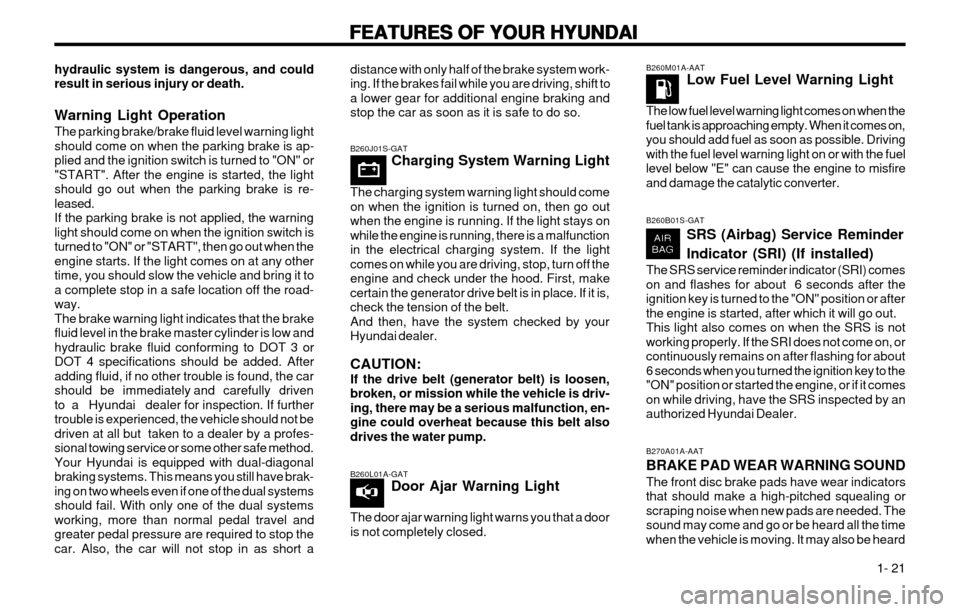
B270A01A-AAT BRAKE PAD WEAR WARNING SOUND The front disc brake pads have wear indicators that should make a high-pitched squealing orscraping noise when new pads are needed. Thesound may come and go or be heard all the timewhen the vehicle is moving. It may also be heard
B260M01A-AAT
Low Fuel Level Warning Light
The low fuel level warning light comes on when thefuel tank is approaching empty. When it comes on,you should add fuel as soon as possible. Drivingwith the fuel level warning light on or with the fuellevel below "E" can cause the engine to misfireand damage the catalytic converter.
hydraulic system is dangerous, and could result in serious injury or death. Warning Light Operation The parking brake/brake fluid level warning light should come on when the parking brake is ap-plied and the ignition switch is turned to "ON" or"START". After the engine is started, the lightshould go out when the parking brake is re-leased.If the parking brake is not applied, the warninglight should come on when the ignition switch isturned to "ON" or "START", then go out when theengine starts. If the light comes on at any othertime, you should slow the vehicle and bring it toa complete stop in a safe location off the road-way.The brake warning light indicates that the brakefluid level in the brake master cylinder is low andhydraulic brake fluid conforming to DOT 3 orDOT 4 specifications should be added. Afteradding fluid, if no other trouble is found, the carshould be immediately and carefully drivento a Hyundai dealer for inspection. If furthertrouble is experienced, the vehicle should not bedriven at all but taken to a dealer by a profes-sional towing service or some other safe method.Your Hyundai is equipped with dual-diagonalbraking systems. This means you still have brak-ing on two wheels even if one of the dual systemsshould fail. With only one of the dual systemsworking, more than normal pedal travel andgreater pedal pressure are required to stop thecar. Also, the car will not stop in as short a B260J01S-GAT
Charging System Warning Light
The charging system warning light should comeon when the ignition is turned on, then go outwhen the engine is running. If the light stays onwhile the engine is running, there is a malfunctionin the electrical charging system. If the lightcomes on while you are driving, stop, turn off theengine and check under the hood. First, makecertain the generator drive belt is in place. If it is,check the tension of the belt.And then, have the system checked by yourHyundai dealer. CAUTION: If the drive belt (generator belt) is loosen,broken, or mission while the vehicle is driv-ing, there may be a serious malfunction, en-gine could overheat because this belt alsodrives the water pump.
B260L01A-GAT Door Ajar Warning Light
The door ajar warning light warns you that a door is not completely closed.
B260B01S-GAT SRS (Airbag) Service Reminder Indicator (SRI) (If installed)
The SRS service reminder indicator (SRI) comes on and flashes for about 6 seconds after theignition key is turned to the "ON" position or afterthe engine is started, after which it will go out.This light also comes on when the SRS is notworking properly. If the SRI does not come on, orcontinuously remains on after flashing for about6 seconds when you turned the ignition key to the"ON" position or started the engine, or if it comeson while driving, have the SRS inspected by anauthorized Hyundai Dealer.
distance with only half of the brake system work- ing. If the brakes fail while you are driving, shift toa lower gear for additional engine braking andstop the car as soon as it is safe to do so.
Page 69 of 249
DRIVING YOUR HYUNDAI
DRIVING YOUR HYUNDAI DRIVING YOUR HYUNDAI
DRIVING YOUR HYUNDAI
DRIVING YOUR HYUNDAI
2- 6 C090G01S-GAT
o L (Low gear):
o L (Low gear): o L (Low gear):
o L (Low gear):
o L (Low gear): Use for driving up a very steep grade or for engine braking when descending steep hills.When downshifting to "L", the transaxle willtemporarily remain in second gear until thevehicle has slowed enough for low gear toengage. Do not exceed 50 km/h (30 mph) in lowgear. "L" shifts to 1st gear only. However, shift up to 2nd is performed when the car exceeds acertain speed and, as speed increases, thetransaxle will shift up to 3rd gear to preventover-revving the engine. C090H01E-GAT
NOTE:
NOTE: NOTE:
NOTE:
NOTE:
oo
oo
o For smooth and safe operation, depress
For smooth and safe operation, depress For smooth and safe operation, depress
For smooth and safe operation, depress
For smooth and safe operation, depress
the brake pedal when shifting from "Neu-
the brake pedal when shifting from "Neu- the brake pedal when shifting from "Neu-
the brake pedal when shifting from "Neu-
the brake pedal when shifting from "Neu-
tral" position or "Park" position to a for-
tral" position or "Park" position to a for- tral" position or "Park" position to a for-
tral" position or "Park" position to a for-
tral" position or "Park" position to a for-
ward or reverse gear.
ward or reverse gear. ward or reverse gear.
ward or reverse gear.
ward or reverse gear.
oo
oo
o The brake pedal fully depressed in order
The brake pedal fully depressed in order The brake pedal fully depressed in order
The brake pedal fully depressed in order
The brake pedal fully depressed in order
to move the shift lever from the "P"
to move the shift lever from the "P" to move the shift lever from the "P"
to move the shift lever from the "P"
to move the shift lever from the "P"
(Park) position to any of the other posi-
(Park) position to any of the other posi- (Park) position to any of the other posi-
(Park) position to any of the other posi-
(Park) position to any of the other posi-
tions.
tions. tions.
tions.
tions.
oo
oo
o It is always possible to shift from "R",
It is always possible to shift from "R", It is always possible to shift from "R",
It is always possible to shift from "R",
It is always possible to shift from "R",
"N", "D", "2", "L" position to "P" posi-
"N", "D", "2", "L" position to "P" posi- "N", "D", "2", "L" position to "P" posi-
"N", "D", "2", "L" position to "P" posi-
"N", "D", "2", "L" position to "P" posi-
tion. The vehicle must be fully stopped to
tion. The vehicle must be fully stopped to tion. The vehicle must be fully stopped to
tion. The vehicle must be fully stopped to
tion. The vehicle must be fully stopped to
avoid transaxle damage.
avoid transaxle damage. avoid transaxle damage.
avoid transaxle damage.
avoid transaxle damage.
C090I01E-AAT CAUTION:
CAUTION: CAUTION:
CAUTION:
CAUTION:
oo
oo
o
Shift into "R" and "P" position only when
Shift into "R" and "P" position only when Shift into "R" and "P" position only when
Shift into "R" and "P" position only when
Shift into "R" and "P" position only when
the vehicle has completely stopped.
the vehicle has completely stopped. the vehicle has completely stopped.
the vehicle has completely stopped.
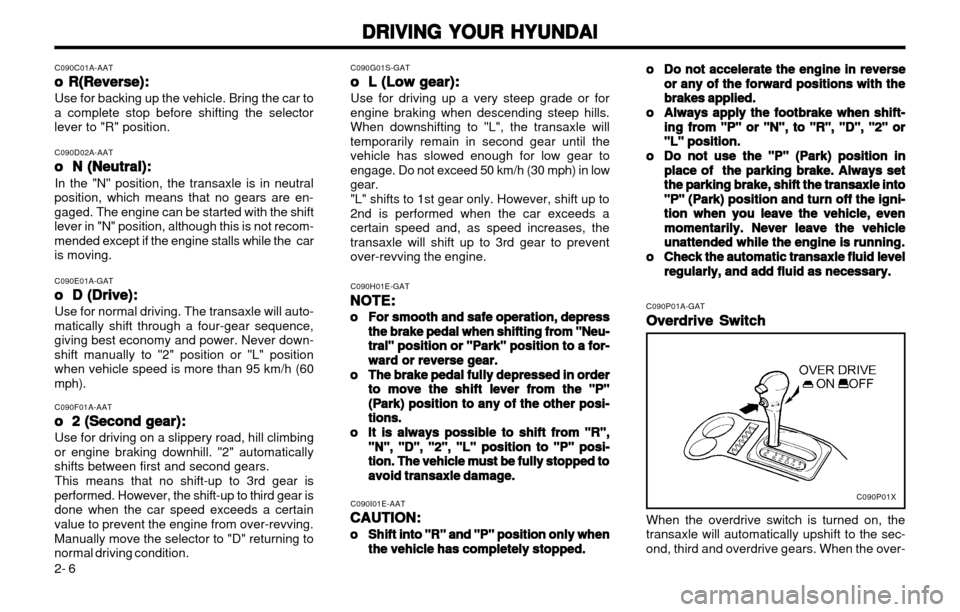
the vehicle has completely stopped. When the overdrive switch is turned on, the transaxle will automatically upshift to the sec-ond, third and overdrive gears. When the over-
C090P01A-GAT
Overdrive Switch
Overdrive Switch Overdrive Switch
Overdrive Switch
Overdrive Switch
C090P01X
oo
oo
o Do not accelerate the engine in reverse
Do not accelerate the engine in reverse Do not accelerate the engine in reverse
Do not accelerate the engine in reverse
Do not accelerate the engine in reverse
or any of the forward positions with the
or any of the forward positions with the or any of the forward positions with the
or any of the forward positions with the
or any of the forward positions with the
brakes applied.
brakes applied. brakes applied.
brakes applied.
brakes applied.
oo
oo
o
Always apply the footbrake when shift-
Always apply the footbrake when shift- Always apply the footbrake when shift-
Always apply the footbrake when shift-
Always apply the footbrake when shift-
ing from "P" or "N", to "R", "D", "2" or
ing from "P" or "N", to "R", "D", "2" or ing from "P" or "N", to "R", "D", "2" or
ing from "P" or "N", to "R", "D", "2" or
ing from "P" or "N", to "R", "D", "2" or
"L" position.
"L" position. "L" position.
"L" position.
"L" position.
oo
oo
o Do not use the "P" (Park) position in
Do not use the "P" (Park) position in Do not use the "P" (Park) position in
Do not use the "P" (Park) position in
Do not use the "P" (Park) position in
place of the parking brake. Always set
place of the parking brake. Always set place of the parking brake. Always set
place of the parking brake. Always set
place of the parking brake. Always set
the parking brake, shift the transaxle into
the parking brake, shift the transaxle into the parking brake, shift the transaxle into
the parking brake, shift the transaxle into
the parking brake, shift the transaxle into
"P" (Park) position and turn off the igni-
"P" (Park) position and turn off the igni- "P" (Park) position and turn off the igni-
"P" (Park) position and turn off the igni-
"P" (Park) position and turn off the igni-
tion when you leave the vehicle, even
tion when you leave the vehicle, even tion when you leave the vehicle, even
tion when you leave the vehicle, even
tion when you leave the vehicle, even
momentarily. Never leave the vehicle
momentarily. Never leave the vehicle momentarily. Never leave the vehicle
momentarily. Never leave the vehicle
momentarily. Never leave the vehicle
unattended while the engine is running.
unattended while the engine is running. unattended while the engine is running.
unattended while the engine is running.
unattended while the engine is running.
oo
oo
o Check the automatic transaxle fluid level
Check the automatic transaxle fluid level Check the automatic transaxle fluid level
Check the automatic transaxle fluid level
Check the automatic transaxle fluid level
regularly, and add fluid as necessary.
regularly, and add fluid as necessary. regularly, and add fluid as necessary.
regularly, and add fluid as necessary.
regularly, and add fluid as necessary.
C090C01A-AAT
o R(Reverse):
o R(Reverse): o R(Reverse):
o R(Reverse):
o R(Reverse):
Use for backing up the vehicle. Bring the car to
a complete stop before shifting the selector lever to "R" position.
C090E01A-GATo D (Drive):
o D (Drive): o D (Drive):
o D (Drive):
o D (Drive):
Use for normal driving. The transaxle will auto-
matically shift through a four-gear sequence,giving best economy and power. Never down-shift manually to "2" position or "L" positionwhen vehicle speed is more than 95 km/h (60mph). C090D02A-AAT
o N (Neutral):
o N (Neutral): o N (Neutral):
o N (Neutral):
o N (Neutral):
In the "N" position, the transaxle is in neutral
position, which means that no gears are en-gaged. The engine can be started with the shiftlever in "N" position, although this is not recom-mended except if the engine stalls while the caris moving.
C090F01A-AATo 2 (Second gear):
o 2 (Second gear): o 2 (Second gear):
o 2 (Second gear):
o 2 (Second gear):
Use for driving on a slippery road, hill climbing
or engine braking downhill. "2" automaticallyshifts between first and second gears.
This means that no shift-up to 3rd gear is
performed. However, the shift-up to third gear isdone when the car speed exceeds a certainvalue to prevent the engine from over-revving. Manually move the selector to "D" returning to normal driving condition.
Page 73 of 249
DRIVING YOUR HYUNDAI
DRIVING YOUR HYUNDAI DRIVING YOUR HYUNDAI
DRIVING YOUR HYUNDAI
DRIVING YOUR HYUNDAI
2- 10 ice. If the lock is frozen internally, you may be able to thaw it out by using a heated key.Handle the heated key with care to avoid burn-ing your fingers.
NOTE:
NOTE: NOTE:
NOTE:
NOTE:
The proper temperature for using the immo-
The proper temperature for using the immo- The proper temperature for using the immo-
The proper temperature for using the immo-
The proper temperature for using the immo-
bilizer key is from -40°C to 80°C. If you heat
bilizer key is from -40°C to 80°C. If you heat bilizer key is from -40°C to 80°C. If you heat
bilizer key is from -40°C to 80°C. If you heat
bilizer key is from -40°C to 80°C. If you heat
the immobilizer key over 80°C to open the
the immobilizer key over 80°C to open the the immobilizer key over 80°C to open the
the immobilizer key over 80°C to open the
the immobilizer key over 80°C to open the
frozen lock,
frozen lock, frozen lock,
frozen lock,
frozen lock, it may cause damage to the
it may cause damage to the it may cause damage to the
it may cause damage to the
it may cause damage to the
transponder in its head.
transponder in its head. transponder in its head.
transponder in its head.
transponder in its head. C160H01A-AAT
Use Approved Anti-Freeze in Window
Use Approved Anti-Freeze in Window Use Approved Anti-Freeze in Window
Use Approved Anti-Freeze in Window
Use Approved Anti-Freeze in Window
Washer System
Washer System Washer System
Washer System
Washer System
To keep the water in the window washer sys- tem from freezing, add an approved anti-freezesolution in accordance with instructions on thecontainer. Window washer anti-freeze is avail-able from Hyundai dealers and most auto partsoutlets. Do not use engine coolant or othertypes of anti-freeze as these may damage thefinish. C160I01X-GAT
Don't Let Your Parking Brake Freeze
Don't Let Your Parking Brake Freeze Don't Let Your Parking Brake Freeze
Don't Let Your Parking Brake Freeze
Don't Let Your Parking Brake Freeze
Under some conditions your parking brake can freeze in the engaged position. This is mostlikely to happen when there is an accumulationof snow or ice around or near the rear brakes orif the brakes are wet. If there is a risk theparking brake may freeze, apply it only tempo-
C160F01A-AAT
Check Spark Plugs and Ignition
Check Spark Plugs and Ignition Check Spark Plugs and Ignition
Check Spark Plugs and Ignition
Check Spark Plugs and Ignition
System
System System
System
System
Inspect your spark plugs as described in Sec-tion 6 and replace them if necessary. Alsocheck all ignition wiring and components to besure they are not cracked, worn or damaged inany way.
C160D01A-AAT
Check Battery and Cables
Check Battery and Cables Check Battery and Cables
Check Battery and Cables
Check Battery and Cables
Winter puts additional burdens on the batterysystem. Visually inspect the battery and cablesas described in Section 6. The level of chargein your battery can be checked by your Hyundaidealer or a service station. C160E01A-AATChange to "Winter Weight" Oil if
Change to "Winter Weight" Oil if Change to "Winter Weight" Oil if
Change to "Winter Weight" Oil if
Change to "Winter Weight" Oil if
Necessary
Necessary Necessary
Necessary
Necessary
In some climates it is recommended that a lower viscosity "winter weight" oil be used dur-ing cold weather. See Section 9 for recommen-dations. If you aren't sure what weight oil youshould use, consult your Hyundai dealer. C160G01A-GAT
To Keep Locks from Freezing
To Keep Locks from Freezing To Keep Locks from Freezing
To Keep Locks from Freezing
To Keep Locks from Freezing
To keep the locks from freezing, squirt an approved de-icer fluid or glycerine into the keyopening. If a lock is covered with ice, squirt itwith an approved de-icing fluid to remove the
Failure to do so may adversely affect the safety
and handling of your car. Speeding, rapid accel-eration, sudden brake applications, and sharpturns are potentially very hazardous practices.During deceleration, use engine braking to thefullest extent. Sudden brake applications onsnowy or icy roads may cause skids to occur.
You need to keep sufficient distance betweenthe vehicle in front and your vehicle. Also, applythe brake gently.
It should be noted that installing tire chains on
the tire will provide a greater driving force, butwill not prevent side skids.
NOTE:
NOTE: NOTE:
NOTE:
NOTE:
Tire chains are not legal in all provinces.
Tire chains are not legal in all provinces. Tire chains are not legal in all provinces.
Tire chains are not legal in all provinces.
Tire chains are not legal in all provinces. Check
Check Check
Check
Check province laws before fitting tire
province laws before fitting tire province laws before fitting tire
province laws before fitting tire
province laws before fitting tire
chains.
chains. chains.
chains.
chains.
C160C01A-AATUse High Quality Ethylene Glycol
Use High Quality Ethylene Glycol Use High Quality Ethylene Glycol
Use High Quality Ethylene Glycol
Use High Quality Ethylene Glycol
Coolant
Coolant Coolant
Coolant
Coolant
Your Hyundai is delivered with high quality
ethylene glycol coolant in the cooling system. It is the only type of coolant that should be usedbecause it helps prevent corrosion in the cool-ing system, lubricates the water pump andprevents freezing. Be sure to replace or replen-ish your coolant in accordance with the main-tenance schedule in Section 5. Before winter,have your coolant tested to assure that itsfreezing point is sufficient for the temperaturesanticipated during the winter.
Page 77 of 249
DRIVING YOUR HYUNDAI
DRIVING YOUR HYUNDAI DRIVING YOUR HYUNDAI
DRIVING YOUR HYUNDAI
DRIVING YOUR HYUNDAI
2- 14
11. Avoid jerky starts, sudden acceleration or
sudden stops.
12. Avoid sharp turns and rapid lane changes.
13. Avoid holding the brake pedal down too long or too frequently. This could cause the brakes to overheat, resulting in reduced brakingefficiency.
14. When going down a hill, shift into a lower gear and use the engine braking effect. When ascending a long grade, downshift the transaxle to a lower gear and reduce speedto reduce chances of engine overloadingand/or overheating.
15. If you have to stop while going uphill, do not hold the vehicle in place by pressing on theaccelerator. This can cause the automatictransaxle to overheat. Use the parking brakeor footbrake.
NOTE:
NOTE: NOTE:
NOTE:
NOTE:
When towing check transaxle fluid more
When towing check transaxle fluid more When towing check transaxle fluid more
When towing check transaxle fluid more
When towing check transaxle fluid more frequently.
frequently. frequently.
frequently.
frequently.
CAUTION:
CAUTION: CAUTION:
CAUTION:
CAUTION:
If overheating should occur when towing,
If overheating should occur when towing, If overheating should occur when towing,
If overheating should occur when towing,
If overheating should occur when towing,(temperature gauge reads near red zone),
(temperature gauge reads near red zone), (temperature gauge reads near red zone),
(temperature gauge reads near red zone),
(temperature gauge reads near red zone),
taking the following action may reduce or
taking the following action may reduce or taking the following action may reduce or
taking the following action may reduce or
taking the following action may reduce or
eliminate the problem.
eliminate the problem. eliminate the problem.
eliminate the problem.
eliminate the problem. 1. Turn off the air conditioner.
2. Reduce highway speed.
3. Select a lower gear when going uphill.
4. While in stop and go traffic, place the gear
selector in park or neutral and idle the en- gine at a higher speed.
Page 80 of 249
WHAT TO DO IN AN EMERGENCY
WHAT TO DO IN AN EMERGENCY WHAT TO DO IN AN EMERGENCY
WHAT TO DO IN AN EMERGENCY
WHAT TO DO IN AN EMERGENCY
3-3
WARNING:
WARNING: WARNING:
WARNING:
WARNING:
While the engine is running, keep hands,
While the engine is running, keep hands, While the engine is running, keep hands,
While the engine is running, keep hands,
While the engine is running, keep hands, long hair
long hair long hair
long hair
long hair
and clothing away from moving
and clothing away from moving and clothing away from moving
and clothing away from moving
and clothing away from moving
parts such as the fan and drive belts to
parts such as the fan and drive belts to parts such as the fan and drive belts to
parts such as the fan and drive belts to
parts such as the fan and drive belts to
prevent
prevent prevent
prevent
prevent
injury.
injury. injury.
injury.
injury.
5. If the water pump drive belt is broken or engine coolant is leaking out, stop the en- gine immediately and call the nearestHyundai dealer for assistance.
WARNING:
WARNING: WARNING:
WARNING:
WARNING:
Do not remove the radiator cap when the
Do not remove the radiator cap when the Do not remove the radiator cap when the
Do not remove the radiator cap when the
Do not remove the radiator cap when the engine is hot. This may allow
engine is hot. This may allow engine is hot. This may allow
engine is hot. This may allow
engine is hot. This may allow coolant to be
coolant to be coolant to be
coolant to be
coolant to be
blown out of the opening and cause serious
blown out of the opening and cause serious blown out of the opening and cause serious
blown out of the opening and cause serious
blown out of the opening and cause serious
burns.
burns. burns.
burns.
burns.
6. If you cannot find the cause of the overheat-
ing, wait until the engine temperature has returned to normal. Then, if engine coolanthas been lost, carefully remove the radiator
cap and add engine coolant to bring the fluidlevel in the reservoir up to the halfway mark.
7. Proceed with caution, keeping alert for fur- ther signs of overheating. If overheating hap-pens again, call a Hyundai dealer for assis-tance.
CAUTION:
CAUTION: CAUTION:
CAUTION:
CAUTION:
Serious loss of engine coolant indicates
Serious loss of engine coolant indicates Serious loss of engine coolant indicates
Serious loss of engine coolant indicates
Serious loss of engine coolant indicates there is a leak in
there is a leak in there is a leak in
there is a leak in
there is a leak in the cooling system and this
the cooling system and this the cooling system and this
the cooling system and this
the cooling system and this
should be checked as soon as possible by a
should be checked as soon as possible by a should be checked as soon as possible by a
should be checked as soon as possible by a
should be checked as soon as possible by a
Hyundai
Hyundai Hyundai
Hyundai
Hyundai dealer.
dealer. dealer.
dealer.
dealer. D040A01A-GAT
SPARE TIRE
SPARE TIRE SPARE TIRE
SPARE TIRE
SPARE TIRE
The following instructions for the FULL SIZE
spare tire should be observed:
Check inflation pressure as soon as practical
after installing the spare tire, and adjust to the specified pressure. The tire pressure should beperiodically checked and maintained at thespecified pressure while the tire is stored.
Tire Size Inflation Pressure Full Size 210 kPa (30 psi)
Spare Tire Pressure
D040B01A-AAT
Handling the Spare Tire
Handling the Spare Tire Handling the Spare Tire
Handling the Spare Tire
Handling the Spare Tire
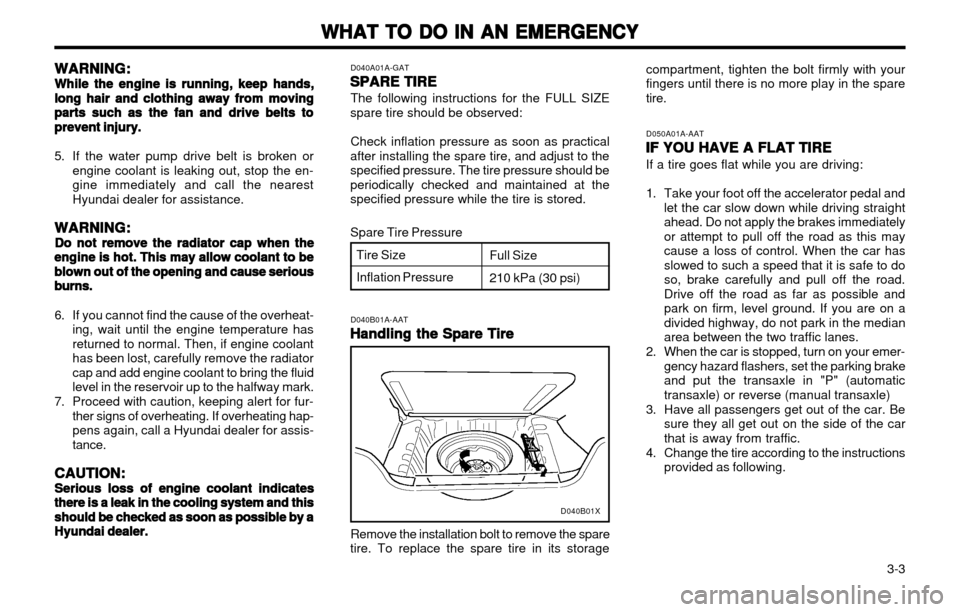
Remove the installation bolt to remove the spare
tire. To replace the spare tire in its storage D050A01A-AAT
IF YOU HAVE A FLAT TIRE
IF YOU HAVE A FLAT TIRE IF YOU HAVE A FLAT TIRE
IF YOU HAVE A FLAT TIRE
IF YOU HAVE A FLAT TIRE If a tire goes flat while you are driving:
1. Take your foot off the accelerator pedal and
let the car slow down while driving straight ahead. Do not apply the brakes immediatelyor attempt to pull off the road as this may
cause a loss of control. When the car hasslowed to such a speed that it is safe to doso, brake carefully and pull off the road.Drive off the road as far as possible and
park on firm, level ground. If you are on adivided highway, do not park in the medianarea between the two traffic lanes.
2. When the car is stopped, turn on your emer- gency hazard flashers, set the parking brakeand put the transaxle in "P" (automatic
transaxle) or reverse (manual transaxle)
3. Have all passengers get out of the car. Be sure they all get out on the side of the carthat is away from traffic.
4. Change the tire according to the instructions provided as following.
compartment, tighten the bolt firmly with yourfingers until there is no more play in the sparetire.
D040B01X
Page 85 of 249
WHAT TO DO IN AN EMERGENCY
WHAT TO DO IN AN EMERGENCY WHAT TO DO IN AN EMERGENCY
WHAT TO DO IN AN EMERGENCY
WHAT TO DO IN AN EMERGENCY
3-8 D080C02A-GAT
Towing a Car With Automatic Transaxle
Towing a Car With Automatic Transaxle Towing a Car With Automatic Transaxle
Towing a Car With Automatic Transaxle
Towing a Car With Automatic Transaxle
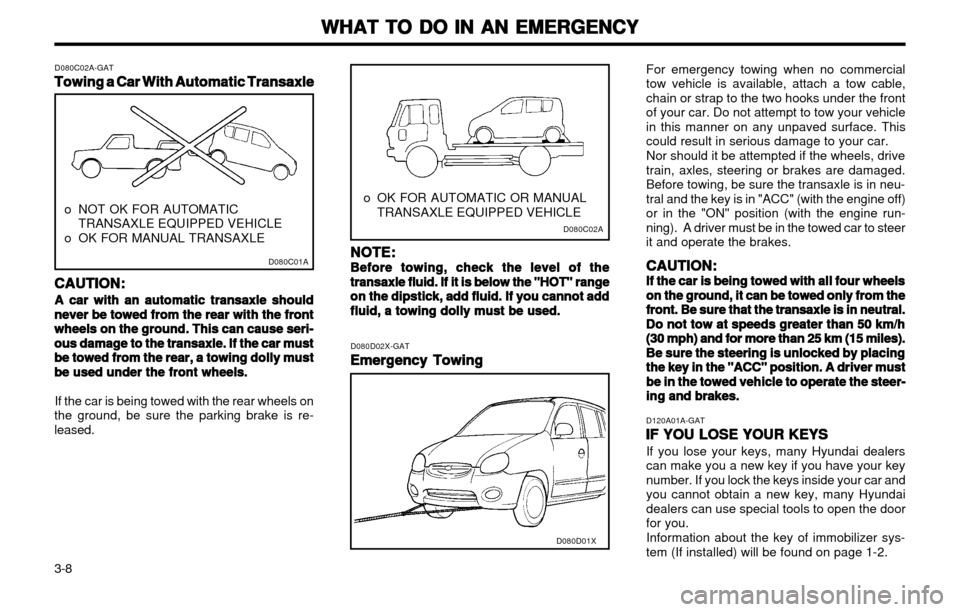
o NOT OK FOR AUTOMATIC TRANSAXLE EQUIPPED VEHICLE
o OK FOR MANUAL TRANSAXLE
CAUTION:
CAUTION: CAUTION:
CAUTION:
CAUTION:
A car with an automatic transaxle should
A car with an automatic transaxle should A car with an automatic transaxle should
A car with an automatic transaxle should
A car with an automatic transaxle should never be towed from the rear with the front
never be towed from the rear with the front never be towed from the rear with the front
never be towed from the rear with the front
never be towed from the rear with the front
wheels on the ground. This can cause seri-
wheels on the ground. This can cause seri- wheels on the ground. This can cause seri-
wheels on the ground. This can cause seri-
wheels on the ground. This can cause seri-
ous damage to the transaxle. If the car must
ous damage to the transaxle. If the car must ous damage to the transaxle. If the car must
ous damage to the transaxle. If the car must
ous damage to the transaxle. If the car must
be towed from the rear, a towing dolly must
be towed from the rear, a towing dolly must be towed from the rear, a towing dolly must
be towed from the rear, a towing dolly must
be towed from the rear, a towing dolly must
be used under the front wheels.
be used under the front wheels. be used under the front wheels.
be used under the front wheels.
be used under the front wheels.
If the car is being towed with the rear wheels on
the ground, be sure the parking brake is re- leased. D080D02X-GAT
Emergency Towing
Emergency Towing Emergency Towing
Emergency Towing
Emergency Towing For emergency towing when no commercialtow vehicle is available, attach a tow cable,chain or strap to the two hooks under the frontof your car. Do not attempt to tow your vehiclein this manner on any unpaved surface. Thiscould result in serious damage to your car. Nor should it be attempted if the wheels, drive train, axles, steering or brakes are damaged.Before towing, be sure the transaxle is in neu-tral and the key is in "ACC" (with the engine off)or in the "ON" position (with the engine run-ning). A driver must be in the towed car to steerit and operate the brakes.
CAUTION:
CAUTION: CAUTION:
CAUTION:
CAUTION:
If the car is being towed with all four wheels
If the car is being towed with all four wheels If the car is being towed with all four wheels
If the car is being towed with all four wheels
If the car is being towed with all four wheels
on the ground, it can be towed only from the
on the ground, it can be towed only from the on the ground, it can be towed only from the
on the ground, it can be towed only from the
on the ground, it can be towed only from the
front. Be sure that the transaxle is in neutral.
front. Be sure that the transaxle is in neutral. front. Be sure that the transaxle is in neutral.
front. Be sure that the transaxle is in neutral.
front. Be sure that the transaxle is in neutral.
Do not tow at speeds greater than 50 km/h
Do not tow at speeds greater than 50 km/h Do not tow at speeds greater than 50 km/h
Do not tow at speeds greater than 50 km/h
Do not tow at speeds greater than 50 km/h
(30 mph) and for more than 25 km (15 miles).
(30 mph) and for more than 25 km (15 miles). (30 mph) and for more than 25 km (15 miles).
(30 mph) and for more than 25 km (15 miles).
(30 mph) and for more than 25 km (15 miles).
Be sure the steering is unlocked by placing
Be sure the steering is unlocked by placing Be sure the steering is unlocked by placing
Be sure the steering is unlocked by placing
Be sure the steering is unlocked by placing
the key in the "ACC" position. A driver must
the key in the "ACC" position. A driver must the key in the "ACC" position. A driver must
the key in the "ACC" position. A driver must
the key in the "ACC" position. A driver must
be in the towed vehicle to operate the steer-
be in the towed vehicle to operate the steer- be in the towed vehicle to operate the steer-
be in the towed vehicle to operate the steer-
be in the towed vehicle to operate the steer-
ing and brakes.
ing and brakes. ing and brakes.
ing and brakes.
ing and brakes.
o OK FOR AUTOMATIC OR MANUAL
TRANSAXLE EQUIPPED VEHICLE
D080C01A
D080C02A
D080D01X
D120A01A-GAT
IF YOU LOSE YOUR KEYS
IF YOU LOSE YOUR KEYS IF YOU LOSE YOUR KEYS
IF YOU LOSE YOUR KEYS
IF YOU LOSE YOUR KEYS
If you lose your keys, many Hyundai dealers can make you a new key if you have your keynumber. If you lock the keys inside your car andyou cannot obtain a new key, many Hyundaidealers can use special tools to open the doorfor you. Information about the key of immobilizer sys- tem (If installed) will be found on page 1-2.
NOTE:
NOTE: NOTE:
NOTE:
NOTE:
Before towing, check the level of the
Before towing, check the level of the Before towing, check the level of the
Before towing, check the level of the
Before towing, check the level of the
transaxle fluid. If it is below the "HOT" range
transaxle fluid. If it is below the "HOT" range transaxle fluid. If it is below the "HOT" range
transaxle fluid. If it is below the "HOT" range
transaxle fluid. If it is below the "HOT" range
on the dipstick, add fluid. If you cannot add
on the dipstick, add fluid. If you cannot add on the dipstick, add fluid. If you cannot add
on the dipstick, add fluid. If you cannot add
on the dipstick, add fluid. If you cannot add
fluid, a towing dolly must be used.
fluid, a towing dolly must be used. fluid, a towing dolly must be used.
fluid, a towing dolly must be used.
fluid, a towing dolly must be used.
Page 88 of 249
CORROSION PREVENTION AND APPEARANCE CARE
CORROSION PREVENTION AND APPEARANCE CARE CORROSION PREVENTION AND APPEARANCE CARE
CORROSION PREVENTION AND APPEARANCE CARE
CORROSION PREVENTION AND APPEARANCE CARE
4-3
(at least once a month). Give special attention
to the removal of salt, mud and other substanc-
es on the underside of the splashboards of the car. Make sure that the outlets and the under-side of the doors are open. Paint damage canbe caused by small accumulation of tar, indus-trial precipitation, tree resin, insects and birddroppings, when not removed immediately.
If water alone is not strong enough to remove
the accumulated dirt, use a mild car washingsolution. Be sure to rinse the surface afterwashing to remove the solution. Never allowthe solution to dry on the painted surfaces. E030C01A-AAT
Polishing and Waxing
Polishing and Waxing Polishing and Waxing
Polishing and Waxing
Polishing and Waxing Always wash and dry the car before polishing or waxing or using a combination cleaner andwax. Use a good quality commercial productand follow the manufacturer's directions on thecontainer. Polish and wax the bright trim piecesas well as the paint.
E030B01A-AAT Spot Cleaning
Spot Cleaning Spot Cleaning
Spot Cleaning
Spot Cleaning
Don't use gasoline, strong solvents or corrosive
cleaning agents. These can damage the finishof the car. To remove road tar, use turpentineon a clean, soft cloth or commercially availablebug and tar remover. Be gentle.
To remove dead insects or tree sap, use warm
water and mild soap or car-washing solution.Soak the spot and rub gently. If the paint haslost its luster, use a commercial car-cleaningpolish. E030D01A-AAT
When to Wax Again
When to Wax Again When to Wax Again
When to Wax Again
When to Wax Again
You should polish and wax the car again when
water no longer beads on a clean surface butspreads out over a larger area.
E030E01A-AATMaintaining Bumpers
Maintaining Bumpers Maintaining Bumpers
Maintaining Bumpers
Maintaining Bumpers
Special precautions must be observed to pre-
serve the appearance of the bumpers on yourHyundai. They are:
o Be careful not to spill battery electrolyte or hydraulic brake fluid on the bumpers. If you do, wash it off immediately with clean water.
o Be gentle when cleaning the bumper sur- faces. They are made of soft plastic and thesurface can be damaged if mistreated. Donot use abrasive cleaners. Use warm waterand mild soap or car-washing solution. o Do not expose the bumpers to high tem-
peratures. For example, if you have yourcar repainted, do not leave the bumpers onthe car if the car is going to be placed in ahigh temperature paint booth.
E040A01A-AAT CLEANING THE INTERIOR
CLEANING THE INTERIOR CLEANING THE INTERIOR
CLEANING THE INTERIOR
CLEANING THE INTERIOR
To Clean the Vinyl Upholstery
To Clean the Vinyl Upholstery To Clean the Vinyl Upholstery
To Clean the Vinyl Upholstery
To Clean the Vinyl Upholstery
To clean the vinyl upholstery, first remove loose
dirt and dust with a vacuum cleaner. Then applya solution of mild soap or detergent and waterusing a clean sponge or soft cloth. Allow this tostay on the surface to loosen the dirt, then wipewith a clean damp sponge or cloth. If all the dirtstains are not removed, repeat this procedureuntil the upholstery is clean. Do not use gaso-line, solvent, paint thinner or other strong clean-ers.
E040B01A-AATTo Clean the Leather Upholstery
To Clean the Leather Upholstery To Clean the Leather Upholstery
To Clean the Leather Upholstery
To Clean the Leather Upholstery
(If Installed)
(If Installed) (If Installed)
(If Installed)
(If Installed)
In the normal course of use, leather upholstered
surfaces will, like any material, pick-up dust anddirt. This dust and dirt must be cleaned off or itmay work into the surface of the leather, caus-ing damage.
Fine leather needs care, and should be cleaned
when necessary. Washing leather thoroughlywith soap and water will keep your leather
lustrous, beautiful and ensure you have manyyears of wear.
Page 90 of 249
VEHICLE MAINTENANCE REQUIREMENTS
VEHICLE MAINTENANCE REQUIREMENTS VEHICLE MAINTENANCE REQUIREMENTS
VEHICLE MAINTENANCE REQUIREMENTS
VEHICLE MAINTENANCE REQUIREMENTS
5-1
5.5.
5.5.
5.
VEHICLE MAINTE-
VEHICLE MAINTE- VEHICLE MAINTE-
VEHICLE MAINTE-
VEHICLE MAINTE-
NANCE REQ
NANCE REQ NANCE REQ
NANCE REQ
NANCE REQ
UIRE-
UIRE- UIRE-
UIRE-
UIRE-
MENTS
MENTS MENTS
MENTS
MENTS
F010A01A-GAT MAINTENANCE INTERVALS
MAINTENANCE INTERVALS MAINTENANCE INTERVALS
MAINTENANCE INTERVALS
MAINTENANCE INTERVALS
Service requirements
Service requirements Service requirements
Service requirements
Service requirements
To assure that you receive the greatest number
of kilometers of satisfying operation from your Hyundai, certain maintenance procedures must
be performed. Although careful design and en-
gineering have reduced these to a minimum,those that are required are of the utmost impor-tance. It is your responsibility to have these mainte-
nance procedures performed to comply with theterms of the warranties covering your newHyundai. The Service Passport supplied withyour new vehicle provides further information
about these warranties. F010B01A-AAT
Maintenance Requirements
Maintenance Requirements Maintenance Requirements
Maintenance Requirements
Maintenance Requirements
The maintenance required for your Hyundai
can be divided into three main areas:
o Specified scheduled procedures
o General everyday checks
o Do-it-yourself maintenance F010C01A-GAT
Specified Scheduled Procedures
Specified Scheduled Procedures Specified Scheduled Procedures
Specified Scheduled Procedures
Specified Scheduled Procedures
These are the procedures such as inspections,
adjustments and replacements that are listed in the maintenance charts starting on page 5-2.These procedures must be performed at theintervals shown in the maintenance schedule to
assure that your warranty remains in effect.Although it is strongly recommended that they
be performed by the factory-trained or distribu-tor-trained technicians at your Hyundai dealer,
these procedures may be performed at any
qualified service facility.
It is suggested that genuine Hyundai service
parts be used for any required repairs or re-placements. Other parts of equivalent quality
such as engine oil, engine coolant, manual orauto transaxle oil, brake fluid and so on which
are not supplied by Hyundai Motor Company or
its distributor may be used without affectingyour warranty coverage but you should always
be sure these are equivalent to the quality of theoriginal Hyundai parts. Your Service Passport
provides further information about your warran-ty coverage. F010E01A-AAT
Do-It-Yourself Maintenance
Do-It-Yourself Maintenance Do-It-Yourself Maintenance
Do-It-Yourself Maintenance
Do-It-Yourself Maintenance
If you are mechanically inclined, own a few
tools that are required and want to take the timeto do so, you can inspect and service a number
of items. For more information about doing ityourself, see Section 6.
F010F01A-AATA Few Tips
A Few Tips A Few Tips
A Few Tips
A Few Tips
o Whenever you have your Hyundai serviced,
keep copies of the service records in your
glovebox. This will help ensure that you candocument that the required procedures have
been performed to keep your warranties ineffect. This is especially important when
service is not performed by an authorizedHyundai dealer.
o If you choose to do your own maintenance and repairs, you may find it helpful to havean official Hyundai Shop Manual. A copy of
this publication may be purchased at yourHyundai dealer's parts department.
F020A02X-GAT SCHEDULED MAINTENANCE RE-
SCHEDULED MAINTENANCE RE- SCHEDULED MAINTENANCE RE-
SCHEDULED MAINTENANCE RE-
SCHEDULED MAINTENANCE RE-
QUIREMENTS
QUIREMENTS QUIREMENTS
QUIREMENTS
QUIREMENTS
Inspection should be performed any time a
malfunction is experienced or suspected. Re-ceipts for all emission control system services
should be retained to demonstrate compliancewith conditions of the emissions system war-ranty. For severe usage maintenance require-ments, see page 5-4 of this section.
F010D01A-AAT
General Checks
General Checks General Checks
General Checks
General Checks
These are the regular checks you should per-
form when you drive your Hyundai or you fill thefuel tank. A list of these items will be found onpage 6-2.
55
55
5