engine overheat Hyundai Atos 2002 Owner's Manual
[x] Cancel search | Manufacturer: HYUNDAI, Model Year: 2002, Model line: Atos, Model: Hyundai Atos 2002Pages: 249, PDF Size: 3.11 MB
Page 30 of 249
FEATURES OF YOUR HYUNDAI
FEATURES OF YOUR HYUNDAI FEATURES OF YOUR HYUNDAI
FEATURES OF YOUR HYUNDAI
FEATURES OF YOUR HYUNDAI
1- 21
B270A01A-AAT BRAKE PAD WEAR WARNING SOUND The front disc brake pads have wear indicators that should make a high-pitched squealing orscraping noise when new pads are needed. Thesound may come and go or be heard all the timewhen the vehicle is moving. It may also be heard
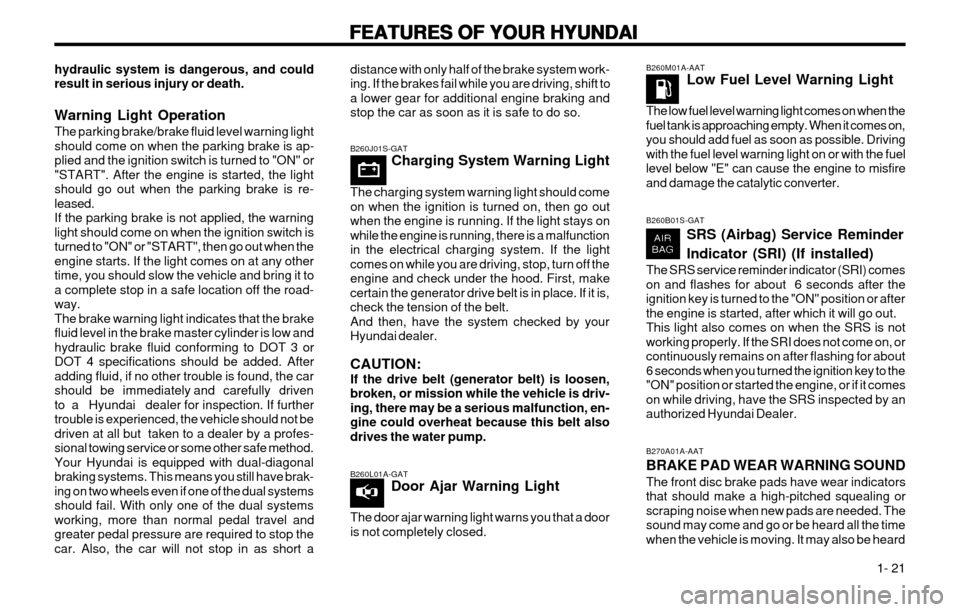
B260M01A-AAT
Low Fuel Level Warning Light
The low fuel level warning light comes on when thefuel tank is approaching empty. When it comes on,you should add fuel as soon as possible. Drivingwith the fuel level warning light on or with the fuellevel below "E" can cause the engine to misfireand damage the catalytic converter.
hydraulic system is dangerous, and could result in serious injury or death. Warning Light Operation The parking brake/brake fluid level warning light should come on when the parking brake is ap-plied and the ignition switch is turned to "ON" or"START". After the engine is started, the lightshould go out when the parking brake is re-leased.If the parking brake is not applied, the warninglight should come on when the ignition switch isturned to "ON" or "START", then go out when theengine starts. If the light comes on at any othertime, you should slow the vehicle and bring it toa complete stop in a safe location off the road-way.The brake warning light indicates that the brakefluid level in the brake master cylinder is low andhydraulic brake fluid conforming to DOT 3 orDOT 4 specifications should be added. Afteradding fluid, if no other trouble is found, the carshould be immediately and carefully drivento a Hyundai dealer for inspection. If furthertrouble is experienced, the vehicle should not bedriven at all but taken to a dealer by a profes-sional towing service or some other safe method.Your Hyundai is equipped with dual-diagonalbraking systems. This means you still have brak-ing on two wheels even if one of the dual systemsshould fail. With only one of the dual systemsworking, more than normal pedal travel andgreater pedal pressure are required to stop thecar. Also, the car will not stop in as short a B260J01S-GAT
Charging System Warning Light
The charging system warning light should comeon when the ignition is turned on, then go outwhen the engine is running. If the light stays onwhile the engine is running, there is a malfunctionin the electrical charging system. If the lightcomes on while you are driving, stop, turn off theengine and check under the hood. First, makecertain the generator drive belt is in place. If it is,check the tension of the belt.And then, have the system checked by yourHyundai dealer. CAUTION: If the drive belt (generator belt) is loosen,broken, or mission while the vehicle is driv-ing, there may be a serious malfunction, en-gine could overheat because this belt alsodrives the water pump.
B260L01A-GAT Door Ajar Warning Light
The door ajar warning light warns you that a door is not completely closed.
B260B01S-GAT SRS (Airbag) Service Reminder Indicator (SRI) (If installed)
The SRS service reminder indicator (SRI) comes on and flashes for about 6 seconds after theignition key is turned to the "ON" position or afterthe engine is started, after which it will go out.This light also comes on when the SRS is notworking properly. If the SRI does not come on, orcontinuously remains on after flashing for about6 seconds when you turned the ignition key to the"ON" position or started the engine, or if it comeson while driving, have the SRS inspected by anauthorized Hyundai Dealer.
distance with only half of the brake system work- ing. If the brakes fail while you are driving, shift toa lower gear for additional engine braking andstop the car as soon as it is safe to do so.
Page 66 of 249
DRIVING YOUR HYUNDAI
DRIVING YOUR HYUNDAI DRIVING YOUR HYUNDAI
DRIVING YOUR HYUNDAI
DRIVING YOUR HYUNDAI
2- 3
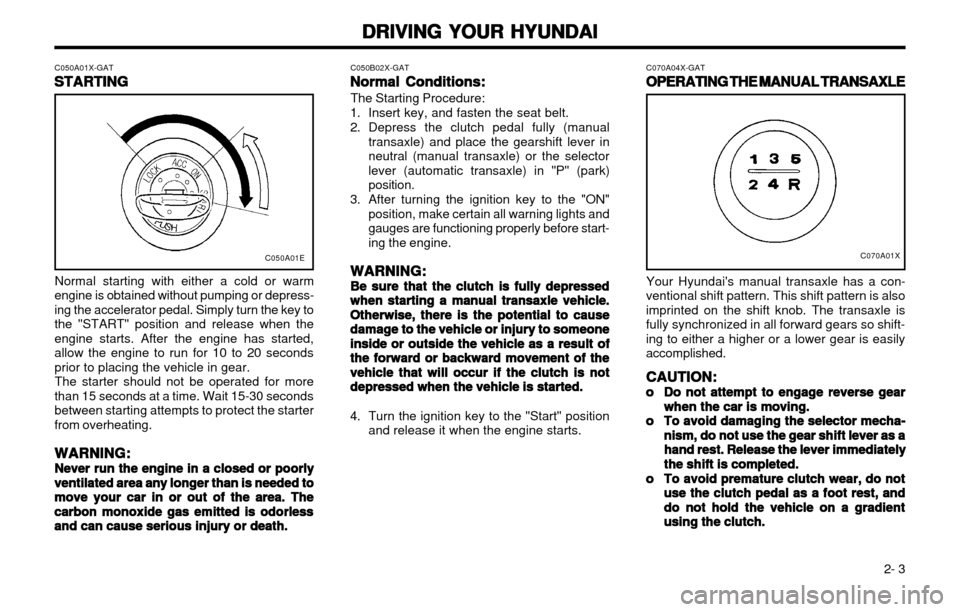
C050A01X-GAT
STARTING
STARTING STARTING
STARTING
STARTING
Normal starting with either a cold or warm
engine is obtained without pumping or depress-
ing the accelerator pedal. Simply turn the key tothe "START" position and release when theengine starts. After the engine has started,allow the engine to run for 10 to 20 secondsprior to placing the vehicle in gear. The starter should not be operated for more
than 15 seconds at a time. Wait 15-30 secondsbetween starting attempts to protect the starterfrom overheating.
WARNING:
WARNING: WARNING:
WARNING:
WARNING:
Never run the engine in a closed or poorly
Never run the engine in a closed or poorly Never run the engine in a closed or poorly
Never run the engine in a closed or poorly
Never run the engine in a closed or poorly ventilated area
ventilated area ventilated area
ventilated area
ventilated area any longer than is needed to
any longer than is needed to any longer than is needed to
any longer than is needed to
any longer than is needed to
move your car in or out of the area. The
move your car in or out of the area. The move your car in or out of the area. The
move your car in or out of the area. The
move your car in or out of the area. The
carbon
carbon carbon
carbon
carbon monoxide gas emitted is odorless
monoxide gas emitted is odorless monoxide gas emitted is odorless
monoxide gas emitted is odorless
monoxide gas emitted is odorless
and can cause serious injury or death.
and can cause serious injury or death. and can cause serious injury or death.
and can cause serious injury or death.
and can cause serious injury or death. C050B02X-GAT
Normal Conditions:
Normal Conditions: Normal Conditions:
Normal Conditions:
Normal Conditions:
The Starting Procedure:
1. Insert key, and fasten the seat belt.
2. Depress the clutch pedal fully (manual transaxle) and place the gearshift lever in neutral (manual transaxle) or the selectorlever (automatic transaxle) in "P" (park)position.
3. After turning the ignition key to the "ON" position, make certain all warning lights andgauges are functioning properly before start-
ing the engine.
WARNING:
WARNING: WARNING:
WARNING:
WARNING:
Be sure that the clutch is fully depressed
Be sure that the clutch is fully depressed Be sure that the clutch is fully depressed
Be sure that the clutch is fully depressed
Be sure that the clutch is fully depressed when starting a
when starting a when starting a
when starting a
when starting a manual transaxle vehicle.
manual transaxle vehicle. manual transaxle vehicle.
manual transaxle vehicle.
manual transaxle vehicle.
Otherwise, there is the potential to cause
Otherwise, there is the potential to cause Otherwise, there is the potential to cause
Otherwise, there is the potential to cause
Otherwise, there is the potential to cause
damage
damage damage
damage
damage to the vehicle or injury to someone
to the vehicle or injury to someone to the vehicle or injury to someone
to the vehicle or injury to someone
to the vehicle or injury to someone
inside or outside the vehicle as a result
inside or outside the vehicle as a result inside or outside the vehicle as a result
inside or outside the vehicle as a result
inside or outside the vehicle as a result ofof
ofof
of
the forward or backward movement of the
the forward or backward movement of the the forward or backward movement of the
the forward or backward movement of the
the forward or backward movement of the
vehicle that will occur if the
vehicle that will occur if the vehicle that will occur if the
vehicle that will occur if the
vehicle that will occur if the clutch is not
clutch is not clutch is not
clutch is not
clutch is not
depressed when the vehicle is started.
depressed when the vehicle is started. depressed when the vehicle is started.
depressed when the vehicle is started.
depressed when the vehicle is started.
4. Turn the ignition key to the "Start" position
and release it when the engine starts. C070A04X-GAT
OPERATING THE MANUAL TRANSAXLE
OPERATING THE MANUAL TRANSAXLE OPERATING THE MANUAL TRANSAXLE
OPERATING THE MANUAL TRANSAXLE
OPERATING THE MANUAL TRANSAXLE
C070A01X
Your Hyundai's manual transaxle has a con-
ventional shift pattern. This shift pattern is also imprinted on the shift knob. The transaxle isfully synchronized in all forward gears so shift-
ing to either a higher or a lower gear is easilyaccomplished.
CAUTION:
CAUTION: CAUTION:
CAUTION:
CAUTION:
oo
oo
o Do not attempt to engage reverse gear
Do not attempt to engage reverse gear Do not attempt to engage reverse gear
Do not attempt to engage reverse gear
Do not attempt to engage reverse gear
when the
when the when the
when the
when the car is moving.
car is moving. car is moving.
car is moving.
car is moving.
oo
oo
o To avoid damaging the selector mecha-
To avoid damaging the selector mecha- To avoid damaging the selector mecha-
To avoid damaging the selector mecha-
To avoid damaging the selector mecha-
nism, do not use the gear
nism, do not use the gear nism, do not use the gear
nism, do not use the gear
nism, do not use the gear shift lever as a
shift lever as a shift lever as a
shift lever as a
shift lever as a
hand rest. Release the lever immediately
hand rest. Release the lever immediately hand rest. Release the lever immediately
hand rest. Release the lever immediately
hand rest. Release the lever immediately
the shift is completed.
the shift is completed. the shift is completed.
the shift is completed.
the shift is completed.
oo
oo
o To avoid premature clutch wear, do not
To avoid premature clutch wear, do not To avoid premature clutch wear, do not
To avoid premature clutch wear, do not
To avoid premature clutch wear, do not
use the clutch pedal as
use the clutch pedal as use the clutch pedal as
use the clutch pedal as
use the clutch pedal as
a foot rest, and
a foot rest, and a foot rest, and
a foot rest, and
a foot rest, and
do not hold the vehicle on a gradient
do not hold the vehicle on a gradient do not hold the vehicle on a gradient
do not hold the vehicle on a gradient
do not hold the vehicle on a gradient
using the clutch.
using the clutch. using the clutch.
using the clutch.
using the clutch.
C050A01E
Page 67 of 249
DRIVING YOUR HYUNDAI
DRIVING YOUR HYUNDAI DRIVING YOUR HYUNDAI
DRIVING YOUR HYUNDAI
DRIVING YOUR HYUNDAI
2- 4 C070B01X-GAT
Using the Clutch of Manual transaxle
Using the Clutch of Manual transaxle Using the Clutch of Manual transaxle
Using the Clutch of Manual transaxle
Using the Clutch of Manual transaxle
The clutch should be pressed all the way to the floor before shifting, then released slowly. Theclutch pedal should be always used after fullyreturning to the original position. Do not restyour foot on the clutch pedal while driving. Thiscan cause unnecessary wear. Do not partiallyengage the clutch to hold the car on an incline.This causes unnecessary wear. Use the park-ing brake to hold the car on an incline. Do notoperate the clutch pedal rapidly and repeatedly. o Slow down when you encounter cross winds.
This gives you much better control of yourcar.
o Be sure the car is completely stopped be- fore you attempt to shift into reverse. Thetransaxle can be damaged if you do not. To
shift into reverse, depress the clutch (manualtransaxle), move the shift lever to neutral,
wait three seconds, then shift to the reverseposition.
o Exercise extreme caution when driving on a slippery surface. Be especially careful whenbraking, accelerating or shifting gears. On aslippery surface, an abrupt change in ve-hicle speed can cause the drive wheels tolose traction and the vehicle to go out ofcontrol.
CAUTION:
CAUTION: CAUTION:
CAUTION:
CAUTION:
oo
oo
o The risk of rollover is greatly increased if
The risk of rollover is greatly increased if The risk of rollover is greatly increased if
The risk of rollover is greatly increased if
The risk of rollover is greatly increased if
you you
you you
you lose control of your vehicle at high-
lose control of your vehicle at high- lose control of your vehicle at high-
lose control of your vehicle at high-
lose control of your vehicle at high-
way speeds.
way speeds. way speeds.
way speeds.
way speeds.
oo
oo
o Loss of control often occurs if two or
Loss of control often occurs if two or Loss of control often occurs if two or
Loss of control often occurs if two or
Loss of control often occurs if two or
more wheels drop off the
more wheels drop off the more wheels drop off the
more wheels drop off the
more wheels drop off the roadway and
roadway and roadway and
roadway and
roadway and
the driver oversteers to reenter the road-
the driver oversteers to reenter the road- the driver oversteers to reenter the road-
the driver oversteers to reenter the road-
the driver oversteers to reenter the road-
way.
way. way.
way.
way.
oo
oo
o In the event your vehicle leaves the road-
In the event your vehicle leaves the road- In the event your vehicle leaves the road-
In the event your vehicle leaves the road-
In the event your vehicle leaves the road-
way, do not steer sharply.
way, do not steer sharply. way, do not steer sharply.
way, do not steer sharply.
way, do not steer sharply. Instead, slow
Instead, slow Instead, slow
Instead, slow
Instead, slow
down before pulling back into the travel
down before pulling back into the travel down before pulling back into the travel
down before pulling back into the travel
down before pulling back into the travel
lanes.
lanes. lanes.
lanes.
lanes.
oo
oo
o
In a collision crash, on unbelted person
In a collision crash, on unbelted person In a collision crash, on unbelted person
In a collision crash, on unbelted person
In a collision crash, on unbelted person
is significantly more likely to die than a
is significantly more likely to die than a is significantly more likely to die than a
is significantly more likely to die than a
is significantly more likely to die than a
person wearing a seatbelt.
person wearing a seatbelt. person wearing a seatbelt.
person wearing a seatbelt.
person wearing a seatbelt.
oo
oo
o Ensure that the engine is not over-revved
Ensure that the engine is not over-revved Ensure that the engine is not over-revved
Ensure that the engine is not over-revved
Ensure that the engine is not over-revved
by upshifting.
by upshifting. by upshifting.
by upshifting.
by upshifting.
oo
oo
o Do not coast with the shift lever at the
Do not coast with the shift lever at the Do not coast with the shift lever at the
Do not coast with the shift lever at the
Do not coast with the shift lever at the
neutral position.
neutral position. neutral position.
neutral position.
neutral position.
oo
oo
o
When descending long gradients, make
When descending long gradients, make When descending long gradients, make
When descending long gradients, make
When descending long gradients, make
use of the engine braking
use of the engine braking use of the engine braking
use of the engine braking
use of the engine braking
to assist the
to assist the to assist the
to assist the
to assist the
footbrake to avoid brake fade or over-
footbrake to avoid brake fade or over- footbrake to avoid brake fade or over-
footbrake to avoid brake fade or over-
footbrake to avoid brake fade or over-
heating.
heating. heating.
heating.
heating.
oo
oo
o When slippery conditions are encoun-
When slippery conditions are encoun- When slippery conditions are encoun-
When slippery conditions are encoun-
When slippery conditions are encoun-
tered, increased caution should
tered, increased caution should tered, increased caution should
tered, increased caution should
tered, increased caution should be ex-
be ex- be ex-
be ex-
be ex-
ecuted when gear changing, braking or
ecuted when gear changing, braking or ecuted when gear changing, braking or
ecuted when gear changing, braking or
ecuted when gear changing, braking or
accelerating. Abrupt changes in
accelerating. Abrupt changes in accelerating. Abrupt changes in
accelerating. Abrupt changes in
accelerating. Abrupt changes in
speed
speed speed
speed
speed
may cause a loss of traction.
may cause a loss of traction. may cause a loss of traction.
may cause a loss of traction.
may cause a loss of traction.
oo
oo
o To shift into reverse, rest the lever in
To shift into reverse, rest the lever in To shift into reverse, rest the lever in
To shift into reverse, rest the lever in
To shift into reverse, rest the lever in
neutral for at least
neutral for at least neutral for at least
neutral for at least
neutral for at least
3 seconds after your
3 seconds after your 3 seconds after your
3 seconds after your
3 seconds after your
car is completely stopped. Then move
car is completely stopped. Then move car is completely stopped. Then move
car is completely stopped. Then move
car is completely stopped. Then move
the lever into the reverse position.
the lever into the reverse position. the lever into the reverse position.
the lever into the reverse position.
the lever into the reverse position.
oo
oo
o During cold weather, shifting may be dif-
During cold weather, shifting may be dif- During cold weather, shifting may be dif-
During cold weather, shifting may be dif-
During cold weather, shifting may be dif-
ficult until the transaxle lubricant has
ficult until the transaxle lubricant has ficult until the transaxle lubricant has
ficult until the transaxle lubricant has
ficult until the transaxle lubricant has
warmed up. This is normal and not harm-
warmed up. This is normal and not harm- warmed up. This is normal and not harm-
warmed up. This is normal and not harm-
warmed up. This is normal and not harm-
ful to the transaxle.
ful to the transaxle. ful to the transaxle.
ful to the transaxle.
ful to the transaxle.
oo
oo
o
If you 've come to a complete stop and
If you 've come to a complete stop and If you 've come to a complete stop and
If you 've come to a complete stop and
If you 've come to a complete stop and
it's hard to shift into 1
it's hard to shift into 1 it's hard to shift into 1
it's hard to shift into 1
it's hard to shift into 1 stst
stst
st
or R(Reverse),
or R(Reverse), or R(Reverse),
or R(Reverse),
or R(Reverse),
put the shift lever in N(Neutral) position
put the shift lever in N(Neutral) position put the shift lever in N(Neutral) position
put the shift lever in N(Neutral) position
put the shift lever in N(Neutral) position
and let up on the clutch. Press the clutch
and let up on the clutch. Press the clutch and let up on the clutch. Press the clutch
and let up on the clutch. Press the clutch
and let up on the clutch. Press the clutch
pedal back down, and then shift into 1
pedal back down, and then shift into 1 pedal back down, and then shift into 1
pedal back down, and then shift into 1
pedal back down, and then shift into 1 stst
stst
st
or R(Reverse) gear position.
or R(Reverse) gear position. or R(Reverse) gear position.
or R(Reverse) gear position.
or R(Reverse) gear position.
oo
oo
o
Do not use the shift lever as a handrest
Do not use the shift lever as a handrest Do not use the shift lever as a handrest
Do not use the shift lever as a handrest
Do not use the shift lever as a handrest
during driving, as this can result in pre-
during driving, as this can result in pre- during driving, as this can result in pre-
during driving, as this can result in pre-
during driving, as this can result in pre-
mature wear of the transaxle shift forks.
mature wear of the transaxle shift forks. mature wear of the transaxle shift forks.
mature wear of the transaxle shift forks.
mature wear of the transaxle shift forks. C070D01X-GAT
Good Driving Practices
Good Driving Practices Good Driving Practices
Good Driving Practices
Good Driving Practices
o Never take the car out of gear and coast
down a hill. This is extremely hazardous. Always leave the car in gear.
o Don't "ride" the brakes. This can cause them to overheat and malfunction. Instead,when you are driving down a long hill, slowdown and shift to a lower gear. When you dothis, engine braking will help slow the car.
o Slow down before shifting to a lower gear. This will help avoid over-revving the engine,which can cause damage.
WARNING:
WARNING: WARNING:
WARNING:
WARNING:
When downshifting from fifth gear to fourth
When downshifting from fifth gear to fourth When downshifting from fifth gear to fourth
When downshifting from fifth gear to fourth
When downshifting from fifth gear to fourth
gear, caution should
gear, caution should gear, caution should
gear, caution should
gear, caution should
be taken not to inad-
be taken not to inad- be taken not to inad-
be taken not to inad-
be taken not to inad-
vertently press the gear shift lever sideways
vertently press the gear shift lever sideways vertently press the gear shift lever sideways
vertently press the gear shift lever sideways
vertently press the gear shift lever sideways
in such
in such in such
in such
in such
a manner that second gear is en-
a manner that second gear is en- a manner that second gear is en-
a manner that second gear is en-
a manner that second gear is en-
gaged. Such over revving of the engine may
gaged. Such over revving of the engine may gaged. Such over revving of the engine may
gaged. Such over revving of the engine may
gaged. Such over revving of the engine may
possibly cause engine damage.
possibly cause engine damage. possibly cause engine damage.
possibly cause engine damage.
possibly cause engine damage.
Page 70 of 249

DRIVING YOUR HYUNDAI
DRIVING YOUR HYUNDAI DRIVING YOUR HYUNDAI
DRIVING YOUR HYUNDAI
DRIVING YOUR HYUNDAI
2- 7
C130A01A-AAT
GOOD BRAKING PRACTICES
GOOD BRAKING PRACTICES GOOD BRAKING PRACTICES
GOOD BRAKING PRACTICES
GOOD BRAKING PRACTICES
WARNING:
WARNING: WARNING:
WARNING:
WARNING:
Do not allow passengers to sit on the cargo
Do not allow passengers to sit on the cargo Do not allow passengers to sit on the cargo
Do not allow passengers to sit on the cargo
Do not allow passengers to sit on the cargo
area while the
area while the area while the
area while the
area while the car is moving as this is not a
car is moving as this is not a car is moving as this is not a
car is moving as this is not a
car is moving as this is not a
proper seating position and no seat belts
proper seating position and no seat belts proper seating position and no seat belts
proper seating position and no seat belts
proper seating position and no seat belts
are are
are are
are available for use when the seat back is
available for use when the seat back is available for use when the seat back is
available for use when the seat back is
available for use when the seat back is
folded down. This could result in
folded down. This could result in folded down. This could result in
folded down. This could result in
folded down. This could result in serious
serious serious
serious
serious
injury or death in case of an accident or a
injury or death in case of an accident or a injury or death in case of an accident or a
injury or death in case of an accident or a
injury or death in case of an accident or a
sudden stop. Objects should
sudden stop. Objects should sudden stop. Objects should
sudden stop. Objects should
sudden stop. Objects should not extend
not extend not extend
not extend
not extend
higher than the top of the front seats. This
higher than the top of the front seats. This higher than the top of the front seats. This
higher than the top of the front seats. This
higher than the top of the front seats. This
could allow cargo
could allow cargo could allow cargo
could allow cargo
could allow cargo
to slide forward and cause
to slide forward and cause to slide forward and cause
to slide forward and cause
to slide forward and cause
injury or damage during sudden stops.
injury or damage during sudden stops. injury or damage during sudden stops.
injury or damage during sudden stops.
injury or damage during sudden stops.
o After being parked, check to be sure the parking brake is not engaged and that the parking brake indicator light is out beforedriving away.
o Driving through water may get the brakes wet. They can also get wet when the car iswashed. Wet brakes can be dangerous!
Your car will not stop as quickly if the brakesare wet and it may also pull to one side. Todry the brakes, apply the brakes lightly untilthe braking action returns to normal, takingcare to keep the car under control at alltimes. If the braking action does not return tonormal, stop as soon as it is safe to do soand call your Hyundai dealer for assistance.
o Don't coast down hills with the car out of gear. This is extremely hazardous. Keep thecar in gear at all times, use the brakes toslow down, then shift to a lower gear so thatengine braking will help you maintain a safespeed.
o Exercise extreme caution when driving on a
slippery surface. Be especially careful whenbraking, accelerating or shifting gears. On aslippery surface, an abrupt change in ve-hicle speed can cause the drive wheels tolose traction and the vehicle to go out ofcontrol.
o Turn the overdrive switch on for good fuel economy and smooth driving. If engine brak-ing is needed in the "D" range or if repeatedupshifting and downshifting between 3rd and4th gear is needed when climbing a gentleslope, it is recommended that the overdriveswitch be turned off. Turn the overdriveswitch back on immediately afterward.
CAUTION:
CAUTION: CAUTION:
CAUTION:
CAUTION:
oo
oo
o The risk of rollover is greatly increased if
The risk of rollover is greatly increased if The risk of rollover is greatly increased if
The risk of rollover is greatly increased if
The risk of rollover is greatly increased if
you lose control of your vehicle at high-
you lose control of your vehicle at high- you lose control of your vehicle at high-
you lose control of your vehicle at high-
you lose control of your vehicle at high-
way speeds.
way speeds. way speeds.
way speeds.
way speeds.
oo
oo
o Loss of control often occurs if two or
Loss of control often occurs if two or Loss of control often occurs if two or
Loss of control often occurs if two or
Loss of control often occurs if two or
more wheels drop off the roadway and
more wheels drop off the roadway and more wheels drop off the roadway and
more wheels drop off the roadway and
more wheels drop off the roadway and
the driver oversteers to reenter the road-
the driver oversteers to reenter the road- the driver oversteers to reenter the road-
the driver oversteers to reenter the road-
the driver oversteers to reenter the road-
way.
way. way.
way.
way.
oo
oo
o In the event your vehicle leaves the road-
In the event your vehicle leaves the road- In the event your vehicle leaves the road-
In the event your vehicle leaves the road-
In the event your vehicle leaves the road-
way, do not steer sharply. Instead, slow
way, do not steer sharply. Instead, slow way, do not steer sharply. Instead, slow
way, do not steer sharply. Instead, slow
way, do not steer sharply. Instead, slow
down before pulling back into the travel
down before pulling back into the travel down before pulling back into the travel
down before pulling back into the travel
down before pulling back into the travel
lanes.
lanes. lanes.
lanes.
lanes.
oo
oo
o In a collision crash, on unbelted person
In a collision crash, on unbelted person In a collision crash, on unbelted person
In a collision crash, on unbelted person
In a collision crash, on unbelted person
is significantly more likely to die than a
is significantly more likely to die than a is significantly more likely to die than a
is significantly more likely to die than a
is significantly more likely to die than a
person wearing a seatbelt.
person wearing a seatbelt. person wearing a seatbelt.
person wearing a seatbelt.
person wearing a seatbelt.
C090N02A-AAT
Good Driving Practices
Good Driving Practices Good Driving Practices
Good Driving Practices
Good Driving Practices
o Never move the gear selector lever from "P"
or "N" to any other position with the acceler- ator pedal depressed.
o Never move the gear selector lever into "P" when the vehicle is in motion.
o Be sure the car is completely stopped be- fore you attempt to shift into "R".
o Never take the car out of gear and coast down a hill. This may be extremely hazard-ous. Always leave the car in gear whenmoving.
o Do not "ride" the brakes. This can cause them to overheat and malfunction. Instead,when you are driving down a long hill, slowdown and shift to a lower gear. When you dothis, engine braking will help slow the car.
o Slow down before shifting to a lower gear. Otherwise, the lower gear may not be en-gaged.
o Always use the parking brake. Do not de- pend on placing the transaxle in "P" to keepthe car from moving.
drive switch is turned off, the transaxle will notupshift to the overdrive gear. For normal driv-ing, the selector lever should be left in the "D"position and the overdrive switch turned on.
If you need to accelerate rapidly, press the
accelerator pedal all the way to the floor. Thetransaxle will automatically shift to a lower gear,depending on the vehicle speed and load.
Page 71 of 249
DRIVING YOUR HYUNDAI
DRIVING YOUR HYUNDAI DRIVING YOUR HYUNDAI
DRIVING YOUR HYUNDAI
DRIVING YOUR HYUNDAI
2- 8 WARNING:
WARNING: WARNING:
WARNING:
WARNING:
Your ABS will not prevent accidents due to
Your ABS will not prevent accidents due to Your ABS will not prevent accidents due to
Your ABS will not prevent accidents due to
Your ABS will not prevent accidents due to improper or dangerous
improper or dangerous improper or dangerous
improper or dangerous
improper or dangerous
driving maneuvers.
driving maneuvers. driving maneuvers.
driving maneuvers.
driving maneuvers.
Even though vehicle control is improved
Even though vehicle control is improved Even though vehicle control is improved
Even though vehicle control is improved
Even though vehicle control is improved
during emergency
during emergency during emergency
during emergency
during emergency
braking, always maintain
braking, always maintain braking, always maintain
braking, always maintain
braking, always maintain
a safe distance between you and objects
a safe distance between you and objects a safe distance between you and objects
a safe distance between you and objects
a safe distance between you and objects
ahead. Vehicle
ahead. Vehicle ahead. Vehicle
ahead. Vehicle
ahead. Vehicle
speeds should always be
speeds should always be speeds should always be
speeds should always be
speeds should always be
reduced during extreme road conditions.
reduced during extreme road conditions. reduced during extreme road conditions.
reduced during extreme road conditions.
reduced during extreme road conditions.
The braking distance for cars equipped with
The braking distance for cars equipped with The braking distance for cars equipped with
The braking distance for cars equipped with
The braking distance for cars equipped withan anti-lock braking system
an anti-lock braking system an anti-lock braking system
an anti-lock braking system
an anti-lock braking system may be longer
may be longer may be longer
may be longer
may be longer
than for those without it in the following
than for those without it in the following than for those without it in the following
than for those without it in the following
than for those without it in the following
road conditions.
road conditions. road conditions.
road conditions.
road conditions.
oo
oo
o Driving on rough, gravel or snow-cov-
Driving on rough, gravel or snow-cov- Driving on rough, gravel or snow-cov-
Driving on rough, gravel or snow-cov-
Driving on rough, gravel or snow-cov-
ered roads.
ered roads. ered roads.
ered roads.
ered roads.
oo
oo
o Driving with tire chains installed.
Driving with tire chains installed. Driving with tire chains installed.
Driving with tire chains installed.
Driving with tire chains installed.
oo
oo
o Driving on roads where the road surface
Driving on roads where the road surface Driving on roads where the road surface
Driving on roads where the road surface
Driving on roads where the road surface
is pitted or has different
is pitted or has different is pitted or has different
is pitted or has different
is pitted or has different surface height.
surface height. surface height.
surface height.
surface height.
During these conditions the vehicle
During these conditions the vehicle During these conditions the vehicle
During these conditions the vehicle
During these conditions the vehicle should
should should
should
should
be driven at reduced speeds. The safety
be driven at reduced speeds. The safety be driven at reduced speeds. The safety
be driven at reduced speeds. The safety
be driven at reduced speeds. The safety
features
features features
features
features of an ABS equipped vehicle should
of an ABS equipped vehicle should of an ABS equipped vehicle should
of an ABS equipped vehicle should
of an ABS equipped vehicle should
not be tested by high speed driving or cor-
not be tested by high speed driving or cor- not be tested by high speed driving or cor-
not be tested by high speed driving or cor-
not be tested by high speed driving or cor-
nering.
nering. nering.
nering.
nering. This could endanger the safety of
This could endanger the safety of This could endanger the safety of
This could endanger the safety of
This could endanger the safety of
yourself or others.
yourself or others. yourself or others.
yourself or others.
yourself or others.
C120A02A-AAT
ANTI-LOCK BRAKE SYSTEM
ANTI-LOCK BRAKE SYSTEM ANTI-LOCK BRAKE SYSTEM
ANTI-LOCK BRAKE SYSTEM
ANTI-LOCK BRAKE SYSTEM
(If installed)
(If installed) (If installed)
(If installed)
(If installed)
The Anti-Lock Brake System (ABS) is designed
to prevent wheel lock-up during sudden braking or on hazardous road surfaces. The ABS con-
trol module monitors the wheel speed and con-trols the pressure applied to each brake. Thus,in emergency situations or on slick roads, ABSwill increase vehicle control during braking.
NOTE:
NOTE: NOTE:
NOTE:
NOTE:
During ABS operation, a slight pulsation
During ABS operation, a slight pulsation During ABS operation, a slight pulsation
During ABS operation, a slight pulsation
During ABS operation, a slight pulsation may be felt in the brake
may be felt in the brake may be felt in the brake
may be felt in the brake
may be felt in the brake
pedal when the
pedal when the pedal when the
pedal when the
pedal when the
brakes are applied. Also, a noise may be
brakes are applied. Also, a noise may be brakes are applied. Also, a noise may be
brakes are applied. Also, a noise may be
brakes are applied. Also, a noise may be
heard in the engine
heard in the engine heard in the engine
heard in the engine
heard in the engine
compartment while brak-
compartment while brak- compartment while brak-
compartment while brak-
compartment while brak-
ing. These conditions are normal and indi-
ing. These conditions are normal and indi- ing. These conditions are normal and indi-
ing. These conditions are normal and indi-
ing. These conditions are normal and indi-
cate that the
cate that the cate that the
cate that the
cate that the
anti-lock brake system is func-
anti-lock brake system is func- anti-lock brake system is func-
anti-lock brake system is func-
anti-lock brake system is func-
tioning properly.
tioning properly. tioning properly.
tioning properly.
tioning properly. put the gear selector lever in "P" (automatic) or in first or reverse gear (manual transaxle)and block the rear wheels so the car cannotroll. Then release the parking brake.
o Do not hold the vehicle on the upgrade with the accelerator pedal. This can cause thetransaxle to overheat. Always use the brake
pedal or parking brake.
o Don't "ride" the brake pedal. Resting your
foot on the brake pedal while driving can bedangerous because it can result in the brakesoverheating and losing their effectiveness. Italso increases the wear of the brake compo-nents.
o If a tire goes flat while you are driving, apply the brakes gently and keep the car pointedstraight ahead while you slow down. Whenyou are moving slowly enough for it to be
safe to do so, pull off the road and stop in asafe place.
o If your car is equipped with an automatic transaxle, don't let your car creep forward.To avoid creeping forward, keep your foot
on the brake pedal when the car is stopped.
o Use caution when parking on a hill. Engage the parking brake and place the gear selec-tor lever in "P" (automatic transaxle) or in
first or reverse gear (manual transaxle). Ifyour car is facing downhill, turn the frontwheels into the curb to help keep the carfrom rolling. If your car is facing uphill, turnthe front wheels away from the curb to helpkeep the car from rolling. If there is no curb
or if it is required by other conditions to keepthe car from rolling, block the wheels.
o Under some conditions your parking brake can freeze in the engaged position. This ismost likely to happen when there is an
accumulation of snow or ice around or nearthe rear brakes or if the brakes are wet. If
there is a risk that the parking brake may
freeze, apply it only temporarily while you
Page 74 of 249
DRIVING YOUR HYUNDAI
DRIVING YOUR HYUNDAI DRIVING YOUR HYUNDAI
DRIVING YOUR HYUNDAI
DRIVING YOUR HYUNDAI
2- 11
C190A01A-GAT
TRAILER OR VEHICLE TOWING
TRAILER OR VEHICLE TOWING TRAILER OR VEHICLE TOWING
TRAILER OR VEHICLE TOWING
TRAILER OR VEHICLE TOWING
If you are considering towing with your car, you
should first check with your Province Depart- ment of Motor Vehicles to determine their legal
requirements. Since laws vary from province to province the
requirements for towing trailers, cars, or other types of vehicles or apparatus may differ. Askyour Hyundai dealer for further details beforetowing.
CAUTION:
CAUTION: CAUTION:
CAUTION:
CAUTION:
Do not do any towing with your car during
Do not do any towing with your car during Do not do any towing with your car during
Do not do any towing with your car during
Do not do any towing with your car during its first 2,000 km (1,200 miles) in order to
its first 2,000 km (1,200 miles) in order to its first 2,000 km (1,200 miles) in order to
its first 2,000 km (1,200 miles) in order to
its first 2,000 km (1,200 miles) in order to
allow the engine to properly break in. Fail-
allow the engine to properly break in. Fail- allow the engine to properly break in. Fail-
allow the engine to properly break in. Fail-
allow the engine to properly break in. Fail-
ure to heed this caution may result in seri-
ure to heed this caution may result in seri- ure to heed this caution may result in seri-
ure to heed this caution may result in seri-
ure to heed this caution may result in seri-
ous engine or transaxle damage.
ous engine or transaxle damage. ous engine or transaxle damage.
ous engine or transaxle damage.
ous engine or transaxle damage.
C190B01S-AATTrailer Hitches
Trailer Hitches Trailer Hitches
Trailer Hitches
Trailer Hitches
Select the proper hitch and ball combination,
making sure that it's location is compatible with that of the trailer or vehicle being towed.
Use a quality non-equalizing hitch which distrib-
utes the tongue load uniformly throughout thechassis.
The hitch should be bolted securely to the car
and installed by a qualified technician. DO NOTUSE A HITCH DESIGNED FOR TEMPORARYINSTALLATION AND NEVER USE ONE THATATTACHES ONLY TO THE BUMPER.
C170A01A-AAT
HIGHER SPEED MOTORING
HIGHER SPEED MOTORING HIGHER SPEED MOTORING
HIGHER SPEED MOTORING
HIGHER SPEED MOTORING
Pre-Trip Inspections
Pre-Trip Inspections Pre-Trip Inspections
Pre-Trip Inspections
Pre-Trip Inspections 1. Tires:
Adjust the tire inflation pressures to specifica-
tion driving. Low tire inflation pressures will result in overheating and possible failure of thetires.
Avoid using worn or damaged tires which may
result in reduced traction or tire failure.
NOTE:
NOTE: NOTE:
NOTE:
NOTE:
Never exceed the maximum tire inflation
Never exceed the maximum tire inflation Never exceed the maximum tire inflation
Never exceed the maximum tire inflation
Never exceed the maximum tire inflation pressure shown on the tires.
pressure shown on the tires. pressure shown on the tires.
pressure shown on the tires.
pressure shown on the tires.
2. Fuel, engine coolant and engine oil:High speed travel consumes 1.5 times more
fuel than urban motoring. Do not forget to check both engine coolant and engine oil. 3. Drive belt:
A loose or damaged drive belt may result in
overheating of the engine.
C180A01A-AATUSE OF LIGHTS
USE OF LIGHTS USE OF LIGHTS
USE OF LIGHTS
USE OF LIGHTS
Check your lights regularly for correct operation
and always keep them clean. When driving during the day in conditions of poor visibility, itis helpful to drive with headlights on low beam.This enables you to be seen as well as to see.
rarily while you put the gear selector lever in"P" (automatic transaxle) or in first or reversegear (manual transaxle) and block the rearwheels so the car cannot roll. Then release theparking brake.
C160J01A-AATDon't Let Ice and Snow Accumulate
Don't Let Ice and Snow Accumulate Don't Let Ice and Snow Accumulate
Don't Let Ice and Snow Accumulate
Don't Let Ice and Snow Accumulate
Underneath
Underneath Underneath
Underneath
Underneath
Under some conditions, snow and ice can build
up under the fenders and interfere with thesteering. When driving in severe winter condi-tions where this may happen, you should peri-odically check underneath the car to be surethe movement of the front wheels and thesteering components are not obstructed.
C160K01A-AATCarry Emergency Equipment
Carry Emergency Equipment Carry Emergency Equipment
Carry Emergency Equipment
Carry Emergency Equipment
Depending on the severity of the weather where
you drive your car, you should carry appropri-ate emergency equipment. Some of the itemsyou may want to carry include tire chains, towstraps or chains, flashlight, emergency flares,sand, a shovel, jumper cables, a windowscraper, gloves, ground cloth, coveralls, a blan-ket, etc.
Page 75 of 249
DRIVING YOUR HYUNDAI
DRIVING YOUR HYUNDAI DRIVING YOUR HYUNDAI
DRIVING YOUR HYUNDAI
DRIVING YOUR HYUNDAI
2- 12 NOTE:
NOTE: NOTE:
NOTE:
NOTE:
1.1.
1.1.
1.
Never load the trailer with more weight in
Never load the trailer with more weight in Never load the trailer with more weight in
Never load the trailer with more weight in
Never load the trailer with more weight in
the back
the back the back
the back
the back
than in the front. About 60% of
than in the front. About 60% of than in the front. About 60% of
than in the front. About 60% of
than in the front. About 60% of
the trailer load should be in the front half
the trailer load should be in the front half the trailer load should be in the front half
the trailer load should be in the front half
the trailer load should be in the front half
on the trailer and the remaining 40% in
on the trailer and the remaining 40% in on the trailer and the remaining 40% in
on the trailer and the remaining 40% in
on the trailer and the remaining 40% in
the rear.
the rear. the rear.
the rear.
the rear.
2.2.
2.2.
2. The total gross vehicle weight with trailer
The total gross vehicle weight with trailer The total gross vehicle weight with trailer
The total gross vehicle weight with trailer
The total gross vehicle weight with trailer
must not exceed the
must not exceed the must not exceed the
must not exceed the
must not exceed the Gross Vehicle Weight
Gross Vehicle Weight Gross Vehicle Weight
Gross Vehicle Weight
Gross Vehicle Weight
Rating (GVWR) shown on the vehicle iden-
Rating (GVWR) shown on the vehicle iden- Rating (GVWR) shown on the vehicle iden-
Rating (GVWR) shown on the vehicle iden-
Rating (GVWR) shown on the vehicle iden-
tification plate
tification plate tification plate
tification plate
tification plate (see page 8-1). The total
(see page 8-1). The total (see page 8-1). The total
(see page 8-1). The total
(see page 8-1). The total
gross vehicle weight
gross vehicle weight gross vehicle weight
gross vehicle weight
gross vehicle weight
is the combined
is the combined is the combined
is the combined
is the combined
weight of the vehicle, driver, all passen-
weight of the vehicle, driver, all passen- weight of the vehicle, driver, all passen-
weight of the vehicle, driver, all passen-
weight of the vehicle, driver, all passen-
gers and their luggage,
gers and their luggage, gers and their luggage,
gers and their luggage,
gers and their luggage, cargo, hitch, trailer
cargo, hitch, trailer cargo, hitch, trailer
cargo, hitch, trailer
cargo, hitch, trailer
tongue load and other optional equip-
tongue load and other optional equip- tongue load and other optional equip-
tongue load and other optional equip-
tongue load and other optional equip-
ment.
ment. ment.
ment.
ment.
3.3.
3.3.
3.
The front or rear axle weight must not
The front or rear axle weight must not The front or rear axle weight must not
The front or rear axle weight must not
The front or rear axle weight must not
exceed the Gross Axle Weight
exceed the Gross Axle Weight exceed the Gross Axle Weight
exceed the Gross Axle Weight
exceed the Gross Axle Weight
Rating
Rating Rating
Rating
Rating
(GAWR) shown on the vehicle identifica-
(GAWR) shown on the vehicle identifica- (GAWR) shown on the vehicle identifica-
(GAWR) shown on the vehicle identifica-
(GAWR) shown on the vehicle identifica-
tion plate (see page 8-1). It is possible
tion plate (see page 8-1). It is possible tion plate (see page 8-1). It is possible
tion plate (see page 8-1). It is possible
tion plate (see page 8-1). It is possible
that your towing package does not ex-
that your towing package does not ex- that your towing package does not ex-
that your towing package does not ex-
that your towing package does not ex-
ceed
ceed ceed
ceed
ceed the GVWR but exceeds the GAWR.
the GVWR but exceeds the GAWR. the GVWR but exceeds the GAWR.
the GVWR but exceeds the GAWR.
the GVWR but exceeds the GAWR.
Improper trailer loading and/or too much
Improper trailer loading and/or too much Improper trailer loading and/or too much
Improper trailer loading and/or too much
Improper trailer loading and/or too much
luggage in the trunk can overload
luggage in the trunk can overload luggage in the trunk can overload
luggage in the trunk can overload
luggage in the trunk can overload thethe
thethe
the
rear axle. Redistribute the load and check
rear axle. Redistribute the load and check rear axle. Redistribute the load and check
rear axle. Redistribute the load and check
rear axle. Redistribute the load and check
the axle weight again.
the axle weight again. the axle weight again.
the axle weight again.
the axle weight again.
4.4.
4.4.
4. The maximum permissible overhang of
The maximum permissible overhang of The maximum permissible overhang of
The maximum permissible overhang of
The maximum permissible overhang of
the coupling point is 570 mm.
the coupling point is 570 mm. the coupling point is 570 mm.
the coupling point is 570 mm.
the coupling point is 570 mm.
(ATOS VAN : 568mm)
(ATOS VAN : 568mm) (ATOS VAN : 568mm)
(ATOS VAN : 568mm)
(ATOS VAN : 568mm)
C190D01A-GAT
Safety Chains
Safety Chains Safety Chains
Safety Chains
Safety Chains
Should the hitch connection between your car
and the trailer or vehicle you are towing fail, the trailer or vehicle could wander dangerouslyacross other lanes of traffic and ultimately col-lide with another vehicle. To eliminate this po-tentially dangerous situation, safety chains, at-tached between your car and the trailer ortowed vehicle, are required in most provinces.
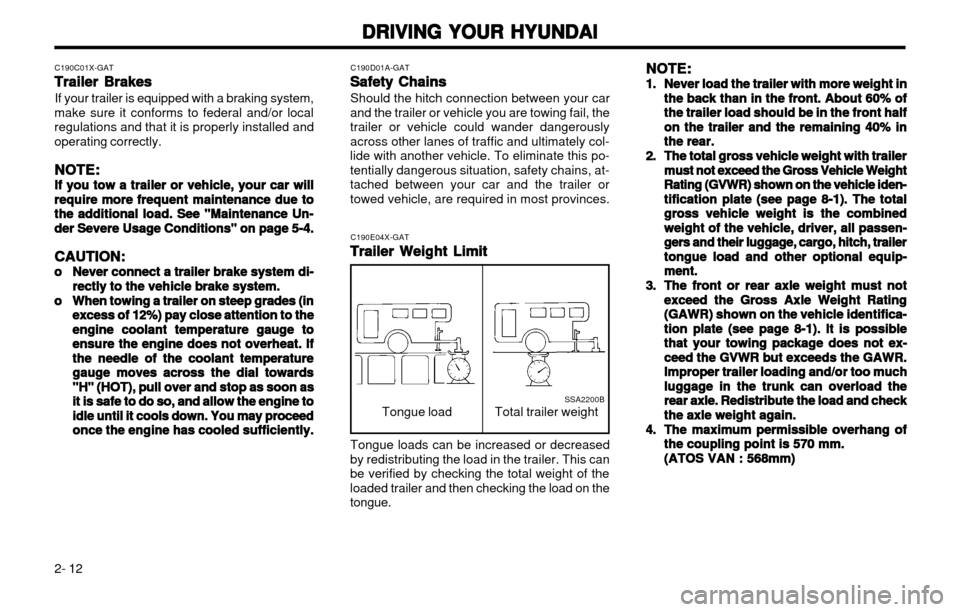
C190E04X-GATTrailer Weight Limit
Trailer Weight Limit Trailer Weight Limit
Trailer Weight Limit
Trailer Weight Limit
Tongue load Total trailer weightSSA2200B
Tongue loads can be increased or decreased
by redistributing the load in the trailer. This can be verified by checking the total weight of the
loaded trailer and then checking the load on thetongue.
C190C01X-GAT
Trailer Brakes
Trailer Brakes Trailer Brakes
Trailer Brakes
Trailer Brakes
If your trailer is equipped with a braking system,
make sure it conforms to federal and/or localregulations and that it is properly installed andoperating correctly.
NOTE:
NOTE: NOTE:
NOTE:
NOTE:
If you tow a trailer or vehicle, your car will
If you tow a trailer or vehicle, your car will If you tow a trailer or vehicle, your car will
If you tow a trailer or vehicle, your car will
If you tow a trailer or vehicle, your car will require more frequent
require more frequent require more frequent
require more frequent
require more frequent maintenance due to
maintenance due to maintenance due to
maintenance due to
maintenance due to
the additional load. See "Maintenance Un-
the additional load. See "Maintenance Un- the additional load. See "Maintenance Un-
the additional load. See "Maintenance Un-
the additional load. See "Maintenance Un-
der Severe
der Severe der Severe
der Severe
der Severe Usage Conditions" on page 5-4.
Usage Conditions" on page 5-4. Usage Conditions" on page 5-4.
Usage Conditions" on page 5-4.
Usage Conditions" on page 5-4.
CAUTION:
CAUTION: CAUTION:
CAUTION:
CAUTION:
oo
oo
o
Never connect a trailer brake system di-
Never connect a trailer brake system di- Never connect a trailer brake system di-
Never connect a trailer brake system di-
Never connect a trailer brake system di-
rectly
rectly rectly
rectly
rectly to the vehicle brake system.
to the vehicle brake system. to the vehicle brake system.
to the vehicle brake system.
to the vehicle brake system.
oo
oo
o
When towing a trailer on steep grades (in
When towing a trailer on steep grades (in When towing a trailer on steep grades (in
When towing a trailer on steep grades (in
When towing a trailer on steep grades (in
excess of 12%) pay close
excess of 12%) pay close excess of 12%) pay close
excess of 12%) pay close
excess of 12%) pay close
attention to the
attention to the attention to the
attention to the
attention to the
engine coolant temperature gauge to
engine coolant temperature gauge to engine coolant temperature gauge to
engine coolant temperature gauge to
engine coolant temperature gauge to
ensure the engine does
ensure the engine does ensure the engine does
ensure the engine does
ensure the engine does not overheat. If
not overheat. If not overheat. If
not overheat. If
not overheat. If
the needle of the coolant temperature
the needle of the coolant temperature the needle of the coolant temperature
the needle of the coolant temperature
the needle of the coolant temperature
gauge moves across
gauge moves across gauge moves across
gauge moves across
gauge moves across the dial towards
the dial towards the dial towards
the dial towards
the dial towards
"H" (HOT), pull over and stop as soon as
"H" (HOT), pull over and stop as soon as "H" (HOT), pull over and stop as soon as
"H" (HOT), pull over and stop as soon as
"H" (HOT), pull over and stop as soon as
it is safe to do
it is safe to do it is safe to do
it is safe to do
it is safe to do so, and allow the engine to
so, and allow the engine to so, and allow the engine to
so, and allow the engine to
so, and allow the engine to
idle until it cools down. You may proceed
idle until it cools down. You may proceed idle until it cools down. You may proceed
idle until it cools down. You may proceed
idle until it cools down. You may proceed
once
once once
once
once the engine has cooled sufficiently.
the engine has cooled sufficiently. the engine has cooled sufficiently.
the engine has cooled sufficiently.
the engine has cooled sufficiently.
Page 77 of 249
DRIVING YOUR HYUNDAI
DRIVING YOUR HYUNDAI DRIVING YOUR HYUNDAI
DRIVING YOUR HYUNDAI
DRIVING YOUR HYUNDAI
2- 14
11. Avoid jerky starts, sudden acceleration or
sudden stops.
12. Avoid sharp turns and rapid lane changes.
13. Avoid holding the brake pedal down too long or too frequently. This could cause the brakes to overheat, resulting in reduced brakingefficiency.
14. When going down a hill, shift into a lower gear and use the engine braking effect. When ascending a long grade, downshift the transaxle to a lower gear and reduce speedto reduce chances of engine overloadingand/or overheating.
15. If you have to stop while going uphill, do not hold the vehicle in place by pressing on theaccelerator. This can cause the automatictransaxle to overheat. Use the parking brakeor footbrake.
NOTE:
NOTE: NOTE:
NOTE:
NOTE:
When towing check transaxle fluid more
When towing check transaxle fluid more When towing check transaxle fluid more
When towing check transaxle fluid more
When towing check transaxle fluid more frequently.
frequently. frequently.
frequently.
frequently.
CAUTION:
CAUTION: CAUTION:
CAUTION:
CAUTION:
If overheating should occur when towing,
If overheating should occur when towing, If overheating should occur when towing,
If overheating should occur when towing,
If overheating should occur when towing,(temperature gauge reads near red zone),
(temperature gauge reads near red zone), (temperature gauge reads near red zone),
(temperature gauge reads near red zone),
(temperature gauge reads near red zone),
taking the following action may reduce or
taking the following action may reduce or taking the following action may reduce or
taking the following action may reduce or
taking the following action may reduce or
eliminate the problem.
eliminate the problem. eliminate the problem.
eliminate the problem.
eliminate the problem. 1. Turn off the air conditioner.
2. Reduce highway speed.
3. Select a lower gear when going uphill.
4. While in stop and go traffic, place the gear
selector in park or neutral and idle the en- gine at a higher speed.
Page 79 of 249
WHAT TO DO IN AN EMERGENCY
WHAT TO DO IN AN EMERGENCY WHAT TO DO IN AN EMERGENCY
WHAT TO DO IN AN EMERGENCY
WHAT TO DO IN AN EMERGENCY
3-2 2. Turn off all unnecessary lights and acces-
sories in both vehicles.
3. Attach the clamps of the jumper cable in the exact order shown in the illustration. That is, first, attach one clamp of the jumper cable tothe positive (+) post or cable of the dis-charged battery. Then attach the other endof the same cable to the positive (+) post orcable of the booster battery. Next, using theother cable, attach one clamp to the nega-tive (-) post or cable of the booster battery.Then attach the other end of that cable to asolid metal part of the engine away from thebattery. Do not connect the cable to anymoving part.
4. Start the engine in the car with the booster battery and let it run for a few minutes. Thiswill help to assure that the booster battery isfully charged. During the jumping operation,run the engine in this vehicle at about 2,000rpm.
5. Start your engine using the normal starting procedure. After the engine starts, leave thejumper cables connected and let the enginerun at fast idle or about 2,000 rpm for sev-eral minutes.
6. Carefully remove the jumper cables in the reverse order of attachment.
If you do not know why your battery becamedischarged (because the lights were left on,etc.), have the charging system checked byyour Hyundai dealer.
WARNING:
WARNING: WARNING:
WARNING:
WARNING:
The gas produced by the battery during the
The gas produced by the battery during the The gas produced by the battery during the
The gas produced by the battery during the
The gas produced by the battery during the jump start operation is highly explosive. If
jump start operation is highly explosive. If jump start operation is highly explosive. If
jump start operation is highly explosive. If
jump start operation is highly explosive. If
these instructions are not followed exactly,
these instructions are not followed exactly, these instructions are not followed exactly,
these instructions are not followed exactly,
these instructions are not followed exactly,
serious personal injury and damage to the
serious personal injury and damage to the serious personal injury and damage to the
serious personal injury and damage to the
serious personal injury and damage to the
vehicle may occur! If you are not sure how
vehicle may occur! If you are not sure how vehicle may occur! If you are not sure how
vehicle may occur! If you are not sure how
vehicle may occur! If you are not sure how
to follow this procedure, seek qualified as-
to follow this procedure, seek qualified as- to follow this procedure, seek qualified as-
to follow this procedure, seek qualified as-
to follow this procedure, seek qualified as-
sistance. Automobile batteries contain sul-
sistance. Automobile batteries contain sul- sistance. Automobile batteries contain sul-
sistance. Automobile batteries contain sul-
sistance. Automobile batteries contain sul-
furic acid. This is poisonous and highly
furic acid. This is poisonous and highly furic acid. This is poisonous and highly
furic acid. This is poisonous and highly
furic acid. This is poisonous and highly
corrosive. When jump starting, wear protec-
corrosive. When jump starting, wear protec- corrosive. When jump starting, wear protec-
corrosive. When jump starting, wear protec-
corrosive. When jump starting, wear protec-
tive glasses and be careful not to get acid on
tive glasses and be careful not to get acid on tive glasses and be careful not to get acid on
tive glasses and be careful not to get acid on
tive glasses and be careful not to get acid on
yourself, your clothing or on the car.
yourself, your clothing or on the car. yourself, your clothing or on the car.
yourself, your clothing or on the car.
yourself, your clothing or on the car.
o If you should accidentally get acid on your
skin or in your eyes, immediately remove any contaminated clothing and flush thearea with clear water for at least 15 minutes.Then promptly obtain medical attention. Ifyou must be transported to an emergencyfacility, continue to apply water to the affect-ed area with a sponge or cloth.
o The gas produced by the battery during the jump start operation is highly explosive. Donot smoke or allow a spark or an open flamein the vicinity.
o The battery being used to provide the jump start must be 12-volt. If you cannot deter-mine that it is a 12-volt battery, do notattempt to use it for the jump start.
o To jump start a car with a discharged bat- tery, follow this procedure exactly:
1. If the booster battery is installed in another vehicle, be sure the two vehicles are nottouching. D030A01A-AAT
IF THE ENGINE OVERHEATS
IF THE ENGINE OVERHEATS IF THE ENGINE OVERHEATS
IF THE ENGINE OVERHEATS
IF THE ENGINE OVERHEATS
If your temperature gauge indicates overheat-ing, you experience a loss of power, or hearloud pinging or knocking, the engine is probablytoo hot. If this happens to you, you should:
1. Pull off the road and stop as soon as it is safe to do so.
2. Place the gear selector lever in "P" (auto- matic transaxle), or neutral (manual
transaxle) and set the parking brake. If theair conditioning is on, turn it off.
3. If engine coolant is running out under the car or steam is coming out from the hood, stopthe engine. Do not open the hood until theengine coolant has stopped running or thesteaming has stopped. If there is no visibleloss of engine coolant and no steam, leavethe engine running and check to be sure theengine cooling fan is operating. If the fan isnot running, turn the engine off.
4. Check to see if the water pump drive belt is missing. If it is not missing, check to see thatit is tight. If the drive belt seems to besatisfactory, check for engine coolant leak-ing from the radiator, hoses or under the car.(If the air conditioning had been in use, it isnormal for cold water to be draining from itwhen you stop).
Page 80 of 249
WHAT TO DO IN AN EMERGENCY
WHAT TO DO IN AN EMERGENCY WHAT TO DO IN AN EMERGENCY
WHAT TO DO IN AN EMERGENCY
WHAT TO DO IN AN EMERGENCY
3-3
WARNING:
WARNING: WARNING:
WARNING:
WARNING:
While the engine is running, keep hands,
While the engine is running, keep hands, While the engine is running, keep hands,
While the engine is running, keep hands,
While the engine is running, keep hands, long hair
long hair long hair
long hair
long hair
and clothing away from moving
and clothing away from moving and clothing away from moving
and clothing away from moving
and clothing away from moving
parts such as the fan and drive belts to
parts such as the fan and drive belts to parts such as the fan and drive belts to
parts such as the fan and drive belts to
parts such as the fan and drive belts to
prevent
prevent prevent
prevent
prevent
injury.
injury. injury.
injury.
injury.
5. If the water pump drive belt is broken or engine coolant is leaking out, stop the en- gine immediately and call the nearestHyundai dealer for assistance.
WARNING:
WARNING: WARNING:
WARNING:
WARNING:
Do not remove the radiator cap when the
Do not remove the radiator cap when the Do not remove the radiator cap when the
Do not remove the radiator cap when the
Do not remove the radiator cap when the engine is hot. This may allow
engine is hot. This may allow engine is hot. This may allow
engine is hot. This may allow
engine is hot. This may allow coolant to be
coolant to be coolant to be
coolant to be
coolant to be
blown out of the opening and cause serious
blown out of the opening and cause serious blown out of the opening and cause serious
blown out of the opening and cause serious
blown out of the opening and cause serious
burns.
burns. burns.
burns.
burns.
6. If you cannot find the cause of the overheat-
ing, wait until the engine temperature has returned to normal. Then, if engine coolanthas been lost, carefully remove the radiator
cap and add engine coolant to bring the fluidlevel in the reservoir up to the halfway mark.
7. Proceed with caution, keeping alert for fur- ther signs of overheating. If overheating hap-pens again, call a Hyundai dealer for assis-tance.
CAUTION:
CAUTION: CAUTION:
CAUTION:
CAUTION:
Serious loss of engine coolant indicates
Serious loss of engine coolant indicates Serious loss of engine coolant indicates
Serious loss of engine coolant indicates
Serious loss of engine coolant indicates there is a leak in
there is a leak in there is a leak in
there is a leak in
there is a leak in the cooling system and this
the cooling system and this the cooling system and this
the cooling system and this
the cooling system and this
should be checked as soon as possible by a
should be checked as soon as possible by a should be checked as soon as possible by a
should be checked as soon as possible by a
should be checked as soon as possible by a
Hyundai
Hyundai Hyundai
Hyundai
Hyundai dealer.
dealer. dealer.
dealer.
dealer. D040A01A-GAT
SPARE TIRE
SPARE TIRE SPARE TIRE
SPARE TIRE
SPARE TIRE
The following instructions for the FULL SIZE
spare tire should be observed:
Check inflation pressure as soon as practical
after installing the spare tire, and adjust to the specified pressure. The tire pressure should beperiodically checked and maintained at thespecified pressure while the tire is stored.
Tire Size Inflation Pressure Full Size 210 kPa (30 psi)
Spare Tire Pressure
D040B01A-AAT
Handling the Spare Tire
Handling the Spare Tire Handling the Spare Tire
Handling the Spare Tire
Handling the Spare Tire
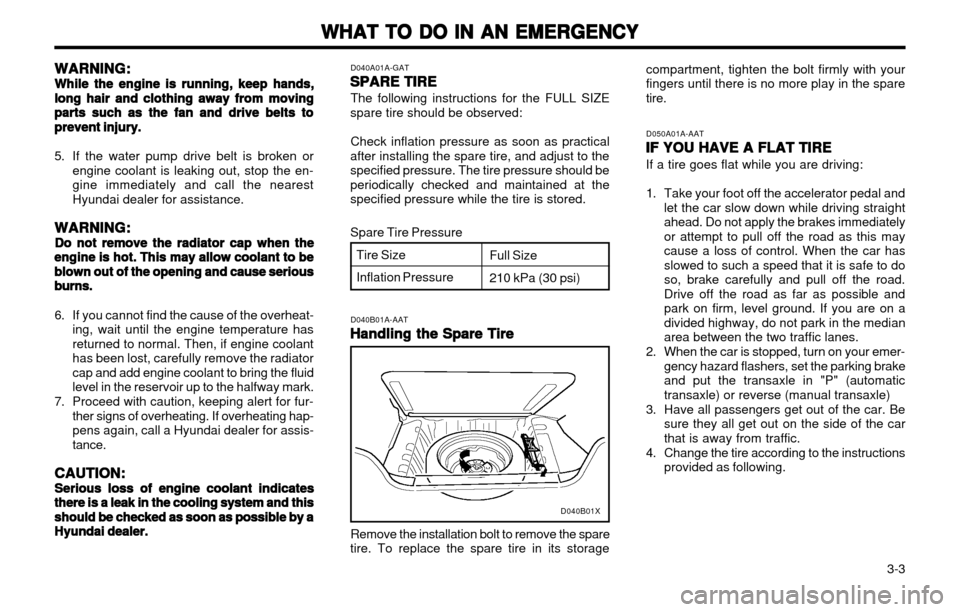
Remove the installation bolt to remove the spare
tire. To replace the spare tire in its storage D050A01A-AAT
IF YOU HAVE A FLAT TIRE
IF YOU HAVE A FLAT TIRE IF YOU HAVE A FLAT TIRE
IF YOU HAVE A FLAT TIRE
IF YOU HAVE A FLAT TIRE If a tire goes flat while you are driving:
1. Take your foot off the accelerator pedal and
let the car slow down while driving straight ahead. Do not apply the brakes immediatelyor attempt to pull off the road as this may
cause a loss of control. When the car hasslowed to such a speed that it is safe to doso, brake carefully and pull off the road.Drive off the road as far as possible and
park on firm, level ground. If you are on adivided highway, do not park in the medianarea between the two traffic lanes.
2. When the car is stopped, turn on your emer- gency hazard flashers, set the parking brakeand put the transaxle in "P" (automatic
transaxle) or reverse (manual transaxle)
3. Have all passengers get out of the car. Be sure they all get out on the side of the carthat is away from traffic.
4. Change the tire according to the instructions provided as following.
compartment, tighten the bolt firmly with yourfingers until there is no more play in the sparetire.
D040B01X