tyre pressure Hyundai Atos 2002 Owner's Manual
[x] Cancel search | Manufacturer: HYUNDAI, Model Year: 2002, Model line: Atos, Model: Hyundai Atos 2002Pages: 249, PDF Size: 3.11 MB
Page 192 of 249
DRIVING YOUR HYUNDAI 2- 3
C050A01A-AAT
STARTING (For Multiport Fuel Injection)
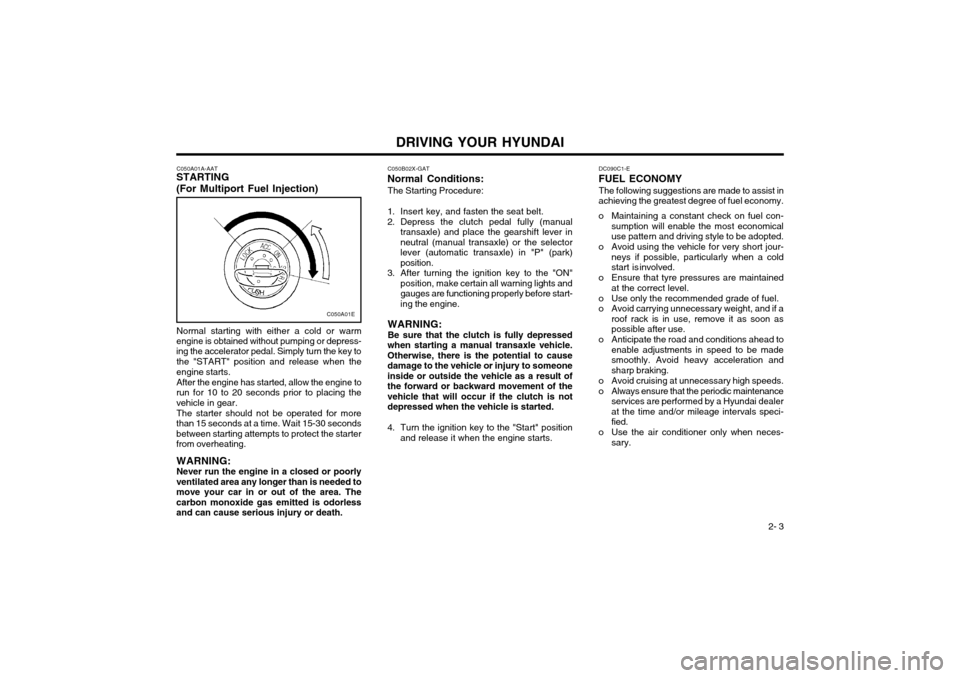
Normal starting with either a cold or warm
engine is obtained without pumping or depress- ing the accelerator pedal. Simply turn the key to
the "START" position and release when the
engine starts.
After the engine has started, allow the engine to
run for 10 to 20 seconds prior to placing thevehicle in gear.
The starter should not be operated for more
than 15 seconds at a time. Wait 15-30 secondsbetween starting attempts to protect the starterfrom overheating.
WARNING:Never run the engine in a closed or poorly
ventilated area any longer than is needed tomove your car in or out of the area. Thecarbon monoxide gas emitted is odorlessand can cause serious injury or death. C050B02X-GAT
Normal Conditions:
The Starting Procedure:
1. Insert key, and fasten the seat belt.
2. Depress the clutch pedal fully (manual transaxle) and place the gearshift lever in neutral (manual transaxle) or the selectorlever (automatic transaxle) in "P" (park)position.
3. After turning the ignition key to the "ON" position, make certain all warning lights andgauges are functioning properly before start-
ing the engine.
WARNING: Be sure that the clutch is fully depressed
when starting a manual transaxle vehicle. Otherwise, there is the potential to cause
damage to the vehicle or injury to someoneinside or outside the vehicle as a result ofthe forward or backward movement of the
vehicle that will occur if the clutch is notdepressed when the vehicle is started.
4. Turn the ignition key to the "Start" position and release it when the engine starts. DC090C1-E
FUEL ECONOMY
The following suggestions are made to assist in
achieving the greatest degree of fuel economy.
o Maintaining a constant check on fuel con- sumption will enable the most economical use pattern and driving style to be adopted.
o Avoid using the vehicle for very short jour- neys if possible, particularly when a coldstart is involved.
o Ensure that tyre pressures are maintained at the correct level.
o Use only the recommended grade of fuel.
o Avoid carrying unnecessary weight, and if a roof rack is in use, remove it as soon aspossible after use.
o Anticipate the road and conditions ahead to enable adjustments in speed to be madesmoothly. Avoid heavy acceleration andsharp braking.
o Avoid cruising at unnecessary high speeds.
o Always ensure that the periodic maintenance services are performed by a Hyundai dealer at the time and/or mileage intervals speci-fied.
o Use the air conditioner only when neces- sary.
C050A01E
Page 201 of 249
DRIVING YOUR HYUNDAI
2- 12 15. If you have to stop while going uphill, do not
hold the vehicle in place by pressing on the accelerator. This can cause the automatictransaxle to overheat. Use the parking brakeor footbrake.
NOTE: When towing, check transaxle fluid more frequently. CAUTION: If overheating should occur when towing,
(temperature gauge reads near red zone),taking the following action may reduce oreliminate the problem.
1. Turn off the air conditioner.
2. Reduce highway speed.
3. Select a lower gear when going uphill.
4. While in stop and go traffic, place the gear selection in park or neutral and idle theengine at a higher speed.
being passed by a large vehicle, keep aconstant speed and steer straight ahead. If there is too much wind buffeting, slow
down to get out of the other vehicle's airturbulence.
8. When parking your car and trailer, especial- ly on a hill, be sure to follow all the normalprecautions. Turn your front wheel into thecurb, set the parking brake firmly, and putthe transaxle in 1st or Reverse (manual) orPark (automatic). In addition, place wheelchocks at each of the trailer's tyres.
9. If the trailer has electric brakes, start your vehicle and trailer moving, and then applythe trailer brake controller by hand to be
sure the brakes are working. This lets you
check your electrical connection at the sametime.
10. During your trip, check occasionally to be sure that the load is secure, and that thelights and any trailer brakes are still working.
11. Avoid jerky starts, sudden acceleration or sudden stops.
12. Avoid sharp turns and rapid lane changes.
13. Avoid holding the brake pedal down too long or too frequently. This could cause the brakes to overheat, resulting in reduced brakingefficiency.
14. When going down a hill, shift into a lower gear and use the engine braking effect.When ascending a long grade, downshift thetransaxle to a lower gear and reduce speedto reduce chances of engine overloading
and or overheating.
WARNING:
o The tongue load should never exceed;
Auto Transaxle : 55.1 lb Manual Transaxle 9: 61.7 lb
o Maximun permissible mass of the cou- pling device (ATOS VAN only) : 44 lb
o Improperly loading your car and trailer can serious affect its steering and brak- ing performance causing a crash in which
you may be seriously injured or killed.
YC200E1-A
Trailer or Vehicle Towing Tips
1. Before towing, check hitch and safety chain connections as well as proper operation of the trailer running lights, brake lights, andturn signals.
2. Always drive your vehicle at a moderate speed (Less than 62 MPH).
3. Trailer towing requires more fuel than nor- mal conditions.
4. To maintain engine braking efficiency and electrical charging performance, do not usefifth gear (manual transaxle) or overdrive(automatic transaxle).
5. Always secure items in the trailer to prevent load shift while driving.
6. Check the condition and air pressure of all tires on the trailer and your car. Low tyrepressure can seriously affect the handling.Also check the spare tyre.
7. The vehicle/trailer combination is more af- fected by crosswind and buffeting. When
Page 204 of 249
3-3
WHAT TO DO IN AN EMERGENCY
ZD050B1-E
Handling Spare Tyre
6. If the cause of the overheating cannot be
found, wait until the engine temperature has returned to normal. Then, if coolant hasbeen lost, carefully remove the radiator capand add water to bring the fluid level in thereservoir up to the base of the radiator fill
opening. Fill the coolant expansion tank tothe halfway mark.
7. Proceed with caution until it is established that the engine is operating normally. If theengine overheats repeatedly, the advice of aHyundai dealer should be sought.
CAUTION: Serious loss of coolant indicates there is aleak in the cooling system and this shouldbe checked as soon as possible by a Hyundaidealer. 3. Passengers must not be allowed to remain
inside the vehicle during wheel changing. Ifa puncture occurs whilst the vehicle is on amotorway, the passengers should take ref-uge on the motorway embankment to avoidthe possibility of injury occurring should thevehicle be struck by other motorway traffic.
4. Wheel changing should be performed ac- cording to the following instructions.
ZD050A1-E
FULL-SIZED SPARE TYRE For customer convenience and satisfaction,Hyundai has included a full-sized spare tyreand wheel. The following instructions should be observed.
1. Check inflation pressure as soon as possi- ble after installing the spare tyre, and adjust to the specified pressure.
2. The spare tyre pressure should be checked once a month while the tyre is stored.
Spare Tyre Pressure (cold)
D040B01X
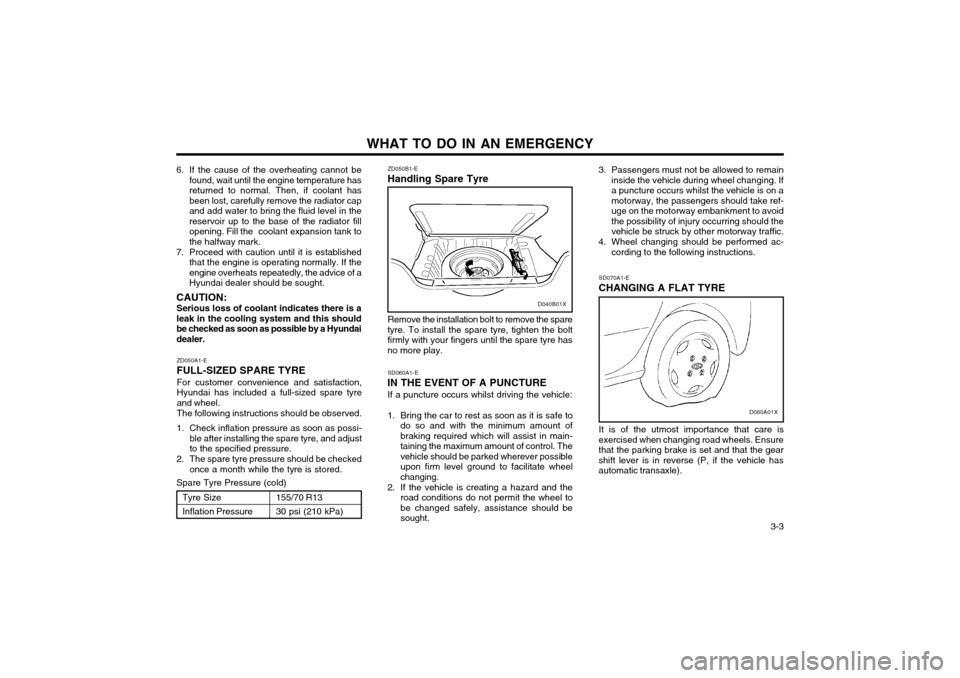
Remove the installation bolt to remove the spare
tyre. To install the spare tyre, tighten the bolt firmly with your fingers until the spare tyre hasno more play.
SD060A1-E
IN THE EVENT OF A PUNCTURE
If a puncture occurs whilst driving the vehicle:
1. Bring the car to rest as soon as it is safe to do so and with the minimum amount ofbraking required which will assist in main-taining the maximum amount of control. Thevehicle should be parked wherever possibleupon firm level ground to facilitate wheelchanging.
2. If the vehicle is creating a hazard and the road conditions do not permit the wheel tobe changed safely, assistance should besought. SD070A1-E
CHANGING A FLAT TYRE
D060A01X
It is of the utmost importance that care is
exercised when changing road wheels. Ensure that the parking brake is set and that the gearshift lever is in reverse (P, if the vehicle hasautomatic transaxle).
Tyre Size Inflation Pressure 155/70 R1330 psi (210 kPa)
Page 207 of 249
WHAT TO DO IN AN EMERGENCY
3-6 SD070I1-E
7. Re-install Wheel Nuts
D060H01A
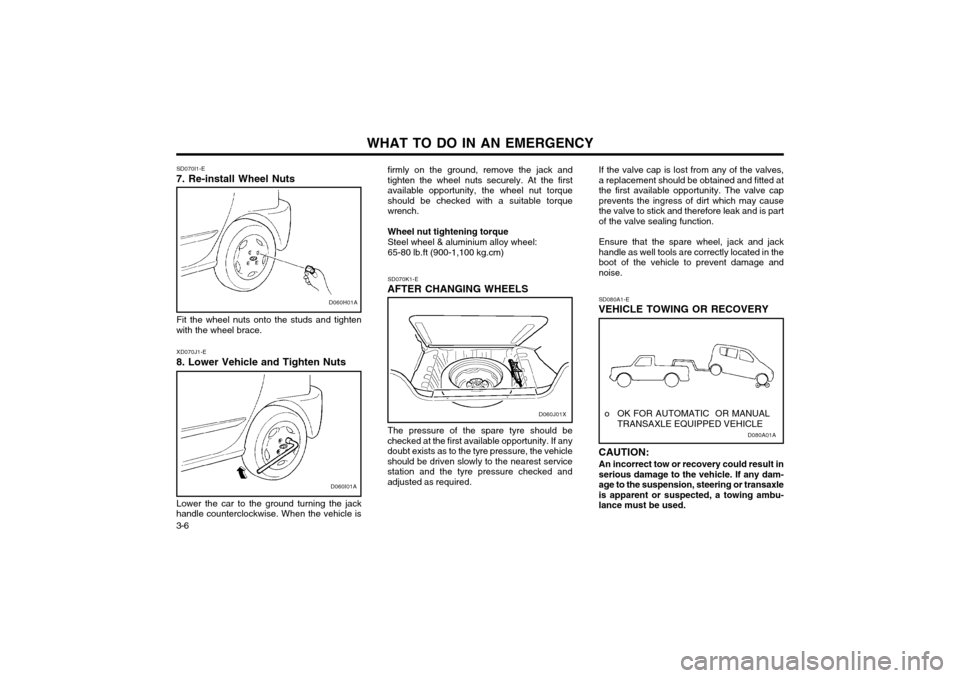
Fit the wheel nuts onto the studs and tighten
with the wheel brace.
D060I01A
XD070J1-E
8. Lower Vehicle and Tighten Nuts
Lower the car to the ground turning the jack
handle counterclockwise. When the vehicle is firmly on the ground, remove the jack and tighten the wheel nuts securely. At the firstavailable opportunity, the wheel nut torqueshould be checked with a suitable torquewrench. Wheel nut tightening torque Steel wheel & aluminium alloy wheel:65-80 lb.ft (900-1,100 kg.cm) SD070K1-E
AFTER CHANGING WHEELS
The pressure of the spare tyre should be
checked at the first available opportunity. If any doubt exists as to the tyre pressure, the vehicleshould be driven slowly to the nearest servicestation and the tyre pressure checked andadjusted as required. If the valve cap is lost from any of the valves,a replacement should be obtained and fitted atthe first available opportunity. The valve capprevents the ingress of dirt which may causethe valve to stick and therefore leak and is partof the valve sealing function. Ensure that the spare wheel, jack and jack handle as well tools are correctly located in theboot of the vehicle to prevent damage andnoise.
D080A01A
o OK FOR AUTOMATIC OR MANUAL
TRANSAXLE EQUIPPED VEHICLE
SD080A1-E
VEHICLE TOWING OR RECOVERY CAUTION:
An incorrect tow or recovery could result in serious damage to the vehicle. If any dam-age to the suspension, steering or transaxleis apparent or suspected, a towing ambu-lance must be used.D060J01X
Page 214 of 249
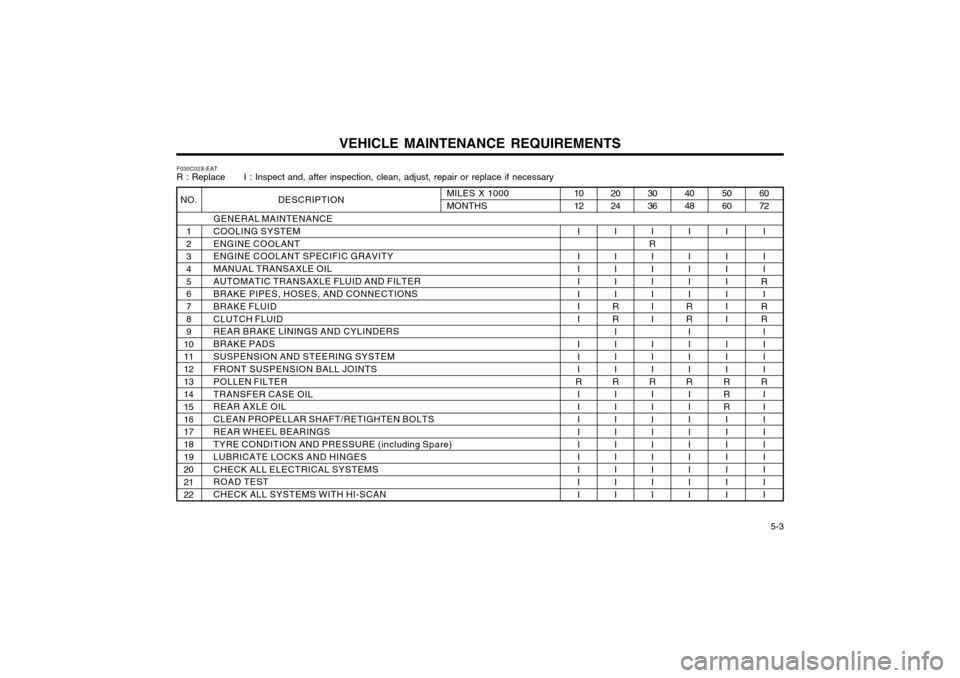
VEHICLE MAINTENANCE REQUIREMENTS 5-3
F030C02X-EAT R : Replace I : Inspect and, after inspection, clean, adjust, repair or replace if necessary
DESCRIPTION
GENERAL MAINTENANCE COOLING SYSTEMENGINE COOLANT ENGINE COOLANT SPECIFIC GRAVITY MANUAL TRANSAXLE OILAUTOMATIC TRANSAXLE FLUID AND FILTER BRAKE PIPES, HOSES, AND CONNECTIONS BRAKE FLUIDCLUTCH FLUID REAR BRAKE LININGS AND CYLINDERS BRAKE PADSSUSPENSION AND STEERING SYSTEM FRONT SUSPENSION BALL JOINTS POLLEN FILTERTRANSFER CASE OIL REAR AXLE OIL CLEAN PROPELLAR SHAFT/RETIGHTEN BOLTSREAR WHEEL BEARINGS TYRE CONDITION AND PRESSURE (incl uding Spare)
LUBRICATE LOCKS AND HINGES CHECK ALL ELECTRICAL SYSTEMS ROAD TEST CHECK ALL SYSTEMS WITH HI-SCAN
60 72
I I I
R I
R R
I I II
R
II I II I II I
50 60
I I I II I I I II
RRR III I II I
40 48
I I I II
RR
I I II
R
II I II I II I
30 36
I
R I I II I I I II
R
II I II I II I
20 24
I I I II
RR
I I II
R
II I II I II I
10 12
I I I II I I I II
R
II I II I II I
MILES X 1000 MONTHSNO.
1 2 3 45 6 78 9
1011 1213 14 1516 17 1819 20 2122
Page 220 of 249
DO-IT-YOURSELF MAINTENANCE
6-2 ZG020B1-E
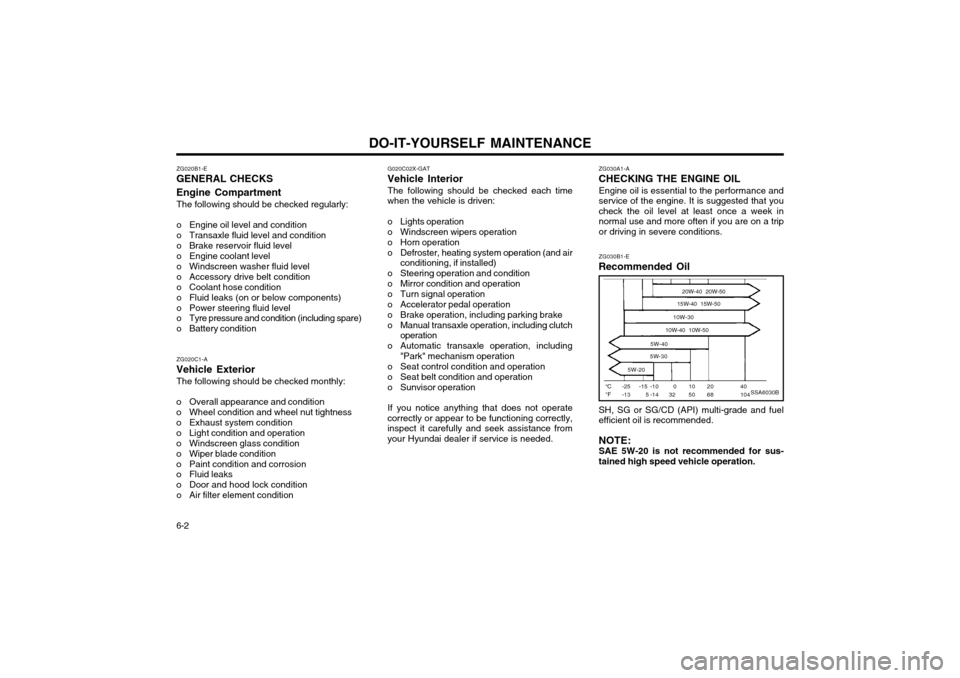
GENERAL CHECKS Engine Compartment
The following should be checked regularly:
o Engine oil level and condition
o Transaxle fluid level and condition
o Brake reservoir fluid level
o Engine coolant level
o Windscreen washer fluid level
o Accessory drive belt condition
o Coolant hose condition
o Fluid leaks (on or below components)
o Power steering fluid level
o Tyre pressure and condition (including spare)
o Battery condition ZG020C1-A
Vehicle Exterior
The following should be checked monthly:
o Overall appearance and condition
o Wheel condition and wheel nut tightness
o Exhaust system condition
o Light condition and operation
o Windscreen glass condition
o Wiper blade condition
o Paint condition and corrosion
o Fluid leaks
o Door and hood lock condition o Air filter element condition G020C02X-GAT
Vehicle Interior
The following should be checked each time
when the vehicle is driven:
o Lights operation
o Windscreen wipers operation
o Horn operation
o Defroster, heating system operation (and air conditioning, if installed)
o Steering operation and condition
o Mirror condition and operation
o Turn signal operation
o Accelerator pedal operation
o Brake operation, including parking brake
o Manual transaxle operation, including clutch operation
o Automatic transaxle operation, including "Park" mechanism operation
o Seat control condition and operation
o Seat belt condition and operation
o Sunvisor operation
If you notice anything that does not operate
correctly or appear to be functioning correctly, inspect it carefully and seek assistance fromyour Hyundai dealer if service is needed. ZG030A1-A
CHECKING THE ENGINE OIL
Engine oil is essential to the performance andservice of the engine. It is suggested that youcheck the oil level at least once a week innormal use and more often if you are on a tripor driving in severe conditions. ZG030B1-E
Recommended Oil
SSA6030B°C °F -25-13 20W-40 20W-50
15W-40 15W-50
10W-30
10W-40 10W-50
5W-40
5W-30
5W-20
40104
2068
1050
032
-15 5 -10-14
SH, SG or SG/CD (API) multi-grade and fuel efficient oil is recommended. NOTE: SAE 5W-20 is not recommended for sus-tained high speed vehicle operation.
Page 241 of 249
CONSUMER INFORMATION 8-1
ZI010B1-A Engine Number
ZI010A1-E VEHICLE IDENTIFICATIONNUMBER (VIN)
ZI000A1-E
8. CONSUMER IN
FORMATION
I010A01A
The vehicle identification number (VIN) is the number used in registering your car and in alllegal matters pertaining to its ownership, etc.
o On the identification plate attached to theengine side of the firewall between the en- gine and passenger compartments.
I010B01A
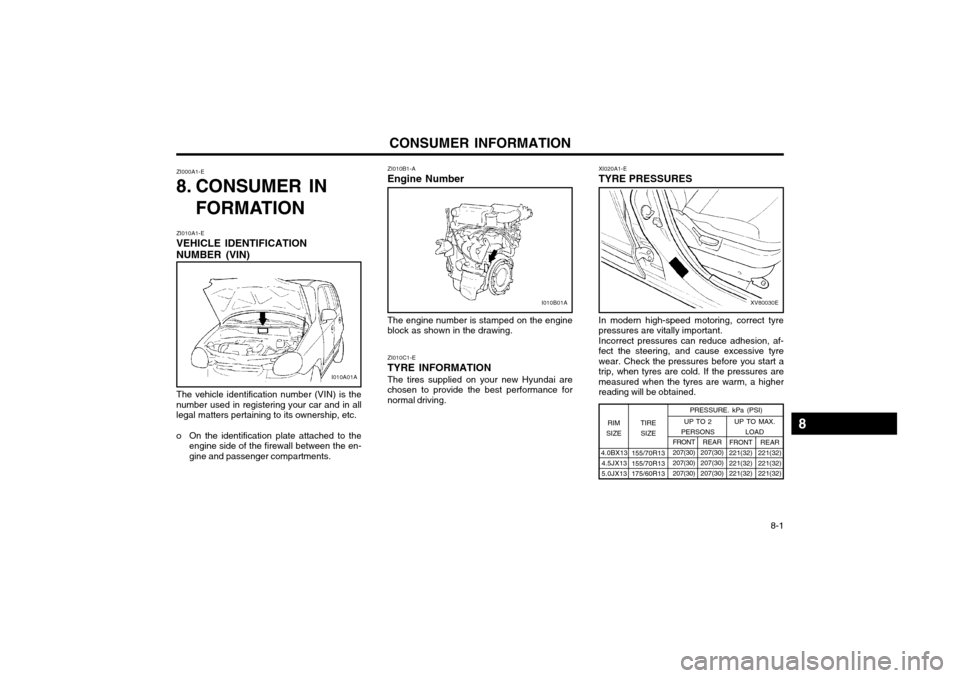
The engine number is stamped on the engine block as shown in the drawing. ZI010C1-E TYRE INFORMATIONThe tires supplied on your new Hyundai are chosen to provide the best performance fornormal driving. XI020A1-E TYRE PRESSURES
XV80030E
In modern high-speed motoring, correct tyre pressures are vitally important.Incorrect pressures can reduce adhesion, af-fect the steering, and cause excessive tyrewear. Check the pressures before you start atrip, when tyres are cold. If the pressures aremeasured when the tyres are warm, a higherreading will be obtained.
8
4.0BX13 4.5JX13 5.0JX13 TIRE
SIZE PRESSURE. kPa (PSI)
155/70R13155/70R13 175/60R13 REAR
207(30) 207(30)207(30) FRONT
221(32)221(32) 221(32)
UP TO 2
PERSONS UP TO MAX.
LOAD
REAR
221(32) 221(32) 221(32)
FRONT 207(30)207(30)207(30)
RIM
SIZE
Page 249 of 249
INDEX10-3
POWER STEER
ING HOSES ........................................................... 6-16
POWER WINDOWS ........................................................................... 1-6
R
REAR FOG LIGHT SWITCH ............................................................ 1-29
REAR WINDOW WIPER AND WASHER ........................................1-23
REMOTE FUEL FILLER LID RELEASE ..........................................1-29
REMOTE TAIL GATE RELEASE ..................................................... 1-29
RUNNING IN ...................................................................................... 1-1
S SCHEDULED MAINTENANCE ................................................. 5-2 ~ 5-3
SEAT BELT PRECAUTIONS ............................................................. 1-7
SEAT BELTS ........................................................................... 1-8 ~ 1-10
SNOW TYRES ................................................................................... 8-1
SPARE TYRE .............................................................................. 3-3, 8-3
SPARK PLUG RE PLACEMENT........................................................ 6-7
SPECIFIATIONS .......................................................................... 9-1, 9-3
SPEEDOMETER .............................................................................. 1-21
SRS AIRBAG SYSTEM ......................................................... 1-12 ~ 1-15
STARTING .......................................................................................... 2-3
STEERING WHEEL FREEPLAY ..................................................... 6-13
STEREO RADIO AND CASSETTE TAPE PLAYER OPERATION (H900) ........................................................ 1-42 ~ 1-44
STEREO RADIO OPERATION (H922M) .............................. 1-45 ~ 1-46
STEREO RADIO OPERATION (HMR90) ............................. 1-40 ~ 1-41
STEREO SOUND SYSTEM .................................................. 1-38 ~ 1-39
SUN-VISOR ...................................................................................... 1-31
T TAIL GATE
....................................................................................... 1-28
TRAILER OR VEHICLE TOWING ........................................ 2-10 ~ 2-12
TRANSAXLE FLUID (AUTOMATIC) ..................................... 6-10 ~ 6-11
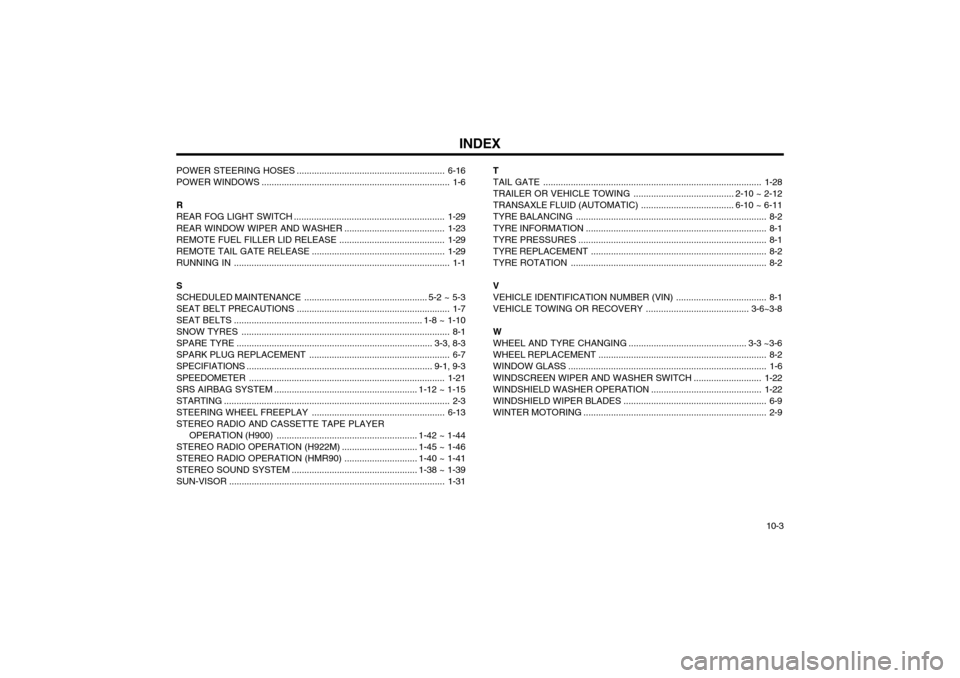
TYRE BALANCING ............................................................................ 8-2
TYRE INFORMATION ........................................................................ 8-1
TYRE PRESSURES ........................................................................... 8-1
TYRE REPLACEMEN T ...................................................................... 8-2
TYRE ROTATION .............................................................................. 8-2
V VEHICLE IDENTIFICATION NUMBER (VIN) .................................... 8-1
VEHICLE TOWING OR RECOVERY ................ .........................3-6~3-8
W WHEEL AND TYRE CHANGING ............................................... 3-3 ~3-6
WHEEL REPLACEMENT ................................................................... 8-2
WINDOW GLASS ............................................................................... 1-6
WINDSCREEN WIPER AND WASHER SWITCH ...........................1-22
WINDSHIELD WASHER OPERATION ............................................1-22
WINDSHIELD WIPER BLADES ......................................................... 6-9
WINTER MOTORING ......................................................................... 2-9