back seat Hyundai Atos 2003 Owner's Manual
[x] Cancel search | Manufacturer: HYUNDAI, Model Year: 2003, Model line: Atos, Model: Hyundai Atos 2003Pages: 127, PDF Size: 1.55 MB
Page 14 of 127

FEATURES OF YOUR HYUNDAI
1- 6 To raise or lower the window, turn the window regulator handle clockwise or counterclockwise. WARNING: When opening or closing the windows, makesure your passenger's arms, hands and bodyare safely out of the way.
B050A01A-AAT WINDOW GLASS
B050A01A
B080D02A-AAT Adjustable Headrests (If installed) Headrests are designed to help reduce the risk of neck injuries.To raise the headrest, pull it up. To lower it, pushit down while pressing the lock knob. WARNING:
o For maximum effectiveness in case of an
accident the headrest should be adjustedso the top of the headrest is at the sameheight as the top of the occupant's ears.For this reason, the use of a cushion thatholds the body away from the seatback isnot recommended.
o Do not operate vehicle with the headrests removed as severe injury to an occupantmay occur in the event of an accident.B080D01A
Lock knob
The seat belt cannot provide full pretection to an occupant if the seat back is reclined.
Headrests may provide protection againstneck injuries when properly adjusted.
B080C01A-AAT Adjusting Seatback Angle To recline the seatback, lean forward to take your weight off it, then pull up on the recliner controllever at the outside edge of the seat. Now leanback until the desired seatback angle is achieved.To lock the seatback into position, release therecliner control lever. WARNING: To minimize risk of severe injury in the eventof a collision or a sudden stop, both the driverand passenger seatbacks should always bein an upright position while the vehicle is inmotion. The protection provided by the seatbelts and airbags may be reduced signifi-cantly when the seatbacks are reclined. Thereis greater risk that the driver and passengerwill slide under the belt which may result inserious injury if a crash occurs when theseatbacks are reclined.
B080C01A
Page 16 of 127

FEATURES OF YOUR HYUNDAI
1- 8 WARNING: Sitting in a reclined position or lying downwhen your vehicle is in motion can be dan-gerous. Even if you buckle up, your seat beltscan't do their job when you're reclined.The shoulder belt can't do its job because itwon't be against your body. Instead, it will bein front of you. In a crash you could go into itwith great force, receiving serious neck orother injuries.The lap belt can't do its job either. In a crashthe belt could go up over your abdomen. Thebelt forces would be applied there, not at yourpelvic bones.This could cause serious internal injuries.For proper protection when the vehicle is inmotion, have the seatback upright. Then sitwell back in the seat and wear your seat beltproperly. B160B01A-AAT Periodic Inspection It is recommended that all seat belts be inspected periodically for wear or damage of any kind.Parts of the system that are damaged should bereplaced as soon as possible.
B160A01S-GAT CARE OF SEAT BELTS Seat belt systems should never be disassembled or modified. In addition, care should be taken toassure that seat belts and belt hardware are notdamaged by seat hinges, doors or other abuse.
B150E01A-AAT Injured Person A seat belt should be used when an injured person is being transported. When this is neces-sary, you should consult a physician for recom-mendations. B150F01A-AAT One Person Per Belt Two people (including children) should never attempt to use a single seat belt. This couldincrease the severity of injuries in case of anaccident. B150G01A-AAT Do Not Lie Down To reduce the chance of injuries in the event of an accident, and to achieve maximum effective-ness of the restraint system, all passengersshould be sitting up and the front seats should bein an upright position when the car is moving. Aseat belt cannot operate properly if the person islying down in the rear seat or if the front seat is ina reclined position.
B150D01A-AAT Pregnant WomenThe use of a seat belt is recommended for pregnant women to lessen the chance of injury inan accident. When a seat belt is used, the lap beltportion should be placed as low and snugly aspossible on the hips, not across the abdomen.For specific recommendations, consult a physi-cian.
The possibility of injury or the severity of injury in
an accident will be decreased if this elementarysafety precaution is observed. In addition, thefollowing recommendations are made: B150B01A-GAT Infant or Small Child Some countries require the use of child restraint systems for infants and small children. Whetherthis is required by law or not, it is stronglyrecommended that a child restraint seat or infantrestraint system be used for infants or smallchildren weighing less than 18 kilograms (40pounds). B150C01A-AAT Larger Children Children who are too large for child restraint systems should occupy the
rear seat and use
the available lap/shoulder belts. The lap portionshould be fastened snug on the hips and as lowas possible. Check belt fit periodically. A child'ssquirming could move the belt out of position.If the larger child (over age 13) is in the front seat,the child should be securely restrained by theseat belt. Under no circumstances should thechild be allowed to stand or kneel on the seat.Children are afforded the most safety in the eventof an accident when they are restrained by aproper restraint system in the rear seat. Never
allow children to ride in the front passenger seat.
Page 18 of 127

FEATURES OF YOUR HYUNDAI
1- 10
SSA1090S
B220A01A-AAT SEAT BELTS (2-Point Static Type) (Rear Seat Center)To Fasten Your Seat Belt To fasten a 2-point static type belt, insert the metal tab into the locking buckle. There will be anaudible "click" when the tab locks into the buckle.Check to make sure the belt is properly lockedand that the belt is not twisted.
B200A01A-GAT Adjusting Your Seat Belt
YR10311B
You should place the belt as low as possible on your hips, not on your waist. If located too high onyour body, the chances of sliding out from underit and suffering serious injury or death are in-creased. Both arms should not be under or overthe belt. Rather, one should be over and the otherunder, as shown in the illustration.
B210A01A-AAT To Release the Seat Belt
YR10321B
The seat belt is released by pressing the release button in the locking buckle. When it is released,the belt should automatically draw back into theretractor.If this does not happen, check the belt to be sureit is not twisted, then try again.
Page 20 of 127
FEATURES OF YOUR HYUNDAI
1- 12 After installation of the child restraint system, try to move it in all directions to be sure the childrestraint system is securely installed.If you need to tighten the belt, pull more webbingtoward the retractor. When you unbuckle theseat belt and allow it to retract, the retractor willautomatically revert back to its normal seatedpassenger emergency locking usage condition. NOTE:
o Before installing the child restraint sys-
tem, read the instructions supplied by thechild restraint system manufacturer.
o If the seat belt does not operate as de- scribed, have the system checked imme-diately by your authorized Hyundai dealer.
WARNING:Do not install any child restraint system in thefront passenger seat. Should an accidentoccur and cause the passenger side airbagto deploy, it could severely injure or kill aninfant or child seated in an infant or childseat. Therefore, only use a child restraintsystem in the rear seat of your vehicle.
o Since a safety belt or child restraint sys-
tem can become very hot if it is left in aclosed vehicle, be sure to check the seatcover and buckles before placing a childthere.
o When the child restraint system is not in use, fasten it with a safety belt so that itwill not be thrown forward in the case of asudden stop or an accident.
o Children who are too large to be in a child restraint should sit in the rear seat and berestrained with the available lap/shoulderbelts. Never allow children to ride in thefront passenger seat.
o Always make sure that the shoulder belt portion of the outboard lap/shoulder beltis positioned midway over the shoulder,never across the neck. Moving the childcloser to the center of the vehicle may helpprovide a good shoulder belt fit. The lapbelt portion of the lap/shoulder belt or thecenter seat lap belt must always be posi-tioned as low as possible on the child'ships and as snug as possible.
o If the seat belt will not properly fit the child, we recommend the use of an ap-proved booster seat in the rear seat inorder to raise the child's seating height sothat the seat belt will properly fit the child.
o Never allow a child to stand up or kneel on the seat.
o Never use an infant carrier or child safety seat that "hooks" over a seatback; it may not provide adequate security in an acci-dent.
o Never allow a child to be held in a person's arms while they are in a moving vehicle, asthis could result in serious injury to thechild in the event of an accident or asudden stop. Holding a child in a movingvehicle does not provide the child withany means of protection during an acci-dent, even if the person holding the childis wearing a seat belt.
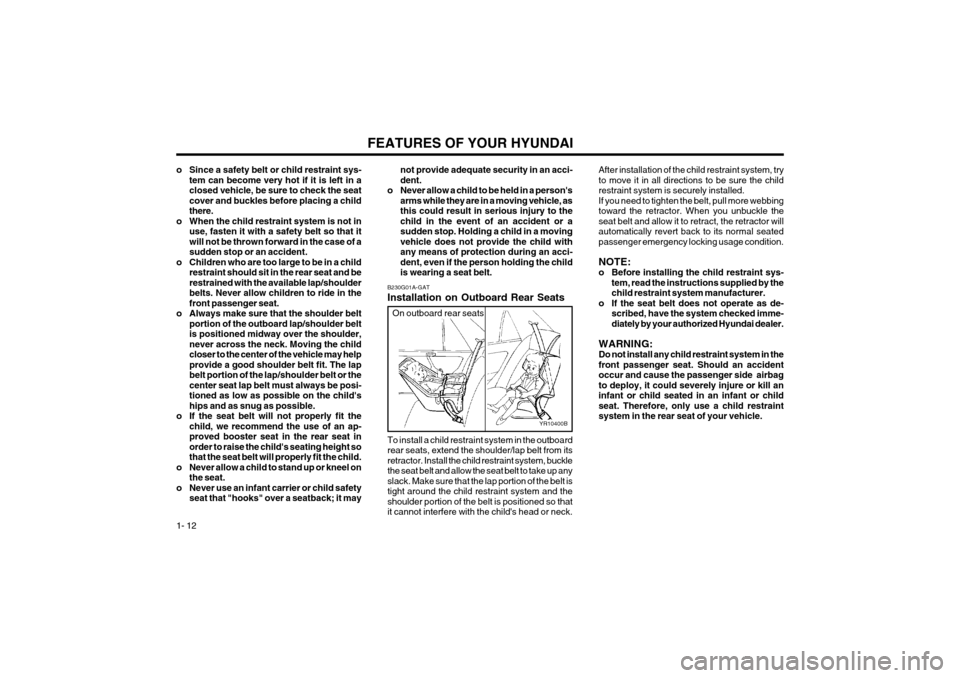
B230G01A-GAT Installation on Outboard Rear Seats
YR10400B
To install a child restraint system in the outboard rear seats, extend the shoulder/lap belt from itsretractor. Install the child restraint system, bucklethe seat belt and allow the seat belt to take up anyslack. Make sure that the lap portion of the belt istight around the child restraint system and theshoulder portion of the belt is positioned so thatit cannot interfere with the child's head or neck.
On outboard rear seats
Page 21 of 127

FEATURES OF YOUR HYUNDAI 1- 13
B240A03F-AAT SUPPLEMENTAL RESTRAINT (AIRBAG) SYSTEM (If installed)
AS10356A
Your Hyundai is equipped with a Supplemental Restraint (Airbag) System. The indications of thesystem's presence are the letters "SRS AIRBAG"embossed on the airbag pad cover in the steeringwheel and the passenger's side front panel padabove the glove box. The Hyundai SRS consists of airbags installed under the pad covers in the center of the steeringwheel and the passenger's side front panel abovethe glove box. The purpose of the SRS is toprovide the vehicle's driver and the front passen-ger with additional protection when used to-gether with the seat belt, in case of a frontalimpact. NOTE: Be sure to read information about the SRS onthe labels provided on the backside of thesun visor and in the glove box.
B180B01X-GAT Pre-tensioner Seat Belt (If installed)Ordinarily the pre-tensioner seat belt operates in the same way as E.L.R (Emergency LockingRetractor) type (When vehicles stop suddenly,
the belt will lock into the position. It will alsolock if you try to lean forward too quickly.) .
However, when vehicles crash, the retractorrewinds the belt webbing. This will restrain thepassenger movement quickly and also reducethe slack between passenger and belt webbing. NOTE:
o When the pre-tensioner seat belt is acti- vated, there may be an explosion noise.This noise is normal and is not hazardous.
o Pre-tensioner seat belt is designed to op- erate only when a sufficiently severe im-pact occurs and it will be only operatedonce.
WARNING:If the pre-tensioner seat belt was activated,never attempt to replace it by yourself. It mustbe replaced by an authorized Hyundai Dealer.
Age Group Seating PositionFront
Passenger Rear
Outboard Rear
Center
0 : Up to 10 kg (0 ~ 9 months)0+ : Up to 13 kg(0 ~ 2 years)I : 9kg to 18kg(9 months ~4 years)II & III : 15kg to 36kg(4 ~ 12 years)XUX
XUX
UF U UF
UF UF UF
U : Suitable for "universal" category restraints approved for use in this mass group
UF : Suitable for forward-facing "universal" cat- egory restraints approved for use in this mass group
X : Seat position not suitable for children in this mass group
B230H01X-GAT Child Seat Restraint Suitability For Seat Po- sitionUse child safety seats that have been officiallyapproved and are appropriate for your children.
Page 22 of 127
FEATURES OF YOUR HYUNDAI
1- 14 B240B03A-AAT SRS Components and Functions
o For maximum safety protection in all types
of crashes, all occupants including the driver should always wear their seat beltswhether or not an airbag is also providedat their seating position to minimize therisk of severe injury or death in the eventof a crash. Do not sit or lean unnecessarilyclose to the airbag while the vehicle is inmotion.
o The SRS airbag system must deploy very rapidly to provide protection in a crash. Ifan occupant is out of position because ofnot wearing a seat belt, the airbag mayforcefully contact the occupant causingserious or fatal injuries.
B240C01X
WARNING:
o As its name implies, the SRS is designed
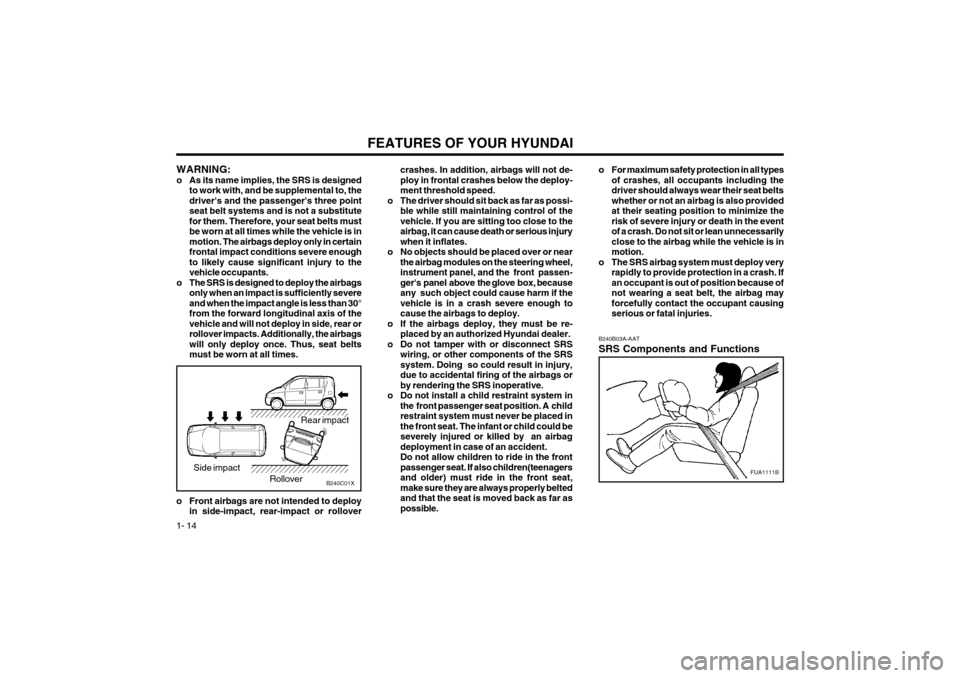
to work with, and be supplemental to, thedriver's and the passenger's three pointseat belt systems and is not a substitutefor them. Therefore, your seat belts mustbe worn at all times while the vehicle is inmotion. The airbags deploy only in certainfrontal impact conditions severe enoughto likely cause significant injury to thevehicle occupants.
o The SRS is designed to deploy the airbags only when an impact is sufficiently severeand when the impact angle is less than 30°from the forward longitudinal axis of thevehicle and will not deploy in side, rear orrollover impacts. Additionally, the airbagswill only deploy once. Thus, seat beltsmust be worn at all times.
Rear impact
Side impact Rollover
o Front airbags are not intended to deploy in side-impact, rear-impact or rollover crashes. In addition, airbags will not de-ploy in frontal crashes below the deploy-ment threshold speed.
o The driver should sit back as far as possi- ble while still maintaining control of thevehicle. If you are sitting too close to theairbag, it can cause death or serious injurywhen it inflates.
o No objects should be placed over or near the airbag modules on the steering wheel,instrument panel, and the front passen-ger's panel above the glove box, becauseany such object could cause harm if thevehicle is in a crash severe enough tocause the airbags to deploy.
o If the airbags deploy, they must be re- placed by an authorized Hyundai dealer.
o Do not tamper with or disconnect SRS wiring, or other components of the SRSsystem. Doing so could result in injury,due to accidental firing of the airbags orby rendering the SRS inoperative.
o Do not install a child restraint system in the front passenger seat position. A childrestraint system must never be placed inthe front seat. The infant or child could beseverely injured or killed by an airbagdeployment in case of an accident.Do not allow children to ride in the frontpassenger seat. If also children(teenagersand older) must ride in the front seat,make sure they are always properly beltedand that the seat is moved back as far aspossible.FUA1111B
Page 37 of 127
FEATURES OF YOUR HYUNDAI 1- 29
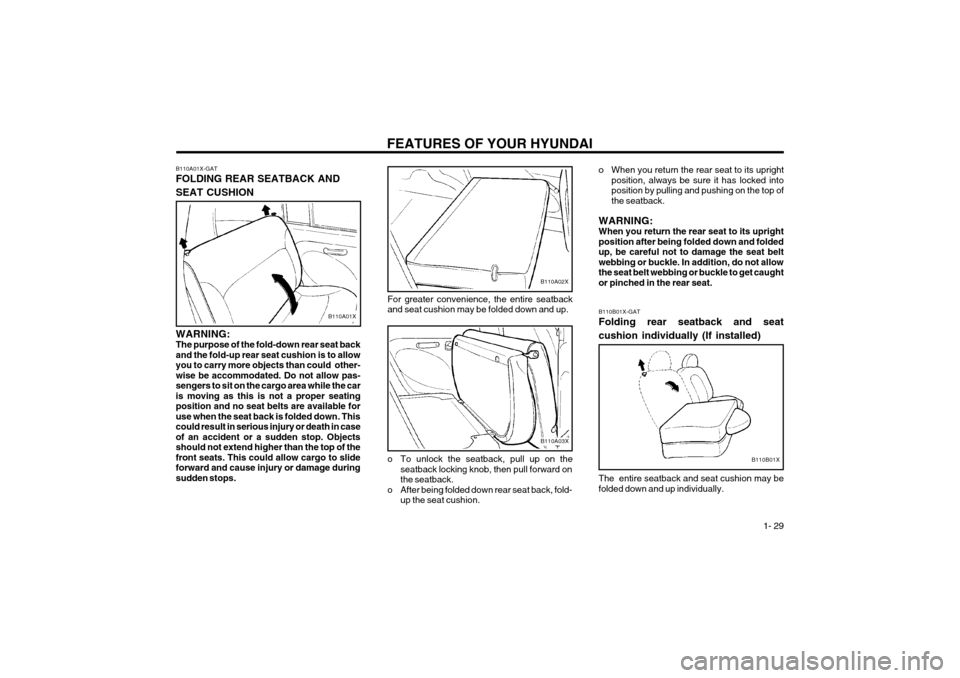
For greater convenience, the entire seatback and seat cushion may be folded down and up.
B110A02X
B110A03X
o To unlock the seatback, pull up on the seatback locking knob, then pull forward on the seatback.
o After being folded down rear seat back, fold- up the seat cushion.
B110A01X-GAT FOLDING REAR SEATBACK AND SEAT CUSHION
B110A01X
WARNING: The purpose of the fold-down rear seat backand the fold-up rear seat cushion is to allowyou to carry more objects than could other-wise be accommodated. Do not allow pas-
sengers to sit on the cargo area while the caris moving as this is not a proper seatingposition and no seat belts are available foruse when the seat back is folded down. This
could result in serious injury or death in caseof an accident or a sudden stop. Objectsshould not extend higher than the top of thefront seats. This could allow cargo to slideforward and cause injury or damage duringsudden stops. o When you return the rear seat to its upright
position, always be sure it has locked intoposition by pulling and pushing on the top ofthe seatback.
WARNING:When you return the rear seat to its uprightposition after being folded down and foldedup, be careful not to damage the seat belt
webbing or buckle. In addition, do not allowthe seat belt webbing or buckle to get caughtor pinched in the rear seat. B110B01X-GAT Folding rear seatback and seat cushion individually (If installed)
B110B01X
The entire seatback and seat cushion may be folded down and up individually.
Page 38 of 127
FEATURES OF YOUR HYUNDAI
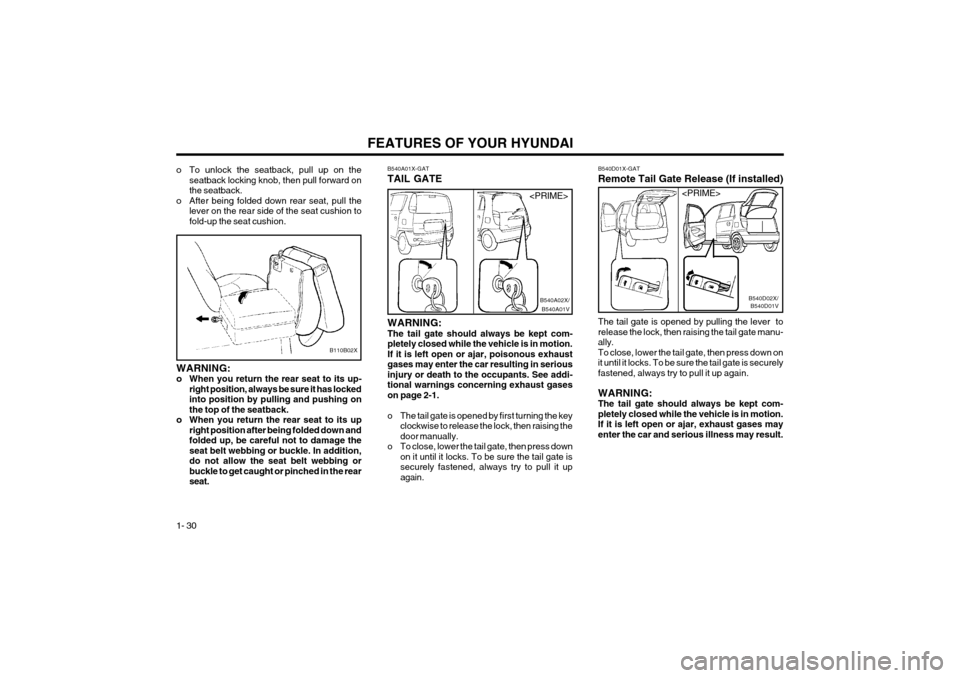
1- 30 B540D01X-GAT Remote Tail Gate Release (If installed) The tail gate is opened by pulling the lever to release the lock, then raising the tail gate manu-ally.To close, lower the tail gate, then press down on
it until it locks. To be sure the tail gate is securelyfastened, always try to pull it up again. WARNING: The tail gate should always be kept com-pletely closed while the vehicle is in motion.If it is left open or ajar, exhaust gases mayenter the car and serious illness may result.
B540D01VB540D02X/
B540A01X-GAT TAIL GATE
B540A01VB540A02X/
WARNING: The tail gate should always be kept com-pletely closed while the vehicle is in motion.If it is left open or ajar, poisonous exhaust
gases may enter the car resulting in seriousinjury or death to the occupants. See addi-tional warnings concerning exhaust gaseson page 2-1.
o The tail gate is opened by first turning the key clockwise to release the lock, then raising the door manually.
o To close, lower the tail gate, then press down on it until it locks. To be sure the tail gate is
securely fastened, always try to pull it upagain.
o To unlock the seatback, pull up on the
seatback locking knob, then pull forward onthe seatback.
o After being folded down rear seat, pull the lever on the rear side of the seat cushion tofold-up the seat cushion.
B110B02X
WARNING:
o When you return the rear seat to its up-right position, always be sure it has lockedinto position by pulling and pushing onthe top of the seatback.
o When you return the rear seat to its up right position after being folded down andfolded up, be careful not to damage the
seat belt webbing or buckle. In addition,do not allow the seat belt webbing or
buckle to get caught or pinched in the rearseat.
Page 64 of 127

DRIVING YOUR HYUNDAI
2- 2 C020A01A-AAT
BEFORE STARTING THE ENGINE
Before you start the engine, you should always:
1. Look around the vehicle to be sure there are no flat tires, puddles of oil, water or other indications of possible trouble.
2. After entering the car, check to be sure the parking brake is engaged.
3. Check that all windows, and lights are clean.
4. Check that the interior and exterior mirrors are clean and in position.
5. Check your seat, seatback and headrest to be sure they are in their proper positions.
6. Lock all the doors.
7. Fasten your seat belt and be sure that all other occupants have fastened theirs.
8. Turn off all lights and accessories that are not needed.
9. When you turn the ignition switch to "ON", check that all appropriate warning lights are operating and that you have sufficient fuel.
10. Check the operation of warning lights and all bulbs when key is in the "ON" position. o To start the engine, insert the ignition key
and turn it to the "START" position. Releaseit as soon as the engine starts. Do not hold
the key in the "START" position for morethan 15 seconds.
NOTE: For safety, the engine will not start if the
shift lever is not in "P" or "N" Position(Automatic Transaxle). C040A01A-AAT
KEY POSITIONS WARNING:
The engine should not be turned off or the
key removed from the ignition key cylinderwhile the vehicle is in motion. The steering
wheel is locked by removing the key. o "START"
The engine is started in this position. It willcrank until you release the key. NOTE: Do not hold the key in the "START" position for more than 15 seconds.
o "ON" When the key is in the "ON" position, the
ignition is on and all accessories may be turnedon. If the engine is not running, the key shouldnot be left in the "ON" position. This will dis-
charge the battery and may also damage theignition system.
o "ACC" With the key in the "ACC" position, the some
electrical accessories (radio etc.) may be oper-ated.
o "LOCK" The key can be removed or inserted in thisposition. To protect against theft, the steeringwheel locks by removing the key. NOTE: To unlock the steering wheel, insert the key, and then turn the steering wheel and keysimultaneously.
C030A02X-GAT
COMBINATION IGNITION SWITCH To Start the Engine
o If your Hyundai is equipped with a manual transaxle, place the shift lever in neutral and depress the clutch pedal fully.
o If your Hyundai has an automatic transaxle, place the shift lever in "P" (park).
C040A01E
LOCK
ACC
ON
START
Page 65 of 127

DRIVING YOUR HYUNDAI 2- 3
C050A01X-GAT
STARTING
Normal starting with either a cold or warm
engine is obtained without pumping or depress-
ing the accelerator pedal. Simply turn the key tothe "START" position and release when theengine starts. After the engine has started,allow the engine to run for 10 to 20 secondsprior to placing the vehicle in gear. The starter should not be operated for more
than 15 seconds at a time. Wait 15-30 secondsbetween starting attempts to protect the starterfrom overheating.
WARNING: Never run the engine in a closed or poorly
ventilated area any longer than is needed to move your car in or out of the area. The
carbon monoxide gas emitted is odorlessand can cause serious injury or death. C050B02X-GAT
Normal Conditions:
The Starting Procedure:
1. Insert key, and fasten the seat belt.
2. Depress the clutch pedal fully (manual transaxle) and place the gearshift lever in neutral (manual transaxle) or the selectorlever (automatic transaxle) in "P" (park)position.
3. After turning the ignition key to the "ON" position, make certain all warning lights andgauges are functioning properly before start-
ing the engine.
WARNING: Be sure that the clutch is fully depressed
when starting a manual transaxle vehicle. Otherwise, there is the potential to cause
damage to the vehicle or injury to someone
inside or outside the vehicle as a result ofthe forward or backward movement of the
vehicle that will occur if the clutch is notdepressed when the vehicle is started.
4. Turn the ignition key to the "Start" position and release it when the engine starts. C070A04X-GAT
OPERATING THE MANUAL TRANSAXLE
C070A01X
Your Hyundai's manual transaxle has a con-
ventional shift pattern. This shift pattern is also imprinted on the shift knob. The transaxle isfully synchronized in all forward gears so shift-
ing to either a higher or a lower gear is easilyaccomplished.
CAUTION:
o Do not attempt to engage reverse gear when the car is moving.
o To avoid damaging the selector mecha- nism, do not use the gear shift lever as ahand rest. Release the lever immediatelythe shift is completed.
o To avoid premature clutch wear, do not use the clutch pedal as a foot rest, anddo not hold the vehicle on a gradientusing the clutch.
C050A01E