change time Hyundai Atos 2003 Owner's Manual
[x] Cancel search | Manufacturer: HYUNDAI, Model Year: 2003, Model line: Atos, Model: Hyundai Atos 2003Pages: 127, PDF Size: 1.55 MB
Page 31 of 127

FEATURES OF YOUR HYUNDAI 1- 23
B340B01A-AAT Lane Change Signal To indicate a lane change, move the lever up or down to a point where it begins flashing.The lever will automatically return to the centerposition when released.
B340A01A-AAT COMBINATION TURN SIGNAL, HEADLIGHT AND HIGH-BEAM SWITCH Turn Signal Operation Pulling down on the lever causes the turn signals on the left side of the car to blink. Pushing upwardon the lever causes the turn signals on the rightside of the car to blink. As the turn is completed,the lever will automatically return to the centerposition and turn off the turn signals at the sametime. If either turn signal indicator light blinksmore rapidly than usual, goes on but does notblink, or does not go on at all, there is a malfunc-tion in the system. Check for a burned-out fuse orbulb or see your Hyundai dealer.
B340B01X
B310A01A-GAT ODOMETERThe odometer records the total driving distance in kilometers or miles, and is useful for keeping arecord for maintenance intervals. NOTE: Any alteration of the odometer may void yourwarranty coverage. B320A01A-GAT TRIP ODOMETER The trip odometer may be used to conveniently record trip distances. Push the reset knob to setthe counter to zero. B340C01A-AAT Headlight Switch To operate the headlights, turn the barrel on the end of the multi-function switch. The first positionturns on the parking lights, sidelights, tail lightsand instrument panel lights. The second positionturns on the headlights.
B340C01X
B340F01A-GAT Daytime Running Lights (If Installed) Your Hyundai is equipped with daytime running lights. The daytime running lights are used toimprove visibility for oncoming traffic. Your vehi-cle daytime running lights are designed to remainon continuously when the engine is operatingeven though the headlight switch is in the "OFF"position. However, the daytime running lights willbe off while the parking brake is applied.
Page 34 of 127

FEATURES OF YOUR HYUNDAI
1- 26 B420A02A-AAT CIGARETTE LIGHTER For the cigarette lighter to work, the key must be in the "ACC" position or the "ON" position.To use the cigarette lighter, push it all the way intoits socket. When the element has heated, thelighter will pop out to the "ready" position.Do not hold the cigarette lighter pressed in. Thiscan damage the heating element and create afire hazard.If it is necessary to replace the cigarette lighter,use only a genuine Hyundai replacement or itsapproved equivalent. CAUTION: Do not use electric accessories or equipmentother than the Hyundai genuine parts in thesocket.
B420A01A-1
B400A01A-AAT DIGITAL CLOCK (If Installed) There are three control buttons for the digital clock. Their functions are: HOUR
- Push "H" to advance the hour indicated.
MIN - Push "M" to advance the minute indicated.
RESET - Push "R" to reset minutes to ":00" to
facilitate resetting the clock to the correct time. When this is done: Pressing "R" between 10 : 30 and 11 : 29 changes the readout to 11 : 00.Pressing "R" between 11 : 30 and 12 : 29 changesthe readout to 12 : 00.
NOTE:The engine must be running for the rearwindow defroster to operate.
B400A01A
turn signal lights to blink. The hazard warning lights will operate even though the key is not inthe ignition.To turn the hazard warning lights off, push in onthe switch a second time. B380A01A-AAT REAR WINDOW DEFROSTER SWITCH The rear window defroster is turned on by push- ing in on the switch. To turn the defroster off, pushin on the switch a second time. The rear windowdefroster automatically turns itself off after about15 minutes. To restart the defroster cycle, pushin on the switch again after it has turned itself off. CAUTION: Do not clean the inner side of the rear windowglass with an abrasive type of glass cleaneror use a scraper to remove the foreign depos-its from the inner surface of the glass as thismay cause damage to the defroster elements.
HMX404C
Page 63 of 127

DRIVING YOUR HYUNDAI 2- 1
2. DRIVING YOUR HYUNDAI
C010A01A-AAT
WARNING: ENGINE EXHAUST CAN BE DANGEROUS!
Engine exhaust fumes can be extremely dangerous. If, at any time, you smell exhaust fumes inside the vehicle, open the windows immediately. o Do not inhale exhaust fumes. Exhaust fumes contain carbon monoxide, a colorless, odorless gas that can cause unconsciousness and death by asphyxiation. o Be sure the exhaust system does not leak. The exhaust system should be checked whenever the vehicle is raised to change the oil or for any other purpose. If you hear a change in the sound of the exhaust or if you drive over something that strikes the underneath side of the car, have theexhaust system checked as soon as possible by your Hyundai dealer. o Do not run the engine in an enclosed area. Letting the engine idle in your garage, even with the garage door open, is a hazardous practice. Never run the engine in your garage any longer than it takes to start the engine and back the car out. o Avoid idling the engine for prolonged periods with people inside the car. If it is necessary to idle the engine for a prolonged period with people inside the car, be sure to do so only in an open area with the air intake set at "Fresh" and the fan operating at one of the higher speeds so fresh air is drawn into the interior.If you must drive with the tail gate open because you are carrying objects that make this necessary: 1. Close all windows. 2. Open side vents.3. Set the air intake control at "Fresh", the air flow control at "Floor" or "Face" and the fan at one of the higher speeds. To assure proper operation of the ventilation system, be sure the ventilation air intakes located just in front of the windshie ld
are kept clear of snow, ice, leaves or other obstructions.
2
Page 69 of 127

DRIVING YOUR HYUNDAI 2- 7
C130A01A-AAT
GOOD BRAKING PRACTICES
WARNING: Do not allow passengers to sit on the cargo area while the car is moving as this is not aproper seating position and no seat belts
are available for use when the seat back isfolded down. This could result in seriousinjury or death in case of an accident or a
sudden stop. Objects should not extendhigher than the top of the front seats. This
could allow cargo to slide forward and causeinjury or damage during sudden stops.
o After being parked, check to be sure the parking brake is not engaged and that theparking brake indicator light is out beforedriving away.
o Driving through water may get the brakes wet. They can also get wet when the car iswashed. Wet brakes can be dangerous!
Your car will not stop as quickly if the brakesare wet and it may also pull to one side. Todry the brakes, apply the brakes lightly untilthe braking action returns to normal, takingcare to keep the car under control at alltimes. If the braking action does not return to
normal, stop as soon as it is safe to do soand call your Hyundai dealer for assistance.
o Don't coast down hills with the car out of gear. This is extremely hazardous. Keep thecar in gear at all times, use the brakes toslow down, then shift to a lower gear so thatengine braking will help you maintain a safespeed.
o Exercise extreme caution when driving on a
slippery surface. Be especially careful whenbraking, accelerating or shifting gears. On aslippery surface, an abrupt change in ve-hicle speed can cause the drive wheels tolose traction and the vehicle to go out ofcontrol.
o Turn the overdrive switch on for good fuel economy and smooth driving. If engine brak-ing is needed in the "D" range or if repeatedupshifting and downshifting between 3rd and4th gear is needed when climbing a gentleslope, it is recommended that the overdriveswitch be turned off. Turn the overdriveswitch back on immediately afterward.
CAUTION:
o The risk of rollover is greatly increased if you lose control of your vehicle at high-way speeds.
o Loss of control often occurs if two or more wheels drop off the roadway andthe driver oversteers to reenter the road-way.
o In the event your vehicle leaves the road- way, do not steer sharply. Instead, slowdown before pulling back into the travellanes.
o In a collision crash, on unbelted person is significantly more likely to die than aperson wearing a seatbelt.
C090N02A-AAT
Good Driving Practices
o Never move the gear selector lever from "P" or "N" to any other position with the acceler- ator pedal depressed.
o Never move the gear selector lever into "P" when the vehicle is in motion.
o Be sure the car is completely stopped be- fore you attempt to shift into "R".
o Never take the car out of gear and coast down a hill. This may be extremely hazard-ous. Always leave the car in gear whenmoving.
o Do not "ride" the brakes. This can cause them to overheat and malfunction. Instead,when you are driving down a long hill, slowdown and shift to a lower gear. When you dothis, engine braking will help slow the car.
o Slow down before shifting to a lower gear. Otherwise, the lower gear may not be en-gaged.
o Always use the parking brake. Do not de- pend on placing the transaxle in "P" to keepthe car from moving.
drive switch is turned off, the transaxle will notupshift to the overdrive gear. For normal driv-ing, the selector lever should be left in the "D"position and the overdrive switch turned on.
If you need to accelerate rapidly, press the
accelerator pedal all the way to the floor. Thetransaxle will automatically shift to a lower gear,depending on the vehicle speed and load.
Page 102 of 127

DO-IT-YOURSELF MAINTENANCE 6-7
4. Turn the radiator cap counterclockwise with-out pressing down on it, until it stops. This relieves any pressure remaining in the cool-ing system. And remove the radiator cap bypushing down and turning counterclockwise. Now fill the radiator with clean demineral- ized or distilled water. Continue to add cleandemineralized or distilled water in small quan-tities until the fluid level stays up in theradiator neck.SSA6060A
Unleaded: 1.0 ~ 1.1 mm (0.039 ~ 0.043 in.) Leaded: 0.8 ~ 0.9 mm (0.031 ~ 0.035 in.)
G060B02A-GAT
REPLACING THE SPARK PLUGS
The spark plugs should be changed at the
intervals specified in the vehicle maintenance schedule in Section 5 or whenever engine per-formance indicates they should be changed.Symptoms that suggest poor spark plug perfor-mance include engine misfiring under load, lossof fuel economy, poor acceleration, etc. Whenspark plugs are replaced, always use sparkplugs recommended by Hyundai. The use ofother spark plugs can result in loss of perfor-mance, radio interference or engine damage.
NOTE: When replacing the spark plug, always use
the genuine parts recommended.
G050D02X
5. Start the engine, top off the radiator with water and then add engine coolant to the reservoir until the level is between "LOW"and "FULL".
6. Replace the radiator and reservoir caps and check to be sure the drain cocks are fullyclosed and not leaking.
WARNING: The cooling fan is controlled by engine cool-
ant temperature and may sometimes oper- ate even when the engine is not running.Use extreme caution when working near theblades of the cooling fan so that you are notinjured by a rotating fan blade. As the en-gine coolant temperature decreases, the fanwill automatically shut off. This is a normalcondition.
G050B01A
Page 103 of 127

DO-IT-YOURSELF MAINTENANCE
6-8 NOTE: Spark plugs should be tightened firmly. Over- tightening can damage the threads in thealuminum cylinder head. Also, leaving them
too loose can cause the spark plug to getvery hot and possibly result in damage tothe engine.
6. Replace the cable by pushing the insulated connector directly down onto the electrode.Check to be sure it has snapped into placeand can't fall off.
G060C03A
G060C02A-AAT
Changing the Spark Plugs
Unleaded
RC9YC4
RC10YC4
BKR5ES-11
NGK Leaded
RC9YC
RC10YC BKR5ES
CHAMPION
G060C01A
You will find it easier to change spark plugs if
the engine is cold. Always change one spark
plug at a time. This helps avoid getting the wiresmixed up.
1. Using a clean cloth, remove any dirt that has accumulated around the base of the spark plug so it cannot fall into the cylinder whenthe spark plug is removed. WARNING: It is recommended that the engine be cool
or cold when changing the spark plugs. If the engine is hot, you could burn yourselfon the insulated connector, the spark plugor the engine itself.
3. When preparing to remove the old spark plug, guide the socket down over the spark plug, being careful not to damage the ce-ramic insulator.
4. To remove the old spark plug, turn the wrench handle in a counterclockwise direc-tion.
5. To install the new spark plug, guide the socket down over the spark plug, beingcareful not to damage the ceramic insulator.
G060C02A
Recommended Spark Plugs:
2. To remove the spark plug cable, pull straight
up on the insulated connector, not the cable. Pulling on the cable may damage the carboncore conductor.
Page 104 of 127

DO-IT-YOURSELF MAINTENANCE 6-9
G090A01X-GAT
FILLING THE WASHER RESERVOIR
The washer fluid reservoir supplies fluid to the
windshield washer system. A good quality washer fluid should be used to fill
the washer reservoir. The fluid level should be checked more frequently during bad weather orwhenever the washer system is in more fre-quent use.
The capacity of the washer reservoir is 2.5
liters (2.63 U.S. quarts).
CAUTION:
o Radiator antifreeze (engine coolant) should not be used in the washer systembecause it will damage the car's finish.
o The washer lever should not be pulled and the washer should not be operated ifthe washer reservoir is empty. This candamage the washer fluid pump.
G070A01X-GAT
CHANGING THE AIR CLEANER FIL- TER G080A02A-AAT
WINDSHIELD WIPER BLADES The wiper blades should be carefully inspected from time to time and cleaned to remove accu-mulations of road film or other debris. To cleanthe wiper blades and arms, use a clean spongeor cloth with a mild soap or detergent and water.If the wipers continue to streak or smear theglass, replace them with Genuine HyundaiReplacement Parts or their equivalent. CAUTION:
o Do not operate the wipers on dry glass. This can result in more rapid wear of the wiper blades and may scratch the glass.
o Keep the blade rubber out of contact with petroleum products such as engineoil, gasoline etc.
To change the filter, loosen the clamps (1) on
the cover. When this is done, the cover can be
lifted off, the old filter removed and the new filterput in its place. Genuine Hyundai replacement
parts are recommended.
CAUTION: Operating your vehicle without a proper air
filter in place can result in excessive engine wear.
G070A01X
(1)
AS60160AG090A01X
Page 108 of 127
DO-IT-YOURSELF MAINTENANCE 6-13
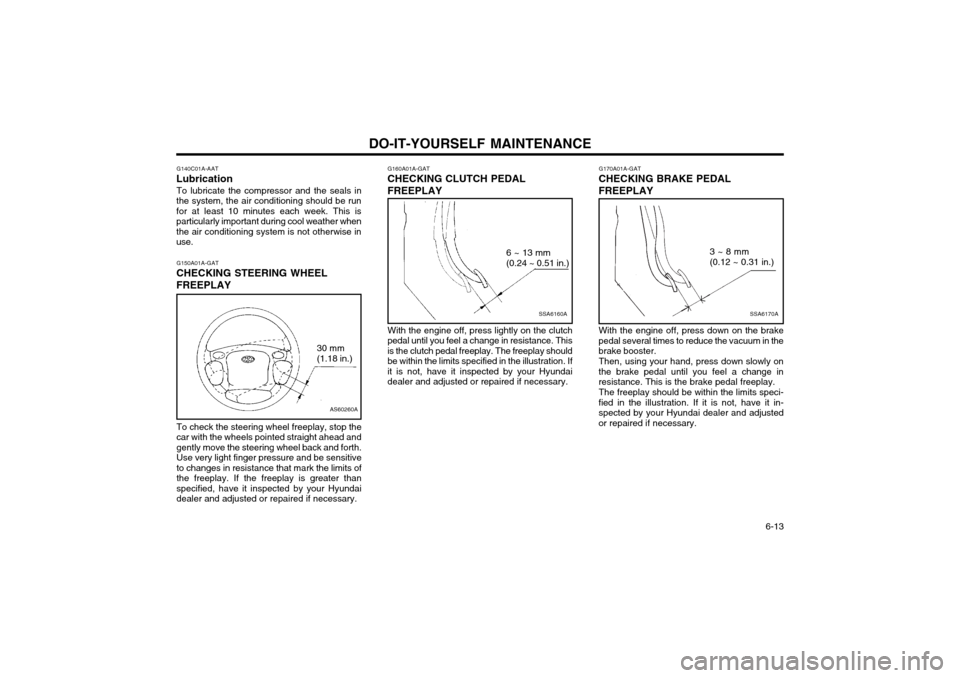
G170A01A-GAT
CHECKING BRAKE PEDAL FREEPLAY
To check the steering wheel freeplay, stop the car with the wheels pointed straight ahead andgently move the steering wheel back and forth.Use very light finger pressure and be sensitiveto changes in resistance that mark the limits ofthe freeplay. If the freeplay is greater thanspecified, have it inspected by your Hyundaidealer and adjusted or repaired if necessary. G160A01A-GAT
CHECKING CLUTCH PEDAL FREEPLAY
SSA6160A
6 ~ 13 mm (0.24 ~ 0.51 in.)
With the engine off, press lightly on the clutch
pedal until you feel a change in resistance. This is the clutch pedal freeplay. The freeplay shouldbe within the limits specified in the illustration. Ifit is not, have it inspected by your Hyundaidealer and adjusted or repaired if necessary.
SSA6170A
3 ~ 8 mm (0.12 ~ 0.31 in.)
With the engine off, press down on the brake
pedal several times to reduce the vacuum in the brake booster.
Then, using your hand, press down slowly on
the brake pedal until you feel a change inresistance. This is the brake pedal freeplay.
The freeplay should be within the limits speci-
fied in the illustration. If it is not, have it in-spected by your Hyundai dealer and adjustedor repaired if necessary.
G140C01A-AAT
Lubrication
To lubricate the compressor and the seals in
the system, the air conditioning should be run for at least 10 minutes each week. This isparticularly important during cool weather whenthe air conditioning system is not otherwise inuse.
G150A01A-GAT
CHECKING STEERING WHEEL FREEPLAY
AS60260A
30 mm (1.18 in.)
Page 112 of 127

DO-IT-YOURSELF MAINTENANCE 6-17
G270A02X-GAT
HEADLIGHT BULB
Replacement instructions:
1. Allow the bulb to cool. Wear eye protection.
2. Always grasp the bulb by its base, avoid touching the glass.
3. Disconnect the connector, then remove the dust cover.
4. Push the bulb spring for removing the head- light bulb.
5. Remove the headlight bulb. If the bulb is burned out, replace it with the same watt- age.
6. Installation is the reverse order of the re- moval.
7. Use the protective cap and carton to promptly dispose of the old bulb.
8. Check for proper headlight aim. WARNING: The halogen bulb contains gas under pres-
sure and if impacted could shatter, and re- sulting in flying fragments. Always wear eye
protection when servicing the bulb. Protectthe bulb against abrasions or scratches andagainst liquids when lighted. Turn the bulbon only when installed in a headlight. Re-place the headlight if damaged or cracked.
Keep the bulb out of the reach of childrenand dispose of the used bulb with care. G290A02X-GAT HEADLIGHT AIMING ADJUSTMENT Before performing aiming adjustment, make sure of the following.
1. Keep all tires inflated to the correct pres- sure.
2. Place the vehicle on level ground and press the front bumper & rear bumper down sev- eral times. Place the vehicle at a distance of3,000 mm (118 in.) from the test wall.
3. See that the vehicle is unloaded (except for full levels of coolant, engine oil and fuel, andspare tire, jack, and tools). Have the driveror equivalent weight placed in driver's seat.
Recommended Fluid
Use PSF-3 type fluid. NOTE: Do not start the engine when the power
steering oil reservoir is empty.
G240A01A-AAT
POWER STEERING HOSES
It is suggested that you check the power steer-
ing hose connections for fluid leakage at those intervals specified in the vehicle maintenanceschedule in Section 5.
The power steering hoses should be replaced if
there is severe surface cracking, pulling, scuff-ing or worn spots. Deterioration of the hosecould cause premature failure.
G260A03A-AAT
REPLACING HEADLIGHT BULBS Before attempting to replace a headlight bulb,
be sure the switch is turned to the "OFF"position.
The next paragraph shows how to reach head-
light bulbs so they may be changed. Be sure toreplace the burned-out bulb with one of thesame number and wattage rating.
CAUTION: Keep the lamps out of contact with petro-
leum product, such as oil, gasoline, etc.
G270A01X
Page 124 of 127

INDEX10-1
Catalytic Converter
.................................................................... 7-1 ~ 7-2
Child-Protector Rear Door Lock ......................................................... 1-5
Cigarette Lighter ................................................................................ 1-26
Clock ................................................................................................ 1-26
Clutch Pedal freeplay ........................................................................ 6-13
Combination Light Daytime running lights ................................................................. 1-23
Headlight flasher .......................................................................... 1-24
Headlight switch ........................................................................... 1-23
High-beam switch ........................................................................ 1-24
Lane change signal ...................................................................... 1-23
Turn signal operation ................................................................... 1-23
Compact Disk Player Operation (H922M) ........................................1-49
Cooling Fans ..................................................................................... 6-16
Corrosion Protection Cleaning the interior ....................................................................... 4-3
Protecting your Hyundai from corrosion ........................................ 4-1
Washing and waxing ...................................................................... 4-2
D Defros ter ........................................................................................... 1-38
Door
Central door locking system .......................................................... 1-7
Door locks ...................................................................................... 1-4 Locking, unlocking front doors with a key ..................................... 1-4
Drive Belts ............................................................................... 6-12, 6-14
Driving Economical driving ......................................................................... 2-9
Smooth cornering ........................................................................... 2-9 Winter driving ................................................................................. 2-9
ZK000A1-G 10. INDEX A
Air bag ....................................................................................
1-13 ~ 1-17
Air Cleaner Filter ................................................................................. 6-9
Air Conditioning Care ............................................................................................. 6-12
Operation ..................................................................................... 1-38
Antenna ............................................................................................. 1-54
Ashtray .............................................................................................. 1-27
Audio Fault Code .............................................................................. 1-51
BBattery ...................................................................................... 2-10, 6-16
Bi-Level Heating ................................................................................ 1-36
Brake Anti-lock system ............................................................................ 2-8
Checking the brakes .................................................................... 6-11
Fluid .................................................................................. 6-11 ~ 6-12
Pedal clearance ........................................................................... 6-14
Pedal freeplay .............................................................................. 6-13
Practices ............................................................................... 2-7 ~ 2-8
Breaking-In your New Hyundai ........................................................... 1-1
CCare of Cassette Tapes ................................................................... 1-52
Cassette Tape Player Operation (H900A) ............................. 1-44 ~ 1-46
10