lock Hyundai Azera 2005 Repair Manual
[x] Cancel search | Manufacturer: HYUNDAI, Model Year: 2005, Model line: Azera, Model: Hyundai Azera 2005Pages: 297, PDF Size: 13.2 MB
Page 198 of 297
2 DRIVING YOUR HYUNDAI
14DRIVING FOR ECONOMY
o Don't coast down hills with the car out of gear. This is extremely haz- ardous. Keep the car in gear at all times, use the brakes to slow down, then shift to a lower gear so thatengine braking will help you main- tain a safe speed.
o Don't "ride" the brake pedal. Rest- ing your foot on the brake pedalwhile driving can be dangerous be- cause it can result in the brakesoverheating and losing their effec- tiveness. It also increases the wear of thebrake components.
o If a tire goes flat while you are
driving, apply the brakes gently andkeep the car pointed straight ahead while you slow down. When you are moving slowly enough for it to besafe to do so, pull off the road and stop in a safe place.
o If your car is equipped with an auto- matic transaxle, don't let your carcreep forward. To avoid creeping forward, keep your foot on the brakepedal when the car is stopped.
o Use caution when parking on a hill.
Engage the parking brake and placethe gear selector lever in "P" (auto- matic transaxle) or in first or reversegear (manual transaxle). If your caris facing downhill, turn the front wheels into the curb to help keep the car from rolling. If your car is facinguphill, turn the front wheels away from the curb to help keep the car from rolling. If there is no curb or if itis required by other conditions to keep the car from rolling, block the wheels.
o Under some conditions your park- ing brake can freeze in the engagedposition. This is most likely to hap-pen when there is an accumulation of snow or ice around or near the rear brakes or if the brakes are wet.If there is a risk that the parking brake may freeze, apply it only tem- porarily while you put the gear se-lector lever in "P" (automatic) or in first or reverse gear (manual transaxle) and block the rear wheelsso the car cannot roll. Then release the parking brake.
o Do not hold the vehicle on the up- grade with the accelerator pedal.This can cause the transaxle to overheat. Always use the brakepedal or parking brake. C140A01A-AAT You can save fuel and get more miles from your car if you follow these sug- gestions:
o Drive smoothly. Accelerate at a
moderate rate. Don't make "jack- rabbit" starts or full-throttle shiftsand maintain a steady cruising speed. Don't race between stop- lights. Try to adjust your speed tothat of the other traffic so you don't have to change speeds unneces- sarily. Avoid heavy traffic wheneverpossible. Always maintain a safe distance from other vehicles so you can avoid unnecessary braking. Thisalso reduces brake wear.
o Drive at a moderate speed. The
faster you drive, the more fuel yourcar uses. Driving at a moderate speed, especially on the highway, is one of the most effective ways toreduce fuel consumption.
o Don't "ride" the brake or clutch pedal.
This can increase fuel consumptionand also increase wear on these components. In addition, driving with
Page 201 of 297

2
DRIVING YOUR HYUNDAI
17
C160G01A-GAT To Keep Locks from Freezing To keep the locks from freezing, squirt an approved de-icer fluid or glycerineinto the key opening. If a lock is cov- ered with ice, squirt it with an approved de-icing fluid to remove the ice. If thelock is frozen internally, you may be able to thaw it out by using a heated key. Handle the heated key with careto avoid burning your fingers. NOTE: The proper temperature for using the immobilizer key is from -40°C (- 40°F) to 80°C (176°F). If you heat the immobilizer key over 80°C (176°F) toopen the frozen lock, it may cause damage to the transponder in its head.
C160D01A-AAT Check Battery and Cables Winter puts additional burdens on the battery system. Visually inspect thebattery and cables as described in Section 6. The level of charge in your battery can be checked by your Hyundaidealer or a service station.
C160F01A-AAT Check Spark Plugs and Ignition System Inspect your spark plugs as described in Section 6 and replace them if neces-sary. Also check all ignition wiring and components to be sure they are not cracked, worn or damaged in any way.
C160E01A-AAT Change to "Winter Weight" Oil if Necessary In some climates it is recommended that a lower viscosity "winter weight" oil be used during cold weather. See Section 9 for recommendations. If youaren't sure what weight oil you should use, consult your Hyundai dealer.
C160H01A-AAT Use Approved Anti-Freeze in Window Washer System To keep the water in the window washer system from freezing, add an approvedanti-freeze solution in accordance with instructions on the container. Window washer anti-freeze is available fromHyundai dealers and most auto parts outlets. Do not use engine coolant or other types of anti-freeze as thesemay damage the finish.
Page 202 of 297
2 DRIVING YOUR HYUNDAI
18
C160I01A-AAT Don't Let Your Parking Brake Freeze Under some conditions your parking brake can freeze in the engaged posi-tion. This is most likely to happen when there is an accumulation of snow or ice around or near the rear brakes orif the brakes are wet. If there is a risk the parking brake may freeze, apply it only temporarily while you put the gearselector lever in "P" (automatic) or in first or reverse gear (manual transaxle) and block the rear wheels so the carcannot roll. Then release the parking brake. C160J01A-AAT Don't Let Ice and Snow Accumu- late Underneath Under some conditions, snow and ice can build up under the fenders andinterfere with the steering. When driv- ing in severe winter conditions where this may happen, you should periodi-cally check underneath the car to be sure the movement of the front wheels and the steering components is notobstructed. C160K01A-AAT Carry Emergency Equipment Depending on the severity of the weather where you drive your car, you should carry appropriate emergency equipment. Some of the items youmay want to carry include tire chains, tow straps or chains, flashlight, emer- gency flares, sand, a shovel, jumpercables, a window scraper, gloves, ground cloth, coveralls, a blanket, etc.HIGHER SPEED MOTORING
C170A01A-AAT Pre-Trip Inspections 1. Tires: Adjust the tire inflation pressures tospecification. Low tire inflation pres- sures will result in overheating and possible failure of the tires.Avoid using worn or damaged tires which may result in reduced traction or tire failure. NOTE: Never exceed the maximum tire in- flation pressure shown on the tires. 2. Fuel, engine coolant and engine oil: High speed travel consumes more fuelthan urban motoring. Do not forget to check both engine coolant and engine oil. 3. Drive belt: A loose or damaged drive belt mayresult in overheating of the engine.
Page 212 of 297
3
WHAT TO DO IN AN EMERGENCY
5
6. If you cannot find the cause of the
overheating, wait until the engine temperature has returned to nor- mal. Then, if coolant has been lost, carefully add coolant to the reservoir(Page 6-8) to bring the fluid level in the reservoir up to the halfway mark.
7. Proceed with caution, keeping alert for further signs of overheating. Ifoverheating happens again, call a Hyundai dealer for assistance.
! CAUTION:
Serious loss of coolant indicates there is a leak in the cooling system and this should be checked as soonas possible by a Hyundai dealer.
SPARE TIRE
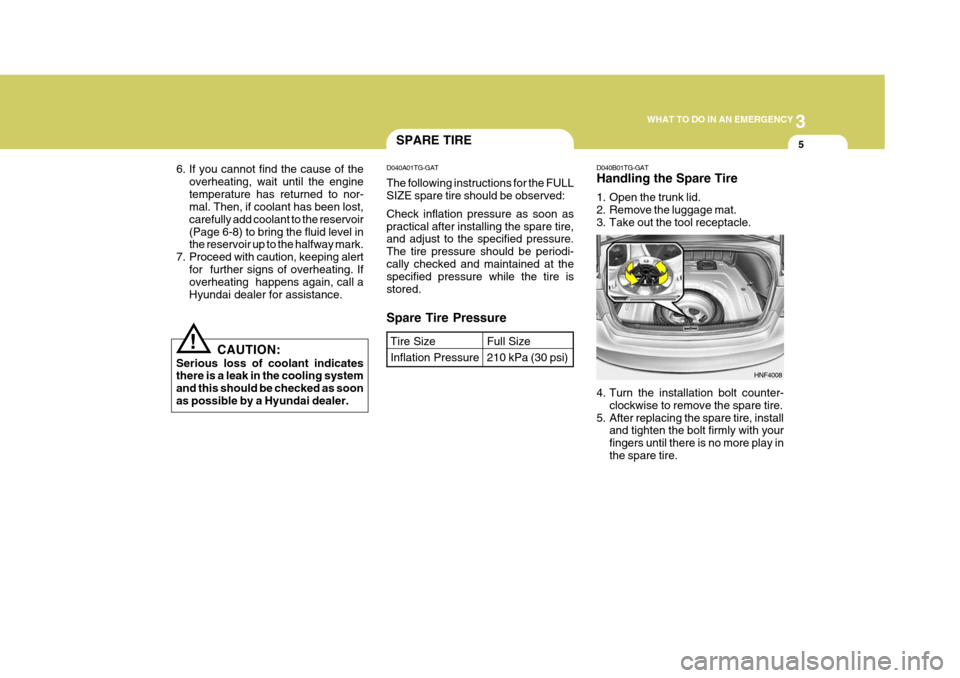
D040B01TG-GAT Handling the Spare Tire
1. Open the trunk lid.
2. Remove the luggage mat.
3. Take out the tool receptacle.
Spare Tire Pressure
D040A01TG-GAT The following instructions for the FULL SIZE spare tire should be observed: Check inflation pressure as soon as practical after installing the spare tire, and adjust to the specified pressure. The tire pressure should be periodi-cally checked and maintained at the specified pressure while the tire is stored.
Tire Size Inflation PressureFull Size 210 kPa (30 psi)
HNF4008
4. Turn the installation bolt counter- clockwise to remove the spare tire.
5. After replacing the spare tire, install and tighten the bolt firmly with your fingers until there is no more play inthe spare tire.
Page 213 of 297
3 WHAT TO DO IN AN EMERGENCY
6CHANGING A FLAT TIREIF YOU HAVE A FLAT TIRE
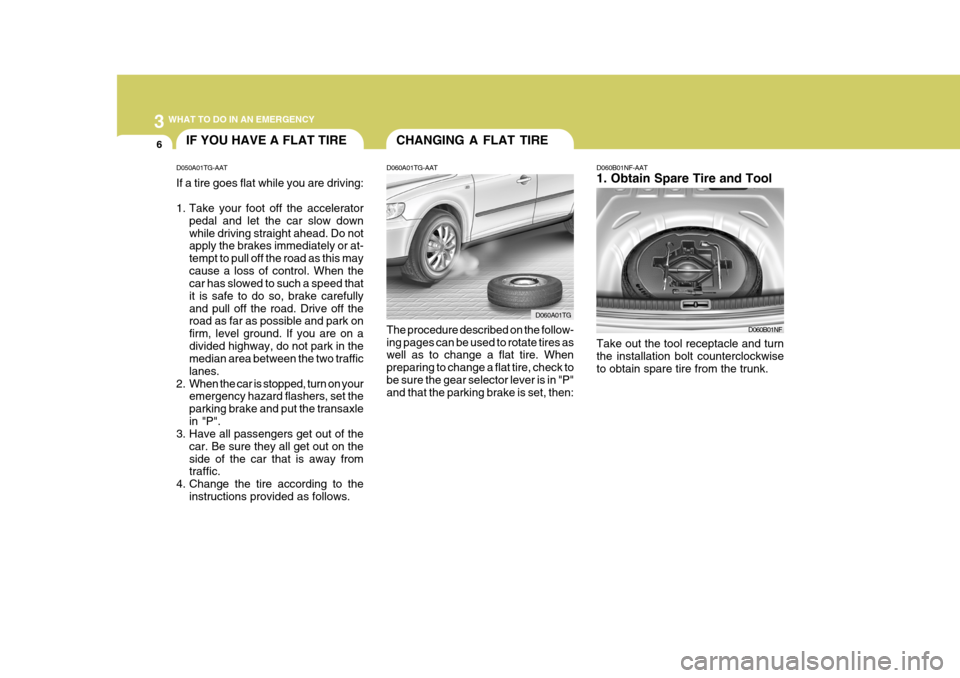
D060A01TG-AAT The procedure described on the follow- ing pages can be used to rotate tires as well as to change a flat tire. When preparing to change a flat tire, check tobe sure the gear selector lever is in "P" and that the parking brake is set, then:
D050A01TG-AAT If a tire goes flat while you are driving:
1. Take your foot off the accelerator
pedal and let the car slow down while driving straight ahead. Do not apply the brakes immediately or at- tempt to pull off the road as this maycause a loss of control. When the car has slowed to such a speed that it is safe to do so, brake carefullyand pull off the road. Drive off the road as far as possible and park on firm, level ground. If you are on adivided highway, do not park in the median area between the two traffic lanes.
2. When the car is stopped, turn on your emergency hazard flashers, set theparking brake and put the transaxlein "P".
3. Have all passengers get out of the
car. Be sure they all get out on theside of the car that is away from traffic.
4. Change the tire according to the instructions provided as follows. D060A01TG
D060B01NF-AAT 1. Obtain Spare Tire and Tool
D060B01NF
Take out the tool receptacle and turn the installation bolt counterclockwiseto obtain spare tire from the trunk.
Page 214 of 297
3
WHAT TO DO IN AN EMERGENCY
7
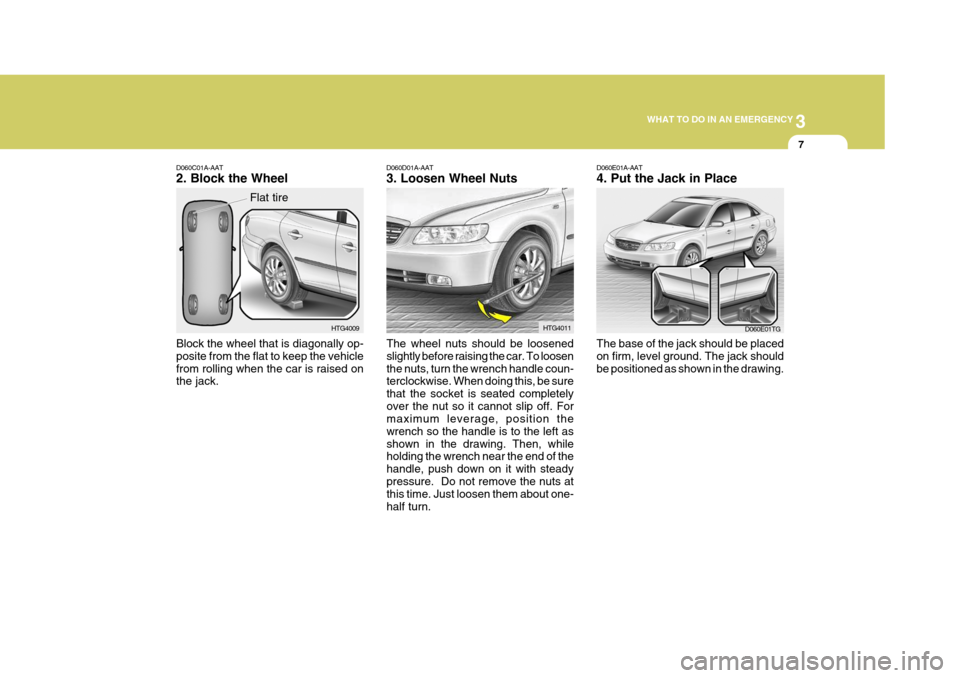
D060C01A-AAT 2. Block the Wheel Block the wheel that is diagonally op- posite from the flat to keep the vehiclefrom rolling when the car is raised on the jack. HTG4009
Flat tireD060E01A-AAT 4. Put the Jack in Place The base of the jack should be placed on firm, level ground. The jack shouldbe positioned as shown in the drawing.
D060D01A-AAT 3. Loosen Wheel Nuts
The wheel nuts should be loosened slightly before raising the car. To loosenthe nuts, turn the wrench handle coun- terclockwise. When doing this, be sure that the socket is seated completelyover the nut so it cannot slip off. For maximum leverage, position the wrench so the handle is to the left asshown in the drawing. Then, while holding the wrench near the end of the handle, push down on it with steadypressure. Do not remove the nuts at this time. Just loosen them about one- half turn. HTG4011
D060E01TG
Page 215 of 297
3 WHAT TO DO IN AN EMERGENCY
8
!
D060G02Y-AAT 6. Changing Wheels
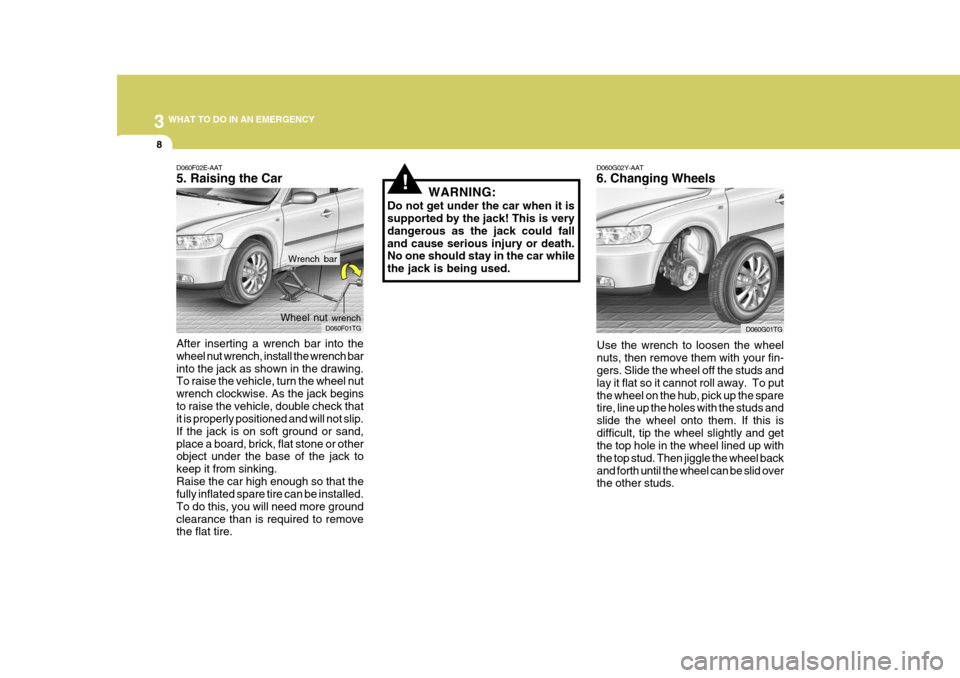
Use the wrench to loosen the wheel nuts, then remove them with your fin- gers. Slide the wheel off the studs and lay it flat so it cannot roll away. To putthe wheel on the hub, pick up the spare tire, line up the holes with the studs and slide the wheel onto them. If this isdifficult, tip the wheel slightly and get the top hole in the wheel lined up with the top stud. Then jiggle the wheel backand forth until the wheel can be slid over the other studs.
D060F02E-AAT 5. Raising the Car After inserting a wrench bar into the wheel nut wrench, install the wrench barinto the jack as shown in the drawing. To raise the vehicle, turn the wheel nut wrench clockwise. As the jack beginsto raise the vehicle, double check that it is properly positioned and will not slip. If the jack is on soft ground or sand,place a board, brick, flat stone or other object under the base of the jack to keep it from sinking.Raise the car high enough so that the fully inflated spare tire can be installed. To do this, you will need more groundclearance than is required to remove the flat tire. WARNING:
Do not get under the car when it issupported by the jack! This is very dangerous as the jack could falland cause serious injury or death. No one should stay in the car while the jack is being used.
D060F01TG
Wheel nut
wrench
D060G01TG
Wrench bar
Page 216 of 297
3
WHAT TO DO IN AN EMERGENCY
9
!WARNING:
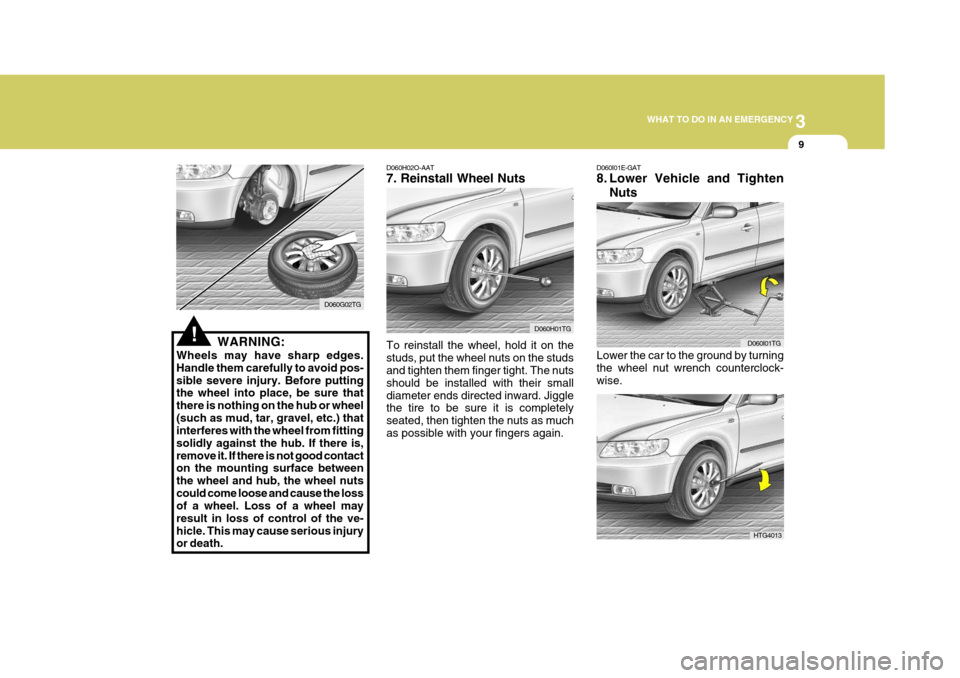
Wheels may have sharp edges. Handle them carefully to avoid pos-sible severe injury. Before putting the wheel into place, be sure that there is nothing on the hub or wheel(such as mud, tar, gravel, etc.) that interferes with the wheel from fitting solidly against the hub. If there is,remove it. If there is not good contact on the mounting surface between the wheel and hub, the wheel nutscould come loose and cause the loss of a wheel. Loss of a wheel may result in loss of control of the ve-hicle. This may cause serious injury or death. D060G02TG
Lower the car to the ground by turning the wheel nut wrench counterclock- wise.
D060I01E-GAT
8. Lower Vehicle and Tighten
Nuts
D060H02O-AAT7. Reinstall Wheel Nuts To reinstall the wheel, hold it on the studs, put the wheel nuts on the studs and tighten them finger tight. The nuts should be installed with their smalldiameter ends directed inward. Jiggle the tire to be sure it is completely seated, then tighten the nuts as muchas possible with your fingers again. D060H01TG
D060I01TG
HTG4013
Page 217 of 297
3 WHAT TO DO IN AN EMERGENCY
10
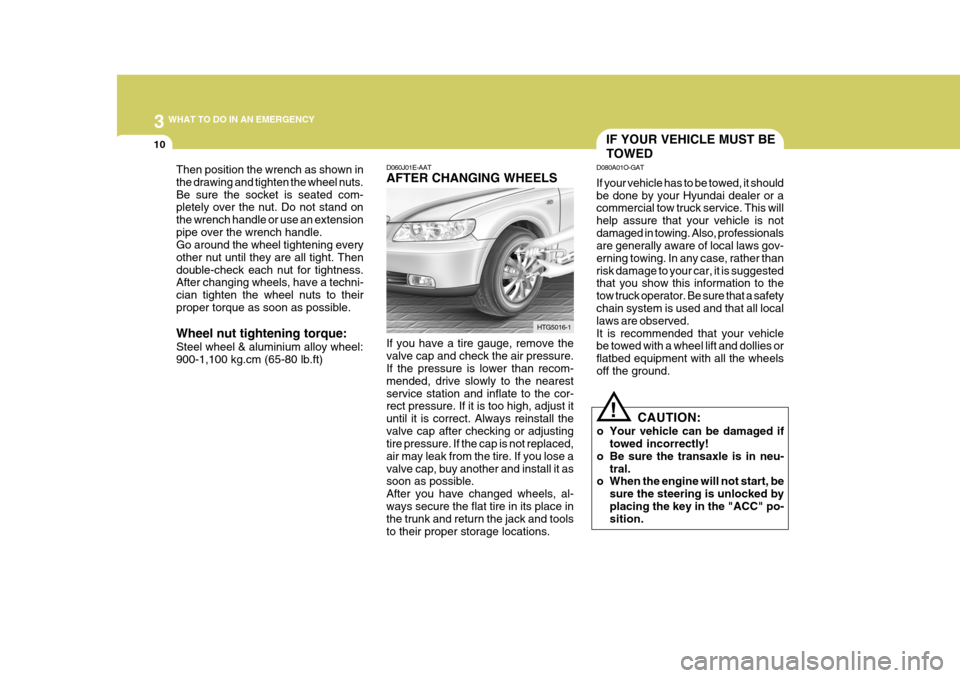
Then position the wrench as shown in the drawing and tighten the wheel nuts.Be sure the socket is seated com- pletely over the nut. Do not stand on the wrench handle or use an extensionpipe over the wrench handle. Go around the wheel tightening every other nut until they are all tight. Thendouble-check each nut for tightness. After changing wheels, have a techni- cian tighten the wheel nuts to theirproper torque as soon as possible. Wheel nut tightening torque: Steel wheel & aluminium alloy wheel: 900-1,100 kg.cm (65-80 lb.ft) D060J01E-AAT AFTER CHANGING WHEELS If you have a tire gauge, remove the valve cap and check the air pressure. If the pressure is lower than recom- mended, drive slowly to the nearestservice station and inflate to the cor- rect pressure. If it is too high, adjust it until it is correct. Always reinstall thevalve cap after checking or adjusting tire pressure. If the cap is not replaced, air may leak from the tire. If you lose avalve cap, buy another and install it as soon as possible. After you have changed wheels, al-ways secure the flat tire in its place in the trunk and return the jack and tools to their proper storage locations.HTG5016-1
IF YOUR VEHICLE MUST BE TOWED
D080A01O-GAT If your vehicle has to be towed, it should be done by your Hyundai dealer or a commercial tow truck service. This will help assure that your vehicle is notdamaged in towing. Also, professionals are generally aware of local laws gov- erning towing. In any case, rather thanrisk damage to your car, it is suggested that you show this information to the tow truck operator. Be sure that a safetychain system is used and that all local laws are observed. It is recommended that your vehicle be towed with a wheel lift and dollies or flatbed equipment with all the wheelsoff the ground.
! CAUTION:
o Your vehicle can be damaged if towed incorrectly!
o Be sure the transaxle is in neu- tral.
o When the engine will not start, be
sure the steering is unlocked by placing the key in the "ACC" po- sition.
Page 220 of 297
3
WHAT TO DO IN AN EMERGENCY
13
CAUTION:
If the car is being towed with all four wheels on the ground, it can be towed only from the front. Be sure that the transaxle is in neutral. Donot tow at speeds greater than 50 km/h (30 mph) and for more than 25 km (15 miles). Be sure the steeringis unlocked by placing the key in the "ACC" position. A driver must be in the towed vehicle to operatethe steering and brakes.
!
IF YOU LOSE YOUR KEYS
D120A01A-GAT If you lose your keys, many Hyundai dealers can make you a new key if you have your key number. If you lock the keys inside your car and you cannotobtain a new key, many Hyundai deal- ers can use special tools to open the door for you.Information about the key of immobi- lizer system (If Installed) will be found on page 1-5.