engine Hyundai Azera 2007 User Guide
[x] Cancel search | Manufacturer: HYUNDAI, Model Year: 2007, Model line: Azera, Model: Hyundai Azera 2007Pages: 308, PDF Size: 12.63 MB
Page 63 of 308
1
FEATURES OF YOUR HYUNDAI
49
!
o Sitting improperly or out of position
can result in serious or fatal injury in
a crash. All occupants should sit up-
right with the seat back in an upright
position, centered on the seat cush-
ion with their seat belt on, legs com-
fortably extended and their feet on the
floor until the vehicle is parked and
the ignition key is removed.
o The SRS airbag system must deploy
very rapidly to provide protection in a
crash. If an occupant is out of position
because of not wearing a seat belt, the
airbag may forcefully contact the oc-
cupant causing serious or fatal inju-
WARNING:
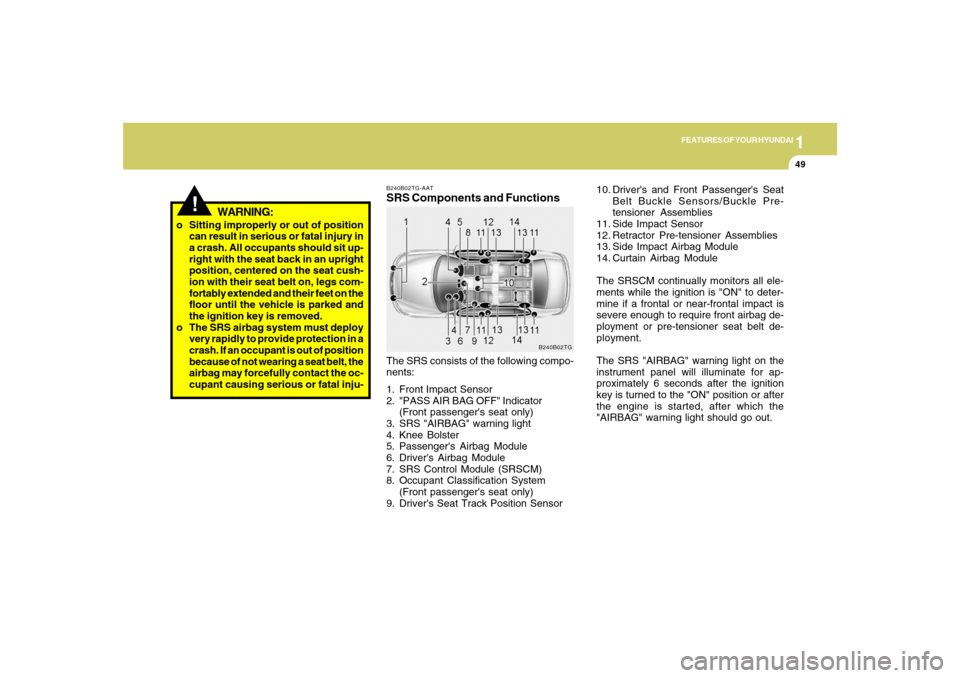
10. Driver's and Front Passenger's Seat
Belt Buckle Sensors/Buckle Pre-
tensioner Assemblies
11. Side Impact Sensor
12. Retractor Pre-tensioner Assemblies
13. Side Impact Airbag Module
14. Curtain Airbag Module
The SRSCM continually monitors all ele-
ments while the ignition is "ON" to deter-
mine if a frontal or near-frontal impact is
severe enough to require front airbag de-
ployment or pre-tensioner seat belt de-
ployment.
The SRS "AIRBAG" warning light on the
instrument panel will illuminate for ap-
proximately 6 seconds after the ignition
key is turned to the "ON" position or after
the engine is started, after which the
"AIRBAG" warning light should go out.
B240B02TG-AATSRS Components and FunctionsThe SRS consists of the following compo-
nents:
1. Front Impact Sensor
2. "PASS AIR BAG OFF" Indicator
(Front passenger's seat only)
3. SRS "AIRBAG" warning light
4. Knee Bolster
5. Passenger's Airbag Module
6. Driver's Airbag Module
7. SRS Control Module (SRSCM)
8. Occupant Classification System
(Front passenger's seat only)
9. Driver's Seat Track Position Sensor
B240B02TG
Page 66 of 308
1FEATURES OF YOUR HYUNDAI52
B990A02TG-AATOCCUPANT CLASSIFICATION SYS-
TEMYour vehicle is equipped with an occupant
classification system in the front
passenger's seat.
The Occupant Classification system is de-
signed to detect the presence of a prop-
erly-seated front passenger and deter-
mine if the passenger's front airbag should
be enabled (may inflate) or not. The driver's
front airbag is not affected or controlled by
the Occupant Classification system.
If the front passenger seat is occupied by
a person that the system determines to be
of adult size sitting properly (sitting upright
with the seatback in an upright position,
centered on the seat cushion with their
seat belt on, legs comfortably extended
and their feet on the floor), the "PASS AIR
BAG OFF" indicator will be turned off and
the front passenger's airbag will be able to
inflate, if necessary, in frontal crashes.
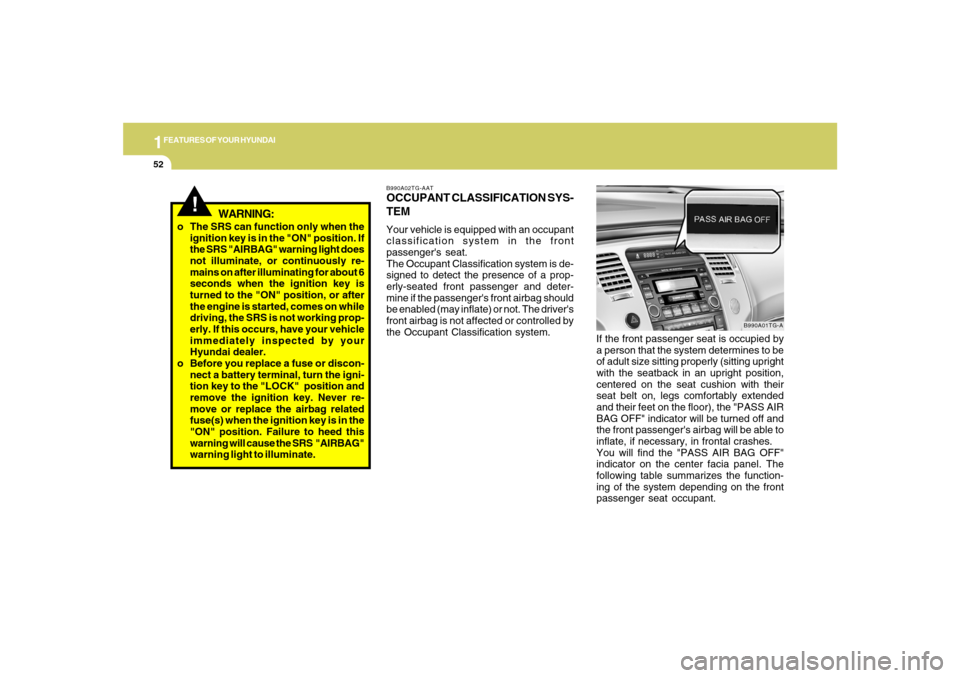
You will find the "PASS AIR BAG OFF"
indicator on the center facia panel. The
following table summarizes the function-
ing of the system depending on the front
passenger seat occupant.
B990A01TG-A
!
o The SRS can function only when the
ignition key is in the "ON" position. If
the SRS "AIRBAG" warning light does
not illuminate, or continuously re-
mains on after illuminating for about 6
seconds when the ignition key is
turned to the "ON" position, or after
the engine is started, comes on while
driving, the SRS is not working prop-
erly. If this occurs, have your vehicle
immediately inspected by your
Hyundai dealer.
o Before you replace a fuse or discon-
nect a battery terminal, turn the igni-
tion key to the "LOCK" position and
remove the ignition key. Never re-
move or replace the airbag related
fuse(s) when the ignition key is in the
"ON" position. Failure to heed this
warning will cause the SRS "AIRBAG"
warning light to illuminate.
WARNING:
Page 67 of 308
1
FEATURES OF YOUR HYUNDAI
53
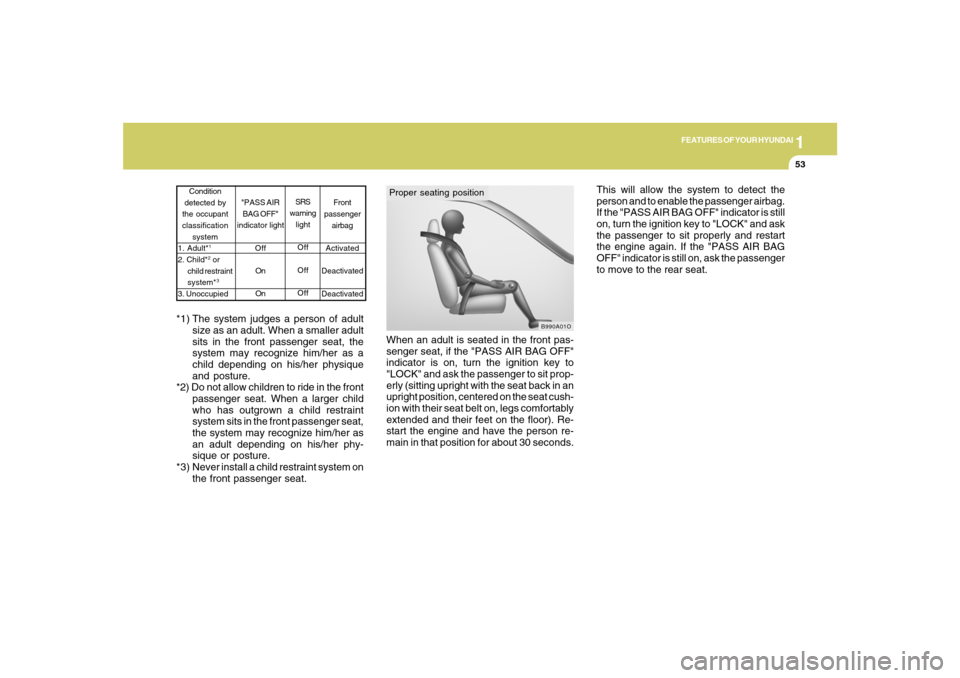
*1) The system judges a person of adult
size as an adult. When a smaller adult
sits in the front passenger seat, the
system may recognize him/her as a
child depending on his/her physique
and posture.
*2) Do not allow children to ride in the front
passenger seat. When a larger child
who has outgrown a child restraint
system sits in the front passenger seat,
the system may recognize him/her as
an adult depending on his/her phy-
sique or posture.
*3) Never install a child restraint system on
the front passenger seat.
Front
passenger
airbag
Activated
Deactivated
Deactivated Condition
detected by
the occupant
classification
system
1. Adult*
1
2. Child*
2 or
child restraint
system*3
3. UnoccupiedSRS
warning
light
Off
Off
Off "PASS AIR
BAG OFF"
indicator light
Off
On
On
When an adult is seated in the front pas-
senger seat, if the "PASS AIR BAG OFF"
indicator is on, turn the ignition key to
"LOCK" and ask the passenger to sit prop-
erly (sitting upright with the seat back in an
upright position, centered on the seat cush-
ion with their seat belt on, legs comfortably
extended and their feet on the floor). Re-
start the engine and have the person re-
main in that position for about 30 seconds.Proper seating position
B990A01O
This will allow the system to detect the
person and to enable the passenger airbag.
If the "PASS AIR BAG OFF" indicator is still
on, turn the ignition key to "LOCK" and ask
the passenger to sit properly and restart
the engine again. If the "PASS AIR BAG
OFF" indicator is still on, ask the passenger
to move to the rear seat.
Page 69 of 308
1
FEATURES OF YOUR HYUNDAI
55
!
NOTE:The "PASS AIR BAG OFF" indicator illu-
minates for about 4 seconds after the
ignition key is turned to the "ON" posi-
tion or after the engine is started. If the
front passenger seat is occupied, the
occupant classification sensor will then
classify the front passenger within ap-
proximately 8 seconds after the ignition
is turned on.
!
WARNING:
o A smaller-stature adult who is not
seated correctly (for example: seat
excessively reclined, leaning on the
center console, or hips shifted for-
ward in the seat) can cause a condi-
tion where the advanced frontal airbag
system senses less weight than if the
occupant were seated properly (sit-
ting upright with the seatback in an
upright position, centered on the seat
cushion with their seat belt on, legs
comfortably extended and their feet
on the floor). This condition can result
in an adult potentially being
misclassified and illumination of the
"PASS AIR BAG OFF" indicator.o Do not allow an adult passenger to
ride in the front seat when the "PASS
AIR BAG OFF" indicator is illuminated,
because the airbag will not deploy in
the event of a crash. If the "PASS AIR
BAG OFF" indicator remains illumi-
nated after the passenger repositions
themselves properly and the car is
restarted, Hyundai recommends that
passenger move to the rear seat be-
cause the passenger's front airbag
will not deploy.
o The "PASS AIR BAG OFF" indicator
will not change according to the occu-
pants posture after the vehicle has
been running for 30 seconds. Front
seat passengers must stay properly
seated to avoid serious injury from a
deploying airbag. For more informa-
tion see page 1-52.
WARNING:
Page 73 of 308
1
FEATURES OF YOUR HYUNDAI
59
!
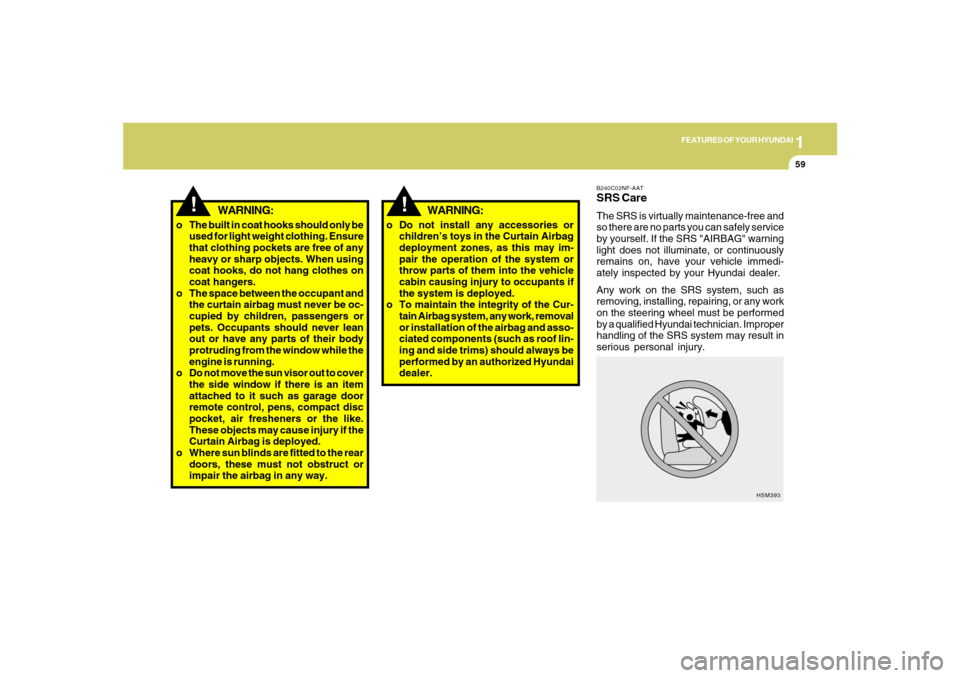
B240C02NF-AATSRS CareThe SRS is virtually maintenance-free and
so there are no parts you can safely service
by yourself. If the SRS "AIRBAG" warning
light does not illuminate, or continuously
remains on, have your vehicle immedi-
ately inspected by your Hyundai dealer.
Any work on the SRS system, such as
removing, installing, repairing, or any work
on the steering wheel must be performed
by a qualified Hyundai technician. Improper
handling of the SRS system may result in
serious personal injury.
HSM393
!
WARNING:
o The built in coat hooks should only be
used for light weight clothing. Ensure
that clothing pockets are free of any
heavy or sharp objects. When using
coat hooks, do not hang clothes on
coat hangers.
o The space between the occupant and
the curtain airbag must never be oc-
cupied by children, passengers or
pets. Occupants should never lean
out or have any parts of their body
protruding from the window while the
engine is running.
o Do not move the sun visor out to cover
the side window if there is an item
attached to it such as garage door
remote control, pens, compact disc
pocket, air fresheners or the like.
These objects may cause injury if the
Curtain Airbag is deployed.
o Where sun blinds are fitted to the rear
doors, these must not obstruct or
impair the airbag in any way.o Do not install any accessories or
children’s toys in the Curtain Airbag
deployment zones, as this may im-
pair the operation of the system or
throw parts of them into the vehicle
cabin causing injury to occupants if
the system is deployed.
o To maintain the integrity of the Cur-
tain Airbag system, any work, removal
or installation of the airbag and asso-
ciated components (such as roof lin-
ing and side trims) should always be
performed by an authorized Hyundai
dealer.
WARNING:
Page 74 of 308
1FEATURES OF YOUR HYUNDAI60
B240D02NF-AATAdditional Safety PrecautionsoNever let passengers ride in the cargo
area (trunk) or on top of a folded-down
back seat. All occupants should sit
upright, fully back in their seats with
their seat belts on and their feet on the
floor.
oPassengers should not move out of or
change seats while the vehicle is mov-
ing. A passenger who is not wearing a
seat belt during a crash or emergency
stop can be thrown against the inside of
the vehicle, against other occupants, or
out of the vehicle.
oEach seat belt is designed to restrain
one occupant. If more than one person
uses the same seat belt, they could be
seriously injured or killed in a collision.
oDo not use any accessories on seat
belts. Devices claiming to improve oc-
cupant comfort or reposition the seat
belt can reduce the protection provided
by the seat belt and increase the chance
of serious injury in a crash.
oPassengers should not place hard or
sharp objects between themselves
and the airbags. Carrying hard or sharp
objects on your lap or in your mouth can
result in injuries if an airbag inflates.
WARNING:
o Do not install a child restraint system
in the front passenger seat position.
A child restraint system must never
be placed in the front seat. The infant
or child could be severely injured by
an airbag deployment in case of an
accident.
o Modification to SRS components or
wiring, including the addition of any
kind of badges to the pad covers or
modifications to the body structure,
can adversely affect SRS perfor-
mance and lead to possible injury.
o For cleaning the airbag pad covers,
use only a soft, dry cloth or one which
has been moistened with plain water.
Solvents or cleaners could adversely
affect the airbag covers and proper
deployment of the system.
o No objects should be placed over or
near the airbag modules on the steer-
ing wheel, instrument panel, and the
front passenger's panel above the
glove box, because any such object
could cause harm if the vehicle is in a
crash severe enough to cause the
airbags to inflate.
!
o If the airbags inflate, they must be
replaced by an authorized Hyundai
dealer.
o Do not tamper with or disconnect SRS
wiring, or other components of the
SRS system. Doing so could result in
injury, due to accidental inflation of
the airbags or by rendering the SRS
inoperative.
o If components of the airbag system
must be discarded, or if the vehicle
must be scrapped, certain safety pre-
cautions must be observed. Your
Hyundai dealer knows these precau-
tions and can give you the necessary
information. Failure to follow these
precautions and procedures could in-
crease the risk of personal injury.
o If your car was flooded and has soaked
carpeting or water on flooring, you
shouldn't try to start the engine; have
the car towed to an authorized Hyundai
dealer.
!
WARNING:
Page 77 of 308

1
FEATURES OF YOUR HYUNDAI
63
1. Check Engine - Malfunction Indicator Light (MIL)
2. Low Oil Pressure Warning Light
3. Charging System Warning Light
4. SRS (Airbag) Warning Light
5. Tachometer
6. Turn Signal Indicator Lights
7. High Beam Indicator Light
8. Electronic Stability Control (ESC) Indicator Lights
(If Installed)
9. Automatic Transaxle Position Indicator Light
10. CRUISE Indicator Light
11. Front Fog Light Indicator Light
12. Cruise SET Indicator Light13. Speedometer
14. Low Windshield Washer Fluid Level Warning Light
15. Trunk Lid Open Warning Light
16. Immobilizer Warning Light
17. Coolant Temperature Gauge
18. ABS Service Reminder Indicator (SRI) (If Installed)
19. Door Ajar Warning Light
20. Seat Belt Warning Light (Driver's side)
21. Odometer/Trip Computer
22. Parking Brake/Low Brake Fluid Level Warning Light
23. Low Fuel Warning Light
24. Fuel Gauge
Page 79 of 308

1
FEATURES OF YOUR HYUNDAI
65
1. Check Engine - Malfunction Indicator Light (MIL)
2. Charging System Warning Light
3. Low Oil Pressure Warning Light
4. Parking Brake/Low Brake Fluid Level Warning Light
5. Tachometer
6. Door Ajar Warning Light
7. Turn Signal Indicator Lights
8. Odometer/Trip Computer/Warning Text
9. Speedometer
10. Trunk Lid Open Warning Light
11. CRUISE Indicator Light
12. Cruise SET Indicator Light
13. Immobilizer Warning Light14. Coolant Temperature Gauge
15. Low Windshield Washer Fluid Level Warning Light
16. SRS (Airbag) Warning Light
17. ABS Service Reminder Indicator (SRI) (If Installed)
18. Electronic Stability Control (ESC) Indicator Lights
(If Installed)
19. Seat Belt Warning Light (Driver's side)
20. High Beam Indicator Light
21. Automatic Transaxle Position Indicator Light
22. Front Fog Light Indicator Light
23. Low Fuel Warning Light
24. Fuel Gauge
Page 80 of 308
1FEATURES OF YOUR HYUNDAI66
WARNING AND INDICATOR LIGHTSB260D01A-AAT
Turn Signal Indicator Lights
The blinking green arrows on the instru-
ment panel show the direction indicated
by the turn signals. If the arrow comes on
but does not blink, blinks more rapidly than
normal, or does not illuminate at all, a
malfunction in the turn signal system is
indicated. Your dealer should be consulted
for repairs.B260F01A-AAT
High Beam Indicator Light
The high beam indicator light comes on
whenever the headlights are switched to
the high beam or flash position.
B260G01TG-AAT
Low Oil Pressure Warning
Light
CAUTION:
If the low oil pressure warning light stays
on while the engine is running, serious
engine damage may result. The oil pres-
sure warning light comes on whenever
there is insufficient oil pressure. In nor-
mal operation, it should come on when
the ignition switch is turned on, then go
out when the engine is started. If the oil
pressure warning light stays on while
the engine is running, there is a serious
malfunction.
If this happens, stop the car as soon as
it is safe to do so, turn off the engine and
check the oil level. If the oil level is low,
fill the engine oil to the proper level and
start the engine again. If the light stays
on with the engine running, turn the en-
gine off immediately. In any instance
where the oil light stays on when the
engine is running, the engine should be
checked by a Hyundai dealer before the
car is driven again.
!
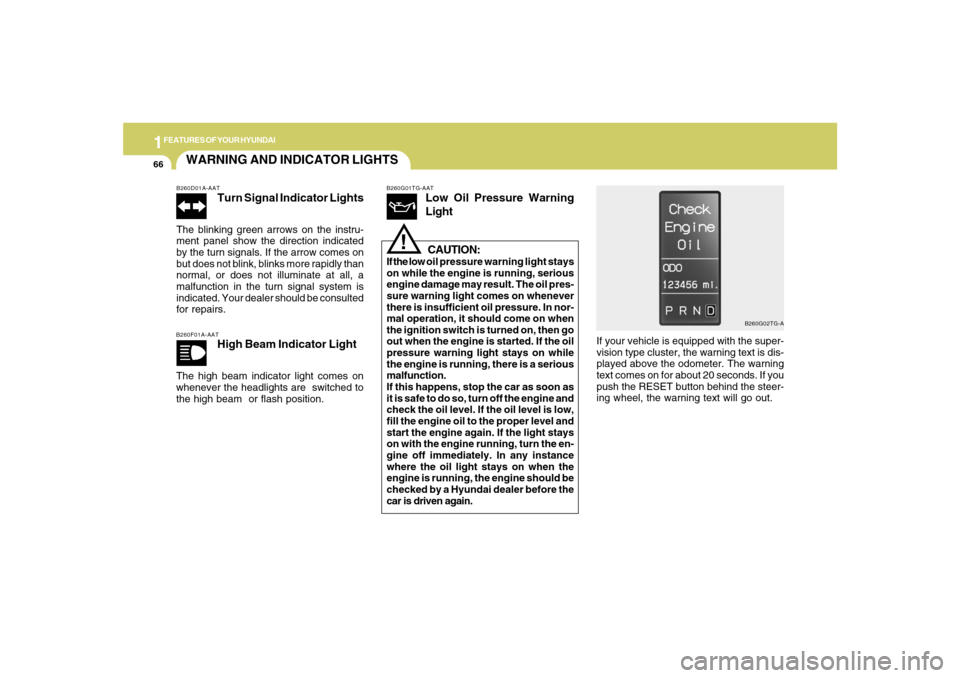
If your vehicle is equipped with the super-
vision type cluster, the warning text is dis-
played above the odometer. The warning
text comes on for about 20 seconds. If you
push the RESET button behind the steer-
ing wheel, the warning text will go out.
B260G02TG-A
Page 81 of 308
1
FEATURES OF YOUR HYUNDAI
67
!
B260H02A-AAT
Parking Brake/Low Brake
Fluid Level Warning Light
Your Hyundai is equipped with dual-di-
agonal braking systems. This means you
still have braking on two wheels even if
one of the dual systems should fail. With
only one of the dual systems working,
more than normal pedal travel and greater
pedal pressure are required to stop the
car. Also, the car will not stop in as short a
distance with only half of the brake system
working. If the brakes fail while you are
driving, shift to a lower gear for additional
engine braking and stop the car as soon as
it is safe to do so.
WARNING:
If you suspect brake trouble, have your
brakes checked by a Hyundai dealer as
soon as possible. Driving your car with
a problem in either the brake electrical
system or brake hydraulic system is
dangerous, and could result in a serious
injury or death.
Warning Light OperationThe parking brake/brake fluid level warn-
ing light should come on when the parking
brake is applied and the ignition switch is
turned to "ON" or "START". After the engine
is started, the light should go out when the
parking brake is released.
If the parking brake is not applied, the
warning light should come on when the
ignition switch is turned to "ON" or "START",
then go out when the engine starts. If the
light comes on at any other time, you should
slow the vehicle and bring it to a complete
stop in a safe location off the roadway.
The brake fluid level warning light indi-
cates that the brake fluid level in the brake
master cylinder is low and hydraulic brake
fluid conforming to DOT 3 or DOT 4 speci-
fications should be added. After adding
fluid, if no other trouble is found, the car
should be immediately and carefully driven
to a Hyundai dealer for inspection. If further
trouble is experienced, the vehicle should
not be driven at all but taken to a dealer by
a professional towing service.