ABS Hyundai Azera 2007 Owner's Manual
[x] Cancel search | Manufacturer: HYUNDAI, Model Year: 2007, Model line: Azera, Model: Hyundai Azera 2007Pages: 308, PDF Size: 12.63 MB
Page 14 of 308

YOUR VEHICLE AT A GLANCEB255A01TG-AATINDICATOR SYMBOLS ON THE INSTRUMENT CLUSTER* More detailed explanations of these items will be found beginning on page 1-66.
Turn Signal Indicator LightsHigh Beam Indicator LightLow Oil Pressure Warning LightParking Brake/Low Brake Fluid Level
Warning Light
Charging System Warning LightDoor Ajar Warning LightTrunk Lid Open Warning LightLow Fuel Level Warning Light
Low Windshield Washer Fluid Level Warning Light
Seat Belt Warning LightFront Fog Light Indicator LightCheck Engine - Malfunction Indicator Light (MIL)SRS (Airbag) Warning LightABS Service Reminder Indicator (If Installed)
Electronic Stability Control (ESC) Indicator
Lights (If Installed)Cruise Indicator LightCruise SET Indicator Light
Immobilizer Warning Light
Page 18 of 308
1FEATURES OF YOUR HYUNDAI4
!
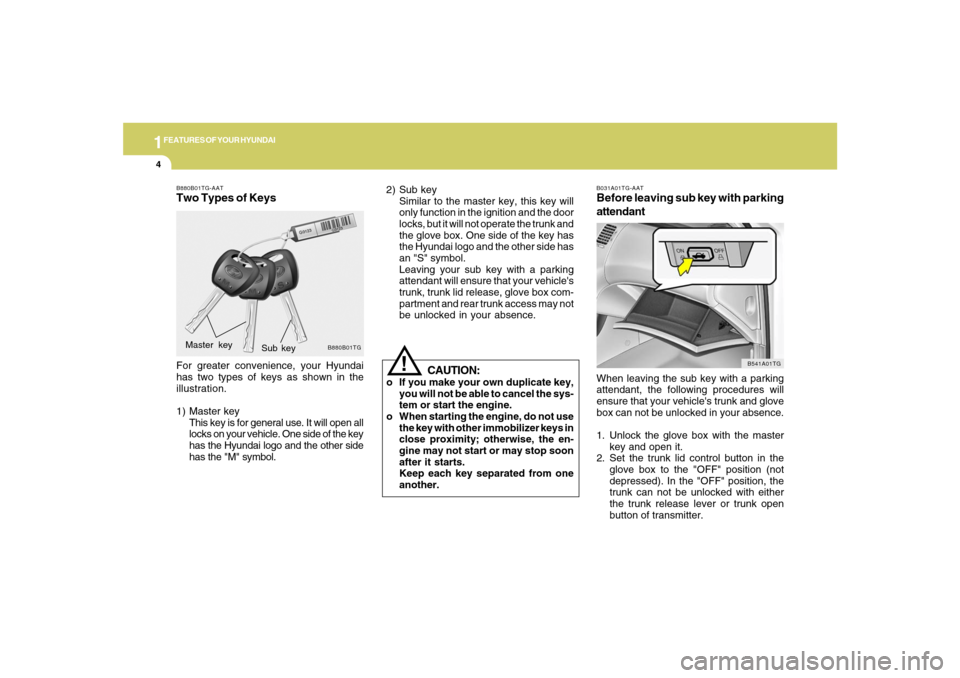
2) Sub key
Similar to the master key, this key will
only function in the ignition and the door
locks, but it will not operate the trunk and
the glove box. One side of the key has
the Hyundai logo and the other side has
an "S" symbol.
Leaving your sub key with a parking
attendant will ensure that your vehicle's
trunk, trunk lid release, glove box com-
partment and rear trunk access may not
be unlocked in your absence.
CAUTION:
o If you make your own duplicate key,
you will not be able to cancel the sys-
tem or start the engine.
o When starting the engine, do not use
the key with other immobilizer keys in
close proximity; otherwise, the en-
gine may not start or may stop soon
after it starts.
Keep each key separated from one
another.
B031A01TG-AATBefore leaving sub key with parking
attendantWhen leaving the sub key with a parking
attendant, the following procedures will
ensure that your vehicle's trunk and glove
box can not be unlocked in your absence.
1. Unlock the glove box with the master
key and open it.
2. Set the trunk lid control button in the
glove box to the "OFF" position (not
depressed). In the "OFF" position, the
trunk can not be unlocked with either
the trunk release lever or trunk open
button of transmitter.
B541A01TG
B880B01TG-AATTwo Types of KeysFor greater convenience, your Hyundai
has two types of keys as shown in the
illustration.
1) Master key
This key is for general use. It will open all
locks on your vehicle. One side of the key
has the Hyundai logo and the other side
has the "M" symbol.
B880B01TG
Sub key Master key
Page 47 of 308
1
FEATURES OF YOUR HYUNDAI
33
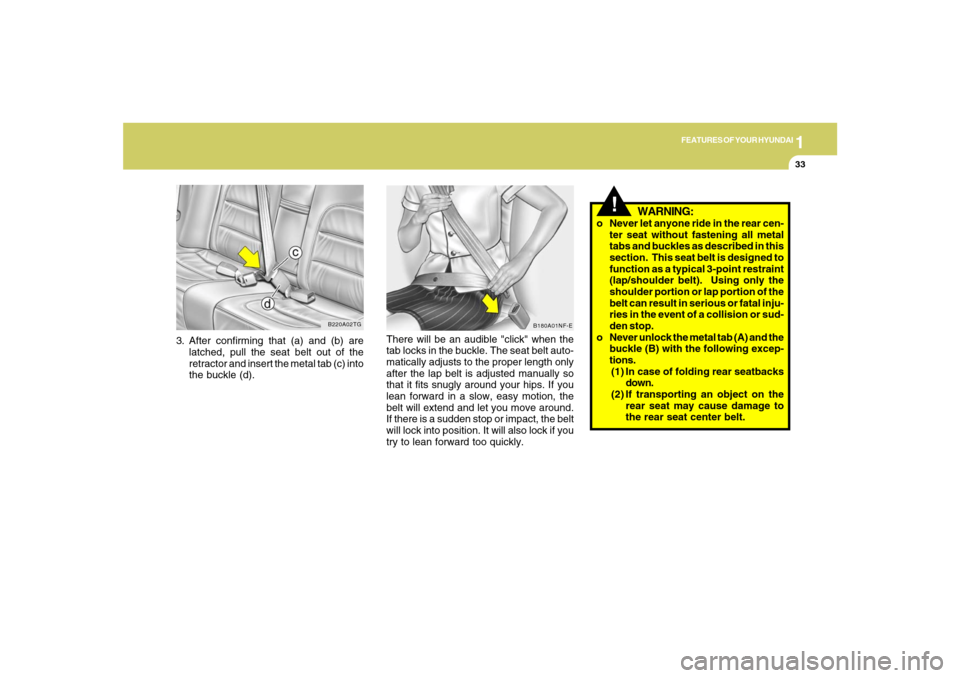
There will be an audible "click" when the
tab locks in the buckle. The seat belt auto-
matically adjusts to the proper length only
after the lap belt is adjusted manually so
that it fits snugly around your hips. If you
lean forward in a slow, easy motion, the
belt will extend and let you move around.
If there is a sudden stop or impact, the belt
will lock into position. It will also lock if you
try to lean forward too quickly.
!
WARNING:
o Never let anyone ride in the rear cen-
ter seat without fastening all metal
tabs and buckles as described in this
section. This seat belt is designed to
function as a typical 3-point restraint
(lap/shoulder belt). Using only the
shoulder portion or lap portion of the
belt can result in serious or fatal inju-
ries in the event of a collision or sud-
den stop.
o Never unlock the metal tab (A) and the
buckle (B) with the following excep-
tions.
(1) In case of folding rear seatbacks
down.
(2) If transporting an object on the
rear seat may cause damage to
the rear seat center belt.
B180A01NF-E
3. After confirming that (a) and (b) are
latched, pull the seat belt out of the
retractor and insert the metal tab (c) into
the buckle (d).
B220A02TG
Page 52 of 308
1FEATURES OF YOUR HYUNDAI38
!
o Never mount more than one child re-
straint to a single tether or to a single
lower anchorage point. The increased
load caused by multiple seats may
cause the tethers or anchorage points
to break, causing serious injury or
death.
o When using the vehicle’s "ISOFIX"
system to install a child restraint sys-
tem in the rear seat, all unused ve-
hicle rear seat belt metal latch plates
or tabs must be latched securely in
their seat belt buckles and the seat
belt webbing must be retracted be-
hind the child restraint to prevent the
child from reaching and taking hold of
unretracted seat belts. Unlatched
metal latch plates or tabs may allow
the child to reach the unretracted seat
belts which may result in strangula-
tion and a serious injury or death to
the child in the child restraint.
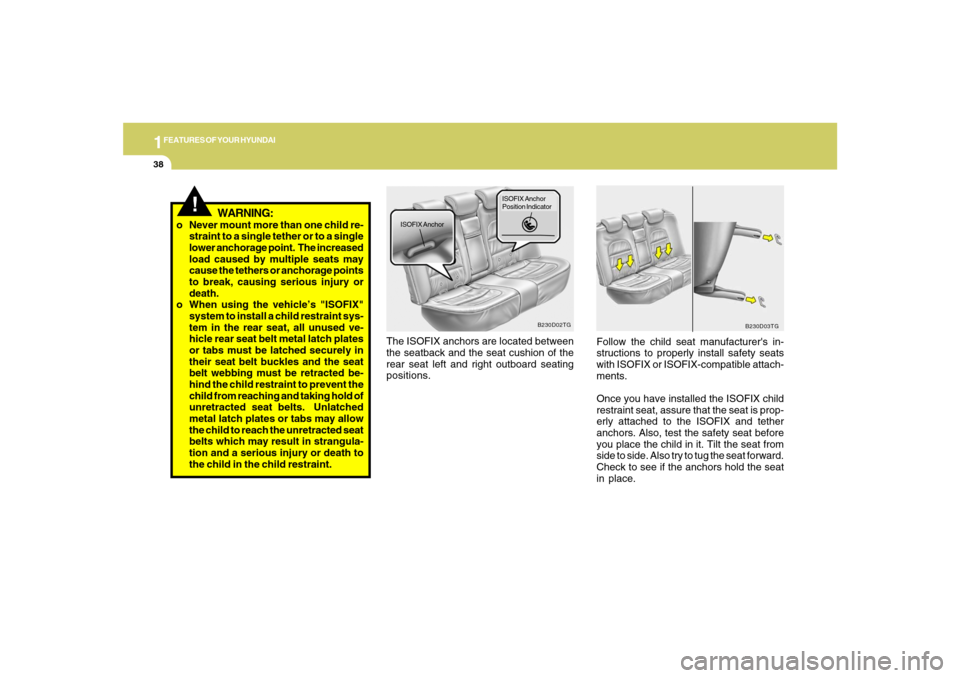
The ISOFIX anchors are located between
the seatback and the seat cushion of the
rear seat left and right outboard seating
positions.
B230D02TG
ISOFIX AnchorISOFIX Anchor
Position Indicator
B230D03TG
Follow the child seat manufacturer's in-
structions to properly install safety seats
with ISOFIX or ISOFIX-compatible attach-
ments.
Once you have installed the ISOFIX child
restraint seat, assure that the seat is prop-
erly attached to the ISOFIX and tether
anchors. Also, test the safety seat before
you place the child in it. Tilt the seat from
side to side. Also try to tug the seat forward.
Check to see if the anchors hold the seat
in place.
WARNING:
Page 77 of 308

1
FEATURES OF YOUR HYUNDAI
63
1. Check Engine - Malfunction Indicator Light (MIL)
2. Low Oil Pressure Warning Light
3. Charging System Warning Light
4. SRS (Airbag) Warning Light
5. Tachometer
6. Turn Signal Indicator Lights
7. High Beam Indicator Light
8. Electronic Stability Control (ESC) Indicator Lights
(If Installed)
9. Automatic Transaxle Position Indicator Light
10. CRUISE Indicator Light
11. Front Fog Light Indicator Light
12. Cruise SET Indicator Light13. Speedometer
14. Low Windshield Washer Fluid Level Warning Light
15. Trunk Lid Open Warning Light
16. Immobilizer Warning Light
17. Coolant Temperature Gauge
18. ABS Service Reminder Indicator (SRI) (If Installed)
19. Door Ajar Warning Light
20. Seat Belt Warning Light (Driver's side)
21. Odometer/Trip Computer
22. Parking Brake/Low Brake Fluid Level Warning Light
23. Low Fuel Warning Light
24. Fuel Gauge
Page 79 of 308

1
FEATURES OF YOUR HYUNDAI
65
1. Check Engine - Malfunction Indicator Light (MIL)
2. Charging System Warning Light
3. Low Oil Pressure Warning Light
4. Parking Brake/Low Brake Fluid Level Warning Light
5. Tachometer
6. Door Ajar Warning Light
7. Turn Signal Indicator Lights
8. Odometer/Trip Computer/Warning Text
9. Speedometer
10. Trunk Lid Open Warning Light
11. CRUISE Indicator Light
12. Cruise SET Indicator Light
13. Immobilizer Warning Light14. Coolant Temperature Gauge
15. Low Windshield Washer Fluid Level Warning Light
16. SRS (Airbag) Warning Light
17. ABS Service Reminder Indicator (SRI) (If Installed)
18. Electronic Stability Control (ESC) Indicator Lights
(If Installed)
19. Seat Belt Warning Light (Driver's side)
20. High Beam Indicator Light
21. Automatic Transaxle Position Indicator Light
22. Front Fog Light Indicator Light
23. Low Fuel Warning Light
24. Fuel Gauge
Page 86 of 308
1FEATURES OF YOUR HYUNDAI72
B260B01JM-AAT
SRS (Airbag) Warning Light
The SRS warning light comes on for ap-
proximately 6 seconds after the key is
turned to the "ON" position or after the
engine is started, after which it will go out.
This light also comes on when the SRS is
not working properly. If the AIRBAG warn-
ing light does not come on, or continuously
remains on after operating for about 6
seconds when you turned the ignition key
to the "ON" position or started the engine,
or if it comes on while driving, have the
SRS inspected by an authorized Hyundai
dealer.
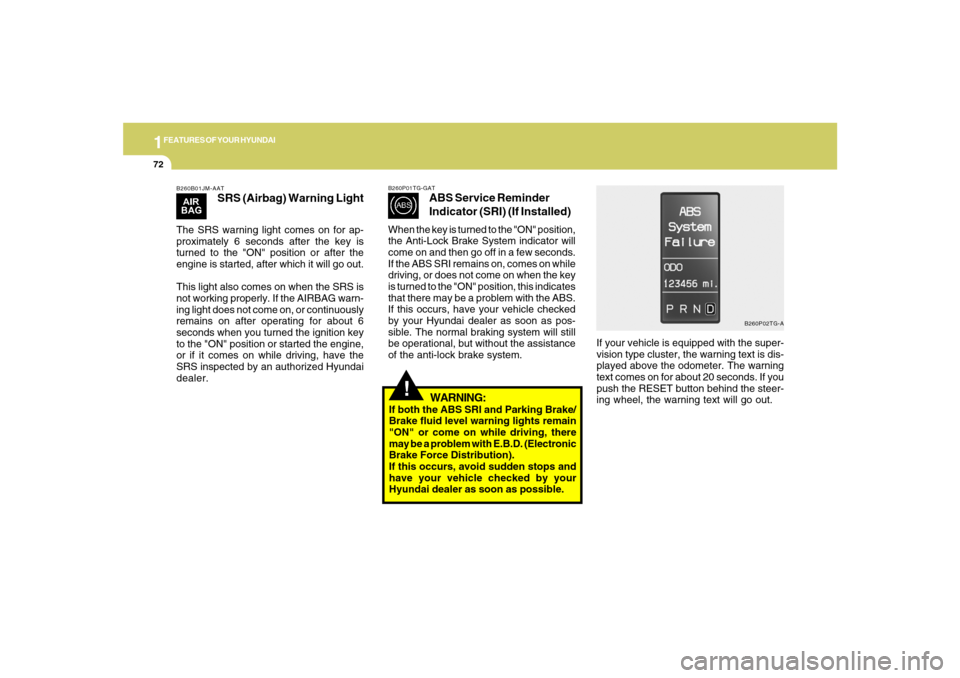
If your vehicle is equipped with the super-
vision type cluster, the warning text is dis-
played above the odometer. The warning
text comes on for about 20 seconds. If you
push the RESET button behind the steer-
ing wheel, the warning text will go out.
B260P02TG-A B260P01TG-GAT
ABS Service Reminder
Indicator (SRI) (If Installed)
When the key is turned to the "ON" position,
the Anti-Lock Brake System indicator will
come on and then go off in a few seconds.
If the ABS SRI remains on, comes on while
driving, or does not come on when the key
is turned to the "ON" position, this indicates
that there may be a problem with the ABS.
If this occurs, have your vehicle checked
by your Hyundai dealer as soon as pos-
sible. The normal braking system will still
be operational, but without the assistance
of the anti-lock brake system.
!
WARNING:
If both the ABS SRI and Parking Brake/
Brake fluid level warning lights remain
"ON" or come on while driving, there
may be a problem with E.B.D. (Electronic
Brake Force Distribution).
If this occurs, avoid sudden stops and
have your vehicle checked by your
Hyundai dealer as soon as possible.
Page 181 of 308
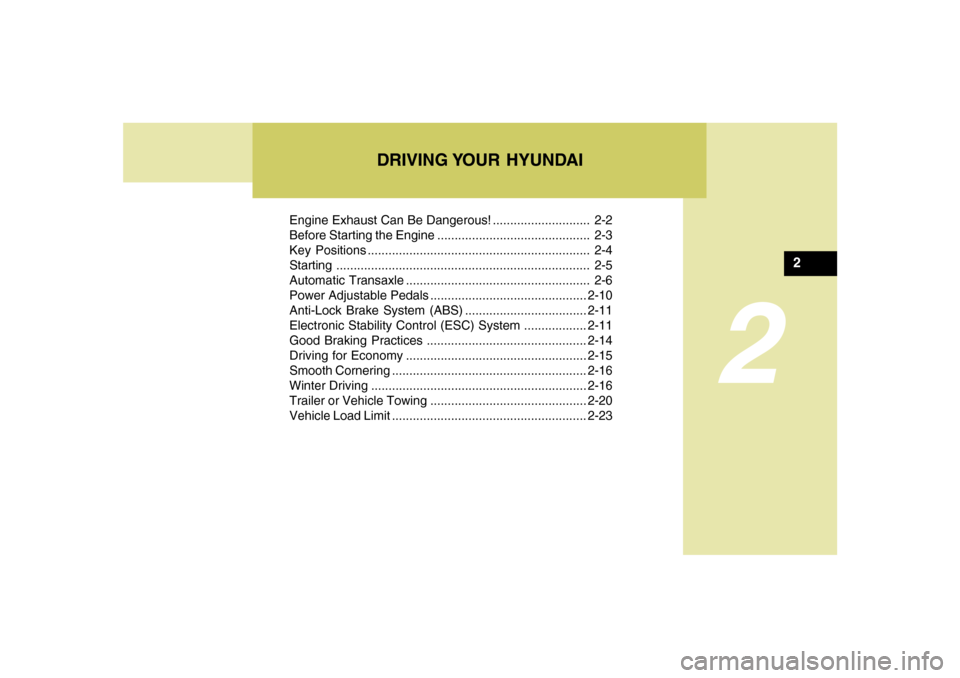
DRIVING YOUR HYUNDAI
2
Engine Exhaust Can Be Dangerous! ............................ 2-2
Before Starting the Engine ............................................ 2-3
Key Positions ................................................................ 2-4
Starting .........................................................................2-5
Automatic Transaxle ..................................................... 2-6
Power Adjustable Pedals.............................................2-10
Anti-Lock Brake System (ABS) ...................................2-11
Electronic Stability Control (ESC) System ..................2-11
Good Braking Practices..............................................2-14
Driving for Economy ....................................................2-15
Smooth Cornering........................................................2-16
Winter Driving..............................................................2-16
Trailer or Vehicle Towing .............................................2-20
Vehicle Load Limit........................................................2-23
2
Page 191 of 308
2
DRIVING YOUR HYUNDAI
11
!
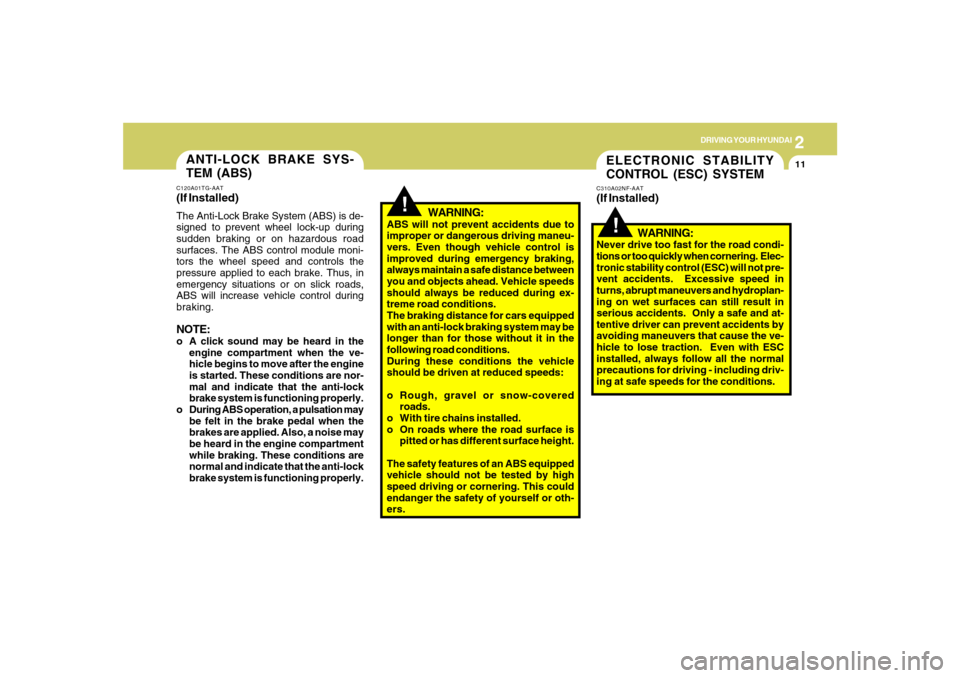
ANTI-LOCK BRAKE SYS-
TEM (ABS)C120A01TG-AAT(If Installed)The Anti-Lock Brake System (ABS) is de-
signed to prevent wheel lock-up during
sudden braking or on hazardous road
surfaces. The ABS control module moni-
tors the wheel speed and controls the
pressure applied to each brake. Thus, in
emergency situations or on slick roads,
ABS will increase vehicle control during
braking.NOTE:o A click sound may be heard in the
engine compartment when the ve-
hicle begins to move after the engine
is started. These conditions are nor-
mal and indicate that the anti-lock
brake system is functioning properly.
o During ABS operation, a pulsation may
be felt in the brake pedal when the
brakes are applied. Also, a noise may
be heard in the engine compartment
while braking. These conditions are
normal and indicate that the anti-lock
brake system is functioning properly.
!
WARNING:
ABS will not prevent accidents due to
improper or dangerous driving maneu-
vers. Even though vehicle control is
improved during emergency braking,
always maintain a safe distance between
you and objects ahead. Vehicle speeds
should always be reduced during ex-
treme road conditions.
The braking distance for cars equipped
with an anti-lock braking system may be
longer than for those without it in the
following road conditions.
During these conditions the vehicle
should be driven at reduced speeds:
o Rough, gravel or snow-covered
roads.
o With tire chains installed.
o On roads where the road surface is
pitted or has different surface height.
The safety features of an ABS equipped
vehicle should not be tested by high
speed driving or cornering. This could
endanger the safety of yourself or oth-
ers.
ELECTRONIC STABILITY
CONTROL (ESC) SYSTEMC310A02NF-AAT(If Installed)
WARNING:Never drive too fast for the road condi-
tions or too quickly when cornering. Elec-
tronic stability control (ESC) will not pre-
vent accidents. Excessive speed in
turns, abrupt maneuvers and hydroplan-
ing on wet surfaces can still result in
serious accidents. Only a safe and at-
tentive driver can prevent accidents by
avoiding maneuvers that cause the ve-
hicle to lose traction. Even with ESC
installed, always follow all the normal
precautions for driving - including driv-
ing at safe speeds for the conditions.
Page 227 of 308

4
CORROSION PREVENTION AND APPEARANCE CARE
5
E030D01A-AATWhen to Wax AgainYou should polish and wax the car again
when water no longer beads on a clean
surface but spreads out over a larger area.E030C01A-AATPolishing and WaxingAlways wash and dry the car before polish-
ing or waxing or using a combination
cleaner and wax. Use a good quality com-
mercial product and follow the
manufacturer's directions on the container.
Polish and wax the bright trim pieces as
well as the paint.
E030B01A-AATSpot CleaningDon't use gasoline, strong solvents or cor-
rosive cleaning agents. These can dam-
age the finish of the car. To remove road
tar, use turpentine on a clean, soft cloth. Be
gentle.
To remove dead insects or tree sap, use
warm water and mild soap or car-washing
solution. Soak the spot and rub gently. If
the paint has lost its luster, use a commer-
cial car-cleaning polish. After rinsing, dry the car using a damp
chamois or soft, absorbent cloth. The rea-
son for drying the car is to remove water
from the car so it will dry without water
spots. Don't rub, this can damage the fin-
ish.
If you find any nicks or scratches in the
paint, use touch-up paint to cover them to
prevent corrosion. To protect the paintwork
of the car against corrosion, you must
clean your Hyundai (at least once a month).
Give special attention
to the removal of salt, mud and other sub-
stances on the underside of the
splashboards of the car. Make sure that the
outlets and the underside of the doors are
open. Paint damage can be caused by
small accumulation of tar, industrial pre-
cipitation, tree resin, insects and bird drop-
pings, when not removed immediately. If
water alone is not strong enough to re-
move the accumulated dirt, use a mild car
washing solution. Be sure to rinse the
surface after washing to remove the solu-
tion. Never allow the solution to dry on the
painted surfaces.
TGhma-4.p658/25/2005, 5:33 PM 5