trunk Hyundai Azera 2007 Owner's Manual
[x] Cancel search | Manufacturer: HYUNDAI, Model Year: 2007, Model line: Azera, Model: Hyundai Azera 2007Pages: 308, PDF Size: 12.63 MB
Page 14 of 308

YOUR VEHICLE AT A GLANCEB255A01TG-AATINDICATOR SYMBOLS ON THE INSTRUMENT CLUSTER* More detailed explanations of these items will be found beginning on page 1-66.
Turn Signal Indicator LightsHigh Beam Indicator LightLow Oil Pressure Warning LightParking Brake/Low Brake Fluid Level
Warning Light
Charging System Warning LightDoor Ajar Warning LightTrunk Lid Open Warning LightLow Fuel Level Warning Light
Low Windshield Washer Fluid Level Warning Light
Seat Belt Warning LightFront Fog Light Indicator LightCheck Engine - Malfunction Indicator Light (MIL)SRS (Airbag) Warning LightABS Service Reminder Indicator (If Installed)
Electronic Stability Control (ESC) Indicator
Lights (If Installed)Cruise Indicator LightCruise SET Indicator Light
Immobilizer Warning Light
Page 18 of 308
1FEATURES OF YOUR HYUNDAI4
!
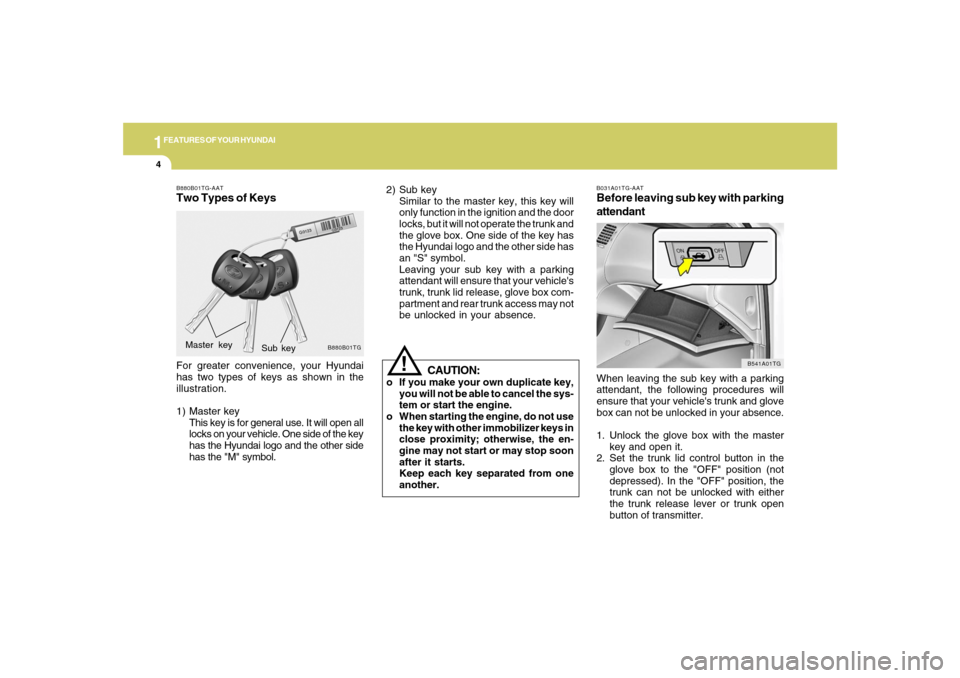
2) Sub key
Similar to the master key, this key will
only function in the ignition and the door
locks, but it will not operate the trunk and
the glove box. One side of the key has
the Hyundai logo and the other side has
an "S" symbol.
Leaving your sub key with a parking
attendant will ensure that your vehicle's
trunk, trunk lid release, glove box com-
partment and rear trunk access may not
be unlocked in your absence.
CAUTION:
o If you make your own duplicate key,
you will not be able to cancel the sys-
tem or start the engine.
o When starting the engine, do not use
the key with other immobilizer keys in
close proximity; otherwise, the en-
gine may not start or may stop soon
after it starts.
Keep each key separated from one
another.
B031A01TG-AATBefore leaving sub key with parking
attendantWhen leaving the sub key with a parking
attendant, the following procedures will
ensure that your vehicle's trunk and glove
box can not be unlocked in your absence.
1. Unlock the glove box with the master
key and open it.
2. Set the trunk lid control button in the
glove box to the "OFF" position (not
depressed). In the "OFF" position, the
trunk can not be unlocked with either
the trunk release lever or trunk open
button of transmitter.
B541A01TG
B880B01TG-AATTwo Types of KeysFor greater convenience, your Hyundai
has two types of keys as shown in the
illustration.
1) Master key
This key is for general use. It will open all
locks on your vehicle. One side of the key
has the Hyundai logo and the other side
has the "M" symbol.
B880B01TG
Sub key Master key
Page 19 of 308
1
FEATURES OF YOUR HYUNDAI
5
3. Close the glove box, and lock the glove
box using the master key.
4. Switch the rear seatback knobs to the
"LOCK" position (refer to page 1-26).
5. Leave the sub key with the attendant.
Trunk and glove box are secured be-
cause the sub key only allows ignition
and door lock operation.
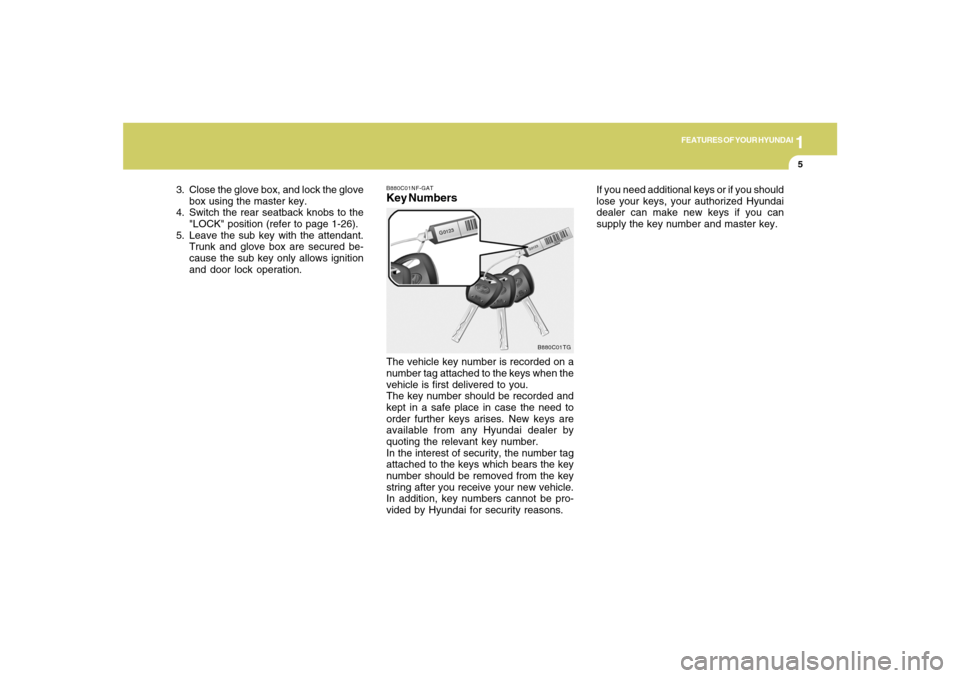
B880C01NF-GATKey NumbersThe vehicle key number is recorded on a
number tag attached to the keys when the
vehicle is first delivered to you.
The key number should be recorded and
kept in a safe place in case the need to
order further keys arises. New keys are
available from any Hyundai dealer by
quoting the relevant key number.
In the interest of security, the number tag
attached to the keys which bears the key
number should be removed from the key
string after you receive your new vehicle.
In addition, key numbers cannot be pro-
vided by Hyundai for security reasons.
B880C01TG
If you need additional keys or if you should
lose your keys, your authorized Hyundai
dealer can make new keys if you can
supply the key number and master key.
Page 24 of 308
1FEATURES OF YOUR HYUNDAI10
B070F02NF-AATKEYLESS ENTRY SYSTEM
NOTE:This device complies with Part 15 of the
FCC rules. Operation is subject to the
following two conditions:
(1) This device may not cause harmful
interference, and (2) this device must
accept any interference received, in-
cluding interference that may cause
undesired operation.
CAUTION:
Changes or modifications not expressly
approved by the party responsible for
compliance could void the user's au-
thority to operate the equipment.
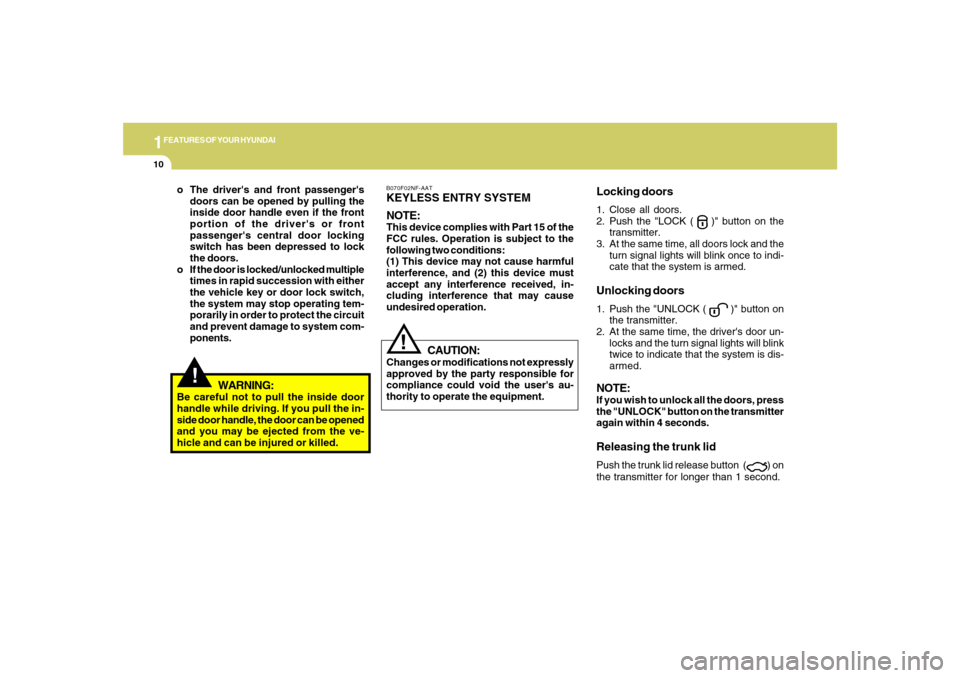
Locking doors1. Close all doors.
2. Push the "LOCK (
)" button on the
transmitter.
3. At the same time, all doors lock and the
turn signal lights will blink once to indi-
cate that the system is armed.
Unlocking doors1. Push the "UNLOCK (
)" button on
the transmitter.
2. At the same time, the driver's door un-
locks and the turn signal lights will blink
twice to indicate that the system is dis-
armed.
NOTE:If you wish to unlock all the doors, press
the "UNLOCK" button on the transmitter
again within 4 seconds.Releasing the trunk lidPush the trunk lid release button (
) on
the transmitter for longer than 1 second.
!
!
WARNING:
Be careful not to pull the inside door
handle while driving. If you pull the in-
side door handle, the door can be opened
and you may be ejected from the ve-
hicle and can be injured or killed. o The driver's and front passenger's
doors can be opened by pulling the
inside door handle even if the front
portion of the driver's or front
passenger's central door locking
switch has been depressed to lock
the doors.
o If the door is locked/unlocked multiple
times in rapid succession with either
the vehicle key or door lock switch,
the system may stop operating tem-
porarily in order to protect the circuit
and prevent damage to system com-
ponents.
Page 25 of 308
1
FEATURES OF YOUR HYUNDAI
11
THEFT-ALARM SYSTEMB070A01A-AATThis system is designed to provide protec-
tion from unauthorized entry into the car.
This system is operated in three stages :
the first is the "Armed" stage, the second is
the "Alarm" stage and the third is the "Dis-
armed" stage. If triggered, the system pro-
vides an audible alarm with blinking of the
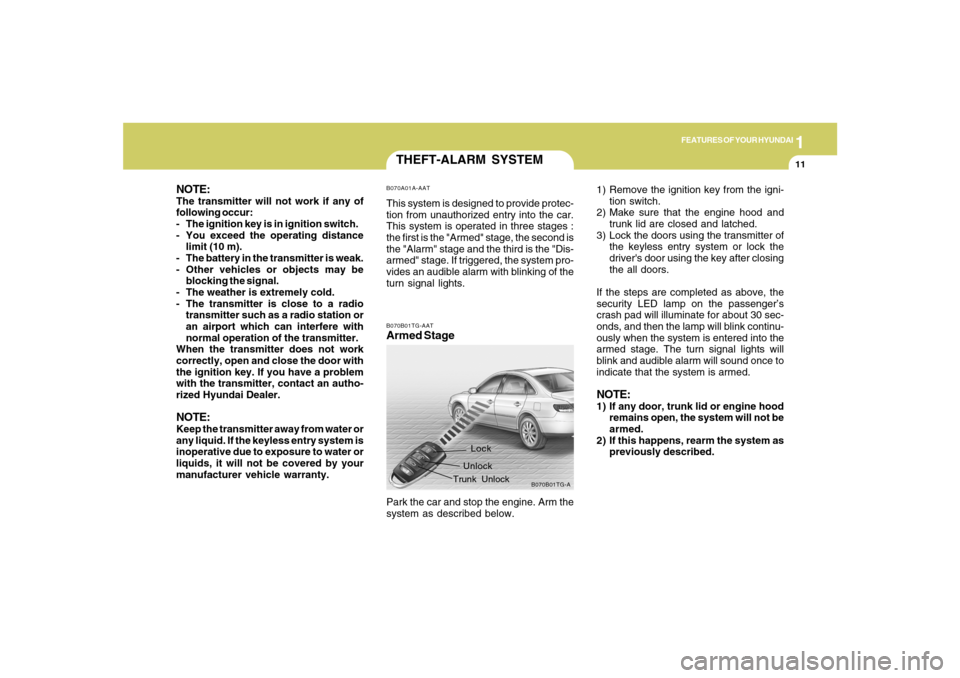
turn signal lights.B070B01TG-AATArmed Stage
B070B01TG-A
Lock
Unlock
Trunk Unlock
Park the car and stop the engine. Arm the
system as described below.1) Remove the ignition key from the igni-
tion switch.
2) Make sure that the engine hood and
trunk lid are closed and latched.
3) Lock the doors using the transmitter of
the keyless entry system or lock the
driver's door using the key after closing
the all doors.
If the steps are completed as above, the
security LED lamp on the passenger’s
crash pad will illuminate for about 30 sec-
onds, and then the lamp will blink continu-
ously when the system is entered into the
armed stage. The turn signal lights will
blink and audible alarm will sound once to
indicate that the system is armed.
NOTE:1) If any door, trunk lid or engine hood
remains open, the system will not be
armed.
2) If this happens, rearm the system as
previously described.
NOTE:The transmitter will not work if any of
following occur:
- The ignition key is in ignition switch.
- You exceed the operating distance
limit (10 m).
- The battery in the transmitter is weak.
- Other vehicles or objects may be
blocking the signal.
- The weather is extremely cold.
- The transmitter is close to a radio
transmitter such as a radio station or
an airport which can interfere with
normal operation of the transmitter.
When the transmitter does not work
correctly, open and close the door with
the ignition key. If you have a problem
with the transmitter, contact an autho-
rized Hyundai Dealer.NOTE:Keep the transmitter away from water or
any liquid. If the keyless entry system is
inoperative due to exposure to water or
liquids, it will not be covered by your
manufacturer vehicle warranty.
Page 26 of 308
1FEATURES OF YOUR HYUNDAI12
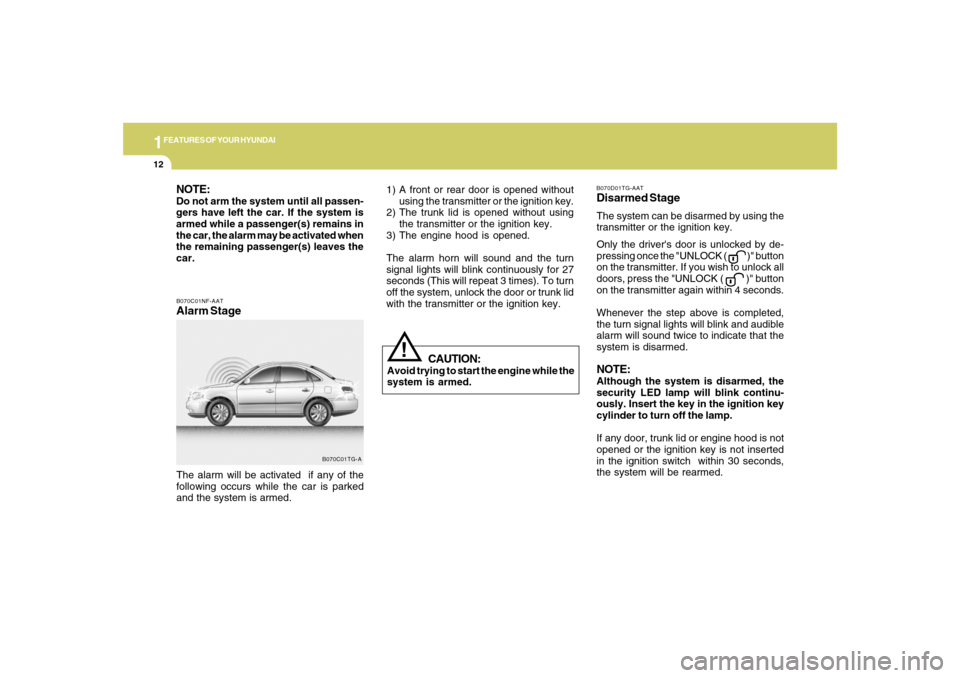
B070C01NF-AATAlarm StageThe alarm will be activated if any of the
following occurs while the car is parked
and the system is armed.
B070C01TG-A
CAUTION:
Avoid trying to start the engine while the
system is armed.
!
NOTE:Do not arm the system until all passen-
gers have left the car. If the system is
armed while a passenger(s) remains in
the car, the alarm may be activated when
the remaining passenger(s) leaves the
car.
B070D01TG-AATDisarmed StageThe system can be disarmed by using the
transmitter or the ignition key.
Only the driver's door is unlocked by de-
pressing once the "UNLOCK (
)" button
on the transmitter. If you wish to unlock all
doors, press the "UNLOCK ( )" button
on the transmitter again within 4 seconds.
Whenever the step above is completed,
the turn signal lights will blink and audible
alarm will sound twice to indicate that the
system is disarmed.
NOTE:Although the system is disarmed, the
security LED lamp will blink continu-
ously. Insert the key in the ignition key
cylinder to turn off the lamp.
If any door, trunk lid or engine hood is not
opened or the ignition key is not inserted
in the ignition switch within 30 seconds,
the system will be rearmed. 1) A front or rear door is opened without
using the transmitter or the ignition key.
2) The trunk lid is opened without using
the transmitter or the ignition key.
3) The engine hood is opened.
The alarm horn will sound and the turn
signal lights will blink continuously for 27
seconds (This will repeat 3 times). To turn
off the system, unlock the door or trunk lid
with the transmitter or the ignition key.
Page 40 of 308
1FEATURES OF YOUR HYUNDAI26
SEAT BELTS!
B150A02S-AATSEAT BELT PRECAUTIONS
WARNING:All occupants of the vehicle must wear
their seat belts at all times. Seat belts
and child restraints reduce the risk of
serious or fatal injuries for all occupants
in the event of a collision or sudden stop.
Without a seat belt, occupants could be
shifted too close to a deploying airbag,
strike the interior structure or be thrown
from the vehicle. Properly worn seat
belts greatly reduce these hazards. Even
with advanced airbags, unbelted occu-
pants can be severely injured by a de-
ploying airbag. Always follow the pre-
cautions about seat belts, airbags and
occupant safety contained in this
manual.
!
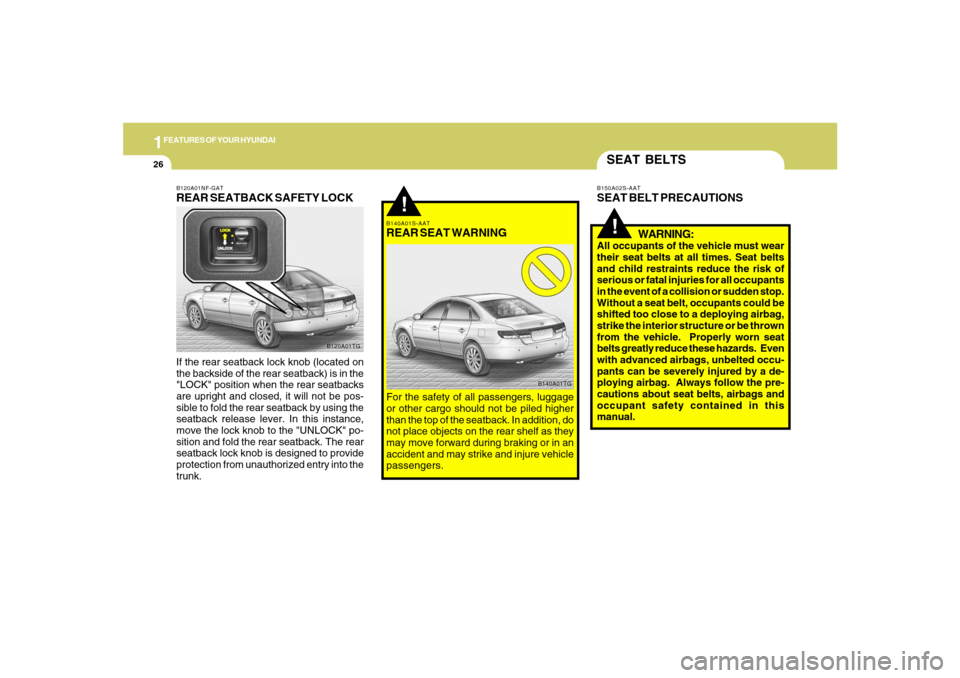
B140A01S-AATREAR SEAT WARNINGFor the safety of all passengers, luggage
or other cargo should not be piled higher
than the top of the seatback. In addition, do
not place objects on the rear shelf as they
may move forward during braking or in an
accident and may strike and injure vehicle
passengers.
B140A01TG B120A01NF-GAT
REAR SEATBACK SAFETY LOCKIf the rear seatback lock knob (located on
the backside of the rear seatback) is in the
"LOCK" position when the rear seatbacks
are upright and closed, it will not be pos-
sible to fold the rear seatback by using the
seatback release lever. In this instance,
move the lock knob to the "UNLOCK" po-
sition and fold the rear seatback. The rear
seatback lock knob is designed to provide
protection from unauthorized entry into the
trunk.
B120A01TG
Page 49 of 308
1
FEATURES OF YOUR HYUNDAI
35
!
To reduce the chance or serious or fatal
injuries:
o Children of all ages are safer when
restrained in the rear seat. A child
riding in the front passenger seat can
be forcefully struck by an inflating
airbag resulting in serious or fatal
injuries.
o Always follow the instructions for in-
stallation and use of the child restraint
maker.
o Always make sure the child seat is
secured properly in the car and your
child is securely restrained in the child
seat.
o Never hold a child in your arms or lap
when riding in a vehicle. The violent
forces created during a crash will tear
the child from your arms and throw
the child against the car’s interior.
o Never put a seat belt over yourself
and a child. During a crash, the belt
could press deep into the child caus-
ing serious internal injuries.o Never leave children unattended in a
vehicle – not even for a short time.
The car can heat up very quickly,
resulting in serious injuries to chil-
dren inside. Even very young chil-
dren may inadvertently cause the
vehicle to move, entangle themselves
in the windows, or lock themselves or
others inside the vehicle.
o Never allow two children, or any two
persons, to use the same seat belt.
o Children often squirm and reposition
themselves improperly. Never let a
child ride with the shoulder belt under
their arm or behind their back. Al-
ways properly position and secure
children in rear seat.
o Never allow a child to stand-up or
kneel on the seat or floorboard of a
moving vehicle. During a collision or
sudden stop, the child can be violently
thrown against the vehicles interior,
resulting in serious injury.
o Never use an infant carrier or a child
safety seat that "hooks" over a
seatback, it may not provide adequate
security in an accident.
!
!
WARNING:
o A child restraint system must be
placed in the rear seat. Never install
a child or infant seat on the front
passenger's seat. Should an accident
occur and cause the passenger's
front airbag to deploy, it could se-
verely injure or kill an infant or child
seated in an infant or child seat. Thus
only use a child restraint in the rear
seat of your vehicle.
o A safety belt or child restraint system
can become very hot if it is left in a
closed vehicle on a sunny day, even
if the outside temperature does not
feel hot. Be sure to check the seat
cover and buckles before placing a
child there.
o When the child restraint system is not
in use, store it in the trunk or fasten it
with a safety belt so that it will not be
thrown forward in the case of a sud-
den stop or an accident.
o Children may be seriously injured or
killed by an inflating airbag. All chil-
dren, even those too large for child
restraints, must ride in the rear seat.
WARNING: WARNING:
Page 74 of 308
1FEATURES OF YOUR HYUNDAI60
B240D02NF-AATAdditional Safety PrecautionsoNever let passengers ride in the cargo
area (trunk) or on top of a folded-down
back seat. All occupants should sit
upright, fully back in their seats with
their seat belts on and their feet on the
floor.
oPassengers should not move out of or
change seats while the vehicle is mov-
ing. A passenger who is not wearing a
seat belt during a crash or emergency
stop can be thrown against the inside of
the vehicle, against other occupants, or
out of the vehicle.
oEach seat belt is designed to restrain
one occupant. If more than one person
uses the same seat belt, they could be
seriously injured or killed in a collision.
oDo not use any accessories on seat
belts. Devices claiming to improve oc-
cupant comfort or reposition the seat
belt can reduce the protection provided
by the seat belt and increase the chance
of serious injury in a crash.
oPassengers should not place hard or
sharp objects between themselves
and the airbags. Carrying hard or sharp
objects on your lap or in your mouth can
result in injuries if an airbag inflates.
WARNING:
o Do not install a child restraint system
in the front passenger seat position.
A child restraint system must never
be placed in the front seat. The infant
or child could be severely injured by
an airbag deployment in case of an
accident.
o Modification to SRS components or
wiring, including the addition of any
kind of badges to the pad covers or
modifications to the body structure,
can adversely affect SRS perfor-
mance and lead to possible injury.
o For cleaning the airbag pad covers,
use only a soft, dry cloth or one which
has been moistened with plain water.
Solvents or cleaners could adversely
affect the airbag covers and proper
deployment of the system.
o No objects should be placed over or
near the airbag modules on the steer-
ing wheel, instrument panel, and the
front passenger's panel above the
glove box, because any such object
could cause harm if the vehicle is in a
crash severe enough to cause the
airbags to inflate.
!
o If the airbags inflate, they must be
replaced by an authorized Hyundai
dealer.
o Do not tamper with or disconnect SRS
wiring, or other components of the
SRS system. Doing so could result in
injury, due to accidental inflation of
the airbags or by rendering the SRS
inoperative.
o If components of the airbag system
must be discarded, or if the vehicle
must be scrapped, certain safety pre-
cautions must be observed. Your
Hyundai dealer knows these precau-
tions and can give you the necessary
information. Failure to follow these
precautions and procedures could in-
crease the risk of personal injury.
o If your car was flooded and has soaked
carpeting or water on flooring, you
shouldn't try to start the engine; have
the car towed to an authorized Hyundai
dealer.
!
WARNING:
Page 77 of 308

1
FEATURES OF YOUR HYUNDAI
63
1. Check Engine - Malfunction Indicator Light (MIL)
2. Low Oil Pressure Warning Light
3. Charging System Warning Light
4. SRS (Airbag) Warning Light
5. Tachometer
6. Turn Signal Indicator Lights
7. High Beam Indicator Light
8. Electronic Stability Control (ESC) Indicator Lights
(If Installed)
9. Automatic Transaxle Position Indicator Light
10. CRUISE Indicator Light
11. Front Fog Light Indicator Light
12. Cruise SET Indicator Light13. Speedometer
14. Low Windshield Washer Fluid Level Warning Light
15. Trunk Lid Open Warning Light
16. Immobilizer Warning Light
17. Coolant Temperature Gauge
18. ABS Service Reminder Indicator (SRI) (If Installed)
19. Door Ajar Warning Light
20. Seat Belt Warning Light (Driver's side)
21. Odometer/Trip Computer
22. Parking Brake/Low Brake Fluid Level Warning Light
23. Low Fuel Warning Light
24. Fuel Gauge