belt Hyundai Azera 2008 Owner's Guide
[x] Cancel search | Manufacturer: HYUNDAI, Model Year: 2008, Model line: Azera, Model: Hyundai Azera 2008Pages: 345, PDF Size: 14.61 MB
Page 67 of 345
1
FEATURES OF YOUR HYUNDAI
53
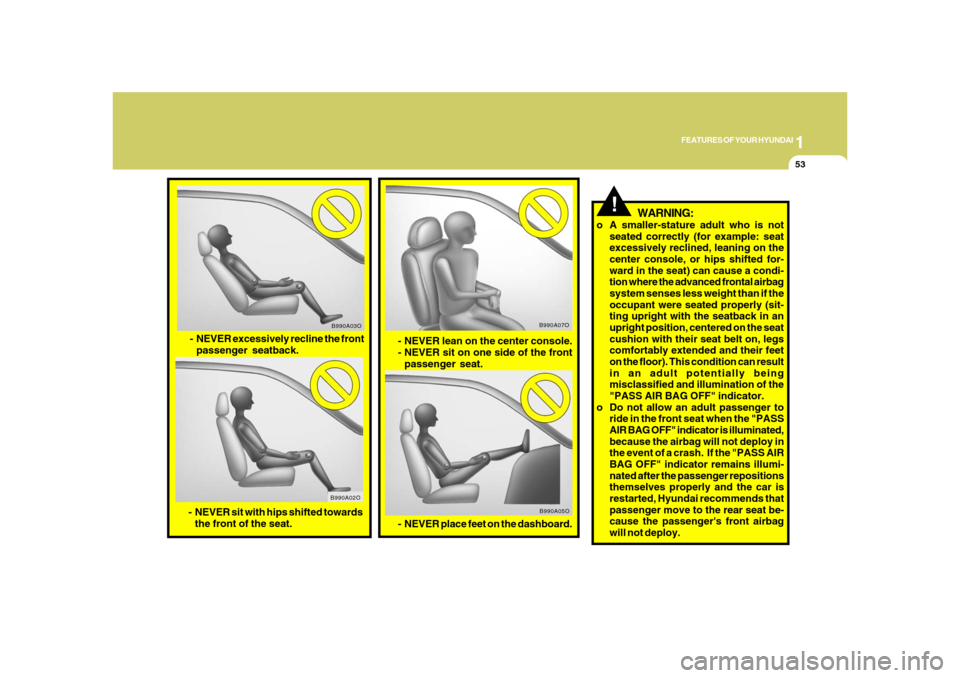
- NEVER lean on the center console.
- NEVER sit on one side of the front
passenger seat.
B990A07O
B990A05O
- NEVER place feet on the dashboard.
- NEVER excessively recline the front
passenger seatback.
- NEVER sit with hips shifted towards
the front of the seat.
B990A03O
B990A02O
!
WARNING:
o A smaller-stature adult who is not
seated correctly (for example: seat
excessively reclined, leaning on the
center console, or hips shifted for-
ward in the seat) can cause a condi-
tion where the advanced frontal airbag
system senses less weight than if the
occupant were seated properly (sit-
ting upright with the seatback in an
upright position, centered on the seat
cushion with their seat belt on, legs
comfortably extended and their feet
on the floor). This condition can result
in an adult potentially being
misclassified and illumination of the
"PASS AIR BAG OFF" indicator.
o Do not allow an adult passenger to
ride in the front seat when the "PASS
AIR BAG OFF" indicator is illuminated,
because the airbag will not deploy in
the event of a crash. If the "PASS AIR
BAG OFF" indicator remains illumi-
nated after the passenger repositions
themselves properly and the car is
restarted, Hyundai recommends that
passenger move to the rear seat be-
cause the passenger's front airbag
will not deploy.
Page 68 of 345
1FEATURES OF YOUR HYUNDAI54
!
CAUTION:
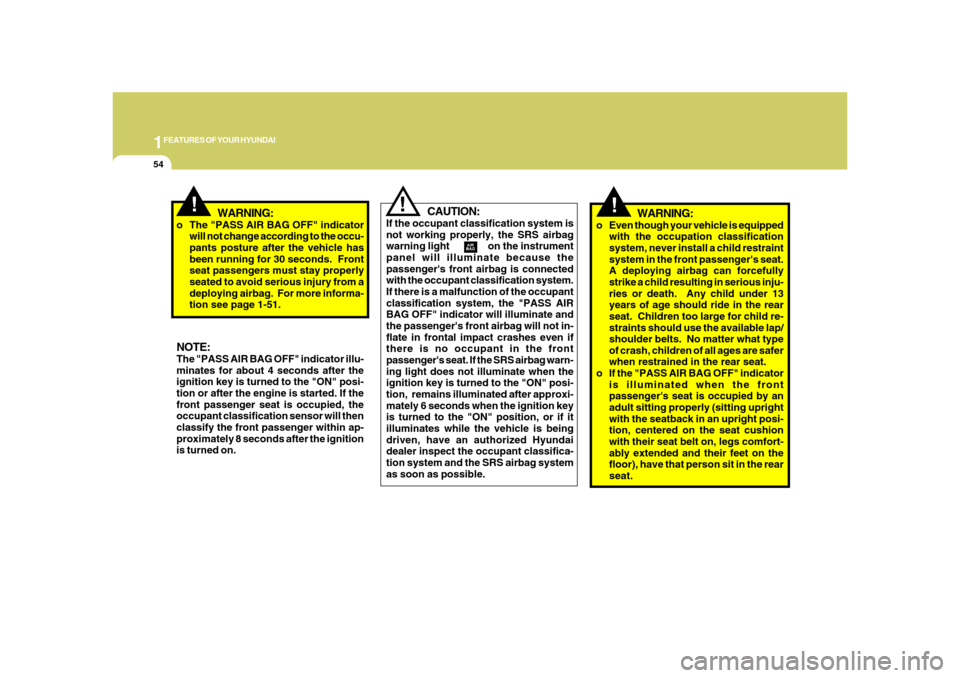
If the occupant classification system is
not working properly, the SRS airbag
warning light on the instrument
panel will illuminate because the
passenger's front airbag is connected
with the occupant classification system.
If there is a malfunction of the occupant
classification system, the "PASS AIR
BAG OFF" indicator will illuminate and
the passenger's front airbag will not in-
flate in frontal impact crashes even if
there is no occupant in the front
passenger's seat. If the SRS airbag warn-
ing light does not illuminate when the
ignition key is turned to the "ON" posi-
tion, remains illuminated after approxi-
mately 6 seconds when the ignition key
is turned to the "ON" position, or if it
illuminates while the vehicle is being
driven, have an authorized Hyundai
dealer inspect the occupant classifica-
tion system and the SRS airbag system
as soon as possible.
!
WARNING:
o Even though your vehicle is equipped
with the occupation classification
system, never install a child restraint
system in the front passenger's seat.
A deploying airbag can forcefully
strike a child resulting in serious inju-
ries or death. Any child under 13
years of age should ride in the rear
seat. Children too large for child re-
straints should use the available lap/
shoulder belts. No matter what type
of crash, children of all ages are safer
when restrained in the rear seat.
o If the "PASS AIR BAG OFF" indicator
is illuminated when the front
passenger's seat is occupied by an
adult sitting properly (sitting upright
with the seatback in an upright posi-
tion, centered on the seat cushion
with their seat belt on, legs comfort-
ably extended and their feet on the
floor), have that person sit in the rear
seat.
!
NOTE:The "PASS AIR BAG OFF" indicator illu-
minates for about 4 seconds after the
ignition key is turned to the "ON" posi-
tion or after the engine is started. If the
front passenger seat is occupied, the
occupant classification sensor will then
classify the front passenger within ap-
proximately 8 seconds after the ignition
is turned on. o The "PASS AIR BAG OFF" indicator
will not change according to the occu-
pants posture after the vehicle has
been running for 30 seconds. Front
seat passengers must stay properly
seated to avoid serious injury from a
deploying airbag. For more informa-
tion see page 1-51.
WARNING:
Page 69 of 345
1
FEATURES OF YOUR HYUNDAI
55
!
WARNING:
o If you change the weight on the front
passenger seat, the "PASS AIR BAG
OFF" indicator may be turned on or off
for a few seconds, disabling or en-
abling the passenger airbags.
o Do not modify or replace the front
passenger seat. Don't place anything
on or attach anything such as a blan-
ket or after market seat heater to the
front passenger seat. This can ad-
versely affect the occupant classifi-
cation system.
o Do not sit on sharp objects such as
tools when occupying the front pas-
senger seat. This can adversely af-
fect the occupant classification sys-
tem.
o Do not use accessory seat covers on
the front seats.
o Airbags can only be used once – have
an authorized Hyundai dealer replace
the airbag immediately after deploy-
ment.
B990B01TG
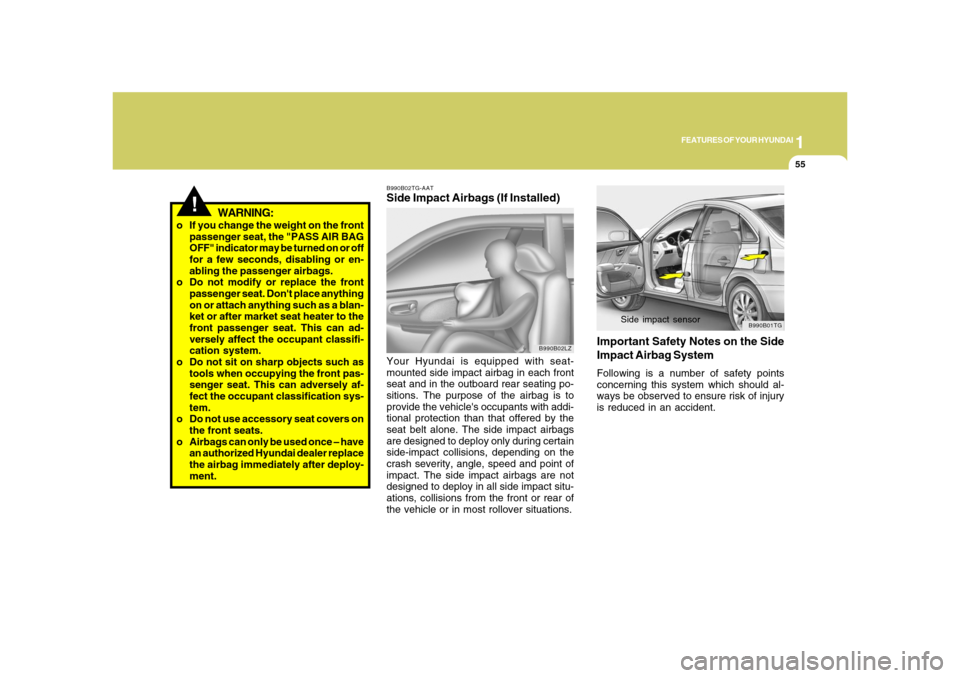
Side impact sensor
Important Safety Notes on the Side
Impact Airbag SystemFollowing is a number of safety points
concerning this system which should al-
ways be observed to ensure risk of injury
is reduced in an accident.
B990B02TG-AATSide Impact Airbags (If Installed)Your Hyundai is equipped with seat-
mounted side impact airbag in each front
seat and in the outboard rear seating po-
sitions. The purpose of the airbag is to
provide the vehicle's occupants with addi-
tional protection than that offered by the
seat belt alone. The side impact airbags
are designed to deploy only during certain
side-impact collisions, depending on the
crash severity, angle, speed and point of
impact. The side impact airbags are not
designed to deploy in all side impact situ-
ations, collisions from the front or rear of
the vehicle or in most rollover situations.
B990B02LZ
Page 70 of 345
1FEATURES OF YOUR HYUNDAI56
!
o Do not install any accessories on the
side or near the side impact airbag.
o Do not place any objects over the
airbag or between the airbag and your-
self.
o Do not place any objects (an umbrella,
bag, etc.) between the front door and
the front seat. Such objects may be-
come dangerous projectiles and
cause injury if the supplemental side
impact airbag inflates.
o To prevent unexpected deployment
of the side impact airbag that may
result in personal injury, avoid impact
to the side impact sensor when the
ignition key is on.
WARNING:
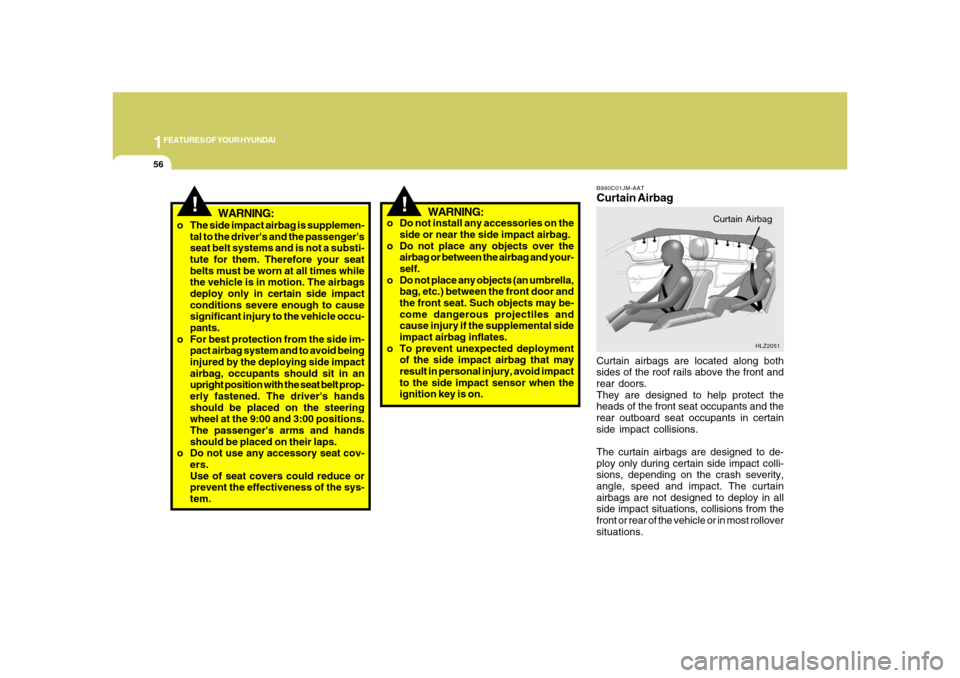
B990C01JM-AATCurtain AirbagCurtain airbags are located along both
sides of the roof rails above the front and
rear doors.
They are designed to help protect the
heads of the front seat occupants and the
rear outboard seat occupants in certain
side impact collisions.
The curtain airbags are designed to de-
ploy only during certain side impact colli-
sions, depending on the crash severity,
angle, speed and impact. The curtain
airbags are not designed to deploy in all
side impact situations, collisions from the
front or rear of the vehicle or in most rollover
situations.
HLZ2051
Curtain Airbag
WARNING:
o The side impact airbag is supplemen-
tal to the driver's and the passenger's
seat belt systems and is not a substi-
tute for them. Therefore your seat
belts must be worn at all times while
the vehicle is in motion. The airbags
deploy only in certain side impact
conditions severe enough to cause
significant injury to the vehicle occu-
pants.
o For best protection from the side im-
pact airbag system and to avoid being
injured by the deploying side impact
airbag, occupants should sit in an
upright position with the seat belt prop-
erly fastened. The driver's hands
should be placed on the steering
wheel at the 9:00 and 3:00 positions.
The passenger's arms and hands
should be placed on their laps.
o Do not use any accessory seat cov-
ers.
Use of seat covers could reduce or
prevent the effectiveness of the sys-
tem.
!
Page 73 of 345
1
FEATURES OF YOUR HYUNDAI
59
B240D02NF-AATAdditional Safety PrecautionsoNever let passengers ride in the cargo
area (trunk) or on top of a folded-down
back seat. All occupants should sit
upright, fully back in their seats with
their seat belts on and their feet on the
floor.
oPassengers should not move out of or
change seats while the vehicle is mov-
ing. A passenger who is not wearing a
seat belt during a crash or emergency
stop can be thrown against the inside of
the vehicle, against other occupants, or
out of the vehicle.
oEach seat belt is designed to restrain
one occupant. If more than one person
uses the same seat belt, they could be
seriously injured or killed in a collision.
oDo not use any accessories on seat
belts. Devices claiming to improve oc-
cupant comfort or reposition the seat
belt can reduce the protection provided
by the seat belt and increase the chance
of serious injury in a crash.
oPassengers should not place hard or
sharp objects between themselves
and the airbags. Carrying hard or sharp
objects on your lap or in your mouth can
result in injuries if an airbag inflates.oKeep occupants away from the airbag
covers. All occupants should sit up-
right, fully back in their seats with their
seat belts on and their feet on the floor.
If occupants are too close to the airbag
covers, they could be injured if the
airbags inflate.
oDo not attach or place objects on or
near the airbag covers. Any object
attached to or placed on the front or side
impact airbag covers could interfere
with the proper operation of the airbags.
oDo not modify the front seats. Modifi-
cation of the front seats could interfere
with the operation of the supplemental
restraint system sensing components
or side impact airbags.
oDo not place items under the front
seats. Placing items under the front
seats could interfere with the operation
of the supplemental restraint system
sensing components and wiring har-
nesses.
oNever hold an infant or child on your
lap. The infant or child could be seri-
ously injured or killed in the event of a
crash. All infants and children should
be properly restrained in appropriate
child safety seats or seat belts in the rear
seat.
!
WARNING:
o Sitting improperly or out of position
can cause occupants to be shifted too
close to a deploying airbag, strike the
interior structure or be thrown from
the vehicle resulting in serious injury
or death.
o Always sit upright with the seatback
in an upright position, centered on the
seat cushion with your seat belt on,
legs comfortably extended and your
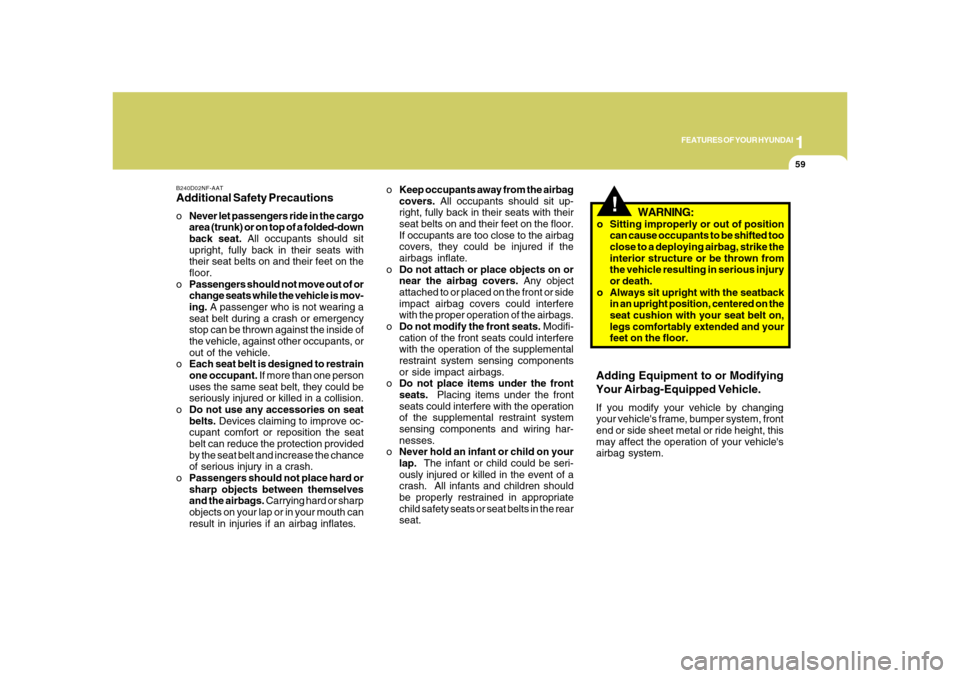
feet on the floor.Adding Equipment to or Modifying
Your Airbag-Equipped Vehicle.If you modify your vehicle by changing
your vehicle's frame, bumper system, front
end or side sheet metal or ride height, this
may affect the operation of your vehicle's
airbag system.
Page 75 of 345

1
FEATURES OF YOUR HYUNDAI
61
1. Check Engine - Malfunction Indicator Light (MIL)
2. Low Oil Pressure Warning Light
3. Charging System Warning Light
4. SRS (Airbag) Warning Light
5. Tachometer
6. Turn Signal Indicator Lights
7. High Beam Indicator Light
8. Electronic Stability Control (ESC) Indicator Lights
(If Installed)
9. Automatic Transaxle Position Indicator Light
10. CRUISE Indicator Light
11. Front Fog Lamp Indicator Light
12. Cruise SET Indicator Light
13. Speedometer14. Low Windshield Washer Fluid Level Warning Light
15. Trunk Lid Open Warning Light
16. Low Tire Pressure Telltale (If Installed)
17. Immobilizer Warning Light
18. TPMS (Tire Pressure Monitoring System) Malfunction Indicator
(If Installed)
19. Coolant Temperature Gauge
20. ABS Service Reminder Indicator (SRI) (If Installed)
21. Door Ajar Warning Light
22. Seat Belt Warning Light (Driver's side)
23. Odometer/Trip Computer
24. Parking Brake/Low Brake Fluid Level Warning Light
25. Low Fuel Warning Light
26. Fuel Gauge
Page 77 of 345

1
FEATURES OF YOUR HYUNDAI
63
1. Check Engine - Malfunction Indicator Light (MIL)
2. Charging System Warning Light
3. Low Oil Pressure Warning Light
4. Parking Brake/Low Brake Fluid Level Warning Light
5. Tachometer
6. Door Ajar Warning Light
7. Turn Signal Indicator Lights
8. Odometer/Trip Computer/Warning Text
9. Speedometer
10. Trunk Lid Open Warning Light
11. CRUISE Indicator Light
12. Cruise SET Indicator Light
13. Immobilizer Warning Light
14. Coolant Temperature Gauge15. Low Windshield Washer Fluid Level Warning Light
16. SRS (Airbag) Warning Light
17. ABS Service Reminder Indicator (SRI) (If Installed)
18. Electronic Stability Control (ESC) Indicator Lights
(If Installed)
19. Seat Belt Warning Light (Driver's side)
20. High Beam Indicator Light
21. Automatic Transaxle Position Indicator Light
22. Front Fog Lamp Indicator Light
23. Low Tire Pressure Telltale (If Installed)
24. TPMS (Tire Pressure Monitoring System) Malfunction Indicator
(If Installed)
25. Low Fuel Warning Light
26. Fuel Gauge
Page 82 of 345
1FEATURES OF YOUR HYUNDAI68
B260S01TG-AAT
Low Windshield Washer
Fluid Level Warning Light
The low windshield washer fluid warning
light comes on when the washer fluid res-
ervoir is approaching empty. When it
comes on, add washer fluid at your earliest
opportunity.
B260S02TG-A
If your vehicle is equipped with the super-
vision type cluster, the warning text is dis-
played above the odometer. The warning
text comes on for about 20 seconds. If you
push the RESET button behind the steer-
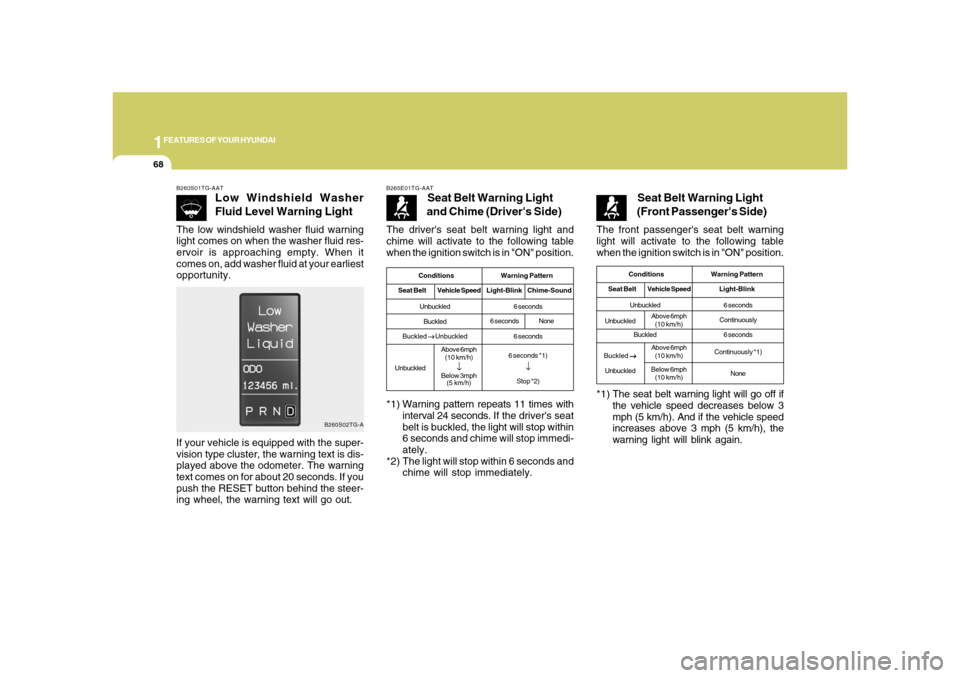
ing wheel, the warning text will go out.The driver's seat belt warning light and
chime will activate to the following table
when the ignition switch is in "ON" position.
B265E01TG-AAT
Seat Belt Warning Light
and Chime (Driver's Side)
*1) Warning pattern repeats 11 times with
interval 24 seconds. If the driver's seat
belt is buckled, the light will stop within
6 seconds and chime will stop immedi-
ately.
*2) The light will stop within 6 seconds and
chime will stop immediately.
Conditions Warning Pattern
Seat BeltVehicle SpeedLight-Blink Chime-SoundUnbuckled
Buckled
Buckled
→ →→ →
→ Unbuckled
UnbuckledAbove 6mph
(10 km/h)
↓
Below 3mph
(5 km/h)6 seconds
6 seconds
6 seconds *1)
↓Stop *2)
6 secondsNone
The front passenger's seat belt warning
light will activate to the following table
when the ignition switch is in "ON" position.
Seat Belt Warning Light
(Front Passenger's Side)
*1) The seat belt warning light will go off if
the vehicle speed decreases below 3
mph (5 km/h). And if the vehicle speed
increases above 3 mph (5 km/h), the
warning light will blink again.
Conditions Warning Pattern
Seat BeltVehicle SpeedLight-BlinkUnbuckled
Buckled6 seconds
Continuously
6 seconds
Continuously *1)
None
UnbuckledAbove 6mph
(10 km/h)
Buckled
→ →→ →
→
UnbuckledAbove 6mph
(10 km/h)
Below 6mph
(10 km/h)
Page 83 of 345
1
FEATURES OF YOUR HYUNDAI
69
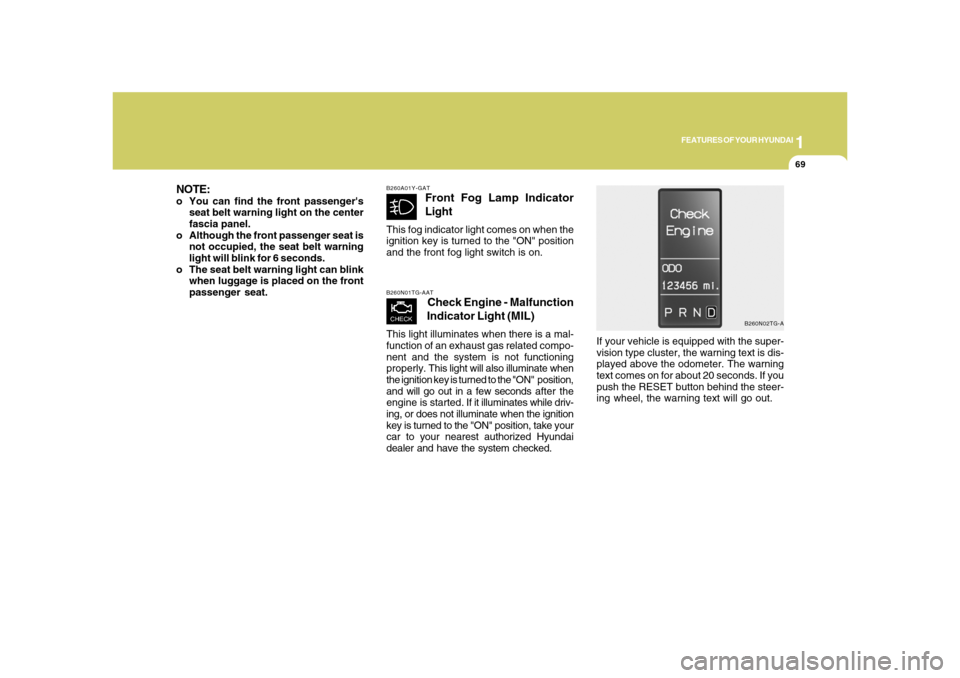
B260N01TG-AAT
Check Engine - Malfunction
Indicator Light (MIL)
This light illuminates when there is a mal-
function of an exhaust gas related compo-
nent and the system is not functioning
properly. This light will also illuminate when
the ignition key is turned to the "ON" position,
and will go out in a few seconds after the
engine is started. If it illuminates while driv-
ing, or does not illuminate when the ignition
key is turned to the "ON" position, take your
car to your nearest authorized Hyundai
dealer and have the system checked.B260A01Y-GAT
Front Fog Lamp Indicator
Light
This fog indicator light comes on when the
ignition key is turned to the "ON" position
and the front fog light switch is on.
B260N02TG-A
If your vehicle is equipped with the super-
vision type cluster, the warning text is dis-
played above the odometer. The warning
text comes on for about 20 seconds. If you
push the RESET button behind the steer-
ing wheel, the warning text will go out.
NOTE:o You can find the front passenger's
seat belt warning light on the center
fascia panel.
o Although the front passenger seat is
not occupied, the seat belt warning
light will blink for 6 seconds.
o The seat belt warning light can blink
when luggage is placed on the front
passenger seat.
Page 88 of 345
1FEATURES OF YOUR HYUNDAI74
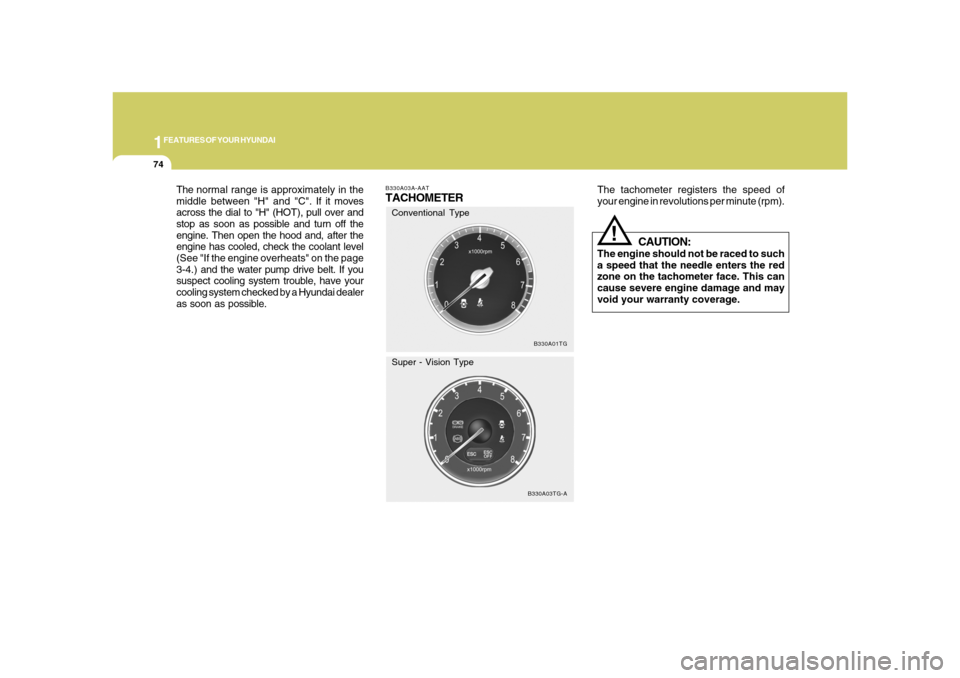
B330A03A-AATTACHOMETER
The tachometer registers the speed of
your engine in revolutions per minute (rpm).
CAUTION:
The engine should not be raced to such
a speed that the needle enters the red
zone on the tachometer face. This can
cause severe engine damage and may
void your warranty coverage.
!
B330A01TGB330A03TG-A
Conventional Type
Super - Vision Type
The normal range is approximately in the
middle between "H" and "C". If it moves
across the dial to "H" (HOT), pull over and
stop as soon as possible and turn off the
engine. Then open the hood and, after the
engine has cooled, check the coolant level
(See "If the engine overheats" on the page
3-4.) and the water pump drive belt. If you
suspect cooling system trouble, have your
cooling system checked by a Hyundai dealer
as soon as possible.