warning Hyundai Azera 2009 User Guide
[x] Cancel search | Manufacturer: HYUNDAI, Model Year: 2009, Model line: Azera, Model: Hyundai Azera 2009Pages: 335, PDF Size: 12.4 MB
Page 26 of 335
1
FEATURES OF YOUR HYUNDAI
13
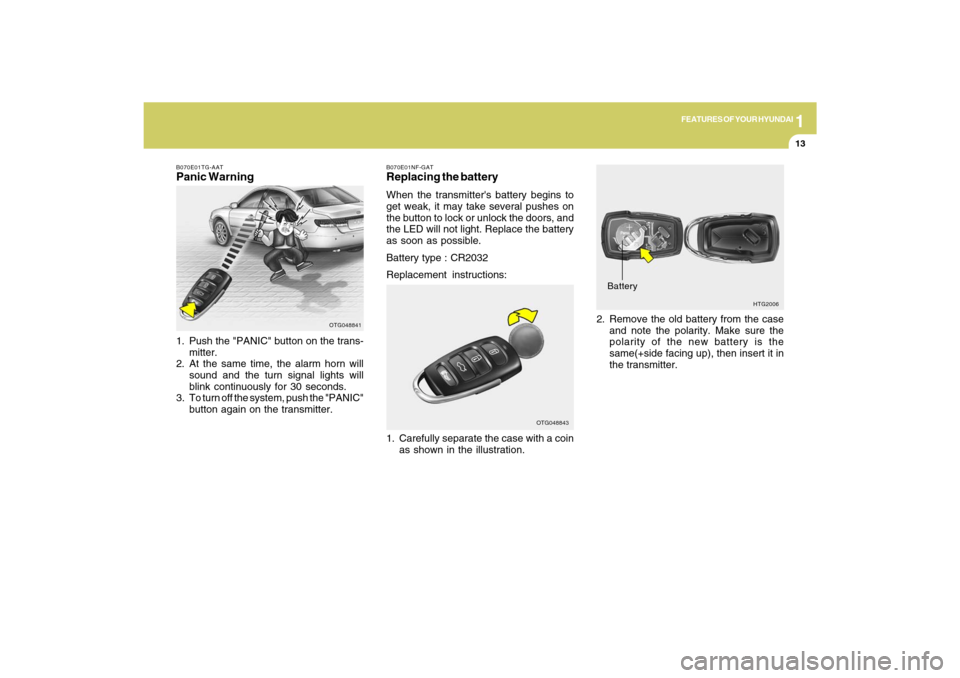
B070E01TG-AATPanic Warning1. Push the "PANIC" button on the trans-
mitter.
2. At the same time, the alarm horn will
sound and the turn signal lights will
blink continuously for 30 seconds.
3. To turn off the system, push the "PANIC"
button again on the transmitter.
OTG048841
HTG2006
Battery2. Remove the old battery from the case
and note the polarity. Make sure the
polarity of the new battery is the
same(+side facing up), then insert it in
the transmitter.
B070E01NF-GATReplacing the batteryWhen the transmitter's battery begins to
get weak, it may take several pushes on
the button to lock or unlock the doors, and
the LED will not light. Replace the battery
as soon as possible.
Battery type : CR2032
Replacement instructions:
1. Carefully separate the case with a coin
as shown in the illustration.
OTG048843
Page 29 of 335

1FEATURES OF YOUR HYUNDAI16
!
OTG048832
Close
Open
WARNING:
o The automatic reverse feature for the
front window is only active when the
“auto up” feature is used by fully pull-
ing up the switch. The automatic re-
verse feature will not operate if the
window is raised using the halfway
position on the power window switch.
o Always check for obstructions be-
fore raising any window to avoid inju-
ries or vehicle damage. If an object
less than 0.16 in. (4 mm) in diameter
is caught between the window glass
and the upper window channel, the
automatic reverse window may not
detect the resistance and will not stop
and reverse direction.B060C02TG-AATFront Window Automatic Reverse
FeatureIf the upward movement of the window is
blocked by an object or part of the body, the
window will detect the resistance and will
stop upward movement. The window will
then lower approximately 11.8 in.(30cm)
to allow the object to be cleared.
NOTE:The power windows can be operated for
30 seconds after the ignition key is
turned to the "ACC" or "LOCK" posi-
tions, or removed from the ignition
switch.
If the front doors are opened during this
30 second period, the power windows
can no longer be operated without the
ignition key turned to the "ON" position.
Window Lock
OTG048824L
In order to prevent operation of the pas-
senger front and rear windows, a window
lock switch is provided on the armrest of
the driver's door. To disable the power
windows, press the window lock switch. To
revert to normal operation, press the win-
dow lock switch a second time.
Page 30 of 335
1
FEATURES OF YOUR HYUNDAI
17
!
WARNING:
o Passengers can be injured if their
head, hands or other body parts are
trapped by a closing window. Always
check for obstructions before raising
any window.
o NEVER leave the ignition key in the
vehicle.
o NEVER leave any child unattended in
the vehicle. Even very young children
may inadvertently cause the vehicle
to move, entangle themselves in the
windows, or otherwise injure them-
selves or others.
o Do not attempt to operate the main
switch on the driver's door and a
switch on another door in opposing
directions at the same time. If this is
done, the window will stop and cannot
be opened or closed.
Page 32 of 335
1
FEATURES OF YOUR HYUNDAI
19
!
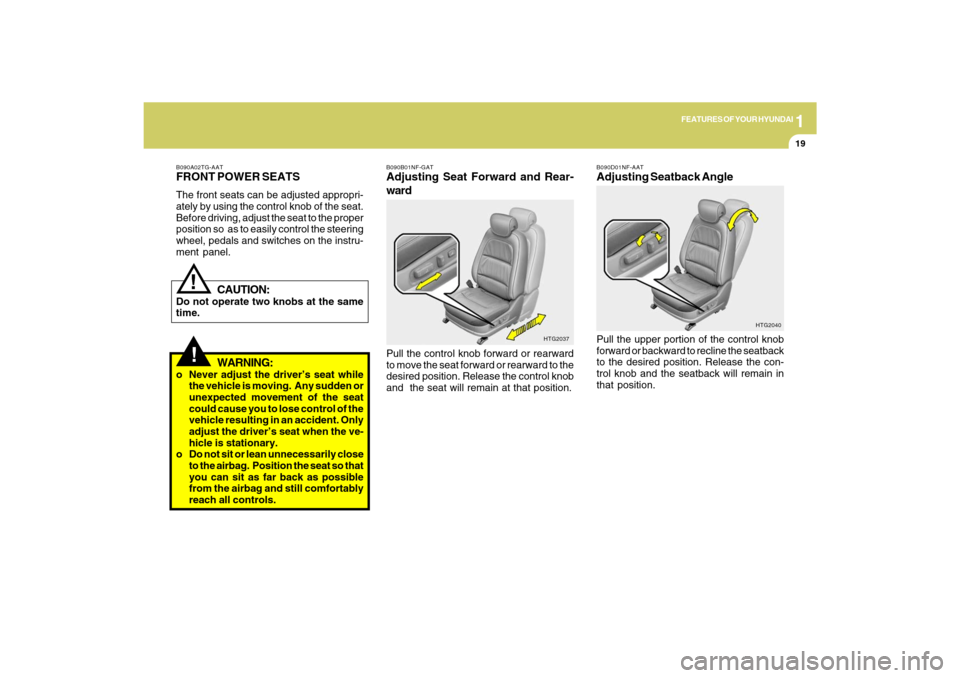
B090A02TG-AATFRONT POWER SEATSThe front seats can be adjusted appropri-
ately by using the control knob of the seat.
Before driving, adjust the seat to the proper
position so as to easily control the steering
wheel, pedals and switches on the instru-
ment panel.
CAUTION:
Do not operate two knobs at the same
time.
WARNING:
o Never adjust the driver’s seat while
the vehicle is moving. Any sudden or
unexpected movement of the seat
could cause you to lose control of the
vehicle resulting in an accident. Only
adjust the driver’s seat when the ve-
hicle is stationary.
o Do not sit or lean unnecessarily close
to the airbag. Position the seat so that
you can sit as far back as possible
from the airbag and still comfortably
reach all controls.
!
B090B01NF-GATAdjusting Seat Forward and Rear-
wardPull the control knob forward or rearward
to move the seat forward or rearward to the
desired position. Release the control knob
and the seat will remain at that position.
HTG2037B090D01NF-AAT
Adjusting Seatback AnglePull the upper portion of the control knob
forward or backward to recline the seatback
to the desired position. Release the con-
trol knob and the seatback will remain in
that position.
HTG2040
Page 33 of 335
1FEATURES OF YOUR HYUNDAI20
!
WARNING:
Riding with a reclined seatback in-
creases your chance of serious or fatal
injuries in the event of a collision or
sudden stop. The protection of your
restraint system (seat belts and airbags)
is greatly reduced by reclining your seat.
Seat belts must be snug against your
hips and chest to work properly. The
more the seatback is reclined, the greater
the chance that an occupant's hips will
slide under the lap belt or the occupant's
neck will strike the shoulder belt. Driv-
ers and passengers should always sit
well back in their seats, properly belted,
and with the seatbacks upright.
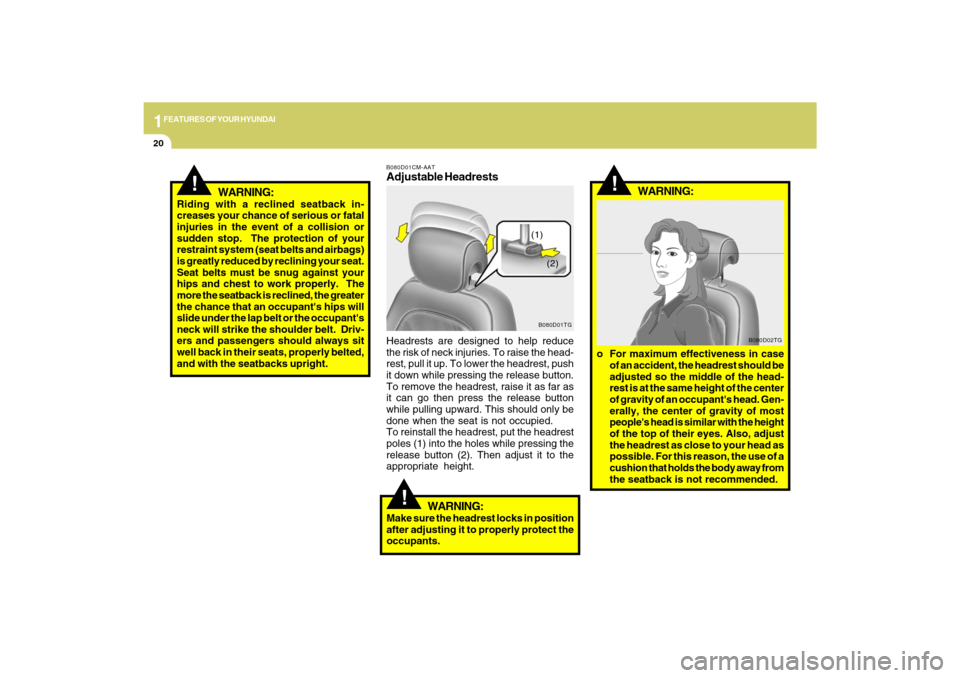
B080D01CM-AATAdjustable HeadrestsHeadrests are designed to help reduce
the risk of neck injuries. To raise the head-
rest, pull it up. To lower the headrest, push
it down while pressing the release button.
To remove the headrest, raise it as far as
it can go then press the release button
while pulling upward. This should only be
done when the seat is not occupied.
To reinstall the headrest, put the headrest
poles (1) into the holes while pressing the
release button (2). Then adjust it to the
appropriate height.
B080D01TG(1)
!
WARNING:
o For maximum effectiveness in case
of an accident, the headrest should be
adjusted so the middle of the head-
rest is at the same height of the center
of gravity of an occupant's head. Gen-
erally, the center of gravity of most
people's head is similar with the height
of the top of their eyes. Also, adjust
the headrest as close to your head as
possible. For this reason, the use of a
cushion that holds the body away from
the seatback is not recommended.
B080D02TG
!
WARNING:
Make sure the headrest locks in position
after adjusting it to properly protect the
occupants.
(2)
Page 38 of 335
1
FEATURES OF YOUR HYUNDAI
25
B110A01NF-GATREAR SEAT
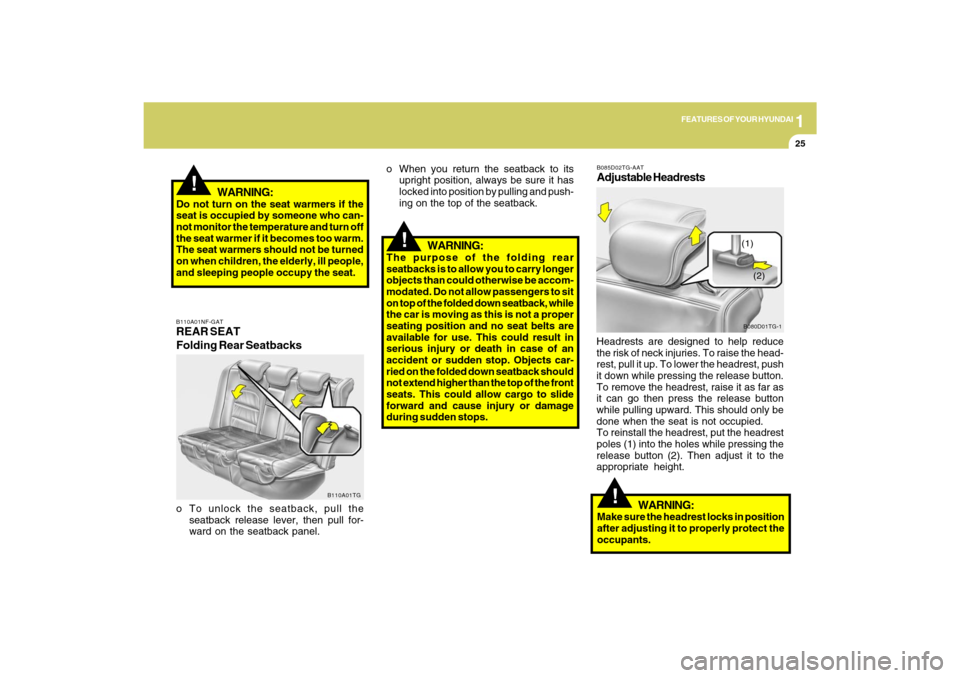
Folding Rear Seatbackso To unlock the seatback, pull the
seatback release lever, then pull for-
ward on the seatback panel.
B110A01TG
!
WARNING:
Do not turn on the seat warmers if the
seat is occupied by someone who can-
not monitor the temperature and turn off
the seat warmer if it becomes too warm.
The seat warmers should not be turned
on when children, the elderly, ill people,
and sleeping people occupy the seat.
!
WARNING:
The purpose of the folding rear
seatbacks is to allow you to carry longer
objects than could otherwise be accom-
modated. Do not allow passengers to sit
on top of the folded down seatback, while
the car is moving as this is not a proper
seating position and no seat belts are
available for use. This could result in
serious injury or death in case of an
accident or sudden stop. Objects car-
ried on the folded down seatback should
not extend higher than the top of the front
seats. This could allow cargo to slide
forward and cause injury or damage
during sudden stops.
B085D02TG-AATAdjustable HeadrestsHeadrests are designed to help reduce
the risk of neck injuries. To raise the head-
rest, pull it up. To lower the headrest, push
it down while pressing the release button.
To remove the headrest, raise it as far as
it can go then press the release button
while pulling upward. This should only be
done when the seat is not occupied.
To reinstall the headrest, put the headrest
poles (1) into the holes while pressing the
release button (2). Then adjust it to the
appropriate height.
B080D01TG-1(1)
o When you return the seatback to its
upright position, always be sure it has
locked into position by pulling and push-
ing on the top of the seatback.
(2)
!
WARNING:
Make sure the headrest locks in position
after adjusting it to properly protect the
occupants.
Page 39 of 335
1FEATURES OF YOUR HYUNDAI26
!
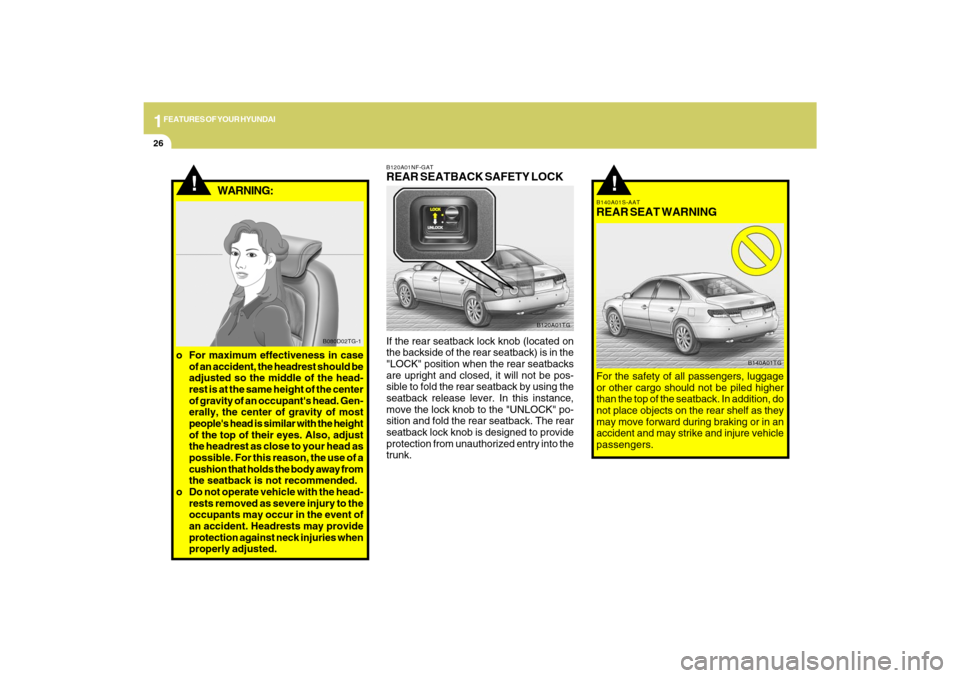
B140A01S-AATREAR SEAT WARNINGFor the safety of all passengers, luggage
or other cargo should not be piled higher
than the top of the seatback. In addition, do
not place objects on the rear shelf as they
may move forward during braking or in an
accident and may strike and injure vehicle
passengers.
B140A01TG B120A01NF-GAT
REAR SEATBACK SAFETY LOCKIf the rear seatback lock knob (located on
the backside of the rear seatback) is in the
"LOCK" position when the rear seatbacks
are upright and closed, it will not be pos-
sible to fold the rear seatback by using the
seatback release lever. In this instance,
move the lock knob to the "UNLOCK" po-
sition and fold the rear seatback. The rear
seatback lock knob is designed to provide
protection from unauthorized entry into the
trunk.
B120A01TG
!
WARNING:
B080D02TG-1
o For maximum effectiveness in case
of an accident, the headrest should be
adjusted so the middle of the head-
rest is at the same height of the center
of gravity of an occupant's head. Gen-
erally, the center of gravity of most
people's head is similar with the height
of the top of their eyes. Also, adjust
the headrest as close to your head as
possible. For this reason, the use of a
cushion that holds the body away from
the seatback is not recommended.
o Do not operate vehicle with the head-
rests removed as severe injury to the
occupants may occur in the event of
an accident. Headrests may provide
protection against neck injuries when
properly adjusted.
Page 40 of 335
1
FEATURES OF YOUR HYUNDAI
27
SEAT BELTS!
B150A02S-AATSEAT BELT PRECAUTIONS
WARNING:All occupants of the vehicle must wear
their seat belts at all times. Seat belts and
child restraints reduce the risk of serious
or fatal injuries for all occupants in the
event of a collision or sudden stop. With-
out a seat belt, occupants could be shifted
too close to a deploying airbag, strike the
interior structure or be thrown from the
vehicle. Properly worn seat belts greatly
reduce these hazards. Even with ad-
vanced airbags, unbelted occupants can
be severely injured by a deploying airbag.
Always follow the precautions about seat
belts, airbags and occupant safety con-
tained in this manual.B150B04Y-AATInfant or Small ChildAll 50 states have child restraint laws. You
should be aware of the specific require-
ments in your state. Child and/or infant
safety seats must be properly placed and
installed in the rear seat. Information about
the use of these restraints begins on page
1-34.
!
WARNING:
Every person in your vehicle needs to be
properly restrained at all times, includ-
ing infants and children. Never hold a
child in your arms or lap when riding in a
vehicle. The violent forces created dur-
ing a crash will tear the child from your
arms and throw the child against the
interior. Always use a child restraint
appropriate for your child's height and
weight, see page 1-34.NOTE:Small children are best protected from
injury in an accident when properly re-
strained in the rear seat by a child re-
straint system that meets the require-
ments of the Federal Motor Vehicle
Safety Standards. Before buying any
child restraint system, make sure that it
has a label certifying that it meets Fed-
eral Motor Vehicle Safety Standard 213.
The restraint must be appropriate for
your child's height and weight. Check
the label on the child restraint for this
information. See page 1-34.
B150C02A-AATLarger ChildrenChildren who are too large for child re-
straint systems should always occupy the
rear seat and use the available lap/shoul-
der belts. The lap portion should be fas-
tened snug on the hips and as low as
possible. Check belt fit periodically. A
child's squirming could put the belt out of
position. Children are afforded the most
safety in the event of an accident when
they are restrained by a proper restraint
system in the rear seat. If a larger child
(over age 13) must be seated in the front
seat, the child should be securely re-
strained by the available lap/shoulder belt
and the seat should be placed in the
rearmost position. Children under the age
of 13 should be restrained securely in the
rear seat. NEVER place a child under the
age of 13 in the front seat. NEVER place a
rear facing child seat in the front seat of a
vehicle.
Page 41 of 335
1FEATURES OF YOUR HYUNDAI28
!
B160A02A-AATCARE OF SEAT BELTSSeat belt systems should never be disas-
sembled or modified. In addition, care
should be taken to assure that seat belts
and belt hardware are not damaged by
seat hinges, doors or other abuse.
WARNING:
When you return the rear seatback to its
upright position after the rear seatback
was folded down, be careful not to dam-
age the seat belt webbing or buckle. Be
sure that the webbing or buckle does not
get caught or pinched in the rear seat. A
seat belt with damaged webbing or buckle
will not be as strong and could possibly
fail during a collision or sudden stop,
resulting in serious injury.
B150D01A-AATPregnant WomenThe use of a seat belt is recommended for
pregnant women to lessen the chance of
injury in an accident. When a seat belt is
used, the lap belt portion should be placed
as low and snugly as possible on the hips,
not across the abdomen. For specific rec-
ommendations, consult a physician.B150E01A-AATInjured PersonA seat belt should be used when an injured
person is being transported. When this is
necessary, you should consult a physician
for recommendations.B150F01A-AATOne Person Per BeltTwo people (including children) should
never attempt to use a single seat belt. This
could increase the severity of injuries in
case of an accident.
WARNING:
Riding with a reclined seatback increases
your chance of serious or fatal injuries in
the event of a collision or sudden stop.
The protection of your restraint system
(seat belts and airbags) is greatly re-
duced by reclining your seat. Seat belts
must be snug against your hips and chest
to work properly. The more the seatback
is reclined, the greater the chance that an
occupant's hips will slide under the lap
belt causing serious internal injuries or
the occupant's neck could strike the
shoulder belt. Drivers and passengers
should always sit well back in their seats,
properly belted (see page 1-30), and with
the seatbacks upright.
!
B150G02A-AATDo Not Lie DownTo reduce the chance of injuries in the
event of an accident and to achieve maxi-
mum effectiveness of the restraint system,
all passengers should be sitting up and the
front seats should be in an upright position
when the car is moving. A seat belt cannot
provide proper protection if the person is
lying down in the rear seat or if the front seat
is in a reclined position.
Page 42 of 335
1
FEATURES OF YOUR HYUNDAI
29
B160C01A-AATKeep Belts Clean and DrySeat belts should be kept clean and dry. If
belts become dirty, they can be cleaned by
using a mild soap solution and warm wa-
ter. Bleach, dye, strong detergents or abra-
sives should not be used because they
may damage and weaken the fabric.B160D01A-AATWhen to Replace Seat BeltsEntire in-use seat belt assembly or assem-
blies should be replaced if the vehicle has
been involved in an accident. This should
be done even if no damage is visible.
Additional questions concerning seat belt
operation should be directed to your
Hyundai Dealer.
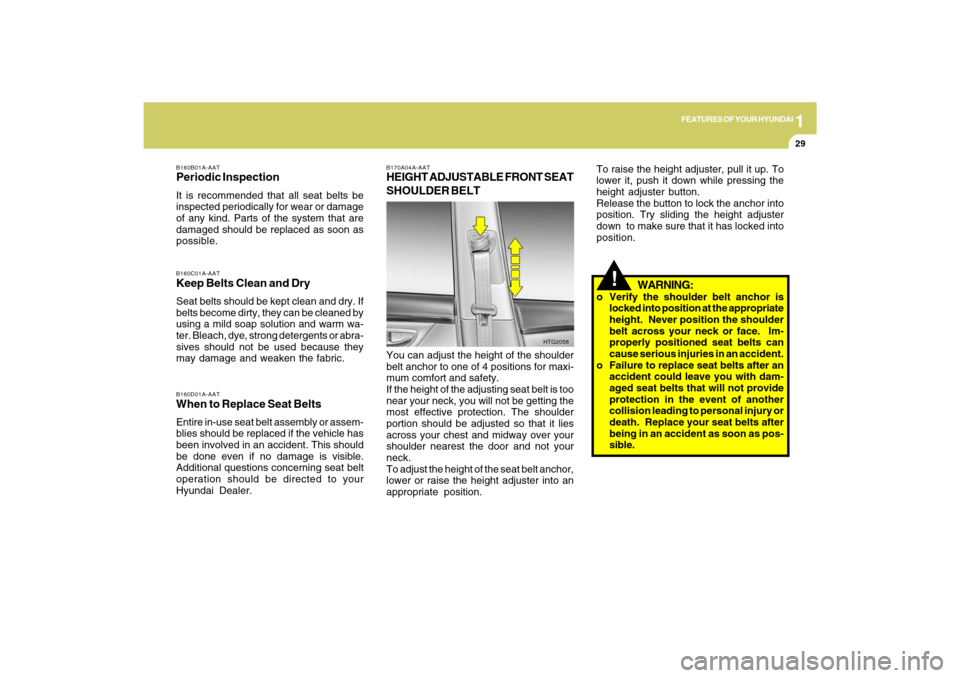
B170A04A-AATHEIGHT ADJUSTABLE FRONT SEAT
SHOULDER BELTYou can adjust the height of the shoulder
belt anchor to one of 4 positions for maxi-
mum comfort and safety.
If the height of the adjusting seat belt is too
near your neck, you will not be getting the
most effective protection. The shoulder
portion should be adjusted so that it lies
across your chest and midway over your
shoulder nearest the door and not your
neck.
To adjust the height of the seat belt anchor,
lower or raise the height adjuster into an
appropriate position.
HTG2058 B160B01A-AAT
Periodic InspectionIt is recommended that all seat belts be
inspected periodically for wear or damage
of any kind. Parts of the system that are
damaged should be replaced as soon as
possible.
!
To raise the height adjuster, pull it up. To
lower it, push it down while pressing the
height adjuster button.
Release the button to lock the anchor into
position. Try sliding the height adjuster
down to make sure that it has locked into
position.
WARNING:
o Verify the shoulder belt anchor is
locked into position at the appropriate
height. Never position the shoulder
belt across your neck or face. Im-
properly positioned seat belts can
cause serious injuries in an accident.
o Failure to replace seat belts after an
accident could leave you with dam-
aged seat belts that will not provide
protection in the event of another
collision leading to personal injury or
death. Replace your seat belts after
being in an accident as soon as pos-
sible.