warning Hyundai Azera 2010 Owner's Manual
[x] Cancel search | Manufacturer: HYUNDAI, Model Year: 2010, Model line: Azera, Model: Hyundai Azera 2010Pages: 334, PDF Size: 12.24 MB
Page 237 of 334
36WHAT TO DO IN AN EMERGENCY
!
Low Tire Pressure Telltale
When the tire pressure monitoring sys-
tem warning telltale is illuminated, one
or more of your tires is significantly
under-inflated.
Immediately reduce your speed, avoid
hard cornering and anticipate increased
stopping distances. You should stop
and check your tires as soon as pos-
sible. Inflate the tires to the proper
pressure as indicated on the vehicle’s
placard or tire inflation pressure label
located on the driver’s side center pillar
outer panel. If you cannot reach a ser-
vice station or if the tire cannot hold the
newly added air, replace the low pres-
sure tire with the temporary spare tire.
Then the TPMS malfunction indicator
may turn on and the Low Tire Pressure
telltale still turn on after restarting and
about 20 minutes of continuous driving
before you have the low-pressure tire
repaired and replaced on the vehicle.CAUTION:
In winter or cold weather, the low tire
pressure telltale may be illuminated
if the tire pressure was adjusted to
the recommended tire inflation pres-
sure in warm weather. It does not
mean your TPMS is malfunctioning
because the decreased temperature
leads to a proportional lowering of
tire pressure.
When you drive your vehicle from a
warm area to a cold area or from a
cold area to a warm area, or the
outside temperature is greatly higher
or lower, you should check the tire
inflation pressure and adjust the tires
to the recommended tire inflation
pressure.WARNING:
Significantly low tire pressure makes
the vehicle unstable and can contrib-
ute to loss of vehicle control and
increased braking distances.
Continued driving on low pressure
tires will cause the tires to overheat
and fail.
TPMS (Tire Pressure Moni-
toring System) Malfunction
Indicator
The TPMS malfunction indicator comes
on and stays on when there is a problem
with the Tire Pressure Monitoring Sys-
tem. If the system is able to correctly
detect an under-inflation warning at the
same time as system failure then it will
illuminate both the TPMS malfunction
and the low tire pressure telltale e.g. if
Front Left sensor fails, the TPMS mal-
function indicator comes on, but if Front
Right, Rear Left, or Rear Right tire is
under-inflated, the low tire pressure tell-
tale may come on with the TPMS mal-
function indicator.
!
Page 239 of 334
38WHAT TO DO IN AN EMERGENCY
!
!
!
CAUTION:
o Do not use any tire sealant if your
vehicle is equipped with a Tire
Pressure Monitoring System. The
liquid sealant can damage the tire
pressure sensors.
o In order for the system to correctly
monitor tires for under-inflation,
there should be a total of exactly 4
sensors fitted to each of the four
driven wheel positions. There
should be no other sensors in the
vehicle including spare tire since
this could cause the system to
monitor the wrong sensors.
WARNING:
Tampering with, modifying, or dis-
abling the Tire Pressure Monitoring
System (TPMS) components may
interfere with the system's ability to
warn the driver of low tire pressure
conditions and/or TPMS malfunc-
tions. Tampering with, modifying,
or disabling the Tire Pressure Moni-
toring System (TPMS) components
may void the warranty for that por-
tion of the vehicle.
!
WARNING - TPMS
o The TPMS cannot alert you to se-
vere and sudden tire damage
caused by external factors such as
nails or road debris.
o If you feel any vehicle instability,
immediately take your foot off the
accelerator, apply the brakes
gradually and with light force, and
slowly move to a safe position off
the road.This device complies with Part 15 of
the FCC rules.
Operation is subject to the following two
conditions:
1. This device may not cause harmful
interference, and
2. This device must accept any inter-
ference received, including interfer-
ence that may cause undesired op-
eration.
WARNING:
Changes or modifications not ex-
pressly approved by the party re-
sponsible for compliance could void
the user’s authority to operate the
equipment.
Page 240 of 334
3
WHAT TO DO IN AN EMERGENCY
9
SPARE TIRED040A03GK-AATTEMPORARY SPARE TIRE
The following instructions for the TEM-
PORARY spare tire should be observed:
1. Check inflation pressure as soon as
practical after installing the spare
tire, and adjust to the specified pres-
sure. The tire pressure should be
periodically checked and maintained
at the specified pressure while the
tire is stored.Tire Size
Inflation Pressure
T125/80D16
420 kPa(60 psi)
4. As the temporary spare tire is spe-
cifically designed for your car, it
should not be used on any other
vehicle.
5. The temporary spare tire should not
be used on any other wheels, nor
should standard tires, snow tires,
wheel covers or trim rings be used
with the temporary spare wheel. If
such use is attempted, damage to
these items or other car components
may occur.
6. The temporary spare tire pressure
should be checked once a month
while the tire is stored.
2. The spare tire should only be used
temporarily and should be returned
to the luggage compartment as soon
as the original tire can be repaired or
replaced.
3. Continuous use at speeds of over 50
mph (80 km/h) is not recommended. Spare Tire Pressure
CAUTION:
o Do not use snow chains with your
temporary spare tire.
o Do not use more than one tempo-
rary spare tire at a time.
o Do not tow a trailer while the tem-
porary spare tire is installed.
!
!
WARNING:
The temporary spare tire is for emer-
gency use only. Do not operate your
vehicle on this temporary spare at
speeds over 50 mph (80 km/h). The
original tire should be repaired or
replaced as soon as is possible to
avoid failure of the spare possibly
leading to personal injury or death.
Page 244 of 334
3
WHAT TO DO IN AN EMERGENCY
13
!
WARNING:
Do not get under the car when it is
supported by the jack! This is very
dangerous as the vehicle could fall
and cause serious injury or death.
No one should stay in the car while
the jack is being used.
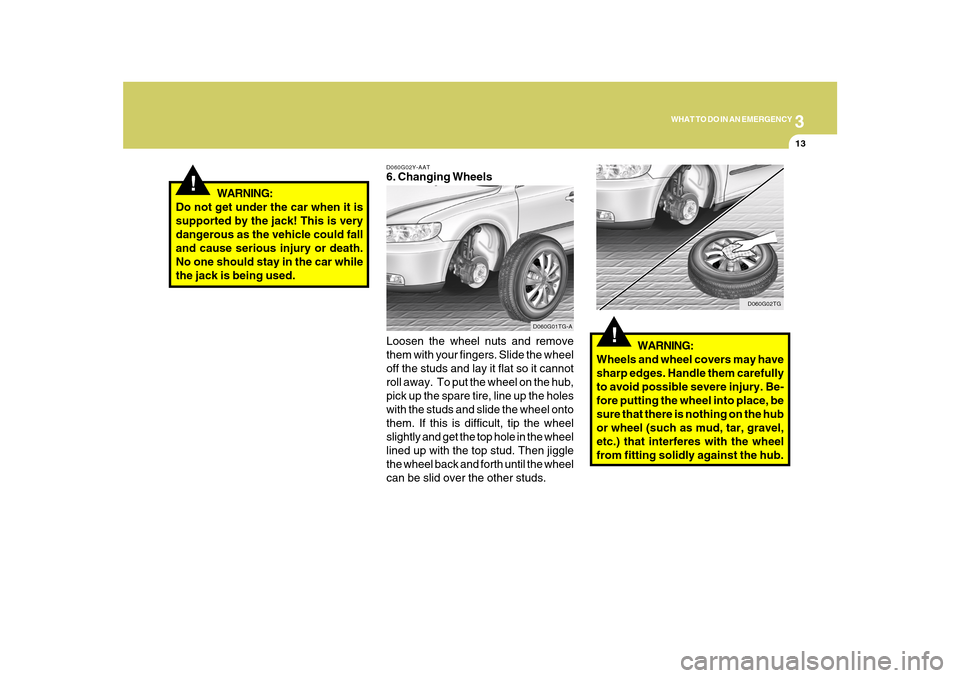
D060G02Y-AAT6. Changing Wheels
Loosen the wheel nuts and remove
them with your fingers. Slide the wheel
off the studs and lay it flat so it cannot
roll away. To put the wheel on the hub,
pick up the spare tire, line up the holes
with the studs and slide the wheel onto
them. If this is difficult, tip the wheel
slightly and get the top hole in the wheel
lined up with the top stud. Then jiggle
the wheel back and forth until the wheel
can be slid over the other studs.
D060G01TG-A
!
WARNING:
Wheels and wheel covers may have
sharp edges. Handle them carefully
to avoid possible severe injury. Be-
fore putting the wheel into place, be
sure that there is nothing on the hub
or wheel (such as mud, tar, gravel,
etc.) that interferes with the wheel
from fitting solidly against the hub.
D060G02TG
Page 245 of 334
314
WHAT TO DO IN AN EMERGENCY
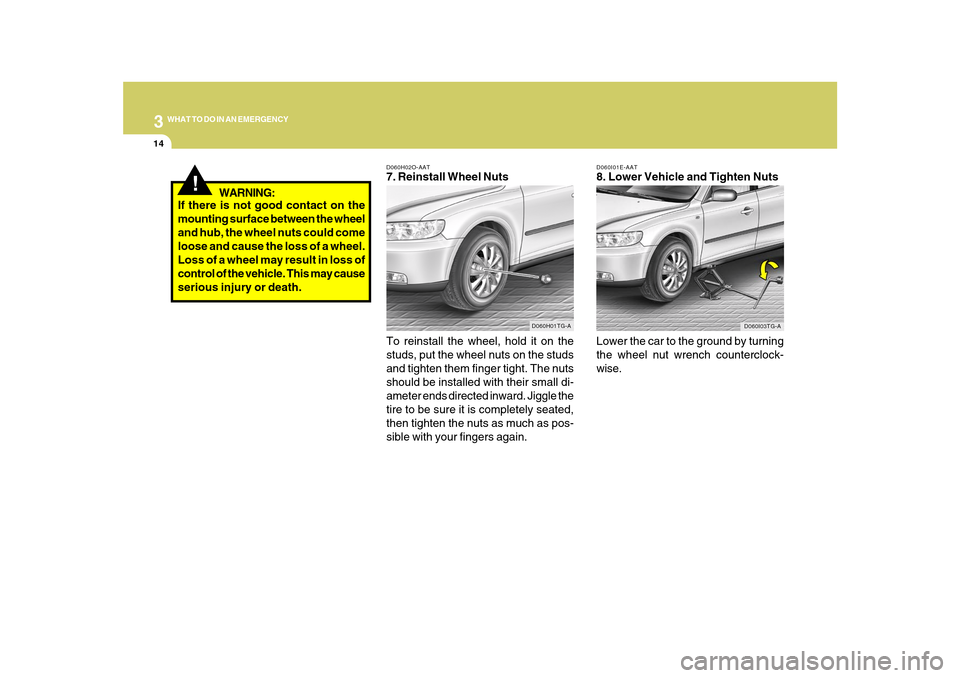
D060I01E-AAT8. Lower Vehicle and Tighten Nuts
Lower the car to the ground by turning
the wheel nut wrench counterclock-
wise.
D060I03TG-A
D060H02O-AAT7. Reinstall Wheel Nuts
To reinstall the wheel, hold it on the
studs, put the wheel nuts on the studs
and tighten them finger tight. The nuts
should be installed with their small di-
ameter ends directed inward. Jiggle the
tire to be sure it is completely seated,
then tighten the nuts as much as pos-
sible with your fingers again.
D060H01TG-A
!
If there is not good contact on the
mounting surface between the wheel
and hub, the wheel nuts could come
loose and cause the loss of a wheel.
Loss of a wheel may result in loss of
control of the vehicle. This may cause
serious injury or death.WARNING:
Page 270 of 334
6
DO-IT-YOURSELF MAINTENANCE
4
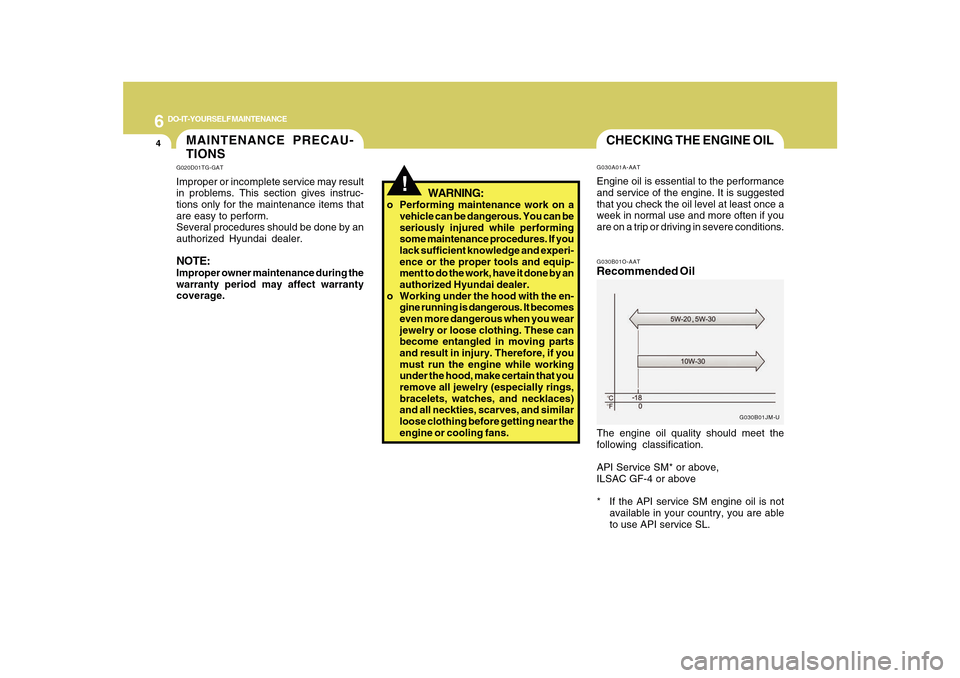
CHECKING THE ENGINE OILG030B01O-AATRecommended OilThe engine oil quality should meet the
following classification.
API Service SM* or above,
ILSAC GF-4 or above
* If the API service SM engine oil is not
available in your country, you are able
to use API service SL.
G030B01JM-U G030A01A-AAT
Engine oil is essential to the performance
and service of the engine. It is suggested
that you check the oil level at least once a
week in normal use and more often if you
are on a trip or driving in severe conditions.
MAINTENANCE PRECAU-
TIONS
!
G020D01TG-GATImproper or incomplete service may result
in problems. This section gives instruc-
tions only for the maintenance items that
are easy to perform.
Several procedures should be done by an
authorized Hyundai dealer.NOTE:Improper owner maintenance during the
warranty period may affect warranty
coverage.
WARNING:
o Performing maintenance work on a
vehicle can be dangerous. You can be
seriously injured while performing
some maintenance procedures. If you
lack sufficient knowledge and experi-
ence or the proper tools and equip-
ment to do the work, have it done by an
authorized Hyundai dealer.
o Working under the hood with the en-
gine running is dangerous. It becomes
even more dangerous when you wear
jewelry or loose clothing. These can
become entangled in moving parts
and result in injury. Therefore, if you
must run the engine while working
under the hood, make certain that you
remove all jewelry (especially rings,
bracelets, watches, and necklaces)
and all neckties, scarves, and similar
loose clothing before getting near the
engine or cooling fans.
Page 271 of 334
6
DO-IT-YOURSELF MAINTENANCE
5
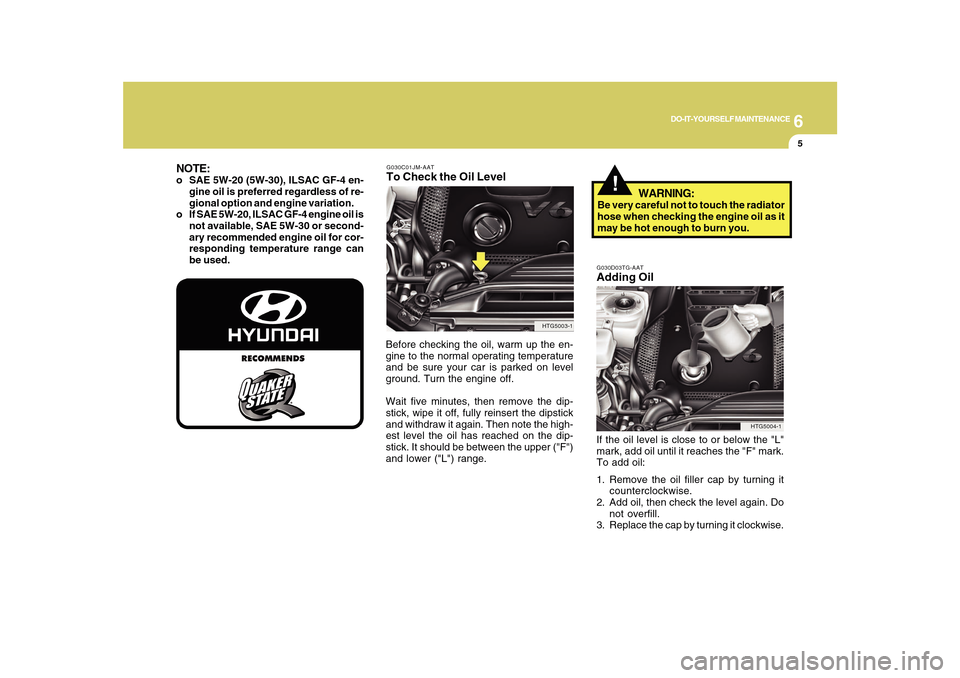
G030C01JM-AATTo Check the Oil LevelBefore checking the oil, warm up the en-
gine to the normal operating temperature
and be sure your car is parked on level
ground. Turn the engine off.
Wait five minutes, then remove the dip-
stick, wipe it off, fully reinsert the dipstick
and withdraw it again. Then note the high-
est level the oil has reached on the dip-
stick. It should be between the upper ("F")
and lower ("L") range.
!
HTG5003-1
NOTE:o SAE 5W-20 (5W-30), ILSAC GF-4 en-
gine oil is preferred regardless of re-
gional option and engine variation.
o If SAE 5W-20, ILSAC GF-4 engine oil is
not available, SAE 5W-30 or second-
ary recommended engine oil for cor-
responding temperature range can
be used.
G030D03TG-AATAdding OilIf the oil level is close to or below the "L"
mark, add oil until it reaches the "F" mark.
To add oil:
1. Remove the oil filler cap by turning it
counterclockwise.
2. Add oil, then check the level again. Do
not overfill.
3. Replace the cap by turning it clockwise.
HTG5004-1
WARNING:
Be very careful not to touch the radiator
hose when checking the engine oil as it
may be hot enough to burn you.
Page 272 of 334
6
DO-IT-YOURSELF MAINTENANCE
6
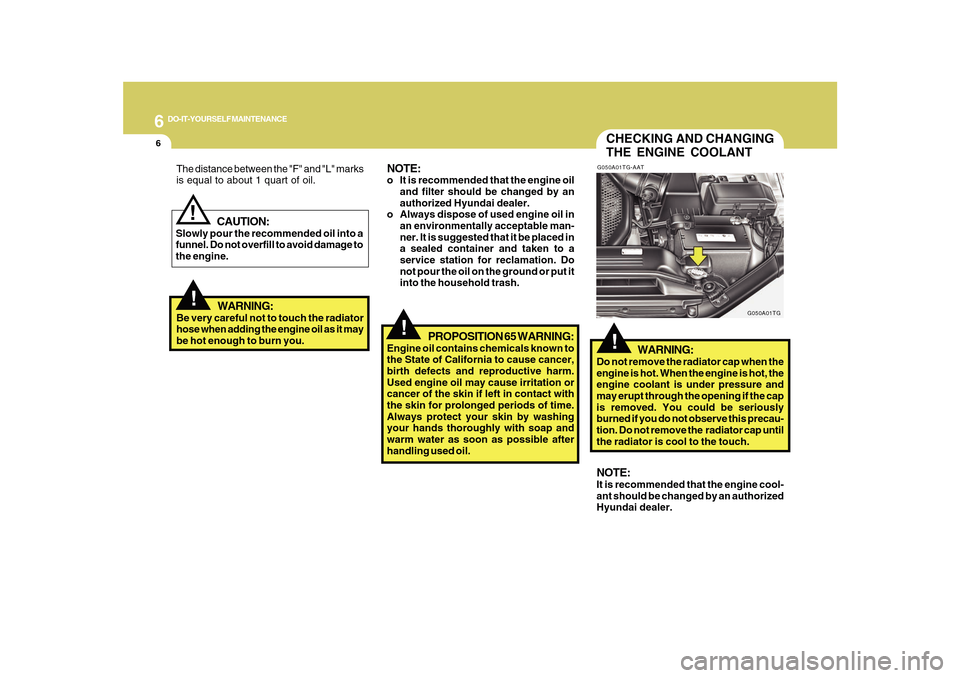
CHECKING AND CHANGING
THE ENGINE COOLANT!
G050A01TG-AAT
WARNING:
Do not remove the radiator cap when the
engine is hot. When the engine is hot, the
engine coolant is under pressure and
may erupt through the opening if the cap
is removed. You could be seriously
burned if you do not observe this precau-
tion. Do not remove the radiator cap until
the radiator is cool to the touch.
!
NOTE:o It is recommended that the engine oil
and filter should be changed by an
authorized Hyundai dealer.
o Always dispose of used engine oil in
an environmentally acceptable man-
ner. It is suggested that it be placed in
a sealed container and taken to a
service station for reclamation. Do
not pour the oil on the ground or put it
into the household trash.
PROPOSITION 65 WARNING:
Engine oil contains chemicals known to
the State of California to cause cancer,
birth defects and reproductive harm.
Used engine oil may cause irritation or
cancer of the skin if left in contact with
the skin for prolonged periods of time.
Always protect your skin by washing
your hands thoroughly with soap and
warm water as soon as possible after
handling used oil.
!!
CAUTION:
Slowly pour the recommended oil into a
funnel. Do not overfill to avoid damage to
the engine.
NOTE:It is recommended that the engine cool-
ant should be changed by an authorized
Hyundai dealer. The distance between the "F" and "L" marks
is equal to about 1 quart of oil.
G050A01TG
WARNING:
Be very careful not to touch the radiator
hose when adding the engine oil as it may
be hot enough to burn you.
Page 273 of 334
6
DO-IT-YOURSELF MAINTENANCE
7
!
G050B01A-AATRecommended Engine CoolantUse a high quality ethylene-glycol coolant
in a 50/50 mix with water. The engine
coolant should be compatible with alumi-
num engine parts. Additional corrosion
inhibitors or additives should not be used.
The cooling system must be maintained
with the correct concentration and type of
engine coolant to prevent freezing and
corrosion. Never allow the concentration
of antifreeze to exceed the 60% level or go
below the 35% level, or damage to the
cooling system may result. For proper con-
centration when adding or replacing the
engine coolant, refer to the following table.
Ambient
temperature
°F (°C)
5 (-15)
-13 (-25)
-31 (-35)
-49 (-45)
65%
60%
50%
40% 35%
40%
50%
60%Water Antifreeze
solution Engine Coolant concentration
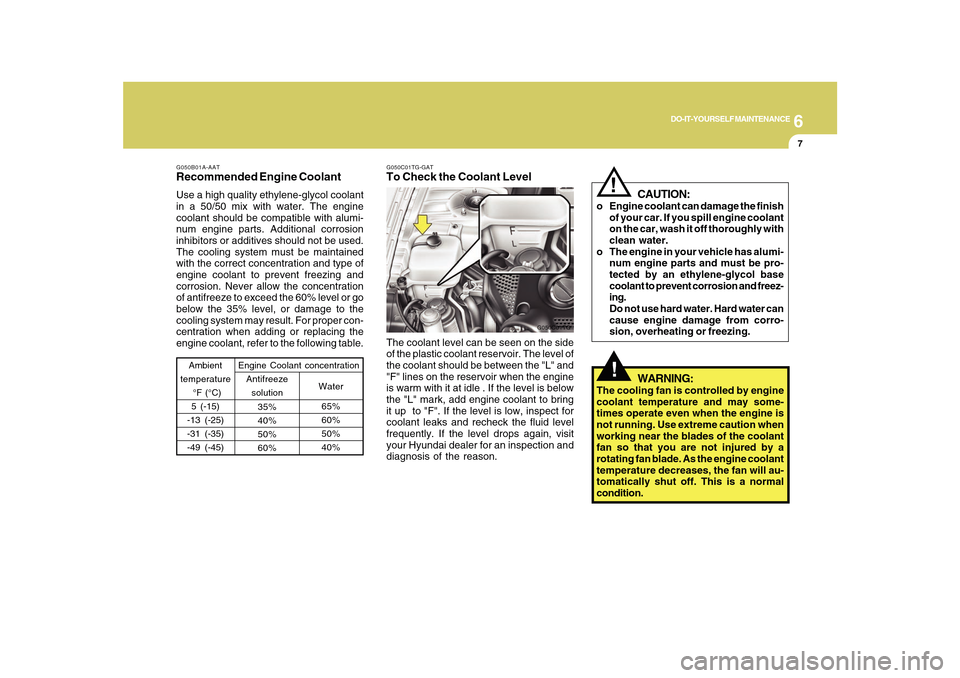
G050C01TG-GATTo Check the Coolant LevelThe coolant level can be seen on the side
of the plastic coolant reservoir. The level of
the coolant should be between the "L" and
"F" lines on the reservoir when the engine
is warm with it at idle . If the level is below
the "L" mark, add engine coolant to bring
it up to "F". If the level is low, inspect for
coolant leaks and recheck the fluid level
frequently. If the level drops again, visit
your Hyundai dealer for an inspection and
diagnosis of the reason.
G050C01TG
!
CAUTION:
o Engine coolant can damage the finish
of your car. If you spill engine coolant
on the car, wash it off thoroughly with
clean water.
o The engine in your vehicle has alumi-
num engine parts and must be pro-
tected by an ethylene-glycol base
coolant to prevent corrosion and freez-
ing.
Do not use hard water. Hard water can
cause engine damage from corro-
sion, overheating or freezing.
WARNING:
The cooling fan is controlled by engine
coolant temperature and may some-
times operate even when the engine is
not running. Use extreme caution when
working near the blades of the coolant
fan so that you are not injured by a
rotating fan blade. As the engine coolant
temperature decreases, the fan will au-
tomatically shut off. This is a normal
condition.
Page 278 of 334
6
DO-IT-YOURSELF MAINTENANCE
12
G110A01E-AATTransaxle fluid in the automatic transaxle
should be checked at those intervals speci-
fied in the vehicle maintenance schedule
in Section 5.NOTE:Automatic transaxle fluid is basically
red in color. As driving distance in-
creases, the fluid color turns darkish red
gradually. It is a normal condition and
you should not judge the need to replace
based upon the changing color.
You must replace the automatic
transaxle fluid in accordance with inter-
vals specified in the vehicle maintenance
schedule in section 5.G110B05A-AATRecommended Fluid
Your Hyundai automatic transaxle is spe-
cially designed to operate with HYUNDAI
GENUINE ATF SP III, DIAMOND ATF SP III,
SK ATF SP III or other brands meeting the
SP III specification approved by Hyundai
Motor Co.. Damage caused by a
nonspecified fluid is not covered by your
new vehicle limited warranty.
CAUTION:
o Radiator antifreeze (engine coolant)
should not be used in the washer sys-
tem because it will damage the car's
finish.
o The washer lever should not be pulled
and the washer should not be oper-
ated if the washer reservoir is empty.
This can damage the washer fluid
pump.
!!
WARNING:
o Windshield washer fluid agents con-
tain some amounts of alcohol and can
be flammable under certain circum-
stances. Do not allow sparks or flame
to contact the washer fluid or the
washer fluid reservoir. Damage to
the vehicle or its occupants could
occur.
o Windshield washer fluid is poisonous
to humans and animals. Do not drink
windshield washer fluid. Serious in-
jury or death could occur.
FILLING THE WASHER
RESERVOIRG090A02NF-AAT
G090A01TG
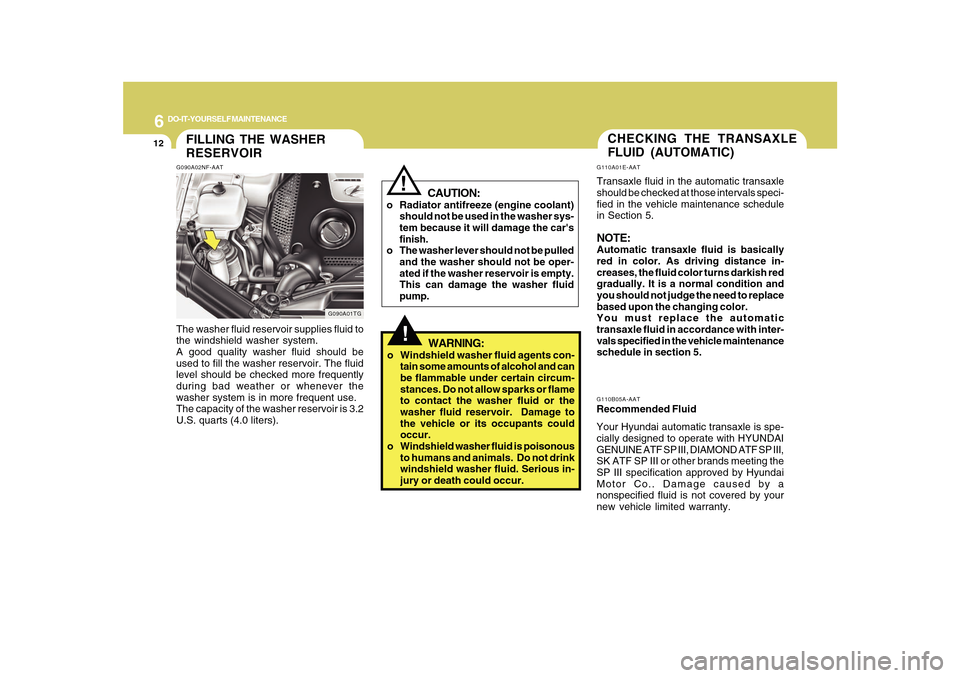
The washer fluid reservoir supplies fluid to
the windshield washer system.
A good quality washer fluid should be
used to fill the washer reservoir. The fluid
level should be checked more frequently
during bad weather or whenever the
washer system is in more frequent use.
The capacity of the washer reservoir is 3.2
U.S. quarts (4.0 liters).
CHECKING THE TRANSAXLE
FLUID (AUTOMATIC)