air filter Hyundai Azera 2017 User Guide
[x] Cancel search | Manufacturer: HYUNDAI, Model Year: 2017, Model line: Azera, Model: Hyundai Azera 2017Pages: 520, PDF Size: 16.33 MB
Page 432 of 520
Maintenance
16
7
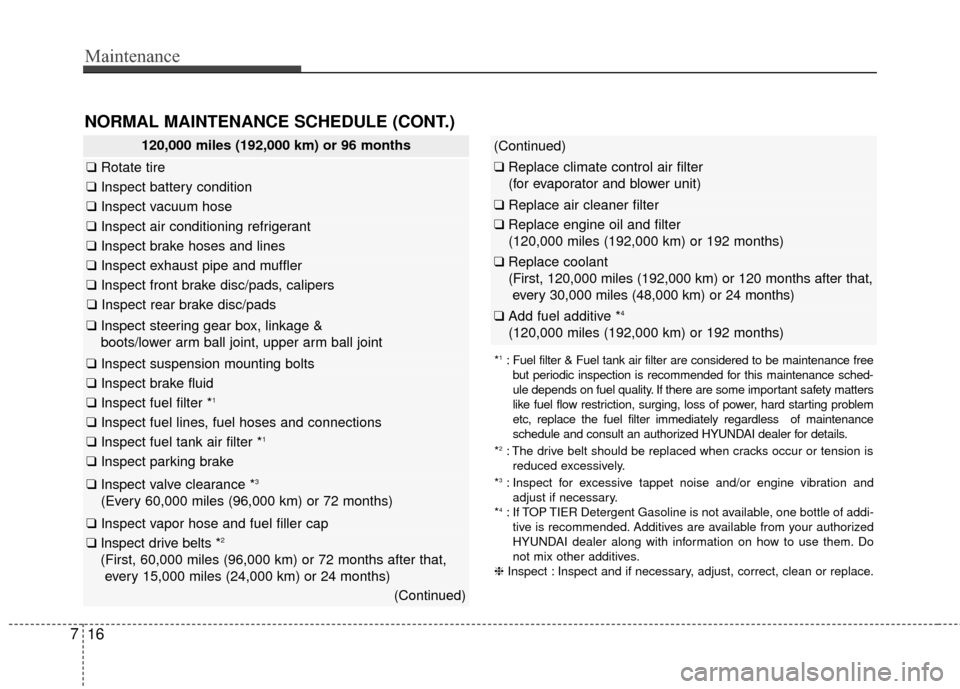
NORMAL MAINTENANCE SCHEDULE (CONT.)
120,000 miles (192,000 km) or 96 months
❑ Rotate tire
❑Inspect battery condition
❑Inspect vacuum hose
❑Inspect air conditioning refrigerant
❑Inspect brake hoses and lines
❑Inspect exhaust pipe and muffler
❑Inspect front brake disc/pads, calipers
❑Inspect rear brake disc/pads
❑Inspect steering gear box, linkage &
boots/lower arm ball joint, upper arm ball joint
❑ Inspect suspension mounting bolts
❑Inspect brake fluid
❑Inspect fuel filter *1
❑Inspect fuel lines, fuel hoses and connections
❑Inspect fuel tank air filter *1
❑Inspect parking brake
❑Inspect valve clearance *3
(Every 60,000 miles (96,000 km) or 72 months)
❑ Inspect vapor hose and fuel filler cap
❑Inspect drive belts *2
(First, 60,000 miles (96,000 km) or 72 months after that,
every 15,000 miles (24,000 km) or 24 months)
(Continued)
*1: Fuel filter & Fuel tank air filter are considered to be maintenance free\
but periodic inspection is recommended for this maintenance sched-
ule depends on fuel quality. If there are some important safety matters
like fuel flow restriction, surging, loss of power, hard starting problem
etc, replace the fuel filter immediately regardless of maintenance
schedule and consult an authorized HYUNDAI dealer for details.
*
2: The drive belt should be replaced when cracks occur or tension is reduced excessively.
*
3: Inspect for excessive tappet noise and/or engine vibration and adjust if necessary.
*
4: If TOP TIER Detergent Gasoline is not available, one bottle of addi- tive is recommended. Additives are available from your authorized
HYUNDAI dealer along with information on how to use them. Do
not mix other additives.
❈ Inspect : Inspect and if necessary, adjust, correct, clean or replace.
(Continued)
❑Replace climate control air filter
(for evaporator and blower unit)
❑ Replace air cleaner filter
❑Replace engine oil and filter
(120,000 miles (192,000 km) or 192 months)
❑Replace coolant
(First, 120,000 miles (192,000 km) or 120 months after that,
every 30,000 miles (48,000 km) or 24 months)
❑ Add fuel additive *4
(120,000 miles (192,000 km) or 192 months)
Page 433 of 520
717
Maintenance
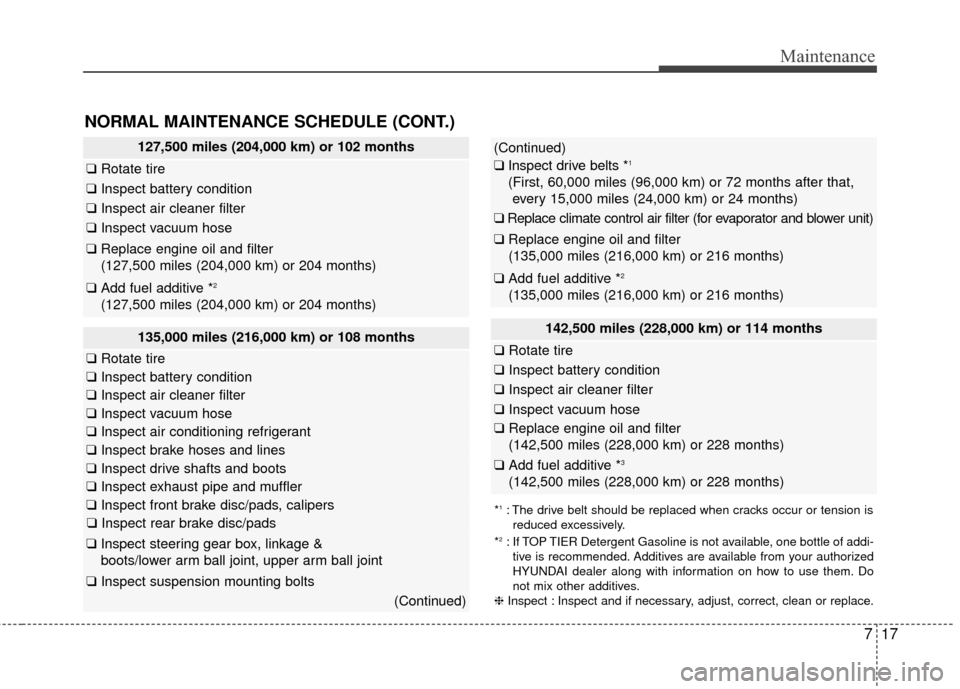
NORMAL MAINTENANCE SCHEDULE (CONT.)
135,000 miles (216,000 km) or 108 months
❑Rotate tire
❑Inspect battery condition
❑Inspect air cleaner filter
❑Inspect vacuum hose
❑Inspect air conditioning refrigerant
❑Inspect brake hoses and lines
❑Inspect drive shafts and boots
❑Inspect exhaust pipe and muffler
❑Inspect front brake disc/pads, calipers
❑Inspect rear brake disc/pads
❑Inspect steering gear box, linkage &
boots/lower arm ball joint, upper arm ball joint
❑ Inspect suspension mounting bolts
(Continued)
142,500 miles (228,000 km) or 114 months
❑Rotate tire
❑Inspect battery condition
❑Inspect air cleaner filter
❑Inspect vacuum hose
❑Replace engine oil and filter
(142,500 miles (228,000 km) or 228 months)
❑Add fuel additive *3
(142,500 miles (228,000 km) or 228 months)
*1: The drive belt should be replaced when cracks occur or tension is
reduced excessively.
*
2: If TOP TIER Detergent Gasoline is not available, one bottle of addi- tive is recommended. Additives are available from your authorized
HYUNDAI dealer along with information on how to use them. Do
not mix other additives.
❈ Inspect : Inspect and if necessary, adjust, correct, clean or replace.
127,500 miles (204,000 km) or 102 months
❑Rotate tire
❑Inspect battery condition
❑Inspect air cleaner filter
❑Inspect vacuum hose
❑Replace engine oil and filter
(127,500 miles (204,000 km) or 204 months)
❑Add fuel additive *2
(127,500 miles (204,000 km) or 204 months)
(Continued)
❑Inspect drive belts *1
(First, 60,000 miles (96,000 km) or 72 months after that,
every 15,000 miles (24,000 km) or 24 months)
❑ Replace climate control air filter (for evaporator and blower unit)
❑ Replace engine oil and filter
(135,000 miles (216,000 km) or 216 months)
❑Add fuel additive *2
(135,000 miles (216,000 km) or 216 months)
Page 434 of 520

No check, No service required
❑ Automatic transaxle fluid
*1: Fuel filter & Fuel tank air filter are considered to be maintenance free\
but peri")
Maintenance
18
7
NORMAL MAINTENANCE SCHEDULE (CONT.)
No check, No service required
❑ Automatic transaxle fluid
*1: Fuel filter & Fuel tank air filter are considered to be maintenance free\
but periodic inspection is recommended for this maintenance sched-
ule depends on fuel quality. If there are some important safety matters
like fuel flow restriction, surging, loss of power, hard starting problem
etc, replace the fuel filter immediately regardless of maintenance
schedule and consult an authorized HYUNDAI dealer for details.
*
2: The drive belt should be replaced when cracks occur or tension is reduced excessively.
*
3: If TOP TIER Detergent Gasoline is not available, one bottle of addi- tive is recommended. Additives are available from your authorized
HYUNDAI dealer along with information on how to use them. Do
not mix other additives.
❈ Inspect : Inspect and if necessary, adjust, correct, clean or replace.
(Continued)
❑Replace climate control air filter (for evaporator and blower unit)
❑ Replace air cleaner filter
❑Replace engine oil and filter
(150,000 miles (240,000 km) or 240 months)
❑Replace coolant
(First, 120,000 miles (192,000 km) or 120 months after that,
every 30,000 miles (48,000 km) or 24 months)
❑ Add fuel additive *3
(150,000 miles (240,000 km) or 240 months)
150,000 miles (240,000 km) or 120 months
❑ Rotate tire
❑Inspect battery condition
❑Inspect vacuum hose
❑Inspect air conditioning refrigerant
❑Inspect brake hoses and lines
❑Inspect exhaust pipe and muffler
❑Inspect front brake disc/pads, calipers
❑Inspect rear brake disc/pads
❑Inspect steering gear box, linkage &
boots/lower arm ball joint, upper arm ball joint
❑ Inspect suspension mounting bolts
❑Inspect brake fluid
❑Inspect fuel filter *1
❑Inspect fuel lines, fuel hoses and connections
❑Inspect fuel tank air filter *1
❑Inspect parking brake
❑Inspect vapor hose and fuel filler cap
❑Inspect drive belts *2
(First, 60,000 miles (96,000 km) or 72 months after that,
every 15,000 miles (24,000 km) or 24 months)
(Continued)
Page 435 of 520
719
Maintenance
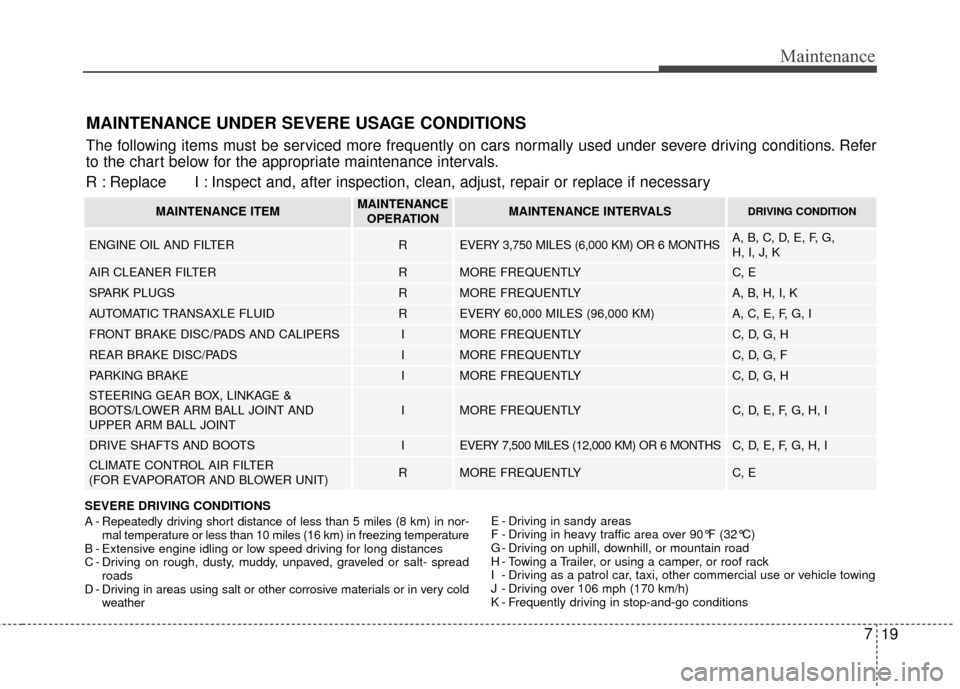
MAINTENANCE UNDER SEVERE USAGE CONDITIONS
SEVERE DRIVING CONDITIONS
A - Repeatedly driving short distance of less than 5 miles (8 km) in nor-mal temperature or less than 10 miles (16 km) in freezing temperature
B - Extensive engine idling or low speed driving for long distances
C - Driving on rough, dusty, muddy, unpaved, graveled or salt- spread roads
D - Driving in areas using salt or other corrosive materials or in very cold weather E - Driving in sandy areas
F - Driving in heavy traffic area over 90°F (32°C)
G - Driving on uphill, downhill, or mountain road
H - Towing a Trailer, or using a camper, or roof rack
I - Driving as a patrol car, taxi, other commercial use or vehicle towing
J - Driving over 106 mph (170 km/h)
K - Frequently driving in stop-and-go conditions
The following items must be serviced more frequently on cars normally used under severe driving conditions. Refer
to the chart below for the appropriate maintenance intervals.
R : Replace I : Inspect and, after inspection, clean, adjust, repair or replace if neces\
sary
MAINTENANCE ITEMMAINTENANCE
OPERATIONMAINTENANCE INTERVALSDRIVING CONDITION
ENGINE OIL AND FILTERREVERY 3,750 MILES (6,000 KM) OR 6 MONTHSA, B, C, D, E, F, G,
H, I, J, K
AIR CLEANER FILTERRMORE FREQUENTLYC, E
SPARK PLUGSRMORE FREQUENTLYA, B, H, I, K
AUTOMATIC TRANSAXLE FLUIDREVERY 60,000 MILES (96,000 KM) A, C, E, F, G, I
FRONT BRAKE DISC/PADS AND CALIPERSIMORE FREQUENTLYC, D, G, H
REAR BRAKE DISC/PADSIMORE FREQUENTLYC, D, G, F
PARKING BRAKEIMORE FREQUENTLYC, D, G, H
STEERING GEAR BOX, LINKAGE &
BOOTS/LOWER ARM BALL JOINT AND
UPPER ARM BALL JOINTIMORE FREQUENTLYC, D, E, F, G, H, I
DRIVE SHAFTS AND BOOTSIEVERY 7,500 MILES (12,000 KM) OR 6 MONTHSC, D, E, F, G, H, I
CLIMATE CONTROL AIR FILTER
(FOR EVAPORATOR AND BLOWER UNIT)RMORE FREQUENTLYC, E
Page 437 of 520
721
Maintenance
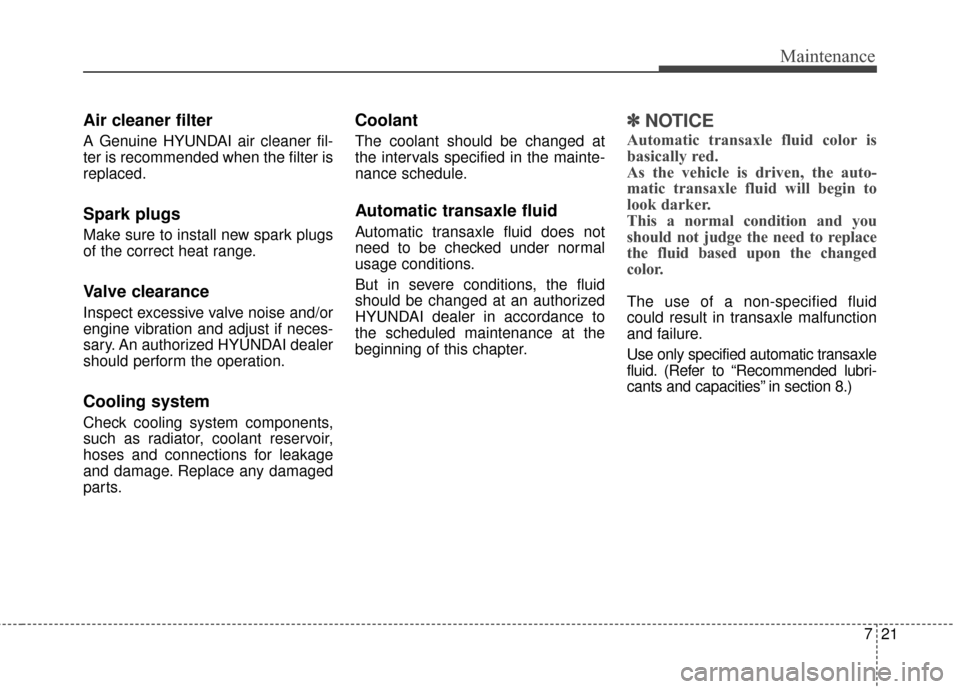
Air cleaner filter
A Genuine HYUNDAI air cleaner fil-
ter is recommended when the filter is
replaced.
Spark plugs
Make sure to install new spark plugs
of the correct heat range.
Valve clearance
Inspect excessive valve noise and/or
engine vibration and adjust if neces-
sary. An authorized HYUNDAI dealer
should perform the operation.
Cooling system
Check cooling system components,
such as radiator, coolant reservoir,
hoses and connections for leakage
and damage. Replace any damaged
parts.
Coolant
The coolant should be changed at
the intervals specified in the mainte-
nance schedule.
Automatic transaxle fluid
Automatic transaxle fluid does not
need to be checked under normal
usage conditions.
But in severe conditions, the fluid
should be changed at an authorized
HYUNDAI dealer in accordance to
the scheduled maintenance at the
beginning of this chapter.
✽ ✽NOTICE
Automatic transaxle fluid color is
basically red.
As the vehicle is driven, the auto-
matic transaxle fluid will begin to
look darker.
This a normal condition and you
should not judge the need to replace
the fluid based upon the changed
color.
The use of a non-specified fluid
could result in transaxle malfunction
and failure.
Use only specified automatic transaxle
fluid. (Refer to “Recommended lubri-
cants and capacities” in section 8.)
Page 445 of 520
729
Maintenance
AIR CLEANER
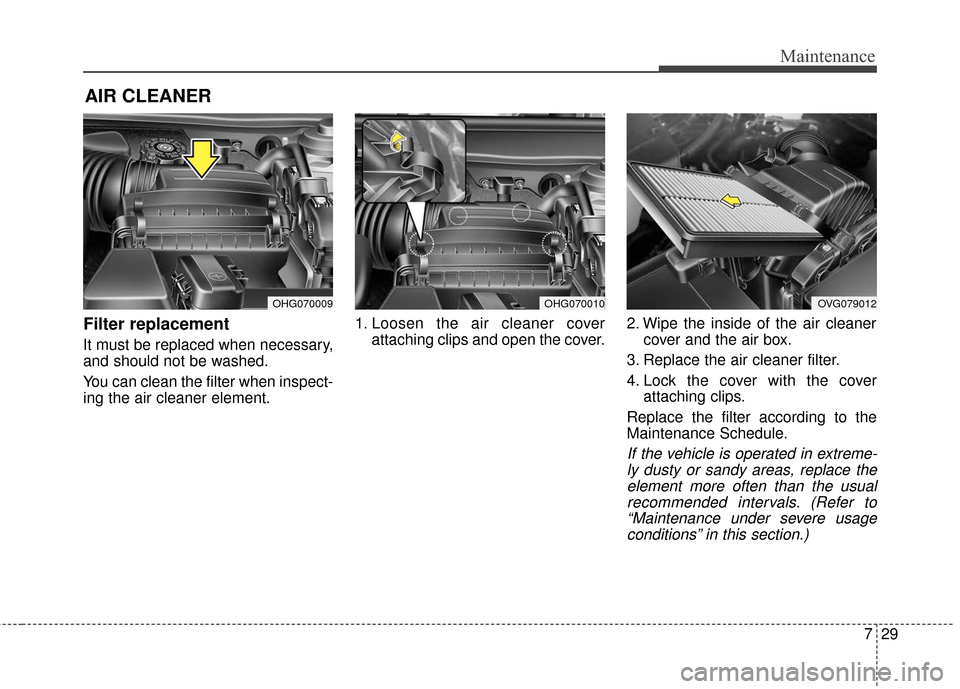
Filter replacement
It must be replaced when necessary,
and should not be washed.
You can clean the filter when inspect-
ing the air cleaner element.1. Loosen the air cleaner cover
attaching clips and open the cover. 2. Wipe the inside of the air cleaner
cover and the air box.
3. Replace the air cleaner filter.
4. Lock the cover with the cover attaching clips.
Replace the filter according to the
Maintenance Schedule.
If the vehicle is operated in extreme- ly dusty or sandy areas, replace the element more often than the usual recommended intervals. (Refer to“Maintenance under severe usageconditions” in this section.)
OHG070009OHG070010OVG079012
Page 446 of 520
Maintenance
30
7
Filter inspection
If the vehicle is operated in the
severely air-polluted cities or on
dusty rough roads for a long period,
it should be inspected more fre-
quently and replaced earlier. When
you, the owner, replace the climate
control air filter, replace it performing
the following procedure, and be care-
ful to avoid damaging other compo-
nents.
Replace the filter according to the
maintenance Schedule.
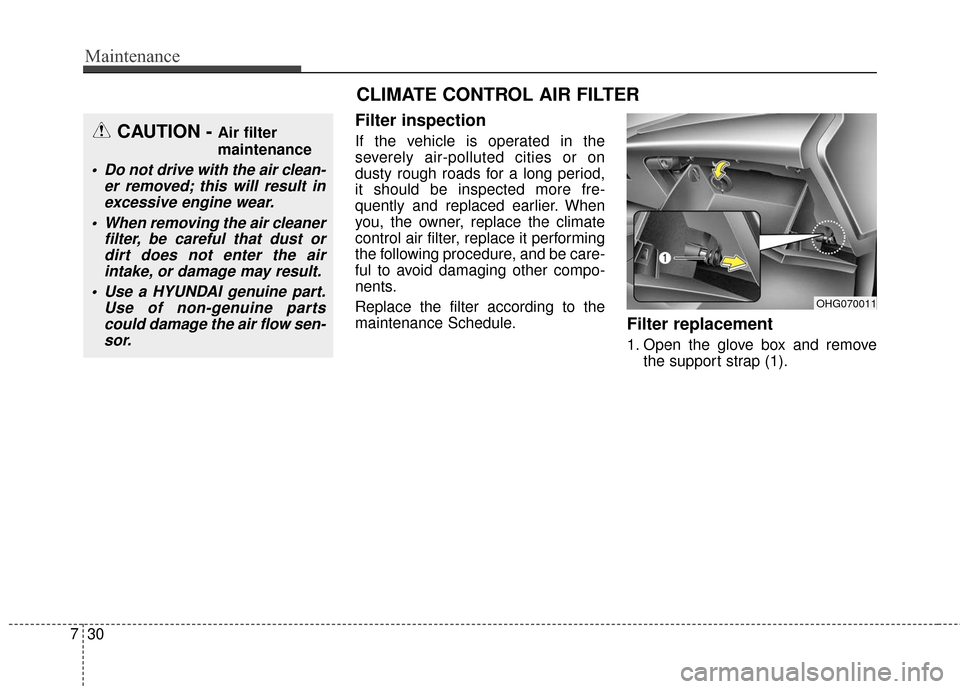
Filter replacement
1. Open the glove box and remove
the support strap (1).
CAUTION - Air filter
maintenance
Do not drive with the air clean-er removed; this will result inexcessive engine wear.
When removing the air cleaner filter, be careful that dust ordirt does not enter the airintake, or damage may result.
Use a HYUNDAI genuine part. Use of non-genuine partscould damage the air flow sen-sor.
CLIMATE CONTROL AIR FILTER
OHG070011
Page 447 of 520
731
Maintenance
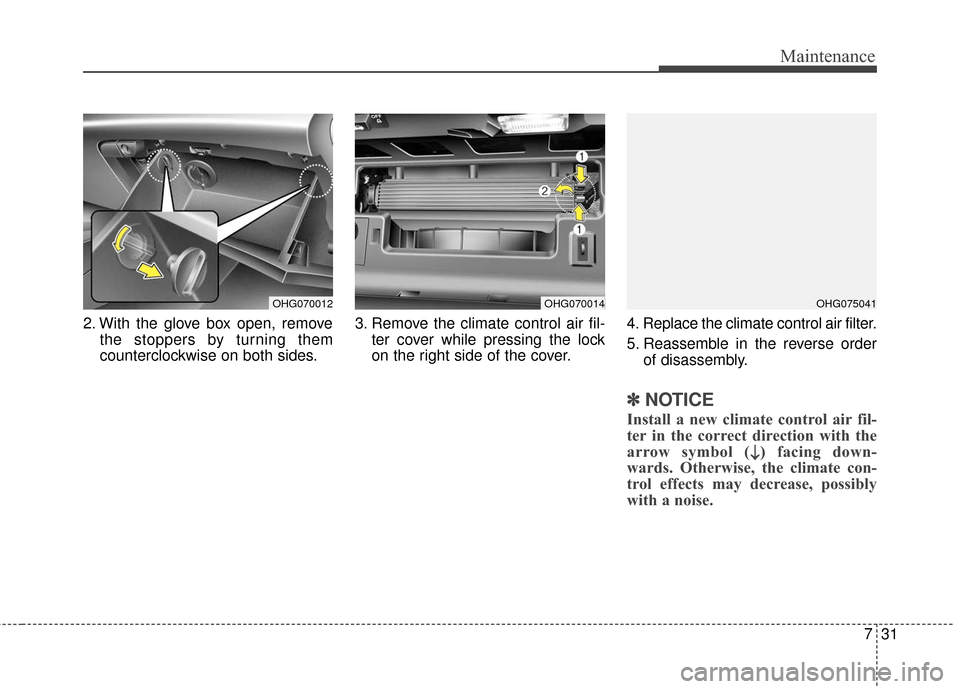
2. With the glove box open, removethe stoppers by turning them
counterclockwise on both sides. 3. Remove the climate control air fil-
ter cover while pressing the lock
on the right side of the cover. 4. Replace the climate control air filter.
5. Reassemble in the reverse order
of disassembly.
✽ ✽NOTICE
Install a new climate control air fil-
ter in the correct direction with the
arrow symbol (
↓ ↓) facing down-
wards. Otherwise, the climate con-
trol effects may decrease, possibly
with a noise.
OHG070012OHG075041OHG070014
Page 495 of 520
779
Maintenance
EMISSION CONTROL SYSTEM
The emission control system of your
vehicle is covered by a written limited
warranty. Please see the warranty
information contained in the Owner’s
Handbook & Warranty Information
booklet in your vehicle.
Your vehicle is equipped with an
emission control system to meet all
applicable emission regulations.
There are three emission control
systems, as follows.
(1) Crankcase emission control sys-tem
(2) Evaporative emission control sys- tem
(3) Exhaust emission control system
In order to assure the proper function
of the emission control systems, it is
recommended that you have your
vehicle inspected and maintained by
an authorized HYUNDAI dealer in
accordance with the maintenance
schedule in this manual. Caution for the Inspection and
Maintenance Test (With Electronic
Stability Control (ESC) system)
To prevent the vehicle from mis-
firing during dynamometer test-
ing, turn the Electronic Stability
Control (ESC) system off by
pressing the ESC switch.
After dynamometer testing is completed, turn the ESC system
back on by pressing the ESC
switch again.1. Crankcase emission control system
The positive crankcase ventilation
system is employed to prevent air
pollution caused by blow-by gases
being emitted from the crankcase.
This system supplies fresh filtered air
to the crankcase through the air
intake hose. Inside the crankcase,
the fresh air mixes with blow-by
gases, which then pass through the
PCV valve into the induction system.
2. Evaporative emission con-trol (including ORVR:
Onboard Refueling Vapor
Recovery) system
The Evaporative Emission Control
System is designed to prevent fuel
vapors from escaping into the atmos-
phere.
(The ORVR system is designed to
allow the vapors from the fuel tank to
be loaded into a canister while refu-
eling at the gas station, preventing
the escape of fuel vapors into the
atmosphere.)
Page 510 of 520
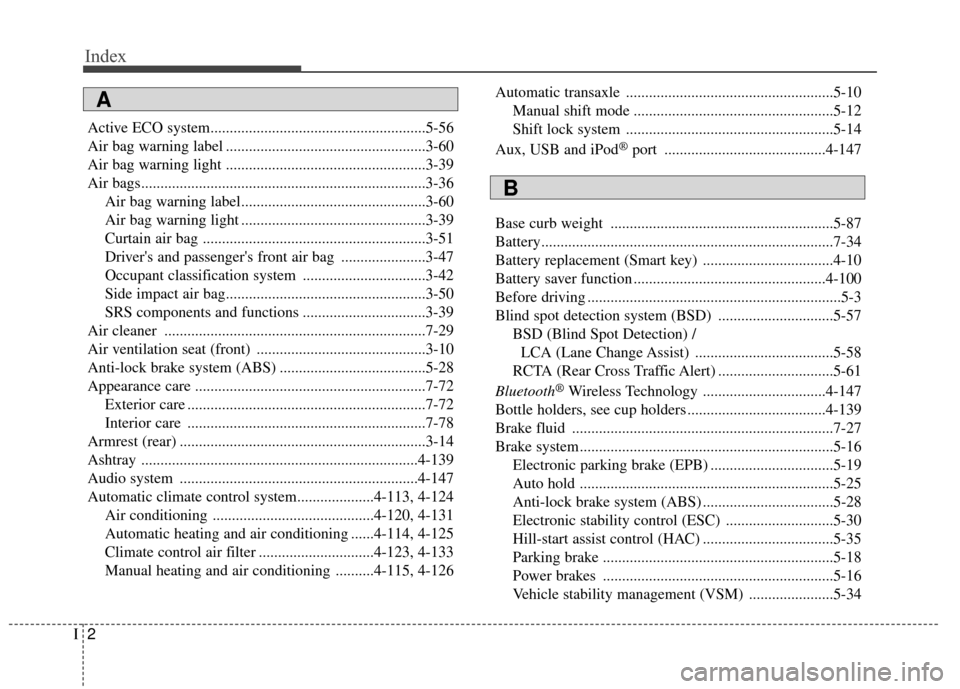
Index
2I
Active ECO system........................................................5-56
Air bag warning label ....................................................3-60
Air bag warning light ....................................................3-39
Air bags........................................................................\
..3-36Air bag warning label................................................3-60
Air bag warning light ................................................3-39
Curtain air bag ..........................................................3-51
Driver's and passenger's front air bag ......................3-47
Occupant classification system ................................3-42
Side impact air bag....................................................3-50
SRS components and functions ................................3-39
Air cleaner ....................................................................7-29\
Air ventilation seat (front) ............................................3-10
Anti-lock brake system (ABS) ......................................5-28
Appearance care ............................................................7-72 Exterior care ..............................................................7-72
Interior care ..............................................................7-78
Armrest (rear) ................................................................3-14
Ashtray ........................................................................\
4-139
Audio system ..............................................................4-147
Automatic climate control system....................4-113, 4-124 Air conditioning ..........................................4-120, 4-131
Automatic heating and air conditioning ......4-114, 4-125
Climate control air filter ..............................4-123, 4-133
Manual heating and air conditioning ..........4-115, 4-126 Automatic transaxle ......................................................5-10
Manual shift mode ....................................................5-12
Shift lock system ......................................................5-14
Aux, USB and iPod
®port ..........................................4-147
Base curb weight ..........................................................5-87
Battery........................................................................\
....7-34
Battery replacement (Smart key) ..................................4-10
Battery saver function ..................................................4-100
Before driving ..................................................................5-3
Blind spot detection system (BSD) ..............................5-57 BSD (Blind Spot Detection) / LCA (Lane Change Assist) ....................................5-58
RCTA (Rear Cross Traffic Alert) ..............................5-61
Bluetooth
®Wireless Technology ................................4-147
Bottle holders, see cup holders ....................................4-139
Brake fluid ....................................................................7-27\
Brake system..................................................................5-16 Electronic parking brake (EPB) ................................5-19
Auto hold ..................................................................5-25
Anti-lock brake system (ABS) ..................................5-28
Electronic stability control (ESC) ............................5-30
Hill-start assist control (HAC) ..................................5-35
Parking brake ............................................................5-18
Power brakes ............................................................5-16
Vehicle stability management (VSM) ......................5-34
A
B