ignition Hyundai Azera 2017 Repair Manual
[x] Cancel search | Manufacturer: HYUNDAI, Model Year: 2017, Model line: Azera, Model: Hyundai Azera 2017Pages: 520, PDF Size: 16.33 MB
Page 397 of 520
65
What to do in an emergency
EMERGENCY STARTING
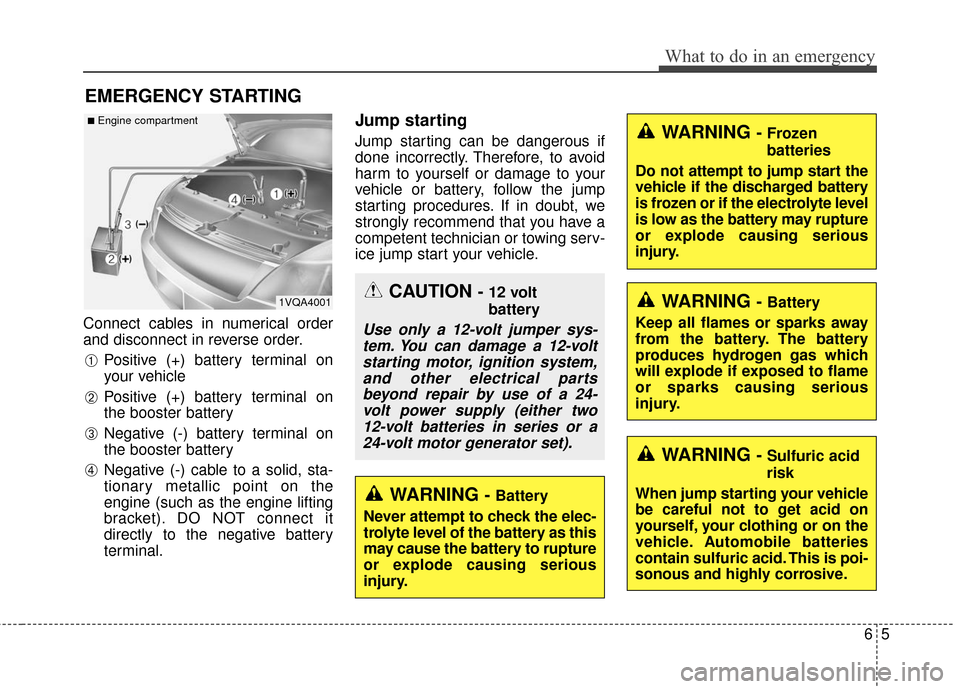
Connect cables in numerical order
and disconnect in reverse order.Positive (+) battery terminal on
your vehicle
Positive (+) battery terminal on
the booster battery
Negative (-) battery terminal on
the booster battery
Negative (-) cable to a solid, sta-
tionary metallic point on the
engine (such as the engine lifting
bracket). DO NOT connect it
directly to the negative battery
terminal.
Jump starting
Jump starting can be dangerous if
done incorrectly. Therefore, to avoid
harm to yourself or damage to your
vehicle or battery, follow the jump
starting procedures. If in doubt, we
strongly recommend that you have a
competent technician or towing serv-
ice jump start your vehicle.
1VQA4001
■Engine compartment
CAUTION - 12 volt
battery
Use only a 12-volt jumper sys-tem. You can damage a 12-voltstarting motor, ignition system,and other electrical partsbeyond repair by use of a 24-volt power supply (either two12-volt batteries in series or a24-volt motor generator set).
WARNING - Battery
Never attempt to check the elec-
trolyte level of the battery as this
may cause the battery to rupture
or explode causing serious
injury.
WARNING - Frozen
batteries
Do not attempt to jump start the
vehicle if the discharged battery
is frozen or if the electrolyte level
is low as the battery may rupture
or explode causing serious
injury.
WARNING - Battery
Keep all flames or sparks away
from the battery. The battery
produces hydrogen gas which
will explode if exposed to flame
or sparks causing serious
injury.
WARNING - Sulfuric acid
risk
When jump starting your vehicle
be careful not to get acid on
yourself, your clothing or on the
vehicle. Automobile batteries
contain sulfuric acid. This is poi-
sonous and highly corrosive.
➀
➁
➂
➃
Page 401 of 520
69
What to do in an emergency
TPMS malfunctions may occur for a
variety of reasons, including the
installation of replacement or alter-
nate tires or wheels on the vehicle
that prevent the TPMS from function-
ing properly. Always check the TPMS
malfunction telltale after replacing
one or more tires or wheels on your
vehicle to ensure that the replace-
ment or alternate tires and wheels
allow the TPMS to continue to func-
tion properly.
✽ ✽NOTICE
Take your vehicle to the nearest
authorized HYUNDAI dealer and
have the system checked if any of
the below happens:
1.The low tire pressure telltale/
TPMS malfunction indicator do
not illuminate for 3 seconds when
the ignition switch is turned to the
ON position or engine is running.
2. The TPMS malfunction indicator remains illuminated after blinking
for approximately 1 minute.
3. The Low tire pressure position telltale remains illuminated.
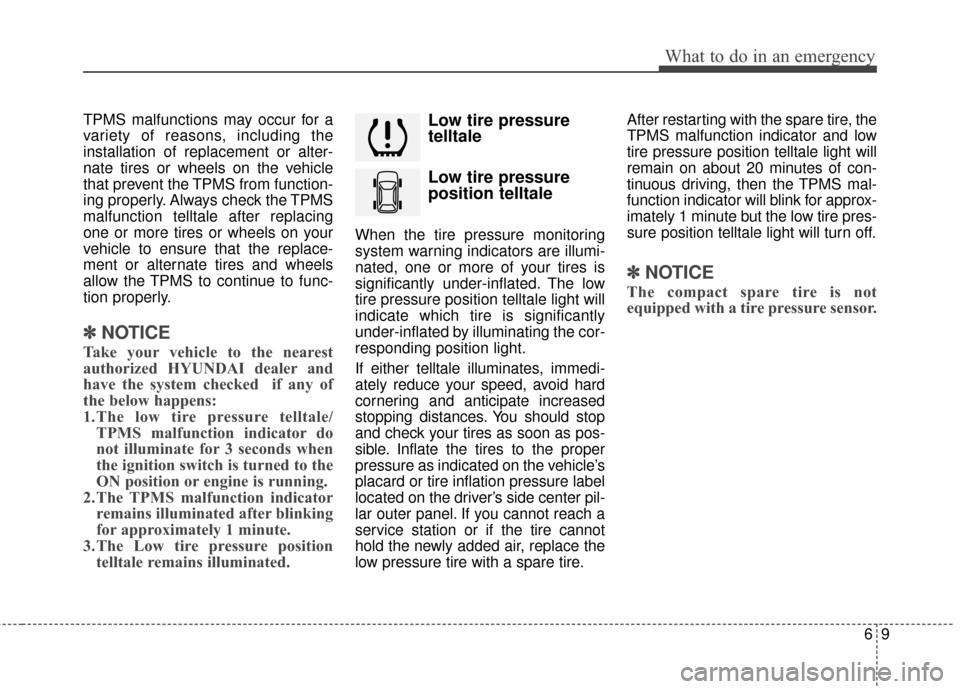
Low tire pressure
telltale
Low tire pressure
position telltale
When the tire pressure monitoring
system warning indicators are illumi-
nated, one or more of your tires is
significantly under-inflated. The low
tire pressure position telltale light will
indicate which tire is significantly
under-inflated by illuminating the cor-
responding position light.
If either telltale illuminates, immedi-
ately reduce your speed, avoid hard
cornering and anticipate increased
stopping distances. You should stop
and check your tires as soon as pos-
sible. Inflate the tires to the proper
pressure as indicated on the vehicle’s
placard or tire inflation pressure label
located on the driver’s side center pil-
lar outer panel. If you cannot reach a
service station or if the tire cannot
hold the newly added air, replace the
low pressure tire with a spare tire. After restarting with the spare tire, the
TPMS malfunction indicator and low
tire pressure position telltale light will
remain on about 20 minutes of con-
tinuous driving, then the TPMS mal-
function indicator will blink for approx-
imately 1 minute but the low tire pres-
sure position telltale light will turn off.
✽ ✽
NOTICE
The compact spare tire is not
equipped with a tire pressure sensor.
Page 414 of 520
What to do in an emergency
22
6
When towing your vehicle in an
emergency without wheel dollies :
1. Set the ignition switch in the ACC
position.
2. Place the shift lever in N (Neutral).
3. Release the parking brake.
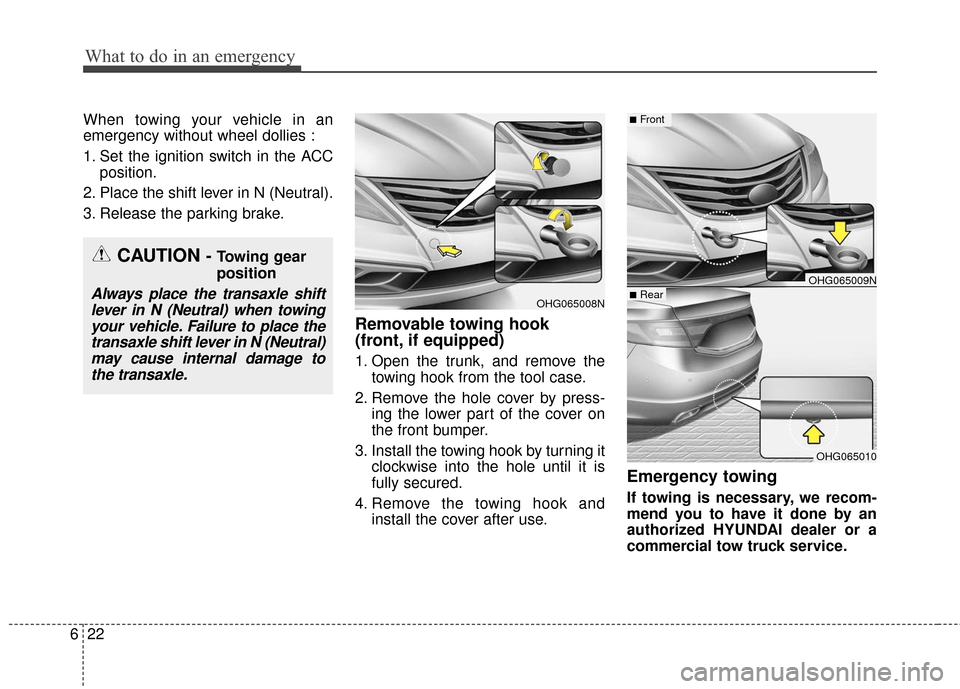
Removable towing hook
(front, if equipped)
1. Open the trunk, and remove the towing hook from the tool case.
2. Remove the hole cover by press- ing the lower part of the cover on
the front bumper.
3. Install the towing hook by turning it clockwise into the hole until it is
fully secured.
4. Remove the towing hook and install the cover after use.
Emergency towing
If towing is necessary, we recom-
mend you to have it done by an
authorized HYUNDAI dealer or a
commercial tow truck service.
OHG065008N
OHG065009N■Rear
■Front
OHG065010
CAUTION - Towing gear
position
Always place the transaxle shiftlever in N (Neutral) when towingyour vehicle. Failure to place thetransaxle shift lever in N (Neutral)may cause internal damage tothe transaxle.
Page 416 of 520
Emergency towing precautions
Place the ignition switch in ACC sothe steering wheel isn’t locked.
Place the transaxle shift lever in N (Neutral).
Release the parking bake.
Depress the brake pedal with more force than normal since you will
have reduced brake performance.
More steering effort will be required because the power steer-
ing system will be disabled.
If you are driving down a long hill, the brakes may overheat and brake
performance will be reduced. Stop
often and let the brakes cool off.
If the vehicle is being towed with all four wheels on the ground, it can
be towed only from the front. Be
sure that the transaxle is in neutral.
Be sure the steering is unlocked by
placing the ignition switch in the
ACC position. A driver must be in
the towed vehicle to operate the
steering and brakes.
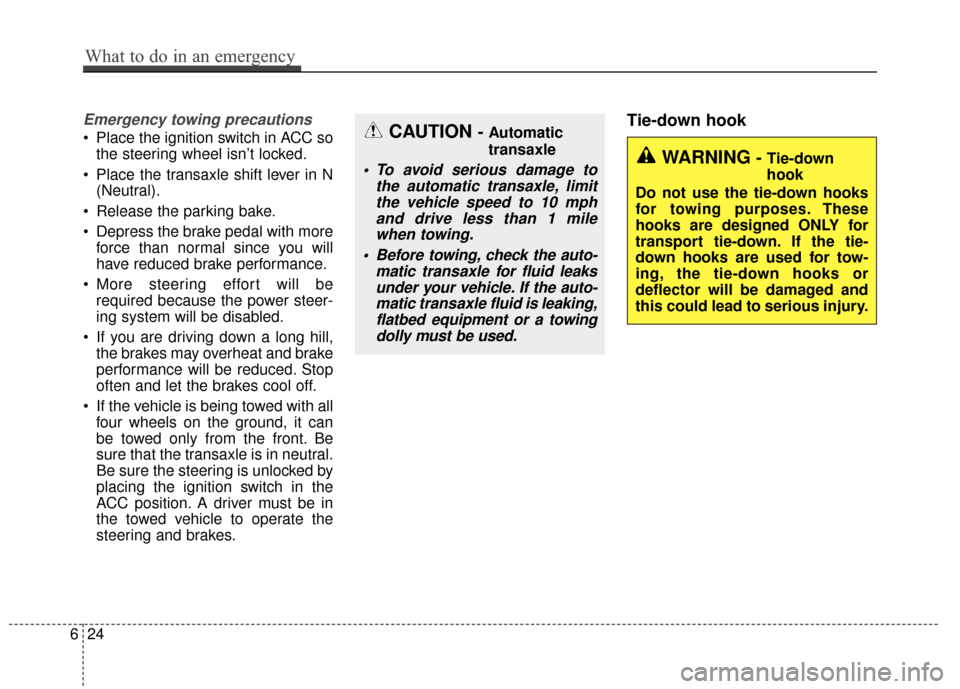
Tie-down hook
WARNING- Tie-down
hook
Do not use the tie-down hooks
for towing purposes. These
hooks are designed ONLY for
transport tie-down. If the tie-
down hooks are used for tow-
ing, the tie-down hooks or
deflector will be damaged and
this could lead to serious injury.
CAUTION - Automatic
transaxle
To avoid serious damage to the automatic transaxle, limitthe vehicle speed to 10 mphand drive less than 1 milewhen towing.
Before towing, check the auto- matic transaxle for fluid leaks
under your vehicle. If the auto- matic transaxle fluid is leaking,
flatbed equipment or a towing dolly must be used.
624
What to do in an emergency
Page 451 of 520

735
Maintenance
When you don’t use the vehicle for a
long time in a low temperature area,
separate the battery and keep it
indoors.
WARNING - Recharging
battery
Never attempt to recharge the
battery when the battery cables
are connected. Some charging
equipment can release a volt-
age spike that will damage vehi-
cle electronics, resulting in
thousands of dollars in required
repair parts which are not cov-
ered by warranty if damaged by
not following this warning.WARNING
-
California proposition 65
Battery posts, terminals, and
related accessories contain
lead and lead compounds,
chemicals known to the State of
California to cause cancer, birth
defects and reproductive harm.
Batteries also contain other
chemicals known to the State of
California to cause cancer.
Wash hands after handling.
WARNING - Risk of
electrocution
Never touch the electrical igni-
tion system while the vehicle is
running. This system works
with high voltage which can
"zap" you.
(Continued) The battery containslead. Do not dispose of it
after use. Please return
the battery to an author-
ized HYUNDAI dealer to
be recycled.
When lifting a plastic-cased battery, excessive pressure
on the case may cause battery
acid to leak, resulting in per-
sonal injury. Lift with a battery
carrier or with your hands on
opposite corners.
Never attempt to recharge the battery when the battery
cables are connected.
The electrical ignition system works with high voltage.
Never touch these compo-
nents with the engine running
or the ignition switched on.
Failure to follow the above
warnings can result in serious
bodily injury or death.
Page 468 of 520
Maintenance
52
7
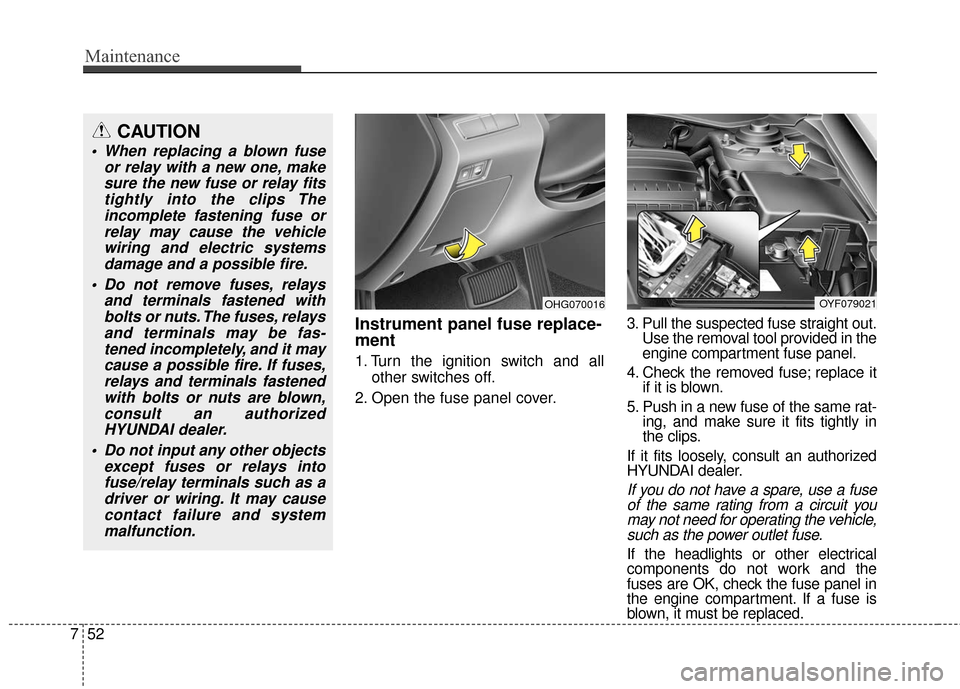
Instrument panel fuse replace-
ment
1. Turn the ignition switch and all
other switches off.
2. Open the fuse panel cover. 3. Pull the suspected fuse straight out.
Use the removal tool provided in the
engine compartment fuse panel.
4. Check the removed fuse; replace it if it is blown.
5. Push in a new fuse of the same rat- ing, and make sure it fits tightly in
the clips.
If it fits loosely, consult an authorized
HYUNDAI dealer.
If you do not have a spare, use a fuse of the same rating from a circuit youmay not need for operating the vehicle,such as the power outlet fuse.
If the headlights or other electrical
components do not work and the
fuses are OK, check the fuse panel in
the engine compartment. If a fuse is
blown, it must be replaced.
OHG070016OYF079021
CAUTION
When replacing a blown fuse
or relay with a new one, makesure the new fuse or relay fitstightly into the clips Theincomplete fastening fuse orrelay may cause the vehiclewiring and electric systemsdamage and a possible fire.
Do not remove fuses, relays and terminals fastened withbolts or nuts. The fuses, relaysand terminals may be fas-tened incompletely, and it maycause a possible fire. If fuses,relays and terminals fastenedwith bolts or nuts are blown,consult an authorizedHYUNDAI dealer.
Do not input any other objects except fuses or relays intofuse/relay terminals such as adriver or wiring. It may causecontact failure and systemmalfunction.
Page 469 of 520
753
Maintenance
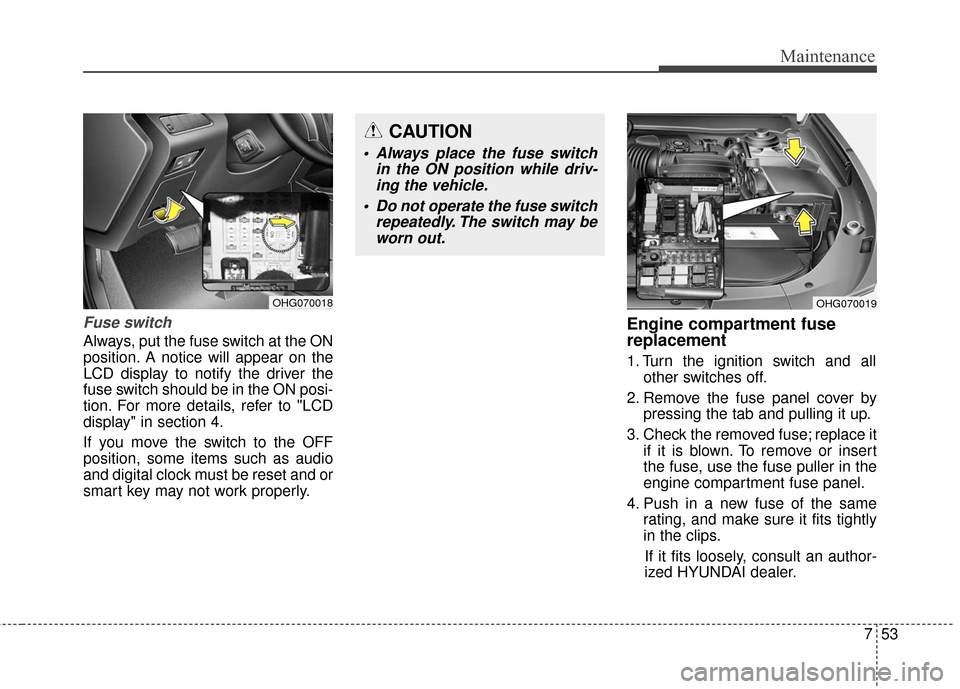
Fuse switch
Always, put the fuse switch at the ON
position. A notice will appear on the
LCD display to notify the driver the
fuse switch should be in the ON posi-
tion. For more details, refer to "LCD
display" in section 4.
If you move the switch to the OFF
position, some items such as audio
and digital clock must be reset and or
smart key may not work properly.
Engine compartment fuse
replacement
1. Turn the ignition switch and allother switches off.
2. Remove the fuse panel cover by pressing the tab and pulling it up.
3. Check the removed fuse; replace it if it is blown. To remove or insert
the fuse, use the fuse puller in the
engine compartment fuse panel.
4. Push in a new fuse of the same rating, and make sure it fits tightly
in the clips.
If it fits loosely, consult an author-
ized HYUNDAI dealer.
OHG070019OHG070018
CAUTION
Always place the fuse switch in the ON position while driv-ing the vehicle.
Do not operate the fuse switch repeatedly. The switch may beworn out.
Page 478 of 520
Maintenance
62
7
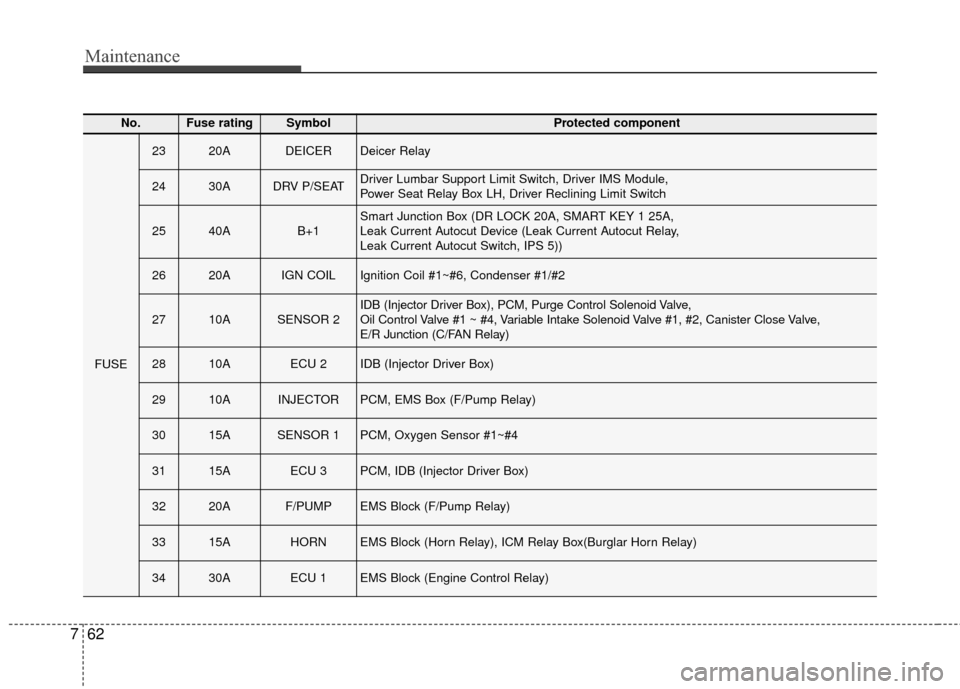
No.Fuse ratingSymbol Protected component
FUSE
2320ADEICERDeicer Relay
2430ADRV P/SEATDriver Lumbar Support Limit Switch, Driver IMS Module,
Power Seat Relay Box LH, Driver Reclining Limit Switch
2540AB+1Smart Junction Box (DR LOCK 20A, SMART KEY 1 25A,
Leak Current Autocut Device (Leak Current Autocut Relay,
Leak Current Autocut Switch, IPS 5))
2620AIGN COILIgnition Coil #1~#6, Condenser #1/#2
2710ASENSOR 2IDB (Injector Driver Box), PCM, Purge Control Solenoid Valve,
Oil Control Valve #1 ~ #4, Variable Intake Solenoid Valve #1, #2, Canister Close Valve,
E/R Junction (C/FAN Relay)
2810AECU 2IDB (Injector Driver Box)
2910AINJECTORPCM, EMS Box (F/Pump Relay)
3015ASENSOR 1PCM, Oxygen Sensor #1~#4
3115AECU 3PCM, IDB (Injector Driver Box)
3220AF/PUMPEMS Block (F/Pump Relay)
3315AHORNEMS Block (Horn Relay), ICM Relay Box(Burglar Horn Relay)
3430AECU 1EMS Block (Engine Control Relay)
Page 479 of 520
763
Maintenance
LIGHT BULBS
Use only the bulbs of the specifiedwattage.
If you do not have necessary tools,
the correct bulbs and the expertise,
consult an authorized HYUNDAI
dealer. In many cases, it is difficult to
replace vehicle light bulbs because
other parts of the vehicle must be
removed before you can get to the
bulb. This is especially true if you
have to remove the headlight assem-
bly to get to the bulb(s).
Removing/installing the headlight
assembly can result in damage to
the vehicle.
✽ ✽ NOTICE
After driving in rain or washing the
vehicle, the headlight and taillight
lenses could appear frosty. This con-
dition is caused by the temperature
difference between the lamp inside
and outside. This is similar to the
condensation on your windows
inside your vehicle during the rain
and doesn’t indicate a problem with
your vehicle. If the water leaks into
the lamp bulb circuitry, have the
vehicle checked by an authorized
HYUNDAI dealer.
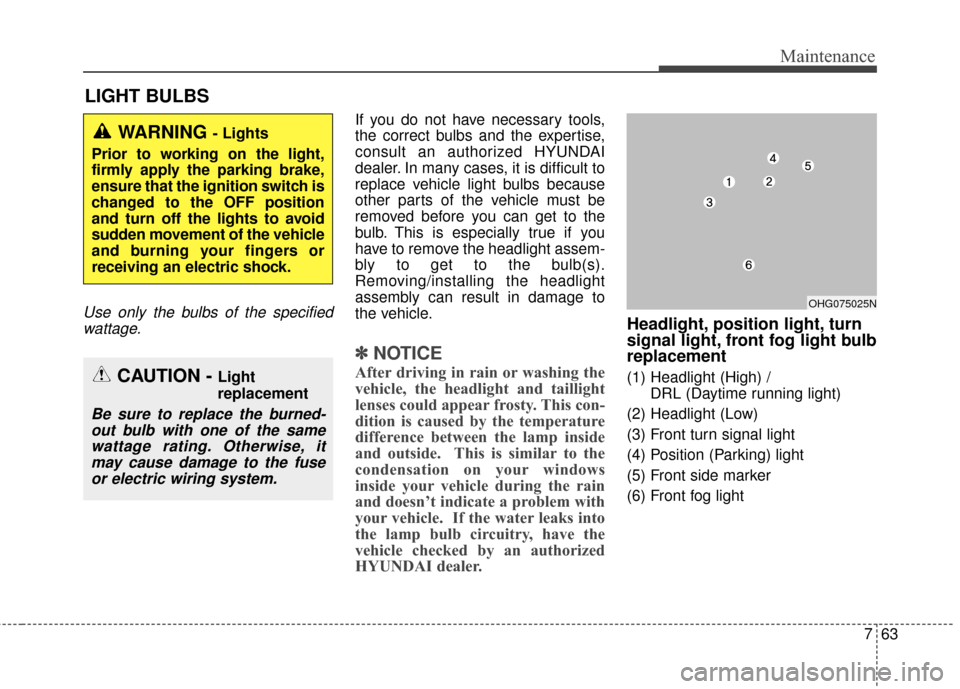
Headlight, position light, turn
signal light, front fog light bulb
replacement
(1) Headlight (High) /
DRL (Daytime running light)
(2) Headlight (Low)
(3) Front turn signal light
(4) Position (Parking) light
(5) Front side marker
(6) Front fog light
WARNING - Lights
Prior to working on the light,
firmly apply the parking brake,
ensure that the ignition switch is
changed to the OFF position
and turn off the lights to avoid
sudden movement of the vehicle
and burning your fingers or
receiving an electric shock.
CAUTION - Light
replacement
Be sure to replace the burned- out bulb with one of the samewattage rating. Otherwise, itmay cause damage to the fuseor electric wiring system.
OHG075025N
Page 498 of 520
CALIFORNIA PERCHLO-
RATE NOTICE
782
Maintenance
Your vehicle is equipped with a catalyt-
ic converter emission control device.
Therefore, the following precautions
must be observed:
Use only UNLEADED FUEL forgasoline engines.
Do not operate the vehicle when there are signs of engine malfunc-
tion, such as misfire or a noticeable
loss of performance.
Do not misuse or abuse the engine. Examples of misuse are
coasting with the ignition off and
descending steep grades in gear
with the ignition off.
Do not operate the engine at high idle speed for extended periods (5
minutes or more).
Do not modify or tamper with any part of the engine or emission con-
trol system. All inspections and
adjustments must be made by an
authorized HYUNDAI dealer.
Avoid driving with an extremely low fuel level. Running out of fuel could
cause the engine to misfire, dam-
aging the catalytic converter. Failure to observe these precautions
could result in damage to the
catalytic converter and to your vehi-
cle. Additionally, such actions could
void your warranties.
Perchlorate Material-special handling
may apply, See www.dtsc.ca.gov/haz-
ardouswaste/perchlorate.
Notice to California Vehicle
Dismantlers: Perchlorate containing
materials, such as air bag inflators,
seatbelt pretensioners and keyless
remote entry batteries, must be dis-
posed of according to Title 22
California Code of Regulations
Section 67384.10 (a).