engine coolant Hyundai Coupe 2002 User Guide
[x] Cancel search | Manufacturer: HYUNDAI, Model Year: 2002, Model line: Coupe, Model: Hyundai Coupe 2002Pages: 140, PDF Size: 1.45 MB
Page 113 of 140
OWNER MAINTENANCE
6-8 CAUTION: Sparking plugs must only be cleaned using purpose designed equipment. Wire brushing may damage the centre electrodeinsulator causing mis-firing to occur. Only the correct grade of sparking plug should be used. Use of an incorrect grade may result in serious engine damage.
3. With the heater temperature control set to the
"HOT" position, remove the radiator cap and open the radiator drain tap.
4. When the engine coolant has drained com- pletely, close the drain tap ensuring that this is not over tightened.
5. Prepare a suitable quantity of new engine
coolant (refer to section 9) and pour this into the radiator.
6. Start the engine with the radiator cap still removed and continue to add coolant as the level decreases as air is expelled from the system. When the level remains constant, replace the radiator cap and replenish the coolant reservoir.
7. When the engine is hot, check to ensure that no coolant leaks are present.
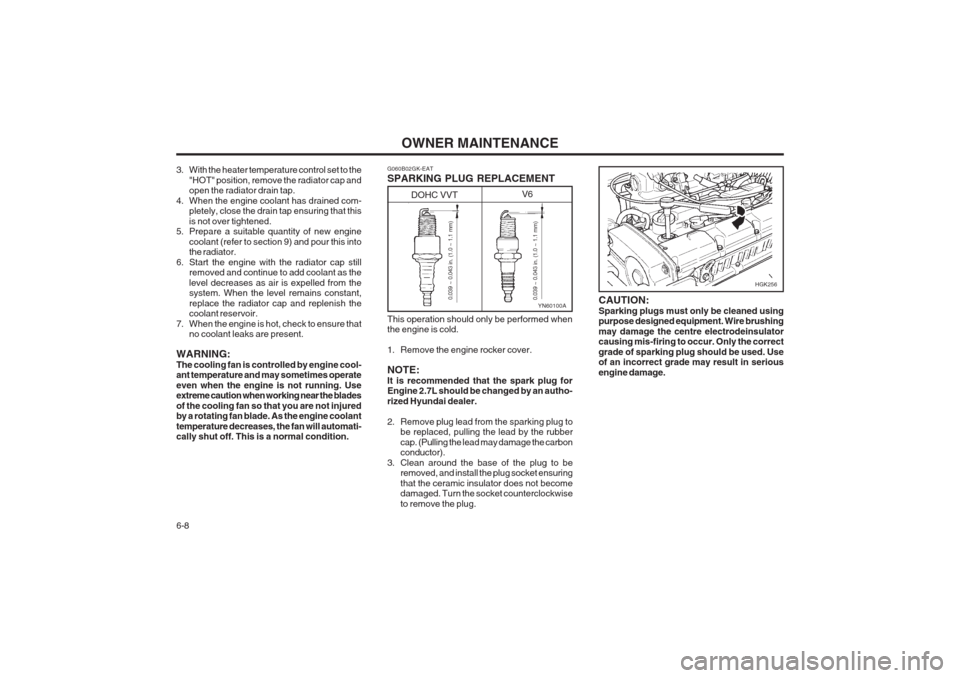
WARNING: The cooling fan is controlled by engine cool- ant temperature and may sometimes operate even when the engine is not running. Use extreme caution when working near the blades of the cooling fan so that you are not injured by a rotating fan blade. As the engine coolant temperature decreases, the fan will automati- cally shut off. This is a normal condition. G060B02GK-EAT SPARKING PLUG REPLACEMENT This operation should only be performed when the engine is cold.
1. Remove the engine rocker cover.NOTE: It is recommended that the spark plug for Engine 2.7L should be changed by an autho- rized Hyundai dealer.
2. Remove plug lead from the sparking plug to
be replaced, pulling the lead by the rubber cap. (Pulling the lead may damage the carbon conductor).
3. Clean around the base of the plug to be removed, and install the plug socket ensuring that the ceramic insulator does not become damaged. Turn the socket counterclockwise to remove the plug.
YN60100A0.039 ~ 0.043 in. (1.0 ~ 1.1 mm)
0.039 ~ 0.043 in. (1.0 ~ 1.1 mm)
DOHC VVT V6
HGK256
Page 115 of 140
OWNER MAINTENANCE
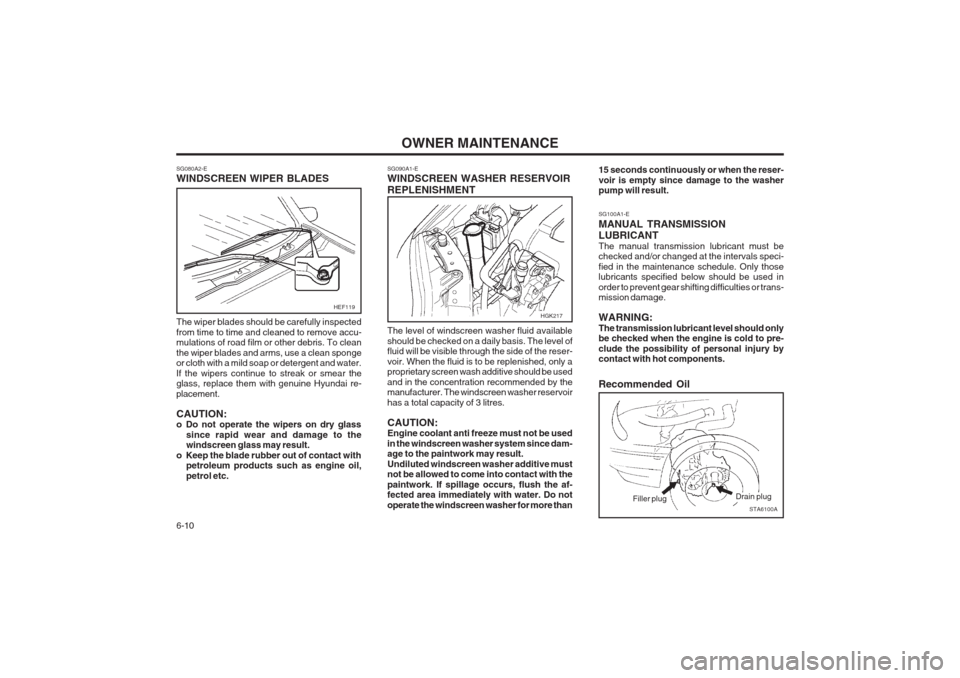
6-10 15 seconds continuously or when the reser- voir is empty since damage to the washer pump will result. SG100A1-E MANUAL TRANSMISSION LUBRICANT The manual transmission lubricant must be checked and/or changed at the intervals speci- fied in the maintenance schedule. Only those lubricants specified below should be used in order to prevent gear shifting difficulties or trans- mission damage. WARNING: The transmission lubricant level should only be checked when the engine is cold to pre- clude the possibility of personal injury by contact with hot components.
Filler plugDrain plug
STA6100A
Recommended Oil
SG080A2-E WINDSCREEN WIPER BLADES
SG090A1-EWINDSCREEN WASHER RESERVOIR REPLENISHMENT
The wiper blades should be carefully inspected from time to time and cleaned to remove accu- mulations of road film or other debris. To clean the wiper blades and arms, use a clean sponge or cloth with a mild soap or detergent and water. If the wipers continue to streak or smear the glass, replace them with genuine Hyundai re- placement. CAUTION:
o Do not operate the wipers on dry glass since rapid wear and damage to thewindscreen glass may result.
o Keep the blade rubber out of contact with petroleum products such as engine oil, petrol etc. The level of windscreen washer fluid availableshould be checked on a daily basis. The level of fluid will be visible through the side of the reser- voir. When the fluid is to be replenished, only a proprietary screen wash additive should be used and in the concentration recommended by the manufacturer. The windscreen washer reservoir has a total capacity of 3 litres. CAUTION: Engine coolant anti freeze must not be used in the windscreen washer system since dam- age to the paintwork may result. Undiluted windscreen washer additive must not be allowed to come into contact with the paintwork. If spillage occurs, flush the af- fected area immediately with water. Do not operate the windscreen washer for more than
HGK217HEF119
Page 117 of 140
OWNER MAINTENANCE
6-12 SG120A1-E BRAKE SYSTEM CHECKING CAUTION: Correct operation of the braking system is essential to the safe operation of the vehicle and therefore, any maintenance operations other than those listed below should be en- trusted to a Hyundai dealer. SG120C2-E Brake Fluid Recommendations Only brake fluid conforming to DOT 3 or DOT 4 specifications or higher may be used in the braking system. Care should be taken to ob- serve the instructions and precautions printed upon the container. SG120D1-E Brake Fluid LevelThe fluid level in the brake fluid reservoir should be checked periodically. The level should be between the "MIN" and "MAX" marks on the side of the reservoir. If the level is at or below the "MIN" mark, fluid should be added having care- fully cleaned the area surrounding the reservoir cap to ensure that dirt is not allowed to enter the system. It should be borne in mind that the brake fluid level will decrease slightly as the friction linings of the pads and shoes become worn and that this is a normal condition.
higher mark. If additional fluid is required, thisshould be poured into the transmission through the dipstick tube with the aid of a suitable funnel. WARNING: The cooling fan is controlled by engine cool- ant temperature and may sometimes operate even when the engine is not running. Use extreme caution when working near the blades of the cooling fan so that you are not injured by a rotating fan blade. As the engine coolant temperature decreases, the fan will automati- cally shut off. This is a normal condition.
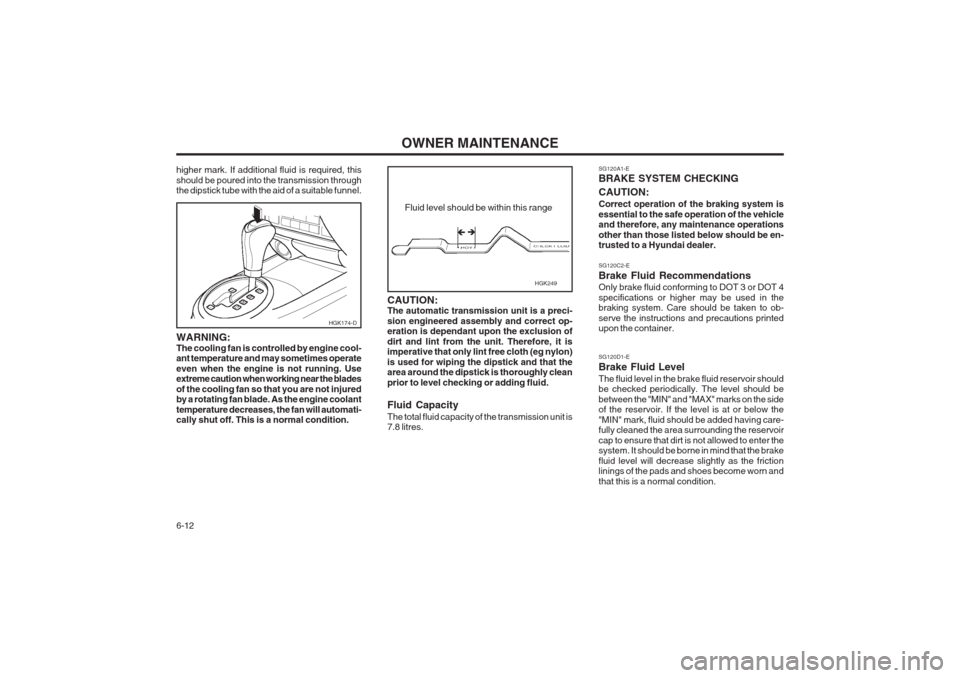
CAUTION:The automatic transmission unit is a preci- sion engineered assembly and correct op- eration is dependant upon the exclusion of dirt and lint from the unit. Therefore, it is imperative that only lint free cloth (eg nylon) is used for wiping the dipstick and that the area around the dipstick is thoroughly clean prior to level checking or adding fluid. Fluid Capacity The total fluid capacity of the transmission unit is 7.8 litres.
HGK174-D
Fluid level should be within this range
HGK249
ÎÎ
Page 122 of 140
OWNER MAINTENANCE 6-17
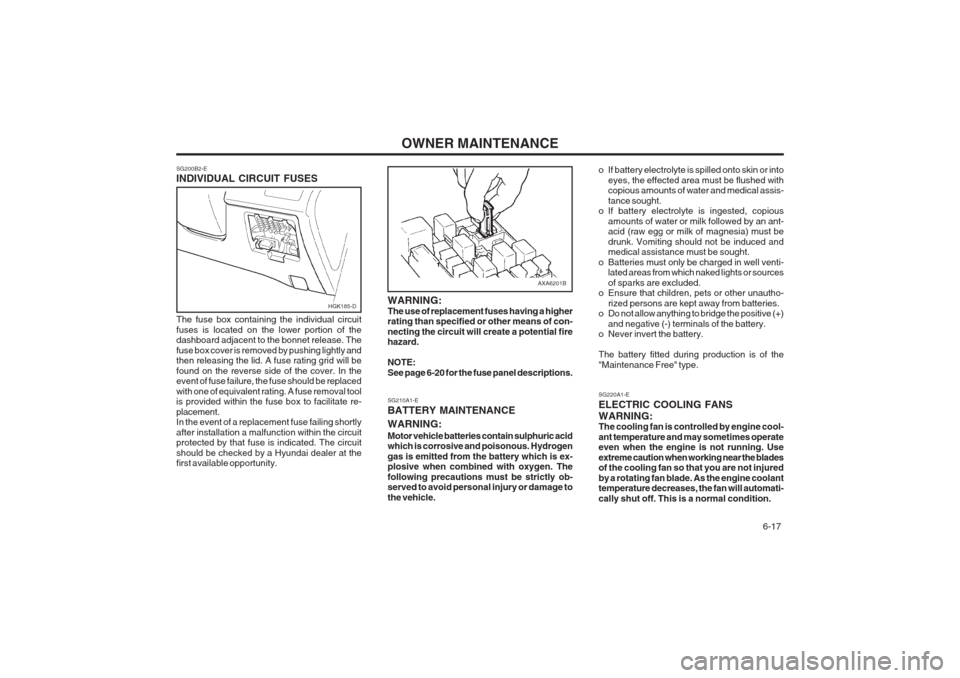
SG200B2-E INDIVIDUAL CIRCUIT FUSES The fuse box containing the individual circuit fuses is located on the lower portion of the dashboard adjacent to the bonnet release. The fuse box cover is removed by pushing lightly and then releasing the lid. A fuse rating grid will be found on the reverse side of the cover. In the event of fuse failure, the fuse should be replaced with one of equivalent rating. A fuse removal tool is provided within the fuse box to facilitate re- placement. In the event of a replacement fuse failing shortly after installation a malfunction within the circuit protected by that fuse is indicated. The circuit should be checked by a Hyundai dealer at the first available opportunity.
AXA6201B
WARNING: The use of replacement fuses having a higher rating than specified or other means of con- necting the circuit will create a potential fire hazard. NOTE: See page 6-20 for the fuse panel descriptions. SG210A1-E BATTERY MAINTENANCE WARNING: Motor vehicle batteries contain sulphuric acid which is corrosive and poisonous. Hydrogen gas is emitted from the battery which is ex- plosive when combined with oxygen. The following precautions must be strictly ob- served to avoid personal injury or damage to the vehicle.
HGK185-D
SG220A1-E ELECTRIC COOLING FANSWARNING: The cooling fan is controlled by engine cool- ant temperature and may sometimes operate even when the engine is not running. Use extreme caution when working near the blades of the cooling fan so that you are not injured by a rotating fan blade. As the engine coolant temperature decreases, the fan will automati- cally shut off. This is a normal condition.
o If battery electrolyte is spilled onto skin or into
eyes, the effected area must be flushed with copious amounts of water and medical assis- tance sought.
o If battery electrolyte is ingested, copious
amounts of water or milk followed by an ant- acid (raw egg or milk of magnesia) must be drunk. Vomiting should not be induced and medical assistance must be sought.
o Batteries must only be charged in well venti- lated areas from which naked lights or sources of sparks are excluded.
o Ensure that children, pets or other unautho-
rized persons are kept away from batteries.
o Do not allow anything to bridge the positive (+)
and negative (-) terminals of the battery.
o Never invert the battery. The battery fitted during production is of the "Maintenance Free" type.
Page 124 of 140
OWNER MAINTENANCE 6-19
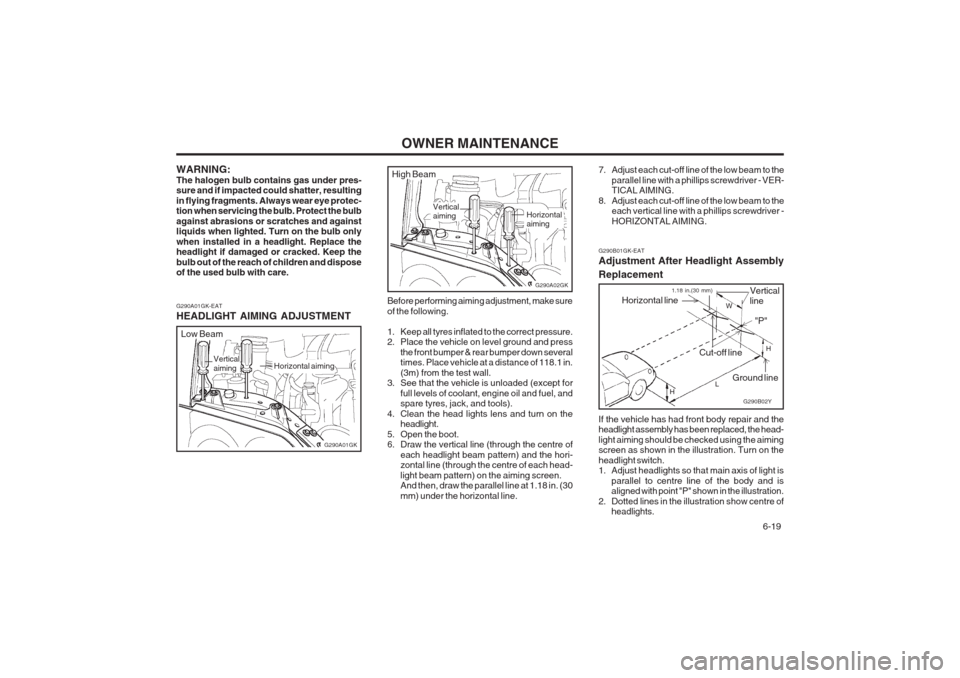
G290A01GK-EAT HEADLIGHT AIMING ADJUSTMENT
Before performing aiming adjustment, make sure of the following.
1. Keep all tyres inflated to the correct pressure.
2. Place the vehicle on level ground and press
the front bumper & rear bumper down severaltimes. Place vehicle at a distance of 118.1 in. (3m) from the test wall.
3. See that the vehicle is unloaded (except for
full levels of coolant, engine oil and fuel, and spare tyres, jack, and tools).
4. Clean the head lights lens and turn on the headlight.
5. Open the boot.
6. Draw the vertical line (through the centre of each headlight beam pattern) and the hori-zontal line (through the centre of each head- light beam pattern) on the aiming screen. And then, draw the parallel line at 1.18 in. (30 mm) under the horizontal line.
WARNING:The halogen bulb contains gas under pres- sure and if impacted could shatter, resulting in flying fragments. Always wear eye protec- tion when servicing the bulb. Protect the bulb against abrasions or scratches and against liquids when lighted. Turn on the bulb only when installed in a headlight. Replace the headlight if damaged or cracked. Keep the bulb out of the reach of children and dispose of the used bulb with care.
Vertical aiming
G290A01GK
Horizontal aiming
Low Beam
Vertical aiming
G290A02GK
Horizontal aiming
High Beam
7. Adjust each cut-off line of the low beam to the
parallel line with a phillips screwdriver - VER- TICAL AIMING.
8. Adjust each cut-off line of the low beam to the each vertical line with a phillips screwdriver - HORIZONTAL AIMING.
G290B01GK-EAT Adjustment After Headlight Assembly Replacement
G290B02Y
Vertical line
Cut-off line Ground line
Horizontal line
LW
H
H "P"1.18 in.(30 mm)
If the vehicle has had front body repair and the headlight assembly has been replaced, the head- light aiming should be checked using the aiming screen as shown in the illustration. Turn on the headlight switch.
1. Adjust headlights so that main axis of light is parallel to centre line of the body and isaligned with point "P" shown in the illustration.
2. Dotted lines in the illustration show centre of headlights.
Page 129 of 140
EMISSION CONTROL SYSTEM 7-1
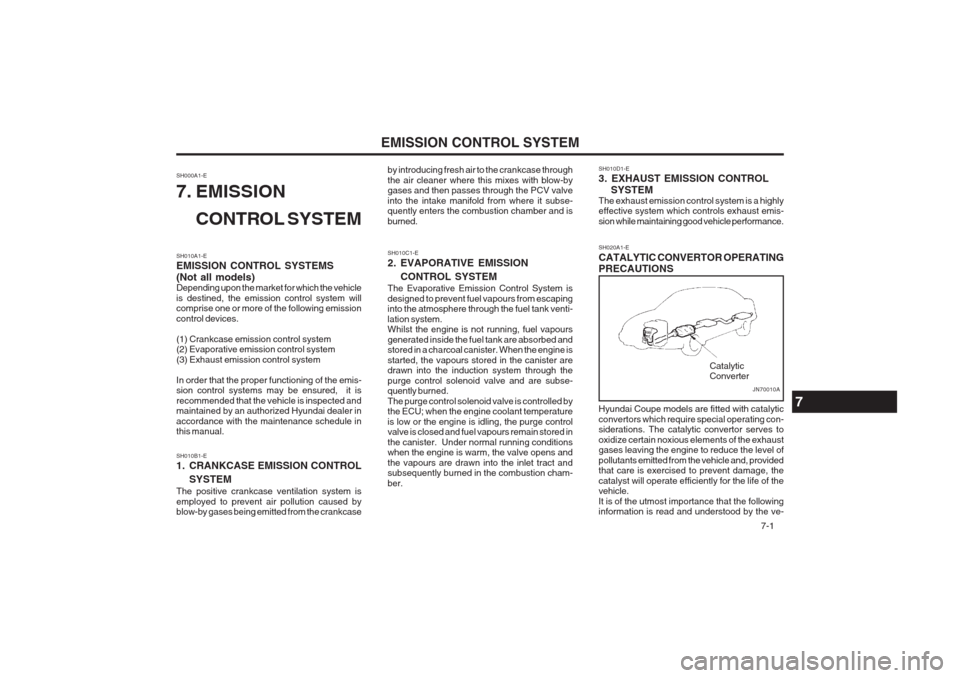
SH010A1-E EMISSION CONTROL SYSTEMS (Not all models) Depending upon the market for which the vehicle is destined, the emission control system will comprise one or more of the following emission control devices. (1) Crankcase emission control system (2) Evaporative emission control system (3) Exhaust emission control system In order that the proper functioning of the emis- sion control systems may be ensured, it is recommended that the vehicle is inspected and maintained by an authorized Hyundai dealer in accordance with the maintenance schedule in this manual.
SH000A1-E
7. EMISSION
CONTROL SYSTEM
SH010B1-E
1. CRANKCASE EMISSION CONTROL SYSTEM
The positive crankcase ventilation system is employed to prevent air pollution caused by blow-by gases being emitted from the crankcase by introducing fresh air to the crankcase through the air cleaner where this mixes with blow-by gases and then passes through the PCV valve into the intake manifold from where it subse- quently enters the combustion chamber and is burned.
SH010D1-E
3. EXHAUST EMISSION CONTROL SYSTEM The exhaust emission control system is a highly effective system which controls exhaust emis- sion while maintaining good vehicle performance.
SH010C1-E
2. EVAPORATIVE EMISSION CONTROL SYSTEM
The Evaporative Emission Control System is designed to prevent fuel vapours from escaping into the atmosphere through the fuel tank venti- lation system. Whilst the engine is not running, fuel vapours generated inside the fuel tank are absorbed and stored in a charcoal canister. When the engine is started, the vapours stored in the canister are drawn into the induction system through the purge control solenoid valve and are subse- quently burned. The purge control solenoid valve is controlled by the ECU; when the engine coolant temperature is low or the engine is idling, the purge control valve is closed and fuel vapours remain stored in the canister. Under normal running conditions when the engine is warm, the valve opens and the vapours are drawn into the inlet tract and subsequently burned in the combustion cham- ber. SH020A1-E CATALYTIC CONVERTOR OPERATING PRECAUTIONS
JN70010A
Catalytic Converter
Hyundai Coupe models are fitted with catalytic convertors which require special operating con- siderations. The catalytic convertor serves to oxidize certain noxious elements of the exhaust gases leaving the engine to reduce the level of pollutants emitted from the vehicle and, provided that care is exercised to prevent damage, the catalyst will operate efficiently for the life of the vehicle. It is of the utmost importance that the following information is read and understood by the ve-7
Page 136 of 140
VEHICLE SPECIFICATIONS 9-3
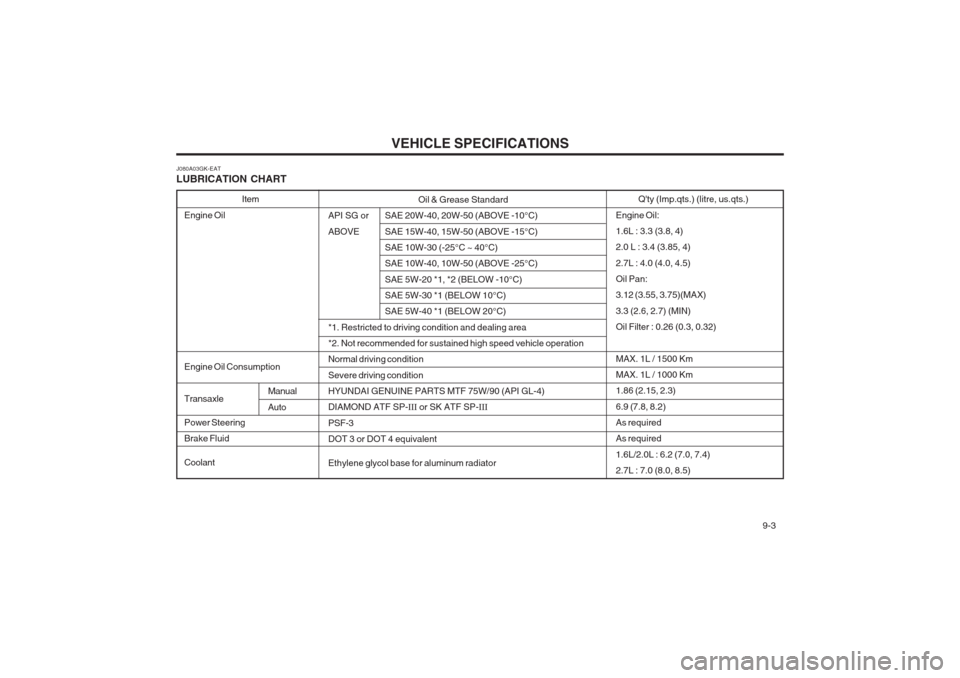
J080A03GK-EAT LUBRICATION CHART
Oil & Grease Standard
API SG or SAE 20W-40, 20W-50 (ABOVE -10°C)
ABOVE SAE 15W-40, 15W-50 (ABOVE -15°C)
SAE 10W-30 (-25°C ~ 40°C) SAE 10W-40, 10W-50 (ABOVE -25°C) SAE 5W-20 *1, *2 (BELOW -10°C) SAE 5W-30 *1 (BELOW 10°C)SAE 5W-40 *1 (BELOW 20°C)
*1. Restricted to driving condition and dealing area*2. Not recommended for sustained high speed vehicle operationNormal driving condition Severe driving condition HYUNDAI GENUINE PARTS MTF 75W/90 (API GL-4)DIAMOND ATF SP- III or SK ATF SP- III
PSF-3DOT 3 or DOT 4 equivalent Ethylene glycol base for aluminum radiator
Item
Engine Oil Engine Oil Consumption Transaxle Power Steering Brake Fluid CoolantQ'ty (Imp.qts.) (litre, us.qts.)
Engine Oil: 1.6L : 3.3 (3.8, 4)2.0 L : 3.4 (3.85, 4) 2.7L : 4.0 (4.0, 4.5) Oil Pan:3.12 (3.55, 3.75)(MAX) 3.3 (2.6, 2.7) (MIN) Oil Filter : 0.26 (0.3, 0.32) MAX. 1L / 1500 Km MAX. 1L / 1000 Km1.86 (2.15, 2.3)
6.9 (7.8, 8.2) As requiredAs required 1.6L/2.0L : 6.2 (7.0, 7.4) 2.7L : 7.0 (8.0, 8.5)
Manual Auto
Page 138 of 140
INDEX
10-2
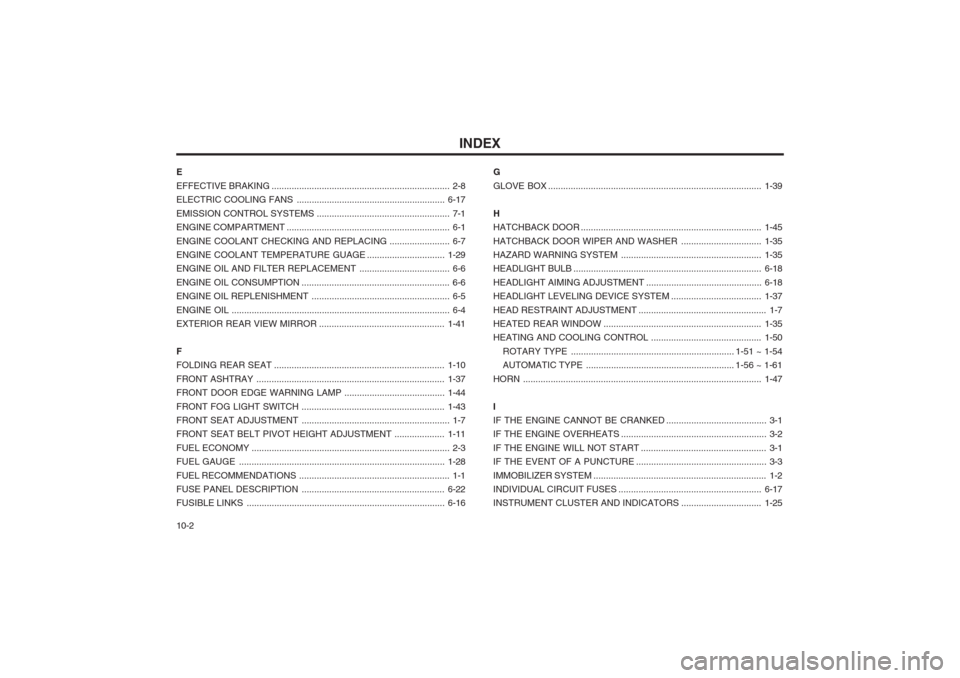
E EFFECTIVE BRAKING
....................................................................... 2-8
ELECTRIC COOLING FANS ........................................................... 6-17
EMISSION CONTROL SYSTEMS ..................................................... 7-1
ENGINE COMPARTMENT ................................................................. 6-1
ENGINE COOLANT CHECKING AND REPLACI NG ........................ 6-7
ENGINE COOLANT TEMPERATURE GUAGE ...............................1-29
ENGINE OIL AND FILTER REPLACEMENT .................................... 6-6
ENGINE OIL CO NSUMPTION ........................................................... 6-6
ENGINE OIL REPLENISHMENT ............ ........................................... 6-5
ENGINE OIL ....................................................................................... 6-4
EXTERIOR REAR VIEW MIRROR .................................................. 1-41
F
FOLDING REAR SEAT .................................................................... 1-10
FRONT ASHTRAY ........ ................................................................... 1-37
FRONT DOOR EDGE WARNING LAMP ........................................1-44
FRONT FOG LIGHT SWITCH ......................................................... 1-43
FRONT SEAT ADJUSTMENT ........................................................... 1-7
FRONT SEAT BELT PIVOT HEIGHT ADJUSTMENT ....................1-11
FUEL ECONOMY ............................................................................... 2-3
FUEL GAUGE .................................................................................. 1-28
FUEL RECOMMENDATIONS ........... ................................................. 1-1
FUSE PANEL DESCRIPTION ......................................................... 6-22
FUSIBLE LINKS ............................................................................... 6-16G
GLOVE BOX .....................................................................................
1-39
H HATCHBACK DOOR ........................................................................ 1-45
HATCHBACK DOOR WIPER AND WA SHER ................................1-35
HAZARD WARNING SYSTEM ........................................................ 1-35
HEADLIGHT BULB ........................................................................... 6-18
HEADLIGHT AIMING ADJUSTMENT ..............................................6-18
HEADLIGHT LEVELING DEVICE SYSTEM ....................................1-37
HEAD RESTRAINT ADJUSTMENT ................................................... 1-7
HEATED REAR WINDOW ............................................................... 1-35
HEATING AND COO LING CONTROL ............................................ 1-50
ROTARY TYPE ................................................................. 1-51 ~ 1-54
AUTOMATIC TYPE ........................................................... 1-56 ~ 1-61
HORN ............................................................................................... 1-47
IIF THE ENGINE CANNOT BE CRANKED ........................................ 3-1
IF THE ENGINE OVERHEATS .......................................................... 3-2
IF THE ENGINE WILL NOT START .................................................. 3-1
IF THE EVENT OF A PUNCTURE .................................................... 3-3
IMMOBILIZER SYSTEM ..................................................................... 1-2
INDIVIDUAL CIRCUIT FUSES ......................................................... 6-17
INSTRUMENT CLUSTER AND INDICATORS ................................1-25