warning Hyundai Coupe 2002 User Guide
[x] Cancel search | Manufacturer: HYUNDAI, Model Year: 2002, Model line: Coupe, Model: Hyundai Coupe 2002Pages: 140, PDF Size: 1.45 MB
Page 24 of 140
CONTROLS AND EQUIPMENT
1- 16
NOTE: At present, this seat is the only one comply- ing with that provision. In case that other manufacturers will furnish proof of a respec- tive certification, Hyundai is going to evalu- ate this seat carefully and will give a recom- mendation provided that seat complies to the law. Please ask your Hyundai dealer in this respect.
B230D02GK
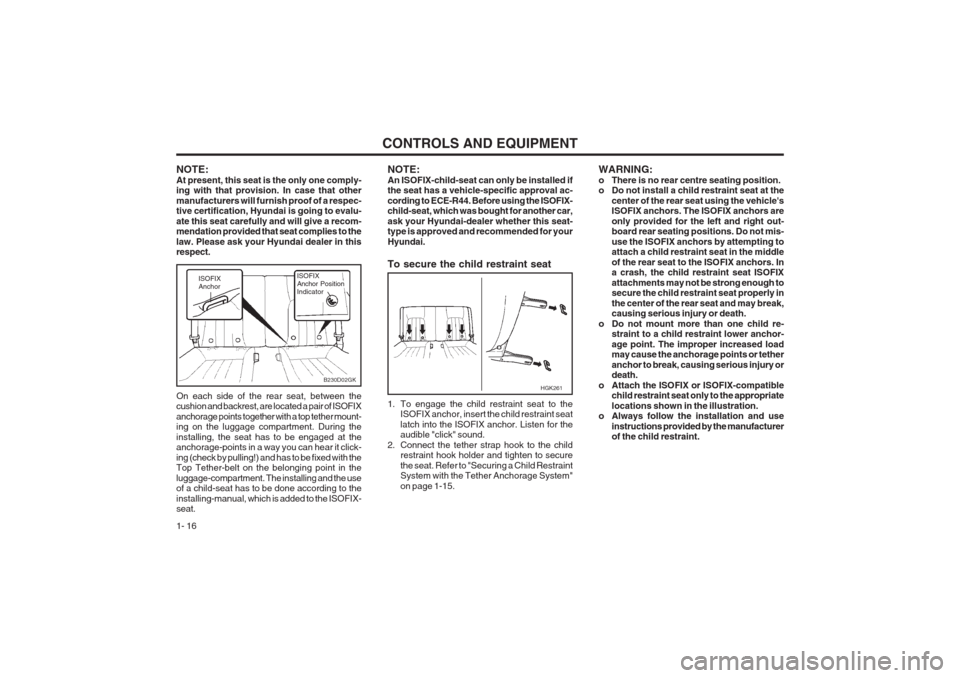
ISOFIX AnchorISOFIX Anchor
Position
Indicator
On each side of the rear seat, between the cushion and backrest, are located a pair of ISOFIX anchorage points together with a top tether mount- ing on the luggage compartment. During the installing, the seat has to be engaged at the anchorage-points in a way you can hear it click- ing (check by pulling!) and has to be fixed with the Top Tether-belt on the belonging point in the luggage-compartment. The installing and the use of a child-seat has to be done according to the installing-manual, which is added to the ISOFIX- seat. NOTE: An ISOFIX-child-seat can only be installed if the seat has a vehicle-specific approval ac- cording to ECE-R44. Before using the ISOFIX- child-seat, which was bought for another car, ask your Hyundai-dealer whether this seat- type is approved and recommended for your Hyundai. To secure the child restraint seat
1. To engage the child restraint seat to the
ISOFIX anchor, insert the child restraint seat latch into the ISOFIX anchor. Listen for the audible "click" sound.
2. Connect the tether strap hook to the child restraint hook holder and tighten to secure the seat. Refer to "Securing a Child Restraint System with the Tether Anchorage System" on page 1-15.
HGK261 WARNING:
o There is no rear centre seating position.
o Do not install a child restraint seat at the
center of the rear seat using the vehicle'sISOFIX anchors. The ISOFIX anchors are only provided for the left and right out- board rear seating positions. Do not mis- use the ISOFIX anchors by attempting to attach a child restraint seat in the middle of the rear seat to the ISOFIX anchors. In a crash, the child restraint seat ISOFIX attachments may not be strong enough to secure the child restraint seat properly in the center of the rear seat and may break, causing serious injury or death.
o Do not mount more than one child re- straint to a child restraint lower anchor- age point. The improper increased load may cause the anchorage points or tether anchor to break, causing serious injury or death.
o Attach the ISOFIX or ISOFIX-compatible child restraint seat only to the appropriate locations shown in the illustration.
o Always follow the installation and use
instructions provided by the manufacturer of the child restraint.
Page 25 of 140
CONTROLS AND EQUIPMENT1- 17
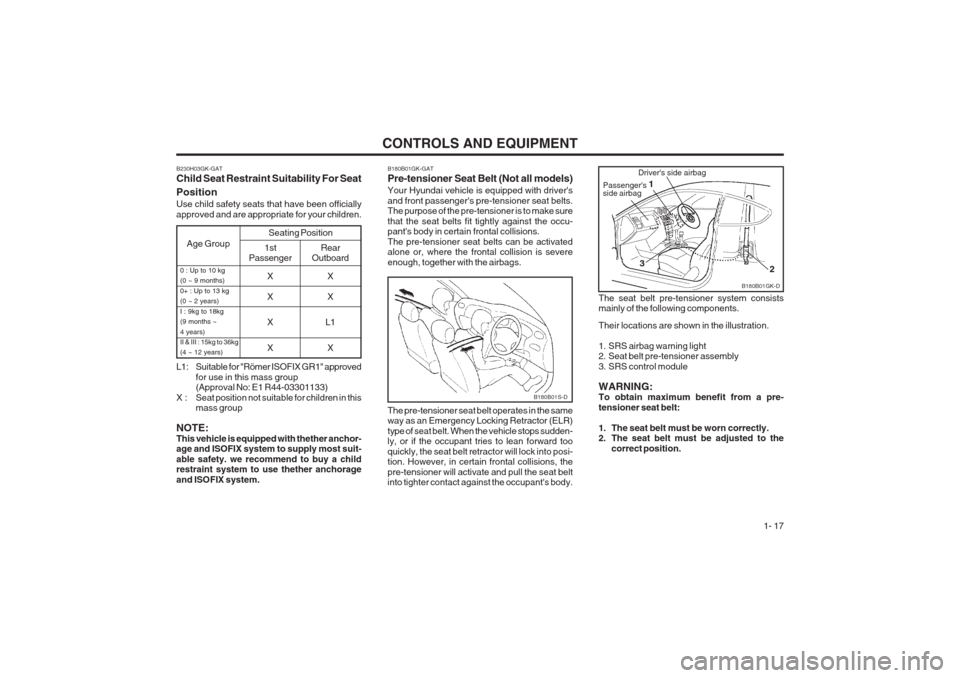
B180B01GK-GAT Pre-tensioner Seat Belt (Not all models) Your Hyundai vehicle is equipped with driver's and front passenger's pre-tensioner seat belts. The purpose of the pre-tensioner is to make sure that the seat belts fit tightly against the occu- pant's body in certain frontal collisions. The pre-tensioner seat belts can be activated alone or, where the frontal collision is severe enough, together with the airbags. The pre-tensioner seat belt operates in the same way as an Emergency Locking Retractor (ELR) type of seat belt. When the vehicle stops sudden- ly, or if the occupant tries to lean forward too quickly, the seat belt retractor will lock into posi- tion. However, in certain frontal collisions, the pre-tensioner will activate and pull the seat belt into tighter contact against the occupant's body.
B180B01S-D
B230H03GK-GAT Child Seat Restraint Suitability For Seat Position Use child safety seats that have been officially approved and are appropriate for your children.
Age Group
Seating Position1st
Passenger Rear
Outboard
0 : Up to 10 kg (0 ~ 9 months) 0+ : Up to 13 kg (0 ~ 2 years) I : 9kg to 18kg (9 months ~ 4 years) II & III : 15kg to 36kg(4 ~ 12 years)X X
L1
X
L1: Suitable for "Römer ISOFIX GR1" approved for use in this mass group (Approval No: E1 R44-03301133)
X : Seat position not suitable for children in this mass group
NOTE: This vehicle is equipped with thether anchor- age and ISOFIX system to supply most suit- able safety. we recommend to buy a child restraint system to use thether anchorage and ISOFIX system. X X X X
The seat belt pre-tensioner system consists mainly of the following components. Their locations are shown in the illustration.
1. SRS airbag warning light
2. Seat belt pre-tensioner assembly
3. SRS control module WARNING: To obtain maximum benefit from a pre- tensioner seat belt:
1. The seat belt must be worn correctly.
2. The seat belt must be adjusted to the
correct position.B180B01GK-D
Driver's side airbag
1
2
3Passenger's side airbag
Page 26 of 140
CONTROLS AND EQUIPMENT
1- 18
B240A01GK
Driver's Side Airbag
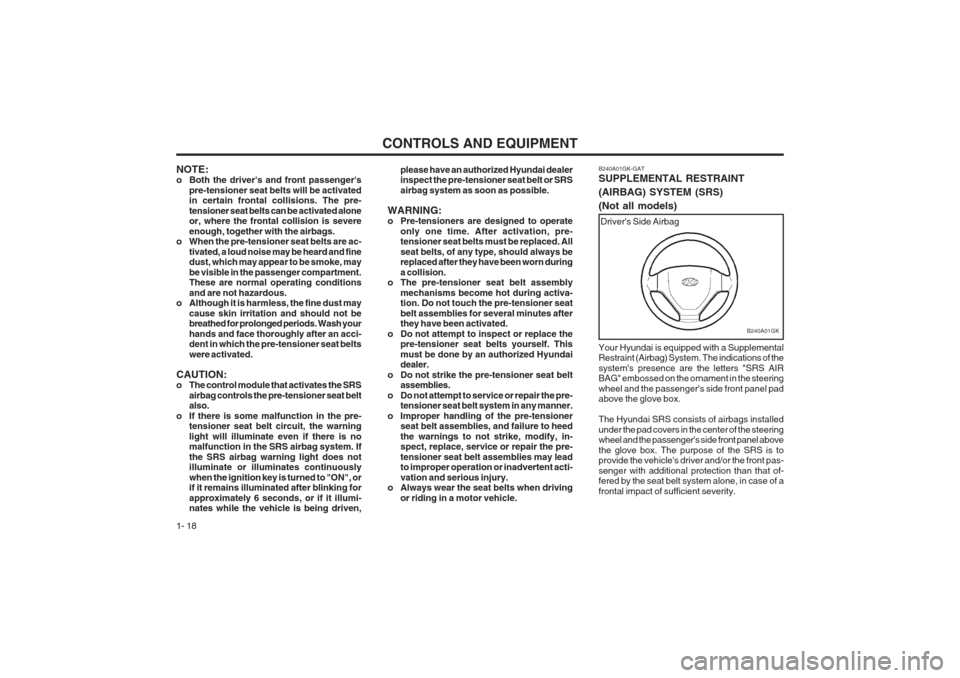
B240A01GK-GAT SUPPLEMENTAL RESTRAINT (AIRBAG) SYSTEM (SRS)(Not all models) Your Hyundai is equipped with a Supplemental Restraint (Airbag) System. The indications of the system's presence are the letters "SRS AIR BAG" embossed on the ornament in the steering wheel and the passenger's side front panel pad above the glove box. The Hyundai SRS consists of airbags installed under the pad covers in the center of the steering wheel and the passenger's side front panel above the glove box. The purpose of the SRS is to provide the vehicle's driver and/or the front pas- senger with additional protection than that of- fered by the seat belt system alone, in case of a frontal impact of sufficient severity.
NOTE:
o Both the driver's and front passenger's
pre-tensioner seat belts will be activatedin certain frontal collisions. The pre- tensioner seat belts can be activated alone or, where the frontal collision is severe enough, together with the airbags.
o When the pre-tensioner seat belts are ac-
tivated, a loud noise may be heard and fine dust, which may appear to be smoke, may be visible in the passenger compartment. These are normal operating conditions and are not hazardous.
o Although it is harmless, the fine dust may
cause skin irritation and should not be breathed for prolonged periods. Wash your hands and face thoroughly after an acci- dent in which the pre-tensioner seat belts were activated.
CAUTION:
o The control module that activates the SRS airbag controls the pre-tensioner seat beltalso.
o If there is some malfunction in the pre- tensioner seat belt circuit, the warning light will illuminate even if there is no malfunction in the SRS airbag system. If the SRS airbag warning light does not illuminate or illuminates continuously when the ignition key is turned to "ON", or if it remains illuminated after blinking for approximately 6 seconds, or if it illumi- nates while the vehicle is being driven, please have an authorized Hyundai dealerinspect the pre-tensioner seat belt or SRS airbag system as soon as possible.
WARNING:
o Pre-tensioners are designed to operate only one time. After activation, pre-tensioner seat belts must be replaced. All seat belts, of any type, should always be replaced after they have been worn during a collision.
o The pre-tensioner seat belt assembly
mechanisms become hot during activa- tion. Do not touch the pre-tensioner seat belt assemblies for several minutes after they have been activated.
o Do not attempt to inspect or replace the pre-tensioner seat belts yourself. This must be done by an authorized Hyundai dealer.
o Do not strike the pre-tensioner seat belt assemblies.
o Do not attempt to service or repair the pre- tensioner seat belt system in any manner.
o Improper handling of the pre-tensioner seat belt assemblies, and failure to heed the warnings to not strike, modify, in- spect, replace, service or repair the pre- tensioner seat belt assemblies may lead to improper operation or inadvertent acti- vation and serious injury.
o Always wear the seat belts when driving
or riding in a motor vehicle.
Page 27 of 140
CONTROLS AND EQUIPMENT1- 19
o The driver should sit back as far as pos-sible while still maintaining control of the vehicle. If you are sitting too close to the airbag, it can cause death or serious injury when it inflates.
o No objects should be placed over or near
the airbag modules on the steering wheel, instrument panel, and the front passenger's panel above the glove box, because any such object could cause harm if the vehicle is in a crash severe enough to cause the airbags to inflate.
o If the airbags inflate, they must be re- placed by an authorized Hyundai dealer.
o Do not tamper with or disconnect SRS wiring, or other components of the SRS system. Doing so could result in injury, due to accidental firing of the airbags or by rendering the SRS inoperative.
B240A02GK
Rear impact
Side Impact Rollover
NOTE: Be sure to read information about the SRS on the labels provided on the backside of the sun visor and in the glove box. WARNING:
o As its name implies, the SRS is designed
to work with, and be supplemental to, thedriver's and the passenger's three point seat belt systems and is not a substitute for them. Therefore your seat belts must be worn at all times while the vehicle is in motion. In addition, the airbags deploy only in certain frontal impact conditions severe enough to cause significant injury to the vehicle occupants.
o The SRS is designed to deploy the airbags
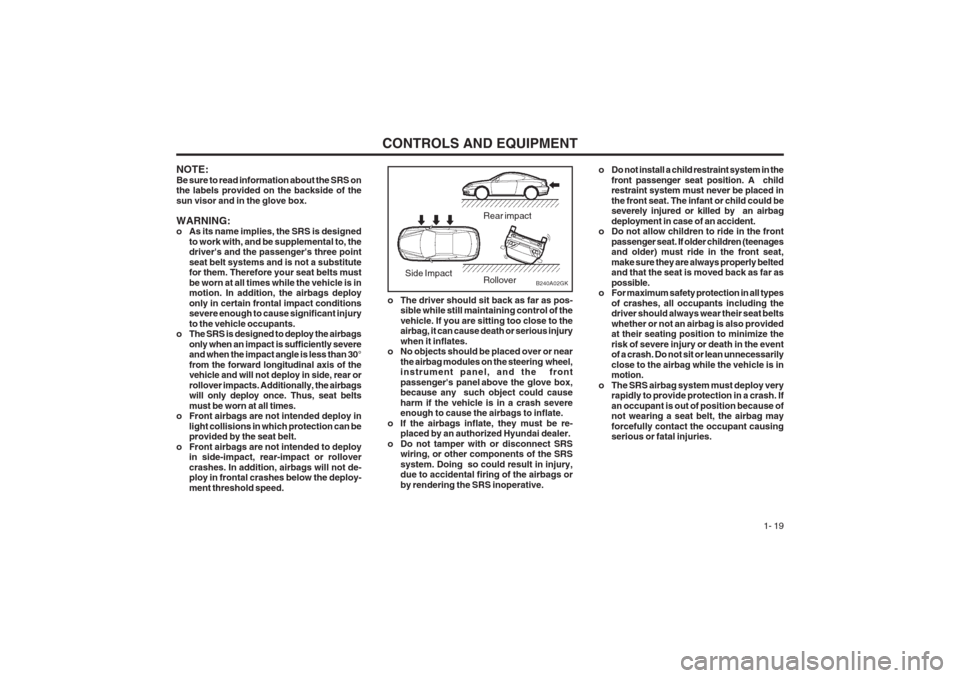
only when an impact is sufficiently severe and when the impact angle is less than 30° from the forward longitudinal axis of the vehicle and will not deploy in side, rear or rollover impacts. Additionally, the airbags will only deploy once. Thus, seat belts must be worn at all times.
o Front airbags are not intended deploy in
light collisions in which protection can be provided by the seat belt.
o Front airbags are not intended to deploy in side-impact, rear-impact or rollover crashes. In addition, airbags will not de- ploy in frontal crashes below the deploy- ment threshold speed. o Do not install a child restraint system in the
front passenger seat position. A child restraint system must never be placed in the front seat. The infant or child could be severely injured or killed by an airbag deployment in case of an accident.
o Do not allow children to ride in the front
passenger seat. If older children (teenages and older) must ride in the front seat, make sure they are always properly belted and that the seat is moved back as far as possible.
o For maximum safety protection in all types
of crashes, all occupants including the driver should always wear their seat belts whether or not an airbag is also provided at their seating position to minimize the risk of severe injury or death in the event of a crash. Do not sit or lean unnecessarily close to the airbag while the vehicle is in motion.
o The SRS airbag system must deploy very rapidly to provide protection in a crash. If an occupant is out of position because of not wearing a seat belt, the airbag may forcefully contact the occupant causing serious or fatal injuries.
Page 29 of 140
CONTROLS AND EQUIPMENT1- 21
WARNING:
o When the SRS is activated, there may be aloud noise and fine dust will be releasedthroughout the vehicle. These conditions are normal and are not hazardous. How- ever, the fine dust generated during airbag deployment may cause skin irritation. Be sure to wash your hands and face thor- oughly with lukewarm water and a mild soap after an accident in which the airbags were deployed.
o The SRS can function only when the igni-
tion key is in the "ON" position. If the SRS SRI does not come on or illuminates continuously when the ignition key is turned to "ON", or continuously remains on after flashing for about 6 seconds when the ignition key is turned to the "ON" position, or after the engine is started, or comes on while driving, the SRS is not working properly. If this occurs, have your vehicle immediately inspected by your Hyundai dealer.
o Before you replace a fuse or disconnect a
battery terminal, turn the ignition key to the "LOCK" position or remove the igni- tion key. Never remove or replace the air bag related fuse(s) when the ignition key is in the "ON" position. Failure to heed this warning will cause the SRS SRI to illumi- nate.
FUD1115A
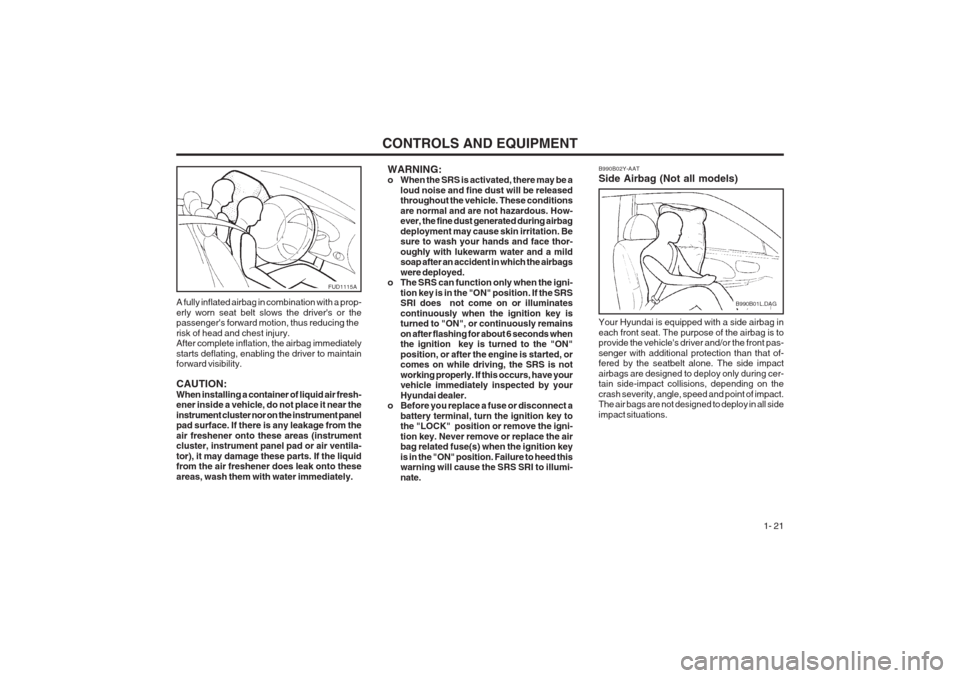
A fully inflated airbag in combination with a prop- erly worn seat belt slows the driver's or the passenger's forward motion, thus reducing the risk of head and chest injury. After complete inflation, the airbag immediately starts deflating, enabling the driver to maintain forward visibility. CAUTION: When installing a container of liquid air fresh- ener inside a vehicle, do not place it near the instrument cluster nor on the instrument panel pad surface. If there is any leakage from the air freshener onto these areas (instrument cluster, instrument panel pad or air ventila- tor), it may damage these parts. If the liquid from the air freshener does leak onto these areas, wash them with water immediately. Your Hyundai is equipped with a side airbag ineach front seat. The purpose of the airbag is to provide the vehicle's driver and/or the front pas- senger with additional protection than that of- fered by the seatbelt alone. The side impact airbags are designed to deploy only during cer- tain side-impact collisions, depending on the crash severity, angle, speed and point of impact. The air bags are not designed to deploy in all side impact situations.
B990B02Y-AAT Side Airbag (Not all models)
B990B01L.DAG
Page 30 of 140
CONTROLS AND EQUIPMENT
1- 22 WARNING:
o Extreme Hazard! Do not use a rearward
facing child restraint on a seat protectedby an airbag in front of it!
o Modification to SRS components or wir-ing,
including the addition of any kind of badges to the pad cover or modifications to the body structure, can adversely affect SRS performance and lead to possible injury.
o For cleaning the horn pad, use only a soft, dry cloth or one which has been moist- ened with plain water. Solvents or clean- ers could adversely affect the airbag cover and proper deployment of the system.
o No objects should be placed over or near
the airbag module on the steering wheel, because any such object could cause harm if the vehicle is in a crash severe enough to cause the airbag to inflate.
o If the airbag inflates, it must be replaced by an authorized Hyundai dealer.
o Do not tamper with or disconnect SRS wiring, or other components of the SRS system. Doing so could result in injury, due to accidental firing of the airbag or by rendering the SRS inoperative.
o If components of the airbag system must
be discarded, or if the vehicle must be scrapped, certain safety precautions must be observed. Your Hyundai dealer knows these precautions and can give you the necessary information. Failure to follow these precautions and procedures could increase the risk of personal injury.
WARNING:
o For best protection from the side airbag
system and to avoid being injured by thedeploying side airbag, both front seat oc- cupants should sit in an upright position with the seat belt properly fastened. The driver's hands should be placed on the steering wheel at the 9:00 and 3:00 o'clock positions. The passenger's arms and hands should be placed in their laps.
o Do not use any accessory seat covers.
o Use of seat covers could prevent or re- duce the effectiveness of the system.
o Do not install any accessories on the side or near the side airbag.
o Do not use excessive force on the side of the seat.
o Do not place any objects over the airbag or between the airbag and yourself.
o Do not place any objects (an umbrella, bag, etc.) between the front door and thefront seat. Such objects may become dan- gerous projectiles and cause injury if the supplemental side air bag inflates.
o To prevent unexpected deployment of the
side air bag that may result in personal injury,avoid impact to the side airbag sen- sor when the ignition key is on. FB110C2-F SRS Care
YT10355A
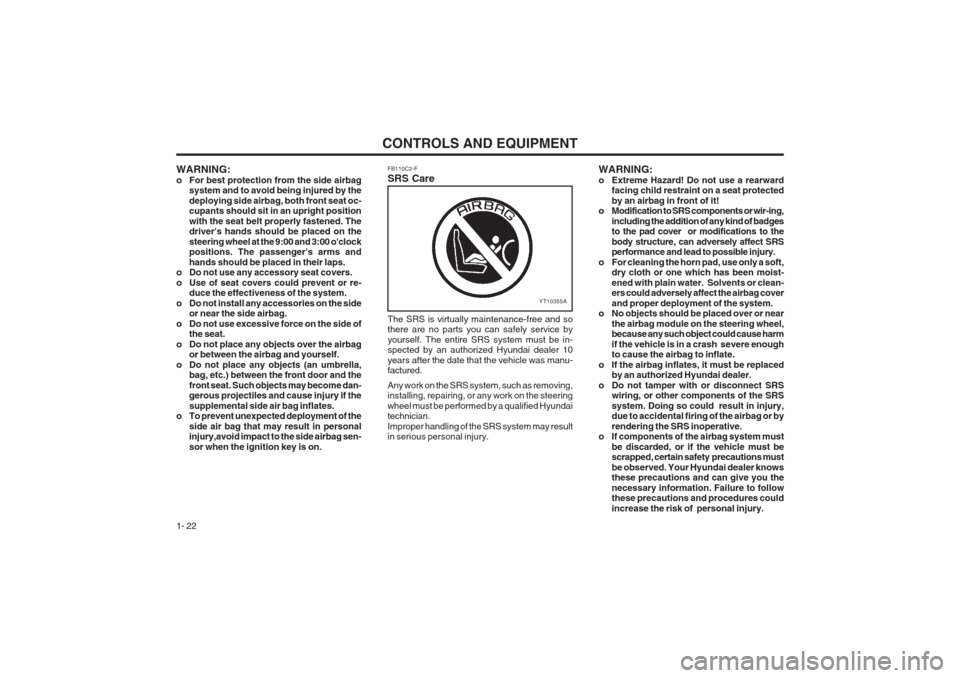
The SRS is virtually maintenance-free and so there are no parts you can safely service by yourself. The entire SRS system must be in- spected by an authorized Hyundai dealer 10 years after the date that the vehicle was manu- factured. Any work on the SRS system, such as removing, installing, repairing, or any work on the steering wheel must be performed by a qualified Hyundai technician. Improper handling of the SRS system may result in serious personal injury.
Page 32 of 140
CONTROLS AND EQUIPMENT
1- 24 8
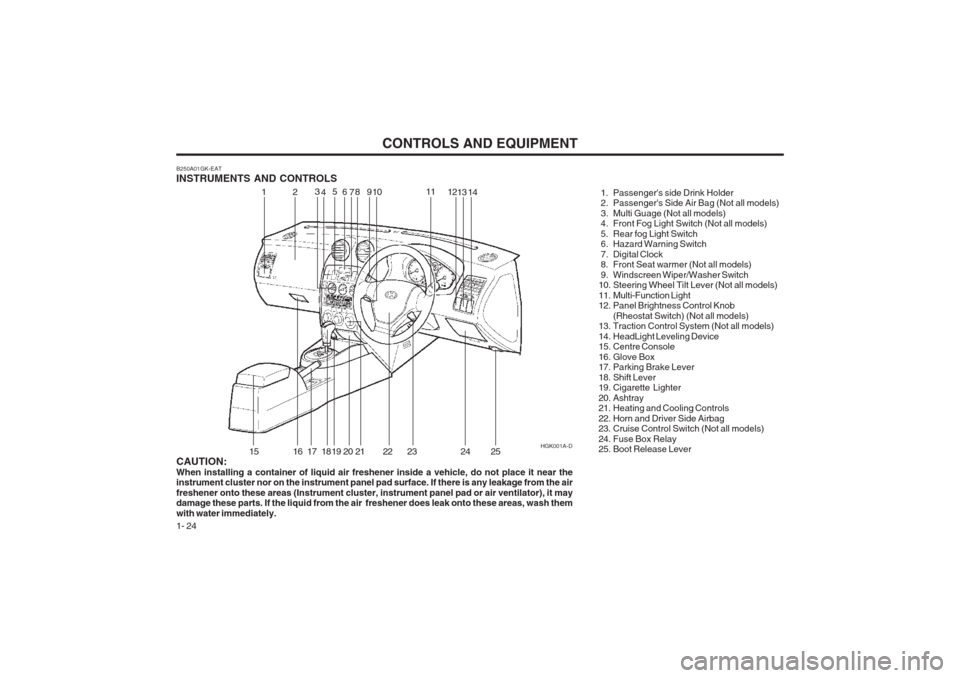
B250A01GK-EAT INSTRUMENTS AND CONTROLS
1. Passenger's side Drink Holder
2. Passenger's Side Air Bag (Not all models)
3. Multi Guage (Not all models)
4. Front Fog Light Switch (Not all models)
5. Rear fog Light Switch
6. Hazard Warning Switch
7. Digital Clock
8. Front Seat warmer (Not all models)
9. Windscreen Wiper/Washer Switch
10. Steering Wheel Tilt Lever (Not all models)
11. Multi-Function Light
12. Panel Brightness Control Knob(Rheostat Switch) (Not all models)
13. Traction Control System (Not all models)
14. HeadLight Leveling Device
15. Centre Console
16. Glove Box
17. Parking Brake Lever
18. Shift Lever
19. Cigarette Lighter
20. Ashtray
21. Heating and Cooling Controls
22. Horn and Driver Side Airbag
23. Cruise Control Switch (Not all models)
24. Fuse Box Relay
25. Boot Release Lever
CAUTION: When installing a container of liquid air freshener inside a vehicle, do not place it near the instrument cluster nor on the instrument panel pad surface. If there is any leakage from the air freshener onto these areas (Instrument cluster, instrument panel pad or air ventilator), it may damage these parts. If the liquid from the air freshener does leak onto these areas, wash them with water immediately. HGK001A-D
12
3
4 5
69 10 11
1213
15
16 17 18 19 20 21 22 23 24
714
25
Page 33 of 140
CONTROLS AND EQUIPMENT1- 25
HGK026B
1
234 5 67 8
910 1112 13 14
151617 18 1920 21
2
2223
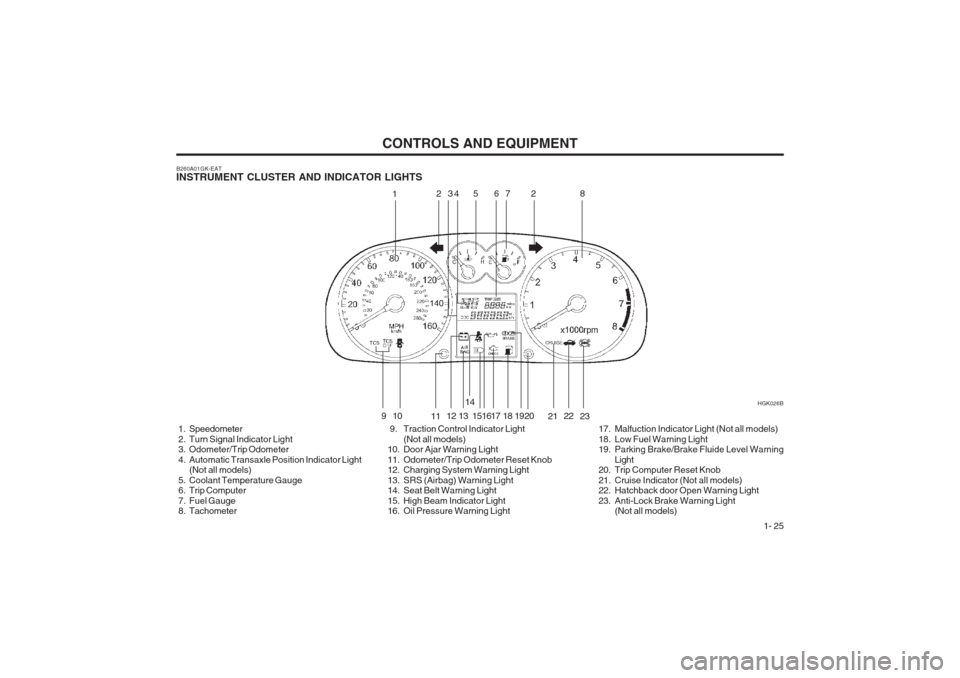
B260A01GK-EAT INSTRUMENT CLUSTER AND INDICATOR LIGHTS
1. Speedometer
2. Turn Signal Indicator Light
3. Odometer/Trip Odometer
4. Automatic Transaxle Position Indicator Light (Not all models)
5. Coolant Temperature Gauge
6. Trip Computer
7. Fuel Gauge
8. Tachometer 9. Traction Control Indicator Light
(Not all models)
10. Door Ajar Warning Light
11. Odometer/Trip Odometer Reset Knob
12. Charging System Warning Light
13. SRS (Airbag) Warning Light
14. Seat Belt Warning Light
15. High Beam Indicator Light
16. Oil Pressure Warning Light 17. Malfuction Indicator Light (Not all models)
18. Low Fuel Warning Light
19. Parking Brake/Brake Fluide Level Warning
Light
20. Trip Computer Reset Knob
21. Cruise Indicator (Not all models)
22. Hatchback door Open Warning Light
23. Anti-Lock Brake Warning Light (Not all models)
Page 34 of 140
CONTROLS AND EQUIPMENT
1- 26 SB210K1-E
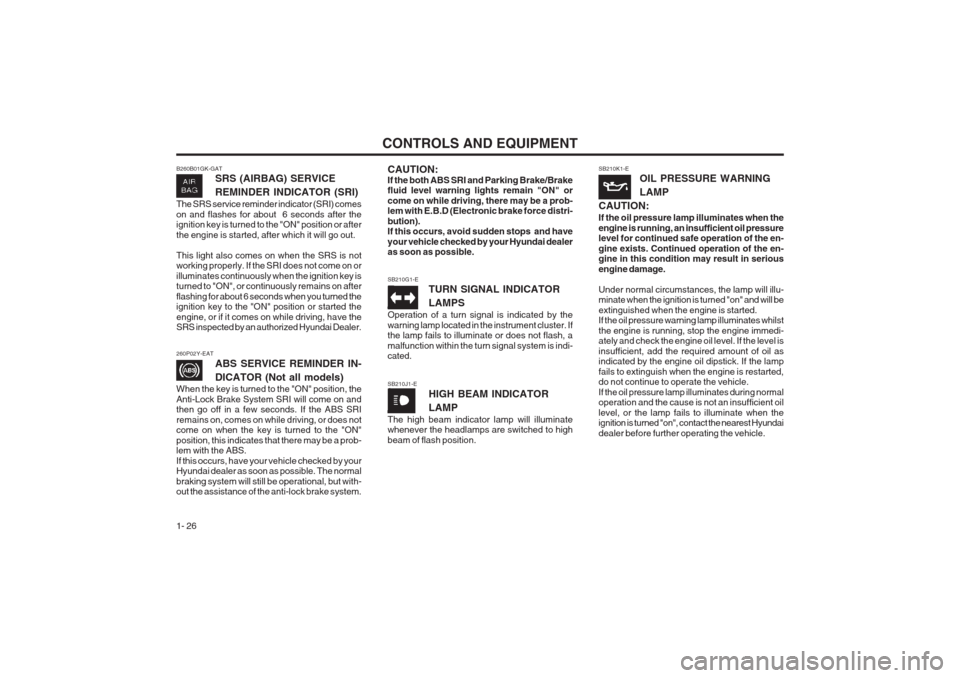
OIL PRESSURE WARNING LAMP
CAUTION: If the oil pressure lamp illuminates when the engine is running, an insufficient oil pressure level for continued safe operation of the en- gine exists. Continued operation of the en- gine in this condition may result in serious engine damage. Under normal circumstances, the lamp will illu- minate when the ignition is turned "on" and will be extinguished when the engine is started. If the oil pressure warning lamp illuminates whilst the engine is running, stop the engine immedi- ately and check the engine oil level. If the level is insufficient, add the required amount of oil as indicated by the engine oil dipstick. If the lamp fails to extinguish when the engine is restarted, do not continue to operate the vehicle. If the oil pressure lamp illuminates during normal operation and the cause is not an insufficient oil level, or the lamp fails to illuminate when the ignition is turned "on", contact the nearest Hyundai dealer before further operating the vehicle.
SB210G1-E TURN SIGNAL INDICATOR LAMPS
Operation of a turn signal is indicated by the warning lamp located in the instrument cluster. If the lamp fails to illuminate or does not flash, a malfunction within the turn signal system is indi- cated.
SB210J1-E HIGH BEAM INDICATOR LAMP
The high beam indicator lamp will illuminate whenever the headlamps are switched to high beam of flash position.
260P02Y-EAT
ABS SERVICE REMINDER IN-
DICATOR (Not all models)
When the key is turned to the "ON" position, the Anti-Lock Brake System SRI will come on and then go off in a few seconds. If the ABS SRI remains on, comes on while driving, or does not come on when the key is turned to the "ON" position, this indicates that there may be a prob- lem with the ABS. If this occurs, have your vehicle checked by your Hyundai dealer as soon as possible. The normal braking system will still be operational, but with- out the assistance of the anti-lock brake system. CAUTION: If the both ABS SRI and Parking Brake/Brake fluid level warning lights remain "ON" or come on while driving, there may be a prob- lem with E.B.D (Electronic brake force distri- bution). If this occurs, avoid sudden stops and have your vehicle checked by your Hyundai dealer as soon as possible.
B260B01GK-GAT
SRS (AIRBAG) SERVICE REMINDER INDICATOR (SRI)
The SRS service reminder indicator (SRI) comes on and flashes for about 6 seconds after the ignition key is turned to the "ON" position or after the engine is started, after which it will go out. This light also comes on when the SRS is not working properly. If the SRI does not come on or illuminates continuously when the ignition key is turned to "ON", or continuously remains on after flashing for about 6 seconds when you turned the ignition key to the "ON" position or started the engine, or if it comes on while driving, have the SRS inspected by an authorized Hyundai Dealer.
Page 35 of 140
CONTROLS AND EQUIPMENT1- 27
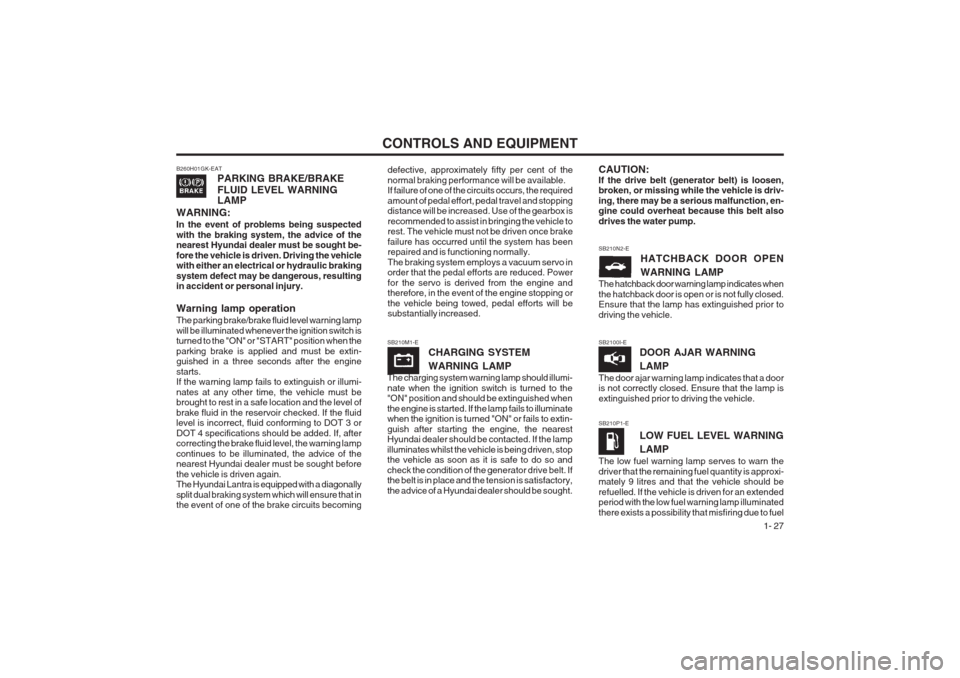
SB2100I-E
DOOR AJAR WARNING LAMP
The door ajar warning lamp indicates that a door is not correctly closed. Ensure that the lamp is extinguished prior to driving the vehicle.
SB210P1-E
LOW FUEL LEVEL WARNING LAMP
The low fuel warning lamp serves to warn the driver that the remaining fuel quantity is approxi- mately 9 litres and that the vehicle should be refuelled. If the vehicle is driven for an extended period with the low fuel warning lamp illuminated there exists a possibility that misfiring due to fuel
defective, approximately fifty per cent of thenormal braking performance will be available. If failure of one of the circuits occurs, the required amount of pedal effort, pedal travel and stopping distance will be increased. Use of the gearbox is recommended to assist in bringing the vehicle to rest. The vehicle must not be driven once brake failure has occurred until the system has been repaired and is functioning normally. The braking system employs a vacuum servo in order that the pedal efforts are reduced. Power for the servo is derived from the engine and therefore, in the event of the engine stopping or the vehicle being towed, pedal efforts will be substantially increased.
SB210M1-E CHARGING SYSTEM WARNING LAMP
The charging system warning lamp should illumi- nate when the ignition switch is turned to the "ON" position and should be extinguished when the engine is started. If the lamp fails to illuminate when the ignition is turned "ON" or fails to extin- guish after starting the engine, the nearest Hyundai dealer should be contacted. If the lamp illuminates whilst the vehicle is being driven, stop the vehicle as soon as it is safe to do so and check the condition of the generator drive belt. If the belt is in place and the tension is satisfactory, the advice of a Hyundai dealer should be sought.
B260H01GK-EAT PARKING BRAKE/BRAKE FLUID LEVEL WARNING LAMP
WARNING: In the event of problems being suspected with the braking system, the advice of the nearest Hyundai dealer must be sought be- fore the vehicle is driven. Driving the vehicle with either an electrical or hydraulic braking system defect may be dangerous, resulting in accident or personal injury. Warning lamp operation The parking brake/brake fluid level warning lamp will be illuminated whenever the ignition switch is turned to the "ON" or "START" position when the parking brake is applied and must be extin- guished in a three seconds after the engine starts. If the warning lamp fails to extinguish or illumi- nates at any other time, the vehicle must be brought to rest in a safe location and the level of brake fluid in the reservoir checked. If the fluid level is incorrect, fluid conforming to DOT 3 or DOT 4 specifications should be added. If, after correcting the brake fluid level, the warning lamp continues to be illuminated, the advice of the nearest Hyundai dealer must be sought before the vehicle is driven again. The Hyundai Lantra is equipped with a diagonally split dual braking system which will ensure that in the event of one of the brake circuits becoming SB210N2-E
HATCHBACK DOOR OPEN WARNING LAMP
The hatchback door warning lamp indicates when the hatchback door is open or is not fully closed. Ensure that the lamp has extinguished prior to driving the vehicle.CAUTION: If the drive belt (generator belt) is loosen, broken, or missing while the vehicle is driv- ing, there may be a serious malfunction, en- gine could overheat because this belt also drives the water pump.