key Hyundai Coupe 2002 Owner's Guide
[x] Cancel search | Manufacturer: HYUNDAI, Model Year: 2002, Model line: Coupe, Model: Hyundai Coupe 2002Pages: 140, PDF Size: 1.45 MB
Page 78 of 140
DRIVING YOUR HYUNDAI
2- 4 CAUTION:
o Do not attempt to engage reverse gear
when the car is in motion.
o To avoid damaging the selector mecha- nism, do not use the gear shift lever as a hand rest. Release the lever immediately the shift is completed.
o To avoid premature clutch wear, do not use the clutch pedal as a foot rest, and donot hold the vehicle on a gradient using the clutch.
o Ensure that the engine is not over-revved by upshifting before the tachometer needleenters the red zone.
o Do not coast with the shift lever at the neutral position.
o When descending long gradients, make use of the engine braking to assist thefootbrake to avoid brake fade or over- heating.
o When slippery conditions are encountered, increased caution should be exercisedwhen gear changing, braking or ac- celerating. Abrupt changes in speed may cause a loss of traction or control of the vehicle.
o The starter motor will not operate unless the clutch pedal is depressed whilst theengine is being started.
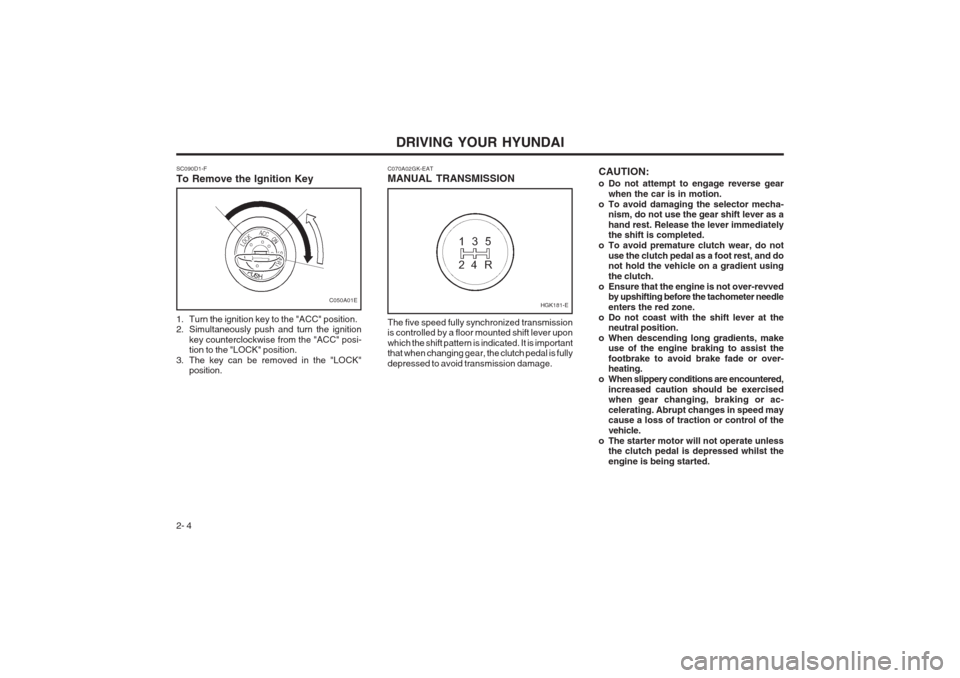
C070A02GK-EAT MANUAL TRANSMISSION The five speed fully synchronized transmission is controlled by a floor mounted shift lever upon which the shift pattern is indicated. It is important that when changing gear, the clutch pedal is fully depressed to avoid transmission damage.
SC090D1-F To Remove the Ignition Key
1. Turn the ignition key to the "ACC" position.
2. Simultaneously push and turn the ignition
key counterclockwise from the "ACC" posi-tion to the "LOCK" position.
3. The key can be removed in the "LOCK" position.
C050A01EHGK181-E
Page 81 of 140
DRIVING YOUR HYUNDAI 2- 7
C090H01L-GAT NOTE:
o For smooth and safe operation, depress
the brake pedal when shifting from "Neu- tral" position or "Park" position to a for- ward or reverse gear.
o The ignition key must be in the "ON" position and the brake pedal fully de-pressed in order to move the shift lever from the "P" (Park) position to any of the other positions.
o It is always possible to shift from "R", "N", "D" position to "P" position. Thevehicle must be fully stopped to avoid transaxle damage.
SKIP
: By rapidly moving the selector forwards
or backwards twice, it is possible to skip onegear, i.e. 1st to 3rd or 3rd to 1st . CAUTION:
o In sports mode, the driver must execute upward shifts in accordance with pre-vailing road conditions, taking care to keep the engine speed below the red zone.
o For engine protection, upward shifts are made automatically when the engine rpmreaches the red zone.
o By rapidly moving the selector lever back- wards (-) twice it is possible to skip onegear by using the sports mode. Since sudden engine braking and/or rapid ac- celeration can cause a loss of traction, however, downshifts must be made care- fully in accordance with the vehicle's speed.
NOTE:
o In sports mode, only the four forward gears can be selected. To reverse or parkthe vehicle, move the selector lever to the "R" or "P" position as required.
o In sports mode, downward shifts are made automatically when the vehicleslows down. When the vehicle stops, 1st gear is automatically selected.
o To maintain the required levels of vehicle performance and safety, the system maynot execute certain gearshifts when the selector lever is operated. o Before driving away from a stop on a
slippery road, push the selector leverforward into the +(UP) position. This causes the transaxle to shift into 2nd gear which is better for smooth driving away on a slippery road. Push the selec- tor lever to the -(DOWN) side to shift back to 1st gear. C090I01L-GAT CAUTION:
o Shift into "R" and "P" position only when
the vehicle has completely stopped.
o Do not accelerate the engine in reverse or any of the forward positions with the brakes applied.
o Always apply the footbrake when shift- ing from "P" or "N", to "R", "D"position.
o Do not use the "P" (Park) position in place of the parking brake. Always set the parking brake, shift the transaxle into "P" (Park) position and turn off the igni- tion when you leave the vehicle, even momentarily. Never leave the vehicle unattended while the engine is running.
o Check the automatic transaxle fluid level regularly, and add fluid as necessary.
C090N01O-AAT Good Driving Practices
o Never move the gear selector lever from "P" or "N" to any other position with the acceler- ator pedal depressed.
o Never move the gear selector lever into "P" when the vehicle is in motion.
o Be sure the car is completely stopped be- fore you attempt to shift into "R".
o Never take the car out of gear and coast down a hill. This may be extremely hazard-ous. Always leave the car in gear when moving.
o Do not "ride" the brakes. This can cause them to overheat and malfunction. Instead,
Page 84 of 140
DRIVING YOUR HYUNDAI
2- 10
C300D01GK-GAT Indicator and WarningThe indicator should illuminate when the igni- tion key is turned to ON
or START but should
go out after three seconds. If the indicator does not illuminate, or the TCS indicator does not go out after 3 seconds, have it checked by an authorized dealer. Should there be any unusual conditions in the device, TCS-OFF either illuminates or blinks as a warning. If TCS-OFF illuminates or blinks, pull your carto a safe place and stop the engine. Then, start the engine again to check if the TCS-OFF indicator goes out. If the indicator remains lit even after the engine has been started, have your car checked by an authorized Hyundai dealer. NOTE:
1) When TCS-OFF illuminates or blinks, trac- tion control is automatically deactivatedfor safety.
3) When the engine starts, a click is heard
from the engine compartment; however, this is only the sound of traction control being checked.
4) When moving out of the mud or fresh snow, pressing the accelerator pedal maynot cause the engine speed to increase. 2) This warning function is not provided
when the driver choose the TCS-OFF mode. o Take care of your tires. Keep them inflated
to the recommended pressure. Incorrect infla-tion, either too much or too little, results in unnecessary tire wear. Check the tire pres- sures at least once a month.
o Be sure that the wheels are aligned cor-
rectly. Improper alignment can result fromhitting curbs or driving too fast over irregular surfaces. Poor alignment causes faster tire wear and may also result in other problems as well as greater fuel consumption.
o Keep your car in good condition. For better
fuel economy and reduced maintenance costs, maintain your car in accordance with the maintenance schedule in Section 5. If you drive your car in severe conditions, more frequent maintenance is required (see Section 5 for details).
o Keep your car clean. For maximum service, your car should be kept clean and free ofcorrosive materials. It is especially impor- tant that mud, dirt, ice, etc. not be allowed to accumulate on the underside of the car. This extra weight can result in increased fuel consumption and also contribute to corro- sion.
o Travel lightly. Don't carry unnecessary weight in your car. Weight is an enemy of good fueleconomy.
o Don't let the engine idle longer than neces- sary. If you are waiting (and not in traffic),turn off your engine and restart only when you're ready to go.
SC150A1-F DRIVING FOR ECONOMYYou can save fuel and get more miles from your car if you follow these suggestions:
o Drive smoothly. Accelerate at a moderate
rate. Don't make "jack-rabbit" starts or full- throttle shifts and maintain a steady cruising speed. Don't race between stoplights. Try to adjust your speed to that of the other traffic so you don't have to change speeds unnec- essarily. Avoid heavy traffic whenever possible. Al-ways maintain a safe distance from other vehicles so you can avoid unnecessary brak- ing. This also reduces brake wear.
o Drive at a moderate speed. The faster you drive, the more fuel your car uses. Driving ata moderate speed, especially on the high- way, is one of the most effective ways to reduce fuel consumption.
o Don't "ride" the brake or clutch pedal. This
can increase fuel consumption and also increase wear on these components. In ad- dition, driving with your foot resting on the brake pedal may cause the brakes to over- heat, which reduces their effectiveness and may lead to more serious consequences.
Page 85 of 140
DRIVING YOUR HYUNDAI 2- 11
o Remember, your car does not require ex-
tended warm-up. As soon as the engine is running smoothly, you can drive away. In very cold weather, however, give your en- gine a slightly longer warm-up period.
o Don't "lug" or "over-rev" the engine. Lugging
is driving too slowly in too high a gearresulting in the engine bucking. If this hap- pens to you, shift to a lower gear. Over-revving is racing the engine beyond its safe limit. This can be avoided by shifting at the recommended speeds.
o Use your air conditioning sparingly. The air conditioning system is operated by the en-gine power so your fuel economy is reduced when you use it.
SC160A1-F SMOOTH CORNERINGAvoid braking or gear changing in corners, especially when roads are wet. Ideally, corners should always be taken under gentle accelera- tion. If you follow these suggestions, tire wear will be held to a minimum. SC170A1-E WINTER MOTORINGThe onset of winter conditions subject motor vehicles to greater operating demands. There- fore, the following suggestions will assist in maintaining peak performance and reliability during these periods: ZC170B1-E Electrical SystemWinter conditions impose severe demands upon vehicle electrical systems, particularly the charg- ing circuit. The battery condition and perfor- mance along with the alternator performance and drive belt condition should be checked prior to the onset of winter. ZC170C1-E Anti-freeze/Corrosion inhibitorThe cooling system must always contain an Ethylene-Glycol based anti-freeze solution. The system is filled during manufacture with solu- tion of the correct strength which should be checked before the onset of winter and adjust- ed or changed as required. NOTE: The anti-freeze solution contains a corro- sion inhibitor to prevent degradation of the aluminum castings contained within the engine. Therefore, never, drain the system and refill with water only. In addition, anti-freeze solution must ALWAYS be used in vehicles fitted with air conditioning, to prevent the heater matrix from freezing and subsequently bursting with the refrigeration sys- tem in use.
ZC170D1-E Door LocksShould the door lock mechanism become fro- zen, a proprietary lock de-icer should be used. Alternatively, warming the door key may thaw the door lock. However, the key should be handled carefully to avoid burning the fingers. Never attempt to thaw a frozen door lock using hot water, since the water will eventually freeze and compound the problem. NOTE: The proper temperature for using the immo-bilizer key is from -40°F (-40°C) to 176°F (80°C). If you heat the immobilizer key over 176°F (80°C) to open the frozen lock, it may cause damage to the transponder in its head. SC170E1-E Windscreen Washers and WipersThe windscreen washer bottle should be filled with a solution of water and a proprietary winter screen wash additive. The windscreen wipers should not be used if the blades are frozen to the windscreen or if they are covered with snow, before this is removed. NOTE: Never allow undiluted screen washer fluid additive to spill upon the paintwork or use engine coolant anti-freeze since damage to the paintwork may result.
Page 96 of 140
IN CASE OF EMERGENCY
3-8 since the steering lock is not designed to withstand the force required to hold the front wheels straight during the tow.
o The vehicle must not be towed with the front wheels on the ground for more than thirty miles.
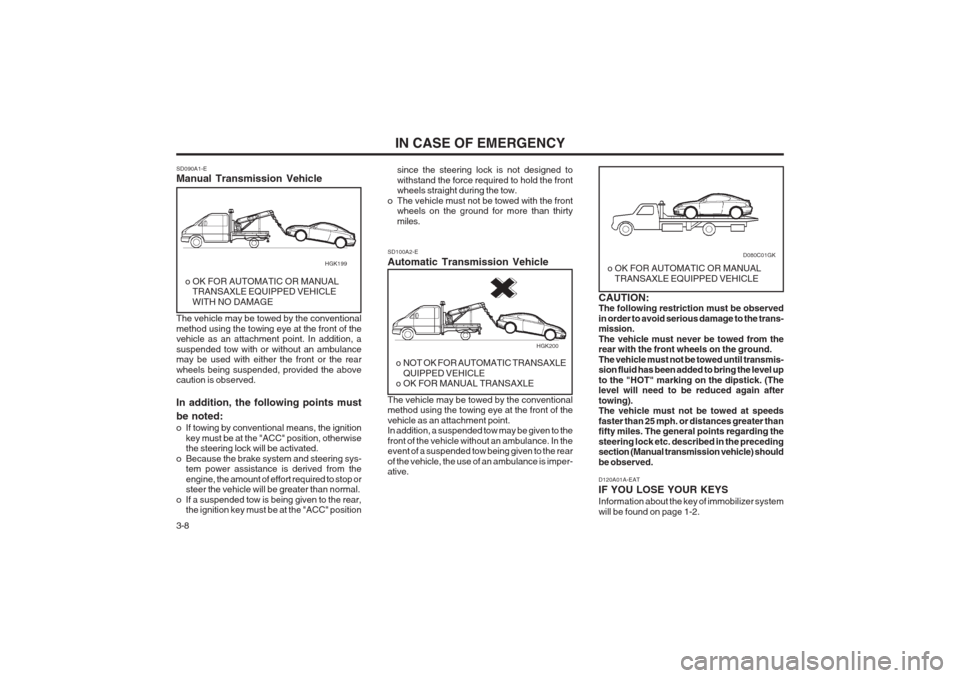
SD100A2-E Automatic Transmission Vehicle
o NOT OK FOR AUTOMATIC TRANSAXLE QUIPPED VEHICLE
o OK FOR MANUAL TRANSAXLE
The vehicle may be towed by the conventional method using the towing eye at the front of the vehicle as an attachment point. In addition, a suspended tow may be given to the front of the vehicle without an ambulance. In the event of a suspended tow being given to the rear of the vehicle, the use of an ambulance is imper- ative.
o OK FOR AUTOMATIC OR MANUAL
TRANSAXLE EQUIPPED VEHICLE
CAUTION: The following restriction must be observed in order to avoid serious damage to the trans- mission. The vehicle must never be towed from the rear with the front wheels on the ground. The vehicle must not be towed until transmis- sion fluid has been added to bring the level up to the "HOT" marking on the dipstick. (The level will need to be reduced again after towing). The vehicle must not be towed at speeds faster than 25 mph. or distances greater than fifty miles. The general points regarding the steering lock etc. described in the preceding section (Manual transmission vehicle) should be observed. D120A01A-EAT IF YOU LOSE YOUR KEYS Information about the key of immobilizer system will be found on page 1-2.
SD090A1-E Manual Transmission Vehicle
o OK FOR AUTOMATIC OR MANUAL
TRANSAXLE EQUIPPED VEHICLE WITH NO DAMAGE
The vehicle may be towed by the conventionalmethod using the towing eye at the front of the vehicle as an attachment point. In addition, a suspended tow with or without an ambulance may be used with either the front or the rear wheels being suspended, provided the above caution is observed. In addition, the following points must be noted:
o If towing by conventional means, the ignition key must be at the "ACC" position, otherwise the steering lock will be activated.
o Because the brake system and steering sys- tem power assistance is derived from the engine, the amount of effort required to stop or steer the vehicle will be greater than normal.
o If a suspended tow is being given to the rear, the ignition key must be at the "ACC" position HGK200
D080C01GK
HGK199
Page 139 of 140
INDEX10-3
INSTRUMENT PANEL ILLUMINATION CONTROL
........................1-36
INSTRUMENTS AND CONTROLS ..................................................1-24
INTERIOR REAR VIEW MIRROR ...................................................1-42
J JUMP STARTING ............................................................................... 3-1
KKEY POSITIONS ................................................................................ 2-2
KEYS .................................................................................................. 1-2
L LIGHTING SWITCH .......................................................................... 1-33
LUGGAGE NET ................................................................................ 1-47
LUMBAR SUPPORT ADJUSTMENT ................................................. 1-8
M
MAINTENANCE AND SERVICING REQUIREM ENTS ..................... 5-1
MAINTENANCE UNDER SEVERE USAGE CONDITIONS .............. 5-4
MANUAL TRANSMISSION LUBRICANT .............. ...........................6-10
MANUAL TRANSMISSION ................................................................ 2-4
MAP LIGHT ...................................................................................... 1-40
MULTI FUNCTION SWITCH ................................ ............................1-32
MULTI GAUGE ................................................................................. 1-32OODOMETER
..................................................................................... 1-30
OUTSIDE REARVIEW MIRROR HEATER ...................................... 1-41
PPARKING BRAKE ............................................................................ 1-42
POWER STEERING FLUID LEVEL ................................................. 6-18
POWER STEERIN G HOSES ........................................................... 6-18
PRE-TENSIONER SEAT BELT ............................................ 1-17 ~ 1-18
PROTECTING YOUR HYUNDAI FROM CORROSION .................... 4-1
R
REAR FOG LIGHT SWITCH ............................................................ 1-43
REAR PARCEL SHELF ................................................................... 1-46
REAR SEAT ENTRY .......................................................................... 1-9
REAR SEAT POSITIONS .................................................................. 1-8
RECOMMENDED SHIFT POINTS ..................................................... 2-5
REMOTE FUEL FILLER LID RELEASE.......................................... 1-45
REPLACING LIGHT BULBS ................................. ...........................6-18
RUNNING IN ...................................................................................... 1-1
S SCHEDULED MAINTENANCE .......................................................... 5-2
SEAT BELT PRECAUTIONS ........................................................... 1-10
SEAT BELTS (3-Point Type) ............................................................ 1-12