ESP Hyundai Coupe 2002 Owner's Manual
[x] Cancel search | Manufacturer: HYUNDAI, Model Year: 2002, Model line: Coupe, Model: Hyundai Coupe 2002Pages: 140, PDF Size: 1.45 MB
Page 2 of 140
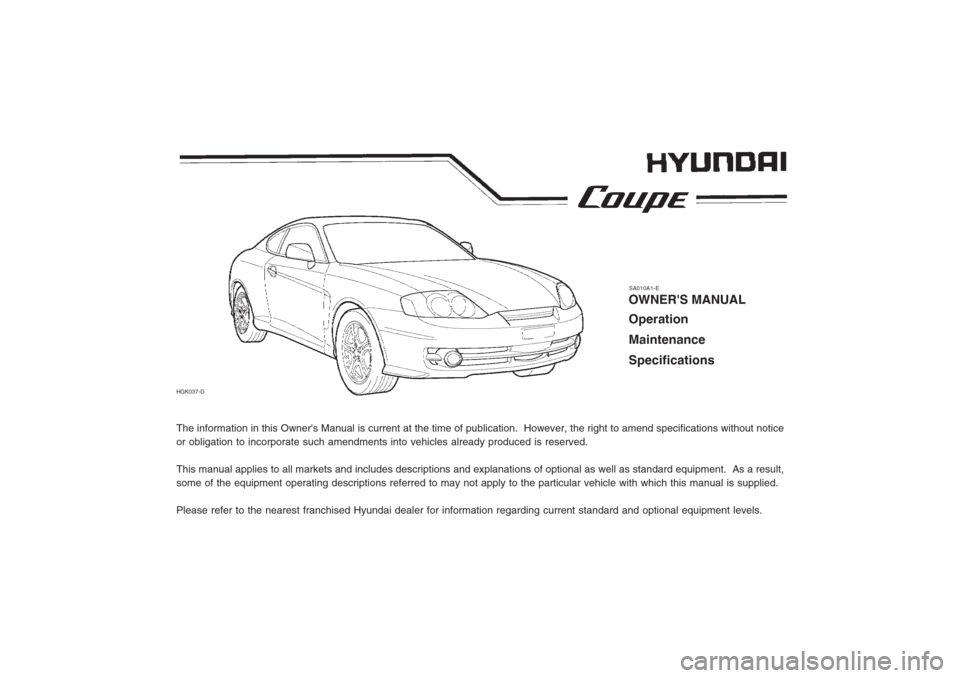
The information in this Owner's Manual is current at the time of publication. However, the right to amend specifications without notice or obligation to incorporate such amendments into vehicles already produced is reserved. This manual applies to all markets and includes descriptions and explanations of optional as well as standard equipment. As a result,
some of the equipment operating descriptions referred to may not apply to the particular vehicle with which this manual is supp lied.
Please refer to the nearest franchised Hyundai dealer for information regarding current standard and optional equipment levels. SA010A1-E
OWNER'S MANUAL Operation MaintenanceSpecifications
HGK037-D
Page 3 of 140
SA020A1-EResponsibilty For Maintenance
It is the responsibility of the vehicle owner/driver to ensure that all routine maintenance services are undertaken in line with the recommendations specified in Section 5 of this manual. In addition, in order to ensure continued validity of thenew vehicle warranty and safe operation of the vehicle, non scheduled mainte-nance/running repairs should be undertaken at the earliest available opportunity.Under severe operating conditions, more frequent maintenance is required.Details of the maintenance schedule for such conditions are also given in section 5. It is recommended that all maintenance operations and repairs are entrusted to afranchised Hyundai dealer to ensure that the latest repair methods, specializedtooling and genuine Hyundai parts are used to ensure the continued reliability andsafety of the vehicle.
Page 10 of 140
CONTROLS AND EQUIPMENT
1- 2 SB040A1-F DOOR LOCKS WARNING:
o Unlocked doors can be dangerous.
Before you drive away-especially if thereare children in the car-be sure that all the doors are securely closed and locked, the doors cannot be opened from inside. This helps assure that doors will not be opened accidentally. Also, when combined with the proper use of seat belts, locking the doors helps keep occupants from being ejected from the car in case of an accident.
o Before opening the door, always look for and avoid oncoming traffic.
B880B03A-GAT Keys
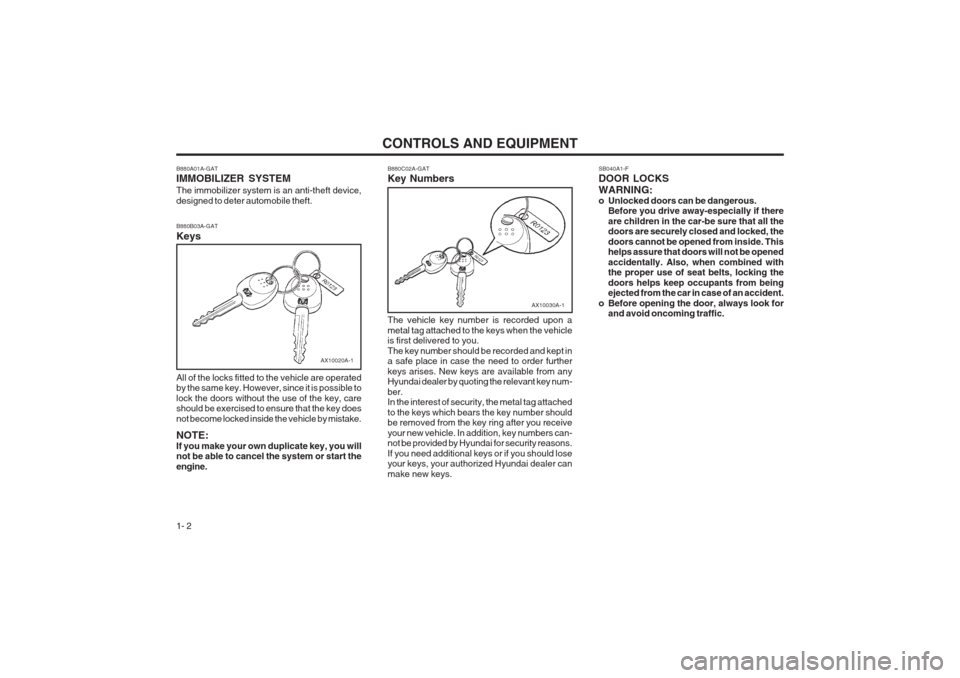
All of the locks fitted to the vehicle are operated by the same key. However, since it is possible to lock the doors without the use of the key, care should be exercised to ensure that the key does not become locked inside the vehicle by mistake. NOTE: If you make your own duplicate key, you will not be able to cancel the system or start the engine. AX10020A-1B880C02A-GAT Key Numbers
AX10030A-1
The vehicle key number is recorded upon a metal tag attached to the keys when the vehicle is first delivered to you. The key number should be recorded and kept in a safe place in case the need to order further keys arises. New keys are available from any Hyundai dealer by quoting the relevant key num- ber. In the interest of security, the metal tag attached to the keys which bears the key number should be removed from the key ring after you receive your new vehicle. In addition, key numbers can- not be provided by Hyundai for security reasons. If you need additional keys or if you should lose your keys, your authorized Hyundai dealer can make new keys.
B880A01A-GAT IMMOBILIZER SYSTEM The immobilizer system is an anti-theft device, designed to deter automobile theft.
Page 14 of 140
CONTROLS AND EQUIPMENT
1- 6
B050A01GK-AAT DOOR WINDOWS Power window (Not all models)
HGK096-D(1)
HGK097-D
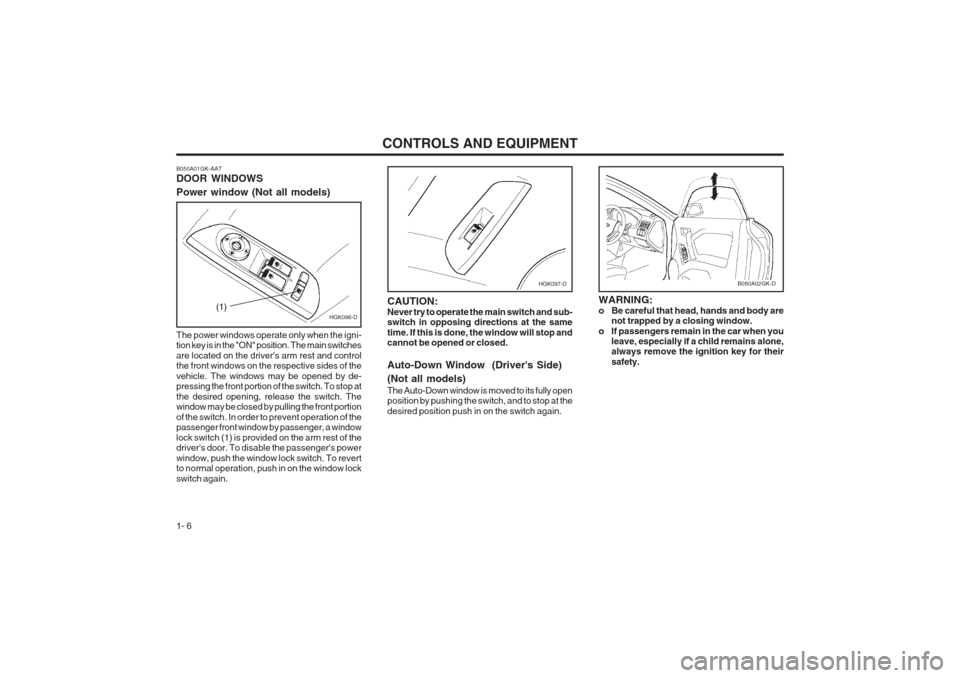
The power windows operate only when the igni- tion key is in the "ON" position. The main switches are located on the driver's arm rest and control the front windows on the respective sides of the vehicle. The windows may be opened by de- pressing the front portion of the switch. To stop at the desired opening, release the switch. The window may be closed by pulling the front portion of the switch. In order to prevent operation of the passenger front window by passenger, a window lock switch (1) is provided on the arm rest of the driver's door. To disable the passenger's power window, push the window lock switch. To revert to normal operation, push in on the window lock switch again.
CAUTION:Never try to operate the main switch and sub- switch in opposing directions at the same time. If this is done, the window will stop and cannot be opened or closed. Auto-Down Window (Driver's Side) (Not all models) The Auto-Down window is moved to its fully open position by pushing the switch, and to stop at the desired position push in on the switch again.
B050A02GK-D
WARNING:
o Be careful that head, hands and body are
not trapped by a closing window.
o If passengers remain in the car when you leave, especially if a child remains alone, always remove the ignition key for their safety.
Page 24 of 140
CONTROLS AND EQUIPMENT
1- 16
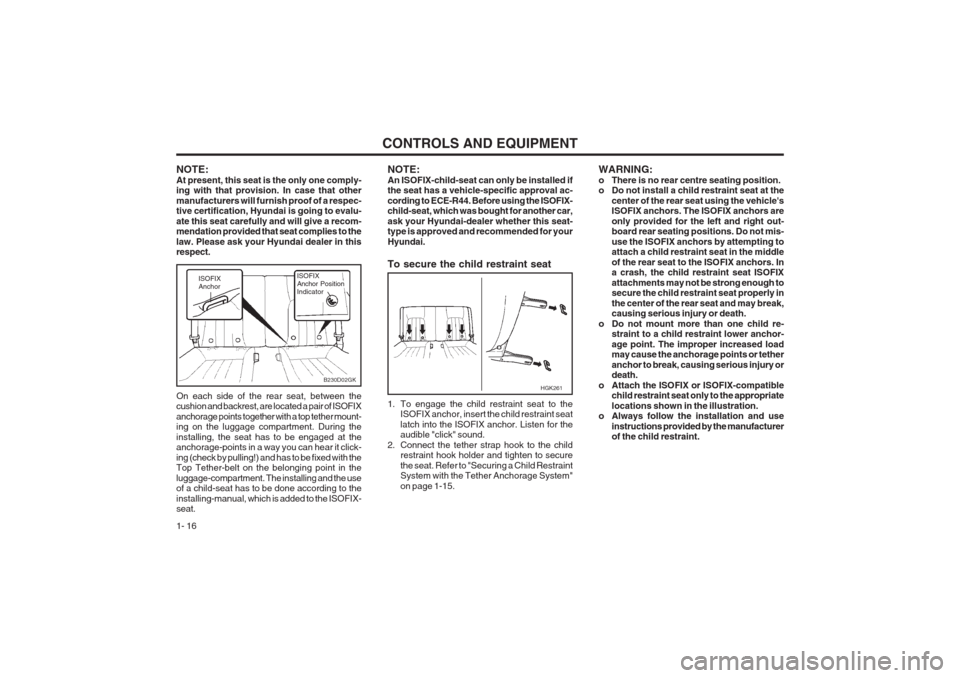
NOTE: At present, this seat is the only one comply- ing with that provision. In case that other manufacturers will furnish proof of a respec- tive certification, Hyundai is going to evalu- ate this seat carefully and will give a recom- mendation provided that seat complies to the law. Please ask your Hyundai dealer in this respect.
B230D02GK
ISOFIX AnchorISOFIX Anchor
Position
Indicator
On each side of the rear seat, between the cushion and backrest, are located a pair of ISOFIX anchorage points together with a top tether mount- ing on the luggage compartment. During the installing, the seat has to be engaged at the anchorage-points in a way you can hear it click- ing (check by pulling!) and has to be fixed with the Top Tether-belt on the belonging point in the luggage-compartment. The installing and the use of a child-seat has to be done according to the installing-manual, which is added to the ISOFIX- seat. NOTE: An ISOFIX-child-seat can only be installed if the seat has a vehicle-specific approval ac- cording to ECE-R44. Before using the ISOFIX- child-seat, which was bought for another car, ask your Hyundai-dealer whether this seat- type is approved and recommended for your Hyundai. To secure the child restraint seat
1. To engage the child restraint seat to the
ISOFIX anchor, insert the child restraint seat latch into the ISOFIX anchor. Listen for the audible "click" sound.
2. Connect the tether strap hook to the child restraint hook holder and tighten to secure the seat. Refer to "Securing a Child Restraint System with the Tether Anchorage System" on page 1-15.
HGK261 WARNING:
o There is no rear centre seating position.
o Do not install a child restraint seat at the
center of the rear seat using the vehicle'sISOFIX anchors. The ISOFIX anchors are only provided for the left and right out- board rear seating positions. Do not mis- use the ISOFIX anchors by attempting to attach a child restraint seat in the middle of the rear seat to the ISOFIX anchors. In a crash, the child restraint seat ISOFIX attachments may not be strong enough to secure the child restraint seat properly in the center of the rear seat and may break, causing serious injury or death.
o Do not mount more than one child re- straint to a child restraint lower anchor- age point. The improper increased load may cause the anchorage points or tether anchor to break, causing serious injury or death.
o Attach the ISOFIX or ISOFIX-compatible child restraint seat only to the appropriate locations shown in the illustration.
o Always follow the installation and use
instructions provided by the manufacturer of the child restraint.
Page 40 of 140
CONTROLS AND EQUIPMENT
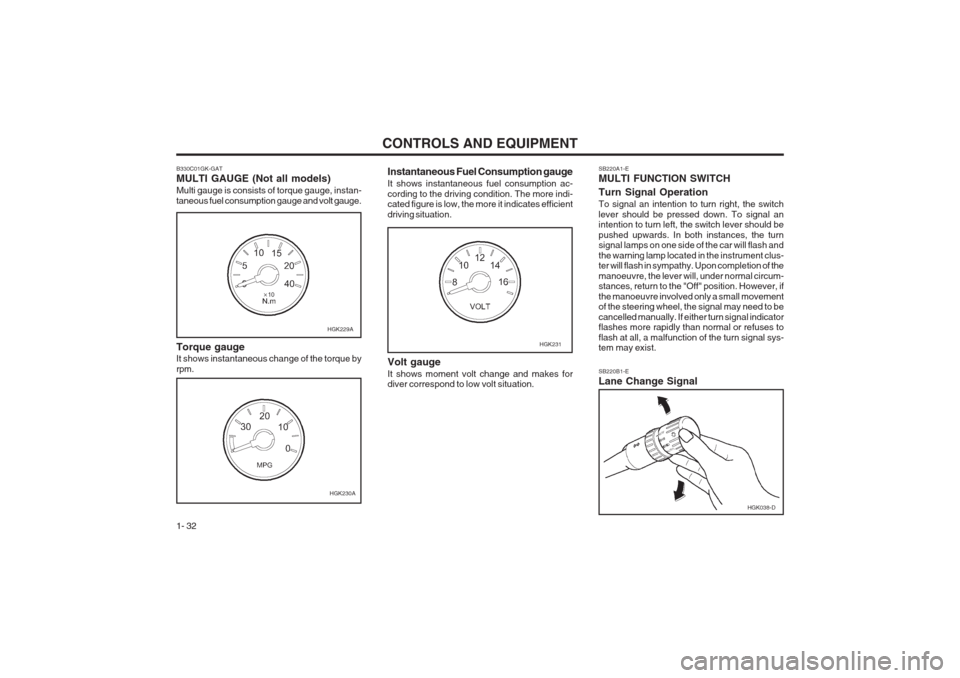
1- 32 Instantaneous Fuel Consumption gauge It shows instantaneous fuel consumption ac- cording to the driving condition. The more indi- cated figure is low, the more it indicates efficient driving situation. Volt gauge It shows moment volt change and makes for diver correspond to low volt situation.
HGK231
B330C01GK-GAT MULTI GAUGE (Not all models) Multi gauge is consists of torque gauge, instan- taneous fuel consumption gauge and volt gauge. Torque gauge It shows instantaneous change of the torque by rpm.
HGK229A
HGK230A
SB220A1-E MULTI FUNCTION SWITCH Turn Signal Operation To signal an intention to turn right, the switch lever should be pressed down. To signal an intention to turn left, the switch lever should be pushed upwards. In both instances, the turn signal lamps on one side of the car will flash and the warning lamp located in the instrument clus- ter will flash in sympathy. Upon completion of the manoeuvre, the lever will, under normal circum- stances, return to the "Off" position. However, if the manoeuvre involved only a small movement of the steering wheel, the signal may need to be cancelled manually. If either turn signal indicator flashes more rapidly than normal or refuses to flash at all, a malfunction of the turn signal sys- tem may exist. SB220B1-E Lane Change Signal
HGK038-D
Page 49 of 140
CONTROLS AND EQUIPMENT1- 41
CAUTION:
o Do not operate the switch continuously
for an unnecessary length of time.
o Scraping ice from the mirror face could
cause permanent damage. To remove any ice, use a sponge, soft cloth or approved de-icer.
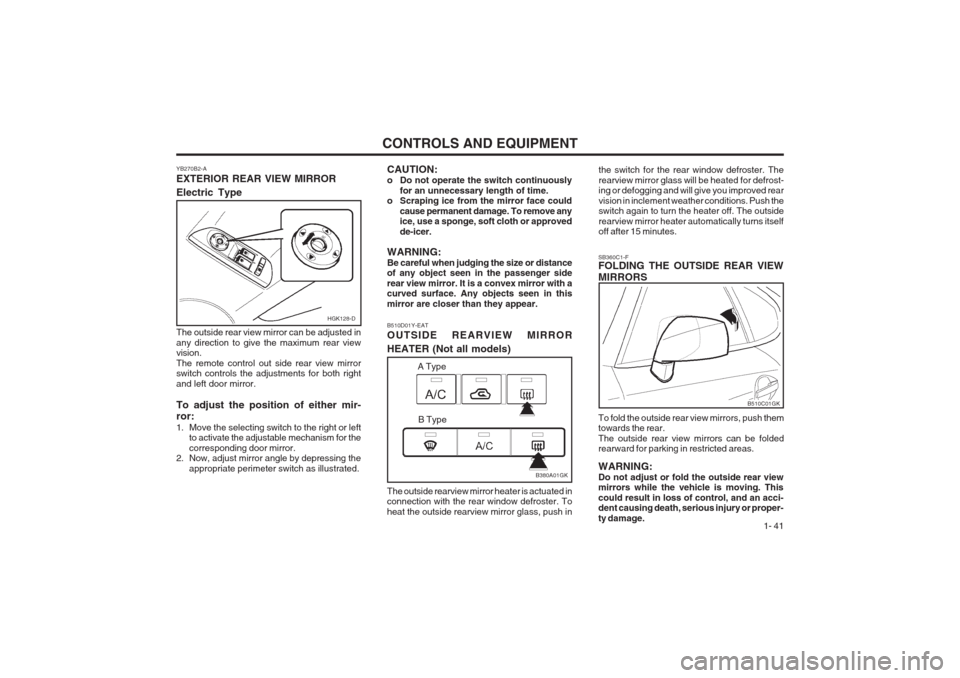
WARNING:Be careful when judging the size or distance of any object seen in the passenger side rear view mirror. It is a convex mirror with a curved surface. Any objects seen in this mirror are closer than they appear. SB360C1-F FOLDING THE OUTSIDE REAR VIEW MIRRORS To fold the outside rear view mirrors, push them towards the rear. The outside rear view mirrors can be folded rearward for parking in restricted areas. WARNING: Do not adjust or fold the outside rear view mirrors while the vehicle is moving. This could result in loss of control, and an acci- dent causing death, serious injury or proper- ty damage.
B510D01Y-EAT OUTSIDE REARVIEW MIRROR HEATER (Not all models) The outside rearview mirror heater is actuated in connection with the rear window defroster. To heat the outside rearview mirror glass, push in the switch for the rear window defroster. Therearview mirror glass will be heated for defrost- ing or defogging and will give you improved rear vision in inclement weather conditions. Push the switch again to turn the heater off. The outside rearview mirror heater automatically turns itself off after 15 minutes.
B510C01GK
B380A01GK
A Type
B Type
HGK128-D
YB270B2-A EXTERIOR REAR VIEW MIRROR Electric Type The outside rear view mirror can be adjusted in any direction to give the maximum rear view vision. The remote control out side rear view mirror switch controls the adjustments for both right and left door mirror. To adjust the position of either mir- ror:
1. Move the selecting switch to the right or left to activate the adjustable mechanism for the corresponding door mirror.
2. Now, adjust mirror angle by depressing the
appropriate perimeter switch as illustrated.
Page 82 of 140

DRIVING YOUR HYUNDAI
2- 8 o Since the power assistance provided by the
brake servo is derived from the engine, coasting with the engine turned off or towing of the vehicle with the engine turned off will result in greatly increased pedal pressures being required to stop the vehicle.
o Do not hold the vehicle on the upgrade with the accelerator pedal. This can cause thetransmission to overheat. Always use the brake pedal or parking brake.
SC140B1-E ANTI-LOCK BRAKE SYSTEM (Not all models) The Anti-Lock Brake System (ABS) is designed to prevent wheel lock-up during sudden braking or on hazardous road surfaces. The ABS con- trol module monitors the wheel speed and con- trols the pressure applied to each brake. Thus, in emergency situations or on slick roads, ABS will increase vehicle control during braking. NOTE: During ABS operation, a slight pulsation may be felt in the brake pedal when the brakes are applied. Also, a noise may be heard in the engine compartment while brak- ing. These conditions are normal and indi- cate that the anti-lock brake system is func- tioning properly.
when you are driving down a long hill, slowdown and shift to a lower gear. When you do this, engine braking will help slow the car.
o Slow down before shifting to a lower gear.
Otherwise, the lower gear may not be en-gaged.
o Always use the parking brake. Do not de- pend on placing the transaxle in "P" to keep the car from moving.
o Exercise extreme caution when driving on a slippery surface. Be especially careful whenbraking, accelerating or shifting gears. On a slippery surface, an abrupt change in vehi- cle speed can cause the drive wheels to lose traction and the vehicle to go out of control.
WARNING:
o Avoid high cornering speeds.
o Do not make quick steering wheel move- ments, such as sharp lane changes orfast, sharp turns.
o Always wear your seat belts.
o The risk of rollover is greatly increased if
you lose control of your vehicle at high- way speeds.
o Loss of control often occurs if two or more wheels drop off the roadway andthe driver oversteers to reenter the road- way.
o In the event your vehicle leaves the road- way, do not steer sharply. Instead, slowdown before pulling back into the travel lanes. o In a collision crash, un unbelted person
is significantly more likely to die than aperson wearing a seatbelt.
SC140A1-E EFFECTIVE BRAKINGBraking system performance and friction mate- rial life are greatly affected by the driving style adopted. The following suggestions are made to assist in achieving the best results from the braking system.
o Anticipate the road and conditions ahead in order that heavy braking may be avoided.
o When descending long gradients, use the engine to assist in retarding the vehicle to minimize the possibility of brake fade occur- ring.
o When trailer towing, ensure that the trailer brakes function correctly and use enginebraking to assist the vehicle braking system.
o Use only genuine Hyundai replacement brake pads and shoes to ensure consistentfriction characteristics and wear rates.
o After driving through deep water (e.g.
fording), the brakes may become wet and performance reduced. Always check brake efficiency after emerging from the water and dry the brakes by lightly depressing the brake pedal several times whilst driving slow- ly.
o Apply the parking brake only when the vehi- cle is at rest.
Page 84 of 140
DRIVING YOUR HYUNDAI
2- 10
C300D01GK-GAT Indicator and WarningThe indicator should illuminate when the igni- tion key is turned to ON
or START but should
go out after three seconds. If the indicator does not illuminate, or the TCS indicator does not go out after 3 seconds, have it checked by an authorized dealer. Should there be any unusual conditions in the device, TCS-OFF either illuminates or blinks as a warning. If TCS-OFF illuminates or blinks, pull your carto a safe place and stop the engine. Then, start the engine again to check if the TCS-OFF indicator goes out. If the indicator remains lit even after the engine has been started, have your car checked by an authorized Hyundai dealer. NOTE:
1) When TCS-OFF illuminates or blinks, trac- tion control is automatically deactivatedfor safety.
3) When the engine starts, a click is heard
from the engine compartment; however, this is only the sound of traction control being checked.
4) When moving out of the mud or fresh snow, pressing the accelerator pedal maynot cause the engine speed to increase. 2) This warning function is not provided
when the driver choose the TCS-OFF mode. o Take care of your tires. Keep them inflated
to the recommended pressure. Incorrect infla-tion, either too much or too little, results in unnecessary tire wear. Check the tire pres- sures at least once a month.
o Be sure that the wheels are aligned cor-
rectly. Improper alignment can result fromhitting curbs or driving too fast over irregular surfaces. Poor alignment causes faster tire wear and may also result in other problems as well as greater fuel consumption.
o Keep your car in good condition. For better
fuel economy and reduced maintenance costs, maintain your car in accordance with the maintenance schedule in Section 5. If you drive your car in severe conditions, more frequent maintenance is required (see Section 5 for details).
o Keep your car clean. For maximum service, your car should be kept clean and free ofcorrosive materials. It is especially impor- tant that mud, dirt, ice, etc. not be allowed to accumulate on the underside of the car. This extra weight can result in increased fuel consumption and also contribute to corro- sion.
o Travel lightly. Don't carry unnecessary weight in your car. Weight is an enemy of good fueleconomy.
o Don't let the engine idle longer than neces- sary. If you are waiting (and not in traffic),turn off your engine and restart only when you're ready to go.
SC150A1-F DRIVING FOR ECONOMYYou can save fuel and get more miles from your car if you follow these suggestions:
o Drive smoothly. Accelerate at a moderate
rate. Don't make "jack-rabbit" starts or full- throttle shifts and maintain a steady cruising speed. Don't race between stoplights. Try to adjust your speed to that of the other traffic so you don't have to change speeds unnec- essarily. Avoid heavy traffic whenever possible. Al-ways maintain a safe distance from other vehicles so you can avoid unnecessary brak- ing. This also reduces brake wear.
o Drive at a moderate speed. The faster you drive, the more fuel your car uses. Driving ata moderate speed, especially on the high- way, is one of the most effective ways to reduce fuel consumption.
o Don't "ride" the brake or clutch pedal. This
can increase fuel consumption and also increase wear on these components. In ad- dition, driving with your foot resting on the brake pedal may cause the brakes to over- heat, which reduces their effectiveness and may lead to more serious consequences.
Page 85 of 140
DRIVING YOUR HYUNDAI 2- 11
o Remember, your car does not require ex-
tended warm-up. As soon as the engine is running smoothly, you can drive away. In very cold weather, however, give your en- gine a slightly longer warm-up period.
o Don't "lug" or "over-rev" the engine. Lugging
is driving too slowly in too high a gearresulting in the engine bucking. If this hap- pens to you, shift to a lower gear. Over-revving is racing the engine beyond its safe limit. This can be avoided by shifting at the recommended speeds.
o Use your air conditioning sparingly. The air conditioning system is operated by the en-gine power so your fuel economy is reduced when you use it.
SC160A1-F SMOOTH CORNERINGAvoid braking or gear changing in corners, especially when roads are wet. Ideally, corners should always be taken under gentle accelera- tion. If you follow these suggestions, tire wear will be held to a minimum. SC170A1-E WINTER MOTORINGThe onset of winter conditions subject motor vehicles to greater operating demands. There- fore, the following suggestions will assist in maintaining peak performance and reliability during these periods: ZC170B1-E Electrical SystemWinter conditions impose severe demands upon vehicle electrical systems, particularly the charg- ing circuit. The battery condition and perfor- mance along with the alternator performance and drive belt condition should be checked prior to the onset of winter. ZC170C1-E Anti-freeze/Corrosion inhibitorThe cooling system must always contain an Ethylene-Glycol based anti-freeze solution. The system is filled during manufacture with solu- tion of the correct strength which should be checked before the onset of winter and adjust- ed or changed as required. NOTE: The anti-freeze solution contains a corro- sion inhibitor to prevent degradation of the aluminum castings contained within the engine. Therefore, never, drain the system and refill with water only. In addition, anti-freeze solution must ALWAYS be used in vehicles fitted with air conditioning, to prevent the heater matrix from freezing and subsequently bursting with the refrigeration sys- tem in use.
ZC170D1-E Door LocksShould the door lock mechanism become fro- zen, a proprietary lock de-icer should be used. Alternatively, warming the door key may thaw the door lock. However, the key should be handled carefully to avoid burning the fingers. Never attempt to thaw a frozen door lock using hot water, since the water will eventually freeze and compound the problem. NOTE: The proper temperature for using the immo-bilizer key is from -40°F (-40°C) to 176°F (80°C). If you heat the immobilizer key over 176°F (80°C) to open the frozen lock, it may cause damage to the transponder in its head. SC170E1-E Windscreen Washers and WipersThe windscreen washer bottle should be filled with a solution of water and a proprietary winter screen wash additive. The windscreen wipers should not be used if the blades are frozen to the windscreen or if they are covered with snow, before this is removed. NOTE: Never allow undiluted screen washer fluid additive to spill upon the paintwork or use engine coolant anti-freeze since damage to the paintwork may result.