instrument panel Hyundai Coupe 2002 Owner's Manual
[x] Cancel search | Manufacturer: HYUNDAI, Model Year: 2002, Model line: Coupe, Model: Hyundai Coupe 2002Pages: 140, PDF Size: 1.45 MB
Page 27 of 140
CONTROLS AND EQUIPMENT1- 19
o The driver should sit back as far as pos-sible while still maintaining control of the vehicle. If you are sitting too close to the airbag, it can cause death or serious injury when it inflates.
o No objects should be placed over or near
the airbag modules on the steering wheel, instrument panel, and the front passenger's panel above the glove box, because any such object could cause harm if the vehicle is in a crash severe enough to cause the airbags to inflate.
o If the airbags inflate, they must be re- placed by an authorized Hyundai dealer.
o Do not tamper with or disconnect SRS wiring, or other components of the SRS system. Doing so could result in injury, due to accidental firing of the airbags or by rendering the SRS inoperative.
B240A02GK
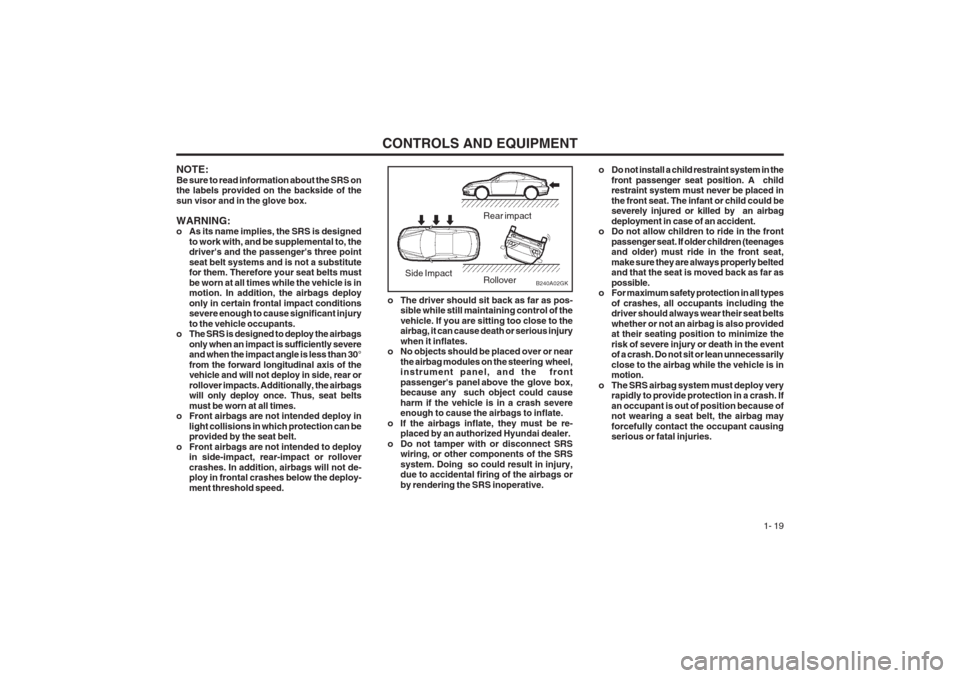
Rear impact
Side Impact Rollover
NOTE: Be sure to read information about the SRS on the labels provided on the backside of the sun visor and in the glove box. WARNING:
o As its name implies, the SRS is designed
to work with, and be supplemental to, thedriver's and the passenger's three point seat belt systems and is not a substitute for them. Therefore your seat belts must be worn at all times while the vehicle is in motion. In addition, the airbags deploy only in certain frontal impact conditions severe enough to cause significant injury to the vehicle occupants.
o The SRS is designed to deploy the airbags
only when an impact is sufficiently severe and when the impact angle is less than 30° from the forward longitudinal axis of the vehicle and will not deploy in side, rear or rollover impacts. Additionally, the airbags will only deploy once. Thus, seat belts must be worn at all times.
o Front airbags are not intended deploy in
light collisions in which protection can be provided by the seat belt.
o Front airbags are not intended to deploy in side-impact, rear-impact or rollover crashes. In addition, airbags will not de- ploy in frontal crashes below the deploy- ment threshold speed. o Do not install a child restraint system in the
front passenger seat position. A child restraint system must never be placed in the front seat. The infant or child could be severely injured or killed by an airbag deployment in case of an accident.
o Do not allow children to ride in the front
passenger seat. If older children (teenages and older) must ride in the front seat, make sure they are always properly belted and that the seat is moved back as far as possible.
o For maximum safety protection in all types
of crashes, all occupants including the driver should always wear their seat belts whether or not an airbag is also provided at their seating position to minimize the risk of severe injury or death in the event of a crash. Do not sit or lean unnecessarily close to the airbag while the vehicle is in motion.
o The SRS airbag system must deploy very rapidly to provide protection in a crash. If an occupant is out of position because of not wearing a seat belt, the airbag may forcefully contact the occupant causing serious or fatal injuries.
Page 28 of 140
CONTROLS AND EQUIPMENT
1- 20
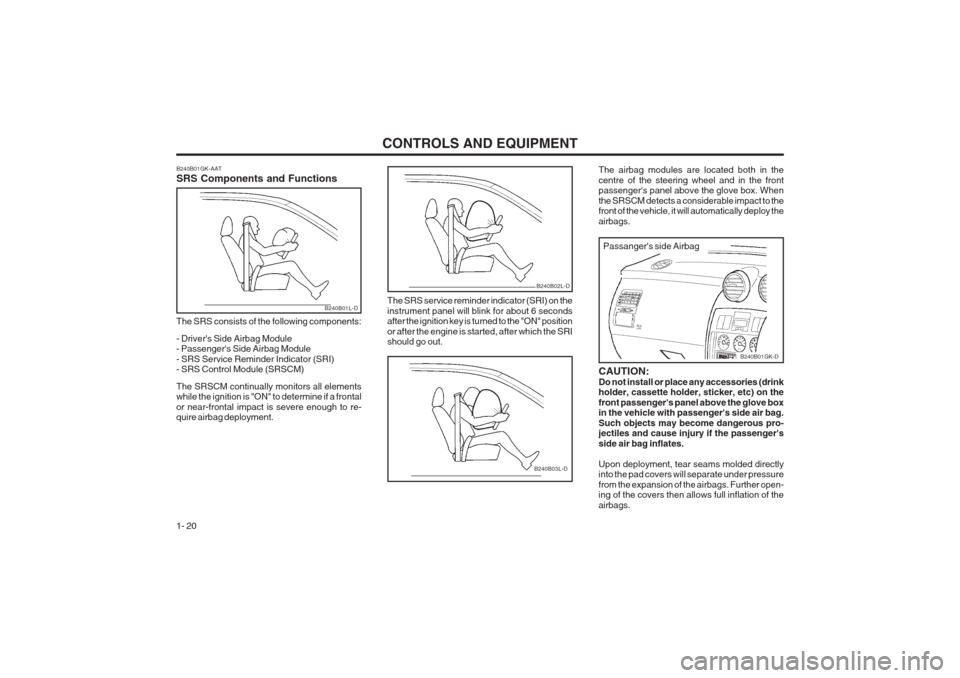
The airbag modules are located both in the centre of the steering wheel and in the front passenger's panel above the glove box. When the SRSCM detects a considerable impact to the front of the vehicle, it will automatically deploy the airbags.
Passanger's side Airbag
B240B01GK-D
CAUTION: Do not install or place any accessories (drink holder, cassette holder, sticker, etc) on the front passenger's panel above the glove box in the vehicle with passenger's side air bag. Such objects may become dangerous pro- jectiles and cause injury if the passenger's side air bag inflates. Upon deployment, tear seams molded directly into the pad covers will separate under pressure from the expansion of the airbags. Further open- ing of the covers then allows full inflation of the airbags.
The SRS service reminder indicator (SRI) on theinstrument panel will blink for about 6 seconds after the ignition key is turned to the "ON" position or after the engine is started, after which the SRI should go out.
B240B01GK-AAT SRS Components and Functions The SRS consists of the following components: - Driver's Side Airbag Module - Passenger's Side Airbag Module - SRS Service Reminder Indicator (SRI) - SRS Control Module (SRSCM) The SRSCM continually monitors all elements while the ignition is "ON" to determine if a frontal or near-frontal impact is severe enough to re- quire airbag deployment.
B240B02L-D
B240B03L-D
B240B01L-D
Page 29 of 140
CONTROLS AND EQUIPMENT1- 21
WARNING:
o When the SRS is activated, there may be aloud noise and fine dust will be releasedthroughout the vehicle. These conditions are normal and are not hazardous. How- ever, the fine dust generated during airbag deployment may cause skin irritation. Be sure to wash your hands and face thor- oughly with lukewarm water and a mild soap after an accident in which the airbags were deployed.
o The SRS can function only when the igni-
tion key is in the "ON" position. If the SRS SRI does not come on or illuminates continuously when the ignition key is turned to "ON", or continuously remains on after flashing for about 6 seconds when the ignition key is turned to the "ON" position, or after the engine is started, or comes on while driving, the SRS is not working properly. If this occurs, have your vehicle immediately inspected by your Hyundai dealer.
o Before you replace a fuse or disconnect a
battery terminal, turn the ignition key to the "LOCK" position or remove the igni- tion key. Never remove or replace the air bag related fuse(s) when the ignition key is in the "ON" position. Failure to heed this warning will cause the SRS SRI to illumi- nate.
FUD1115A
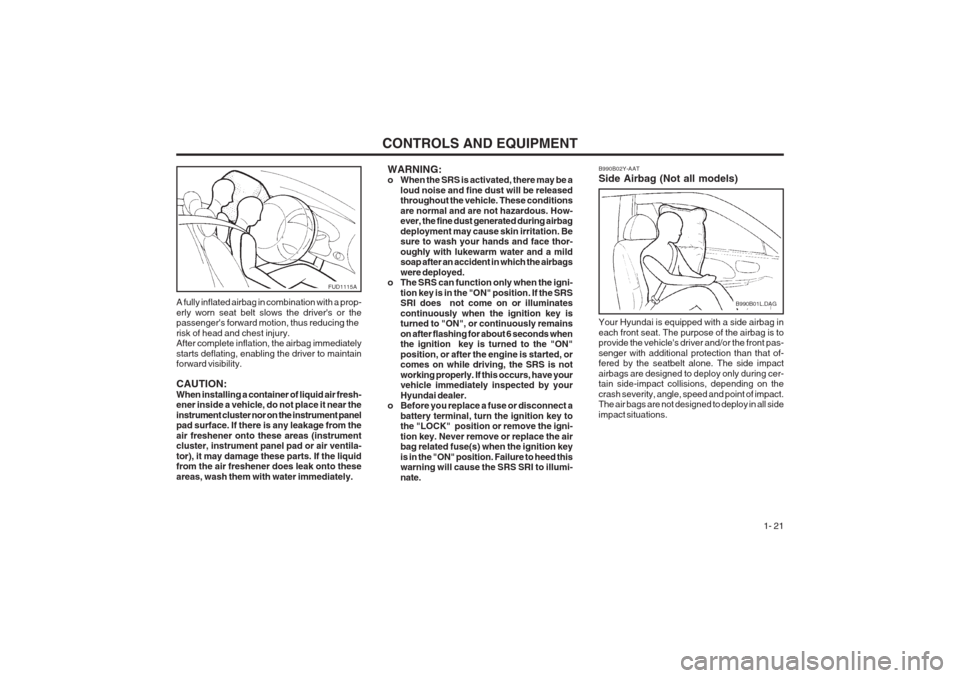
A fully inflated airbag in combination with a prop- erly worn seat belt slows the driver's or the passenger's forward motion, thus reducing the risk of head and chest injury. After complete inflation, the airbag immediately starts deflating, enabling the driver to maintain forward visibility. CAUTION: When installing a container of liquid air fresh- ener inside a vehicle, do not place it near the instrument cluster nor on the instrument panel pad surface. If there is any leakage from the air freshener onto these areas (instrument cluster, instrument panel pad or air ventila- tor), it may damage these parts. If the liquid from the air freshener does leak onto these areas, wash them with water immediately. Your Hyundai is equipped with a side airbag ineach front seat. The purpose of the airbag is to provide the vehicle's driver and/or the front pas- senger with additional protection than that of- fered by the seatbelt alone. The side impact airbags are designed to deploy only during cer- tain side-impact collisions, depending on the crash severity, angle, speed and point of impact. The air bags are not designed to deploy in all side impact situations.
B990B02Y-AAT Side Airbag (Not all models)
B990B01L.DAG
Page 32 of 140
CONTROLS AND EQUIPMENT
1- 24 8
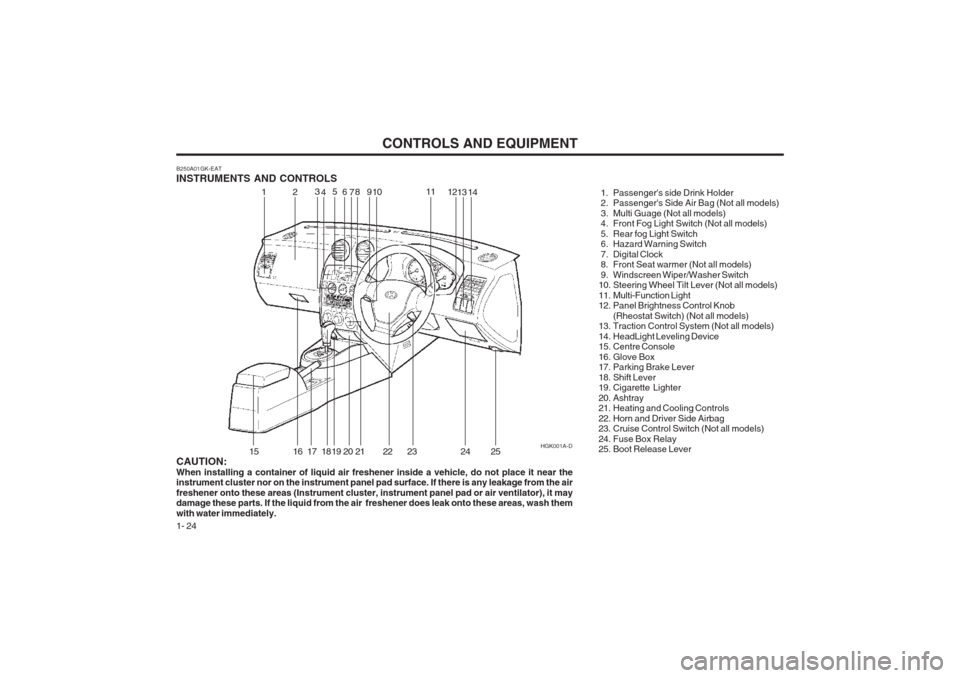
B250A01GK-EAT INSTRUMENTS AND CONTROLS
1. Passenger's side Drink Holder
2. Passenger's Side Air Bag (Not all models)
3. Multi Guage (Not all models)
4. Front Fog Light Switch (Not all models)
5. Rear fog Light Switch
6. Hazard Warning Switch
7. Digital Clock
8. Front Seat warmer (Not all models)
9. Windscreen Wiper/Washer Switch
10. Steering Wheel Tilt Lever (Not all models)
11. Multi-Function Light
12. Panel Brightness Control Knob(Rheostat Switch) (Not all models)
13. Traction Control System (Not all models)
14. HeadLight Leveling Device
15. Centre Console
16. Glove Box
17. Parking Brake Lever
18. Shift Lever
19. Cigarette Lighter
20. Ashtray
21. Heating and Cooling Controls
22. Horn and Driver Side Airbag
23. Cruise Control Switch (Not all models)
24. Fuse Box Relay
25. Boot Release Lever
CAUTION: When installing a container of liquid air freshener inside a vehicle, do not place it near the instrument cluster nor on the instrument panel pad surface. If there is any leakage from the air freshener onto these areas (Instrument cluster, instrument panel pad or air ventilator), it may damage these parts. If the liquid from the air freshener does leak onto these areas, wash them with water immediately. HGK001A-D
12
3
4 5
69 10 11
1213
15
16 17 18 19 20 21 22 23 24
714
25
Page 44 of 140
CONTROLS AND EQUIPMENT
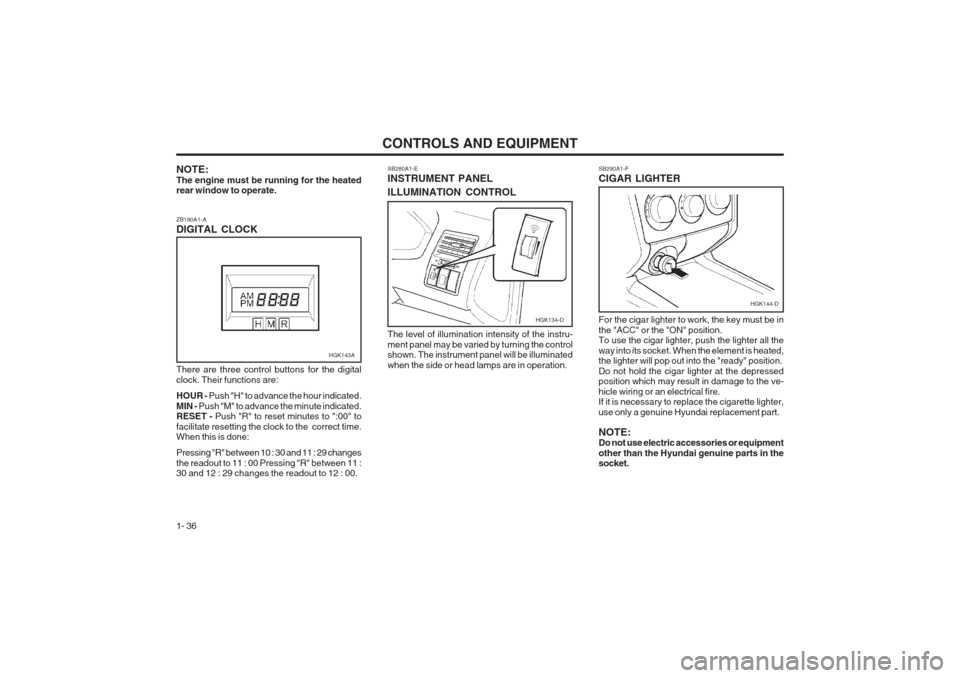
1- 36 SB290A1-F CIGAR LIGHTER
NOTE: The engine must be running for the heated rear window to operate. ZB190A1-A DIGITAL CLOCK SB280A1-EINSTRUMENT PANEL ILLUMINATION CONTROL
There are three control buttons for the digital clock. Their functions are: HOUR - Push "H" to advance the hour indicated.
MIN - Push "M" to advance the minute indicated.
RESET - Push "R" to reset minutes to ":00" to
facilitate resetting the clock to the correct time. When this is done: Pressing "R" between 10 : 30 and 11 : 29 changes the readout to 11 : 00 Pressing "R" between 11 : 30 and 12 : 29 changes the readout to 12 : 00. The level of illumination intensity of the instru- ment panel may be varied by turning the control shown. The instrument panel will be illuminated when the side or head lamps are in operation.
For the cigar lighter to work, the key must be inthe "ACC" or the "ON" position. To use the cigar lighter, push the lighter all the way into its socket. When the element is heated, the lighter will pop out into the "ready" position. Do not hold the cigar lighter at the depressed position which may result in damage to the ve- hicle wiring or an electrical fire. If it is necessary to replace the cigarette lighter, use only a genuine Hyundai replacement part. NOTE: Do not use electric accessories or equipment other than the Hyundai genuine parts in the socket.
HGK143A
HGK134-D
HGK144-D
Page 65 of 140
CONTROLS AND EQUIPMENT1- 57
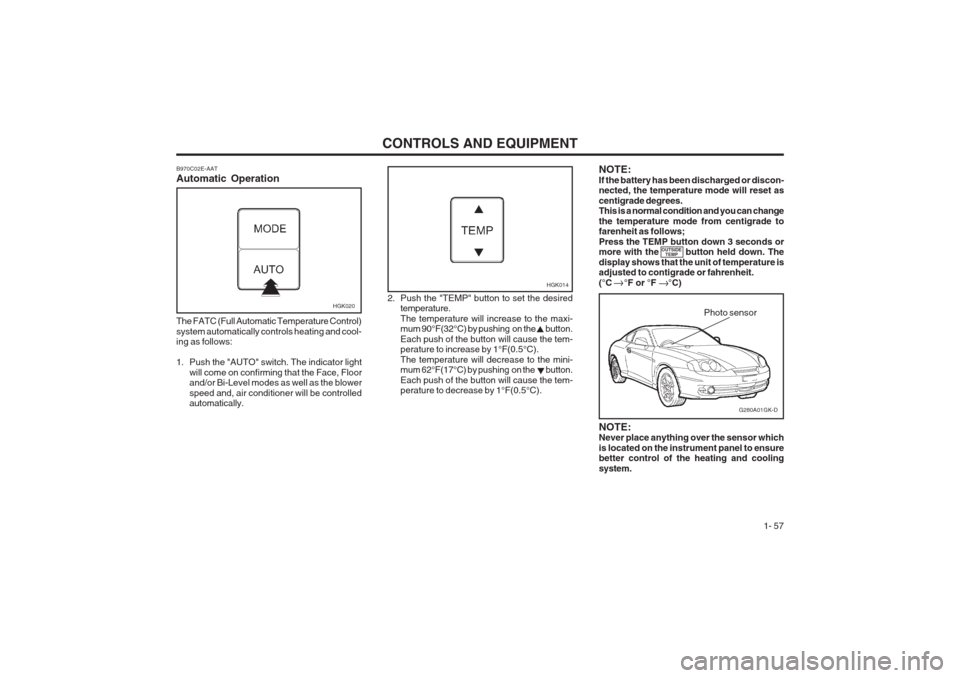
B970C02E-AAT Automatic Operation
HGK020
The FATC (Full Automatic Temperature Control) system automatically controls heating and cool- ing as follows:
1. Push the "AUTO" switch. The indicator light will come on confirming that the Face, Floor and/or Bi-Level modes as well as the blower speed and, air conditioner will be controlled automatically. 2. Push the "TEMP" button to set the desired
temperature. The temperature will increase to the maxi- mum 90°F(32°C) by pushing on the button. Each push of the button will cause the tem- perature to increase by 1°F(0.5°C). The temperature will decrease to the mini- mum 62°F(17°C) by pushing on the button. Each push of the button will cause the tem- perature to decrease by 1°F(0.5°C).
G280A01GK-D
Photo sensor
HGK014
NOTE: Never place anything over the sensor which is located on the instrument panel to ensure better control of the heating and cooling system.
NOTE:If the battery has been discharged or discon- nected, the temperature mode will reset as centigrade degrees. This is a normal condition and you can change the temperature mode from centigrade to farenheit as follows; Press the TEMP button down 3 seconds or more with the button held down. The display shows that the unit of temperature is adjusted to contigrade or fahrenheit. (°C °F or °F °C)
OUTSIDE
TEMP
Page 138 of 140

INDEX
10-2
E EFFECTIVE BRAKING
....................................................................... 2-8
ELECTRIC COOLING FANS ........................................................... 6-17
EMISSION CONTROL SYSTEMS ..................................................... 7-1
ENGINE COMPARTMENT ................................................................. 6-1
ENGINE COOLANT CHECKING AND REPLACI NG ........................ 6-7
ENGINE COOLANT TEMPERATURE GUAGE ...............................1-29
ENGINE OIL AND FILTER REPLACEMENT .................................... 6-6
ENGINE OIL CO NSUMPTION ........................................................... 6-6
ENGINE OIL REPLENISHMENT ............ ........................................... 6-5
ENGINE OIL ....................................................................................... 6-4
EXTERIOR REAR VIEW MIRROR .................................................. 1-41
F
FOLDING REAR SEAT .................................................................... 1-10
FRONT ASHTRAY ........ ................................................................... 1-37
FRONT DOOR EDGE WARNING LAMP ........................................1-44
FRONT FOG LIGHT SWITCH ......................................................... 1-43
FRONT SEAT ADJUSTMENT ........................................................... 1-7
FRONT SEAT BELT PIVOT HEIGHT ADJUSTMENT ....................1-11
FUEL ECONOMY ............................................................................... 2-3
FUEL GAUGE .................................................................................. 1-28
FUEL RECOMMENDATIONS ........... ................................................. 1-1
FUSE PANEL DESCRIPTION ......................................................... 6-22
FUSIBLE LINKS ............................................................................... 6-16G
GLOVE BOX .....................................................................................
1-39
H HATCHBACK DOOR ........................................................................ 1-45
HATCHBACK DOOR WIPER AND WA SHER ................................1-35
HAZARD WARNING SYSTEM ........................................................ 1-35
HEADLIGHT BULB ........................................................................... 6-18
HEADLIGHT AIMING ADJUSTMENT ..............................................6-18
HEADLIGHT LEVELING DEVICE SYSTEM ....................................1-37
HEAD RESTRAINT ADJUSTMENT ................................................... 1-7
HEATED REAR WINDOW ............................................................... 1-35
HEATING AND COO LING CONTROL ............................................ 1-50
ROTARY TYPE ................................................................. 1-51 ~ 1-54
AUTOMATIC TYPE ........................................................... 1-56 ~ 1-61
HORN ............................................................................................... 1-47
IIF THE ENGINE CANNOT BE CRANKED ........................................ 3-1
IF THE ENGINE OVERHEATS .......................................................... 3-2
IF THE ENGINE WILL NOT START .................................................. 3-1
IF THE EVENT OF A PUNCTURE .................................................... 3-3
IMMOBILIZER SYSTEM ..................................................................... 1-2
INDIVIDUAL CIRCUIT FUSES ......................................................... 6-17
INSTRUMENT CLUSTER AND INDICATORS ................................1-25
Page 139 of 140
INDEX10-3
INSTRUMENT PANEL ILLUMINATION CONTROL
........................1-36
INSTRUMENTS AND CONTROLS ..................................................1-24
INTERIOR REAR VIEW MIRROR ...................................................1-42
J JUMP STARTING ............................................................................... 3-1
KKEY POSITIONS ................................................................................ 2-2
KEYS .................................................................................................. 1-2
L LIGHTING SWITCH .......................................................................... 1-33
LUGGAGE NET ................................................................................ 1-47
LUMBAR SUPPORT ADJUSTMENT ................................................. 1-8
M
MAINTENANCE AND SERVICING REQUIREM ENTS ..................... 5-1
MAINTENANCE UNDER SEVERE USAGE CONDITIONS .............. 5-4
MANUAL TRANSMISSION LUBRICANT .............. ...........................6-10
MANUAL TRANSMISSION ................................................................ 2-4
MAP LIGHT ...................................................................................... 1-40
MULTI FUNCTION SWITCH ................................ ............................1-32
MULTI GAUGE ................................................................................. 1-32OODOMETER
..................................................................................... 1-30
OUTSIDE REARVIEW MIRROR HEATER ...................................... 1-41
PPARKING BRAKE ............................................................................ 1-42
POWER STEERING FLUID LEVEL ................................................. 6-18
POWER STEERIN G HOSES ........................................................... 6-18
PRE-TENSIONER SEAT BELT ............................................ 1-17 ~ 1-18
PROTECTING YOUR HYUNDAI FROM CORROSION .................... 4-1
R
REAR FOG LIGHT SWITCH ............................................................ 1-43
REAR PARCEL SHELF ................................................................... 1-46
REAR SEAT ENTRY .......................................................................... 1-9
REAR SEAT POSITIONS .................................................................. 1-8
RECOMMENDED SHIFT POINTS ..................................................... 2-5
REMOTE FUEL FILLER LID RELEASE.......................................... 1-45
REPLACING LIGHT BULBS ................................. ...........................6-18
RUNNING IN ...................................................................................... 1-1
S SCHEDULED MAINTENANCE .......................................................... 5-2
SEAT BELT PRECAUTIONS ........................................................... 1-10
SEAT BELTS (3-Point Type) ............................................................ 1-12