warning lights Hyundai Coupe 2004 User Guide
[x] Cancel search | Manufacturer: HYUNDAI, Model Year: 2004, Model line: Coupe, Model: Hyundai Coupe 2004Pages: 389, PDF Size: 10.22 MB
Page 106 of 389

DRIVING YOUR HYUNDAI 2- 11
off your engine and restart only when you're ready to go.
o Remember, your Hyundai does not require extended warm-up. As soon as the engine isrunning smoothly, you can drive away. Invery cold weather, however, give your enginea slightly longer warm-up period.
o Don't "lug" or "over-rev" the engine. Lugging is driving too slowly in too high a gear result-ing in the engine bucking. If this happens, shiftto a lower gear. Over-revving is racing theengine beyond its safe limit. This can beavoided by shifting at the recommendedspeeds.
o Use your air conditioning sparingly. The air conditioning system is operated by enginepower so your fuel economy is reduced whenyou use it.
crease wear on these components. In addi-tion, driving with your foot resting on the brakepedal may cause the brakes to overheat,which reduces their effectiveness and maylead to more serious consequences.
o Take care of your tires. Keep them inflated to the recommended pressure. Incorrect infla-tion, either too much or too little, results inunnecessary tire wear. Check the tire pres-sures at least once a month.
o Be sure that the wheels are aligned correctly. Improper alignment can result from hittingcurbs or driving too fast over irregular surfac-es. Poor alignment causes faster tire wearand may also result in other problems as wellas greater fuel consumption.
o Keep your car in good condition. For better fuel economy and reduced maintenancecosts, maintain your car in accordance withthe maintenance schedule in Section 5. If youdrive your car in severe conditions, morefrequent maintenance is required (see Sec-tion 5 for details).
o Keep your car clean. For maximum service, your Hyundai should be kept clean and free ofcorrosive materials. It is especially importantthat mud, dirt, ice, etc. not be allowed toaccumulate on the underside of the car. Thisextra weight can result in increased fuel con-sumption and also contribute to corrosion.
o Travel lightly. Don't carry unnecessary weight in your car. Weight reduces fuel economy.
o Don't let the engine idle longer than neces- sary. If you are waiting (and not in traffic), turn C150A01A-AAT
SMOOTH CORNERING
Avoid braking or gear changing in corners, espe-cially when roads are wet. Ideally, corners shouldalways be taken under gentle acceleration. If youfollow these suggestions, tire wear will be held toa minimum. C160A01A-AAT WINTER DRIVING The more severe weather conditions of winter result in greater wear and other problems. Tominimize the problems of winter driving, youshould follow these suggestions:
If the indicator remains lit even after the enginehas been started, have your car checked by anauthorized Hyundai dealer. NOTE:
1) When the TCS-OFF indicator illuminates,
traction control is automatically deacti-vated for safety.
2) This warning function is not provided when the driver selects the TCS-OFF mode.
C140A01A-GAT DRIVING FOR ECONOMY You can save fuel and get more kilometers from your car if you follow these suggestions:
o Drive smoothly. Accelerate at a moderate rate. Don't make "jack-rabbit" starts or full- throttle shifts and maintain a steady cruisingspeed. Don't race between stoplights. Try toadjust your speed to that of the other traffic soyou don't have to change speeds unneces-sarily. Avoid heavy traffic whenever possible.Always maintain a safe distance from othervehicles so you can avoid unnecessary brak-ing. This also reduces brake wear.
o Drive at a moderate speed. The faster you drive, the more fuel your car uses. Driving ata moderate speed, especially on the high-way, is one of the most effective ways toreduce fuel consumption.
o Don't "ride" the brake or clutch pedal. This can increase fuel consumption and also in-
Page 110 of 389

DRIVING YOUR HYUNDAI 2- 15
Maximum
Towable Weight Trailer550
1,200 1,400
CAUTION: The following specifications are recom-
mended when towing a trailer. The loadedtrailer weight cannot safely exceed the val-ues in the following chart.
kg
With Brake Type1.6 L
2.0/2.7 L
4. The maximum permissible static vertical
load on the coupling device:
WARNING: Improperly loading your car and trailer can
seriously affect its steering and braking per-formance causing a crash which you may be
serious injury or death.Without Brake Type
Coupling point
HGK260
1.6 L
2.0/2.7 L 50 kg 60 kg
View from below the vehicle
5. The maximum permissible overhang of
the coupling point : 990 mm.
C190F01A-GAT Trailer or Vehicle Towing Tips
1. Before towing, check hitch and safety chainconnections as well as proper operation of the trailer running lights, brake lights, and turnsignals.
2. Always drive your vehicle at a moderate speed (Less than 100 km/H).
3. Trailer towing requires more fuel than normal conditions.
4. To maintain engine braking efficiency and electrical charging performance, do not usefifth gear (manual transaxle) or overdrive(automatic transaxle).
5. Always secure items in the trailer to prevent load shift while driving.
6. Check the condition and air pressure of all tires on the trailer and your car. Low tirepressure can seriously affect the handling.Also check the spare tire.
7. The vehicle/trailer combination is more af- fected by crosswind and buffeting.When being passed by a large vehicle, keepa constant speed and steer straight ahead. Ifthere is too much wind buffeting, slow down toget out of the other vehicle's air turbulence.
8. When parking your car and trailer, especially on a hill, be sure to follow all the normalprecautions. Turn your front wheel into thecurb, set the parking brake firmly, and put thetransmission in 1st or Reverse (manual) orPark (automatic). In addition, place wheelchocks at each of the trailer's tires.
Page 113 of 389

WHAT TO DO IN AN EMERGENCY
3-2
tance. Automobile batteries contain sulfuric acid. This is poisonous and highly corrosive.When jump starting, wear protective glassesand be careful not to get acid on yourself,your clothing or on the car.
o If you should accidentally get acid on your
skin or in your eyes, immediately remove any contaminated clothing and flush the area withclear water for at least 15 minutes. Thenpromptly obtain medical attention. If you mustbe transported to an emergency facility, con-tinue to apply water to the affected area witha sponge or cloth.
o The gas produced by the battery during the jump-start operation is highly explosive. Donot smoke or allow a spark or open flame inthe vicinity.
o The battery being used to provide the jump start must be 12-volt. If you cannot determinethat it is a 12-volt battery, do not attempt touse it for the jump start.
o To jump start a car with a discharged battery, follow this procedure exactly:
1. If the booster battery is installed in another vehicle, be sure the two vehicles are nottouching.
2. Turn off all unnecessary lights and acces- sories in both vehicles. 3. Attach the clamps of the jumper cable in the
exact location shown on the previous page.First, attach one clamp of the jumper cable tothe positive (+) post or cable of the dis-charged battery. Then attach the other end ofthe same cable to the positive (+) post orcable of the booster battery. Next, using theother cable, attach one clamp to the negative(-) post or cable of the booster battery. Thenattach the other end of that cable to a solidmetal part of the engine away from thebattery. Do not connect the cable to anymoving part.
4. Start the engine in the car with the booster battery and let it run for a few minutes. Thiswill help to assure that the booster battery isfully charged. During the jumping operation,run the engine in this vehicle at about 2000rpm.
5. Start the engine in the car with the discharged battery using the normal starting procedure.After the engine starts, leave the jumpercables connected and let the engine run atfast idle or about 2000 rpm for several min-utes.
6. Carefully remove the jumper cables in the reverse order of attachment.
If you do not know why your battery becamedischarged (because the lights were left on,etc.), have the charging system checked by yourHyundai dealer. D030A02A-AAT IF THE ENGINE OVERHEATSIf your temperature gauge indicates overheating, you experience a loss of power, or hear loudpinging or knocking, the engine is probably toohot. If this happens to you, you should:
1. Pull off the road and stop as soon as it is safe
to do so.
2. Place the gear selector lever in "P" (auto- matic), or neutral (manual transaxle) and set the parking brake. If the air conditioning is on,turn it off.
3. If engine coolant is running out under the car or steam is coming out from the hood, stopthe engine. Do not open the hood until theengine coolant has stopped running or thesteaming has stopped. If there is no visibleloss of engine coolant and no steam, leavethe engine running and check to be sure theengine cooling fan is operating. If the fan isnot running, turn the engine off.
4. Check to see if the water pump drive belt is missing. If it is not missing, check to see thatit is tight. If the drive belt seems to be satis-factory, check for engine coolant leaking fromthe radiator, hoses or under the car. (If the airconditioning had been in use, it is normal forcold water to be draining from it when youstop).
WARNING:While the engine is running, keep hair, hands,and clothing away from moving parts such asthe fan and drive belts to prevent injury.
Page 153 of 389

DO-IT-YOURSELF MAINTENANCE 6-21
G290A02GK-GAT
HEADLIGHT AIMING ADJUSTMENT
Horizontal aiming
G290A01GK
Vertical aiming
3. Disconnect the power cord from the bulb
base in the back of the headlight.
4. Remove the dust cover.
5. Push the bulb spring for removing the head- light bulb.
6. Remove the protective cap from the re- placement bulb and install the new bulb by matching the plastic base with the headlighthole. Install the dust cover after retighteningthe bulb spring and reconnect the powercord.
7. Use the protective cap and carton to dis- pose of the old bulb.
8. Check for proper headlight aim.
WARNING: The halogen bulb contains gas under pres-
sure and if impacted could shatter, resulting in flying fragments. Always wear eye pro-tection when servicing the bulb. Protect thebulb against abrasions or scratches andagainst liquids when lighted. Turn the bulbon only when installed in a headlight. Re-place the headlight if damaged or cracked.Keep the bulb out of the reach of childrenand dispose of the used bulb with care.
Before performing aiming adjustment, make sure
of the following.
Low Beam
G290A02GK
Vertical aiming
High Beam
Horizontal aiming1. Keep all tires inflated to the correct pres-
sure.
2. Place the vehicle on level ground and press the front bumper & rear bumper down sev- eral times. Place vehicle at a distance of 3m(118 in.) from the test wall.
3. See that the vehicle is unloaded (except for full levels of coolant, engine oil and fuel, andspare tire, jack, and tools).
4. Clean the head light lenses and turn on the headlights.
5. Open the hood.
6. Draw the vertical line (through the center of each headlight beam pattern) and the hori-zontal line (through the center of each head-light beam pattern) on the aiming screen. And then, draw a parallel line at 30 mm (1.18 in.) under the horizontal line.
7. Adjust each cut-off line of the low beam to the parallel line with a phillips screwdriver -VERTICAL AIMING.
8. Adjust each cut-off line of the low beam to each vertical line with a phillips screwdriver- HORIZONTAL AIMING.
Page 169 of 389

INDEX
10-4
Tires
Balancing ........................................................................................ 8-3
Chains ............................................................................................ 8-2
Changing a flat tire ......................................................................... 3-4
If you have a fl at tire ...................................................................... 3-4
Information ...................................................................................... 8-1
Pressure ......................................................................................... 8-1
Replacement ................................................................................... 8-3
Rotation .......................................................................................... 8-2
Snow tires ....................................................................................... 8-2
Spare ti re ........................................................................................ 3-3
Traction ........................................................................................... 8-3
Towing Emergency ..................................................................................... 3-9
If your car must be towed .............................................................. 3-8
Trailer or vehicle towing ............................................................... 2-13
Transaxle Automatic ........................................................................................ 2-6
Automatic transaxle fluid checking ...............................................6-11
Manual ............................................................................................ 2-4
Manual transaxle oil checking ...................................................... 6-11
Trip Computer ................................................................................... 1-31
Trip Odometer ................................................................................... 1-30
V Vehicle Identificat ion Number (VIN) .................................................... 8-1
Vehicle Specification ........................................................................... 9-1Ventilation Center ventilator ........................................................................... 1-50
Side ventilator ............................................................................... 1-50WWasher fluid
...................................................................................... 6-10
Warning Lights ....................................................................... 1-28 ~ 1-29
Windows Glass ................................................................................... 1-7
Windshield Wiper and Washer ......................................................... 1-34
Windshield Wiper Blades .................................................................. 6-10
Page 180 of 389

YOUR VEHICLE AT A GLANCE
B255A01GK-EAT INDICATOR SYMBOLS ON THE INSTRUMENT PANEL * More detailed explanations of these items will be found beginning on page 1-40.
Malfunction Indicator Light (Not all models)
SRS (Airbag) Service Reminder Indicator (SRI)(Not all models)
Hatchback Door Open Warning Light
Low Fuel Level Warning Light
Door Ajar Warning Light (Not all models)
ABS Service Reminder Indicator (Not all models)
Turn Signal Indicator Lights
High Beam Indicator Light Low Oil Pressure Warning Light Parking Brake/Brake Fluid Level Warning Light Charging System Warning Light
Cruise Indicator (Not all models)
Seat Belt Warning Light
CRUISE SET Indicator Light (Not all models)
Electronic Stability Program (ESP) Indicator Light (Not all models)
Immobiliser Warning Light
Page 181 of 389
1
Fuel Recommendations ............................................... 1-2
Running In Your New Hyundai ..................................... 1-3
Immobiliser System ...................................................... 1-4
Door Locks ................................................................... 1-6
Theft-Alarm System ...................................................... 1-8
Power Windows ..........................................................1-11
Seats .......................................................................... 1-12
Seat Belts ................................................................... 1-18
Child Restraint System............................................... 1-22
Supplemental Restraint (AIRBAG) System ............... 1-30
Instrument Cluster and Indicator Lights ..................... 1-38
Warning and Indicator Lights ..................................... 1-40
Trip Computer ............................................................ 1-47
Multi Gauge ................................................................ 1-49
Multi-function Switch .................................................. 1-50
Windscreen Wiper/Washer Switch ............................. 1-52
Sunroof ....................................................................... 1-59
Mirror .......................................................................... 1-62
Bonnet Release .......................................................... 1-65
Cruise Control ............................................................ 1-70
Audio Remote Control ................................................ 1-73
Heating and Cooling Control ...................................... 1-75
Stereo Sound System ................................................ 1-93
Antenna ...................................................................... 1-97
CONTROLS AND EQUIPMENT
1
Page 220 of 389
1CONTROLS AND EQUIPMENT
40
!
!
WARNING AND INDICATOR LIGHTS
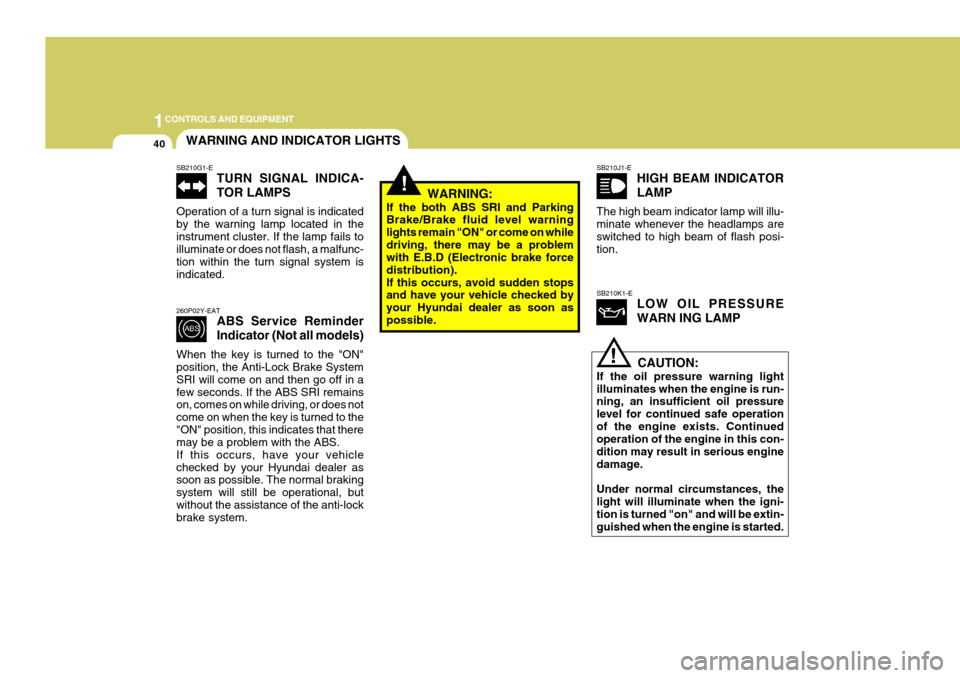
SB210K1-ELOW OIL PRESSURE WARN ING LAMP
SB210G1-ETURN SIGNAL INDICA- TOR LAMPS
Operation of a turn signal is indicated by the warning lamp located in theinstrument cluster. If the lamp fails to illuminate or does not flash, a malfunc- tion within the turn signal system isindicated. 260P02Y-EAT ABS Service Reminder Indicator (Not all models)
When the key is turned to the "ON" position, the Anti-Lock Brake System SRI will come on and then go off in afew seconds. If the ABS SRI remains on, comes on while driving, or does not come on when the key is turned to the"ON" position, this indicates that there may be a problem with the ABS. If this occurs, have your vehiclechecked by your Hyundai dealer as soon as possible. The normal braking system will still be operational, butwithout the assistance of the anti-lock brake system. WARNING:
If the both ABS SRI and ParkingBrake/Brake fluid level warning lights remain "ON" or come on whiledriving, there may be a problem with E.B.D (Electronic brake force distribution).If this occurs, avoid sudden stops and have your vehicle checked by your Hyundai dealer as soon aspossible.SB210J1-E HIGH BEAM INDICATOR LAMP
The high beam indicator lamp will illu- minate whenever the headlamps areswitched to high beam of flash posi- tion.
CAUTION:
If the oil pressure warning light illuminates when the engine is run- ning, an insufficient oil pressure level for continued safe operationof the engine exists. Continued operation of the engine in this con- dition may result in serious enginedamage. Under normal circumstances, the light will illuminate when the igni- tion is turned "on" and will be extin- guished when the engine is started.
Page 223 of 389

1
CONTROLS AND EQUIPMENT
43
B260N01GK-EAT Malfunction Indicator Lamp
This lamp illuminates when there is a malfunction of an exhaust gas relatedcomponent, and the system is not functioning properly so that the ex- haust gas regulation values are notsatisfied. This lamp will also illuminate when the ignition key is turned to the "ON" position, and will go out afterengine starting. If it illuminates while driving, or does not illuminate when the ignition key is turned to the "ON"position, take your car to your nearest authorized Hyundai dealer and have the system checked.
B260E01HP-GAT Seat Belt Warning Light
The seat belt warning light blinks for about 6 seconds when the ignition key is turned from the "OFF" position to"ON" or "START".
B260Q01E-EAT Cruise Indicator (Not all models)
The cruise indicator light in the instru- ment cluster is illuminated when thecruise control main switch on the end of the barrel is pushed. The indicator light does not illuminatewhen the cruise control main switch is pushed a second time. Information about the use of cruisecontrol is beginning on page 1-48.B265C01LZ-EAT Electronic Stability Program Indicator Lights(Not all models)
The electronic stability program indi- cators change operation according to the ignition switch position and whetherthe system is in operation or not. They will illuminate when the ignition key is turned to the "ON" position, butshould go out after three seconds. If the ESP or ESP-OFF indicator stays on, take your car to your authorizedHyundai dealer and have the system checked. See section 2 for more infor- mation about the ESP.
B260R01E-EAT CRUISE SET Indicator
Light (Not all models)
The set indicator light in the instrument cluster is illuminated when the cruisecontrol switch is pushed downward to "SET (COAST)". The set indicator light does not illumi-nate when the control switch is in the "CANCEL" position. B260U01TB-EAT
Immobiliser Warning Light (Not all models)
This indicator light comes on for some seconds after the ignition key is turned to the "ON" position. At this time, youcan start the engine. The light goes out after the engine is running. In case this light goes out before you start theengine, you must turn to the "LOCK" position and restart the engine. In case
Page 238 of 389
1CONTROLS AND EQUIPMENT
58
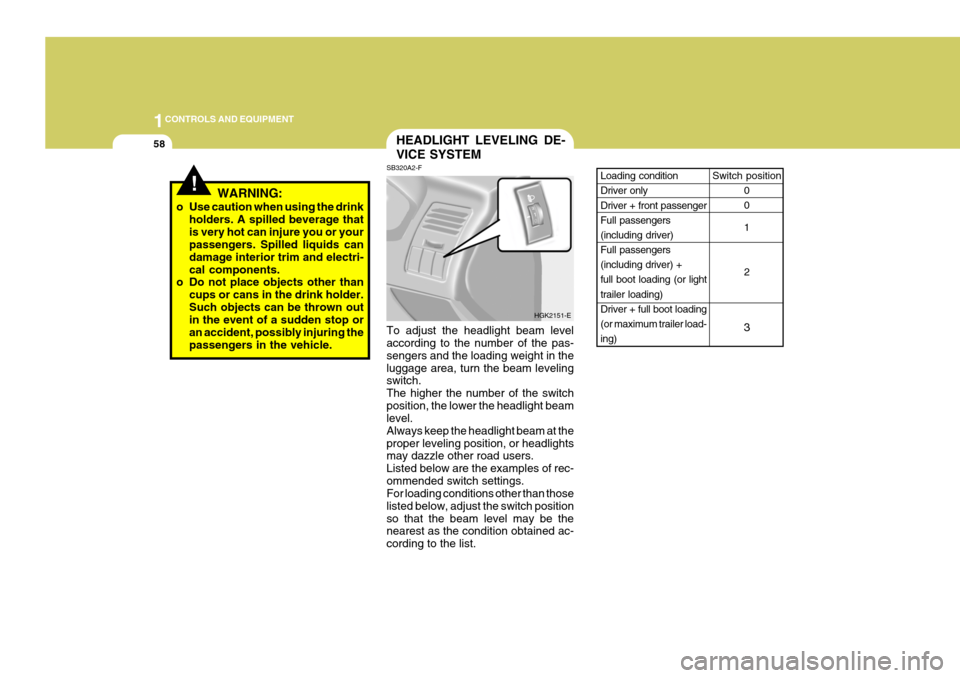
Switch position
0 0 1 2
3Loading condition Driver only Driver + front passenger Full passengers(including driver) Full passengers (including driver) +full boot loading (or light trailer loading) Driver + full boot loading(or maximum trailer load-ing)
!WARNING:
o Use caution when using the drink holders. A spilled beverage that is very hot can injure you or your passengers. Spilled liquids can damage interior trim and electri-cal components.
o Do not place objects other than
cups or cans in the drink holder.Such objects can be thrown out in the event of a sudden stop or an accident, possibly injuring thepassengers in the vehicle.
HEADLIGHT LEVELING DE- VICE SYSTEM
SB320A2-F To adjust the headlight beam level according to the number of the pas- sengers and the loading weight in theluggage area, turn the beam leveling switch. The higher the number of the switchposition, the lower the headlight beam level. Always keep the headlight beam at theproper leveling position, or headlights may dazzle other road users. Listed below are the examples of rec-ommended switch settings. For loading conditions other than those listed below, adjust the switch positionso that the beam level may be the nearest as the condition obtained ac- cording to the list. HGK2151-E