engine oil Hyundai Coupe 2004 Owner's Guide
[x] Cancel search | Manufacturer: HYUNDAI, Model Year: 2004, Model line: Coupe, Model: Hyundai Coupe 2004Pages: 389, PDF Size: 10.22 MB
Page 151 of 389

DO-IT-YOURSELF MAINTENANCE 6-19
CAUTION: A burned-out fuse indicates that there is a
problem in the electrical circuit. If you re- place a fuse and it blows as soon as theaccessory is turned on, the problem is seri-ous and should be referred to a Hyundaidealer for diagnosis and repair. Never re-place a fuse with anything except a fusewith the same or a lower amperage rating. Ahigher capacity fuse could cause damageand create a fire hazard.
NOTE: See page 6-23 for the fuse panel descrip-
tions.
Burned out
G200B03YGood G210A01A-AAT
CHECKING THE BATTERY
WARNING: Batteries can be dangerous! When working
with batteries, carefully observe the follow- ing precautions to avoid serious injuries.
The fluid in the battery contains a strong solu-
tion of sulfuric acid, which is poisonous andhighly corrosive. Be careful not to spill it onyourself or the car. If you do spill battery fluid onyourself, immediately do the following:
o If battery fluid is on your skin, flush the affected areas with water for at least 15 minutes and then seek medical assistance.
o If battery fluid is in your eyes, rinse out your eyes with water and get medical assistanceas soon as possible. While you are beingdriven to get medical assistance, continueto rinse your eyes by using a sponge or softcloth saturated with water.
o If you swallow battery fluid, drink a large quantity of water or milk followed by milk ofmagnesia, eat a raw egg or drink vegetableoil. Get medical assistance as soon aspossible.
While batteries are being charged (either by a
battery charger or by the vehicle's alternator),they produce explosive gases. Always observethese warnings to prevent injuries from occur-ring: G210B01A-AAT
Checking the Battery Keep the battery clean. Any evidence of corro-
sion around the battery posts or terminals shouldbe removed using a solution of household bak-ing soda and warm water. After the batteryterminals are dry, cover them with a light coat-ing of grease.
G220A01A-AAT
CHECKING ELECTRIC COOLING FANS WARNING: The cooling fan is controlled by engine cool-
ant temperature and may sometimes oper- ate even when the engine is not running.Use extreme caution when working near theblades of the coolant fan, so that you are notinjured by a rotating fan blade. As the cool-ant temperature decreases the fan will auto-matically shut off. This is a normal condi-tion.
G220B01A-AAT
Checking Engine Cooling Fan The engine coolant fan should come on auto-
matically if the engine coolant temperature ishigh.
o Charge batteries only in a well ventilated
area.
o Do not permit flames, sparks or smoking in the area.
o Keep children away from the area.
Page 152 of 389

DO-IT-YOURSELF MAINTENANCE
6-20 G260A02A-AAT
REPLACING LIGHT BULBS
Before attempting to replace a headlight bulb, be sure the switch is turned to the "OFF"position. The next paragraph shows how to reach head- light bulbs so they may be changed. Be sure toreplace the burned-out bulb with one of thesame number and wattage rating. CAUTION: Keep the lamps out of contact with petro-leum products such as oil, gasoline etc. G270A02A-GAT HEADLIGHT BULB Replacement instructions:
HGK225
1. Allow the bulb to cool. Wear eye protection.
2. Always grasp the bulb by its plastic base, avoid touching the glass.High Beam Low Beam
Turn signal Light
G240A01A-AAT POWER STEERING HOSES It is suggested that you check the power steer- ing hose connections for fluid leakage daily.The power steering hoses should be replaced ifthere is severe surface cracking, pulling, scuff-ing or worn spots. Deterioration of the hosecould cause premature failure. G250A01A-AAT
FOR MORE INFORMATION ABOUT YOUR HYUNDAI
If you desire additional information about main- taining and servicing your Hyundai, you maypurchase a factory Shop Manual at your Hyundaidealer's parts department. This is the samemanual used by dealership technicians andwhile it is highly technical it can be useful inobtaining a better understanding of your carand how it works.
G230A03A-GAT
POWER STEERING FLUID LEVEL
The power steering fluid level should be checked
regularly.
To check the power steering fluid level, be sure
the ignition is "OFF", then check to make cer-tain that the power steering fluid level is be-tween the "MAX" and "MIN" level markings onthe fluid reservoir.
NOTE: Grinding noise from the power steering
pump may be heard immediately after the engine is started in extremely cold condi-tions (below - 20°F). If the noise stops dur-
HGK214
G220C01A-AAT
Checking Condenser Cooling Fan
The condenser coolant fan should come on
automatically whenever the air conditioning is in operation. ing warm up, there is no abnormal functionin the system. It is due to a power steeringfluid characteristic in extremely cold condi-tions. Recommended Fluid Use PSF-3 type fluid NOTE: Do not start the engine when the power steering oil reservoir is empty.
Page 153 of 389

DO-IT-YOURSELF MAINTENANCE 6-21
G290A02GK-GAT
HEADLIGHT AIMING ADJUSTMENT
Horizontal aiming
G290A01GK
Vertical aiming
3. Disconnect the power cord from the bulb
base in the back of the headlight.
4. Remove the dust cover.
5. Push the bulb spring for removing the head- light bulb.
6. Remove the protective cap from the re- placement bulb and install the new bulb by matching the plastic base with the headlighthole. Install the dust cover after retighteningthe bulb spring and reconnect the powercord.
7. Use the protective cap and carton to dis- pose of the old bulb.
8. Check for proper headlight aim.
WARNING: The halogen bulb contains gas under pres-
sure and if impacted could shatter, resulting in flying fragments. Always wear eye pro-tection when servicing the bulb. Protect thebulb against abrasions or scratches andagainst liquids when lighted. Turn the bulbon only when installed in a headlight. Re-place the headlight if damaged or cracked.Keep the bulb out of the reach of childrenand dispose of the used bulb with care.
Before performing aiming adjustment, make sure
of the following.
Low Beam
G290A02GK
Vertical aiming
High Beam
Horizontal aiming1. Keep all tires inflated to the correct pres-
sure.
2. Place the vehicle on level ground and press the front bumper & rear bumper down sev- eral times. Place vehicle at a distance of 3m(118 in.) from the test wall.
3. See that the vehicle is unloaded (except for full levels of coolant, engine oil and fuel, andspare tire, jack, and tools).
4. Clean the head light lenses and turn on the headlights.
5. Open the hood.
6. Draw the vertical line (through the center of each headlight beam pattern) and the hori-zontal line (through the center of each head-light beam pattern) on the aiming screen. And then, draw a parallel line at 30 mm (1.18 in.) under the horizontal line.
7. Adjust each cut-off line of the low beam to the parallel line with a phillips screwdriver -VERTICAL AIMING.
8. Adjust each cut-off line of the low beam to each vertical line with a phillips screwdriver- HORIZONTAL AIMING.
Page 165 of 389

VEHICLE SPECIFICATIONS 9-3
Oil & Grease Standard
1.6L / 2.7L API SG or SAE 20W-40, 20W-50 (ABOVE -10°C)
ABOVE SAE 15W-40, 15W-50 (ABOVE -15°C) SAE 10W-30 (-25°C ~ 40°C) SAE 10W-40, 10W-50 (ABOVE -25°C)SAE 5W-20 *1, *2 (BELOW -10°C) SAE 5W-30 *1 (BELOW 10°C) SAE 5W-40 *1 (BELOW 20°C)
2.0L API SH or SAE 15W- 40 (ABOVE -10°C)
ABOVE, SAE 10W-30 (-25°C ~ 40°C)
ILSAC GF-1 SAE 10W-40 (ABOVE -25°C)
or ABOVE SAE 5W-20 (BELOW -10°C) *1, *2
SAE 5W-30 (BELOW 10°C) *1SAE 5W-40 (BELOW 20°C) *1
*1. Restricted to driving condition and vehicle destination*2. Not recommended for sustained high speed vehicle operationNormal driving condition Severe driving condition HYUNDAI GENUINE PARTS MTF 75W/90 (API GL-4)DIAMOND ATF SP- III or SK ATF SP- III
PSF-3DOT 3 or DOT 4 equivalent Ethylene glycol base for aluminium radiator
J080A03GK-GAT
LUBRICATION CHART
Item
Engine Oil Engine Oil Consumption TransaxlePower Steering Brake Fluid CoolantQ'ty (liter) (us.qts., Imp.qts.)
Engine Oil: 1.6 L : 3.3 (3.5, 2.9)2.0 L : 3.85 (4.07, 3.39) 2.7 L : 4.5 (4.76, 4.0) Oil Pan: 1.6 L : 3.0 (3.17, 2.64) (MAX)
2.0 (2.11, 1.76) (MIN)
2.0 L : 3.55 (3.75, 3.12) (MAX) 2.6 (2.75, 3.3) (MIN)
2.7 L : 4.2 (4.44, 3.7) (MAX) 3.4 (3.59, 3) (MIN)
Oil Filter : 0.3 (0.32, 0.26) MAX. 1L / 1500 Km MAX. 1L / 1000 Km5 speed:2.15(2.27, 1.86) 6 speed:2.2(2.32, 1.94)
7.8 (8.2, 6.9) As requiredAs required 1.6L/2.0L : 7.0 (7.4, 6.2) 2.7L : 8.0 (8.5, 7.0)
Manual Auto
Page 167 of 389

INDEX
10-2
Driving
Economical driving ....................................................................... 2-11
Smooth cornering ......................................................................... 2-11
Winter driving ................................................................................ 2-11
E Emissions Control Systems ................................................................ 7-1
Engine Before starting the engine .............................................................. 2-2
Changing the oil and filter .............................................................. 6-6
Compartment .................................................................................. 6-1
Coolant ........................................................................................... 6-7
Coolant temperature gauge .......................................................... 1-29
If the engine overheats ................................................................... 3-2
Number ........................................................................................... 8-1
Oil .................................................................................................. 6-4 Oil consumption .............................................................................. 6-6
Starting ........................................................................................... 2-3
Engine Exhaust Can Be Dangerous ................................................... 2-1
FFog Li ght ........................................................................................... 1-43
Front Seats Adjustable front seats ..................................................................... 1-8
Adjustable headrests ...................................................................... 1-8Adjusting seat forward and rearward ............................................. 1-8
Adjusting seatback angle ...................... ......................................... 1-8
Lumbar support control ............... ................................................... 1-9
Seat cushion height adjustment ..................................................... 1-9
Seat warm er ................................................................................... 1-9
Fuel
Capacity .......................................................................................... 9-1
Gauge ........................................................................................... 1-28
Recommendations .......................................................................... 1-1 Fuel Filler Lid
Remote release ............................................................................ 1-45
Fuse Panel Description .......................................................... 6-23 ~ 6-24
Fuses ................................................................................................ 6-17
GGeneral Everyday Checks .................................................................. 6-4
Glove box .......................................................................................... 1-41
HHazard Warn ing System ................................................................... 1-36
Headlight Bulb ................................................................................... 6-20
Headlight Leveling Device System ................................................... 1-38
Heating and Cooling Control Rotary type ........................................................................ 1-51 ~ 1-56
Automatic type ................................................................... 1-57 ~ 1-62
High-mounted rear stoplight .............................................................. 1-44
Hood Release ................................................................................... 1-44
Horn ................................................................................................ 1-47
IIgnition Switch ..................................................................................... 2-2
Immobilizer System ............................................................................. 1-2
Infinity Sound System (B260) ........................................................... 1-80
Anti-Theft Device .......................................................................... 1-81
General operation ......................................................................... 1-81
Radio operation ............................................................................ 1-82
CD operation ................................................................................ 1-83
Instrument Cluster and Indicator ....................................................... 1-26
Instrument Panel Light Control (Rheostat) .......................................1-37
Instruments and Controls .................................................................. 1-25
Intermittent Wiper .............................................................................. 1-35
Page 183 of 389
1
CONTROLS AND EQUIPMENT
3RUNNING IN YOUR NEW HYUNDAI
B020A01S-EAT The longevity and performance of the vehicle are greatly affected by the care exercised during the first 1,000 miles of motoring. Because of modern manu-facturing techniques, rigid guidelines regarding maximum road speeds have become unnecessary. However, cer-tain precautions should be observed in order to obtain the best possible per- formance and useful life from the ve-hicle.
1) Do not race the engine without a
load (i.e revving the engine in neu- tral).
2) During the first 500 miles the maxi- mum engine speed should be re-stricted to 3,000 rpm and gradually increased thereafter.
3) Avoid prolonged constant speed operation. The internal componentsof the engine will become morequickly run in if the operation speed is varied during the running in pe- riod.
4) Never allow the engine to labour. Use the gearbox freely and avoidlarge throttle openings when theengine speed is below 1,500 rpm.BEFORE ENTERING THE VEHICLEAFTER ENTERING THE VEHICLE
YB020A1-E
o Ensure that all windows, mirrors
and lamps are clean.
o Check condition of all tyres.
o Ensure that no fluid leaks are evi-
dent.
o Ensure that the area around the vehicle is clear before driving off. YB020B1-E
o Ensure that all occupants fasten
and correctly adjust seat belts.
o Ensure that seat and headrestraint positions are adjusted for optimum safety, control and comfort.
o Adjust interior and exterior rear view mirrors.
o Verify correct operation of lamps, horn and other electrical equipment.
o Ensure that warning lamps illumi-
nate when ignition is turned on.
NOTE: Fluid levels such as engine oil, en- gine coolant, brake and windscreenwasher fluid should be checked daily or at each refuelling, which- ever occurs sooner.
Page 220 of 389
1CONTROLS AND EQUIPMENT
40
!
!
WARNING AND INDICATOR LIGHTS
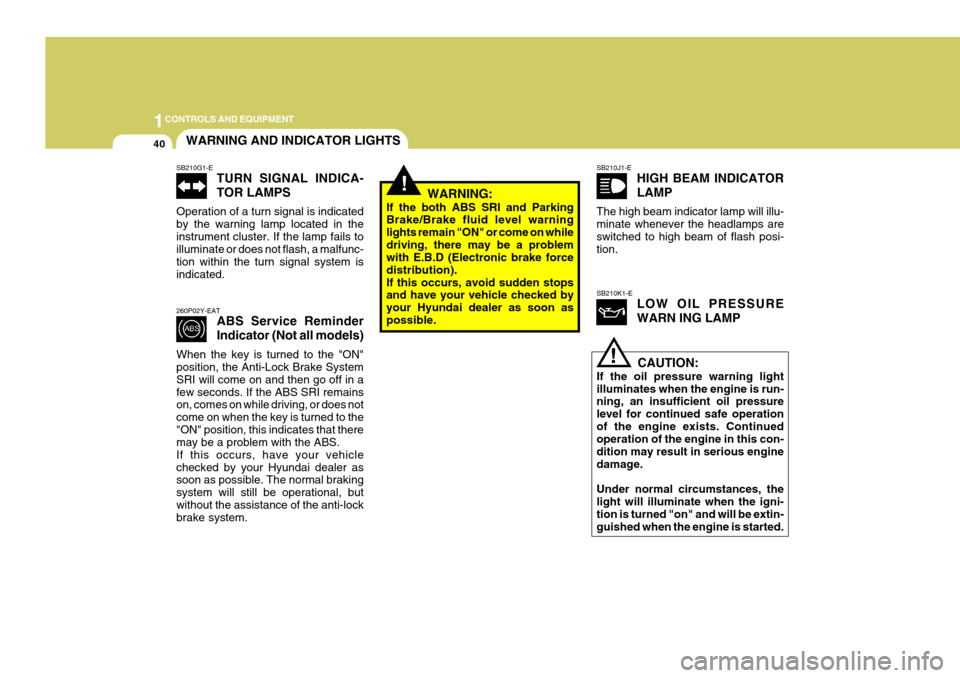
SB210K1-ELOW OIL PRESSURE WARN ING LAMP
SB210G1-ETURN SIGNAL INDICA- TOR LAMPS
Operation of a turn signal is indicated by the warning lamp located in theinstrument cluster. If the lamp fails to illuminate or does not flash, a malfunc- tion within the turn signal system isindicated. 260P02Y-EAT ABS Service Reminder Indicator (Not all models)
When the key is turned to the "ON" position, the Anti-Lock Brake System SRI will come on and then go off in afew seconds. If the ABS SRI remains on, comes on while driving, or does not come on when the key is turned to the"ON" position, this indicates that there may be a problem with the ABS. If this occurs, have your vehiclechecked by your Hyundai dealer as soon as possible. The normal braking system will still be operational, butwithout the assistance of the anti-lock brake system. WARNING:
If the both ABS SRI and ParkingBrake/Brake fluid level warning lights remain "ON" or come on whiledriving, there may be a problem with E.B.D (Electronic brake force distribution).If this occurs, avoid sudden stops and have your vehicle checked by your Hyundai dealer as soon aspossible.SB210J1-E HIGH BEAM INDICATOR LAMP
The high beam indicator lamp will illu- minate whenever the headlamps areswitched to high beam of flash posi- tion.
CAUTION:
If the oil pressure warning light illuminates when the engine is run- ning, an insufficient oil pressure level for continued safe operationof the engine exists. Continued operation of the engine in this con- dition may result in serious enginedamage. Under normal circumstances, the light will illuminate when the igni- tion is turned "on" and will be extin- guished when the engine is started.
Page 221 of 389
1
CONTROLS AND EQUIPMENT
41
!
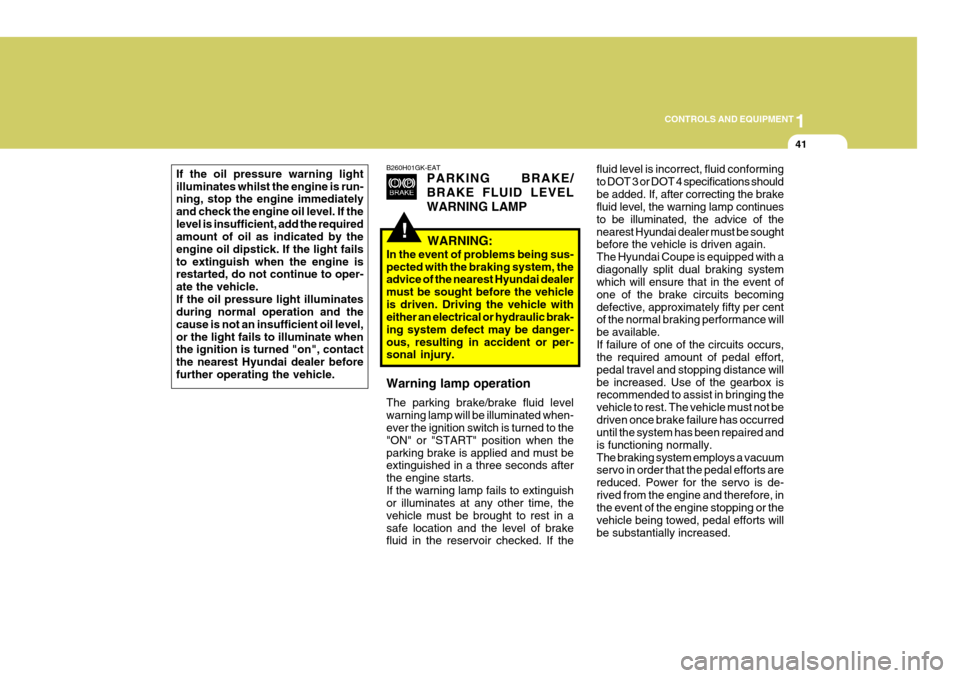
If the oil pressure warning light illuminates whilst the engine is run- ning, stop the engine immediately and check the engine oil level. If thelevel is insufficient, add the required amount of oil as indicated by the engine oil dipstick. If the light failsto extinguish when the engine is restarted, do not continue to oper- ate the vehicle.If the oil pressure light illuminates during normal operation and the cause is not an insufficient oil level,or the light fails to illuminate when the ignition is turned "on", contact the nearest Hyundai dealer beforefurther operating the vehicle. B260H01GK-EAT
PARKING BRAKE/ BRAKE FLUID LEVELWARNING LAMP
WARNING:
In the event of problems being sus- pected with the braking system, the advice of the nearest Hyundai dealer must be sought before the vehicleis driven. Driving the vehicle with either an electrical or hydraulic brak- ing system defect may be danger-ous, resulting in accident or per- sonal injury. Warning lamp operation The parking brake/brake fluid level warning lamp will be illuminated when- ever the ignition switch is turned to the "ON" or "START" position when theparking brake is applied and must be extinguished in a three seconds after the engine starts.If the warning lamp fails to extinguish or illuminates at any other time, the vehicle must be brought to rest in asafe location and the level of brake fluid in the reservoir checked. If the fluid level is incorrect, fluid conforming to DOT 3 or DOT 4 specifications shouldbe added. If, after correcting the brake fluid level, the warning lamp continues to be illuminated, the advice of thenearest Hyundai dealer must be sought
before the vehicle is driven again. The Hyundai Coupe is equipped with adiagonally split dual braking system which will ensure that in the event of one of the brake circuits becomingdefective, approximately fifty per cent of the normal braking performance will be available.If failure of one of the circuits occurs, the required amount of pedal effort, pedal travel and stopping distance willbe increased. Use of the gearbox is recommended to assist in bringing the vehicle to rest. The vehicle must not bedriven once brake failure has occurred until the system has been repaired and is functioning normally.The braking system employs a vacuum servo in order that the pedal efforts are reduced. Power for the servo is de-rived from the engine and therefore, in the event of the engine stopping or the vehicle being towed, pedal efforts willbe substantially increased.
Page 222 of 389

1CONTROLS AND EQUIPMENT
42
!
SB210M1-E
CHARGING SYSTEM WARNING LAMP
The charging system warning lamp should illuminate when the ignitionswitch is turned to the "ON" position and should be extinguished when the engine is started. If the lamp fails toilluminate when the ignition is turned "ON" or fails to extinguish after starting the engine, the nearest Hyundai dealershould be contacted. If the lamp illumi- nates whilst the vehicle is being driven, stop the vehicle as soon as it is safe todo so and check the condition of the generator drive belt. If the belt is in place and the tension is satisfactory,the advice of a Hyundai dealer should be sought.
CAUTION:
If the drive belt (generator belt) is loose, broken, or missing while thevehicle is driving, there may be a serious malfunction, engine could overheat because this belt alsodrives the water pump.
SB210P1-E LOW FUEL LEVEL WARNING LAMP
The low fuel warning lamp serves to warn the driver that the remaining fuelquantity is approximately 9 litres and that the vehicle should be refuelled. If the vehicle is driven for an extendedperiod with the low fuel warning lamp illuminated there exists a possibility that misfiring due to fuel shortage mayoccur. This situation must be avoided to prevent damage to the catalyst oc- curring.
SB2100I-E
DOOR AJAR WARNING LAMP
The door ajar warning lamp indicates that a door is not correctly closed.Ensure that the lamp is extinguished prior to driving the vehicle.
B260B01JM-AATSRS (Airbag) Service Re- minder Indicator (SRI)(Not all models)
The SRS service reminder indicator (SRI) comes on for about 6 seconds after key is turned to the "ON" positionor after the engine is started, after which it will go out. This light also comes on when the SRS is not working properly. If the SRI does not come on, or continuously remainson after operating for about 6 seconds when you turned the ignition key to the "ON" position or started the engine, orif it comes on while driving, have the SRS inspected by an authorized Hyundai Dealer.
SB210N2-E HATCHBACK DOOR OPEN WARNING LAMP
The hatchback door warning lamp in- dicates when the hatchback door isopen or is not fully closed. Ensure that the lamp has extinguished prior to driving the vehicle.
Page 279 of 389
2
DRIVING YOUR HYUNDAI
3TO START THE ENGINEBEFORE STARTING THE EN- GINE
SC030A1-E Before you start the engine, you should always:
1. Look around the vehicle to be sure
there are no flat tires, puddles of oil or water or other indications of pos- sible trouble.
2. After entering the car, check to be sure the parking brake is engaged.
3. Check that all windows, and lights
are clean.
4. Check that the interior and exterior mirrors are clean and in position.
5. Check your seat, seatback and head restraint to be sure they are intheir proper positions.
6. Close all the doors.
7. Fasten your seat belt and be sure that all other occupants have fas-tened theirs.
8. Turn off all lights and accessories that are not needed.
9. When you turn the ignition switch to "ON' check that all appropriate warning lights are operating and that you have sufficient fuel.
10.Check the operation of warning lights and all bulbs when key is inthe "ON" position. SC040A1-F COMBINATION IGNITION SWITCH AND STEERING LOCK
o If your Hyundai is equipped with a
manual transaxle, place the shift lever in neutral and depress the clutch pedal fully.
o If your Hyundai has an automatic
transaxle, place the shift lever in "P"(park).
o To start the engine, insert the igni- tion key and turn it to the "START"position. Release it as soon as the engine starts. Do not hold the key inthe "START" position for more that 15 seconds.
NOTE: For safety, the engine will not start if the shift lever is not in "P" or "N" Position (Auto T/A).
!
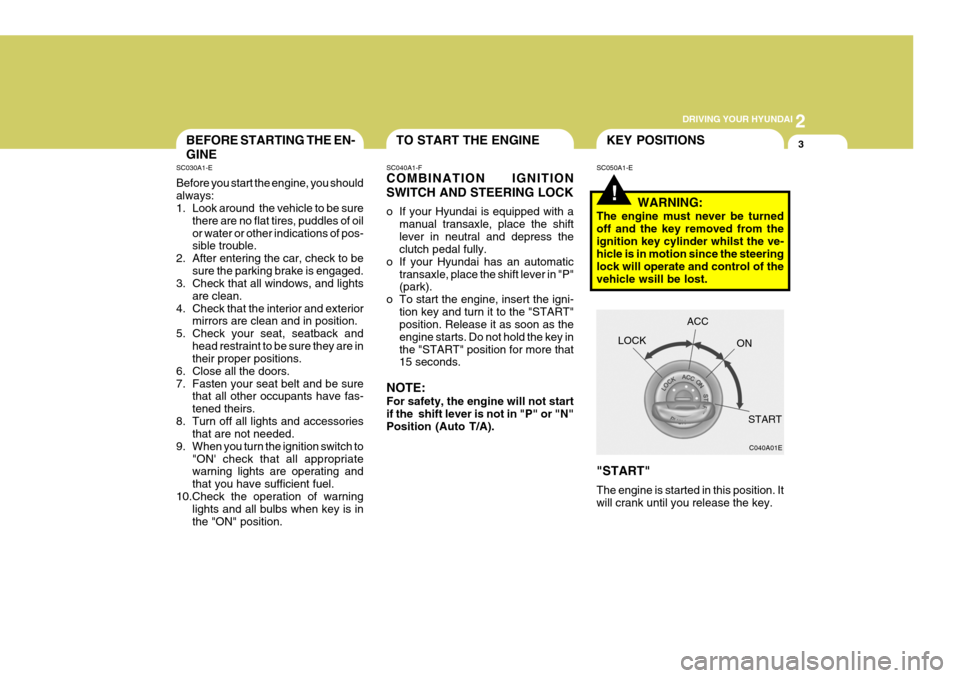
SC050A1-E KEY POSITIONS
WARNING:
The engine must never be turned off and the key removed from theignition key cylinder whilst the ve- hicle is in motion since the steering lock will operate and control of thevehicle wsill be lost. "START" The engine is started in this position. It will crank until you release the key. LOCK
C040A01E
ACC
ON
START