air condition Hyundai Coupe 2004 Repair Manual
[x] Cancel search | Manufacturer: HYUNDAI, Model Year: 2004, Model line: Coupe, Model: Hyundai Coupe 2004Pages: 389, PDF Size: 10.22 MB
Page 336 of 389
6OWNER MAINTENANCE
10
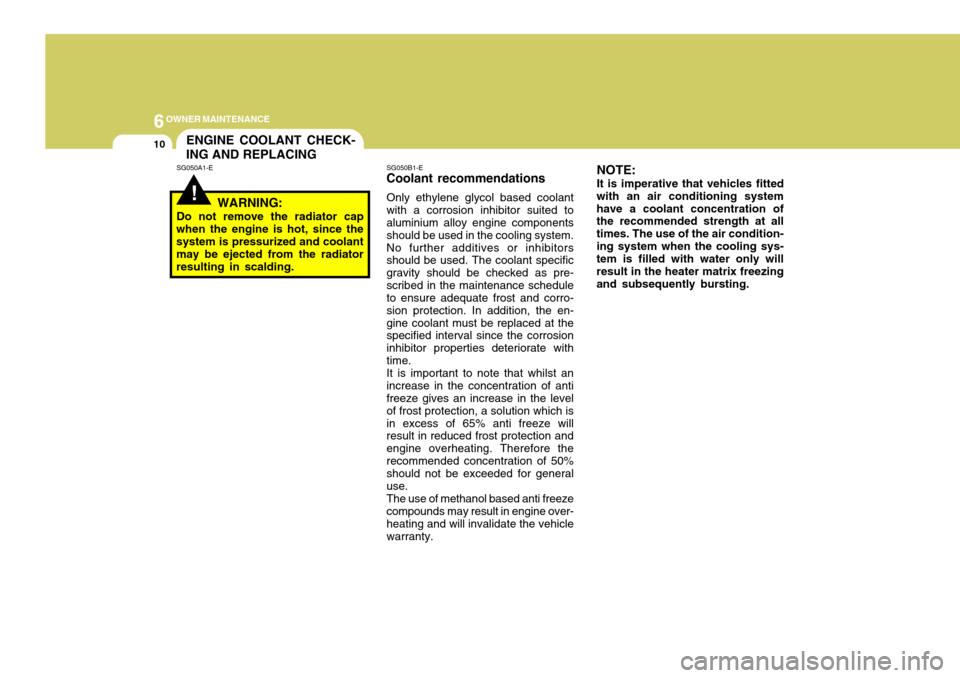
SG050B1-E
Coolant recommendations
Only ethylene glycol based coolant with a corrosion inhibitor suited to aluminium alloy engine components should be used in the cooling system.No further additives or inhibitors should be used. The coolant specific gravity should be checked as pre-scribed in the maintenance schedule to ensure adequate frost and corro- sion protection. In addition, the en-gine coolant must be replaced at the specified interval since the corrosion inhibitor properties deteriorate withtime.It is important to note that whilst anincrease in the concentration of anti freeze gives an increase in the level of frost protection, a solution which isin excess of 65% anti freeze will result in reduced frost protection and engine overheating. Therefore therecommended concentration of 50% should not be exceeded for general use. The use of methanol based anti freeze compounds may result in engine over- heating and will invalidate the vehiclewarranty.
!
ENGINE COOLANT CHECK- ING AND REPLACING
SG050A1-E
WARNING:
Do not remove the radiator cap
when the engine is hot, since the system is pressurized and coolant may be ejected from the radiator resulting in scalding. NOTE: It is imperative that vehicles fitted
with an air conditioning system have a coolant concentration of the recommended strength at all times. The use of the air condition-ing system when the cooling sys- tem is filled with water only will result in the heater matrix freezingand subsequently bursting.
Page 338 of 389

6OWNER MAINTENANCE
12
G050D04E
SPARK PLUGS
G060A01GK-EAT Your engine was originally equipped with platinum-tipped or iridium-tipped spark plugs (2.7L only).Platinum-tipped or iridium-tipped sparkplugs will last longer than conven-tional type spark plugs. Platinum- tipped spark plug can be identified by blue lines on the ceramic shell. NOTE: Do not clean or regap platinum- tipped/iridium-tipped spark plugs.
0.039 ~ 0.043 in. (1.0~1.1 mm)
!WARNING:
The cooling fan is controlled by engine coolant temperature and may sometimes operate even whenthe engine is not running. Use extreme caution when working near the blades of the cooling fan sothat you are not injured by a rotat- ing fan blade. As the engine cool- ant temperature decreases, the fanwill automatically shut off. This is a normal condition.
5. Prepare a suitable quantity of new
engine coolant (refer to section 9) and pour this into the radiator.
HSM392
1.6L/2.0L 2.7L
0.039 ~ 0.043 in. (1.0~1.1 mm)
6. Start the engine with the radiator
cap still removed and continue to add coolant as the level decreases as air is expelled from the system.When the level remains constant, replace the radiator cap and re- plenish the coolant reservoir.
7. When the engine is hot, check to ensure that no coolant leaks arepresent.
Page 348 of 389

6OWNER MAINTENANCE
22
HGK5013-E
CHECKING THE CLUTCH FLUID
SG130A1-C
(Not all models)To Check the Clutch Fluid
The clutch fluid level in the master cylinder should be checked when performing other under bonnet checks. The system should be checked forleakage at the same time.Ensure that the clutch fluid level isalways between the "MAX" and "MIN" level markings on the fluid reservoir. Fill as required. Fluid loss indicates aleak in the clutch system which should be inspected and repaired immedi- ately.
HGK5012
SG120D1-E Brake Fluid Level The fluid level in the brake fluid reser- voir should be checked periodically. The level should be between the "MIN" and "MAX" marks on the side of thereservoir. If the level is at or below the "MIN" mark, fluid should be added having carefully cleaned the area sur-rounding the reservoir cap to ensure that dirt is not allowed to enter the system. It should be borne in mindthat the brake fluid level will decrease slightly as the friction linings of the pads and shoes become worn andthat this is a normal condition.
WARNING:
Brake fluid is hygroscopic and should never be stored in an un- sealed container. The presence ofwater in the braking system will cause vapour locks and increase the possibility of brake fade alongwith promoting corrosion within the braking system. The brake fluid must be changed at the specifiedtime or mileage interval to ensure continued safe operation of the system. Brake fluid will cause rapidand serious damage to paintwork. If accidental spillage occurs, the affected area must be rinsed withwater immediately. Do not allow brake fluid to come into contact with the eyes or to be ingestedand ensure that fluid is safely stored away form the reach of chil- dren.
!
Page 349 of 389

6
OWNER MAINTENANCE
23
!
SG130B2-E
Adding Fluid
Recommended brake fluid conform-
ing to DOT 3 or DOT 4 should be used. The reservoir cap must be fully tightened to avoid contamination fromforeign matter or moisture.
WARNING:
Brake fluid will cause rapid and
serious damage to paintwork. Ifaccidental spillage occurs, the af-fected area must be rinsed with water immediately. Do not allow brake fluid to come into contactwith the eyes or to be ingested and ensure that fluid is safely stored away form the reach of children. SG140A1-E
Condenser
Ensure that the condenser is periodi-cally inspected and that accumula- tions of dirt, dead insects and leaves etc, are removed to ensure that theefficiency of the system is not im- paired. Care must be exercised to ensure that the condenser fins arenot damaged during cleaning. AIR CONDITIONING SYSTEM MAINTENANCE
!
SG140C2-E
Checking the Refrigerant
1. Start the engine and run at idle for
several minutes with the refrigera- tion system running at the coldest setting.
2. If the air coming out of the in-dash vents is not cold, have the air con-ditioning system inspected by your Hyundai dealer.
CAUTION:
Running the air conditioning sys-
tem for extended periods of time with a low refrigerant level maydamage the compressor.
CAUTION:
Brake fluid is hygroscopic andshould never be stored in an un-sealed container. Do not allow petroleum base fluid to contami- nate the brake fluid since damageto the rubber seals of the system may result.
!
Page 350 of 389

6OWNER MAINTENANCE
24
SG140D1-E Off Season Maintenance The air conditioning must be run for ten minutes or so weekly during peri- ods when the system would not nor- mally be used to ensure that thecompressor and seals are lubricated. If this precaution is not observed the compressor seals may become stuckto the compressor shaft and dam- aged when the system is next used resulting in a loss of refrigerant anddamage to the compressor. SG140B1-E
Compressor Drive Belt The air conditioning compressor drive
belt should be checked to ensurefreedom from damage or excessive wear and correct tension. The belt tension is correct when the belt de-flects by about 0.3 inches (8 mm) when a force of 98 N is applied to the belt halfway between the compressorand crankshaft pulleys. Adjustment of the belt should be entrusted to a Hyundai dealer.
Crankshaft pulley HTB219
A/C
Tension pulley 8mm (0.315 in.)
1.6L / 2.0L
G190A02B
A/C comp.
Crankshaft pulley
Power steering
Auto tensioner
Generator
2.7 L
Page 356 of 389
6OWNER MAINTENANCE
30
o If battery electrolyte is spilled onto
skin or into eyes, the effected area must be flushed with copious amounts of water and medical assis-tance sought.
o If battery electrolyte is ingested, copious amounts of water or milkfollowed by an ant-acid (raw egg ormilk of magnesia) must be drunk. Vomiting should not be induced and medical assistance must besought.
o Batteries must only be charged in well venti-lated areas from which naked lights or sources of sparks are excluded.
o Ensure that children, pets or other unautho-rized persons are keptaway from batteries.
o Do not allow anything to bridge the
positive (+) and negative (-) termi-nals of the battery.
o Never invert the battery.
The battery fitted during production isof the "Maintenance Free" type.
ELECTRIC COOLING FANS
!
YG210A1-E
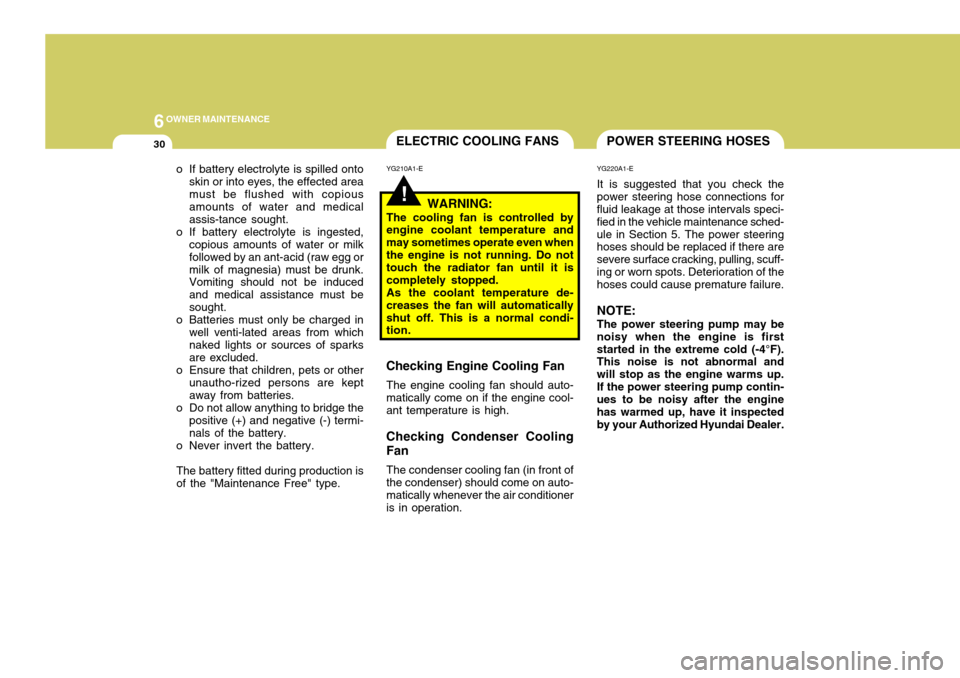
WARNING:
The cooling fan is controlled by engine coolant temperature and may sometimes operate even whenthe engine is not running. Do not touch the radiator fan until it is completely stopped.As the coolant temperature de-creases the fan will automaticallyshut off. This is a normal condi- tion.
Checking Engine Cooling Fan The engine cooling fan should auto- matically come on if the engine cool-ant temperature is high.
Checking Condenser Cooling Fan The condenser cooling fan (in front of the condenser) should come on auto- matically whenever the air conditioneris in operation.
POWER STEERING HOSES
YG220A1-E It is suggested that you check the power steering hose connections for fluid leakage at those intervals speci- fied in the vehicle maintenance sched-ule in Section 5. The power steering hoses should be replaced if there are severe surface cracking, pulling, scuff-ing or worn spots. Deterioration of the hoses could cause premature failure. NOTE: The power steering pump may be noisy when the engine is firststarted in the extreme cold (-4°F). This noise is not abnormal and will stop as the engine warms up.If the power steering pump contin- ues to be noisy after the engine has warmed up, have it inspectedby your Authorized Hyundai Dealer.
Page 372 of 389
7EMISSION CONTROL SYSTEMS
2
SH010A1-E (Not all models) Depending upon the market for which the vehicle is destined, the emission control system will comprise one or more of the following emission controldevices.
(1) Crankcase emission control sys-
tem
(2) Evaporative emission control sys- tem
(3) Exhaust emission control systemIn order that the proper functioning of the emission control systems may be ensured, it is recommended that the vehicle is inspected and maintainedby an authorized Hyundai dealer in accordance with the maintenance schedule in this manual. EMISSION CONTROL SYS- TEMS
SH010B1-E
1. CRANKCASE EMISSION CON- TROL SYSTEM The positive crankcase ventilation system is employed to prevent air pollution caused by blow-by gases being emitted from the crankcase byintroducing fresh air to the crankcase through the air cleaner where this mixes with blow-by gases and thenpasses through the PCV valve into the intake manifold from where it sub- sequently enters the combustionchamber and is burned.
SH010C1-E
2. EVAPORATIVE EMISSION
CONTROL SYSTEM
The Evaporative Emission Control
System is designed to prevent fuelvapours from escaping into the atmo-sphere through the fuel tank ventila- tion system. SH010D1-E
3. EXHAUST EMISSION
CONTROL SYSTEM
The exhaust emission control system
is a highly effective system which controls exhaust emission while main- taining good vehicle performance. Whilst the engine is not running, fuel vapours generated inside the fuel tankare absorbed and stored in a char- coal canister. When the engine is started, the vapours stored in thecanister are drawn into the induction system through the purge control so- lenoid valve and are subsequentlyburned.The purge control solenoid valve iscontrolled by the ECU; when the en-gine coolant temperature is low or the engine is idling, the purge control valve is closed and fuel vapours re-main stored in the canister. Under normal running conditions when the engine is warm, the valve opens andthe vapours are drawn into the inlet tract and subsequently burned in the combustion chamber.
Page 386 of 389
10INDEX
2
A Air bag ....................................................................... 1-30
Air conditioning switch .............................................. 1-82
Air conditioning system m aintenance ....................... 6-23
Antenna ..................................................................... 1-96
Anti-lock brake system (ABS) ................................... 2-12
Audio remote control switch ..................................... 1-73
Automatic transaxle lubricant ....................................6-19
Automatic transaxle .................................................... 2-8
BBattery maintenance ................................................. 6-29
Before folding the rear seats .................................... 1-17
Before starting the engine .......................................... 2-3 Bonnet release .......................................................... 1-65
Brake pedal freeplay ................................................. 6-26
Brake system checking ............................................. 6-21
C Care of cassette tape ............................................... 1-95
Care of disc .............................................................. 1-94
Care of seat belts ..................................................... 1-20
Catalytic convertor ...................................................... 7-3
Central door lock ......................................................... 1-7
Changing a flat type ................................................... 3-6
Changing the air cleaner filter .................................. 6-15
Checking the clutch fluid ................... ....................... 6-22 Child restraint system
............................................... 1-22
Cigar lighter ............................................................... 1-56
Clutch pedal freeplay ................................................ 6-26
Cruise control ............................................................ 1-70
D Daily operating checks ................................................ 6-5
Day/nignt rear view mirror ... .....................................1-63
Defrosting/defogging ................................................. 1-80
Digital clock ............................................................... 1-56
Door locks ................................................................... 1-6
Drink holder ............................................................... 1-57
Drive belts ................................................................. 6-27
Driving for econom y .................................................. 2-14
EEffective braking ....................................................... 2-11
Electric cooling fans .................................................. 6-30
Emission control systems ........................................... 7-2
Engine compartm ent ................................................... 6-2
Engine coolant checking and replacing ....................6-10
Engine coolant temperature guage ...........................1-44
Engine oil and filter replacement ................................ 6-8
Engine oil consumption ............................................... 6-7
Engine oil r eplenishment ............................................. 6-7
Engine oil .................................................................... 6-5
Exterior rear view mirror .... .......................................1-62