radiator Hyundai Coupe 2005 User Guide
[x] Cancel search | Manufacturer: HYUNDAI, Model Year: 2005, Model line: Coupe, Model: Hyundai Coupe 2005Pages: 478, PDF Size: 13.44 MB
Page 209 of 478
6
DO-IT-YOURSELF MAINTENANCE
11
HGK4006
G050C01A-AAT
To Check the Coolant Level
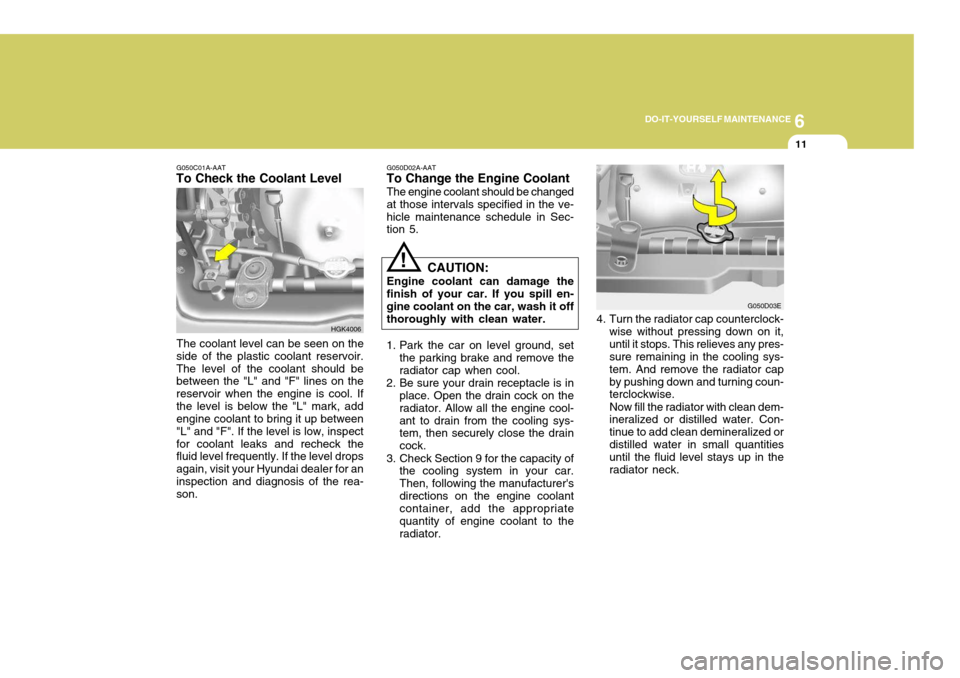
The coolant level can be seen on the
side of the plastic coolant reservoir. The level of the coolant should be between the "L" and "F" lines on the reservoir when the engine is cool. Ifthe level is below the "L" mark, add engine coolant to bring it up between "L" and "F". If the level is low, inspectfor coolant leaks and recheck the fluid level frequently. If the level drops again, visit your Hyundai dealer for aninspection and diagnosis of the rea- son. G050D02A-AAT
To Change the Engine Coolant
The engine coolant should be changed at those intervals specified in the ve-hicle maintenance schedule in Sec- tion 5.
CAUTION:
Engine coolant can damage the finish of your car. If you spill en- gine coolant on the car, wash it off thoroughly with clean water.
!
1. Park the car on level ground, set the parking brake and remove the radiator cap when cool.
2. Be sure your drain receptacle is in place. Open the drain cock on the radiator. Allow all the engine cool-ant to drain from the cooling sys- tem, then securely close the drain cock.
3. Check Section 9 for the capacity of the cooling system in your car.Then, following the manufacturer'sdirections on the engine coolant container, add the appropriate quantity of engine coolant to theradiator. 4. Turn the radiator cap counterclock-
wise without pressing down on it,until it stops. This relieves any pres- sure remaining in the cooling sys- tem. And remove the radiator capby pushing down and turning coun- terclockwise. Now fill the radiator with clean dem- ineralized or distilled water. Con- tinue to add clean demineralized ordistilled water in small quantities until the fluid level stays up in the radiator neck. G050D03E
Page 210 of 478
6 DO-IT-YOURSELF MAINTENANCE
12CHANGING THE AIR CLEANER FILTER
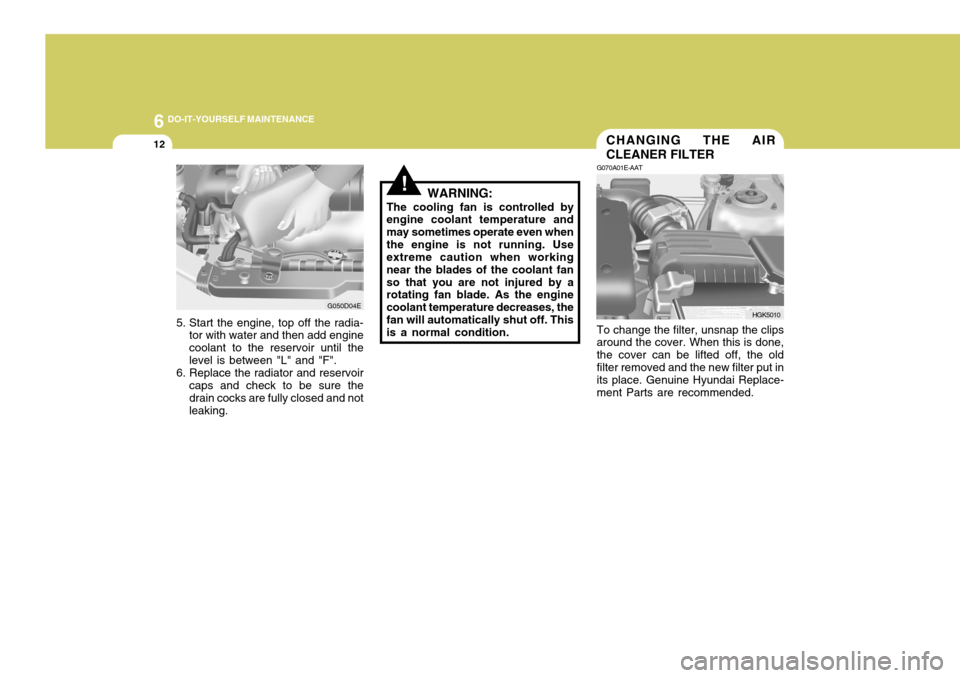
G070A01E-AAT To change the filter, unsnap the clips around the cover. When this is done, the cover can be lifted off, the oldfilter removed and the new filter put in its place. Genuine Hyundai Replace- ment Parts are recommended.
HGK5010G050D04E
!WARNING:
The cooling fan is controlled by engine coolant temperature and may sometimes operate even whenthe engine is not running. Use extreme caution when working near the blades of the coolant fanso that you are not injured by a rotating fan blade. As the engine coolant temperature decreases, thefan will automatically shut off. This is a normal condition.
5. Start the engine, top off the radia-
tor with water and then add engine coolant to the reservoir until the level is between "L" and "F".
6. Replace the radiator and reservoir caps and check to be sure thedrain cocks are fully closed and not leaking.
Page 213 of 478
6
DO-IT-YOURSELF MAINTENANCE
15
2. Pull up the wiper blade until you
hear an audible "click" to engage in the end of the wiper arm.
NOTE: Do not allow the wiper arm to fall against the windshield. HHR5051
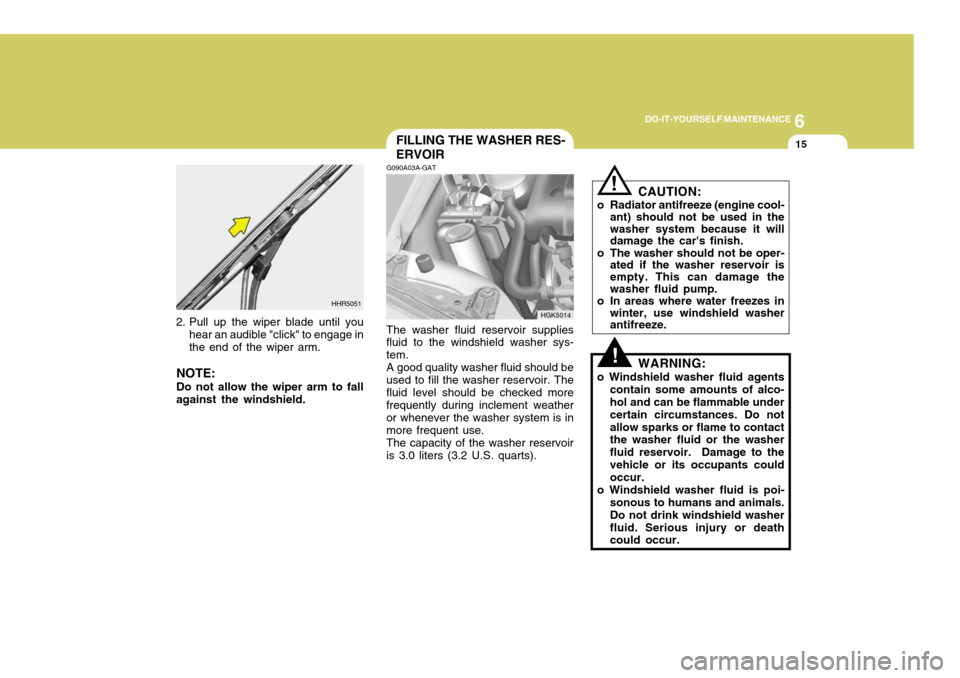
G090A03A-GAT The washer fluid reservoir supplies fluid to the windshield washer sys- tem.A good quality washer fluid should beused to fill the washer reservoir. Thefluid level should be checked more frequently during inclement weather or whenever the washer system is inmore frequent use.The capacity of the washer reservoiris 3.0 liters (3.2 U.S. quarts).FILLING THE WASHER RES- ERVOIR
HGK5014
!
CAUTION:
o Radiator antifreeze (engine cool- ant) should not be used in the washer system because it will damage the car's finish.
o The washer should not be oper- ated if the washer reservoir is empty. This can damage the washer fluid pump.
o In areas where water freezes in winter, use windshield washerantifreeze.!
WARNING:
o Windshield washer fluid agents contain some amounts of alco- hol and can be flammable under certain circumstances. Do notallow sparks or flame to contact the washer fluid or the washer fluid reservoir. Damage to thevehicle or its occupants could occur.
o Windshield washer fluid is poi- sonous to humans and animals. Do not drink windshield washerfluid. Serious injury or death could occur.
Page 215 of 478
6
DO-IT-YOURSELF MAINTENANCE
17
HGK5007
HGK3025
G110D02Y-AAT
To Check the Transaxle Fluid Level
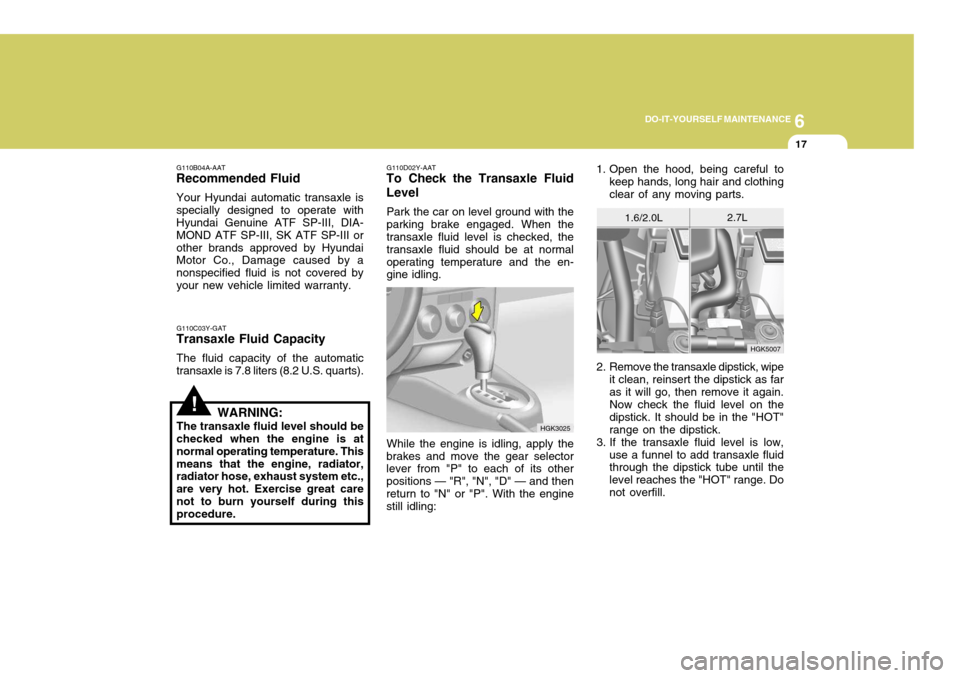
Park the car on level ground with the parking brake engaged. When the transaxle fluid level is checked, the transaxle fluid should be at normaloperating temperature and the en- gine idling. 1. Open the hood, being careful to
keep hands, long hair and clothing clear of any moving parts.
1.6/2.0L
!
G110C03Y-GAT
Transaxle Fluid Capacity
The fluid capacity of the automatic transaxle is 7.8 liters (8.2 U.S. quarts).
WARNING:
The transaxle fluid level should be checked when the engine is at normal operating temperature. Thismeans that the engine, radiator, radiator hose, exhaust system etc., are very hot. Exercise great carenot to burn yourself during this procedure. 2.7L
While the engine is idling, apply the
brakes and move the gear selectorlever from "P" to each of its other positions — "R", "N", "D" — and thenreturn to "N" or "P". With the engine still idling: 2. Remove the transaxle dipstick, wipe
it clean, reinsert the dipstick as far as it will go, then remove it again. Now check the fluid level on the dipstick. It should be in the "HOT"range on the dipstick.
3. If the transaxle fluid level is low,
use a funnel to add transaxle fluid through the dipstick tube until the level reaches the "HOT" range. Donot overfill.
G110B04A-AAT
Recommended Fluid
Your Hyundai automatic transaxle isspecially designed to operate with Hyundai Genuine ATF SP-III, DIA- MOND ATF SP-III, SK ATF SP-III orother brands approved by Hyundai Motor Co., Damage caused by a nonspecified fluid is not covered byyour new vehicle limited warranty.
Page 218 of 478
6 DO-IT-YOURSELF MAINTENANCE
20
!
!
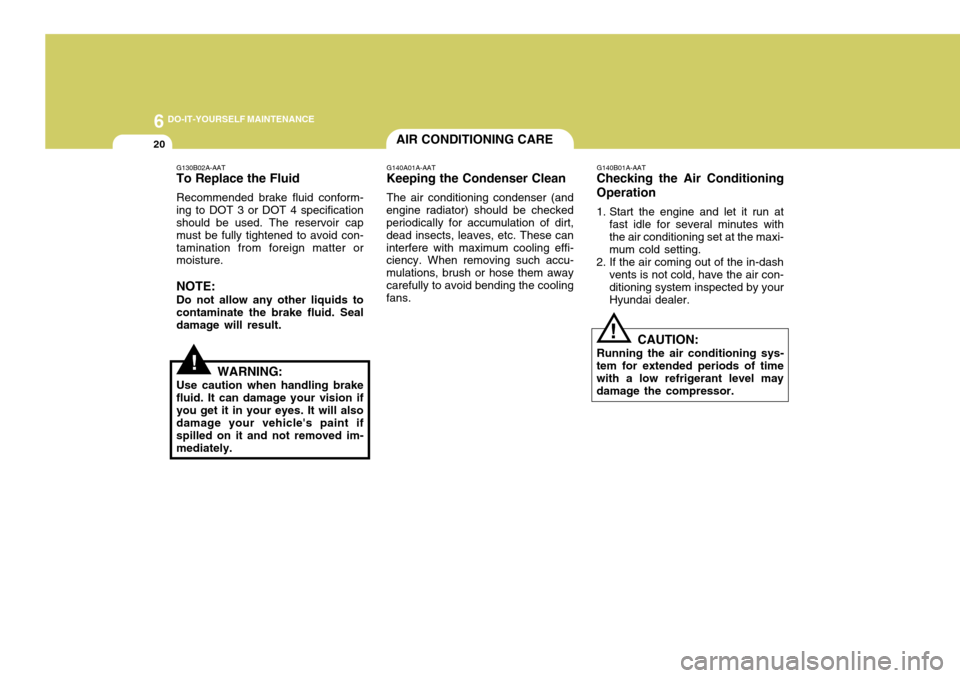
G130B02A-AAT To Replace the Fluid Recommended brake fluid conform- ing to DOT 3 or DOT 4 specification should be used. The reservoir cap must be fully tightened to avoid con-tamination from foreign matter or moisture. NOTE: Do not allow any other liquids to contaminate the brake fluid. Sealdamage will result.
WARNING:
Use caution when handling brakefluid. It can damage your vision ifyou get it in your eyes. It will also damage your vehicle's paint if spilled on it and not removed im-mediately. G140A01A-AAT
Keeping the Condenser Clean
The air conditioning condenser (and
engine radiator) should be checked periodically for accumulation of dirt, dead insects, leaves, etc. These caninterfere with maximum cooling effi- ciency. When removing such accu- mulations, brush or hose them awaycarefully to avoid bending the cooling fans. AIR CONDITIONING CARE
G140B01A-AAT
Checking the Air Conditioning Operation
1. Start the engine and let it run at
fast idle for several minutes with the air conditioning set at the maxi- mum cold setting.
2. If the air coming out of the in-dash vents is not cold, have the air con-ditioning system inspected by yourHyundai dealer.
CAUTION:
Running the air conditioning sys-
tem for extended periods of timewith a low refrigerant level maydamage the compressor.
Page 239 of 478

6
DO-IT-YOURSELF MAINTENANCE
41
PROTECTED COMPONENTS
Generator(1.6L/2.0L) BCM BOX(Tail lamp relay,Power connector,Fuse(2,7,12,13,19,20,24))Condenser fan relayRadiator fan relayEngine control relay, Fuel pump relay, A/T control relay, Generator,ECM(1.6L/2.7L),PCM(2.0L) Ignition switch,Start relayABS/ESP control module,ESP Air bleeding connectorABS/ESP control module,ESP Air bleeding connectorBlower relayInjector Oxygen sensor,Camshaft position sensor, Idle speed control actuator DRL control moduleFront fog lamp relayTCM(2.7L),ECM(2.7L/1.6L)Horn relay,A/C relay Head lamp relay(High) Head lamp relay(Low)
FUSERATING 120A50A 30A30A 30A 30A 40A40A30A 15A 10A15A15A10A15A 15A 15A
DESCRIPTION
BATTBATT
COND RAD ECU
IGN
ABS 1 ABS 2
BLOWER INJ
SNSR DRL
F/FOG ECU
HORN,A/CON H/LP (HI)
H/LP (LO)
Page 254 of 478
9 VEHICLE SPECIFICATIONS
4
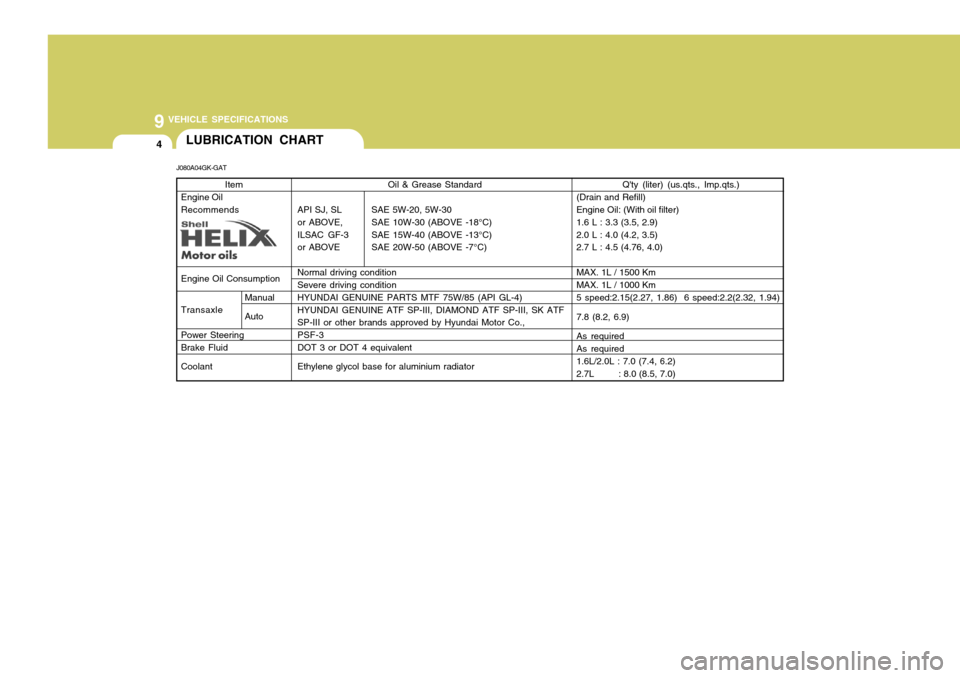
Q'ty (liter) (us.qts., Imp.qts.)
(Drain and Refill) Engine Oil: (With oil filter) 1.6 L : 3.3 (3.5, 2.9)2.0 L : 4.0 (4.2, 3.5) 2.7 L : 4.5 (4.76, 4.0) MAX. 1L / 1500 Km MAX. 1L / 1000 Km 5 speed:2.15(2.27, 1.86) 6 speed:2.2(2.32, 1.94) 7.8 (8.2, 6.9) As required As required1.6L/2.0L : 7.0 (7.4, 6.2) 2.7L : 8.0 (8.5, 7.0)
LUBRICATION CHART
J080A04GK-GAT Oil & Grease Standard
API SJ, SL SAE 5W-20, 5W-30
or ABOVE, SAE 10W-30 (ABOVE -18°C)
ILSAC GF-3 SAE 15W-40 (ABOVE -13°C)
or ABOVE SAE 20W-50 (ABOVE -7°C) Normal driving condition Severe driving condition HYUNDAI GENUINE PARTS MTF 75W/85 (API GL-4)HYUNDAI GENUINE ATF SP-III, DIAMOND ATF SP-III, SK ATF SP-III or other brands approved by Hyundai Motor Co., PSF-3DOT 3 or DOT 4 equivalent Ethylene glycol base for aluminium radiator
Item
Engine Oil Recommends Engine Oil Consumption Transaxle Power Steering Brake Fluid Coolant
Manual Auto
Page 315 of 478
1CONTROLS AND EQUIPMENT
44
!
INSTRUMENT CLUSTER
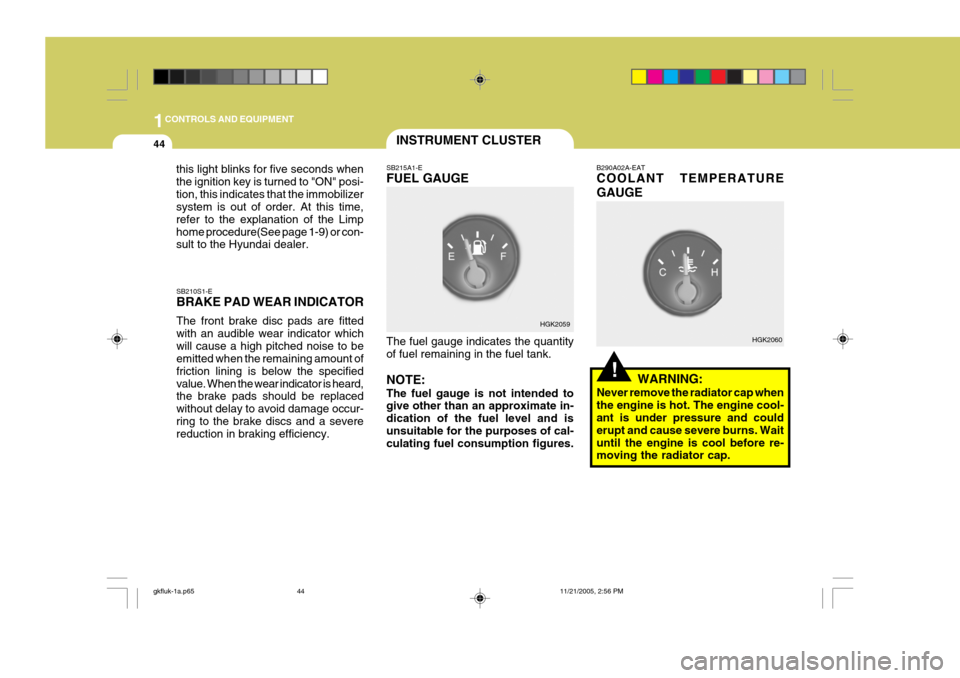
SB210S1-E BRAKE PAD WEAR INDICATOR The front brake disc pads are fitted with an audible wear indicator whichwill cause a high pitched noise to be emitted when the remaining amount of friction lining is below the specifiedvalue. When the wear indicator is heard, the brake pads should be replaced without delay to avoid damage occur-ring to the brake discs and a severe reduction in braking efficiency. SB215A1-E FUEL GAUGE The fuel gauge indicates the quantity of fuel remaining in the fuel tank. NOTE: The fuel gauge is not intended to give other than an approximate in- dication of the fuel level and isunsuitable for the purposes of cal- culating fuel consumption figures. B290A02A-EAT COOLANT TEMPERATURE GAUGE
WARNING:
Never remove the radiator cap when the engine is hot. The engine cool- ant is under pressure and could erupt and cause severe burns. Waituntil the engine is cool before re- moving the radiator cap.
HGK2059
HGK2060
this light blinks for five seconds when the ignition key is turned to "ON" posi-tion, this indicates that the immobilizer system is out of order. At this time, refer to the explanation of the Limphome procedure(See page 1-9) or con- sult to the Hyundai dealer.
gkfluk-1a.p65
11/21/2005, 2:56 PM
44
Page 337 of 478
1CONTROLS AND EQUIPMENT
66
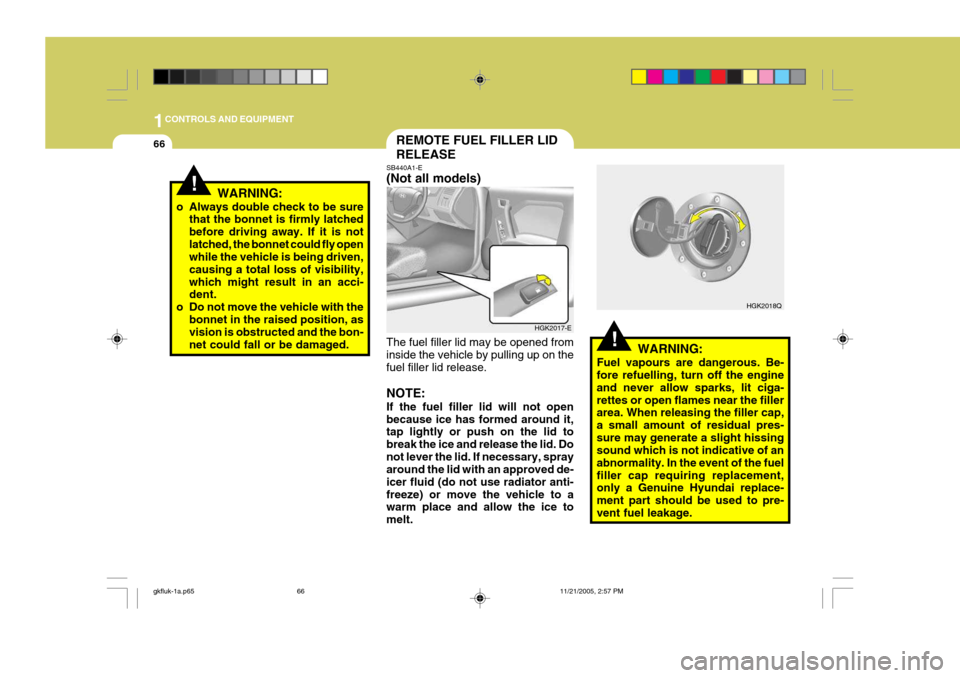
!WARNING:
Fuel vapours are dangerous. Be- fore refuelling, turn off the engine and never allow sparks, lit ciga-rettes or open flames near the filler area. When releasing the filler cap, a small amount of residual pres-sure may generate a slight hissing sound which is not indicative of an abnormality. In the event of the fuelfiller cap requiring replacement, only a Genuine Hyundai replace- ment part should be used to pre-vent fuel leakage. HGK2018Q
SB440A1-E (Not all models) The fuel filler lid may be opened from inside the vehicle by pulling up on thefuel filler lid release. NOTE: If the fuel filler lid will not open because ice has formed around it, tap lightly or push on the lid to break the ice and release the lid. Donot lever the lid. If necessary, spray around the lid with an approved de- icer fluid (do not use radiator anti-freeze) or move the vehicle to a warm place and allow the ice to melt.REMOTE FUEL FILLER LID RELEASE
HGK2017-E
!WARNING:
o Always double check to be sure that the bonnet is firmly latched before driving away. If it is notlatched, the bonnet could fly open while the vehicle is being driven, causing a total loss of visibility,which might result in an acci- dent.
o Do not move the vehicle with the bonnet in the raised position, asvision is obstructed and the bon- net could fall or be damaged.
gkfluk-1a.p65 11/21/2005, 2:57 PM
66
Page 394 of 478
3 IN CASE OF EMERGENCY
4
7. Swithc "ON" the main beam
headlamps before carefully remov- ing the jumper cables have been removed, switch "OFF" the main beam geadlamps. SD040A2-E If the temperature gauge indicates overheating:
1. Pull off the road and stop as soon as
it is safe to do so.
2. Place the gear selector lever in "P"
(automatic), or neutral (manual transaxle) and set the parking brake. If the air conditioning is on, turn it off.
3. If coolant is running out under the car or steam is coming out fromunder the bonnet stop the engine. Do not open the bonnet until thecoolant has stopped running or the steaming has stopped. If there is no visible loss of coolant and no steam,leave the engine running and check to be sure the engine cooling fan is operating.If the fan is not running, turn the engine off.
4. Check to see if the water pump drive belt is broken. If it is not missing,check to see that it is tight. If the drive belt seems to be satisfac-tory,check for coolant leaking from the radiator, hoses or under the car. (If the air conditioning had been in use,it is normal for cold water to be draining from it).
IF THE ENGINE OVERHEATS
1. Ensure that the booster battery is 12 volt type. If the booster battery is installed in another vehicle, ensure that the two vehicles are not touch- ing.
2. Turn off all unnecessary electrical equipment in both vehicles.
3. Ensure that the engine of the ve- hicle providing the jump start is run- ning prior to connection of the jump cables.
4. Connect the red jump cable to the positive (+) terminal of the boosterbattery and the other end to thepositive (+) terminal of the dis- charged battery.
5. Attach the black jump cable to the negative (-) terminal of thebooster battery, and the other end to a ground point within the enginecompartment of the vehicle with the flat battery. Do not connect to the negative battery terminal of the flatbattery since sparks may be gener- ated with the subsequent risk of explosion.
6. Raise the booster vehicle engine speed to 2,000 r.p.m. and start theengine of the vehicle with the flatbattery. CAUTION:
If the jump cables are incorrectlyinstalled, damage to the vehicle elec-trical system may occur, in particu- lar the electronic components such as the Fuel Injection system com- puter and the Automatic Transaxle computer. The battery must neverbe disconnected whilst the engine is running.
!
gkfluk-3.p65 11/21/2005, 3:02 PM
4