towing Hyundai Coupe 2005 User Guide
[x] Cancel search | Manufacturer: HYUNDAI, Model Year: 2005, Model line: Coupe, Model: Hyundai Coupe 2005Pages: 478, PDF Size: 13.44 MB
Page 180 of 478
3 WHAT TO DO IN AN EMERGENCY
12
HGK4017
!
!
1) If the vehicle is being towed with the
rear wheels on the ground, be sure the parking brake is released.
NOTE: Before towing, check the level of the automatic transaxle fluid. If it is below the "HOT" range on the dip-stick, add fluid. If you cannot add fluid, a towing dolly must be used.
2) If any of the loaded wheels or sus- pension components are damaged or the vehicle is being towed with the front wheels on the ground, use a towing dolly under the front wheels.
o Manual Transaxle: If you do not use a towing dolly,place the ignition key in the "ACC"position and put the transaxle in "N (Neutral)".
CAUTION:
Do not tow with the key removed or in the "LOCK" position when tow- ing from the rear without a towing dolly. o Automatic Transaxle:
Be sure to use a towing dolly underthe front wheels.
CAUTION:
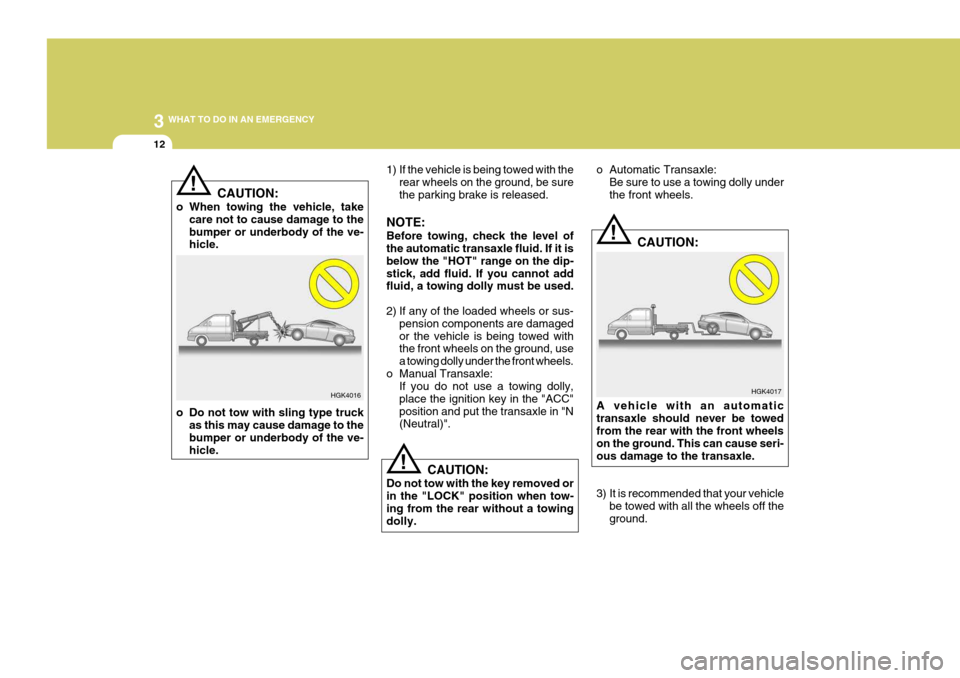
A vehicle with an automatictransaxle should never be towed from the rear with the front wheels on the ground. This can cause seri-ous damage to the transaxle.
3) It is recommended that your vehicle be towed with all the wheels off the ground.
o When towing the vehicle, take
care not to cause damage to the bumper or underbody of the ve- hicle.
o Do not tow with sling type truck as this may cause damage to the bumper or underbody of the ve-hicle. HGK4016
!
CAUTION:
Page 181 of 478
3
WHAT TO DO IN AN EMERGENCY
13
D080D01GK
!
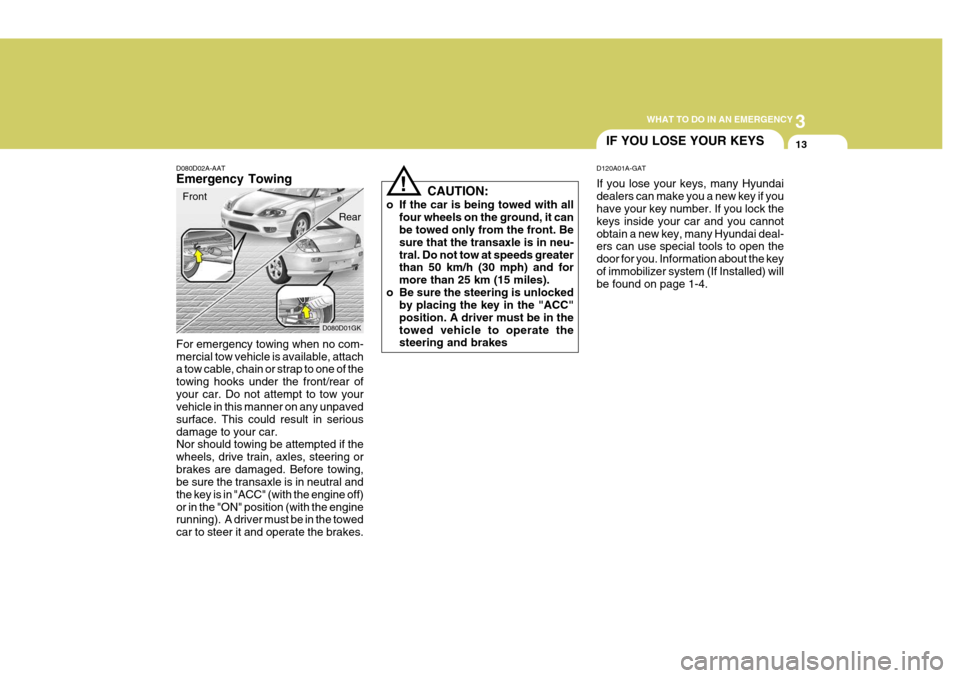
D080D02A-AAT Emergency Towing For emergency towing when no com- mercial tow vehicle is available, attach a tow cable, chain or strap to one of the towing hooks under the front/rear ofyour car. Do not attempt to tow your vehicle in this manner on any unpaved surface. This could result in seriousdamage to your car. Nor should towing be attempted if the wheels, drive train, axles, steering orbrakes are damaged. Before towing, be sure the transaxle is in neutral and the key is in "ACC" (with the engine off)or in the "ON" position (with the engine running). A driver must be in the towed car to steer it and operate the brakes. CAUTION:
o If the car is being towed with all four wheels on the ground, it can be towed only from the front. Be sure that the transaxle is in neu-tral. Do not tow at speeds greater than 50 km/h (30 mph) and for more than 25 km (15 miles).
o Be sure the steering is unlocked by placing the key in the "ACC"position. A driver must be in thetowed vehicle to operate the steering and brakes
IF YOU LOSE YOUR KEYS
D120A01A-GAT If you lose your keys, many Hyundai dealers can make you a new key if you have your key number. If you lock the keys inside your car and you cannotobtain a new key, many Hyundai deal- ers can use special tools to open the door for you. Information about the keyof immobilizer system (If Installed) will be found on page 1-4.
Front
Rear
Page 194 of 478
5VEHICLE MAINTENANCE REQUIREMENTS
6
ENGINE OIL AND FILTER AIR CLEANER FILTER SPARK PLUGS TIMING BELT BRAKE PADS, CALIPERS AND ROTORS REAR BRAKE DRUMS/LININGS/PADS, PARKING BRAKE STEERING GEAR BOX, LINKAGE & BOOTS/LOWER ARM BALL JOINT DRIVESHAFTS AND BOOTS MANUAL TRANSAXLE OIL AUTOMATIC TRANSAXLE FLUID
AIR CONDITIONER FILTER (IN FRONT OF BLOWER UNIT) European Community Only Except European Community
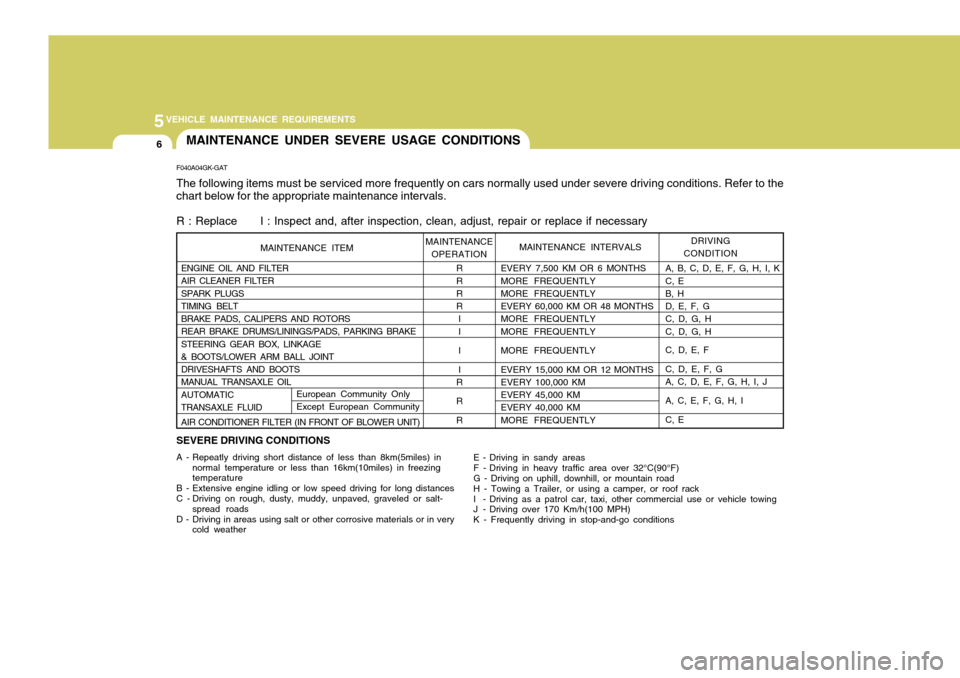
F040A04GK-GAT The following items must be serviced more frequently on cars normally used under severe driving conditions. Refer to the chart below for the appropriate maintenance intervals. R : Replace I : Inspect and, after inspection, clean, adjust, repair or replace if necessary SEVERE DRIVING CONDITIONS
A - Repeatly driving short distance of less than 8km(5miles) in
normal temperature or less than 16km(10miles) in freezing temperature
B - Extensive engine idling or low speed driving for long distances
C - Driving on rough, dusty, muddy, unpaved, graveled or salt- spread roads
D - Driving in areas using salt or other corrosive materials or in very cold weather
MAINTENANCE UNDER SEVERE USAGE CONDITIONS
MAINTENANCE INTERVALS
A, B, C, D, E, F, G, H, I, K C, E B, H D, E, F, G C, D, G, H C, D, G, H C, D, E, F C, D, E, F, G A, C, D, E, F, G, H, I, J A, C, E, F, G, H, IC, E
MAINTENANCE ITEMDRIVING
CONDITION
EVERY 7,500 KM OR 6 MONTHS MORE FREQUENTLY MORE FREQUENTLY EVERY 60,000 KM OR 48 MONTHS MORE FREQUENTLY MORE FREQUENTLY MORE FREQUENTLYEVERY 15,000 KM OR 12 MONTHS EVERY 100,000 KM EVERY 45,000 KM EVERY 40,000 KM MORE FREQUENTLY
R R R R II II
RR R
MAINTENANCE
OPERATION
E - Driving in sandy areas
F - Driving in heavy traffic area over 32°C(90°F)G - Driving on uphill, downhill, or mountain roadH - Towing a Trailer, or using a camper, or roof rack
I - Driving as a patrol car, taxi, other commercial use or vehicle towing
J - Driving over 170 Km/h(100 MPH) K - Frequently driving in stop-and-go conditions
Page 259 of 478

10
INDEX
5
P Parking Brake ........................................................... 1-66
Power Steering Fluid Level ......................................... 6-29
RRear Seats Before Folding the Rear S eats ..............................1-18
Fold down .............................................................. 1-18
Rear seat entry ...................................................... 1-17
Rear Seat Pos itions............................................... 1-17
Rear Window Defroster Switch ................................ 1-57
Rear Window Wiper and Washer Switc h .................1-55
S Seat Belts 3-Point type ............................................................ 1-22
Adjustable height .................................................... 1-22
Adjusting your seat be lt .........................................1-23
Care of seat belts .................................................. 1-21
Precautions ............................................................ 1-19
Pre-tentioner Seat Belt ..................... ..................... 1-30
Spectacle Ca se .......................................................... 1-63
Speedometer .............................................................. 1-47
Starting Pr ocedures..................................................... 2-5
Steering Wheel
Free play ................................................................. 6-23
Tilt lever .................................................................. 1-71Stereo Radio Operation (H250, H260, J290)
.......................................................... 1-96, 1-101, 1-110
Stereo Sound System ................................................ 1-94
Sun Visor .................................................................... 1-70
Sunroof ....................................................................... 1-61
T Tachometer ............................................................... 1-47
Tail Gat e ................................................................... 1-69
Electronic Stability Program (ESP) ...........................2-14
Theft Alarm System .................................................... 1-9
Tires Balancing .................................................................. 8-5
Chains ...................................................................... 8-4
Changing a flat tire .................................................. 3-6
If you have a flat tire ............................................... 3-6
Information ............................................................... 8-3
Pressure ................................................................... 8-3
Replacement ............................................................ 8-6
Rotation .................................................................... 8-5
Snow tires ................................................................ 8-4
Spare tire ................................................................. 3-5
Traction .................................................................... 8-5
Towing Emergency ............................................................. 3-13
If your car must be towed .....................................3-11
Trailer or vehicle towing .................... ..................... 2-21
Page 275 of 478
1CONTROLS AND EQUIPMENT
4
!
IMMOBILISER SYSTEM
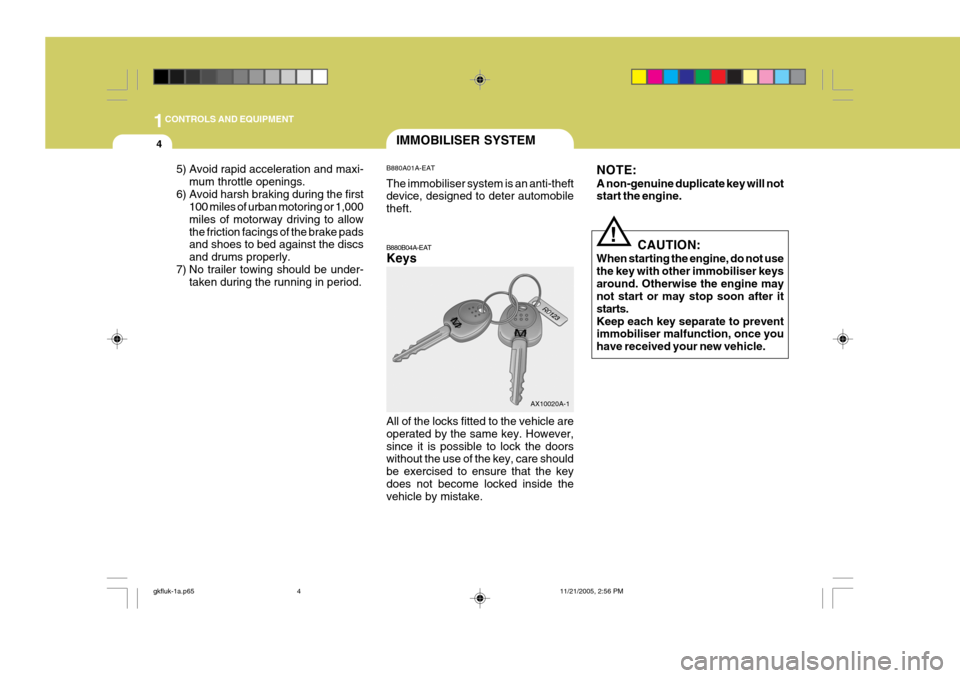
B880B04A-EAT Keys All of the locks fitted to the vehicle are operated by the same key. However,since it is possible to lock the doors without the use of the key, care should be exercised to ensure that the keydoes not become locked inside the vehicle by mistake. AX10020A-1
5) Avoid rapid acceleration and maxi-
mum throttle openings.
6) Avoid harsh braking during the first 100 miles of urban motoring or 1,000 miles of motorway driving to allowthe friction facings of the brake pads and shoes to bed against the discs and drums properly.
7) No trailer towing should be under- taken during the running in period. B880A01A-EAT The immobiliser system is an anti-theft device, designed to deter automobile theft.
NOTE: A non-genuine duplicate key will not start the engine.
CAUTION:
When starting the engine, do not use the key with other immobiliser keysaround. Otherwise the engine may not start or may stop soon after it starts.Keep each key separate to prevent immobiliser malfunction, once you have received your new vehicle.
gkfluk-1a.p65 11/21/2005, 2:56 PM
4
Page 368 of 478
2
Engine Exhaust Can Be Dangerous! ........................... 2-2
Before Starting the Engine ........................................... 2-3
Key Positions ................................................................ 2-3Starting......................................................................... 2-5
Manual Transaxle ......................................................... 2-6
Automatic Transaxle .................................................... 2-8Effective Braking ......................................................... 2-12
Anti-Lock Brake System (ABS) ................................... 2-13
Electronic Stability Program (ESP) ..............................2-14
Driving for Economy .................................................... 2-15
Smooth Cornering ........................................................ 2-17
Winter Motoring ............................................................ 2-17
Trailer or Vehicle Towing ............................................. 2-19
DRIVING YOUR HYUNDAI
2
gkfluk-2.p65
11/21/2005, 2:58 PM
1
Page 379 of 478
2DRIVING YOUR HYUNDAI
12EFFECTIVE BRAKING
SC140A2-E Braking system performance and fric- tion material life are greatly affected by the driving style adopted. The follow- ing suggestions are made to assist inachieving the best results from the braking system.
o Anticipate the road and conditions ahead in order that heavy braking may be avoided.
o When descending long gradients, use the engine to assist in retardingthe vehicle to minimise the possibil-ity of brake fade occurring.
o When trailer towing, ensure that the
trailer brakes function correctly anduse engine braking to assist the vehicle braking system.
o Use only genuine Hyundai replace- ment brake pads and shoes to en-sure consistent friction characteris- tics and wear rates.
o After driving through deep water (e.g. fording), the brakes may be-come wet and performance reduced.Always check brake efficiency after emerging from the water and dry the brakes by lightly depressing the brakepedal several times whilst driving slowly. o Apply the parking brake only when
the vehicle is at rest.
o Since the power assistance pro- vided by the brake servo is derived from the engine, coasting with theengine turned off or towing of the vehicle with the engine turned off will result in greatly increased pedalpressures being required to stop the vehicle.
o Do not hold the vehicle on an incline with the accelerator pedal. This cancause the transaxle to overheat. Al- ways use the brake pedal or parkingbrake.
o Use caution when parking on a hill.
Engage the parking brake and placethe gear selector lever in "P" (auto- matic transaxle) or in first or reverse gear (manual transaxle). If your caris facing downhill, turn the front wheels into the curb to help keep the car from rolling. If your car is facinguphill, turn the front wheels away from the curb to help keep the car from rolling.If there is no curb or if it is required by other conditions to keep the car from rolling, block the wheels.
o Check the automatic transaxle fluid
level regularly, and add fluid asnecessary. See the maintenance schedule for the proper fluid recommendation.
gkfluk-2.p65 11/21/2005, 2:58 PM
12
Page 386 of 478
2
DRIVING YOUR HYUNDAI
19TRAILER OR VEHICLE TOWING
YC200A1-E If you are considering towing with your car, you should first check with your Local Laws to determine their legal requirements.Since laws vary from county to county, the requirements for towing trailers, cars, or other types of vehicles orapparatus may differ. Ask your Hyundai authorised repairer for further details before towing.
CAUTION:
Do not do any towing with your carduring its first 1,000 miles in order toallow the engine to have properly run-in. Failure to heed this caution may result in serious engine ortransaxle damage.
! YC200C3-A Trailer Brakes If your trailer is equipped with a braking system, make sure it conforms to localregulations and that it is properly in- stalled and operating correctly. NOTE: If you tow a trailer or vehicle, your car will require more frequent main- tenance due to the additional load.See Maintenance Under Severe Usage Conditions" on page 5-6.
YC200B2-E Trailer Hitches Select the proper towbar and ball com- bination, making sure that its location is compatible with that of the trailer or vehicle being towed.Use a quality non-equalizing hitch which distributes the nose weight uniformly throughout the chassis. The towbar should be bolted securely to the car and installed by a qualifiedtechnician.
gkfluk-2.p65
11/21/2005, 2:58 PM
19
Page 387 of 478
2DRIVING YOUR HYUNDAI
20
C190E01L
CAUTION:
o Never connect a trailer brake sys- tem directly to the vehicle brake system.
o When towing a trailer on steep grades (in excess of 12%) payclose attention to the engine cool-ant temperature gauge to ensure the engine does not overheat. If the needle of the coolant tem-perature gauge moves across the dial towards "H" (HOT), pull over and stop as soon as it is safe todo so, and allow the engine to idle until it cools down. You may proceed once the engine hascooled sufficiently.
! YC200D2-E Safety Cables Should the towbar connection between your car and the trailer or vehicle youare towing fail, the trailer or vehicle could wander dangerously across other lanes of traffic and ultimately leave theroadway. To eliminate this potentially dangerous situation, safety cable, at- tached between your car and the traileror towed vehicle, are required.
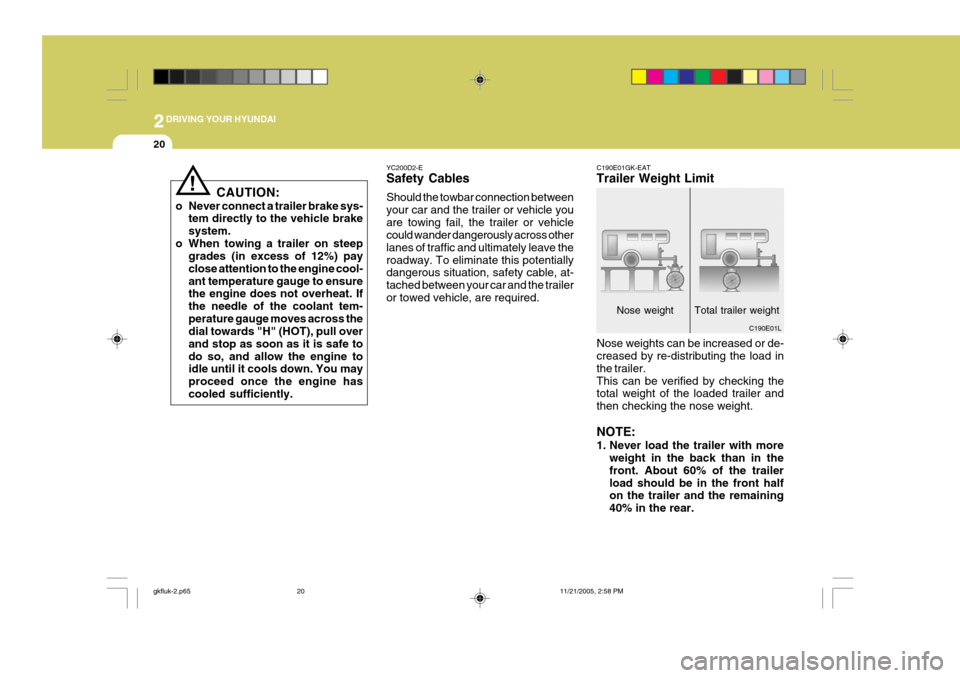
Nose weight Total trailer weight
C190E01GK-EAT Trailer Weight Limit Nose weights can be increased or de- creased by re-distributing the load in the trailer.This can be verified by checking the total weight of the loaded trailer and then checking the nose weight. NOTE:
1. Never load the trailer with more
weight in the back than in the front. About 60% of the trailerload should be in the front half on the trailer and the remaining 40% in the rear.
gkfluk-2.p65 11/21/2005, 2:58 PM
20
Page 388 of 478
2
DRIVING YOUR HYUNDAI
21
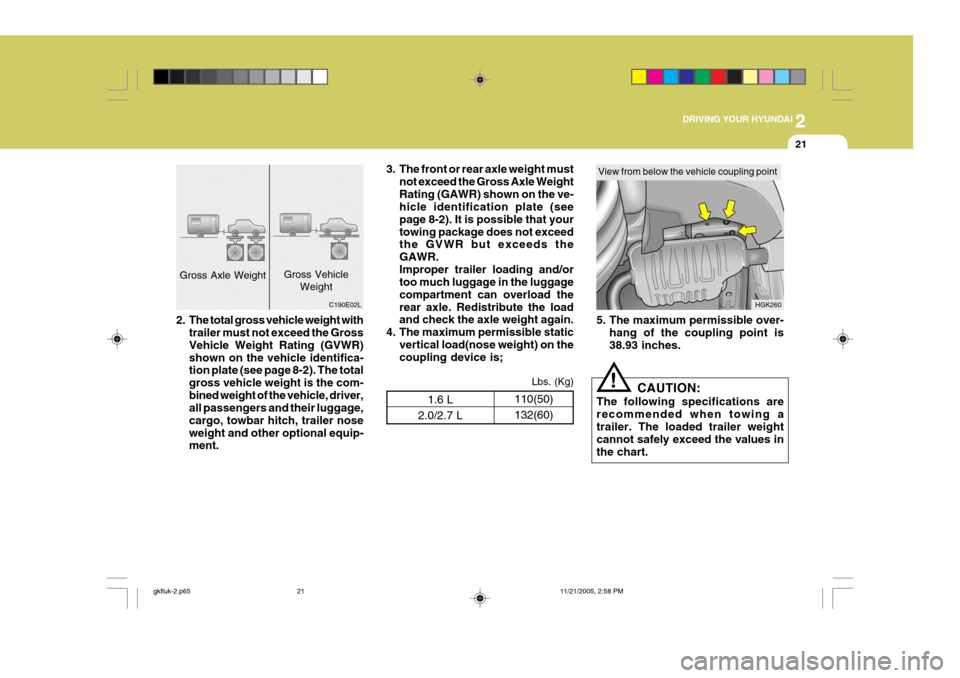
3. The front or rear axle weight must
not exceed the Gross Axle Weight Rating (GAWR) shown on the ve- hicle identification plate (see page 8-2). It is possible that yourtowing package does not exceed the GVWR but exceeds the GAWR.Improper trailer loading and/or too much luggage in the luggage compartment can overload therear axle. Redistribute the load and check the axle weight again.
4. The maximum permissible static vertical load(nose weight) on thecoupling device is;
2. The total gross vehicle weight with
trailer must not exceed the Gross Vehicle Weight Rating (GVWR)shown on the vehicle identifica- tion plate (see page 8-2). The total gross vehicle weight is the com-bined weight of the vehicle, driver, all passengers and their luggage, cargo, towbar hitch, trailer noseweight and other optional equip- ment.
Gross Axle Weight
Gross Vehicle
Weight
C190E02L
1.6 L
2.0/2.7 L 110(50) 132(60)CAUTION:
The following specifications are recommended when towing a trailer. The loaded trailer weight cannot safely exceed the values inthe chart.!
5. The maximum permissible over-
hang of the coupling point is 38.93 inches.
Lbs. (Kg) View from below the vehicle coupling point
HGK260
gkfluk-2.p65
11/21/2005, 2:58 PM
21