belt Hyundai Coupe 2005 Owner's Guide
[x] Cancel search | Manufacturer: HYUNDAI, Model Year: 2005, Model line: Coupe, Model: Hyundai Coupe 2005Pages: 478, PDF Size: 13.44 MB
Page 47 of 478
1
FEATURES OF YOUR HYUNDAI
33
!
system alone, in case of a frontal im- pact of sufficient severity. NOTE: Be sure to read information about the SRS on the labels provided in the front of the sun visor and in theglove box.
WARNING:
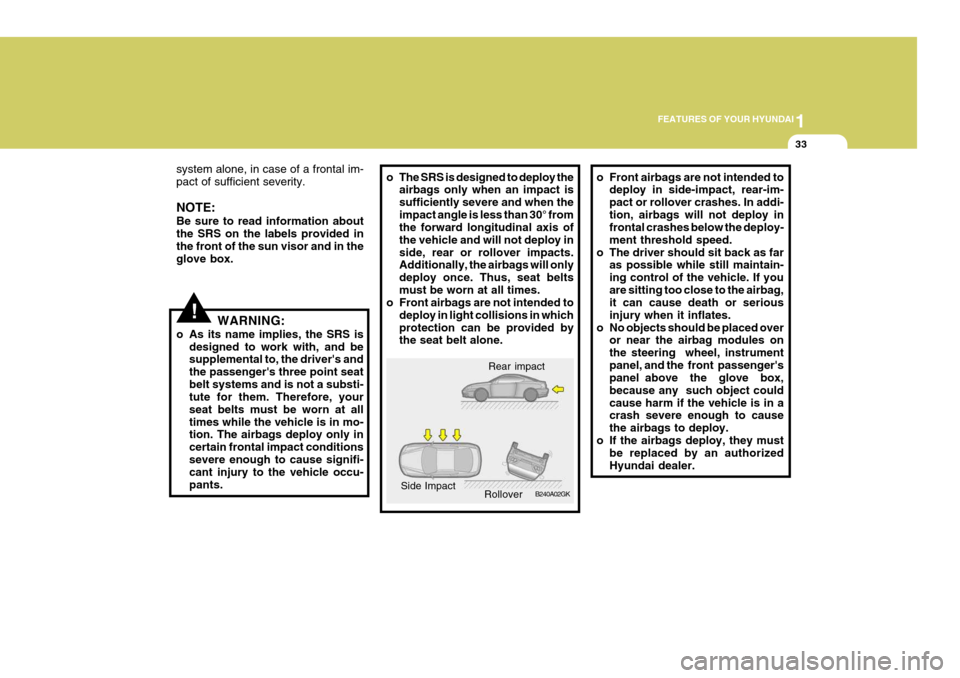
o As its name implies, the SRS is designed to work with, and be supplemental to, the driver's and the passenger's three point seatbelt systems and is not a substi- tute for them. Therefore, your seat belts must be worn at alltimes while the vehicle is in mo- tion. The airbags deploy only in certain frontal impact conditionssevere enough to cause signifi- cant injury to the vehicle occu- pants.o The SRS is designed to deploy theairbags only when an impact is sufficiently severe and when theimpact angle is less than 30° from the forward longitudinal axis of the vehicle and will not deploy inside, rear or rollover impacts. Additionally, the airbags will only deploy once. Thus, seat beltsmust be worn at all times.
o Front airbags are not intended to
deploy in light collisions in whichprotection can be provided by the seat belt alone. o Front airbags are not intended to
deploy in side-impact, rear-im- pact or rollover crashes. In addi-tion, airbags will not deploy in frontal crashes below the deploy- ment threshold speed.
o The driver should sit back as far as possible while still maintain-ing control of the vehicle. If youare sitting too close to the airbag, it can cause death or serious injury when it inflates.
o No objects should be placed over or near the airbag modules onthe steering wheel, instrumentpanel, and the front passenger's panel above the glove box, because any such object couldcause harm if the vehicle is in a crash severe enough to cause the airbags to deploy.
o If the airbags deploy, they must be replaced by an authorizedHyundai dealer.
Rear impact
B240A02GK
Side Impact
Rollover
Page 48 of 478
1FEATURES OF YOUR HYUNDAI
34
injury or death in the event of a crash. Do not sit or lean unneces- sarily close to the airbag while the vehicle is in motion.
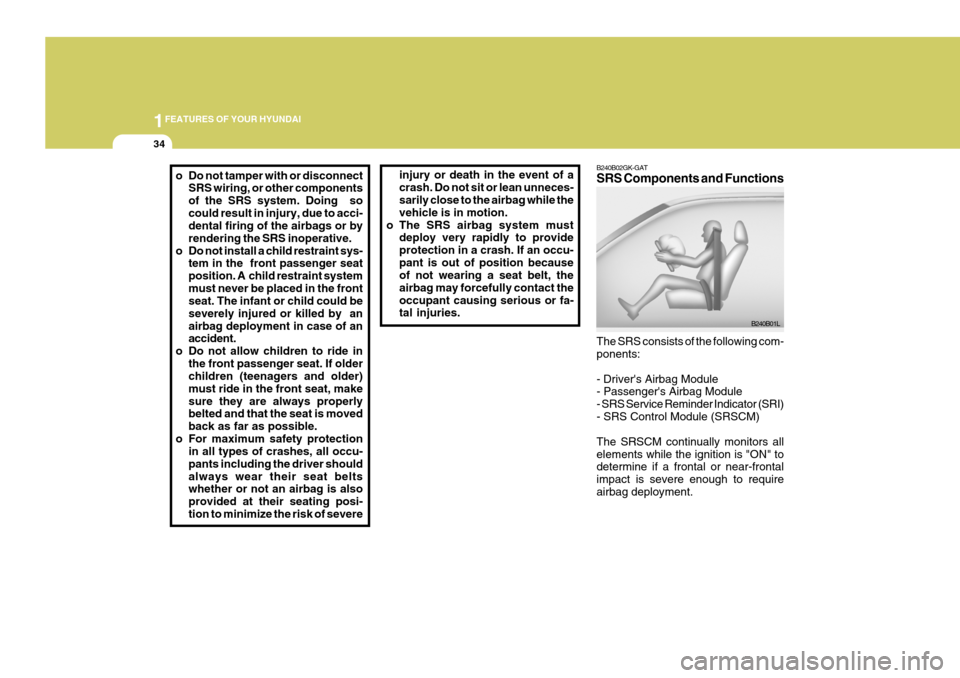
o The SRS airbag system must deploy very rapidly to provideprotection in a crash. If an occu-pant is out of position because of not wearing a seat belt, the airbag may forcefully contact theoccupant causing serious or fa- tal injuries. B240B02GK-GAT SRS Components and Functions The SRS consists of the following com- ponents: - Driver's Airbag Module - Passenger's Airbag Module - SRS Service Reminder Indicator (SRI)- SRS Control Module (SRSCM) The SRSCM continually monitors all elements while the ignition is "ON" to determine if a frontal or near-frontal impact is severe enough to requireairbag deployment.B240B01Lo Do not tamper with or disconnect
SRS wiring, or other components of the SRS system. Doing socould result in injury, due to acci- dental firing of the airbags or by rendering the SRS inoperative.
o Do not install a child restraint sys- tem in the front passenger seatposition. A child restraint systemmust never be placed in the front seat. The infant or child could be severely injured or killed by anairbag deployment in case of an accident.
o Do not allow children to ride in
the front passenger seat. If olderchildren (teenagers and older) must ride in the front seat, makesure they are always properly belted and that the seat is moved back as far as possible.
o For maximum safety protection in all types of crashes, all occu-pants including the driver shouldalways wear their seat belts whether or not an airbag is also provided at their seating posi-tion to minimize the risk of severe
Page 49 of 478
1
FEATURES OF YOUR HYUNDAI
35
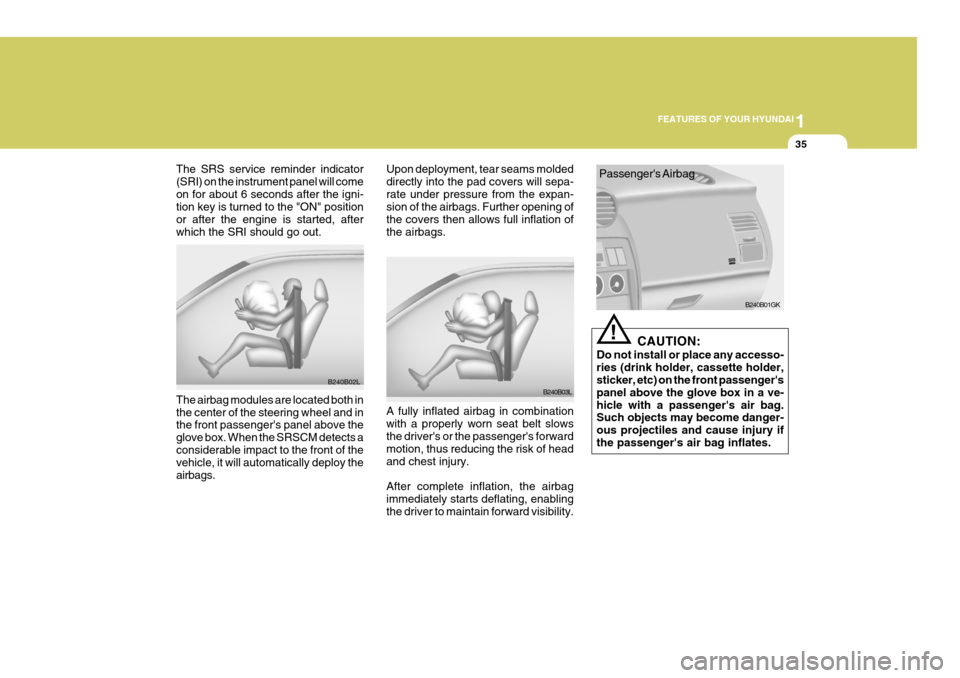
The SRS service reminder indicator (SRI) on the instrument panel will comeon for about 6 seconds after the igni- tion key is turned to the "ON" position or after the engine is started, afterwhich the SRI should go out. The airbag modules are located both in the center of the steering wheel and in the front passenger's panel above the glove box. When the SRSCM detects aconsiderable impact to the front of the vehicle, it will automatically deploy the airbags. B240B02LPassenger's Airbag
Upon deployment, tear seams molded directly into the pad covers will sepa-rate under pressure from the expan- sion of the airbags. Further opening of the covers then allows full inflation ofthe airbags. A fully inflated airbag in combination with a properly worn seat belt slows the driver's or the passenger's forward motion, thus reducing the risk of headand chest injury. After complete inflation, the airbag immediately starts deflating, enabling the driver to maintain forward visibility. B240B03L
B240B01GK
!
CAUTION:
Do not install or place any accesso- ries (drink holder, cassette holder, sticker, etc) on the front passenger's panel above the glove box in a ve-hicle with a passenger's air bag. Such objects may become danger- ous projectiles and cause injury ifthe passenger's air bag inflates.
Page 51 of 478
1
FEATURES OF YOUR HYUNDAI
37
B990B04Y-AAT Side Impact Airbag (If installed)
B990B02Y
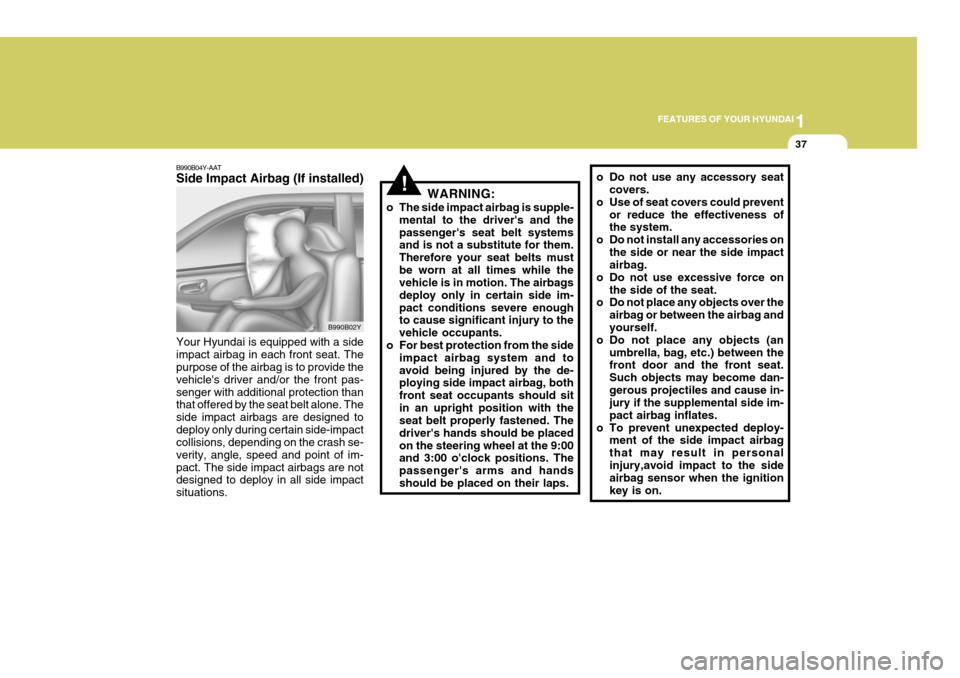
Your Hyundai is equipped with a side impact airbag in each front seat. The purpose of the airbag is to provide the vehicle's driver and/or the front pas-senger with additional protection than that offered by the seat belt alone. The side impact airbags are designed todeploy only during certain side-impact collisions, depending on the crash se- verity, angle, speed and point of im-pact. The side impact airbags are not designed to deploy in all side impact situations.
!WARNING:
o The side impact airbag is supple- mental to the driver's and the passenger's seat belt systems and is not a substitute for them. Therefore your seat belts mustbe worn at all times while the vehicle is in motion. The airbags deploy only in certain side im-pact conditions severe enough to cause significant injury to the vehicle occupants.
o For best protection from the side
impact airbag system and toavoid being injured by the de- ploying side impact airbag, both front seat occupants should sitin an upright position with the seat belt properly fastened. The driver's hands should be placedon the steering wheel at the 9:00 and 3:00 o'clock positions. The passenger's arms and handsshould be placed on their laps. o Do not use any accessory seat
covers.
o Use of seat covers could prevent
or reduce the effectiveness of the system.
o Do not install any accessories on
the side or near the side impactairbag.
o Do not use excessive force on the side of the seat.
o Do not place any objects over the
airbag or between the airbag and yourself.
o Do not place any objects (an
umbrella, bag, etc.) between the front door and the front seat. Such objects may become dan-gerous projectiles and cause in- jury if the supplemental side im- pact airbag inflates.
o To prevent unexpected deploy- ment of the side impact airbagthat may result in personalinjury,avoid impact to the side airbag sensor when the ignition key is on.
Page 55 of 478

1
FEATURES OF YOUR HYUNDAI
41
1. Speedometer
2. Turn Signal Indicator Light
3. Odometer/Trip Odometer
4. Automatic Transaxle Position Indicator Light (If installed)
5. Coolant Temperature Gauge
6. Trip Computer
7. Fuel Gauge
8. Tachometer
9. Electronic Stability Program (ESP) indicator Light (If installed)
10.Immobilizer Warning Light (If installed)
11.Trip Odometer Reset Knob
12.Charging System Warning Light 13.Supplemental Restraint System (Airbag) Service Re-
minder Indicator (SRI) Light (If installed)
14.Seat Belt Warning Light
15.High Beam Indicator Light
16.Oil Pressure Warning Light
17.Malfunction Indicator Light (MIL) (If installed)
18.Low Fuel Warning Light
19.Parking Brake/Low Brake Fluid Level Warning Light
20.Trip Computer Reset Knob
21.CRUISE Indicator Light (If installed)
22.CRUISE SET Indicator Light (If installed)
23.Tail Gate Open Warning Light
24.Door Ajar Warning Light
25.ABS Service Reminder Indicator Light (If installed)
Page 58 of 478

1FEATURES OF YOUR HYUNDAI
44
!
B260J01S-GAT
Charging System Warn- ing Light
The charging system warning light should come on when the ignition isturned on, then go out when the engine is running. If the light stays on while the engine is running, there is a malfunc-tion in the electrical charging system. If the light comes on while you are driv- ing, stop, turn off the engine and checkunder the hood. First, make certain the generator drive belt is in place. If it is, check the tension of the belt.And then, have the system checked by your Hyundai dealer.
CAUTION:
If the drive belt (generator belt) isloose, broken, or mission while the vehicle is driving, there may be aserious malfunction, engine could overheat because this belt also drives the water pump.
B260M01A-AAT Low Fuel Level Warning Light
The low fuel level warning light comes on when the fuel tank is approaching empty. When it comes on, you should add fuel as soon as possible. Drivingwith the fuel level warning light on or with the fuel level below "E" can cause the engine to misfire and damage thecatalytic converter.
B260L01A-GAT
Door Ajar Warning Light
The door ajar warning light warns youthat a door is not completely closed.
B260B01JM-AATSRS (Airbag) Service Re- minder Indicator (SRI)(If installed)
The SRS service reminder indicator (SRI) comes on for about 6 seconds after key is turned to the "ON" positionor after the engine is started, after which it will go out. This light also comes on when the SRS is not working properly. If the SRI does not come on, or continuously remainson after operating for about 6 seconds when you turned the ignition key to the "ON" position or started the engine, orif it comes on while driving, have the SRS inspected by an authorized Hyundai Dealer.
B260K01F-AAT Tail Gate Open Warning Light
This light remains on unless the tail gate is completely closed and latched.
Page 59 of 478

1
FEATURES OF YOUR HYUNDAI
45
B260N02A-AAT Malfunction Indicator Light (If Installed)
This light illuminates when there is a malfunction of an exhaust gas relatedcomponent, and the system is not functioning properly so that the ex- haust gas regulation values are notsatisfied. This light will also illuminate when the ignition key is turned to the "ON" position, and then it will go out ina few seconds after the engine is started. If it illuminates while driving, or does not illuminate when the ignitionkey is turned to the "ON" position, take your car to your nearest authorized Hyundai dealer and have the systemchecked.
B260E01HP-GAT Seat Belt Warning Light
The seat belt warning light blinks for about 6 seconds when the ignition key is turned from the "OFF" position to"ON" or "START".
B260Q01E-GAT CRUISE Indicator (If Installed)
The cruise indicator light in the instru- ment cluster is illuminated when thecruise control main switch on the end of the barrel is pushed. The indicator light does not illuminatewhen the cruise control main switch is pushed a second time. Information about the use of cruisecontrol is beginning on page 1-72.B265C01LZ-AAT Electronic Stability Program Indicator Lights(If installed)
The electronic stability program indi- cators change operation according to the ignition switch position and whetherthe system is in operation or not. They will illuminate when the ignition key is turned to the "ON" position, butshould go out after three seconds. If the ESP or ESP-OFF indicator stays on, take your car to your authorizedHyundai dealer and have the system checked. See section 2 for more infor- mation about the ESP.
B260R01E-GAT CRUISE SET Indicator
Light (If installed)
The set indicator light in the instrument cluster is illuminated when the cruisecontrol switch is pushed downward to "SET (COAST)". The set indicator light does not illumi-nate when the control switch is in the "CANCEL" position. B260U01TB-GAT
Immobilizer Warning Light (If Installed)
This indicator light comes on for some seconds after the ignition key is turned to the "ON" position. At this time, youcan start the engine. The light goes out after the engine is running. In case this light goes out before you start theengine, you must turn to the "LOCK" position and restart the engine. In case
Page 61 of 478
1
FEATURES OF YOUR HYUNDAI
47
!
The needle on the engine coolant tem- perature gauge should stay in the nor-mal range. If it moves across the dial to "H" (Hot), pull over and stop as soon as possible and turn off the engine. Thenopen the hood and, after the engine has cooled, check the coolant level and the water pump drive belt. If yoususpect cooling system trouble, have your cooling system checked by a Hyundai dealer as soon as possible.
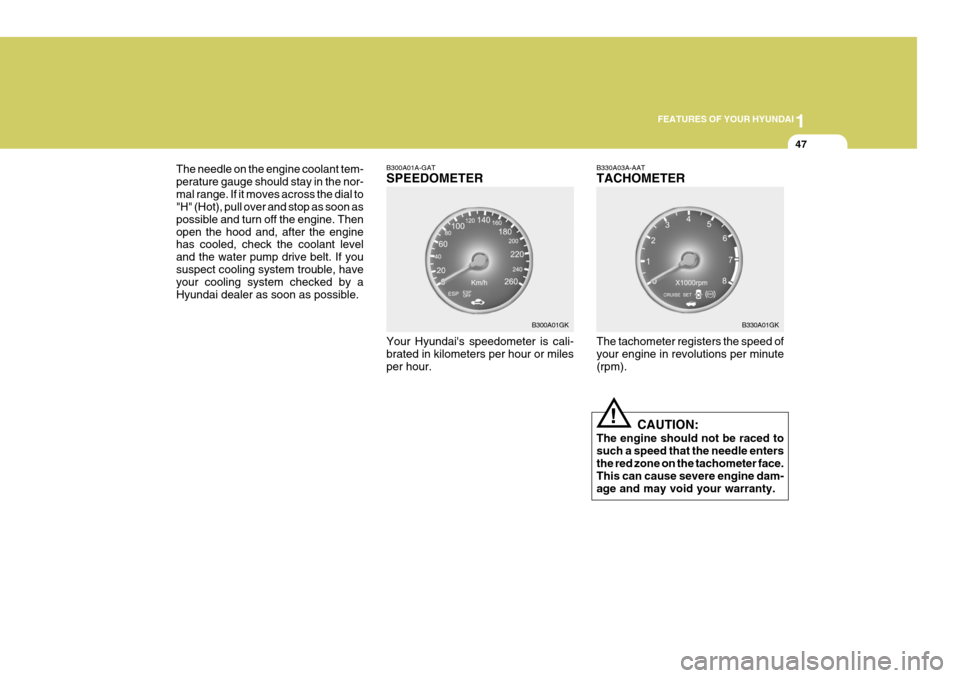
B300A01A-GAT SPEEDOMETER Your Hyundai's speedometer is cali- brated in kilometers per hour or miles per hour.B330A03A-AAT TACHOMETER The tachometer registers the speed of your engine in revolutions per minute (rpm).
CAUTION:
The engine should not be raced tosuch a speed that the needle entersthe red zone on the tachometer face. This can cause severe engine dam- age and may void your warranty.
B300A01GK
B330A01GK
Page 146 of 478
2
DRIVING YOUR HYUNDAI
3TO START THE ENGINEBEFORE STARTING THE EN- GINE
C020A01A-AAT Before you start the engine, you should always:
1. Look around the vehicle to be sure
there are no flat tires, puddles of oil, water or other indications of pos- sible trouble.
2. After entering the car, check to be sure the parking brake is engaged.
3. Check that all windows, and lights are clean.
4. Check that the interior and exterior
mirrors are clean and in position.
5. Check your seat, seatback and headrest to be sure they are in theirproper positions.
6. Close all the doors.
7. Fasten your seat belt and be sure
that all other occupants have fas- tened theirs.
8. Turn off all lights and accessories
that are not needed.
9. When you turn the ignition switch to "ON", check that all appropriatewarning lights are operating andthat you have sufficient fuel.
10.Check the operation of warning
lights and all bulbs when key is inthe "ON" position. C030A01A-GAT COMBINATION IGNITION SWITCH
o If your Hyundai is equipped with a
manual transaxle, place the shift lever in neutral and depress the clutch pedal fully.
o If your Hyundai has an automatic
transaxle, place the shift lever in "P"(park).
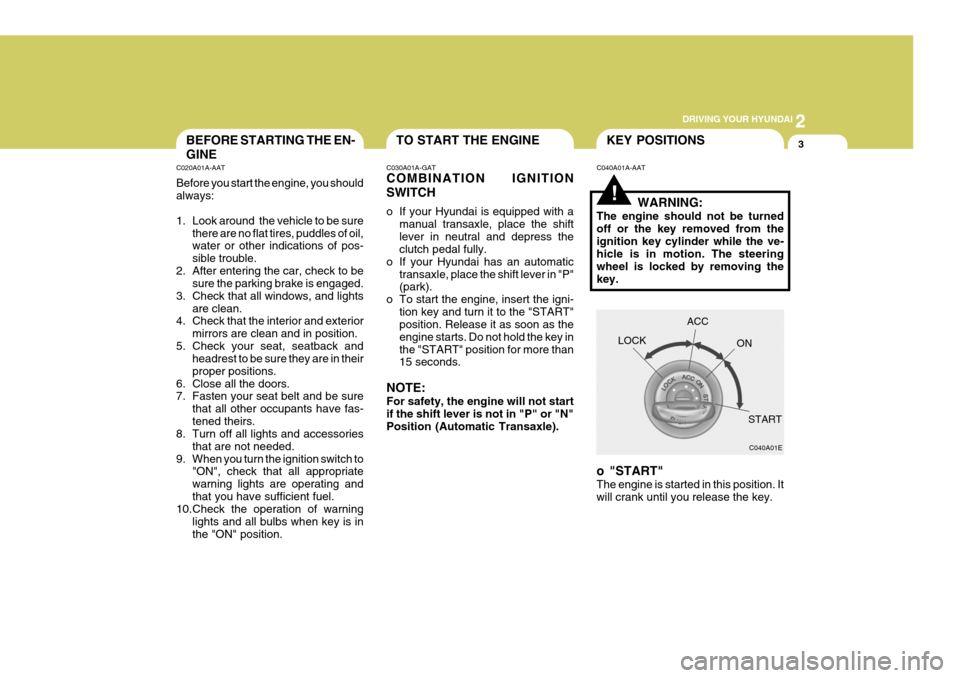
o To start the engine, insert the igni- tion key and turn it to the "START"position. Release it as soon as the engine starts. Do not hold the key inthe "START" position for more than 15 seconds.
NOTE: For safety, the engine will not start if the shift lever is not in "P" or "N" Position (Automatic Transaxle).
!
C040A01A-AAT KEY POSITIONS
WARNING:
The engine should not be turned off or the key removed from theignition key cylinder while the ve- hicle is in motion. The steering wheel is locked by removing thekey.
o "START" The engine is started in this position. It will crank until you release the key. LOCK
C040A01E
ACC
ON
START
Page 148 of 478
2
DRIVING YOUR HYUNDAI
5
!
C050B01A-GAT Normal Conditions: The Starting Procedure:
1. Insert key, and fasten the seat belt.
2. Depress the clutch pedal fully and
place the gearshift lever (manual transaxle) in neutral or the selector lever (automatic transaxle) in "P" (park) position.
3. After turning the ignition key to the "ON" position, make certain all warn-ing lights and gauges are function-ing properly before starting the en- gine.
WARNING:
Be sure that the clutch is fully de- pressed when starting a manual transaxle vehicle. Otherwise, there is the potential to cause damage tothe vehicle or injury to someone inside or outside the vehicle as a result of the forward or backwardmovement of the vehicle that will occur if the clutch is not depressed when the vehicle is started. 4. Turn the ignition key to the "Start"
position and release it when theengine starts.
OPERATING THE MANUAL TRANSAXLE
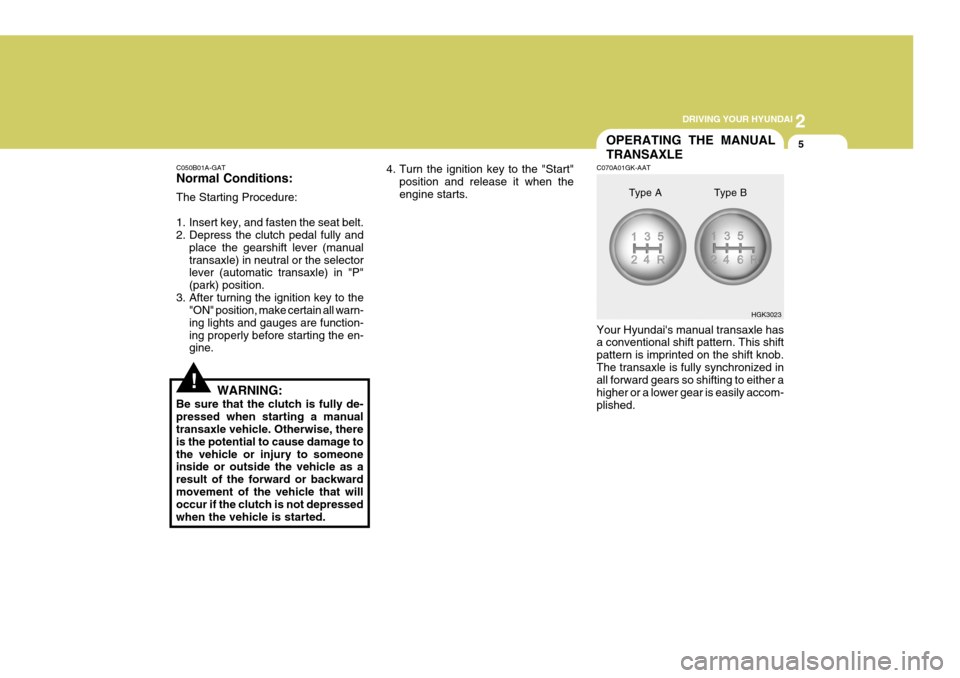
C070A01GK-AAT Your Hyundai's manual transaxle has a conventional shift pattern. This shift pattern is imprinted on the shift knob.The transaxle is fully synchronized in all forward gears so shifting to either a higher or a lower gear is easily accom-plished. HGK3023
Type A Type B