engine oil Hyundai Coupe 2005 Owner's Guide
[x] Cancel search | Manufacturer: HYUNDAI, Model Year: 2005, Model line: Coupe, Model: Hyundai Coupe 2005Pages: 478, PDF Size: 13.44 MB
Page 311 of 478
1CONTROLS AND EQUIPMENT
40
!
!
WARNING AND INDICATOR LIGHTS
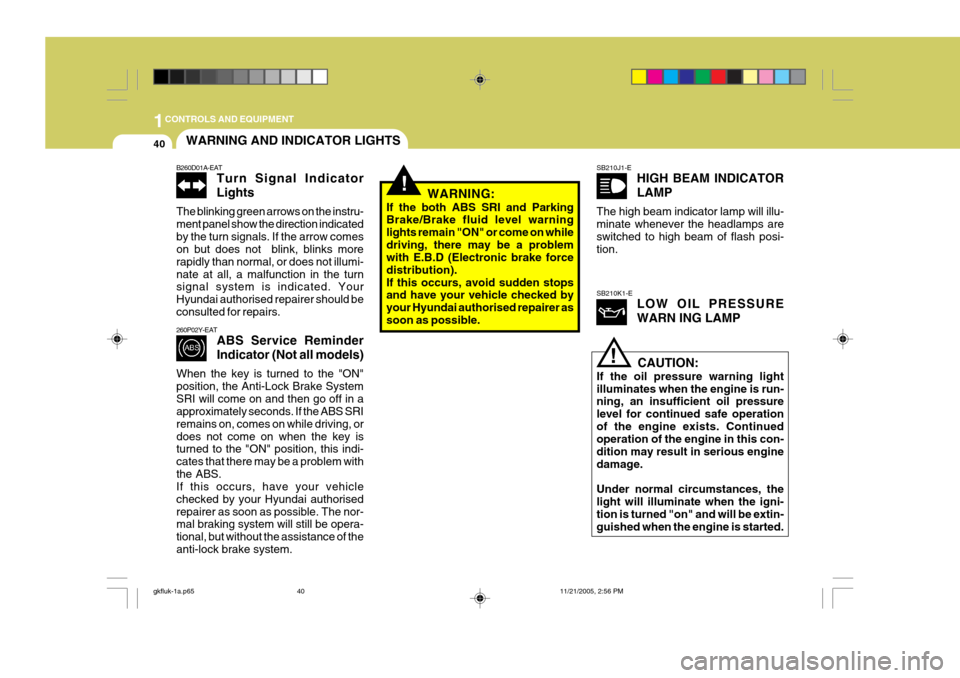
SB210K1-ELOW OIL PRESSURE WARN ING LAMP
260P02Y-EAT
ABS Service ReminderIndicator (Not all models)
When the key is turned to the "ON" position, the Anti-Lock Brake SystemSRI will come on and then go off in a approximately seconds. If the ABS SRI remains on, comes on while driving, ordoes not come on when the key is turned to the "ON" position, this indi- cates that there may be a problem withthe ABS. If this occurs, have your vehicle checked by your Hyundai authorisedrepairer as soon as possible. The nor- mal braking system will still be opera- tional, but without the assistance of theanti-lock brake system. WARNING:
If the both ABS SRI and Parking Brake/Brake fluid level warning lights remain "ON" or come on whiledriving, there may be a problem with E.B.D (Electronic brake force distribution).If this occurs, avoid sudden stops and have your vehicle checked by your Hyundai authorised repairer assoon as possible.
SB210J1-E HIGH BEAM INDICATOR LAMP
The high beam indicator lamp will illu- minate whenever the headlamps areswitched to high beam of flash posi- tion.
CAUTION:
If the oil pressure warning light illuminates when the engine is run- ning, an insufficient oil pressure level for continued safe operationof the engine exists. Continued operation of the engine in this con- dition may result in serious enginedamage. Under normal circumstances, the light will illuminate when the igni- tion is turned "on" and will be extin- guished when the engine is started.
B260D01A-EAT
Turn Signal Indicator Lights
The blinking green arrows on the instru- ment panel show the direction indicatedby the turn signals. If the arrow comes on but does not blink, blinks more rapidly than normal, or does not illumi-nate at all, a malfunction in the turn signal system is indicated. Your Hyundai authorised repairer should beconsulted for repairs.
gkfluk-1a.p65 11/21/2005, 2:56 PM
40
Page 312 of 478
1
CONTROLS AND EQUIPMENT
41
!
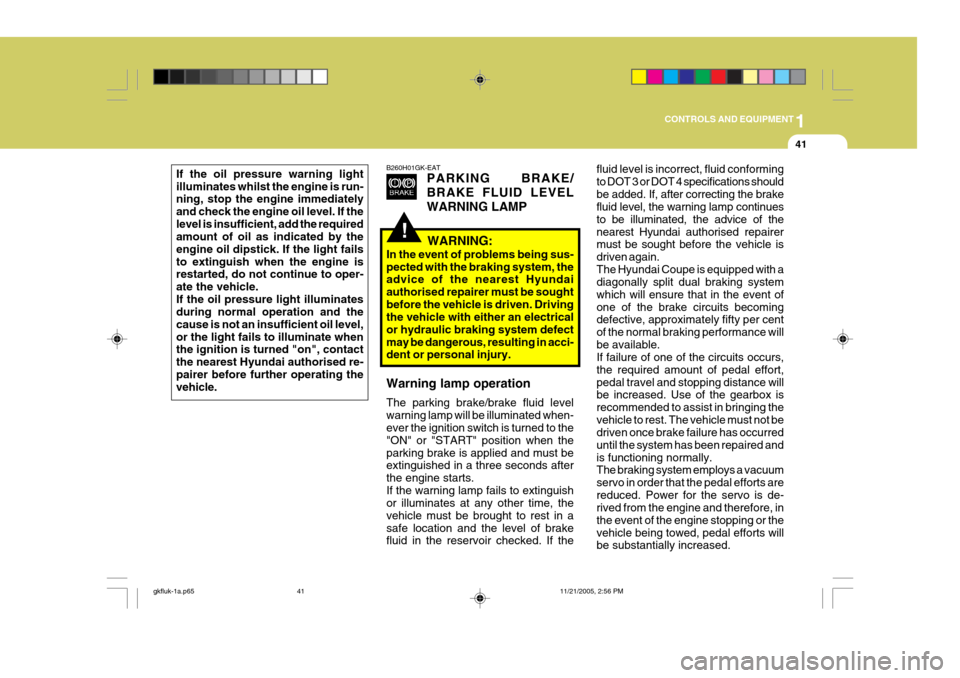
If the oil pressure warning light illuminates whilst the engine is run- ning, stop the engine immediately and check the engine oil level. If thelevel is insufficient, add the required amount of oil as indicated by the engine oil dipstick. If the light failsto extinguish when the engine is restarted, do not continue to oper- ate the vehicle.If the oil pressure light illuminates during normal operation and the cause is not an insufficient oil level,or the light fails to illuminate when the ignition is turned "on", contact the nearest Hyundai authorised re-pairer before further operating the vehicle. B260H01GK-EAT
PARKING BRAKE/ BRAKE FLUID LEVELWARNING LAMP
WARNING:
In the event of problems being sus- pected with the braking system, the advice of the nearest Hyundai authorised repairer must be soughtbefore the vehicle is driven. Driving the vehicle with either an electrical or hydraulic braking system defectmay be dangerous, resulting in acci- dent or personal injury. Warning lamp operation The parking brake/brake fluid level warning lamp will be illuminated when- ever the ignition switch is turned to the "ON" or "START" position when theparking brake is applied and must be extinguished in a three seconds after the engine starts.If the warning lamp fails to extinguish or illuminates at any other time, the vehicle must be brought to rest in asafe location and the level of brake fluid in the reservoir checked. If the fluid level is incorrect, fluid conforming to DOT 3 or DOT 4 specifications shouldbe added. If, after correcting the brake fluid level, the warning lamp continues to be illuminated, the advice of the
nearest Hyundai auth
orised repairer
must be sought b efore the vehicle is
driven again.The Hyundai Coupe is equipped with a diagonally split dual braking system which will ensure that in the event ofone of the brake circuits becoming defective, approximately fifty per cent of the normal braking performance willbe available. If failure of one of the circuits occurs, the required amount of pedal effort,pedal travel and stopping distance will be increased. Use of the gearbox is recommended to assist in bringing thevehicle to rest. The vehicle must not be driven once brake failure has occurred until the system has been repaired andis functioning normally. The braking system employs a vacuum servo in order that the pedal efforts arereduced. Power for the servo is de- rived from the engine and therefore, in the event of the engine stopping or thevehicle being towed, pedal efforts will be substantially increased.
gkfluk-1a.p65 11/21/2005, 2:56 PM
41
Page 313 of 478
1CONTROLS AND EQUIPMENT
42
!
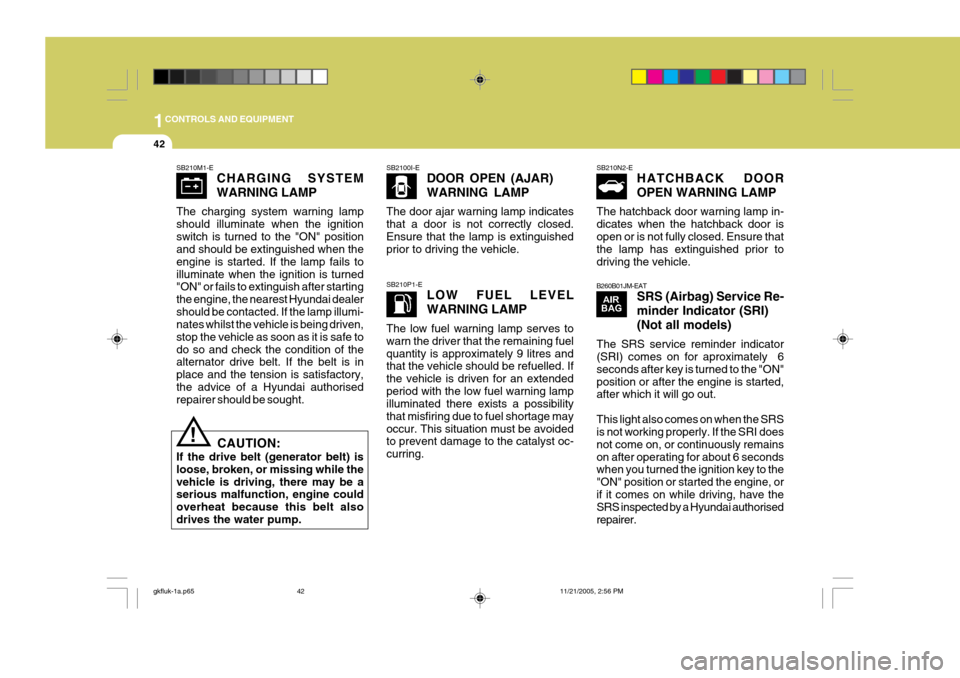
SB210M1-E
CHARGING SYSTEM WARNING LAMP
The charging system warning lamp should illuminate when the ignitionswitch is turned to the "ON" position and should be extinguished when the engine is started. If the lamp fails toilluminate when the ignition is turned "ON" or fails to extinguish after starting the engine, the nearest Hyundai dealershould be contacted. If the lamp illumi- nates whilst the vehicle is being driven, stop the vehicle as soon as it is safe todo so and check the condition of the alternator drive belt. If the belt is in place and the tension is satisfactory,the advice of a Hyundai authorised repairer should be sought.
CAUTION:
If the drive belt (generator belt) is loose, broken, or missing while thevehicle is driving, there may be a serious malfunction, engine could overheat because this belt alsodrives the water pump.
SB210P1-E LOW FUEL LEVEL WARNING LAMP
The low fuel warning lamp serves to warn the driver that the remaining fuelquantity is approximately 9 litres and that the vehicle should be refuelled. If the vehicle is driven for an extendedperiod with the low fuel warning lamp illuminated there exists a possibility that misfiring due to fuel shortage mayoccur. This situation must be avoided to prevent damage to the catalyst oc- curring.
SB2100I-E
DOOR OPEN (AJAR) WARNING LAMP
The door ajar warning lamp indicates that a door is not correctly closed.Ensure that the lamp is extinguished prior to driving the vehicle.
B260B01JM-EATSRS (Airbag) Service Re- minder Indicator (SRI)(Not all models)
The SRS service reminder indicator (SRI) comes on for aproximately 6 seconds after key is turned to the "ON"position or after the engine is started, after which it will go out. This light also comes on when the SRS is not working properly. If the SRI does not come on, or continuously remainson after operating for about 6 seconds when you turned the ignition key to the "ON" position or started the engine, orif it comes on while driving, have the SRS inspected by a Hyundai authorised repairer.
SB210N2-E HATCHBACK DOOR OPEN WARNING LAMP
The hatchback door warning lamp in- dicates when the hatchback door isopen or is not fully closed. Ensure that the lamp has extinguished prior to driving the vehicle.
gkfluk-1a.p65 11/21/2005, 2:56 PM
42
Page 370 of 478
2
DRIVING YOUR HYUNDAI
3TO START THE ENGINEBEFORE STARTING THE EN- GINE
SC030A1-E Before you start the engine, you should always:
1. Look around the vehicle to be sure
there are no flat tires, puddles of oil or water or other indications of pos- sible trouble.
2. After entering the car, check to be sure the parking brake is engaged.
3. Check that all windows, and lights
are clean.
4. Check that the interior and exterior mirrors are clean and in position.
5. Check your seat, seatback and head restraint to be sure they are intheir proper positions.
6. Close all the doors.
7. Fasten your seat belt and be sure that all other occupants have fas-tened theirs.
8. Turn off all lights and accessories that are not needed.
9. When you turn the ignition switch to "ON' check that all appropriate warning lights are operating and that you have sufficient fuel.
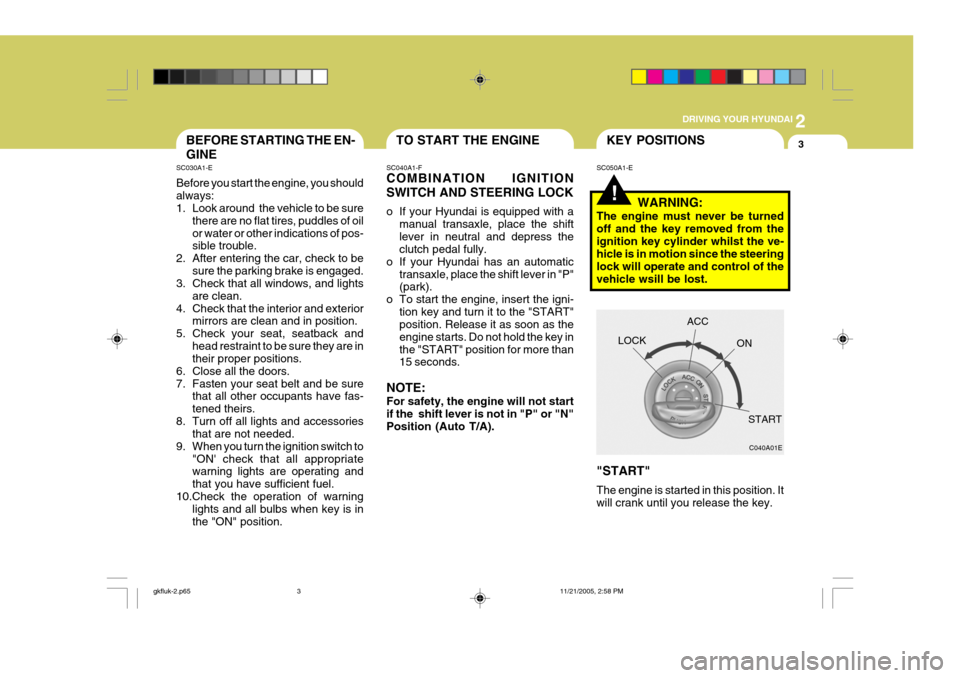
10.Check the operation of warning lights and all bulbs when key is inthe "ON" position. SC040A1-F COMBINATION IGNITION SWITCH AND STEERING LOCK
o If your Hyundai is equipped with a
manual transaxle, place the shift lever in neutral and depress the clutch pedal fully.
o If your Hyundai has an automatic
transaxle, place the shift lever in "P"(park).
o To start the engine, insert the igni- tion key and turn it to the "START"position. Release it as soon as the engine starts. Do not hold the key inthe "START" position for more than 15 seconds.
NOTE: For safety, the engine will not start if the shift lever is not in "P" or "N" Position (Auto T/A).
!
SC050A1-E KEY POSITIONS
WARNING:
The engine must never be turned off and the key removed from theignition key cylinder whilst the ve- hicle is in motion since the steering lock will operate and control of thevehicle wsill be lost. "START" The engine is started in this position. It will crank until you release the key. LOCK
C040A01E
ACC
ON
START
gkfluk-2.p65 11/21/2005, 2:58 PM
3
Page 393 of 478
3
IN CASE OF EMERGENCY
3
!
!
D010C01A-EAT If Engine Turns Over Normally but Does Not Start
1. Check fuel level.
2. With the key in the off position,
Check all connectors at ignition coils and spark plugs. Reconnect any that may be disconnected or loose.
3. Check the fuel line in the engine room.
4. If engine still refuses to start, call a Hyundai authorised repairer or seek other qualified assistance.
D010D01A-EAT If Engine Stalls While Driving
1. Reduce your speed gradually, keep- ing a straight line. Move cautiously off the road to a safe place.
2. Turn on your hazard lamp.
3. Try to start the engine again. If your vehicle will not start, contact aHyundai authorised repairer or seekother qualified assistance. SD030A2-E
CAUTION:
Personal injury and damage to thevehicle may occur if jump startingis not performed correctly. If any doubt exists as to how this opera- tion should be performed, seek as-sistance from qualified personnel.
JUMP STARTING
WARNING:
Motor vehicle batteries contain sulphuric acid and emit hydrogen gas. Protective clothing should beworn and care exercised to prevent the acid from coming into contact with skin or clothing and the ve-hicle. Naked lights should not be permitted in the vicinity of the bat- tery. Care should be exercised toprevent sparks occurring during connection. If acid accidentally comes into contact with skin oreyes, the affected area should im- mediately be flushed with copious amounts of water and medical as-sistance sought.
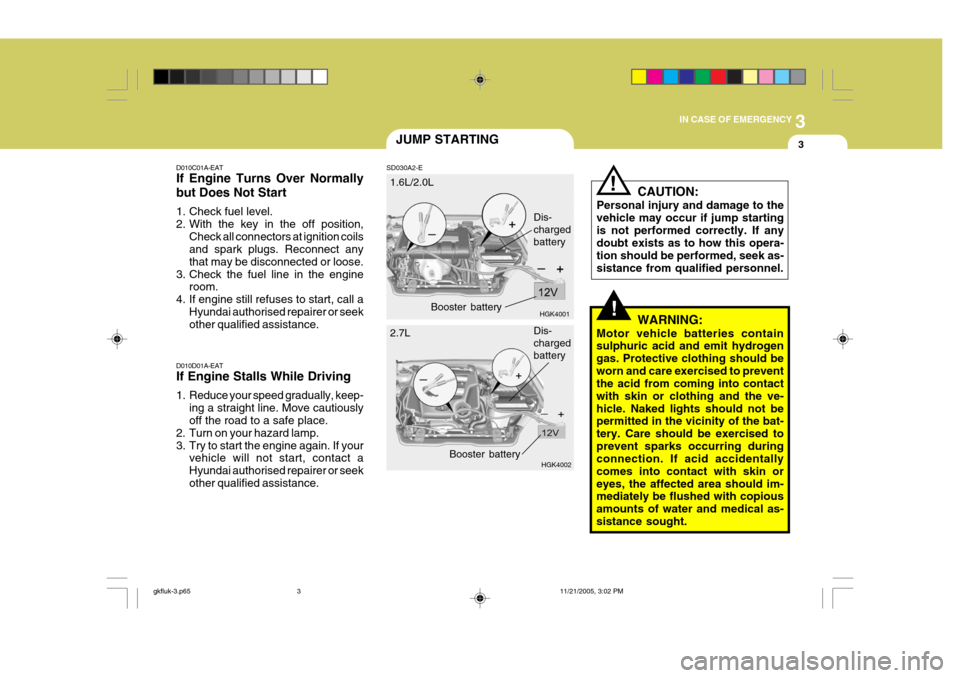
1.6L/2.0L
HGK4001
HGK4002
Dis- chargedbattery
2.7L Booster battery
Dis- chargedbattery
Booster battery
gkfluk-3.p65 11/21/2005, 3:02 PM
3
Page 395 of 478
3
IN CASE OF EMERGENCY
5
!
!WARNING:
Whilst the engine is running, keep hands and clothing away from mov- ing parts such as the fan and drive belts to prevent injury.
5. If the water pump drive belt is broken or coolant is leaking out, stop the engine immediately and call the near- est Hyundai authorised repairer forassistance.
WARNING:
Do not remove the radiator cap when the engine is hot since steam and boiling water may be ejected fromthe radiator resulting in burns or scalding.
!
6. If the cause of the overheating can- not be found, wait until the engine temperature has returned to normal. Then, if coolant has been lost, care- fully add coolant to the reservoir(page 6-11) to bring the fluid level in the reservoir up to the base of the radiator fill opening. Fill the coolantexpansion tank to the halfway mark. To ensure the correct water to cool- ant mix is obtained after top up,testing by an authorised repairer is required.
7. Proceed with caution until it is estab- lished that the engine is operatingnormally. If the engine overheats repeatedly, the advice of a Hyundaiauthorised repairer should be sought.
CAUTION:
Serious loss of coolant indicates there is a leak in the cooling system and this should be checked as soonas possible by a Hyundai authorised repairer.D040A01GK-EAT TEMPORARY SPARE TYRE The following instructions for the tem- porary spare tyre should be observed:
1. Check inflation pressure as soon as practical after installing the spare tyre, and adjust to the specified pressure. The tyre pressure should be periodically checked and main-tained at the specified pressure while the tyre is stored.
2. The spare tyre should only be used temporarily and should be returnedto the luggage compartment as soon as the original tyre can be repairedor replaced.
SPARE TYRE
Tyre Size
Inflation Pressure T125/70 R16
420 kPa (60 psi)
Spare Tyre Pressure
3. Continuous use at speeds of over 50 mph (80 km/h) is not recom- mended.
4. As the temporary spare tyre is spe-
cifically designed for your car, itshould not be used on any other vehicle.
gkfluk-3.p65 11/21/2005, 3:02 PM
5
Page 410 of 478

5VEHICLE MAINTENANCE REQUIREMENTS
2MAINTENANCE AND SER- VICING REQUIREMENTS
SF020A1-E To ensure the continued reliability and safety of the vehicle, certain routinemaintenance operations are required at specific mileage or time intervals. It is the responsibility of the vehicle owner to ensure that the maintenance schedules shown in both this OwnersManual and the Warranty and Service Passport are adhered to. The new vehicle warranty may be invalidated if the routine maintenance operations are not performed in line with the recommendations outlined andthe safety and durability of the vehicle adversely affected. It is recommended that all mainte- nance operations with the exception of the daily operating checks are en-trusted to a Hyundai authorised re- pairer to ensure that the latest repair and maintenance procedures andspecialised servicing tools are em- ployed. In addition, the use of genuine Hyundai replacement parts will ensurethat the vehicle safety and perfor- mance will not be compromised. NOTE:
The inspection and testing of cer-
tain electronic fuel injection/enginemanagement and automatic trans- mission control systems requirespecialised electronic equipment specifically designed for Hyundai vehicles. The use of general pur-pose electrical test equipment may result in damage to the control unit microprocessors. SF020C2-E
Specified Scheduled Procedures
The Specified scheduled procedures
are listed in the maintenance charts beginning at page 5-3. The operations specified must be performed at thetime or mileage intervals shown irre- spective of whether the mileage inter- val has been reached before the speci-fied time interval.
Certain lubricants and components
degrade with both time and mileage (e.g. engine oil and brake fluid) and therefore it is not permissable to basethe maintenance schedule upon mile- age alone. It is strongly recommended that the maintenance operations areperformed by the factory-trained or distributor-trained technicians at your Hyundai authorised repairer becauseof the need for specialised knowledge and tooling and to ensure that no possibility of invalidating the manufac-turers warranty exists. The maintenance schedules relate to
vehicles operated under normal condi-tions, vehicles which are operated under adverse conditions will require more frequent maintenance which isdescribed at page 5-6.
gkfluk-5.p65 11/21/2005, 3:01 PM
2
Page 412 of 478

5VEHICLE MAINTENANCE REQUIREMENTS
4
DESCRIPTION ENGINE CONTROL SYSTEM MAINTENANCE ENGINE OIL & FILTER
DRIVE BELT 1.6 DOHC/2.0 DOHC CVVT (ALT, W/PUMP, P/STR'G) 2.7 V6 (AUTO-TENSIONER, ALT, P/STR'G, A/CON)
FUEL FILTER(MPI TYPE)FLUID LEAKSTIMING BELTCRANKCASE VENTILATION HOSEAIR CLEANER FILTER SPARK PLUGS (NICKEL COATED) SPARK PLUGS (PLATINUM COATED)SPARK PLUGS (IRIDIUM COATED)VALVE CLEARENCE (2.0 DOHC CVVT) 30 36
R I I I I
See Note (1) See Note (2) See Note (3) See Note (4)
NO.
1 2 3 4567 8 9
SF040A3-E In order to ensure the continued safety, reliability and longevity of the vehicle, the following maintenance service operations should be performed at the time or mileage intervals specified. It is recommended that all routine maintenance services are entrusted to a Hyundai authorised repairer to ensure that the manufacturers recommended procedures are employed and that only genuine Hyundai replacement parts are used. Incorrect maintenance techniques or the use of non genuine replacement parts may invalidate the vehicle warranty. F030B01GK-EAT R : REPLACE I : INSPECT AND, AFTER INSPECTION, CLEAN, ADJUST, REPAIR OR REPLACE IF NECESSARY50 60
R
I I I 6072
R II I
R R
40 48
R I
R I
R
2024
R I I
R
10 12
R
I I
MILES X 1000 MONTHS
SCHEDULED MAINTENANCE
Note : (1) FOR EVERY 25,000 MILES: "R"
(2) FOR EVERY 60,000 MILES: "R"
(3) FOR EVERY 100,000 MILES: "R"
(4) FOR EVERY 60,000 MILES OR 48 MONTHS, WHICHEVER OCCURS FIRST : "I"
gkfluk-5.p65 11/21/2005, 3:01 PM
4
Page 414 of 478
5VEHICLE MAINTENANCE REQUIREMENTS
6
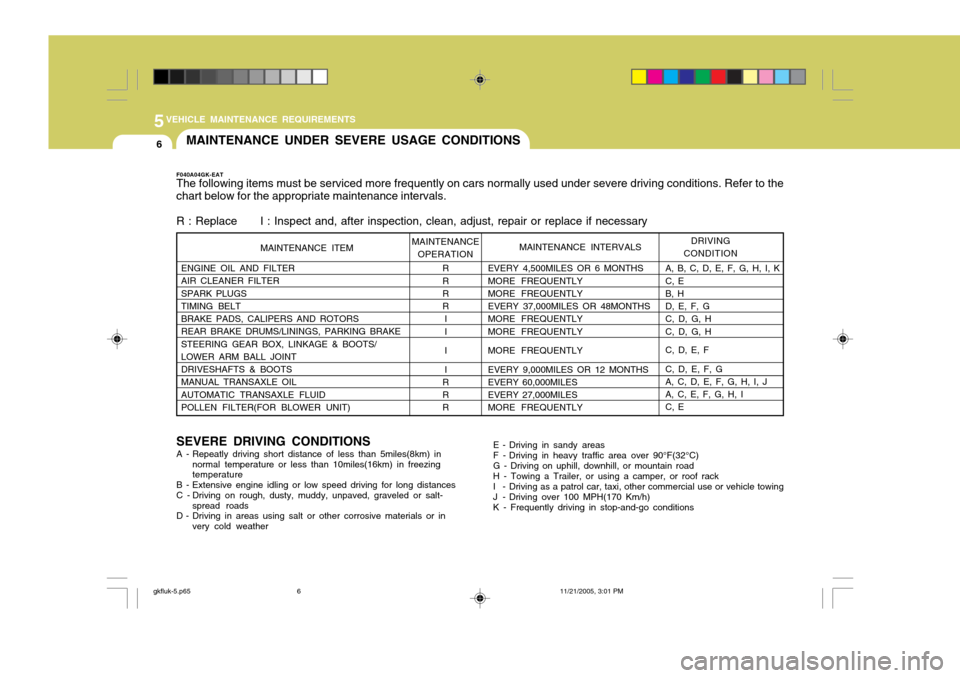
ENGINE OIL AND FILTER AIR CLEANER FILTER SPARK PLUGS TIMING BELT BRAKE PADS, CALIPERS AND ROTORS REAR BRAKE DRUMS/LININGS, PARKING BRAKE STEERING GEAR BOX, LINKAGE & BOOTS/ LOWER ARM BALL JOINT DRIVESHAFTS & BOOTS MANUAL TRANSAXLE OIL AUTOMATIC TRANSAXLE FLUID POLLEN FILTER(FOR BLOWER UNIT)
F040A04GK-EAT The following items must be serviced more frequently on cars normally used under severe driving conditions. Refer to the chart below for the appropriate maintenance intervals. R : Replace I : Inspect and, after inspection, clean, adjust, repair or replace if necessaryMAINTENANCE UNDER SEVERE USAGE CONDITIONS
MAINTENANCE INTERVALS
A, B, C, D, E, F, G, H, I, K C, E B, H D, E, F, G C, D, G, H C, D, G, H C, D, E, F C, D, E, F, G A, C, D, E, F, G, H, I, J A, C, E, F, G, H, I C, E
MAINTENANCE ITEMDRIVING
CONDITION
EVERY 4,500MILES OR 6 MONTHS MORE FREQUENTLY MORE FREQUENTLY EVERY 37,000MILES OR 48MONTHS MORE FREQUENTLY MORE FREQUENTLY MORE FREQUENTLYEVERY 9,000MILES OR 12 MONTHS EVERY 60,000MILES EVERY 27,000MILES MORE FREQUENTLY
R R R R II II
R R R
MAINTENANCE
OPERATION
SEVERE DRIVING CONDITIONS
A - Repeatly driving short distance of less than 5miles(8km) in normal temperature or less than 10miles(16km) in freezing temperature
B - Extensive engine idling or low speed driving for long distances
C - Driving on rough, dusty, muddy, unpaved, graveled or salt- spread roads
D - Driving in areas using salt or other corrosive materials or in very cold weather E - Driving in sandy areas
F - Driving in heavy traffic area over 90°F(32°C)G - Driving on uphill, downhill, or mountain roadH - Towing a Trailer, or using a camper, or roof rack
I - Driving as a patrol car, taxi, other commercial use or vehicle towing
J - Driving over 100 MPH(170 Km/h) K - Frequently driving in stop-and-go conditions
gkfluk-5.p65
11/21/2005, 3:01 PM
6
Page 415 of 478

5
VEHICLE MAINTENANCE REQUIREMENTS
7EXPLANATION OF SCHEDULED MAINTENANCE ITEMS
6ZF060M1-A
o Engine oil and filter
The engine oil and filter should be changed at the intervals specified in the maintenance schedule. If the car is being driven in severe conditions,more frequent oil and filter changes are required. 6ZF060B2-A
o Drive belts
Inspect all drive belts for evidence of cuts, cracks, excessive wear or oilsaturation and replace if necessary. Drive belts should be checked periodi- cally for proper tension and adjustedas necessary. 6ZF060C1-A
o Fuel filter
A clogged filter can limit the speed at
which the vehicle may be driven, dam- age the emission system and cause hard starting. If an excessive amountof foreign matter accumulates in the fuel tank, the filter may require re- placement more frequently. After installing a new filter, run the
engine for several minutes, and checkfor leaks at the connections.
6ZF060D1-A
o Fuel lines, fuel hoses and
connections
Check the fuel lines, fuel hoses and
connections for leakage and damage. Replace any damaged or leaking parts immediately. 6ZF060E1-A o Timing belt Inspect all parts related to the timing belt for damage and deformation. Replace any damaged parts immedi- ately. 6ZF060G1-A
o Vapour hose and fuel filler cap The vapor hose and fuel filler cap should be inspected at those intervals specified in the maintenance sched- ule. Make sure that a new vapour hoseor fuel filler cap is correctly replaced.
gkfluk-5.p65
11/21/2005, 3:01 PM
7