warning light Hyundai Coupe 2005 Workshop Manual
[x] Cancel search | Manufacturer: HYUNDAI, Model Year: 2005, Model line: Coupe, Model: Hyundai Coupe 2005Pages: 478, PDF Size: 13.44 MB
Page 332 of 478
1
CONTROLS AND EQUIPMENT
61
B460E03GK-GAT Resetting the Sunroof System If the battery has been recharged, disconnected or if the sunroof is oper-ated with the hexagonal head wrench manually, you may need to reset the sunroof. To do this;
1. Turn the ignition switch "OFF".
2. With pressing " " "up" button at the
same time, turn the ignition switch"ON". The resetting is failed when the ignition key to the "OFF" within1.5 seconds.
3. If the sunroof is set like this, the sunroof is reset with tilting up/down automatically once for all.
CAUTION:
If the sunroof is not reset, it may not be operated properly.
!
MAP LIGHT
B480A01GK-GAT
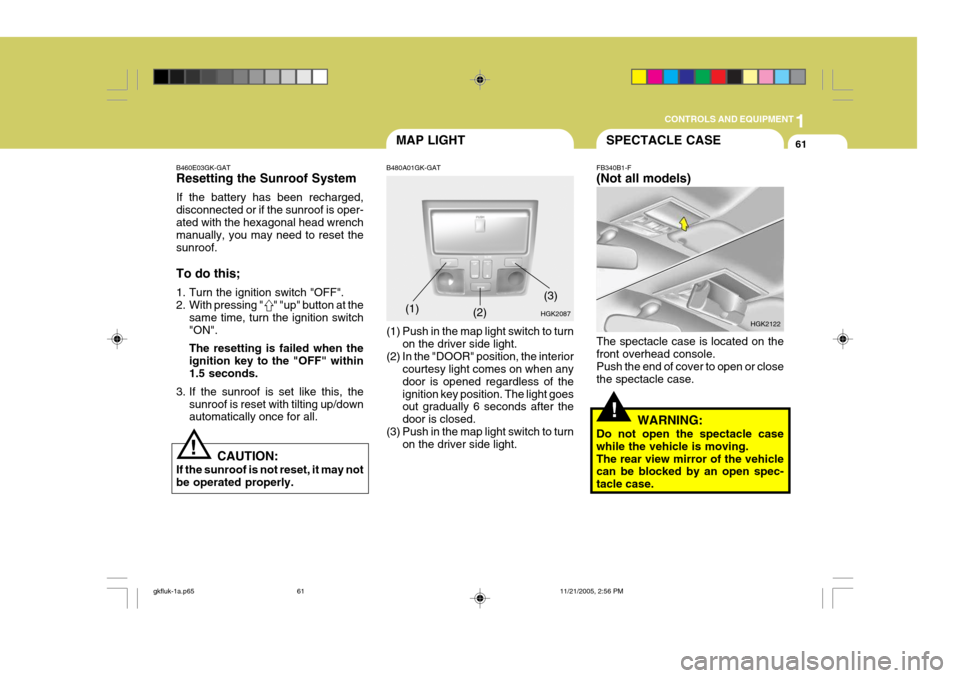
(1) Push in the map light switch to turn on the driver side light.
(2) In the "DOOR" position, the interior courtesy light comes on when any door is opened regardless of theignition key position. The light goes out gradually 6 seconds after the door is closed.
(3) Push in the map light switch to turn on the driver side light.(1)
HGK2087
(2)
(3)
!
SPECTACLE CASE
FB340B1-F (Not all models) The spectacle case is located on the front overhead console. Push the end of cover to open or closethe spectacle case.
WARNING:
Do not open the spectacle casewhile the vehicle is moving.The rear view mirror of the vehicle can be blocked by an open spec- tacle case. HGK2122
gkfluk-1a.p65
11/21/2005, 2:56 PM
61
Page 335 of 478
1CONTROLS AND EQUIPMENT
64HIGH-MOUNTED REAR STOP LIGHT
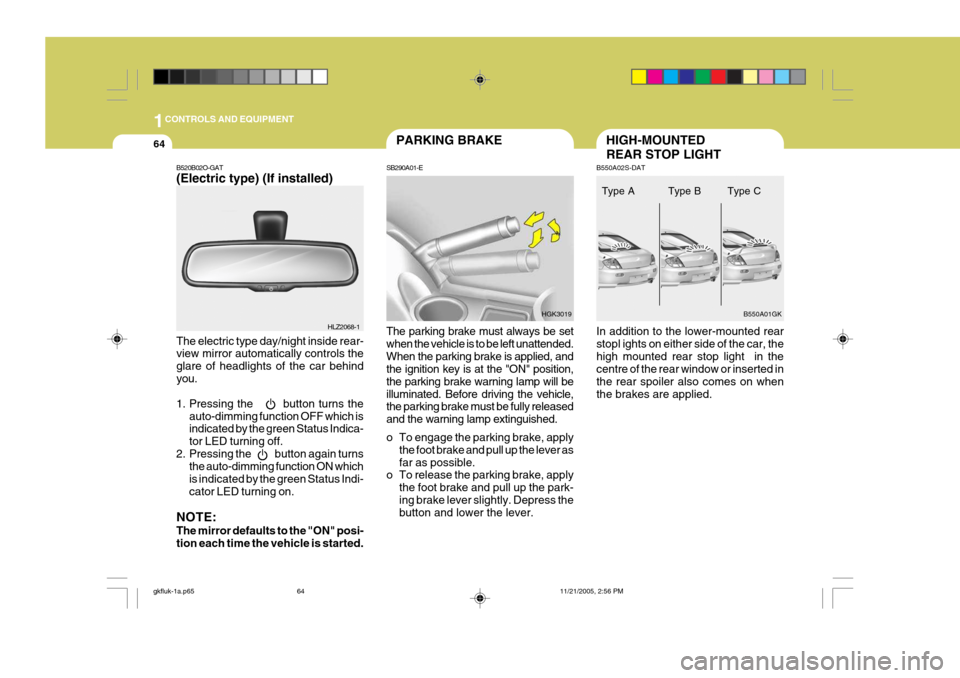
B550A02S-DAT In addition to the lower-mounted rear stopl ights on either side of the car, thehigh mounted rear stop light in the centre of the rear window or inserted in the rear spoiler also comes on whenthe brakes are applied. Type A
B550A01GK
Type B Type C
PARKING BRAKE
SB290A01-E The parking brake must always be set when the vehicle is to be left unattended.When the parking brake is applied, and the ignition key is at the "ON" position, the parking brake warning lamp will beilluminated. Before driving the vehicle, the parking brake must be fully released and the warning lamp extinguished.
o To engage the parking brake, apply the foot brake and pull up the lever as far as possible.
o To release the parking brake, apply
the foot brake and pull up the park-ing brake lever slightly. Depress the button and lower the lever. HGK3019
B520B02O-GAT (Electric type) (If installed) The electric type day/night inside rear- view mirror automatically controls the glare of headlights of the car behindyou.
1. Pressing the button turns the
auto-dimming function OFF which is indicated by the green Status Indica- tor LED turning off.
2. Pressing the button again turns the auto-dimming function ON whichis indicated by the green Status Indi-cator LED turning on.
NOTE: The mirror defaults to the "ON" posi- tion each time the vehicle is started. HLZ2068-1
gkfluk-1a.p65
11/21/2005, 2:56 PM
64
Page 337 of 478
1CONTROLS AND EQUIPMENT
66
!WARNING:
Fuel vapours are dangerous. Be- fore refuelling, turn off the engine and never allow sparks, lit ciga-rettes or open flames near the filler area. When releasing the filler cap, a small amount of residual pres-sure may generate a slight hissing sound which is not indicative of an abnormality. In the event of the fuelfiller cap requiring replacement, only a Genuine Hyundai replace- ment part should be used to pre-vent fuel leakage. HGK2018Q
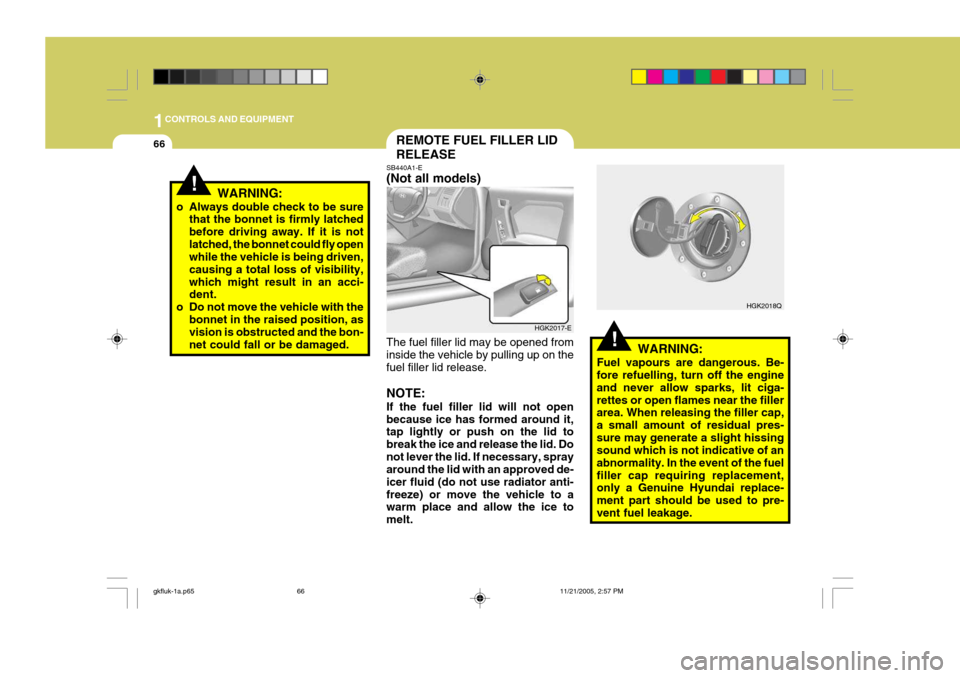
SB440A1-E (Not all models) The fuel filler lid may be opened from inside the vehicle by pulling up on thefuel filler lid release. NOTE: If the fuel filler lid will not open because ice has formed around it, tap lightly or push on the lid to break the ice and release the lid. Donot lever the lid. If necessary, spray around the lid with an approved de- icer fluid (do not use radiator anti-freeze) or move the vehicle to a warm place and allow the ice to melt.REMOTE FUEL FILLER LID RELEASE
HGK2017-E
!WARNING:
o Always double check to be sure that the bonnet is firmly latched before driving away. If it is notlatched, the bonnet could fly open while the vehicle is being driven, causing a total loss of visibility,which might result in an acci- dent.
o Do not move the vehicle with the bonnet in the raised position, asvision is obstructed and the bon- net could fall or be damaged.
gkfluk-1a.p65 11/21/2005, 2:57 PM
66
Page 342 of 478
1
CONTROLS AND EQUIPMENT
71
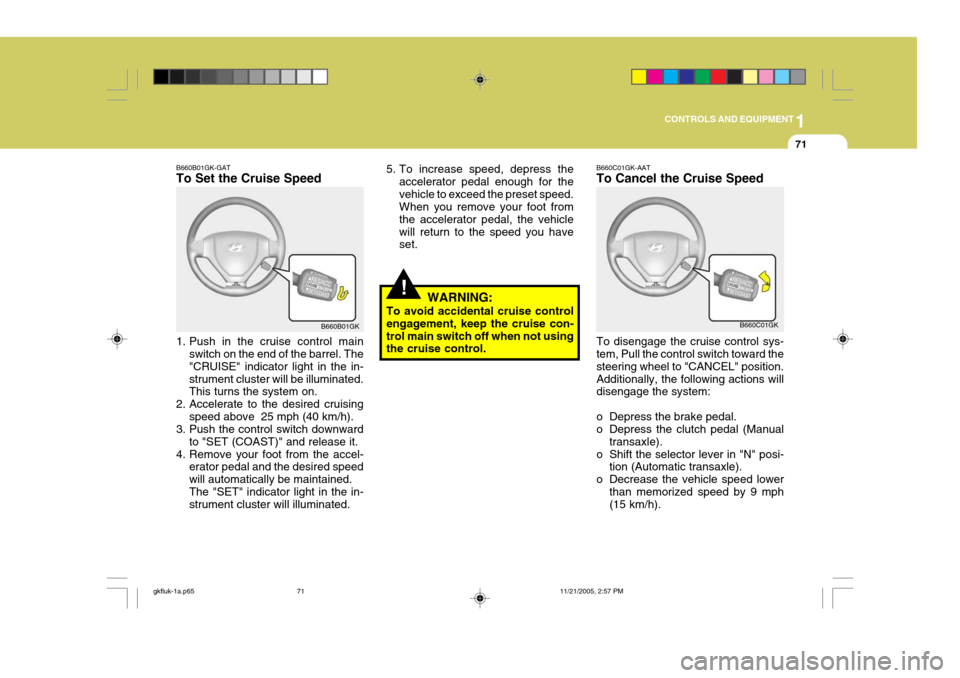
B660B01GK-GAT To Set the Cruise Speed
1. Push in the cruise control main
switch on the end of the barrel. The "CRUISE" indicator light in the in-strument cluster will be illuminated. This turns the system on.
2. Accelerate to the desired cruising speed above 25 mph (40 km/h).
3. Push the control switch downward
to "SET (COAST)" and release it.
4. Remove your foot from the accel- erator pedal and the desired speed will automatically be maintained.The "SET" indicator light in the in- strument cluster will illuminated. B660B01GK
!
5. To increase speed, depress the
accelerator pedal enough for the vehicle to exceed the preset speed. When you remove your foot from the accelerator pedal, the vehiclewill return to the speed you have set.
WARNING:
To avoid accidental cruise controlengagement, keep the cruise con- trol main switch off when not using the cruise control.B660C01GK-AAT To Cancel the Cruise Speed To disengage the cruise control sys- tem, Pull the control switch toward the steering wheel to "CANCEL" position.Additionally, the following actions will disengage the system:
o Depress the brake pedal.
o Depress the clutch pedal (Manual transaxle).
o Shift the selector lever in "N" posi- tion (Automatic transaxle).
o Decrease the vehicle speed lower than memorized speed by 9 mph(15 km/h). B660C01GK
gkfluk-1a.p65
11/21/2005, 2:57 PM
71
Page 370 of 478
2
DRIVING YOUR HYUNDAI
3TO START THE ENGINEBEFORE STARTING THE EN- GINE
SC030A1-E Before you start the engine, you should always:
1. Look around the vehicle to be sure
there are no flat tires, puddles of oil or water or other indications of pos- sible trouble.
2. After entering the car, check to be sure the parking brake is engaged.
3. Check that all windows, and lights
are clean.
4. Check that the interior and exterior mirrors are clean and in position.
5. Check your seat, seatback and head restraint to be sure they are intheir proper positions.
6. Close all the doors.
7. Fasten your seat belt and be sure that all other occupants have fas-tened theirs.
8. Turn off all lights and accessories that are not needed.
9. When you turn the ignition switch to "ON' check that all appropriate warning lights are operating and that you have sufficient fuel.
10.Check the operation of warning lights and all bulbs when key is inthe "ON" position. SC040A1-F COMBINATION IGNITION SWITCH AND STEERING LOCK
o If your Hyundai is equipped with a
manual transaxle, place the shift lever in neutral and depress the clutch pedal fully.
o If your Hyundai has an automatic
transaxle, place the shift lever in "P"(park).
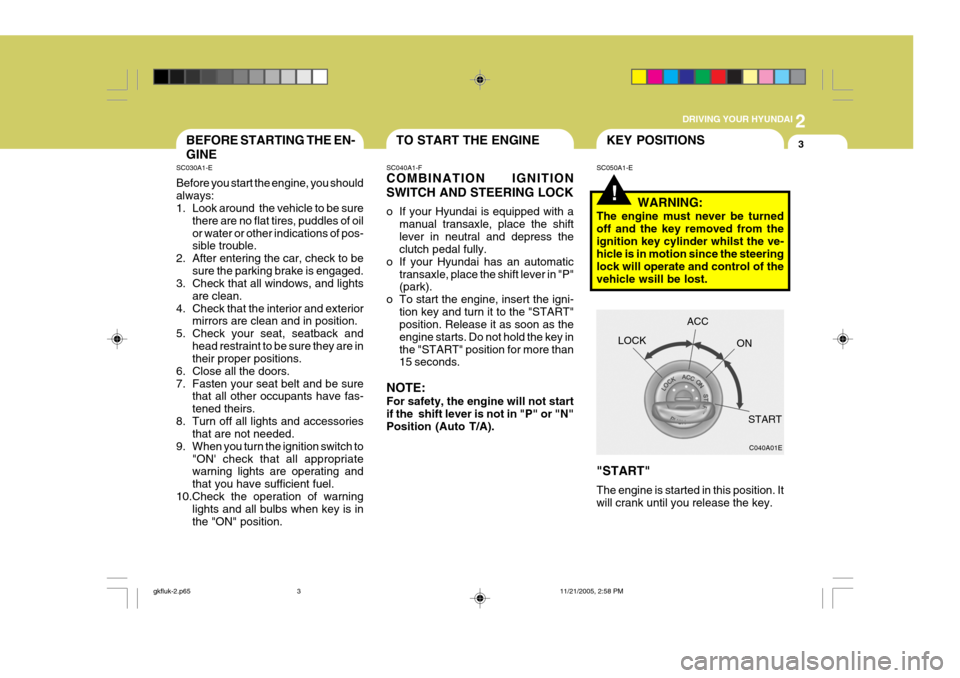
o To start the engine, insert the igni- tion key and turn it to the "START"position. Release it as soon as the engine starts. Do not hold the key inthe "START" position for more than 15 seconds.
NOTE: For safety, the engine will not start if the shift lever is not in "P" or "N" Position (Auto T/A).
!
SC050A1-E KEY POSITIONS
WARNING:
The engine must never be turned off and the key removed from theignition key cylinder whilst the ve- hicle is in motion since the steering lock will operate and control of thevehicle wsill be lost. "START" The engine is started in this position. It will crank until you release the key. LOCK
C040A01E
ACC
ON
START
gkfluk-2.p65 11/21/2005, 2:58 PM
3
Page 372 of 478
2
DRIVING YOUR HYUNDAI
5
!
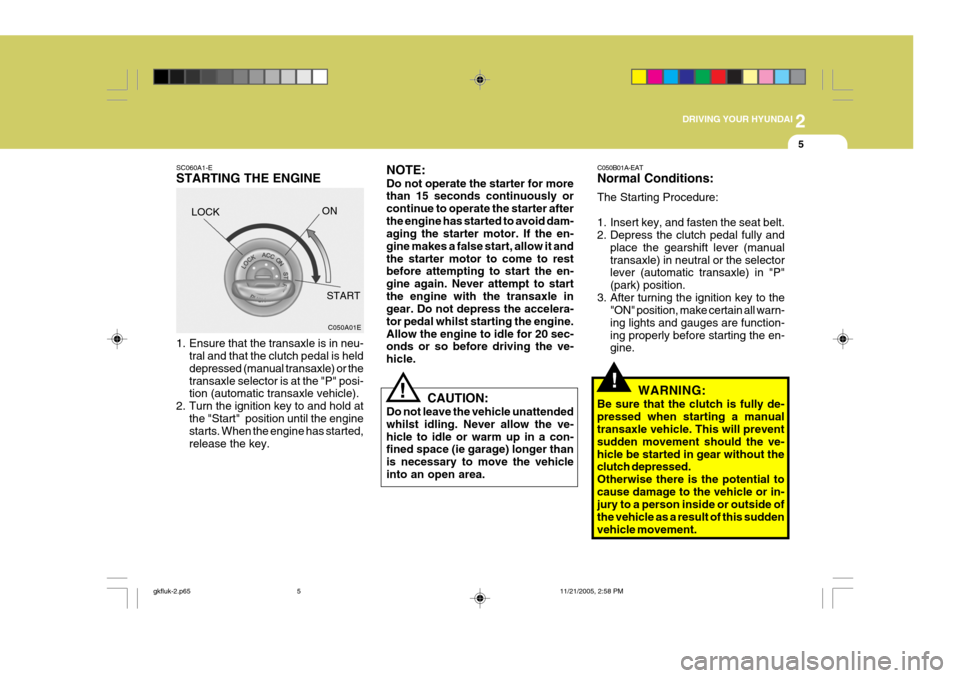
SC060A1-E STARTING THE ENGINE
LOCK
C050A01E
ON
START NOTE: Do not operate the starter for more than 15 seconds continuously or continue to operate the starter afterthe engine has started to avoid dam- aging the starter motor. If the en- gine makes a false start, allow it andthe starter motor to come to rest before attempting to start the en- gine again. Never attempt to startthe engine with the transaxle in gear. Do not depress the accelera- tor pedal whilst starting the engine.Allow the engine to idle for 20 sec- onds or so before driving the ve- hicle.
1. Ensure that the transaxle is in neu-
tral and that the clutch pedal is helddepressed (manual transaxle) or thetransaxle selector is at the "P" posi- tion (automatic transaxle vehicle).
2. Turn the ignition key to and hold at the "Start" position until the enginestarts. When the engine has started, release the key. CAUTION:
Do not leave the vehicle unattendedwhilst idling. Never allow the ve-hicle to idle or warm up in a con- fined space (ie garage) longer than is necessary to move the vehicleinto an open area.
! C050B01A-EAT Normal Conditions: The Starting Procedure:
1. Insert key, and fasten the seat belt.
2. Depress the clutch pedal fully and
place the gearshift lever (manual transaxle) in neutral or the selector lever (automatic transaxle) in "P" (park) position.
3. After turning the ignition key to the "ON" position, make certain all warn-ing lights and gauges are function-ing properly before starting the en- gine.
WARNING:
Be sure that the clutch is fully de- pressed when starting a manual transaxle vehicle. This will prevent sudden movement should the ve-hicle be started in gear without the clutch depressed. Otherwise there is the potential tocause damage to the vehicle or in- jury to a person inside or outside of the vehicle as a result of this suddenvehicle movement.
gkfluk-2.p65 11/21/2005, 2:58 PM
5
Page 380 of 478
2
DRIVING YOUR HYUNDAI
13
WARNING:
ABS will not prevent accidents due to improper or dangerous driving manoeuvres. Even though vehiclecontrol is improved during emer- gency braking, always maintain a safe distance between you and ob-jects ahead. Vehicle speeds should always be reduced during extreme road conditions.The braking distance for cars equipped with an anti-lock braking system may be longer than for thosewithout it in the following road con- ditions. These roads should be driven at reduced speeds.
o Rough, gravel or snow-covered roads.
o With tyre chains installed.
o On roads where the road surface
is pitted or has different surface height.!The safety features of an ABS equipped vehicle should not be tested by high speed driving or cornering. This could endanger the safety ofyourself or others.
ANTI-LOCK BRAKE SYSTEM (ABS)
C120A03A-EAT (Not all models) The Anti-Lock Brake System (ABS) is designed to prevent wheel lock-up during sudden braking or on hazard- ous road surfaces. The ABS controlmodule monitors the wheel speed and controls the pressure applied to each brake. Thus, in emergency situationsor on slick roads, ABS will increase vehicle control during braking. NOTE:
o A click sound may be heard in the
engine compartment when the ve- hicle begins to move after the en-gine is started. These conditions are normal and indicate that the anti-lock brake system (ElectronicStability Program) is functioning properly.
o During ABS operation, a slight
pulsation may be felt in the brakepedal when the brakes are ap- plied. Also, a noise may be heardin the engine compartment while braking. These conditions are normal and indicate that the anti-lock brake system is functioning properly.
gkfluk-2.p65 11/21/2005, 2:58 PM
13
Page 382 of 478
2
DRIVING YOUR HYUNDAI
15
SC150A1-F You can save fuel and get more miles from your car if you follow these sug- gestions:
o Drive smoothly. Accelerate at a
moderate rate. Don't make "jack- rabbit" starts or full-throttle shiftsand maintain a steady cruising speed. Don't race between stop- lights. Try to adjust your speed tothat of the other traffic so you don't have to change speeds unneces- sarily.Avoid heavy traffic whenever pos- sible. Always maintain a safe dis- tance from other vehicles so youcan avoid unnecessary brak-ing. This also reduces brake wear.
o Drive at a moderate speed. The faster you drive, the more fuel yourcar uses. Driving at a moderate speed, especially on the highway, isone of the most effective ways to reduce fuel consumption.
DRIVING FOR ECONOMY
C310B01JM-AAT ESP ON/OFF Mode When the ESP is operating, the ESP indicator in the instrument cluster willblink. If you turn the system off by pressing the ESP switch, the ESP-OFF indica-tor will come on and stay on. In the ESP-OFF mode, the stability control will be deactivated. Adjust your drivingaccordingly. To turn the system back on, press the switch again. The ESP- OFF indicator should go off. NOTE: The ESP mode will automatically be turned ON after the engine is turnedoff and restarted. C310D01JM-EAT Indicators and Warning The indicators should illuminate when the ignition key is turned to ON orSTART but should go out after approxi- mately 3 seconds. If the indicators do not illuminate, or theESP or ESP-OFF indicator does not go out after approximately 3 seconds, have the vehicle checked by an authorizeddealer. Should there be any unusual conditions in the device while driving, ESP-OFF indicator illuminates as a warning. If ESP-OFF indicator illuminates, pullyour car to a safe place and stop the engine. Then, start the engine again to check ifthe ESP-OFF indicator goes out. If the indicator remains lit even after the engine has been started, have your car checked by an authorized Hyundai dealer.
gkfluk-2.p65
11/21/2005, 2:58 PM
15
Page 389 of 478
2DRIVING YOUR HYUNDAI
22
!WARNING:
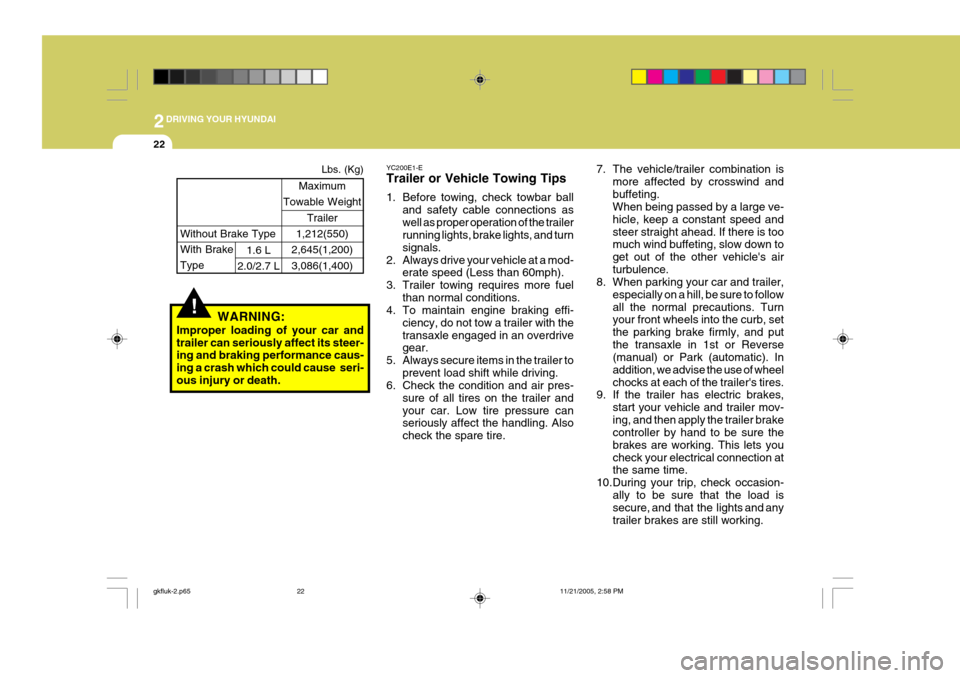
Improper loading of your car and trailer can seriously affect its steer- ing and braking performance caus- ing a crash which could cause seri-ous injury or death. Without Brake Type
Maximum
Towable Weight
Trailer
1,212(550)
2,645(1,200) 3,086(1,400)
With Brake Type1.6 L
2.0/2.7 L Lbs. (Kg)
7. The vehicle/trailer combination is
more affected by crosswind and buffeting. When being passed by a large ve- hicle, keep a constant speed andsteer straight ahead. If there is too much wind buffeting, slow down to get out of the other vehicle's airturbulence.
8. When parking your car and trailer,
especially on a hill, be sure to followall the normal precautions. Turn your front wheels into the curb, set the parking brake firmly, and putthe transaxle in 1st or Reverse (manual) or Park (automatic). In addition, we advise the use of wheelchocks at each of the trailer's tires.
9. If the trailer has electric brakes,
start your vehicle and trailer mov-ing, and then apply the trailer brake controller by hand to be sure the brakes are working. This lets youcheck your electrical connection at the same time.
10.During your trip, check occasion- ally to be sure that the load issecure, and that the lights and any trailer brakes are still working.
YC200E1-E Trailer or Vehicle Towing Tips
1. Before towing, check towbar ball
and safety cable connections as well as proper operation of the trailer running lights, brake lights, and turn signals.
2. Always drive your vehicle at a mod- erate speed (Less than 60mph).
3. Trailer towing requires more fuel than normal conditions.
4. To maintain engine braking effi-
ciency, do not tow a trailer with thetransaxle engaged in an overdrive gear.
5. Always secure items in the trailer to prevent load shift while driving.
6. Check the condition and air pres-
sure of all tires on the trailer and your car. Low tire pressure can seriously affect the handling. Also check the spare tire.
gkfluk-2.p65 11/21/2005, 2:58 PM
22
Page 393 of 478
3
IN CASE OF EMERGENCY
3
!
!
D010C01A-EAT If Engine Turns Over Normally but Does Not Start
1. Check fuel level.
2. With the key in the off position,
Check all connectors at ignition coils and spark plugs. Reconnect any that may be disconnected or loose.
3. Check the fuel line in the engine room.
4. If engine still refuses to start, call a Hyundai authorised repairer or seek other qualified assistance.
D010D01A-EAT If Engine Stalls While Driving
1. Reduce your speed gradually, keep- ing a straight line. Move cautiously off the road to a safe place.
2. Turn on your hazard lamp.
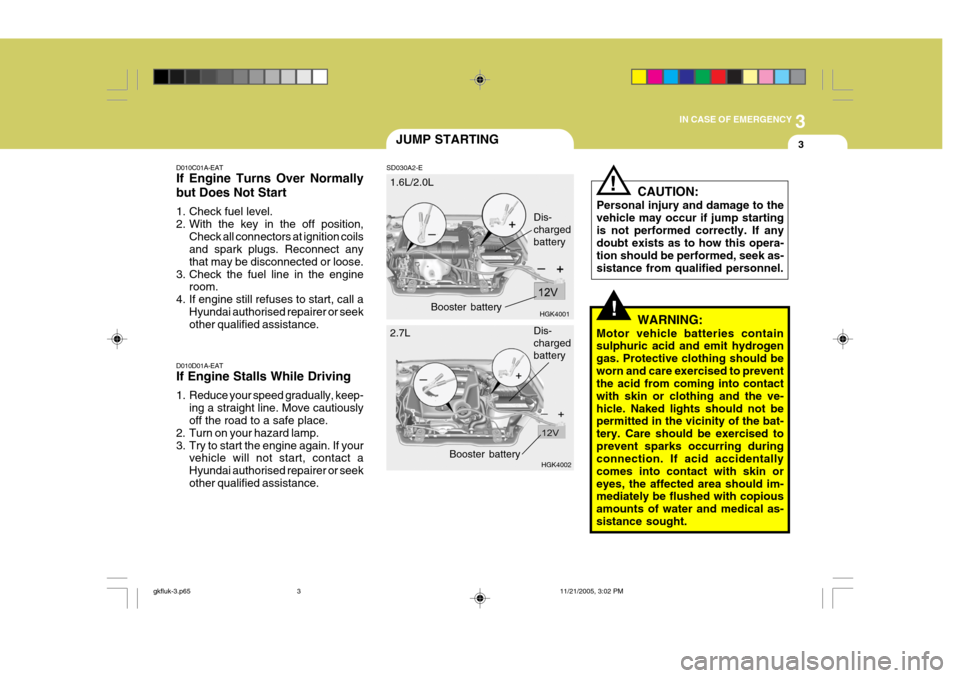
3. Try to start the engine again. If your vehicle will not start, contact aHyundai authorised repairer or seekother qualified assistance. SD030A2-E
CAUTION:
Personal injury and damage to thevehicle may occur if jump startingis not performed correctly. If any doubt exists as to how this opera- tion should be performed, seek as-sistance from qualified personnel.
JUMP STARTING
WARNING:
Motor vehicle batteries contain sulphuric acid and emit hydrogen gas. Protective clothing should beworn and care exercised to prevent the acid from coming into contact with skin or clothing and the ve-hicle. Naked lights should not be permitted in the vicinity of the bat- tery. Care should be exercised toprevent sparks occurring during connection. If acid accidentally comes into contact with skin oreyes, the affected area should im- mediately be flushed with copious amounts of water and medical as-sistance sought.
1.6L/2.0L
HGK4001
HGK4002
Dis- chargedbattery
2.7L Booster battery
Dis- chargedbattery
Booster battery
gkfluk-3.p65 11/21/2005, 3:02 PM
3