lock Hyundai Coupe 2007 Owners Manual
[x] Cancel search | Manufacturer: HYUNDAI, Model Year: 2007, Model line: Coupe, Model: Hyundai Coupe 2007Pages: 487, PDF Size: 12.96 MB
Page 333 of 487
1
CONTROLS AND EQUIPMENT
65
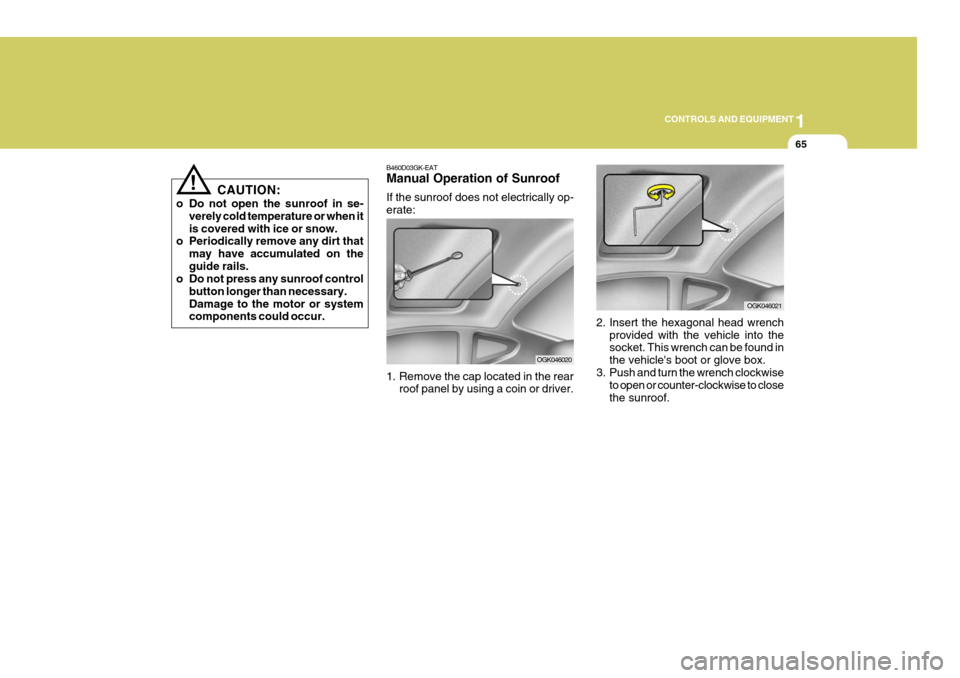
2. Insert the hexagonal head wrench provided with the vehicle into the socket. This wrench can be found in the vehicle's boot or glove box.
3. Push and turn the wrench clockwise
to open or counter-clockwise to closethe sunroof.
OGK046021
B460D03GK-EAT Manual Operation of Sunroof If the sunroof does not electrically op- erate:
1. Remove the cap located in the rear
roof panel by using a coin or driver.
OGK046020
! CAUTION:
o Do not open the sunroof in se- verely cold temperature or when it is covered with ice or snow.
o Periodically remove any dirt that
may have accumulated on theguide rails.
o Do not press any sunroof control
button longer than necessary.Damage to the motor or system components could occur.
Page 335 of 487
1
CONTROLS AND EQUIPMENT
67
!
GLOVE BOX
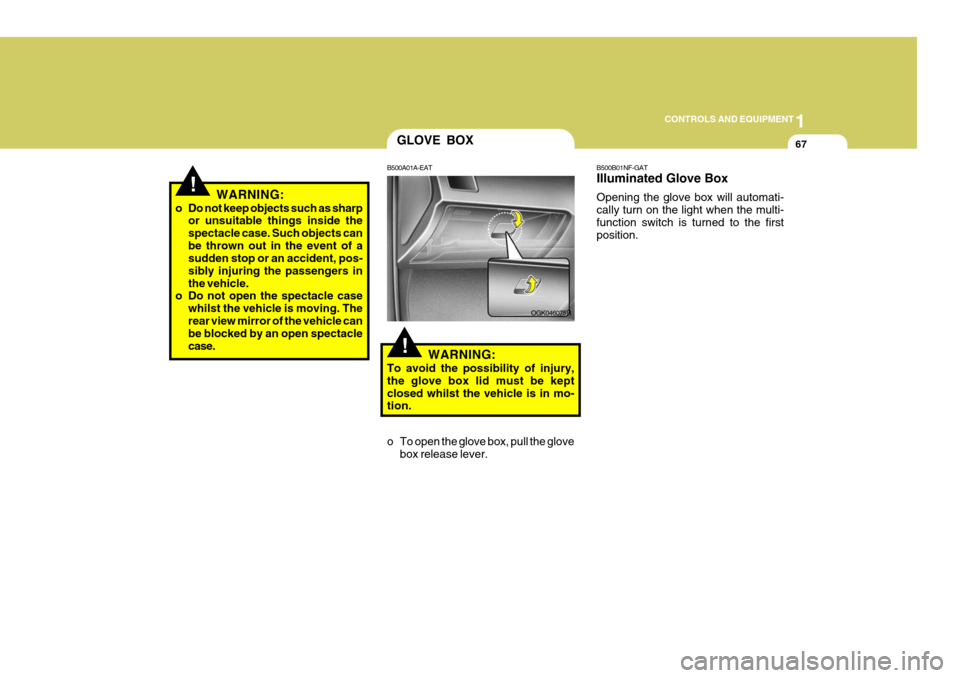
B500A01A-EAT
WARNING:
To avoid the possibility of injury, the glove box lid must be keptclosed whilst the vehicle is in mo- tion.
o To open the glove box, pull the glove box release lever. OGK046075R
!WARNING:
o Do not keep objects such as sharp or unsuitable things inside the spectacle case. Such objects canbe thrown out in the event of a sudden stop or an accident, pos- sibly injuring the passengers inthe vehicle.
o Do not open the spectacle case
whilst the vehicle is moving. Therear view mirror of the vehicle can be blocked by an open spectacle case. B500B01NF-GAT Illuminated Glove Box Opening the glove box will automati- cally turn on the light when the multi-function switch is turned to the first position.
Page 340 of 487
1CONTROLS AND EQUIPMENT
72
!WARNING:
o Always double check to be sure that the bonnet is firmly latched before driving away. If it is not latched, the bonnet could fly openwhilst the vehicle is being driven, causing a total loss of visibility, which might result in an acci-dent.
o Do not move the vehicle with the
bonnet in the raised position, asvision is obstructed and the bon- net could fall or be damaged.
When closing the bonnet, slowly close the bonnet and make sure it locks intoplace.
REMOTE FUEL FILLER FLAP RELEASE
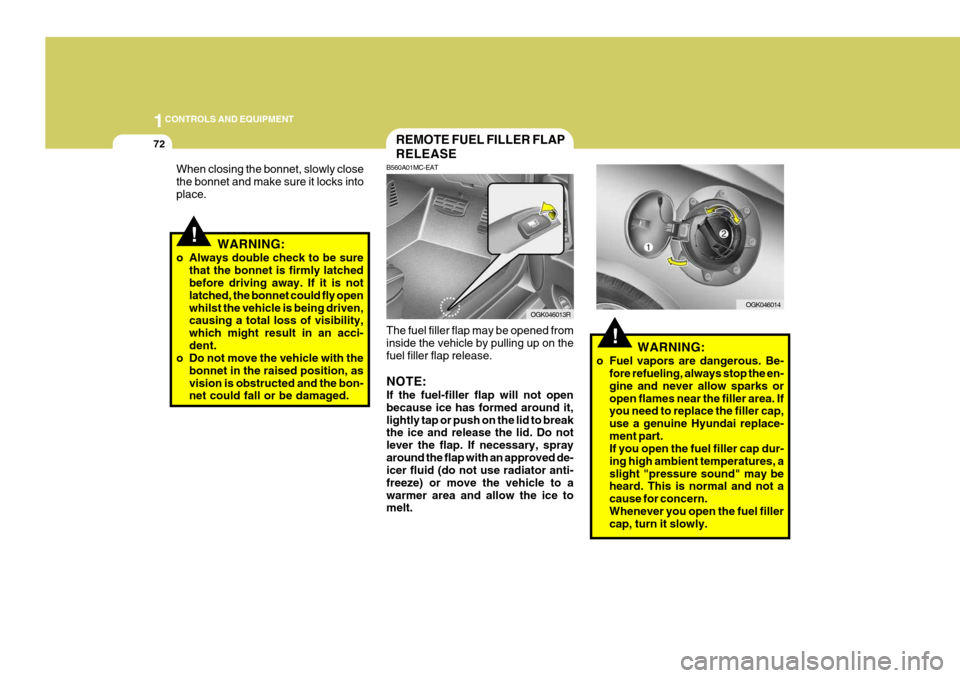
B560A01MC-EAT The fuel filler flap may be opened from inside the vehicle by pulling up on thefuel filler flap release. NOTE: If the fuel-filler flap will not open because ice has formed around it,lightly tap or push on the lid to break the ice and release the lid. Do not lever the flap. If necessary, sprayaround the flap with an approved de- icer fluid (do not use radiator anti- freeze) or move the vehicle to awarmer area and allow the ice to melt.
OGK046013R
!WARNING:
o Fuel vapors are dangerous. Be- fore refueling, always stop the en- gine and never allow sparks oropen flames near the filler area. If you need to replace the filler cap, use a genuine Hyundai replace-ment part. If you open the fuel filler cap dur- ing high ambient temperatures, aslight "pressure sound" may be heard. This is normal and not a cause for concern.Whenever you open the fuel filler cap, turn it slowly.
OGK046014
Page 342 of 487
1CONTROLS AND EQUIPMENT
74HATCHBACK DOOR
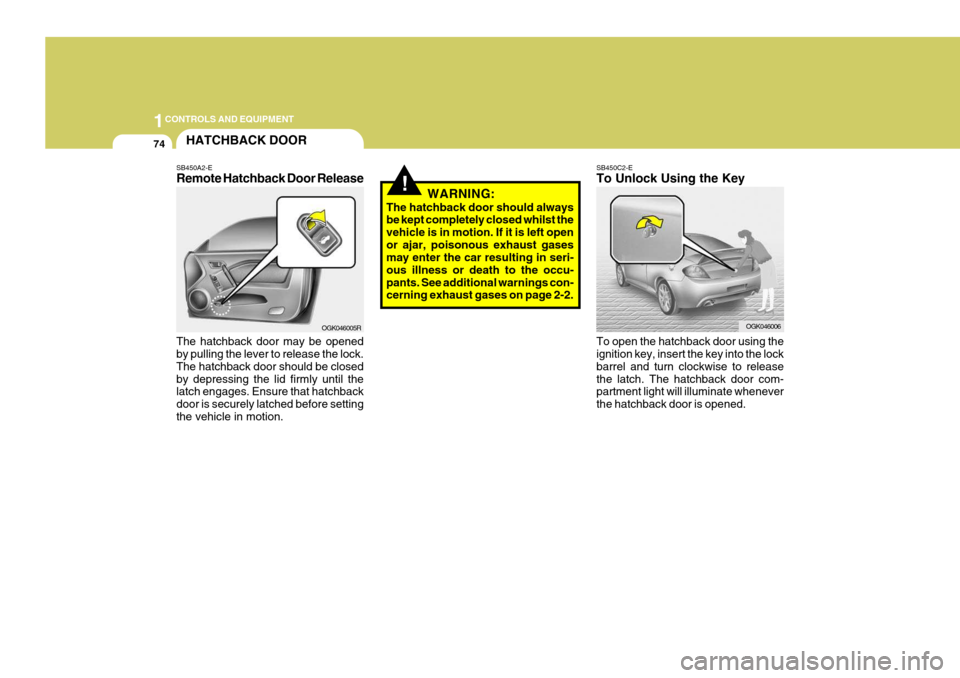
SB450A2-E Remote Hatchback Door Release The hatchback door may be opened by pulling the lever to release the lock. The hatchback door should be closedby depressing the lid firmly until the latch engages. Ensure that hatchback door is securely latched before settingthe vehicle in motion. OGK046005R
!WARNING:
The hatchback door should always be kept completely closed whilst the vehicle is in motion. If it is left openor ajar, poisonous exhaust gases may enter the car resulting in seri- ous illness or death to the occu-pants. See additional warnings con- cerning exhaust gases on page 2-2.
SB450C2-E To Unlock Using the Key To open the hatchback door using the ignition key, insert the key into the lock barrel and turn clockwise to releasethe latch. The hatchback door com- partment light will illuminate whenever the hatchback door is opened. OGK046006
Page 344 of 487
1CONTROLS AND EQUIPMENT
76
!WARNING:
Do not place the sunvisor in such a manner that it obscures visibility ofthe roadway, traffic or the objects.
!
STEERING WHEEL TILT LEVER
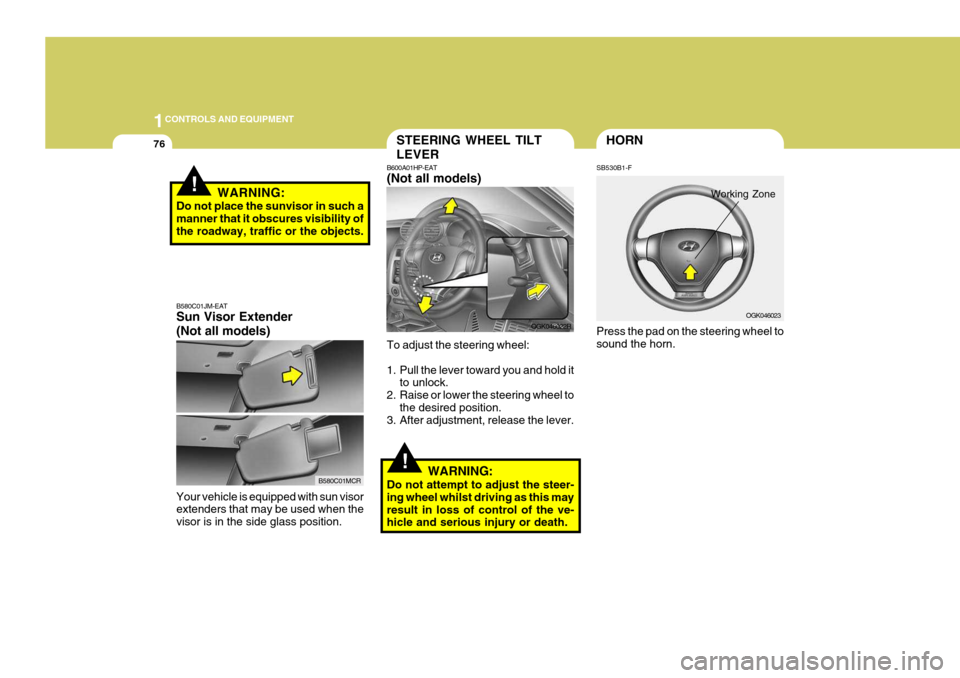
B600A01HP-EAT (Not all models) To adjust the steering wheel:
1. Pull the lever toward you and hold it
to unlock.
2. Raise or lower the steering wheel to
the desired position.
3. After adjustment, release the lever.
WARNING:
Do not attempt to adjust the steer- ing wheel whilst driving as this mayresult in loss of control of the ve- hicle and serious injury or death. OGK046022R
OGK046023
HORN
SB530B1-F Press the pad on the steering wheel to sound the horn.
Working Zone
B580C01JM-EAT Sun Visor Extender (Not all models) Your vehicle is equipped with sun visor extenders that may be used when the visor is in the side glass position.
B580C01MCR
Page 357 of 487
1
FEATURES OF YOUR HYUNDAI
89AIR CONDITIONING SYSTEM
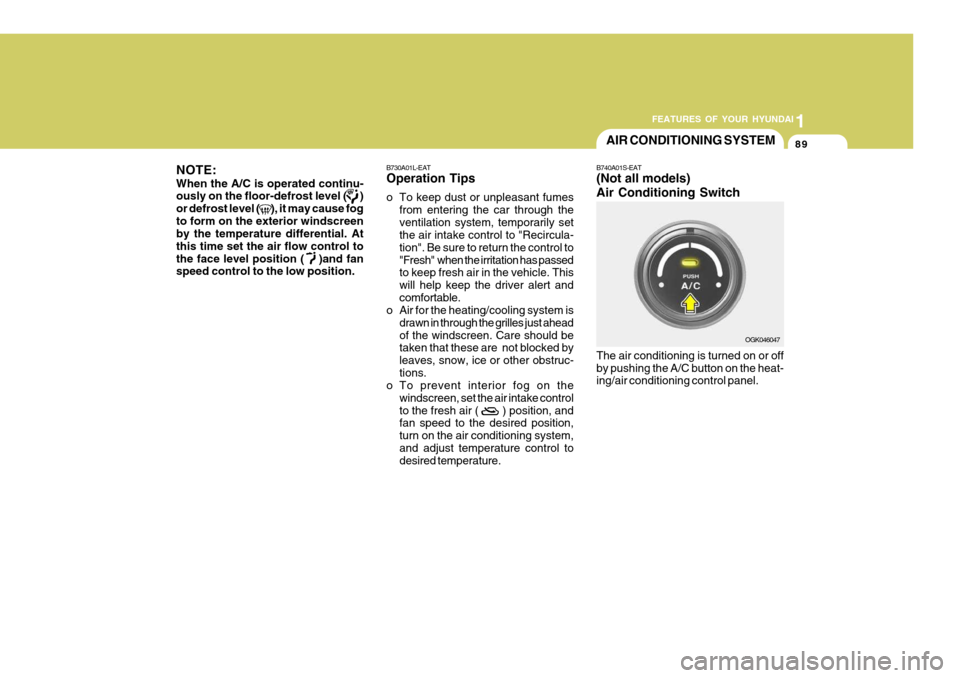
B740A01S-EAT (Not all models) Air Conditioning Switch The air conditioning is turned on or off by pushing the A/C button on the heat- ing/air conditioning control panel. OGK046047
NOTE: When the A/C is operated continu- ously on the floor-defrost level ( ) or defrost level ( ), it may cause fogto form on the exterior windscreen by the temperature differential. At this time set the air flow control tothe face level position ( )and fan speed control to the low position.
B730A01L-EAT Operation Tips
o To keep dust or unpleasant fumes
from entering the car through the ventilation system, temporarily set the air intake control to "Recircula- tion". Be sure to return the control to"Fresh" when the irritation has passed to keep fresh air in the vehicle. This will help keep the driver alert andcomfortable.
o Air for the heating/cooling system is
drawn in through the grilles just aheadof the windscreen. Care should be taken that these are not blocked by leaves, snow, ice or other obstruc-tions.
o To prevent interior fog on the
windscreen, set the air intake controlto the fresh air ( ) position, and fan speed to the desired position, turn on the air conditioning system,and adjust temperature control to desired temperature.
Page 361 of 487
1
FEATURES OF YOUR HYUNDAI
93
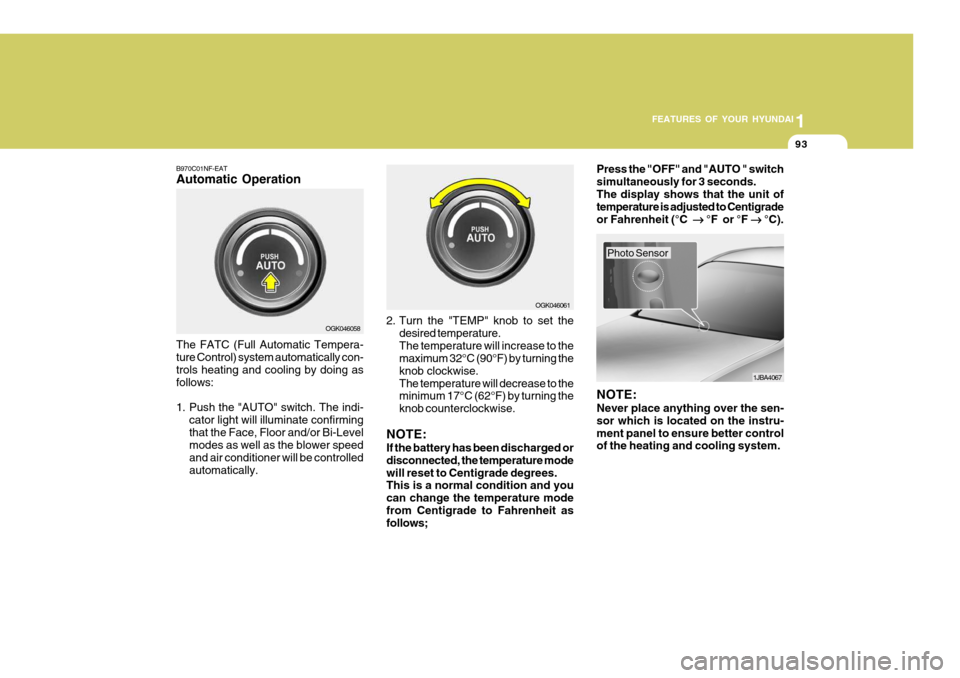
B970C01NF-EAT Automatic Operation The FATC (Full Automatic Tempera- ture Control) system automatically con- trols heating and cooling by doing as follows:
1. Push the "AUTO" switch. The indi-
cator light will illuminate confirming that the Face, Floor and/or Bi-Level modes as well as the blower speed and air conditioner will be controlledautomatically. 2. Turn the "TEMP" knob to set the
desired temperature.The temperature will increase to the maximum 32°C (90°F) by turning the knob clockwise.The temperature will decrease to the minimum 17°C (62°F) by turning the knob counterclockwise.
NOTE: If the battery has been discharged or disconnected, the temperature modewill reset to Centigrade degrees. This is a normal condition and you can change the temperature modefrom Centigrade to Fahrenheit as follows; Press the "OFF" and "AUTO " switch simultaneously for 3 seconds.The display shows that the unit of temperature is adjusted to Centigrade or Fahrenheit (°C
°F or °F
°C).
OGK046058 OGK046061
1JBA4067
NOTE: Never place anything over the sen- sor which is located on the instru-ment panel to ensure better control of the heating and cooling system.
Photo Sensor
Page 367 of 487
1
FEATURES OF YOUR HYUNDAI
99CLIMATE CONTROL AIR FILTER (IN FRONT OF BLOWER UNIT)
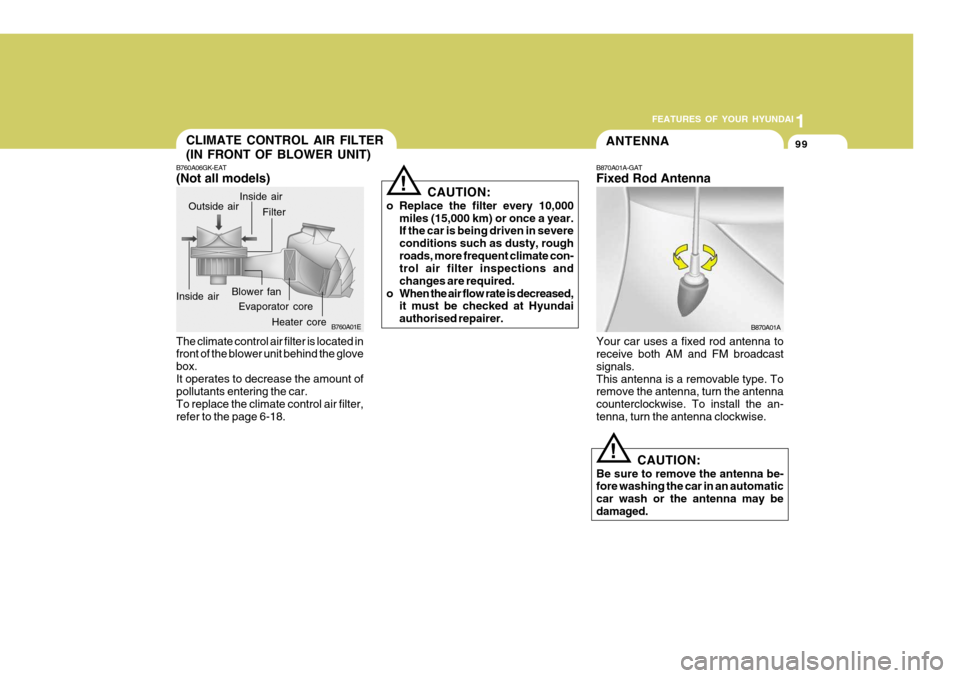
B760A06GK-EAT (Not all models)
B760A01E
Evaporator core Filter
Heater core
Outside air
Inside air Inside air
Blower fan
The climate control air filter is located in front of the blower unit behind the glove box.It operates to decrease the amount of pollutants entering the car. To replace the climate control air filter,refer to the page 6-18. CAUTION:
o Replace the filter every 10,000 miles (15,000 km) or once a year. If the car is being driven in severe conditions such as dusty, roughroads, more frequent climate con- trol air filter inspections and changes are required.
o When the air flow rate is decreased, it must be checked at Hyundaiauthorised repairer.
!
ANTENNA
B870A01A
!
B870A01A-GAT Fixed Rod Antenna Your car uses a fixed rod antenna to receive both AM and FM broadcast signals.This antenna is a removable type. To remove the antenna, turn the antenna counterclockwise. To install the an-tenna, turn the antenna clockwise.
CAUTION:
Be sure to remove the antenna be- fore washing the car in an automatic car wash or the antenna may bedamaged.
Page 370 of 487
1FEATURES OF YOUR HYUNDAI
102
!
B750A04L
B750A05L
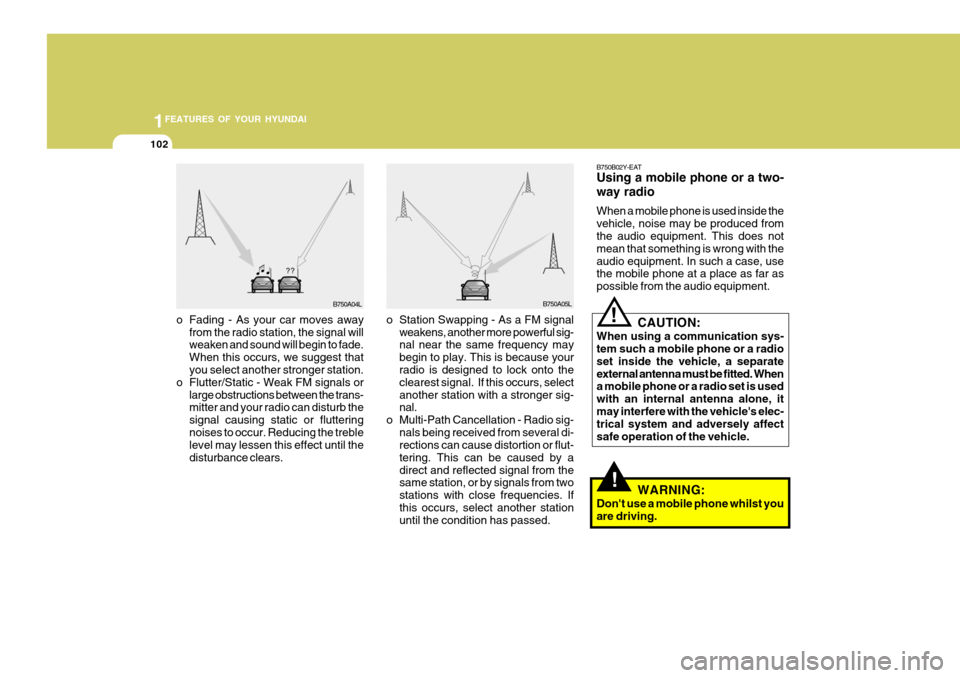
o Station Swapping - As a FM signal weakens, another more powerful sig- nal near the same frequency may begin to play. This is because your radio is designed to lock onto the clearest signal. If this occurs, selectanother station with a stronger sig- nal.
o Multi-Path Cancellation - Radio sig- nals being received from several di-rections can cause distortion or flut- tering. This can be caused by adirect and reflected signal from the same station, or by signals from two stations with close frequencies. Ifthis occurs, select another station until the condition has passed.
o Fading - As your car moves away
from the radio station, the signal willweaken and sound will begin to fade. When this occurs, we suggest that you select another stronger station.
o Flutter/Static - Weak FM signals or large obstructions between the trans-mitter and your radio can disturb the signal causing static or flutteringnoises to occur. Reducing the treble level may lessen this effect until the disturbance clears. B750B02Y-EAT Using a mobile phone or a two- way radio When a mobile phone is used inside the vehicle, noise may be produced from the audio equipment. This does not mean that something is wrong with theaudio equipment. In such a case, use the mobile phone at a place as far as possible from the audio equipment.
!
CAUTION:
When using a communication sys- tem such a mobile phone or a radio set inside the vehicle, a separateexternal antenna must be fitted. When a mobile phone or a radio set is used with an internal antenna alone, itmay interfere with the vehicle's elec- trical system and adversely affect safe operation of the vehicle.
WARNING:
Don't use a mobile phone whilst youare driving.
Page 374 of 487
2
Engine Exhaust Can Be Dangerous! ............................ 2-2
Before Starting the Engine ............................................ 2-3
Key Positions ................................................................ 2-4Starting ......................................................................... 2-5
Fuel Economy ............................................................... 2-6
Manual Transaxle ......................................................... 2-7
Automatic Transaxle ..................................................... 2-9Anti-Lock Brake System (ABS) ................................... 2-14
Electronic Stability Program (ESP) ..............................2-15
Effective Braking ......................................................... 2-16
Driving for Economy .................................................... 2-17
Smooth Cornering ........................................................ 2-18
Winter Motoring ............................................................ 2-19
Trailer or Vehicle Towing ............................................. 2-20
DRIVING YOUR HYUNDAI
2