engine Hyundai Coupe 2007 Owner's Manual
[x] Cancel search | Manufacturer: HYUNDAI, Model Year: 2007, Model line: Coupe, Model: Hyundai Coupe 2007Pages: 487, PDF Size: 12.96 MB
Page 463 of 487
6OWNER MAINTENANCE
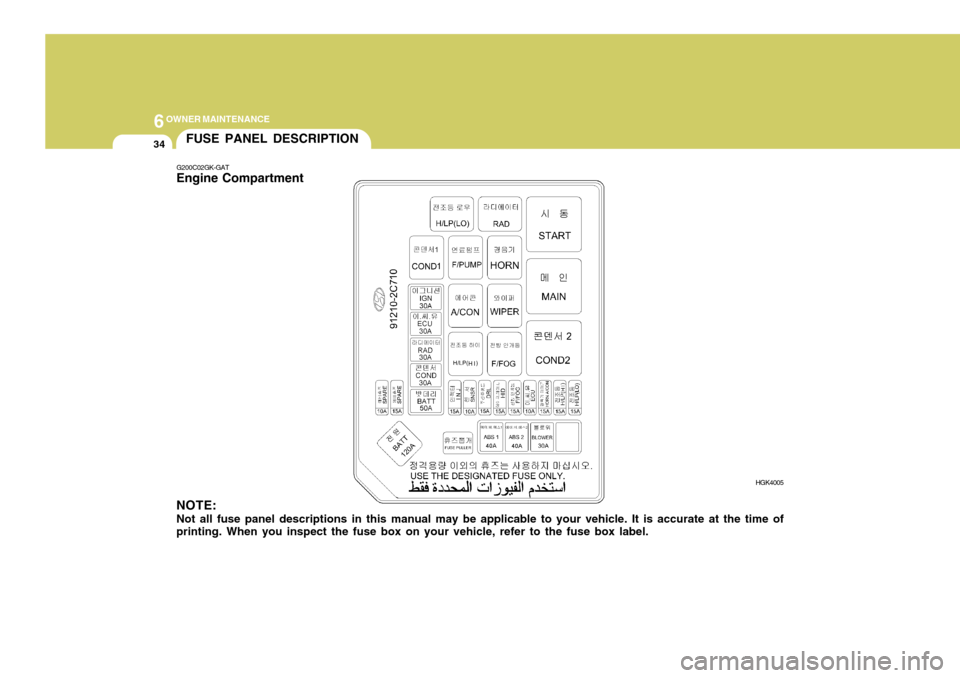
34FUSE PANEL DESCRIPTION
G200C02GK-GAT
Engine Compartment NOTE: Not all fuse panel descriptions in this manual may be applicable to your vehicle. It is accurate at the time of printing. When you inspect the fuse box on your vehicle, refer to the fuse box label. HGK4005
Page 464 of 487

6
OWNER MAINTENANCE
35
PROTECTED COMPONENTS
Generator(1.6L/2.0L) BCM BOX(Tail lamp relay,Power connector,Fuse(2,7,12,13,19,20,24))Condenser fan relayRadiator fan relayEngine control relay, Fuel pump relay, A/T control relay, Generator,ECM(1.6L/2.7L),PCM(2.0L) Ignition switch,Start relayABS/ESP control module,ESP Air bleeding connectorABS/ESP control module,ESP Air bleeding connectorBlower relayInjector Oxygen sensor,Camshaft position sensor, Idle speed control actuator DRL control moduleFront fog lamp relayTCM(2.7L),ECM(2.7L/1.6L)Horn relay,A/C relay Head lamp relay(High) Head lamp relay(Low)
FUSERATING 120A50A 30A30A 30A 30A 40A40A30A 15A 10A15A15A10A15A 15A 15A
DESCRIPTION
BATTBATT
COND RAD ECU
IGN
ABS 1 ABS 2
BLOWER INJ
SNSR DRL
F/FOG ECU
HORN,A/CON H/LP (HI)
H/LP (LO)
Page 468 of 487
7EMISSION CONTROL SYSTEMS
2
SH010A1-E (Not all models) Depending upon the market for which the vehicle is destined, the emission control system will comprise one or more of the following emission controldevices.
(1) Crankcase emission control sys-
tem
(2) Evaporative emission control sys- tem
(3) Exhaust emission control systemIn order that the proper functioning of the emission control systems may be ensured, it is recommended that the vehicle is inspected and maintainedby a Hyundai authorised repairer in accordance with the maintenance schedule in this manual. EMISSION CONTROL SYS- TEMS
DH010B1-E
1. Crankcase Emission Control
System
The positive crankcase ventilation (PCV) system is employed to prevent air pollution caused by blow-by gases being emitted from the crankcase. This system supplies fresh air to the crankcase through the air cleaner. In- side the crankcase, the fresh air mixeswith blow-by gases, then passes through the PCV valve into the intake system. When the engine is running, the fuelvapors absorbed in the canister aredrawn into the induction system through the purge control solenoid valve. Purge Control Solenoid Valve The purge control solenoid valve is controlled by the ECU (Engine Control Unit); when the engine coolant tem- perature is low, and during idling, itcloses, so that evaporated fuel is not taken into the surge tank. After engine warm-up, during ordinary driving, itopens to introduce evaporated fuel to the surge tank.
JH010D1-E
3. Exhaust Emission Control
System
This system helps control oxides of
nitrogen by recirculating a portion of the exhaust gases into the intake manifold, thereby reducing cylinder combustion temperatures.
ZH010C1-E
2. Evaporative Emission
Control System
The Evaporative Emission Control System is designed to prevent fuelvapors from escaping into the atmo- sphere. Canister Whilst the engine is inoperative, fuel vapors generated inside the fuel tank are absorbed and stored in the canis- ter.
Page 469 of 487
7
EMISSION CONTROL SYSTEMS
3CATALYTIC CONVERTOR
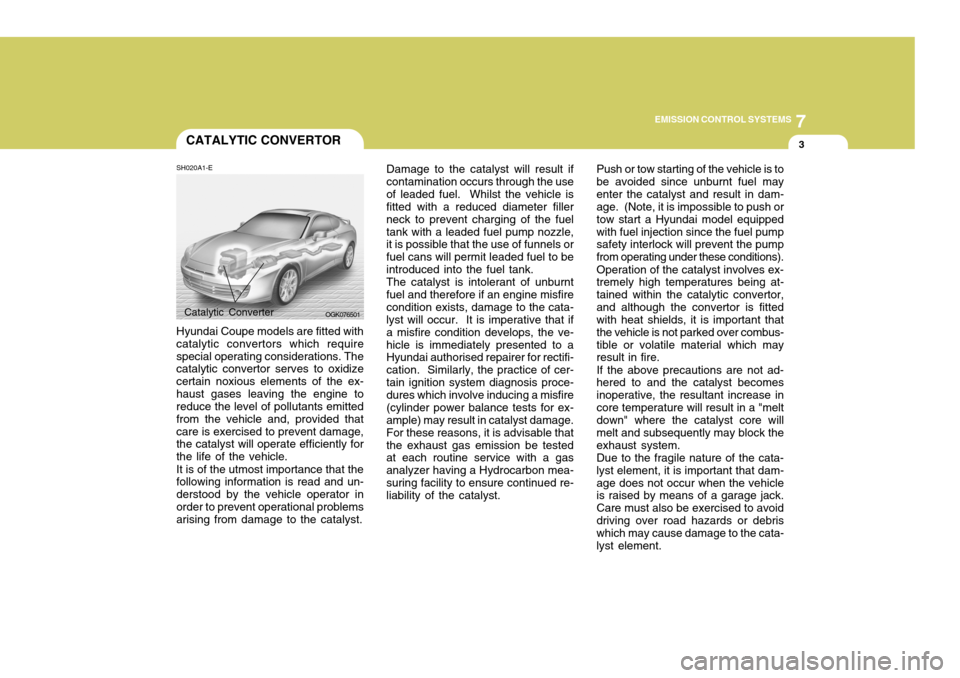
SH020A1-E Hyundai Coupe models are fitted with catalytic convertors which requirespecial operating considerations. The catalytic convertor serves to oxidize certain noxious elements of the ex-haust gases leaving the engine to reduce the level of pollutants emitted from the vehicle and, provided thatcare is exercised to prevent damage, the catalyst will operate efficiently for the life of the vehicle. It is of the utmost importance that the following information is read and un- derstood by the vehicle operator inorder to prevent operational problems arising from damage to the catalyst. Damage to the catalyst will result if contamination occurs through the useof leaded fuel. Whilst the vehicle is fitted with a reduced diameter filler neck to prevent charging of the fueltank with a leaded fuel pump nozzle, it is possible that the use of funnels or fuel cans will permit leaded fuel to beintroduced into the fuel tank.The catalyst is intolerant of unburntfuel and therefore if an engine misfirecondition exists, damage to the cata- lyst will occur. It is imperative that if a misfire condition develops, the ve-hicle is immediately presented to a Hyundai authorised repairer for rectifi- cation. Similarly, the practice of cer-tain ignition system diagnosis proce- dures which involve inducing a misfire (cylinder power balance tests for ex-ample) may result in catalyst damage.For these reasons, it is advisable thatthe exhaust gas emission be tested at each routine service with a gas analyzer having a Hydrocarbon mea-suring facility to ensure continued re- liability of the catalyst.
Catalytic Converter
OGK076501 Push or tow starting of the vehicle is to be avoided since unburnt fuel mayenter the catalyst and result in dam- age. (Note, it is impossible to push or tow start a Hyundai model equippedwith fuel injection since the fuel pump safety interlock will prevent the pump from operating under these conditions). Operation of the catalyst involves ex- tremely high temperatures being at- tained within the catalytic convertor,and although the convertor is fitted with heat shields, it is important that the vehicle is not parked over combus-tible or volatile material which may result in fire. If the above precautions are not ad- hered to and the catalyst becomes inoperative, the resultant increase incore temperature will result in a "melt down" where the catalyst core will melt and subsequently may block theexhaust system.Due to the fragile nature of the cata-lyst element, it is important that dam-age does not occur when the vehicle is raised by means of a garage jack. Care must also be exercised to avoiddriving over road hazards or debris which may cause damage to the cata- lyst element.
Page 470 of 487
Vehicle Identification Number (VIN) ............................ 8-2
Engine Number ............................................................ 8-2
Tyre Information ........................................................... 8-3
Tyre Pressures ............................................................. 8-3
Snow Tyres .................................................................. 8-4
Tyre Chains .................................................................. 8-4
Tyre Rotation ............................................................... 8-5
Tyre Balancing ............................................................. 8-6
Tyre Replacement ........................................................ 8-6
Wheel Replacement ..................................................... 8-7
Spare Tyre and Tools .................................................. 8-7
8
CONSUMER INFORMATION
8
Page 471 of 487
8CONSUMER INFORMATION
2
F040A02TB-1
1.6LOGK086001
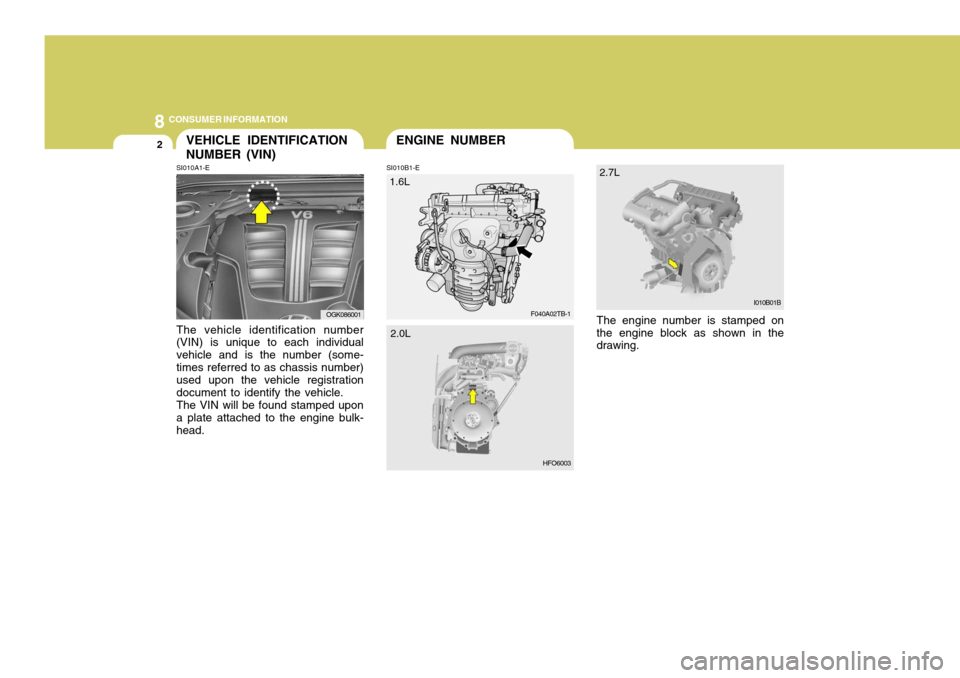
SI010A1-E
VEHICLE IDENTIFICATION NUMBER (VIN)
The vehicle identification number (VIN) is unique to each individual vehicle and is the number (some-times referred to as chassis number) used upon the vehicle registration document to identify the vehicle.The VIN will be found stamped upona plate attached to the engine bulk-head. SI010B1-E
ENGINE NUMBER
The engine number is stamped onthe engine block as shown in the drawing.I010B01B
2.7L
HFO6003
2.0L
Page 477 of 487
MEASUREMENT......................................................... 9-2
ENGINE ....................................................................... 9-3
LUBRICATION CHART ............................................... 9-4
9
VEHICLE SPECIFICATIONS
9
Page 479 of 487
9
VEHICLE SPECIFICATIONS
3
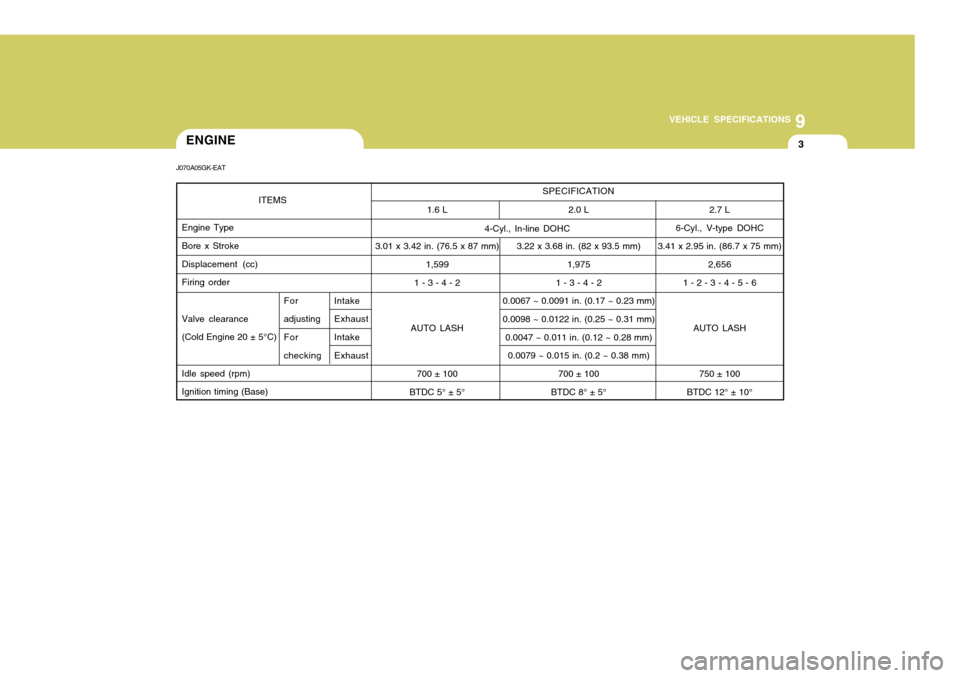
4-Cyl., In-line DOHC
ITEMS
Engine Type Bore x Stroke Displacement (cc) Firing order Valve clearance (Cold Engine 20 ± 5°C) Idle speed (rpm) Ignition timing (Base)
For adjustingFor checking Intake ExhaustIntake Exhaust
ENGINE
J070A05GK-EAT SPECIFICATION
1.6 L
3.01 x 3.42 in. (76.5 x 87 mm) 1,599
1 - 3 - 4 - 2
AUTO LASH 700 ± 100
BTDC 5° ± 5° 2.0 L
3.22 x 3.68 in. (82 x 93.5 mm) 1,975
1 - 3 - 4 - 2
0.0067 ~ 0.0091 in. (0.17 ~ 0.23 mm) 0.0098 ~ 0.0122 in. (0.25 ~ 0.31 mm)
0.0047 ~ 0.011 in. (0.12 ~ 0.28 mm)0.0079 ~ 0.015 in. (0.2 ~ 0.38 mm)
700 ± 100
BTDC 8° ± 5° 2.7 L
6-Cyl., V-type DOHC
3.41 x 2.95 in. (86.7 x 75 mm)
2,656
1 - 2 - 3 - 4 - 5 - 6
AUTO LASH
750 ± 100
BTDC 12° ± 10°
Page 480 of 487
9 VEHICLE SPECIFICATIONS
4
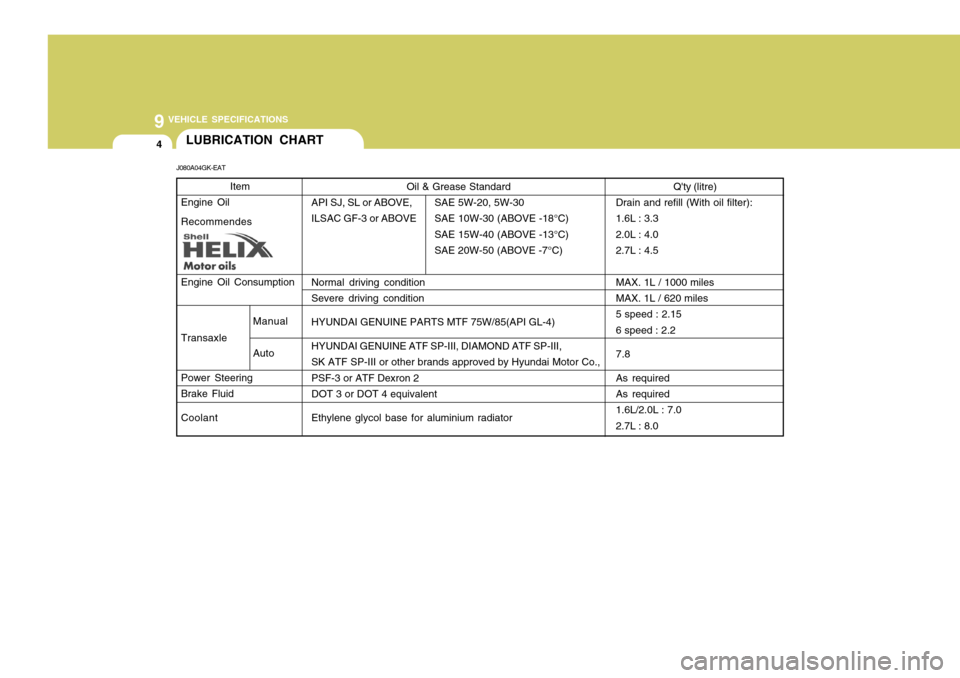
Q'ty (litre)
Drain and refill (With oil filter): 1.6L : 3.32.0L : 4.0 2.7L : 4.5 MAX. 1L / 1000 miles MAX. 1L / 620 miles 5 speed : 2.156 speed : 2.2 7.8As required As required 1.6L/2.0L : 7.02.7L : 8.0
LUBRICATION CHART
J080A04GK-EAT Oil & Grease Standard
API SJ, SL or ABOVE, SAE 5W-20, 5W-30
ILSAC GF-3 or ABOVE SAE 10W-30 (ABOVE -18°C)
SAE 15W-40 (ABOVE -13°C) SAE 20W-50 (ABOVE -7°C)
Normal driving conditionSevere driving condition HYUNDAI GENUINE PARTS MTF 75W/85(API GL-4)HYUNDAI GENUINE ATF SP-III, DIAMOND ATF SP-III, SK ATF SP-III or other brands approved by Hyundai Motor Co.,PSF-3 or ATF Dexron 2 DOT 3 or DOT 4 equivalent Ethylene glycol base for aluminium radiator
Item
Engine Oil Recommendes Engine Oil Consumption Transaxle Power Steering Brake Fluid Coolant
Manual Auto
Page 483 of 487

10
INDEX
3
Engine Before starting the engine ........................................ 2-3 Compartment ............................................................ 6-2
Coolant ..................................................................... 6-9
Coolant temperature gauge ......................................1-47
If the engine overheats ............................................. 3-4
Number ..................................................................... 8-2
Oil ............................................................................. 6-6Starting ..................................................................... 2-5
Engine Exhaust Can Be Dangerous ............................ 2-2
F Fog Light .................................................................... 1-58
Front Seats Adjustable head restraints ....................................... 1-14
Seat rake adjustment .............................................. 1-13
Seat recline adjustment ........................................... 1-13
Lumbar support control ............................................ 1-15
Seat cushion height adjustment .............................. 1-15
Seat warmer ............................................................ 1-16
Fuel Capacity ................................................................... 9-2
Economy .................................................................. 2-6
Gauge ...................................................................... 1-47
Recommendations .................................................... 1-2
Fuel Filler Lid Remote release ....................................................... 1-72
Fuse Panel Description .............................................. 6-34
Fuses ......................................................................... 6-20G
Glove box ...................................................................
1-67
HHatchback Door .......................................................... 1-74
Hazard Warning System ............................................. 1-59
Headlight Leveling Device S ystem .............................1-62
Heating and Air Conditioning Control Rotary type .............................................................. 1-83
Automatic type ........................................................ 1-92
High-Mounted Rear Stop Light .................................... 1-71
Horn ............................................................................ 1-76
IIgnition Switch ............................................................. 2-4
Immobiliser System ..................................................... 1-4
Instrument Cluster and Indicator Lights ...................... 1-40
Instrument Panel Illumination Control .........................1-60
Intermittent Wiper ....................................................... 1-57
J Jump Starting .............................................................. 3-3
KKeys ............................................................................ 1-4
If you lose your keys .............................................. 3-14
Positions ................................................................... 2-4