check engine light Hyundai Coupe 2007 User Guide
[x] Cancel search | Manufacturer: HYUNDAI, Model Year: 2007, Model line: Coupe, Model: Hyundai Coupe 2007Pages: 487, PDF Size: 12.96 MB
Page 167 of 487
3 WHAT TO DO IN AN EMERGENCY
2IF THE ENGINE WILL NOT START
!
D010A01A-AAT
WARNING:
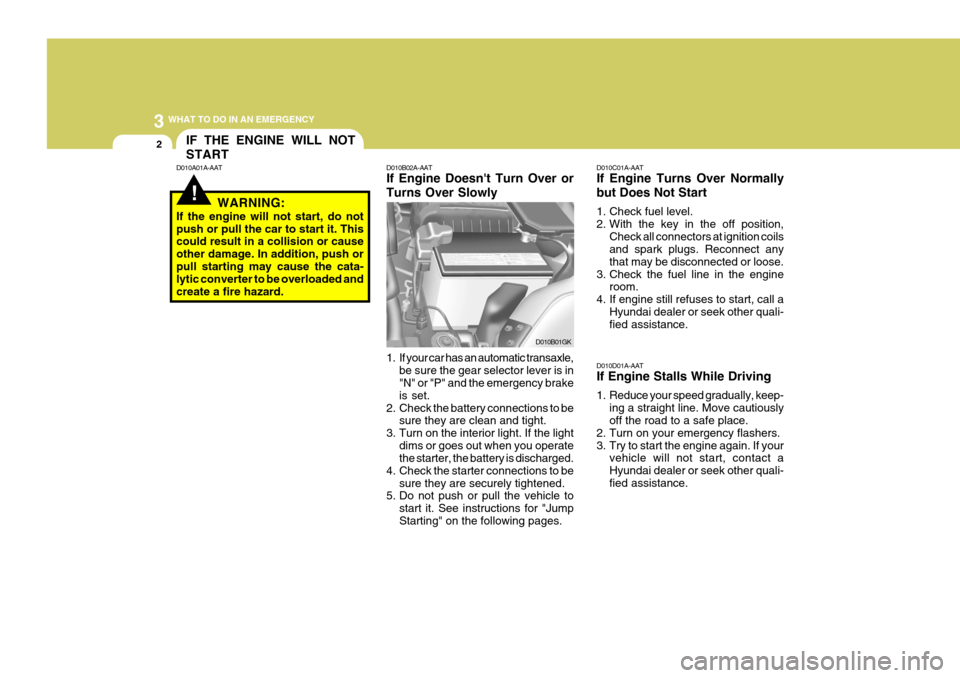
If the engine will not start, do not push or pull the car to start it. This could result in a collision or cause other damage. In addition, push orpull starting may cause the cata- lytic converter to be overloaded and create a fire hazard. D010B02A-AAT If Engine Doesn't Turn Over or Turns Over Slowly
D010C01A-AAT If Engine Turns Over Normally but Does Not Start
1. Check fuel level.
2. With the key in the off position,
Check all connectors at ignition coils and spark plugs. Reconnect any that may be disconnected or loose.
3. Check the fuel line in the engine room.
4. If engine still refuses to start, call a Hyundai dealer or seek other quali- fied assistance.
D010D01A-AAT If Engine Stalls While Driving
1. Reduce your speed gradually, keep- ing a straight line. Move cautiously off the road to a safe place.
2. Turn on your emergency flashers.
3. Try to start the engine again. If your vehicle will not start, contact aHyundai dealer or seek other quali-fied assistance.
1. If your car has an automatic transaxle,
be sure the gear selector lever is in "N" or "P" and the emergency brake is set.
2. Check the battery connections to be sure they are clean and tight.
3. Turn on the interior light. If the light dims or goes out when you operate the starter, the battery is discharged.
4. Check the starter connections to be sure they are securely tightened.
5. Do not push or pull the vehicle to
start it. See instructions for "Jump Starting" on the following pages. D010B01GK
Page 169 of 487
3 WHAT TO DO IN AN EMERGENCY
4
!
booster battery. Then attach the other end of that cable to a solid metal partof the engine away from the battery. Do not connect the cable to any moving part.
4. Start the engine in the car with the booster battery and let it run for afew minutes. This will help to as-sure that the booster battery is fully charged. During the jumping opera- tion, run the engine in this vehicle atabout 2000 rpm.
5. Start the engine in the car with the
discharged battery using the nor-mal starting procedure. After the engine starts, leave the jumper cables connected and let the enginerun at fast idle or about 2000 rpm for several minutes.
6. carefully remove the jumper cables in the reverse order of attachment.
If you do not know why your battery became discharged (because the lights were left on, etc.), have the charging system checked by your Hyundaidealer. D030A02A-AAT If your temperature gauge indicates overheating, you experience a loss of power, or hear loud pinging or knock- ing, the engine is probably too hot. Ifthis happens to you, you should:
1. Pull off the road and stop as soon as
it is safe to do so.
2. Place the gear selector lever in "P"
(automatic), or neutral (manual transaxle) and set the parking brake. If the air conditioning is on, turn it off.
3. If engine coolant is running out un- der the car or steam is coming outfrom the hood, stop the engine. Donot open the hood until the engine coolant has stopped running or the steaming has stopped. If there is novisible loss of engine coolant and no steam, leave the engine running and check to be sure the enginecooling fan is operating. If the fan is not running, turn the engine off.
IF THE ENGINE OVERHEATS
4. Check to see if the water pump drivebelt is missing. If it is not missing, check to see that it is tight. If the drive belt seems to be satisfactory, check for engine coolant leakingfrom the radiator, hoses or under the car. (If the air conditioning had been in use, it is normal for coldwater to be draining from it when you stop).
WARNING:
While the engine is running, keephair, hands, and clothing away from moving parts such as the fan anddrive belts to prevent injury.
5. If the water pump drive belt is broken or engine coolant is leaking out, stop the engine immediately and call thenearest Hyundai dealer for assis- tance.
Page 199 of 487
Engine Compartment .................................................... 6-2
General Checks ........................................................... 6-5
Checking the Engine Oil .............................................. 6-6
Checking and Changing the Engine Coolant ............... 6-9
Changing the Air Cleaner Filter ...................................6-11
Checking the Transaxle Oil (Manual) ......................... 6-15
Checking the Transaxle Fluid (Automatic) .................6-15
Checking the Brakes .................................................. 6-17
Checking the Clutch Fluid ........................................... 6-18
Air Conditioning Care .................................................. 6-18
Changing the Climate Control Air Filter .. ....................6-19
Checking and Replacing Fuses ..................................6-21
Checking the Battery .................................................. 6-23
Checking Electric Cooling Fans .................................6-24
Power Steering Fluid Level ......................................... 6-25
Headlight Aiming Adjustment ...................................... 6-26
Replacement of Light Bulbs ........................................6-27
Bulb Wattage ............................................................... 6-36
Fuse Panel D escription ............................................... 6-37
DO-IT-YOURSELF MAINTENANCE
6
6
Page 203 of 487
6
DO-IT-YOURSELF MAINTENANCE
5
G020B01A-AAT
Vehicle Exterior
The following should be checked
monthly:
o Overall appearance and condition
o Wheel condition and wheel nut
torque
o Exhaust system condition
o Light condition and operation
o Windshield glass condition
o Wiper blade condition
o Paint condition and body corrosion
o Fluid leaks
o Door and hood lock condition
o Tire pressure and condition (in- cluding spare tire) G020C01A-AAT
Vehicle Interior
The following should be checked each time when the vehicle is driven:
o Lights operation
o Windshield wiper operation
o Horn operation
o Defroster, heating system opera- tion (and air conditioning, if installed)
o Steering operation and condition
o Mirror condition and operation
o Turn signal operation
o Accelerator pedal operation
o Brake operation, including parking
brake
o Manual transaxle operation, includ-
ing clutch operation
o Automatic transaxle operation, in- cluding "Park" mechanism opera-tion
o Seat control condition and opera-
tion
o Seat belt condition and operation
o Sunvisor operation
If you notice anything that does notoperate correctly or appears to be functioning incorrectly, inspect it care- fully and seek assistance from yourHyundai dealer if service is needed.
G020A01A-AAT
Engine Compartment
The following should be checked regu-larly:
o Engine oil level and condition
o Transaxle fluid level and condition
o Brake fluid level
o Clutch fluid level
o Engine coolant level
o Windshield washer fluid level
o Accessory drive belt condition
o Engine Coolant hose condition
o Fluid leaks (on or below compo- nents)
o Power steering fluid level
o Battery condition
o Air filter condition GENERAL CHECKS
Page 224 of 487
6 DO-IT-YOURSELF MAINTENANCE
26
OGK076068N
G240A01A-AAT Power Steering Hoses It is suggested that you check the power steering hose connections for fluid leakage daily. The power steer- ing hoses should be replaced if thereis severe surface cracking, pulling, scuffing or worn spots. Deterioration of the hose could cause prematurefailure. G290A02GK-GAT
HEADLIGHT AIMING ADJUSTMENT
1. Keep all tires inflated to the correctpressure.
2. Place the vehicle on level ground and press the front bumper & rearbumper down several times. Placevehicle at a distance of 3m (118 in.) from the test wall.
3. See that the vehicle is unloaded (except for full levels of coolant, engine oil and fuel, and spare tire,jack, and tools).
4. Clean the head light lenses and
turn on the headlights.
5. Open the hood.
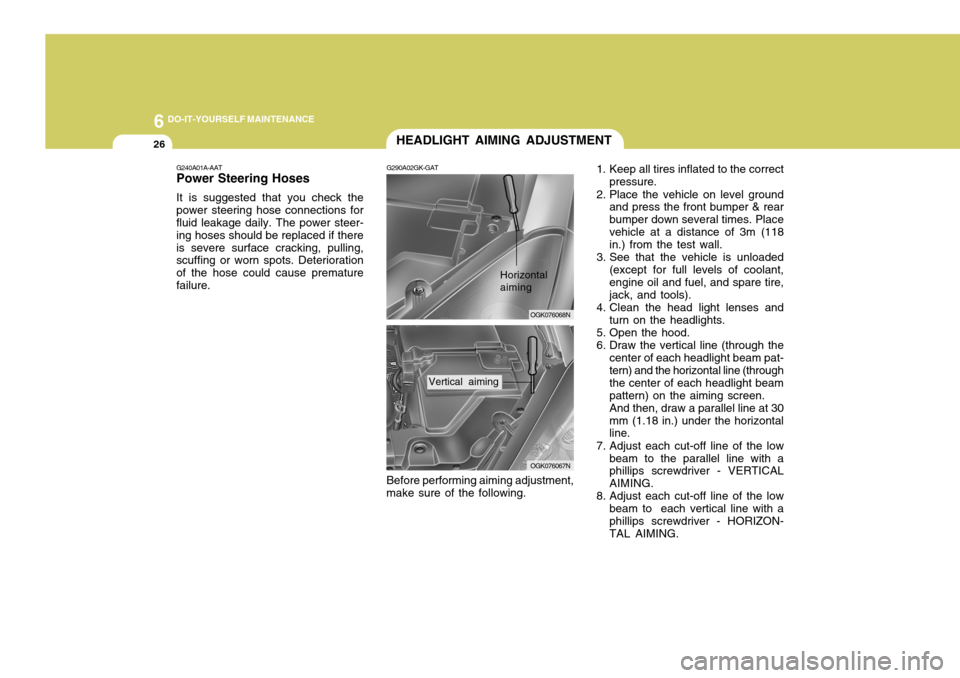
6. Draw the vertical line (through the center of each headlight beam pat- tern) and the horizontal line (through the center of each headlight beampattern) on the aiming screen.And then, draw a parallel line at 30mm (1.18 in.) under the horizontal line.
7. Adjust each cut-off line of the low beam to the parallel line with aphillips screwdriver - VERTICAL AIMING.
8. Adjust each cut-off line of the low
beam to each vertical line with aphillips screwdriver - HORIZON- TAL AIMING.
Before performing aiming adjustment,
make sure of the following.
OGK076067N
Horizontal aiming
Vertical aiming
Page 254 of 487

10
INDEX
3
Driving Economical driving .................................................. 2-16
Smooth corneri ng ..................................................... 2-17
Winter driving ........................................................... 2-17
E Electronic Stability Program (ESP) ............................2-13
Emissions Control Systems ........................................ 7-2 Engine Before starting the engine ........................................ 2-3
Changing the oil and filter ......................................... 6-6Compartment (1.6L, 2.0L, 2.7L) ................................ 6-2
Coolant ..................................................................... 6-9
Coolant temperature gauge ......................................1-50
If the engine overheats ............................................. 3-4
Number ..................................................................... 8-2
Oil ............................................................................. 6-6Oil consumption ........................................................ 6-8
Starting ..................................................................... 2-5
Engine Exhaust Can Be Dangerous ............................ 2-2
FFog Light .................................................................... 1-60
Front Seats Adjustable front seats .............................................. 1-13
Adjustable headrests ............................................... 1-14
Adjusting seat forward and rearward ........................ 1-13
Adjusting seatback angle ........................................ 1-14
Lumbar support control ............................................ 1-16
Seat cushion height adjustment .............................. 1-16Seat warmer
............................................................ 1-16
Fuel Capacity ................................................................... 9-2
Gauge ...................................................................... 1-50
Recommendations .................................................... 1-2
Fuel Filler Lid Remote release ....................................................... 1-74
Fuse Panel Description .............................................. 6-37
Fuses ......................................................................... 6-21
G
General Everyday Checks ..... ...................................... 6-5
Glove box ................................................................... 1-69
H Hazard Warning System ............................................. 1-61
Headlight Leveling Device S ystem .............................1-64
Heating and Air Conditioning Control Rotary type .............................................................. 1-84
Automatic type ........................................................ 1-93
High-mounted rear stoplight .. ......................................1-72
Hood Release ............................................................. 1-73
Horn ............................................................................ 1-78
I Ignition Switch ............................................................. 2-4
Immobilizer System ..................................................... 1-4
Instrument Cluster and Indicator Lights ...................... 1-42
Instrument Panel Light Control (Rheostat) .................. 1-62
Intermittent Wiper ....................................................... 1-59
Page 310 of 487
1CONTROLS AND EQUIPMENT
42WARNING AND INDICATOR LIGHTS
SB210G1-E Turn Signal Indicator Lights
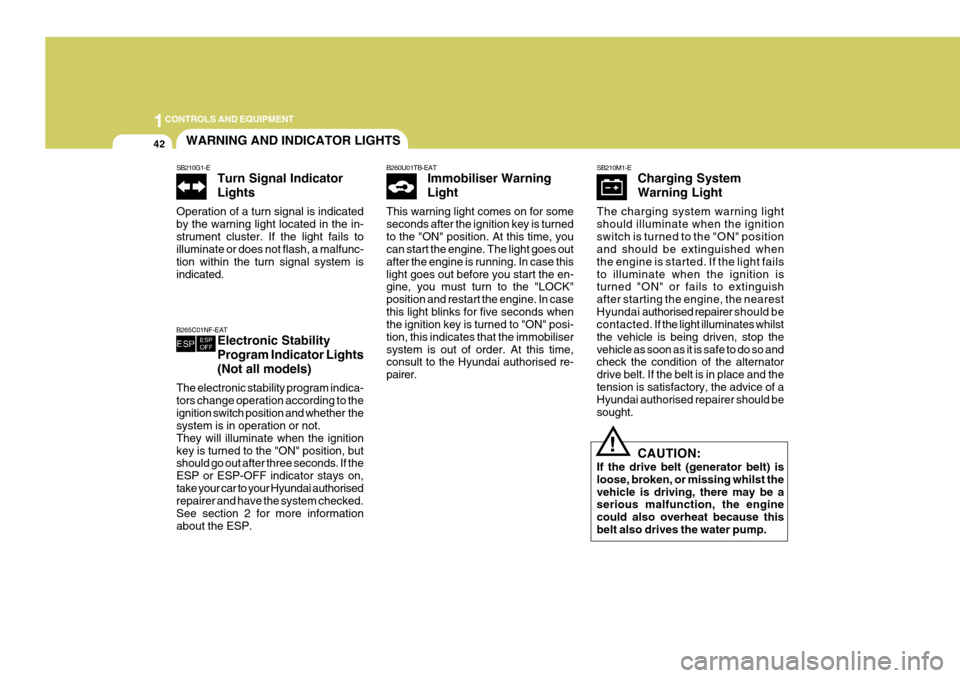
Operation of a turn signal is indicated by the warning light located in the in-strument cluster. If the light fails to illuminate or does not flash, a malfunc- tion within the turn signal system isindicated.
B265C01NF-EAT Electronic Stability Program Indicator Lights(Not all models)
The electronic stability program indica- tors change operation according to theignition switch position and whether the system is in operation or not. They will illuminate when the ignitionkey is turned to the "ON" position, but should go out after three seconds. If the ESP or ESP-OFF indicator stays on,take your car to your Hyundai authorised repairer and have the system checked. See section 2 for more informationabout the ESP.
B260U01TB-EAT Immobiliser Warning Light
This warning light comes on for some seconds after the ignition key is turnedto the "ON" position. At this time, you can start the engine. The light goes out after the engine is running. In case thislight goes out before you start the en- gine, you must turn to the "LOCK" position and restart the engine. In casethis light blinks for five seconds when the ignition key is turned to "ON" posi- tion, this indicates that the immobilisersystem is out of order. At this time, consult to the Hyundai authorised re- pairer.SB210M1-E Charging System Warning Light
The charging system warning light should illuminate when the ignitionswitch is turned to the "ON" position and should be extinguished when the engine is started. If the light failsto illuminate when the ignition is turned "ON" or fails to extinguish after starting the engine, the nearestHyundai authorised repairer should be
contacted. If the light illuminates whilst
the vehicle is being driven, stop thevehicle as soon as it is safe to do so and check the condition of the alternator drive belt. If the belt is in place and thetension is satisfactory, the advice of a Hyundai authorised repairer should be sought.
CAUTION:
If the drive belt (generator belt) is loose, broken, or missing whilst thevehicle is driving, there may be a serious malfunction, the engine could also overheat because thisbelt also drives the water pump.!
Page 311 of 487

1
CONTROLS AND EQUIPMENT
43
B260B01JM-EAT SRS (Airbag) Service Reminder Indicator (SRI)(Not all models)
The SRS service reminder indicator (SRI) comes on for approximately 6 seconds after the ignition key is turnedto the "ON" position or after the engine is started, after which it will go out. This light also comes on when the SRS is not working properly. If the SRI does not come on, or continuously remainson after flashing for about 6 seconds when you turned the ignition key to the "ON" position or started the engine, orif it comes on whilst driving, have the SRS inspected by a Hyundai authorised repairer.
B260E01HP-GAT Seat Belt Warning Light
The seat belt warning light blinks for 6 about seconds when the ignition key is turned from the "OFF" position to "ON"or "START".
SB210J1-E High Beam Indicator Light
The high beam indicator light will illumi- nate whenever the headlights are switched to high beam of flash position.
SB210K1-E Low Oil Pressure Warning Light
!CAUTION:
If the oil pressure warning light illu- minates when the engine is running,an insufficient oil pressure level for continued safe operation of the en- gine exists. Continued operation ofthe engine in this condition may result in serious engine damage. Under normal circumstances, the light will illuminate when the igni- tion is turned "on" and will be extin-guished when the engine is started. If the oil pressure warning light illu- minates whilst the engine is run-ning, stop the engine immediately and check the engine oil level. If the level is insufficient, add the required amount of oil as indicated by the engine oil dipstick. If the light fails to extinguish when the engineis restarted, do not continue to oper- ate the vehicle. If the oil pressure light illuminatesduring normal operation and the cause is not an insufficient oil level, or the light fails to illuminate whenthe ignition is turned "on", contact the nearest Hyundai authorised re- pairer before further operating thevehicle.
Page 312 of 487
1CONTROLS AND EQUIPMENT
44
B260N02A-EAT Malfunction Indicator
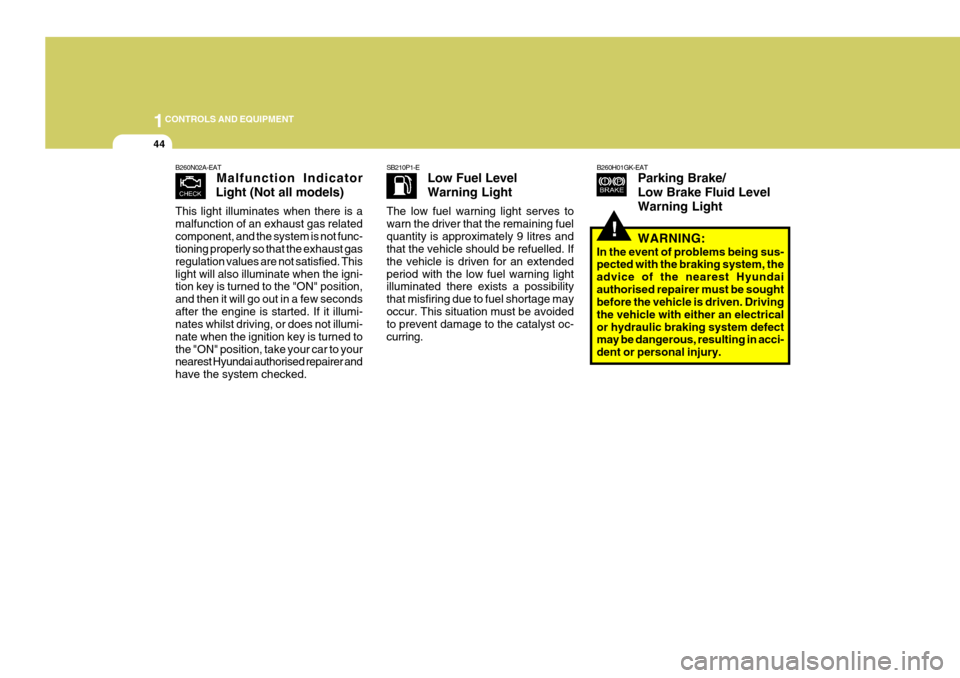
Light (Not all models)
This light illuminates when there is a malfunction of an exhaust gas relatedcomponent, and the system is not func- tioning properly so that the exhaust gas regulation values are not satisfied. Thislight will also illuminate when the igni- tion key is turned to the "ON" position, and then it will go out in a few secondsafter the engine is started. If it illumi- nates whilst driving, or does not illumi- nate when the ignition key is turned tothe "ON" position, take your car to your nearest Hyundai authorised repairer and have the system checked.
SB210P1-E Low Fuel Level Warning Light
The low fuel warning light serves to warn the driver that the remaining fuelquantity is approximately 9 litres and that the vehicle should be refuelled. If the vehicle is driven for an extendedperiod with the low fuel warning light illuminated there exists a possibility that misfiring due to fuel shortage mayoccur. This situation must be avoided to prevent damage to the catalyst oc- curring.
!
B260H01GK-EAT Parking Brake/ Low Brake Fluid LevelWarning Light
WARNING:
In the event of problems being sus- pected with the braking system, the advice of the nearest Hyundaiauthorised repairer must be sought before the vehicle is driven. Driving the vehicle with either an electricalor hydraulic braking system defect may be dangerous, resulting in acci- dent or personal injury.
Page 313 of 487

1
CONTROLS AND EQUIPMENT
45
If failure of one of the circuits occurs, the required amount of pedal effort,pedal travel and stopping distance will be increased. Use of the gearbox is recommended to assist in bringing thevehicle to rest. The vehicle must not be driven once brake failure has occurred until the system has been repaired andis functioning normally. The braking system employs a vacuum servo in order that the pedal efforts arereduced. Power for the servo is derived from the engine and therefore, in the event of the engine stopping or thevehicle being towed, pedal efforts will be substantially increased.
Warning light operation The parking brake/brake fluid level warn- ing light will be illuminated wheneverthe ignition switch is turned to the "ON" or "START" position when the parking brake is applied and must be extin-guished in a three seconds after the engine starts. If the warning light fails to extinguish orilluminates at any other time, the ve- hicle must be brought to rest in a safe location and the level of brake fluid inthe reservoir checked. If the fluid level is incorrect, fluid conforming
to DOT 3
or DOT 4 specifications should be added. If, after correcting the brake fluid level, the warning light continues to be illumi-
nated, the advice of the nearest Hyundai authorised repairer must be sought be-
fore the vehicle is driven again.The Hyundai Coupe is equipped with adiagonally split dual braking system which will ensure that in the event of one of the brake circuits becomingdefective, approximately fifty per cent of the normal braking performance will be available.
B260Q01E-EAT Cruise Indicator Light (Not all models)
The cruise indicator light in the instru- ment cluster is illuminated when the cruise control main switch on the end of the barrel is pushed.The indicator light does not illuminate when the cruise control main switch is pushed a second time.Information about the use of cruise control is beginning on page 1-76.
B260R01E-EAT CRUISE SET Indicator
Light (Not all models)
The set indicator light in the instrument cluster is illuminated when the cruise control switch is pushed downward to"SET (COAST)". The set indicator light does not illumi- nate when the control switch is in the"CANCEL" position.