maintenance schedule Hyundai Coupe 2007 User Guide
[x] Cancel search | Manufacturer: HYUNDAI, Model Year: 2007, Model line: Coupe, Model: Hyundai Coupe 2007Pages: 487, PDF Size: 12.96 MB
Page 213 of 487
6
DO-IT-YOURSELF MAINTENANCE
15CHECKING THE TRANSAXLE OIL (MANUAL)
G100A01MC-GAT
Transaxle lubricant in the manual transaxle should be checked at those intervals specified in the vehicle main-tenance schedule in Section 5.
!WARNING:
It is always better to check the
transaxle oil level when the engine is cool or cold. If the engine is hot, you should exercise great caution to avoid burning yourself on hotengine or exhaust parts.
NOTE: It is recommended that the manual
transaxle fluid should be checked by an authorized Hyundai dealer.
CHECKING THE TRANSAXLE FLUID (AUTOMATIC)
G110A01MC-AAT Transaxle fluid in the automatic transaxle should be checked at those intervals specified in the vehicle main-tenance schedule in Section 5. NOTE: Automatic transaxle fluid is basi- cally a red color. As driving dis- tance increases, the fluid color turnsdarkish red gradually. It is normal condition and you should not judge the need to replace based upon thechanging color.You must replace the automatictransaxle fluid in accordance withintervals specified in the vehicle maintenance schedule in section 5.
!WARNING:
The transaxle fluid level should be
checked when the engine is at nor- mal operating temperature. This means that the engine, radiator, exhaust system etc., are very hot.Exercise great care not to burn your- self during this procedure.
Page 215 of 487
6
DO-IT-YOURSELF MAINTENANCE
17
G120D02A-AAT
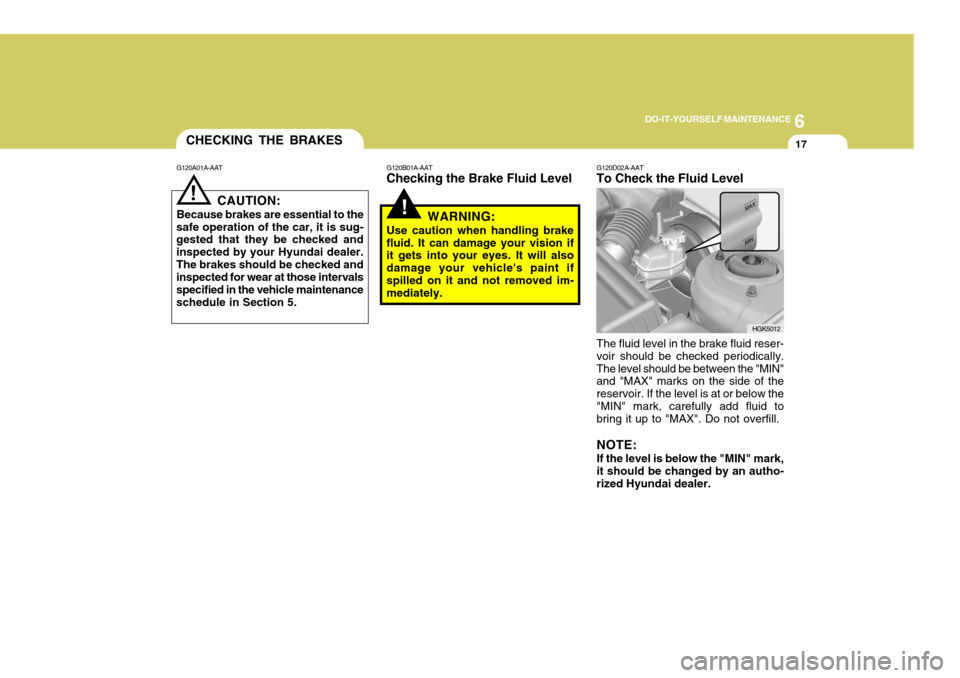
To Check the Fluid Level
The fluid level in the brake fluid reser- voir should be checked periodically.The level should be between the "MIN" and "MAX" marks on the side of the reservoir. If the level is at or below the"MIN" mark, carefully add fluid to bring it up to "MAX". Do not overfill. NOTE: If the level is below the "MIN" mark, it should be changed by an autho-rized Hyundai dealer.
HGK5012
!
!
G120A01A-AAT CHECKING THE BRAKES
CAUTION:
Because brakes are essential to the
safe operation of the car, it is sug- gested that they be checked and inspected by your Hyundai dealer.The brakes should be checked and inspected for wear at those intervals specified in the vehicle maintenanceschedule in Section 5. G120B01A-AAT Checking the Brake Fluid Level
WARNING:
Use caution when handling brake fluid. It can damage your vision if it gets into your eyes. It will also damage your vehicle's paint ifspilled on it and not removed im- mediately.
Page 240 of 487
7EMISSION CONTROL SYSTEMS
2
H010A01A-GAT (If Installed) Your Hyundai is equipped with an emission control system to meet all requirements of the Emission prohibi- tion rules of your province.There are three emission control sys-tems which are as follows.
(1) Crankcase emission control sys-
tem
(2) Evaporative emission control sys-
tem
(3) Exhaust emission control systemIn order to assure the proper function of the emission control systems, it isrecommended that you have your car inspected and maintained by an au- thorized Hyundai dealer in accordancewith the maintenance schedule in this manual. EMISSION CONTROL SYSTEMS
H010B01F-GAT 1. Crankcase Emission ControlSystem
The positive crankcase ventilation system is employed to prevent air pollution caused by blow-by gases being emitted from the crankcase.This system supplies fresh air to the crankcase through the air cleaner. Inside the crankcase, the fresh airmixes with blow-by gases, then passes through the PCV valve into the induction system.
H010C01F-GAT
2. Evaporative Emission Control
System (If Installed)
The evaporative emission control sys-
tem is designed to prevent fuel va-pors from escaping into the atmo-sphere. H010D01A-AAT
3. Exhaust Emission Control
System
The exhaust emission control system is a highly effective system which controls exhaust emissions while maintaining good vehicle performace.
Canister While the engine is inoperative, fuel vapors generated inside the fuel tank are absorbed and stored in the canis-ter. When the engine is running, the fuel vapors absorbed in the canister are drawn into the induction systemthrough the purge control solenoid valve. Purge Control Solenoid Valve The purge control solenoid valve is controlled by the ECM; when the en- gine coolant temperature is low, and during idling, it closes, so that evapo- rated fuel is not taken into the engine. After engine warm-up, during ordi-nary driving, it opens so as to intro- duce evaporated fuel to the engine.
Page 255 of 487

10INDEX
4
J Jump Starting .............................................................. 3-3
KKeys ............................................................................ 1-4
If you lose y our keys .............................................. 3-15
Positions ................................................................... 2-3
L
Light Bulb Replacement .............................................. 6-27
Lubrication Chart .......................................................... 9-4
Luggage Net ............................................................... 1-78
M Maintenance Intervals Explanation of scheduled maintenance items
................................................................................. 5-8
Maintenance under severe usage conditions ............ 5-7
Scheduled maintenance ............................................ 5-4
Service requirements ................................................ 5-2
Map Light .................................................................... 1-68
Mirros
Day-night inside rearview ......................................... 1-71
Outside rearview folding ............... ...........................1-70
Outsde rearview heating ....... ...................................1-70
Multi gauge ................................................................. 1-55
OOdometer .................................................................... 1-52PParking
Brake ............................................................. 1-71
Power Steering Fluid Level ......................................... 6-25
RRear Seats Before Folding the Rear Seats ................................ 1-18
Fold down ................................................................ 1-19
Rear seat entry ........................................................ 1-17
Rear Seat Positions ................................................ 1-18
Rear Window Defroster Switch ................................... 1-61
Rear Window Wiper and Washer Switch ....................1-59
SSeat Belts 3-Point type ............................................................. 1-23
Adjustable height ..................................................... 1-23
Adjusting your seat belt ........................................... 1-24
Care of seat belts .................................................... 1-22
Precautions .............................................................. 1-20
Pre-tentioner Seat Belt ............................................ 1-31
Spectacle C ase .......................................................... 1-68
Speedometer ............................................................... 1-51
Starting Pr ocedures..................................................... 2-5
Steering Wheel Tilt lever ............................................ 1-78
Stereo Radio Operation (H280, H265, H465)
........................................................ 1-104, 1-113, 1-119
Stereo Sound System .............................................. 1-102
Sun Visor .................................................................... 1-77
Sunroof ....................................................................... 1-65
Page 260 of 487
F2
Responsibilty For Maintenance
It is the responsibility of the vehicle owner/driver to ensure that all routine mainte- nance services are undertaken in line with the recommendations specified in Section 5 of this manual. In addition, in order to ensure continued validity of the new vehiclewarranty and safe operation of the vehicle, non scheduled maintenance/running repairs should be undertaken at the earliest available opportunity. Under severe operating conditions, more frequent maintenance is required. Detailsof the maintenance schedule for such conditions are also given in section 5. It is recommended that all maintenance operations and repairs are entrusted to a Hyundai authorised repairer to ensure that the latest repair methods, specialised toolingand genuine Hyundai parts are used to ensure the continued reliability and safety of the vehicle.
SA020A1-E
Page 386 of 487

2
DRIVING YOUR HYUNDAI
13
o Check the automatic transaxle fluid level regularly, and add fluid as necessary.
o See the maintenance schedule for
the proper fluid recommendation.
C090N05O-EAT General Operating Instructions
o The engine may only be started when
the selector lever is at position "P".
o Ensure that the footbrake is firmly applied when shifting from "P" or "N", to "R" or "D" and vice versa.
o Always engage the parking brake when the vehicle is unattended, neveruse the "P" or "R" position in place ofthe parking brake.
o Under normal circumstances, the
selector lever should be placed in the"D" position and the transaxle al- lowed to select the most ideal ratio for the circumstances. In this posi-tion maximum fuel economy will be achieved.
o When descending steep gradients where engine braking is required, theselector lever should be shifted into 1st gear whilst in sport mode de-pending upon the vehicle speed.
o When climbing steep gradients and
using large throttle openings, thetransaxle may repeatedly change between two adjacent ratios. This is a normal characteristic and may beprevented by shifting into 1st gear whilst in sport mode depending upon the vehicle speed. o Never move the selector lever to or
from the "P" or "N" position with theaccelerator depressed.
o If rapid acceleration is required, fully
depress the accelerator pedal. Inthis condition, the kickdown mecha- nism will be operated and the transaxle will automatically down-shift according to the vehicle speed.
o Do not depress the accelerator pedal
with the brakes applied and the se-lector at the "R" or "D" position.
o The automatic transaxle may be used
to great effect if the vehicle becomesstuck in snow or mud by allowing the vehicle to be rocked to and fro. The engine speed should be held at ap-proximately 1,000rpm by means of the accelerator pedal and the selec- tor lever moved between the "D" and"R" positions to induce a rocking motion.
o Optimum vehicle performance and economy is obtained by smoothlydepressing and releasing the accel- erator pedal.
Page 390 of 487
2
DRIVING YOUR HYUNDAI
17
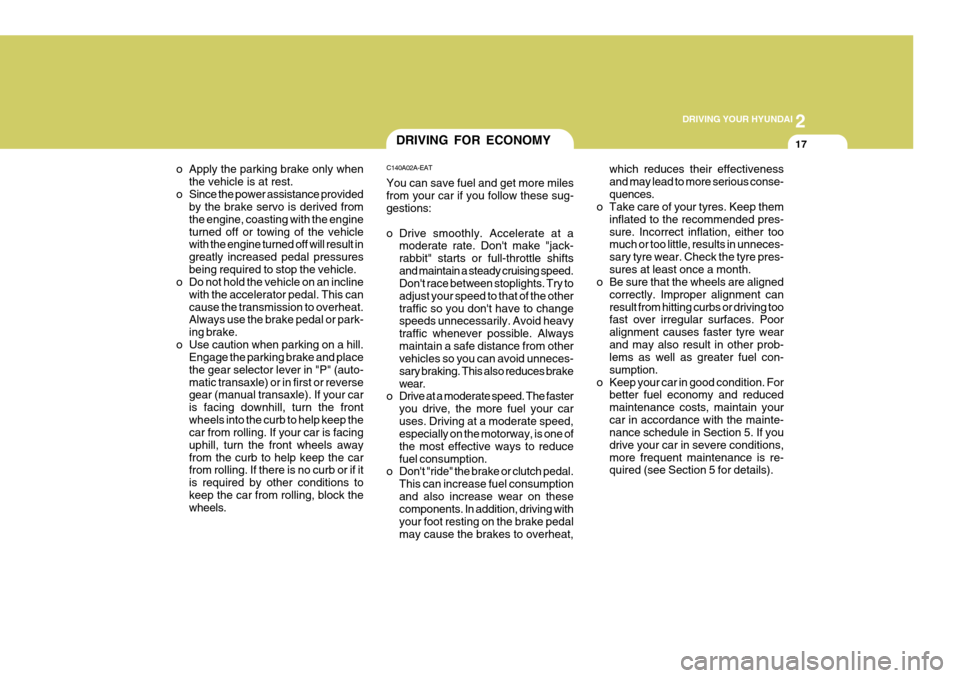
o Apply the parking brake only when the vehicle is at rest.
o Since the power assistance provided by the brake servo is derived from the engine, coasting with the engineturned off or towing of the vehicle with the engine turned off will result in greatly increased pedal pressuresbeing required to stop the vehicle.
o Do not hold the vehicle on an incline
with the accelerator pedal. This cancause the transmission to overheat. Always use the brake pedal or park- ing brake.
o Use caution when parking on a hill. Engage the parking brake and placethe gear selector lever in "P" (auto-matic transaxle) or in first or reverse gear (manual transaxle). If your car is facing downhill, turn the frontwheels into the curb to help keep the car from rolling. If your car is facing uphill, turn the front wheels awayfrom the curb to help keep the car from rolling. If there is no curb or if it is required by other conditions tokeep the car from rolling, block the wheels.DRIVING FOR ECONOMY
C140A02A-EAT You can save fuel and get more miles from your car if you follow these sug- gestions:
o Drive smoothly. Accelerate at a moderate rate. Don't make "jack- rabbit" starts or full-throttle shiftsand maintain a steady cruising speed. Don't race between stoplights. Try to adjust your speed to that of the othertraffic so you don't have to change speeds unnecessarily. Avoid heavy traffic whenever possible. Alwaysmaintain a safe distance from other vehicles so you can avoid unneces- sary braking. This also reduces brakewear.
o Drive at a moderate speed. The faster
you drive, the more fuel your caruses. Driving at a moderate speed, especially on the motorway, is one of the most effective ways to reducefuel consumption.
o Don't "ride" the brake or clutch pedal.
This can increase fuel consumptionand also increase wear on these components. In addition, driving with your foot resting on the brake pedalmay cause the brakes to overheat, which reduces their effectivenessand may lead to more serious conse-quences.
o Take care of your tyres. Keep them
inflated to the recommended pres-sure. Incorrect inflation, either too much or too little, results in unneces- sary tyre wear. Check the tyre pres-sures at least once a month.
o Be sure that the wheels are aligned
correctly. Improper alignment canresult from hitting curbs or driving too fast over irregular surfaces. Poor alignment causes faster tyre wearand may also result in other prob- lems as well as greater fuel con- sumption.
o Keep your car in good condition. For better fuel economy and reducedmaintenance costs, maintain yourcar in accordance with the mainte- nance schedule in Section 5. If you drive your car in severe conditions,more frequent maintenance is re- quired (see Section 5 for details).
Page 419 of 487
5
Maintenance and Servicing Requirements ................... 5-2
Scheduled Maintenance ............................................... 5-4
Maintenance under Severe Usage Conditions ............. 5-7
Explanation of Scheduled Maintenance Items .............. 5-8VEHICLE MAINTENANCE REQUIREMENTS
5
Page 420 of 487
5VEHICLE MAINTENANCE REQUIREMENTS
2MAINTENANCE AND SER- VICING REQUIREMENTS
SF020A1-E To ensure the continued reliability and safety of the vehicle, certain routinemaintenance operations are required at specific mileage or time intervals. It is the responsibility of the vehicle owner to ensure that the maintenance schedules shown in both this OwnersManual and the Warranty and Service Passport are adhered to. The new vehicle warranty may be invalidated if the routine maintenance operations are not performed in line with the recommendations outlined andthe safety and durability of the vehicle adversely affected. It is recommended that all mainte- nance operations with the exception of the daily operating checks are en-trusted to a Hyundai authorised re- pairer to ensure that the latest repair and maintenance procedures andspecialised servicing tools are em- ployed. In addition, the use of genuine Hyundai replacement parts will ensurethat the vehicle safety and perfor- mance will not be compromised. NOTE:
The inspection and testing of cer-
tain electronic fuel injection/enginemanagement and automatic trans- mission control systems requirespecialised electronic equipment specifically designed for Hyundai vehicles. The use of general pur-pose electrical test equipment may result in damage to the control unit microprocessors. SF020C2-E
Specified Scheduled Procedures
The Specified scheduled procedures
are listed in the maintenance charts beginning at page 5-4. The operations specified must be performed at thetime or mileage intervals shown irre- spective of whether the mileage inter- val has been reached before the speci-fied time interval.
Certain lubricants and components
degrade with both time and mileage (e.g. engine oil and brake fluid) and therefore it is not permissable to basethe maintenance schedule upon mile- age alone. It is strongly recommended that the maintenance operations areperformed by the factory-trained or distributor-trained technicians at your Hyundai authorised repairer becauseof the need for specialised knowledge and tooling and to ensure that no possibility of invalidating the manufac-turers warranty exists. The maintenance schedules relate to
vehicles operated under normal condi-tions, vehicles which are operated under adverse conditions will require more frequent maintenance which isdescribed at page 5-7.
Page 421 of 487
5
VEHICLE MAINTENANCE REQUIREMENTS
3
SF030B1-E
SERVICE HISTORY
It is important that all scheduled main- tenance services are recorded in thewarranty and service passport to en- sure that proof of maintenance is avail- able when warranty service is required.
NOTE:
Service schedules may change de-pending on individual country needs. Please ask your local Hyundai authorised repairer for acopy of the service schedule that relates to that country.