air condition Hyundai Coupe 2007 Workshop Manual
[x] Cancel search | Manufacturer: HYUNDAI, Model Year: 2007, Model line: Coupe, Model: Hyundai Coupe 2007Pages: 487, PDF Size: 12.96 MB
Page 366 of 487
1FEATURES OF YOUR HYUNDAI
98
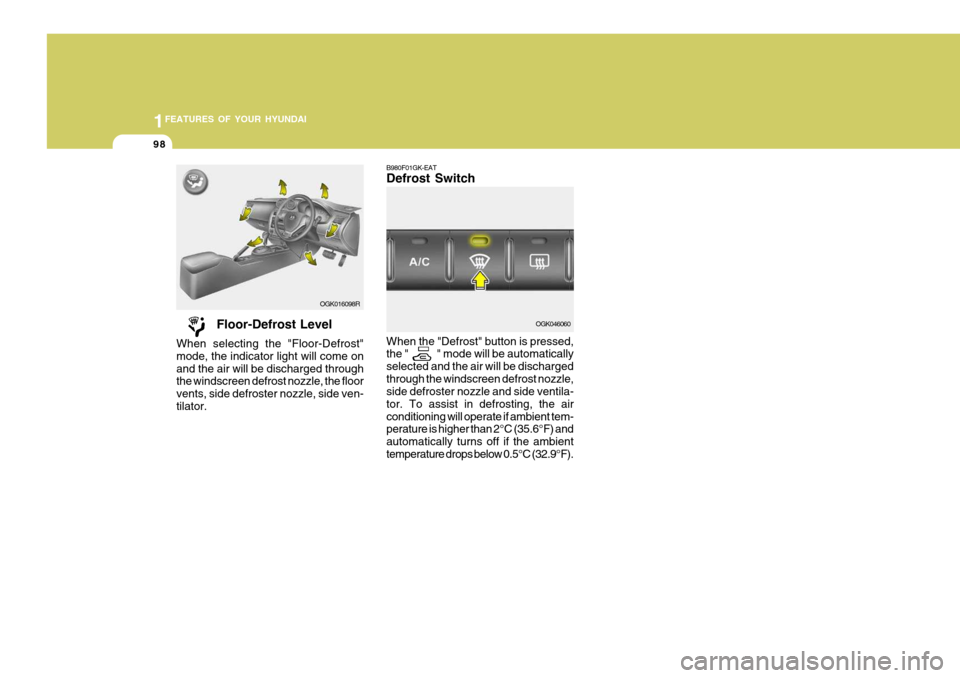
B980F01GK-EAT Defrost Switch When the "Defrost" button is pressed, the " " mode will be automatically selected and the air will be dischargedthrough the windscreen defrost nozzle, side defroster nozzle and side ventila- tor. To assist in defrosting, the airconditioning will operate if ambient tem- perature is higher than 2°C (35.6°F) and automatically turns off if the ambienttemperature drops below 0.5°C (32.9°F). OGK046060
Floor-Defrost Level
When selecting the "Floor-Defrost" mode, the indicator light will come onand the air will be discharged through the windscreen defrost nozzle, the floor vents, side defroster nozzle, side ven-tilator.
OGK016098R
Page 367 of 487
1
FEATURES OF YOUR HYUNDAI
99CLIMATE CONTROL AIR FILTER (IN FRONT OF BLOWER UNIT)
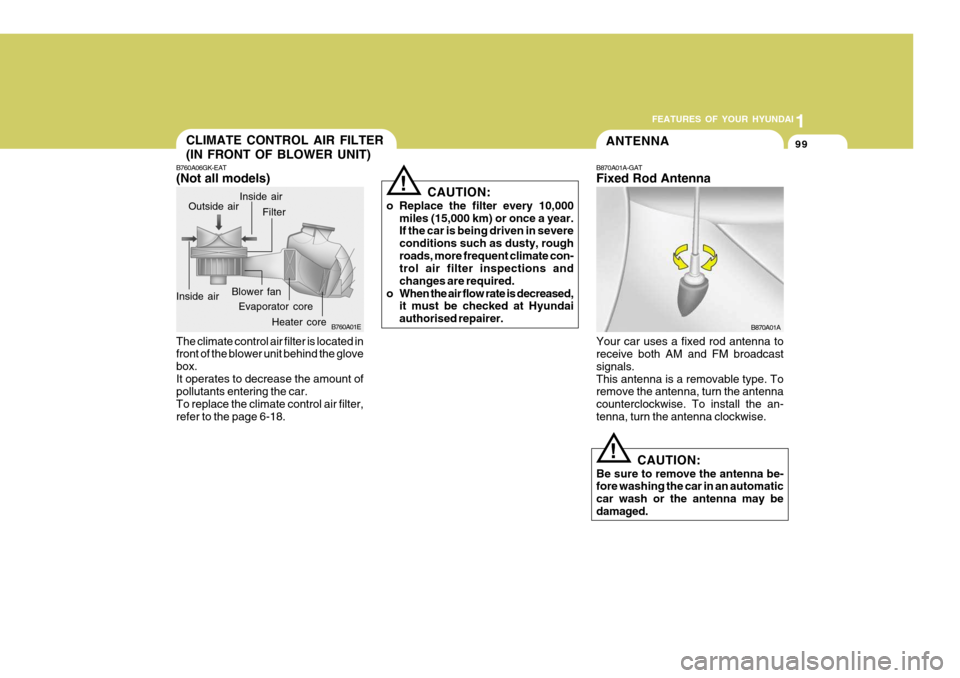
B760A06GK-EAT (Not all models)
B760A01E
Evaporator core Filter
Heater core
Outside air
Inside air Inside air
Blower fan
The climate control air filter is located in front of the blower unit behind the glove box.It operates to decrease the amount of pollutants entering the car. To replace the climate control air filter,refer to the page 6-18. CAUTION:
o Replace the filter every 10,000 miles (15,000 km) or once a year. If the car is being driven in severe conditions such as dusty, roughroads, more frequent climate con- trol air filter inspections and changes are required.
o When the air flow rate is decreased, it must be checked at Hyundaiauthorised repairer.
!
ANTENNA
B870A01A
!
B870A01A-GAT Fixed Rod Antenna Your car uses a fixed rod antenna to receive both AM and FM broadcast signals.This antenna is a removable type. To remove the antenna, turn the antenna counterclockwise. To install the an-tenna, turn the antenna clockwise.
CAUTION:
Be sure to remove the antenna be- fore washing the car in an automatic car wash or the antenna may bedamaged.
Page 375 of 487
2DRIVING YOUR HYUNDAI
2
C010A02O-EAT
WARNING: ENGINE EXHAUST CAN BE DANGEROUS!
Engine exhaust gases are potentially lethal. If at any time engine exhaust gas is detected within the passenger compartment, move the vehicle to an open area and open all windows. o Never inhale exhaust gas. Exhaust gases contain Carbon Monoxide which is colourless and odourless. Carbon Monoxide is poisonous and can cause unconsciousness and death by asphyxiation. o Exhaust System Maintenance. Ensure that the exhaust system is maintained in good condition and is free from excessive corrosion anddamage which may result in leakage. If the vehicle is driven over an object which strikes the exhaust system, ensure that the exhaust system is inspected at the first available opportunity to ensure that no leakage exists. o Confined Areas. Do not run the engine in confined spaces, allowing the engine to idle in a garage, even when the doors are open is dangerous practice. Only start the engine immediately prior to moving the vehicle out of the garage. o Prolonged Idling. If it is necessary to allow the vehicle to idle for prolonged periods, ensure that the heating system air intakecontrol is set to the "Fresh" position, the blower is set to high speed operation and that the vehicle is standing in an open area. To ensure correct operation of the heater system, the air intake grilles at the base of the windscreen must not be obstructed by snow leaves etc..
!
Page 379 of 487
2DRIVING YOUR HYUNDAI
6FUEL ECONOMY
4. Turn the ignition key to the "START" position and release it when the en- gine starts. SC060B1-E The following suggestions are made to assist in achieving the greatest degree of fuel economy.
o Maintaining a constant check on fuel
consumption will enable the most economical use pattern and drivingstyle to be adopted.
o Avoid using the vehicle for very short journeys if possible, particularly whena cold start is involved.
o Ensure that tyre pressures are main- tained at the correct level.
o Use only the recommended grade of
fuel.
o Avoid carrying unnecessary weight, and if a roof rack is in use, remove itas soon as possible after use.
o Anticipate the road and conditions ahead to enable adjustments in speedto be made smoothly. Avoid heavyacceleration and sharp braking.
o Avoid cruising at unnecessary high speeds.
o Always ensure that the periodic main- tenance services are performed by aHyundai authorised repairer at the
time and/or mileage intervals speci-fied.
o Use the air conditioning only when necessary.
!
C050B01A-EAT Normal Conditions The Starting Procedure:
1. Insert key, and fasten the seat belt.
2. Depress the clutch pedal fully and
place the gearshift lever (manual transaxle) in neutral or the selector lever (automatic transaxle) in "P" (park) position.
3. After turning the ignition key to the "ON" position, make certain all warn-ing lights and gauges are function-ing properly before starting the en- gine.
WARNING:
Be sure that the clutch is fully de- pressed when starting a manual transaxle vehicle. This will prevent sudden movement should the ve-hicle be started in gear without the clutch depressed. Otherwise there is the potential tocause damage to the vehicle or in- jury to a person inside or outside of the vehicle as a result of this suddenvehicle movement.
Page 389 of 487
2DRIVING YOUR HYUNDAI
16EFFECTIVE BRAKING
SC140A2-E Braking system performance and fric- tion material life are greatly affected by the driving style adopted. The following suggestions are made to assist inachieving the best results from the braking system.
o Anticipate the road and conditions ahead in order that heavy braking may be avoided.
o When descending long gradients, use the engine to assist in retarding thevehicle to minimise the possibility ofbrake fade occurring.
o When trailer towing, ensure that the
trailer brakes function correctly anduse engine braking to assist the vehicle braking system.
o Use only genuine Hyundai replace- ment brake pads and shoes to en-sure consistent friction characteris- tics and wear rates.
o After driving through deep water (e.g. fording), the brakes may becomewet and performance reduced. Al-ways check brake efficiency after emerging from the water and dry the brakes by lightly depressing the brakepedal several times whilst driving slowly.
C310B01JM-AAT ESP ON/OFF Mode When the ESP is operating, the ESP indicator in the instrument cluster willblink. If you turn the system off by pressing the ESP switch, the ESP-OFF indica-tor will come on and stay on. In the ESP-OFF mode, the stability control will be deactivated. Adjust your drivingaccordingly. To turn the system back on, press the switch again. The ESP- OFF indicator should go off. NOTE: The ESP mode will automatically be turned ON after the engine is turnedoff and restarted.
C310D02JM-EAT Indicators and Warning The indicators should illuminate when the ignition key is turned ON or STARTbut should go out after approximately 3 seconds. If the indicators do not illuminate, or theESP-OFF indicator does not go out after approximately 3 seconds, have the vehicle checked by a Hyundaiauthorised repairer. Should there be any unusual conditions in the device whilst driving, ESP-OFF indicator illuminates as a warning. If ESP-OFF indicator illuminates, pullyour car to a safe place and stop the engine. Then, start the engine again to check ifthe ESP-OFF indicator goes out. If the indicator remains lit even after the engine has been started, have your car checked by a Hyundai authorised re- pairer.
Page 391 of 487
2DRIVING YOUR HYUNDAI
18
o Keep your car clean. For maximumservice, your Hyundai should be kept clean and free of corrosive materi- als. It is especially important that mud, dirt, ice, etc. not be allowed toaccumulate on the underside of the car. This extra weight can result in increased fuel consumption and alsocontribute to corrosion.
o Travel lightly. Don't carry unneces-
sary weight in your car. Weight re-duces fuel economy.
o Don't let the engine idle longer than
necessary. If you are waiting (andnot in traffic), turn off your engine and restart only when you're ready to go.
o Remember, your Hyundai does not require extended warm-up. After theengine has started, allow the engine to run for 10 to 20 seconds prior toplacing the vehicle in gear. In very cold weather, however, give your engine a slightly longer warm-up pe-riod. o Don't "labour" or "over-rev" the en-
gine. Labouring is driving too slowlyin too high a gear resulting in the vehicle kangarooing. If this happens, shift to a lower gear. Over-revving isracing the engine beyond its safe limit. This can be avoided by shifting at the recommended speeds.
o Use your air conditioning sparingly. The air conditioning system is oper-ated by engine power so your fueleconomy is reduced when you use it.SMOOTH CORNERING
C150A01A-EAT Avoid braking or gear changing in cor- ners, especially when roads are wet. Ideally, corners should always be taken under gentle acceleration. If you followthese suggestions, tyre wear will be held to a minimum.
Page 392 of 487
2
DRIVING YOUR HYUNDAI
19
ZC170C1-E Anti-freeze/Corrosion inhibitor The cooling system must always con- tain an Ethylene-Glycol based anti-freeze solution. The system is filled during manufacture with solution of the correct strength which should bechecked before the onset of winter and adjusted or changed as required. NOTE: The anti-freeze solution contains a corrosion inhibitor to prevent degra- dation of the aluminium castingscontained within the engine. There- fore, never, drain the system and refill with water only. In addition, anti-freeze solution must ALWAYS be used in vehicles fitted withair conditioning, to prevent the heater matrix from freezing and subsequently bursting with the refrigeration system inuse.WINTER MOTORING
DC170A1-E The onset of winter conditions subject motor vehicles to greater operating de- mands. Therefore, the following sug- gestions will assist in maintaining peakperformance and reliability during these periods: ZC170B1-E Electrical System Winter conditions impose severe de- mands upon vehicle electrical systems,particularly the charging circuit. The battery condition and performance along with the alternator performance anddrive belt condition should be checked prior to the onset of winter. ZC170D1-E Door Locks Should the door lock mechanism be- come frozen, a proprietary lock de-icershould be used. Alternatively, warming the door key may thaw the door lock. However, the key should be handledcarefully to avoid burning the fingers. Never attempt to thaw a frozen door lock using hot water, since the waterwill eventually freeze and compound the problem. NOTE: The proper temperature for using the immobiliser key is from -40°C to 80°C (-40°F to 176°F). If you heat theimmobiliser key over 80°C (176°F) to open the frozen lock, it may cause damage to the transponder in itshead.
Page 393 of 487
2DRIVING YOUR HYUNDAI
20
ZC170E1-E Windscreen Washers & Wipers The windscreen washer bottle should be filled with a solution of water and aproprietary winter screen wash addi- tive. The windscreen wipers should not be used if the blades are frozen to thewindscreen or if they are covered with snow, before this is removed. NOTE: Never allow undiluted screen washer fluid additive to spill upon the paintwork or use engine coolant anti-freeze since damage to the paintwork may result.
o When driving in extreme conditions,the windscreen wiper blades may fail to clear the screen properly due tothe formation of ice upon the blade edge. It will therefore be necessary to periodically remove such ice torestore their efficiency.
o If the power operated door mirrors
become frozen, attempts to adjustthese may damage the mechanism. o The formation of snow or ice build up
inside the wheel arches may inter-fere with the roadwheels or steering mechanism. In such instances, un- usual noises or an increase in steer-ing effort may result. Therefore, en- sure that the wheelarches are checked periodically and any accu-mulated snow or ice removed.
o It is advisable to carry emergency
equipment including, torch, shovel,tow rope, blankets etc., if a journey is to be undertaken into areas of severe road conditions.TRAILER OR VEHICLE TOWING
YC200A2-E If you are considering towing with your car, you should first check with your Local Laws to determine their legal requirements.Since laws vary from county to county, the requirements for towing trailers, cars, or other types of vehicles or appa-ratus may differ. Ask your Hyundai authorised repairer for further details before towing.
CAUTION:
Do not carry out any towing withyour car during it's first 1000 miles inorder to allow both the engine to have properly run-in and the clutch (manual transaxle) to have correctlybedded-in. Failure to heed this cau- tion may result in serious engine or transaxle damage.
!
Page 397 of 487
2DRIVING YOUR HYUNDAI
24
13. Avoid holding the brake pedal downtoo long or too frequently. This could cause the brakes to overheat, re- sulting in reduced braking efficiency.
14. When going down a hill, shift into a
lower gear and use the engine brak-ing effect. When climbing a long grade, down-shift the transaxle to a lower gear and reduce speed to reduce chances of engine overloading and/or over-heating.
15. If you have to stop whilst going
uphill, do not hold the vehicle inplace by pressing on the accelera- tor. This can cause the automatic transaxle to overheat. Use the park-ing brake or footbrake.
NOTE: When towing, check transaxle fluid more frequently.
8. When parking your car and trailer,
especially on a hill, be sure to followall the normal precautions. Turn your front wheels into the curb, set the parking brake firmly, and put thetransaxle in 1st or Reverse (manual) or Park (automatic). In addition we advise the use of wheel chocks ateach of the trailer's tyres.
9. If the trailer has electric brakes, start
your vehicle and trailer moving, andthen apply the trailer brake controller by hand to be sure the brakes are working. This lets you check yourelectrical connection at the same time.
10. During your trip, check occasionally to be sure that the load is secure,and that the lights and any trailer brakes are still working.
11. Avoid jerky starts, sudden accel- eration or sudden stops.
12. Avoid sharp turns and rapid lane changes.
YC200E3-E Trailer or Vehicle Towing Tips
1. Before towing, check towbar ball and
safety cable connections as well as proper operation of the trailer running lights, brake lights, and turn signals.
2. Always drive your vehicle at a mod-
erate speed (Less than 60 mph).
3. Trailer towing requires more fuel than
normal conditions.
4. To maintain engine braking effi- ciency, do not tow a trailer with the transaxle in fifth gear (manual transaxle) or overdrive (automatic transaxle).
5. Always secure items in the trailer to prevent load shift whilst driving.
6. Check the condition and air pressure of all tyres on the trailer and your car. Low tyre pressure can seriously af- fect the handling. Also check thespare tyre.
7. The vehicle/trailer combination is
more affected by crosswind and buf-feting. When being passed by a large vehicle, keep a constant speed and steer straight ahead. If there is toomuch wind buffeting, slow down to get out of the other vehicle's air turbulence.
Page 398 of 487

2
DRIVING YOUR HYUNDAI
25
CAUTION:
If overheating should occur when towing, (temperature gauge reads near red zone), taking the followingaction may reduce or eliminate the problem.
1. Turn off the air conditioner.
2. Reduce highway speed.
3. Select a lower gear when going uphill.
4. Whilst in stop and go traffic, place
the gear selector in park or neutraland idle the engine at a higher speed.
!