air conditioning Hyundai Coupe 2008 User Guide
[x] Cancel search | Manufacturer: HYUNDAI, Model Year: 2008, Model line: Coupe, Model: Hyundai Coupe 2008Pages: 407, PDF Size: 11.03 MB
Page 160 of 407

2
DRIVING YOUR HYUNDAI
17
o Don't "lug" or "over-rev" the engine. Lugging is driving too slowly in too high a gear resulting in the engine bucking. If this happens, shift to a lower gear. Over-revving is racingthe engine beyond its safe limit. This can be avoided by shifting at the recommended speeds.
o Use your air conditioning sparingly. The air conditioning system is oper-ated by engine power so your fueleconomy is reduced when you use it.
C150A01A-AAT Avoid braking or gear changing in cor- ners, especially when roads are wet. Ideally, corners should always be taken under gentle acceleration. If you followthese suggestions, tire wear will be held to a minimum.SMOOTH CORNERINGC160A01A-AAT The more severe weather conditions of winter result in greater wear and other problems. To minimize the prob- lems of winter driving, you should fol-low these suggestions:
WINTER DRIVING
Page 172 of 407
3 WHAT TO DO IN AN EMERGENCY
4
!
booster battery. Then attach the other end of that cable to a solid metal partof the engine away from the battery. Do not connect the cable to any moving part.
4. Start the engine in the car with the booster battery and let it run for afew minutes. This will help to as-sure that the booster battery is fully charged. During the jumping opera- tion, run the engine in this vehicle atabout 2000 rpm.
5. Start the engine in the car with the
discharged battery using the nor-mal starting procedure. After the engine starts, leave the jumper cables connected and let the enginerun at fast idle or about 2000 rpm for several minutes.
6. carefully remove the jumper cables in the reverse order of attachment.
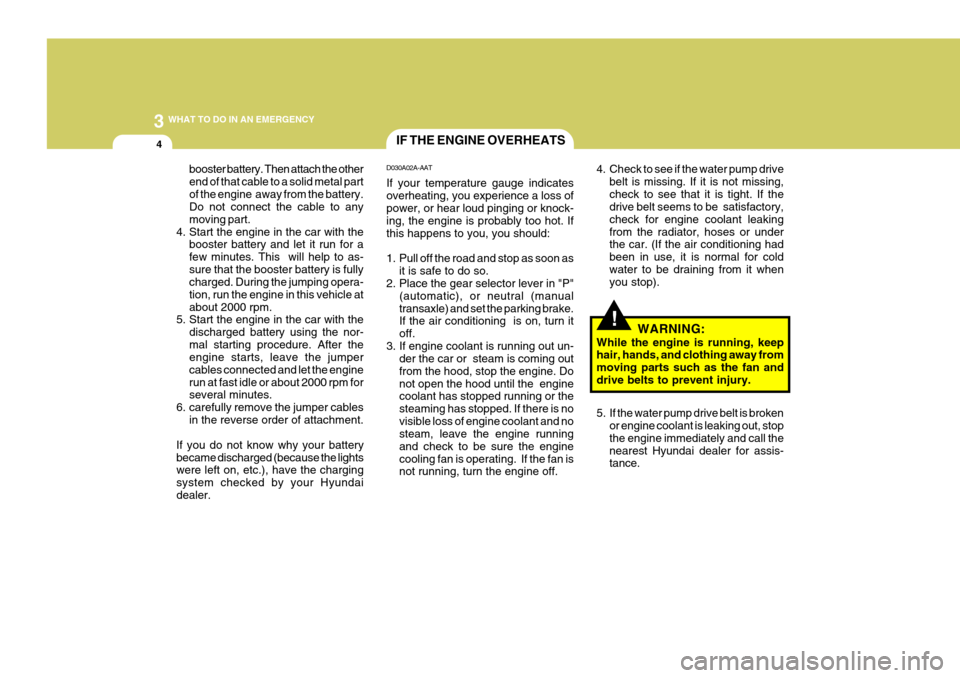
If you do not know why your battery became discharged (because the lights were left on, etc.), have the charging system checked by your Hyundaidealer. D030A02A-AAT If your temperature gauge indicates overheating, you experience a loss of power, or hear loud pinging or knock- ing, the engine is probably too hot. Ifthis happens to you, you should:
1. Pull off the road and stop as soon as
it is safe to do so.
2. Place the gear selector lever in "P"
(automatic), or neutral (manual transaxle) and set the parking brake. If the air conditioning is on, turn it off.
3. If engine coolant is running out un- der the car or steam is coming outfrom the hood, stop the engine. Donot open the hood until the engine coolant has stopped running or the steaming has stopped. If there is novisible loss of engine coolant and no steam, leave the engine running and check to be sure the enginecooling fan is operating. If the fan is not running, turn the engine off.
IF THE ENGINE OVERHEATS
4. Check to see if the water pump drivebelt is missing. If it is not missing, check to see that it is tight. If the drive belt seems to be satisfactory, check for engine coolant leakingfrom the radiator, hoses or under the car. (If the air conditioning had been in use, it is normal for coldwater to be draining from it when you stop).
WARNING:
While the engine is running, keephair, hands, and clothing away from moving parts such as the fan anddrive belts to prevent injury.
5. If the water pump drive belt is broken or engine coolant is leaking out, stop the engine immediately and call thenearest Hyundai dealer for assis- tance.
Page 196 of 407
5VEHICLE MAINTENANCE REQUIREMENTS
6
75 60I I I I I I I I I I I I
R
NO.
12 3 4 5 6 7 8 9
1011 12 13 14 15 DESCRIPTION
GENERAL MAINTENANCECOOLING SYSTEM COOLANT MANUAL TRANSAXLE OIL AUTOMATIC TRANSAXLE FLUID BRAKE HOSES AND LINES BRAKE FLUID & CLUTCH FLUID REAR BRAKE DRUMS/LININGS, PARKING BRAKE BRAKE PADS, CALIPERS AND ROTORS EXHAUST PIPE AND MUFFLER SUSPENSION MOUNTING BOLTS STEERING GEAR BOX, LINKAGE & BOOTS/LOWER ARM BALL JOINT POWER STEERING PUMP, BELT AND HOSES DRIVE SHAFTS AND BOOTS AIR CONDITIONING REFRIGERANT CLIMATE CONTROL AIR FILTER (IN FRONT OF BLOWER UNIT)
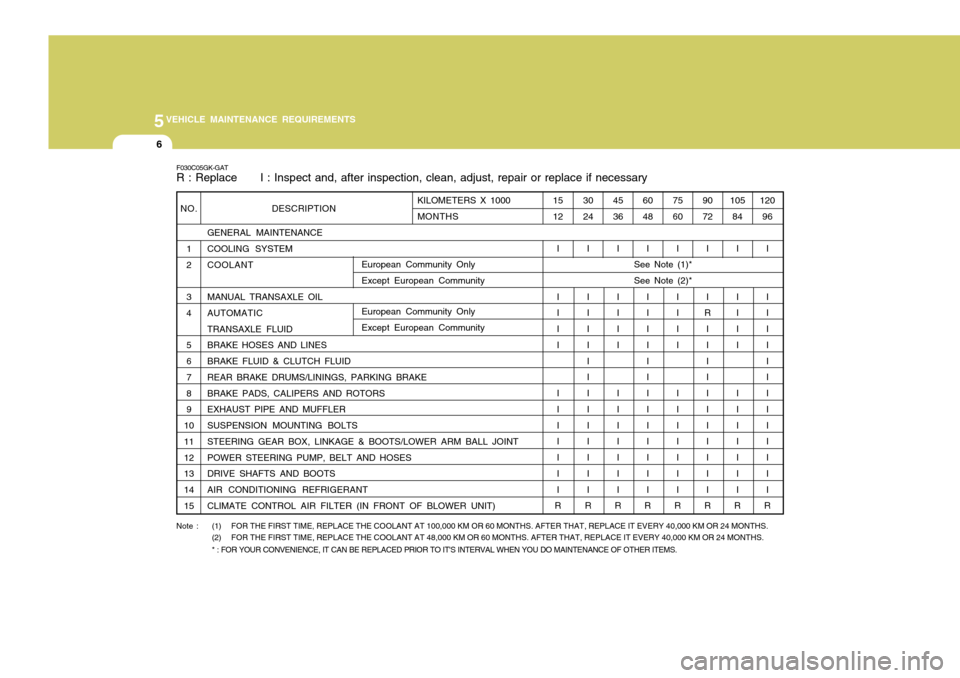
F030C05GK-GAT R : Replace I : Inspect and, after inspection, clean, adjust, repair or replace if necessary
Note : (1) FOR THE FIRST TIME, REPLACE THE COOLANT AT 100,000 KM OR 60 MONTHS. AFTER THAT, REPLACE IT EVERY 40,000 KM OR 24 MONTH
S.
(2) FOR THE FIRST TIME, REPLACE THE COOLANT AT 48,000 KM OR 60 MONTHS. AFTER THAT, REPLACE IT EVERY 40,000 KM OR 24 MONTHS.
* : FOR YOUR CONVENIENCE, IT CAN BE REPLACED PRIOR TO IT'S INTERVAL WHEN YOU DO MAINTENANCE OF OTHER ITEMS.
120
96
I I I I I I I I I I I I I I
R
105
84
I I I I I I I I I I I I
R
90 72
I I
R
I I I I I I I I I I I
R
60 48
I I I I I I I I I I I I I I
R
45 36
I I I I I I I I I I I I
R
30 24
I I I I I I I I I I I I I I
R
15 12
I I I I I I I I I I I I
R
KILOMETERS X 1000 MONTHS
European Community Only Except European Community
See Note (1)* See Note (2)*European Community Only Except European Community
Page 201 of 407
5
VEHICLE MAINTENANCE REQUIREMENTS
11
F070M01A-AAT
o Steering Gear Box, Linkage &
Boots/Lower Arm Ball Joint
With the vehicle stopped and engine off, check for excessive free-play in the steering wheel. Check the linkage for bends or damage. Check the dustboots and ball joints for deterioration, cracks, or damage. Replace any dam- aged parts. F070N01A-AAT
o Power Steering Pump, Belt
and Hoses
Check the power steering pump and hoses for leakage and damage. Re- place any damaged or leaking partsimmediately. Inspect the power steer- ing belt for evidence of cuts, cracks, excessive wear, oiliness and propertension. Replace or adjust it if neces- sary. F070P01A-AAT
o Drive Shafts and Boots
Check the drive shafts, boots and
clamps for cracks, deterioration, ordamage. Replace any damaged parts and, if necessary, repack the grease.
F070Q01A-AAT
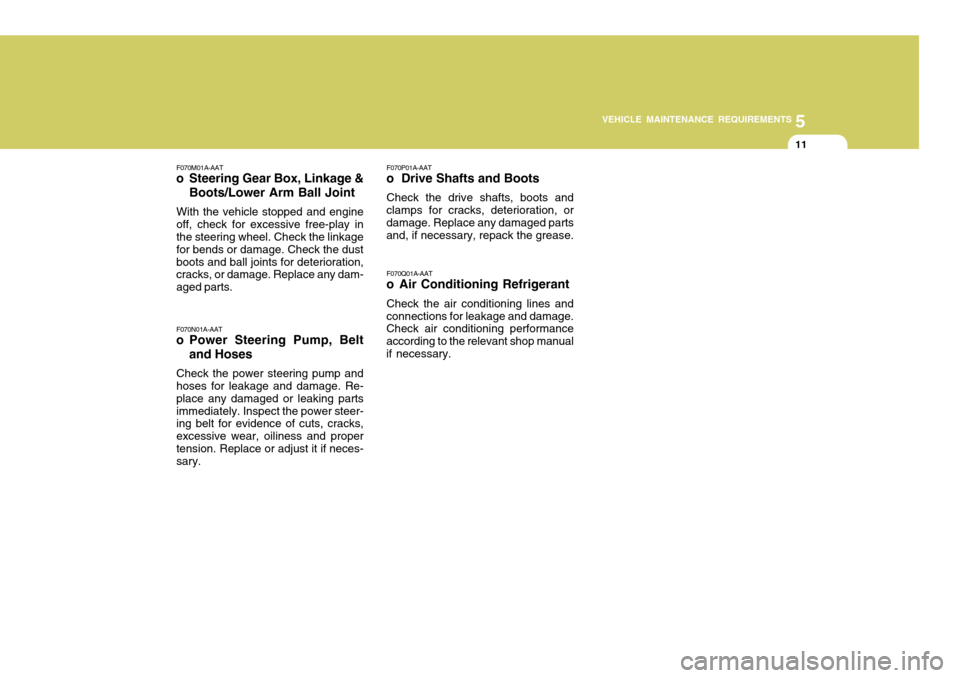
o Air Conditioning Refrigerant
Check the air conditioning lines and
connections for leakage and damage. Check air conditioning performance according to the relevant shop manualif necessary.
Page 202 of 407
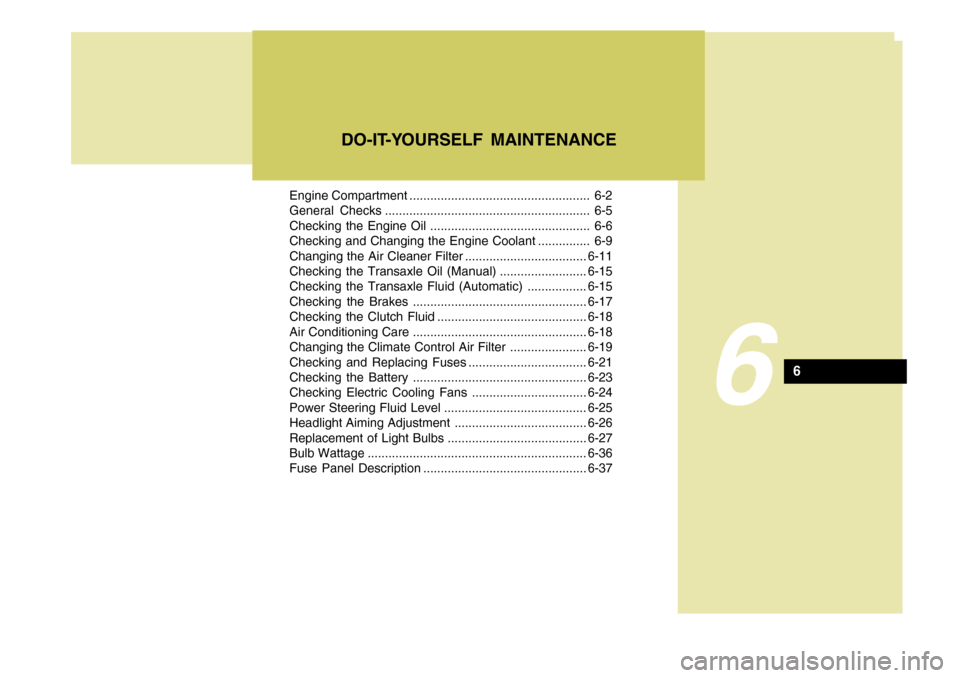
Engine Compartment .................................................... 6-2
General Checks ........................................................... 6-5
Checking the Engine Oil .............................................. 6-6
Checking and Changing the Engine Coolant ............... 6-9
Changing the Air Cleaner Filter ...................................6-11
Checking the Transaxle Oil (Manual) ......................... 6-15
Checking the Transaxle Fluid (Automatic) .................6-15
Checking the Brakes .................................................. 6-17
Checking the Clutch Fluid ........................................... 6-18
Air Conditioning Care .................................................. 6-18
Changing the Climate Control Air Filter .. ....................6-19
Checking and Replacing Fuses ..................................6-21
Checking the Battery .................................................. 6-23
Checking Electric Cooling Fans .................................6-24
Power Steering Fluid Level ......................................... 6-25
Headlight Aiming Adjustment ...................................... 6-26
Replacement of Light Bulbs ........................................6-27
Bulb Wattage ............................................................... 6-36
Fuse Panel D escription ............................................... 6-37
DO-IT-YOURSELF MAINTENANCE
6
6
Page 206 of 407
6
DO-IT-YOURSELF MAINTENANCE
5
G020B01A-AAT
Vehicle Exterior
The following should be checked
monthly:
o Overall appearance and condition
o Wheel condition and wheel nut
torque
o Exhaust system condition
o Light condition and operation
o Windshield glass condition
o Wiper blade condition
o Paint condition and body corrosion
o Fluid leaks
o Door and hood lock condition
o Tire pressure and condition (in- cluding spare tire) G020C01A-AAT
Vehicle Interior
The following should be checked each time when the vehicle is driven:
o Lights operation
o Windshield wiper operation
o Horn operation
o Defroster, heating system opera- tion (and air conditioning, if installed)
o Steering operation and condition
o Mirror condition and operation
o Turn signal operation
o Accelerator pedal operation
o Brake operation, including parking
brake
o Manual transaxle operation, includ-
ing clutch operation
o Automatic transaxle operation, in- cluding "Park" mechanism opera-tion
o Seat control condition and opera-
tion
o Seat belt condition and operation
o Sunvisor operation
If you notice anything that does notoperate correctly or appears to be functioning incorrectly, inspect it care- fully and seek assistance from yourHyundai dealer if service is needed.
G020A01A-AAT
Engine Compartment
The following should be checked regu-larly:
o Engine oil level and condition
o Transaxle fluid level and condition
o Brake fluid level
o Clutch fluid level
o Engine coolant level
o Windshield washer fluid level
o Accessory drive belt condition
o Engine Coolant hose condition
o Fluid leaks (on or below compo- nents)
o Power steering fluid level
o Battery condition
o Air filter condition GENERAL CHECKS
Page 219 of 407
6 DO-IT-YOURSELF MAINTENANCE
18
HGK5013
CHECKING THE CLUTCH FLUID
To add brake fluid, first wipe away any dirt then unscrew the fluid reservoircap. Slowly pour the recommended fluid into the reservoir. Do not overfill. Carefully replace the cap on the reser-voir and tighten. G130A01S-AAT
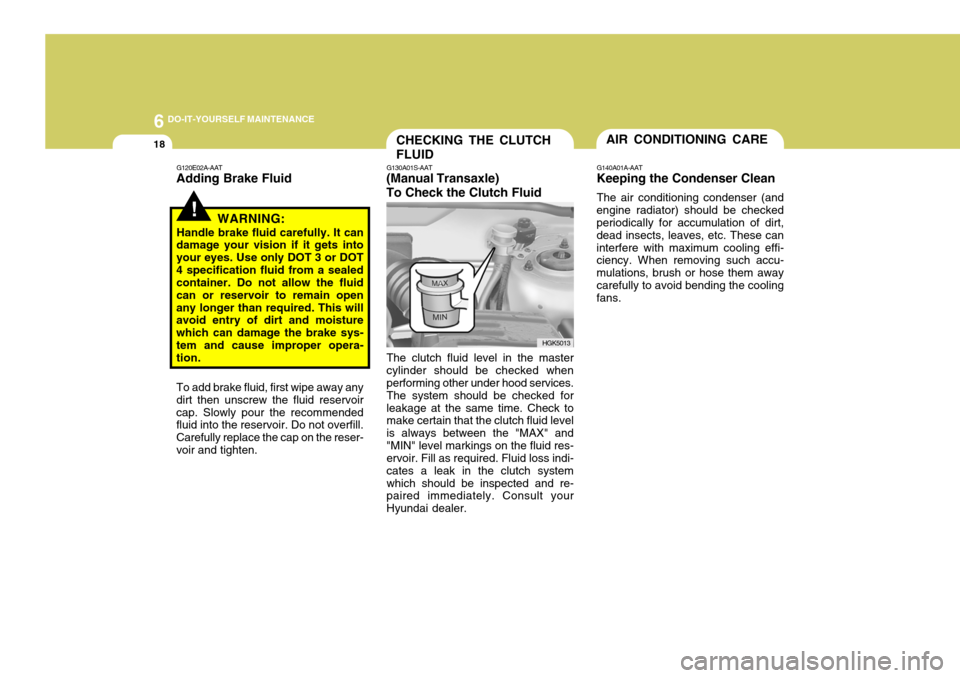
(Manual Transaxle) To Check the Clutch Fluid
!
G120E02A-AAT
Adding Brake Fluid
WARNING:
Handle brake fluid carefully. It can
damage your vision if it gets into your eyes. Use only DOT 3 or DOT4 specification fluid from a sealed container. Do not allow the fluid can or reservoir to remain openany longer than required. This will avoid entry of dirt and moisture which can damage the brake sys- tem and cause improper opera- tion. The clutch fluid level in the mastercylinder should be checked when performing other under hood services. The system should be checked forleakage at the same time. Check to make certain that the clutch fluid level is always between the "MAX" and"MIN" level markings on the fluid res- ervoir. Fill as required. Fluid loss indi- cates a leak in the clutch systemwhich should be inspected and re- paired immediately. Consult your Hyundai dealer.G140A01A-AAT
Keeping the Condenser Clean
The air conditioning condenser (and
engine radiator) should be checked periodically for accumulation of dirt, dead insects, leaves, etc. These caninterfere with maximum cooling effi- ciency. When removing such accu- mulations, brush or hose them awaycarefully to avoid bending the cooling fans. AIR CONDITIONING CARE
Page 220 of 407
6
DO-IT-YOURSELF MAINTENANCE
19CHANGING THE CLIMATE CONTROL AIR FILTER
G145A03GK-GAT
(In front of blower unit)(If installed)
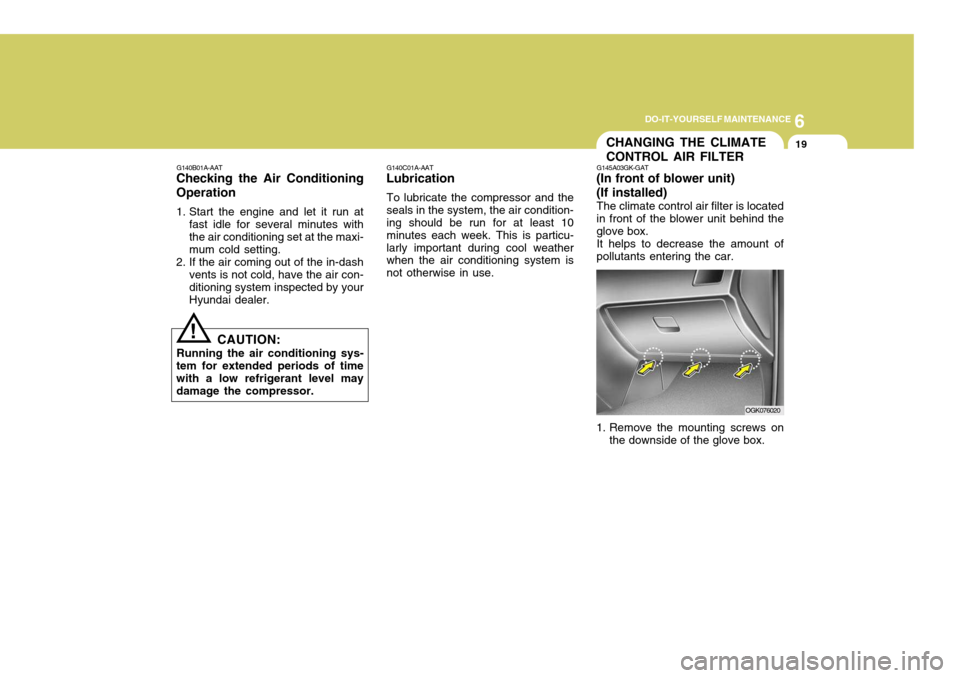
The climate control air filter is located in front of the blower unit behind the glove box.It helps to decrease the amount ofpollutants entering the car.
1. Remove the mounting screws on the downside of the glove box. OGK076020
G140C01A-AAT
Lubrication
To lubricate the compressor and theseals in the system, the air condition- ing should be run for at least 10 minutes each week. This is particu-larly important during cool weather when the air conditioning system is not otherwise in use.
!
G140B01A-AAT
Checking the Air Conditioning Operation
1. Start the engine and let it run at
fast idle for several minutes with the air conditioning set at the maxi- mum cold setting.
2. If the air coming out of the in-dash vents is not cold, have the air con-ditioning system inspected by yourHyundai dealer.
CAUTION:
Running the air conditioning sys-
tem for extended periods of timewith a low refrigerant level maydamage the compressor.
Page 226 of 407
6
DO-IT-YOURSELF MAINTENANCE
25
G220B01A-AAT
Checking Engine Cooling Fan
The engine coolant fan should come on automatically if the engine coolant temperature is high. G220C01A-AAT
Checking Condenser Cooling Fan
The condenser coolant fan should come on automatically whenever the air conditioning is in operation. G230A01GK-GAT
POWER STEERING FLUID LEVEL
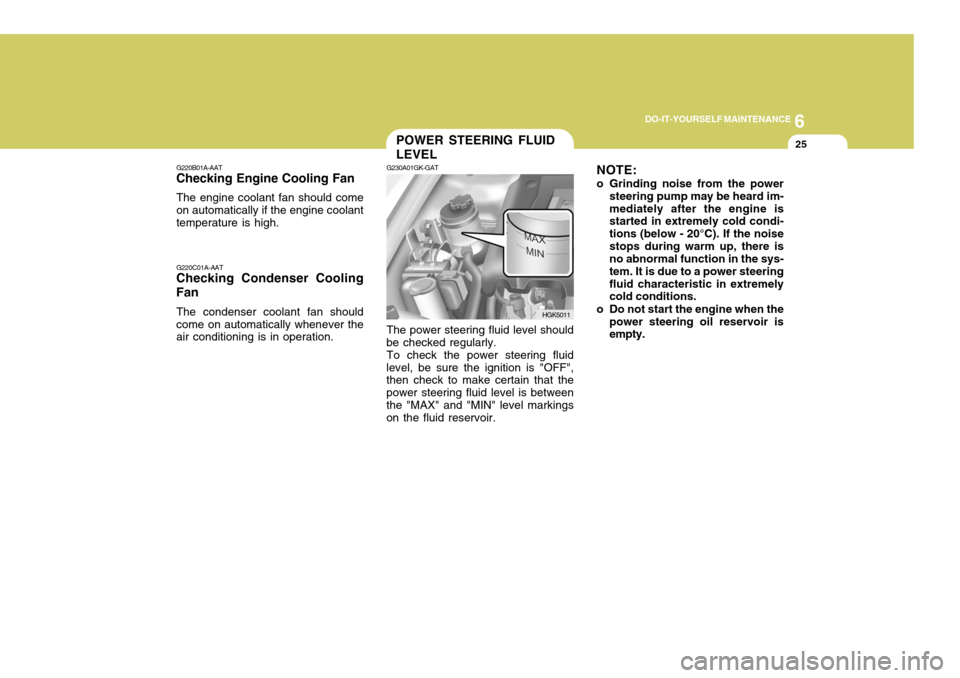
The power steering fluid level should
be checked regularly.
To check the power steering fluid
level, be sure the ignition is "OFF", then check to make certain that the power steering fluid level is betweenthe "MAX" and "MIN" level markings on the fluid reservoir. NOTE:
o Grinding noise from the power
steering pump may be heard im- mediately after the engine is started in extremely cold condi- tions (below - 20°C). If the noisestops during warm up, there is no abnormal function in the sys- tem. It is due to a power steeringfluid characteristic in extremely cold conditions.
o Do not start the engine when the power steering oil reservoir isempty.
HGK5011
Page 256 of 407
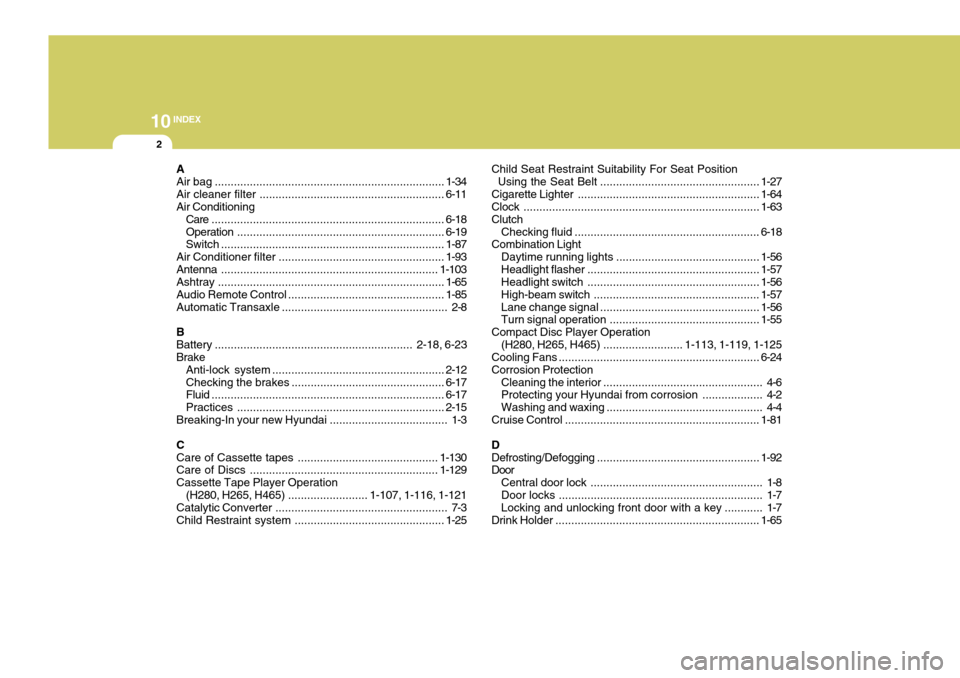
10INDEX
2
A Air bag ........................................................................ 1-34
Air clean er filter .......................................................... 6-11
Air Conditioning
Care ......................................................................... 6-18
Operation ................................................................. 6-19
Switch ...................................................................... 1-87
Air Cond itioner filter .................................................... 1-93
Antenna .................................................................... 1-103
Ashtray ....................................................................... 1-65
Audio Remote Control ................................................. 1-85
Automatic Transaxle .................................................... 2-8
BBattery .............................................................. 2-18, 6-23
Brake
Anti-lock system ...................................................... 2-12
Checking the brakes ................................................ 6-17
Fluid ......................................................................... 6-17
Practices ................................................................. 2-15
Breaking-In your new Hyundai ..................................... 1-3
CCare of Cassette tapes ............................................ 1-130
Care of D iscs ........................................................... 1-129
Cassette Tape Player Operation (H280, H265, H465) .........................1-107, 1-116, 1-121
Catalytic Converter ...................................................... 7-3
Child Restraint system ............................................... 1-25Child Seat Restraint Suitability For Seat Position
Using the Seat Belt .................................................. 1-27
Cigarette Lighter ......................................................... 1-64
Clock .......................................................................... 1-63
Clutch Checking fluid .......................................................... 6-18
Combination Light
Daytime running lights ............................................. 1-56
Headlight flasher ...................................................... 1-57
Headlight swi tch ...................................................... 1-56
High-beam switch .................................................... 1-57
Lane change si gnal .................................................. 1-56
Turn signal operation ............................................... 1-55
Compact Disc Player Operation
(H280, H265, H465) .........................1-113, 1-119, 1-125
Cooling Fans ............................................................... 6-24
Corrosion Protection
Cleaning the interior .................................................. 4-6
Protecting your Hyundai from corrosion ................... 4-2
Washing and waxing ................................................. 4-4
Cruise Control ............................................................. 1-81
DDefrosting/Defogging ................................................... 1-92
Door
Central door lock ...................................................... 1-8
Door locks ................................................................ 1-7 Locking and unlocking front door with a key ............ 1-7
Drink Holder ................................................................ 1-65