clutch Hyundai Coupe 2008 User Guide
[x] Cancel search | Manufacturer: HYUNDAI, Model Year: 2008, Model line: Coupe, Model: Hyundai Coupe 2008Pages: 407, PDF Size: 11.03 MB
Page 203 of 407
6 DO-IT-YOURSELF MAINTENANCE
2
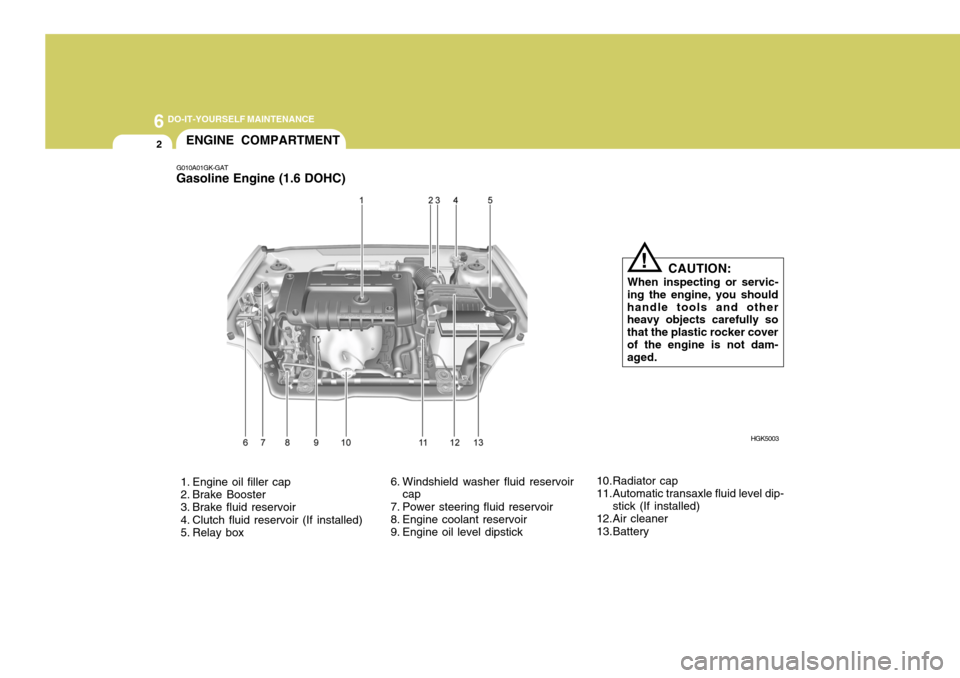
1. Engine oil filler cap
2. Brake Booster
3. Brake fluid reservoir
4. Clutch fluid reservoir (If installed)
5. Relay box
G010A01GK-GAT Gasoline Engine (1.6 DOHC)
ENGINE COMPARTMENT
HGK5003
CAUTION:
When inspecting or servic-
ing the engine, you should handle tools and other heavy objects carefully so that the plastic rocker coverof the engine is not dam- aged.
!
6. Windshield washer fluid reservoir cap
7. Power steering fluid reservoir
8. Engine coolant reservoir
9. Engine oil level dipstick 10.Radiator cap
11.Automatic transaxle fluid level dip-
stick (If installed)
12.Air cleaner
13.Battery
Page 204 of 407
6
DO-IT-YOURSELF MAINTENANCE
3
G010B01GK-GAT
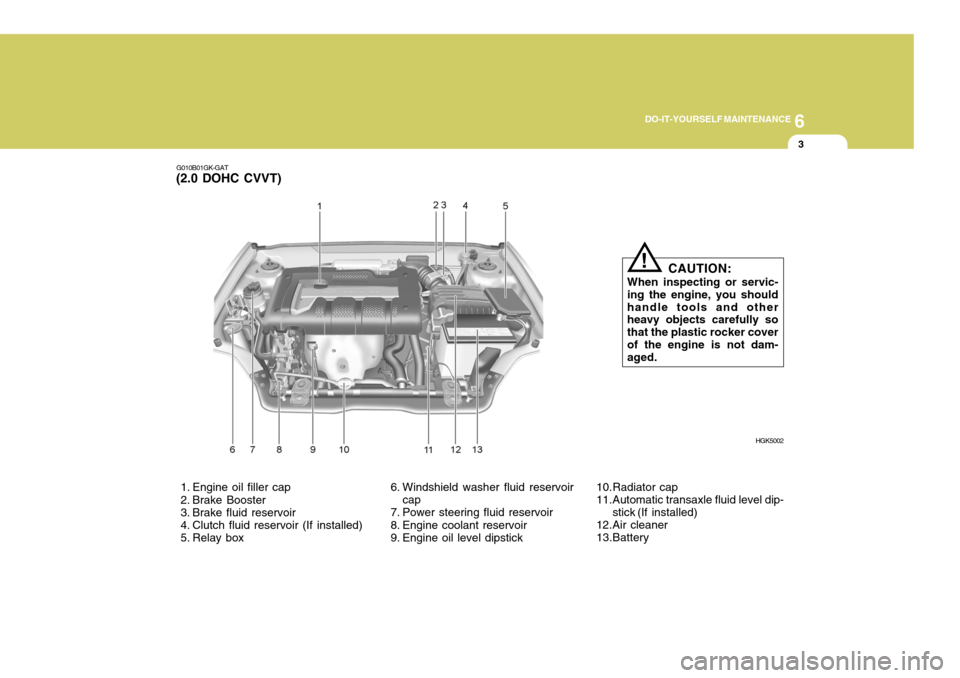
(2.0 DOHC CVVT)
1. Engine oil filler cap
2. Brake Booster
3. Brake fluid reservoir
4. Clutch fluid reservoir (If installed)
5. Relay box 6. Windshield washer fluid reservoir
cap
7. Power steering fluid reservoir
8. Engine coolant reservoir
9. Engine oil level dipstick 10.Radiator cap
11.Automatic transaxle fluid level dip-
stick (If installed)
12.Air cleaner
13.Battery CAUTION:
When inspecting or servic-ing the engine, you shouldhandle tools and other heavy objects carefully so that the plastic rocker coverof the engine is not dam- aged.
!
HGK5002
Page 206 of 407
6
DO-IT-YOURSELF MAINTENANCE
5
G020B01A-AAT
Vehicle Exterior
The following should be checked
monthly:
o Overall appearance and condition
o Wheel condition and wheel nut
torque
o Exhaust system condition
o Light condition and operation
o Windshield glass condition
o Wiper blade condition
o Paint condition and body corrosion
o Fluid leaks
o Door and hood lock condition
o Tire pressure and condition (in- cluding spare tire) G020C01A-AAT
Vehicle Interior
The following should be checked each time when the vehicle is driven:
o Lights operation
o Windshield wiper operation
o Horn operation
o Defroster, heating system opera- tion (and air conditioning, if installed)
o Steering operation and condition
o Mirror condition and operation
o Turn signal operation
o Accelerator pedal operation
o Brake operation, including parking
brake
o Manual transaxle operation, includ-
ing clutch operation
o Automatic transaxle operation, in- cluding "Park" mechanism opera-tion
o Seat control condition and opera-
tion
o Seat belt condition and operation
o Sunvisor operation
If you notice anything that does notoperate correctly or appears to be functioning incorrectly, inspect it care- fully and seek assistance from yourHyundai dealer if service is needed.
G020A01A-AAT
Engine Compartment
The following should be checked regu-larly:
o Engine oil level and condition
o Transaxle fluid level and condition
o Brake fluid level
o Clutch fluid level
o Engine coolant level
o Windshield washer fluid level
o Accessory drive belt condition
o Engine Coolant hose condition
o Fluid leaks (on or below compo- nents)
o Power steering fluid level
o Battery condition
o Air filter condition GENERAL CHECKS
Page 219 of 407
6 DO-IT-YOURSELF MAINTENANCE
18
HGK5013
CHECKING THE CLUTCH FLUID
To add brake fluid, first wipe away any dirt then unscrew the fluid reservoircap. Slowly pour the recommended fluid into the reservoir. Do not overfill. Carefully replace the cap on the reser-voir and tighten. G130A01S-AAT
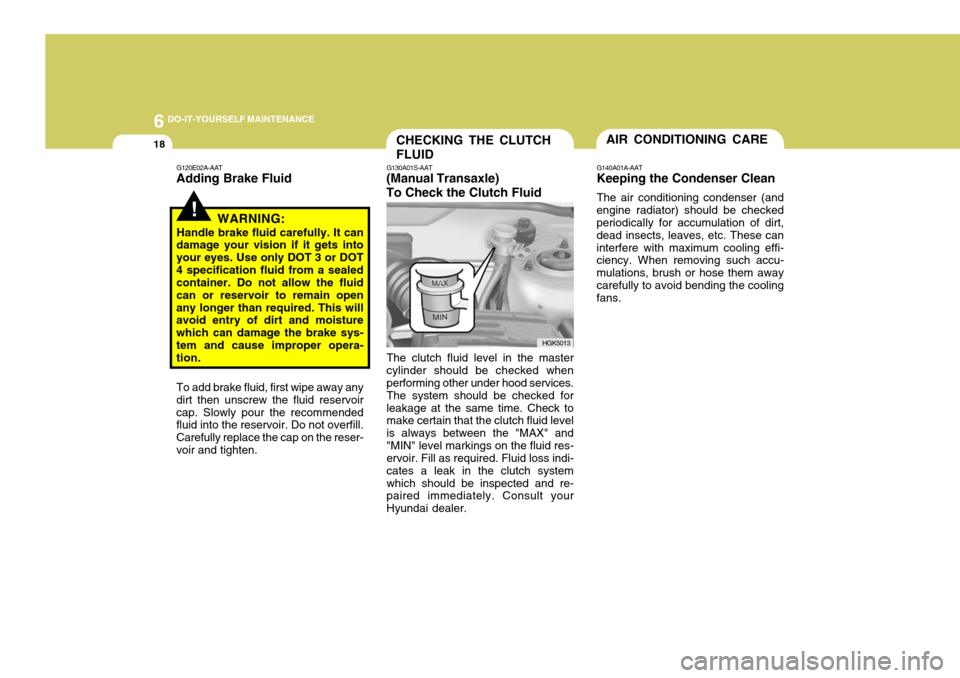
(Manual Transaxle) To Check the Clutch Fluid
!
G120E02A-AAT
Adding Brake Fluid
WARNING:
Handle brake fluid carefully. It can
damage your vision if it gets into your eyes. Use only DOT 3 or DOT4 specification fluid from a sealed container. Do not allow the fluid can or reservoir to remain openany longer than required. This will avoid entry of dirt and moisture which can damage the brake sys- tem and cause improper opera- tion. The clutch fluid level in the mastercylinder should be checked when performing other under hood services. The system should be checked forleakage at the same time. Check to make certain that the clutch fluid level is always between the "MAX" and"MIN" level markings on the fluid res- ervoir. Fill as required. Fluid loss indi- cates a leak in the clutch systemwhich should be inspected and re- paired immediately. Consult your Hyundai dealer.G140A01A-AAT
Keeping the Condenser Clean
The air conditioning condenser (and
engine radiator) should be checked periodically for accumulation of dirt, dead insects, leaves, etc. These caninterfere with maximum cooling effi- ciency. When removing such accu- mulations, brush or hose them awaycarefully to avoid bending the cooling fans. AIR CONDITIONING CARE
Page 256 of 407

10INDEX
2
A Air bag ........................................................................ 1-34
Air clean er filter .......................................................... 6-11
Air Conditioning
Care ......................................................................... 6-18
Operation ................................................................. 6-19
Switch ...................................................................... 1-87
Air Cond itioner filter .................................................... 1-93
Antenna .................................................................... 1-103
Ashtray ....................................................................... 1-65
Audio Remote Control ................................................. 1-85
Automatic Transaxle .................................................... 2-8
BBattery .............................................................. 2-18, 6-23
Brake
Anti-lock system ...................................................... 2-12
Checking the brakes ................................................ 6-17
Fluid ......................................................................... 6-17
Practices ................................................................. 2-15
Breaking-In your new Hyundai ..................................... 1-3
CCare of Cassette tapes ............................................ 1-130
Care of D iscs ........................................................... 1-129
Cassette Tape Player Operation (H280, H265, H465) .........................1-107, 1-116, 1-121
Catalytic Converter ...................................................... 7-3
Child Restraint system ............................................... 1-25Child Seat Restraint Suitability For Seat Position
Using the Seat Belt .................................................. 1-27
Cigarette Lighter ......................................................... 1-64
Clock .......................................................................... 1-63
Clutch Checking fluid .......................................................... 6-18
Combination Light
Daytime running lights ............................................. 1-56
Headlight flasher ...................................................... 1-57
Headlight swi tch ...................................................... 1-56
High-beam switch .................................................... 1-57
Lane change si gnal .................................................. 1-56
Turn signal operation ............................................... 1-55
Compact Disc Player Operation
(H280, H265, H465) .........................1-113, 1-119, 1-125
Cooling Fans ............................................................... 6-24
Corrosion Protection
Cleaning the interior .................................................. 4-6
Protecting your Hyundai from corrosion ................... 4-2
Washing and waxing ................................................. 4-4
Cruise Control ............................................................. 1-81
DDefrosting/Defogging ................................................... 1-92
Door
Central door lock ...................................................... 1-8
Door locks ................................................................ 1-7 Locking and unlocking front door with a key ............ 1-7
Drink Holder ................................................................ 1-65
Page 296 of 407
2
DRIVING YOUR HYUNDAI
3TO START THE ENGINEBEFORE STARTING THE ENGINE
SC030A3-E Before you start the engine, you should always:
1. Look around the vehicle to be sure
there are no flat tyres, puddles of oil or water or other indications of pos- sible trouble.
2. After entering the car, check to be sure the parking brake is engaged.
3. Check that all windows, and lights
are clean.
4. Check that the interior and exterior mirrors are clean and in position.
5. Check your seat, seatback and head restraint to be sure they are intheir proper positions.
6. Close all the doors.
7. Fasten your seat belt and be sure that all other occupants have fas-tened theirs.
8. Turn off all lights and accessories that are not needed.
9. When you turn the ignition switch to "ON" check that all appropriate warn- ing lights are operating and that you have sufficient fuel.
10.Check the operation of warning lights and all bulbs when key is inthe "ON" position.
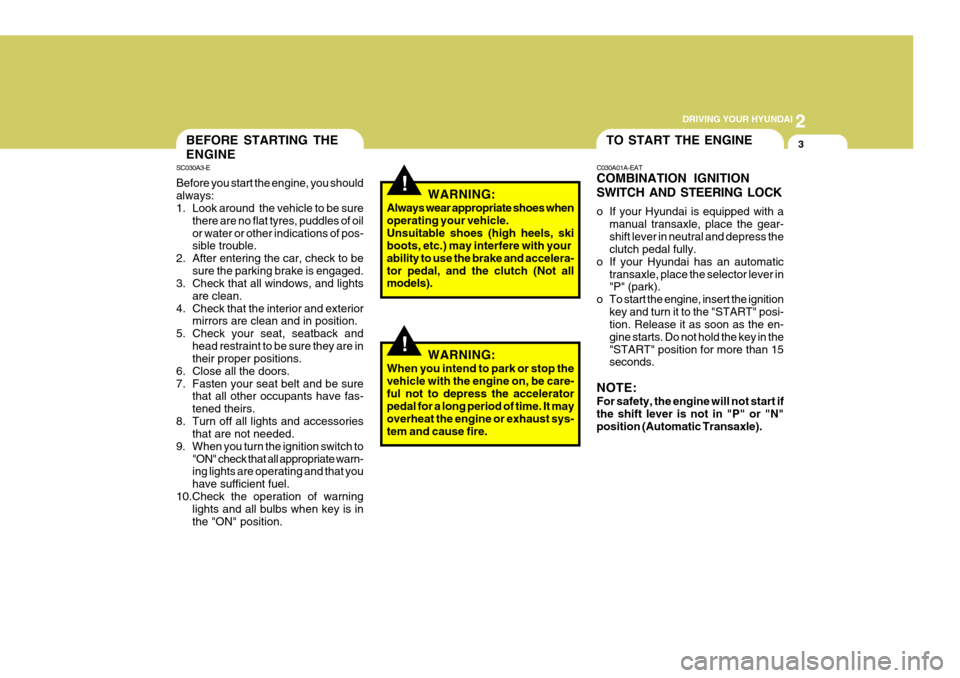
!WARNING:
Always wear appropriate shoes when operating your vehicle.Unsuitable shoes (high heels, ski boots, etc.) may interfere with your ability to use the brake and accelera-tor pedal, and the clutch (Not all models). C030A01A-EAT COMBINATION IGNITION SWITCH AND STEERING LOCK
o If your Hyundai is equipped with a
manual transaxle, place the gear- shift lever in neutral and depress the clutch pedal fully.
o If your Hyundai has an automatic
transaxle, place the selector lever in"P" (park).
o To start the engine, insert the ignition key and turn it to the "START" posi-tion. Release it as soon as the en- gine starts. Do not hold the key in the"START" position for more than 15 seconds.
NOTE: For safety, the engine will not start if the shift lever is not in "P" or "N" position (Automatic Transaxle).
!WARNING:
When you intend to park or stop the vehicle with the engine on, be care-ful not to depress the accelerator pedal for a long period of time. It may overheat the engine or exhaust sys-tem and cause fire.
Page 298 of 407
2
DRIVING YOUR HYUNDAI
5
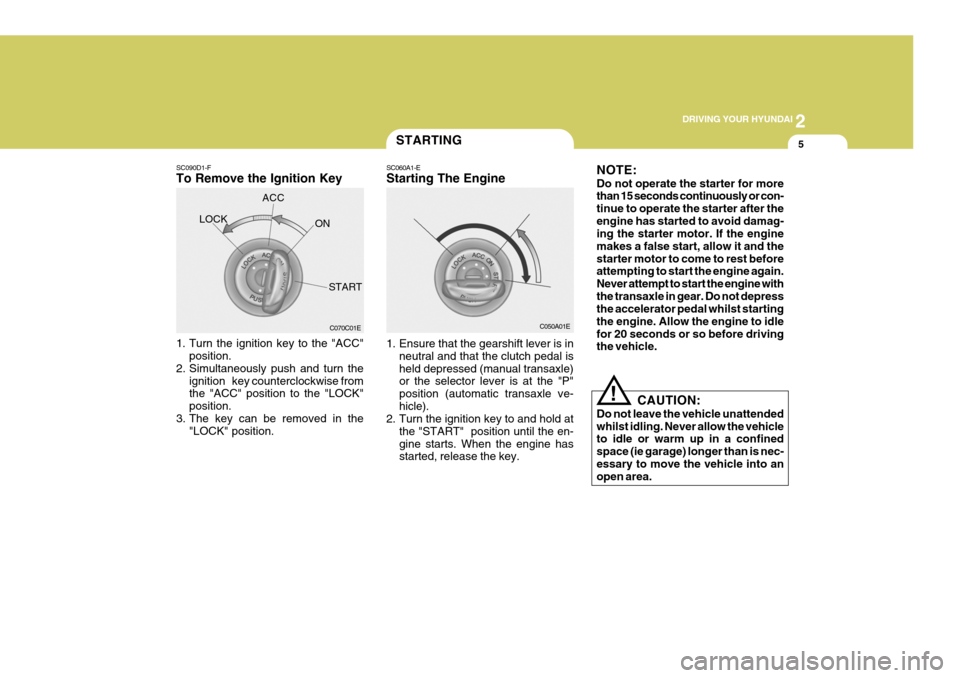
SC090D1-F To Remove the Ignition Key
1. Turn the ignition key to the "ACC"
position.
2. Simultaneously push and turn the
ignition key counterclockwise from the "ACC" position to the "LOCK" position.
3. The key can be removed in the "LOCK" position.LOCK
C070C01E
ACC
ON
START
STARTING
SC060A1-E Starting The Engine
1. Ensure that the gearshift lever is in neutral and that the clutch pedal is held depressed (manual transaxle) or the selector lever is at the "P" position (automatic transaxle ve-hicle).
2. Turn the ignition key to and hold at
the "START" position until the en-gine starts. When the engine has started, release the key. NOTE: Do not operate the starter for more than 15 seconds continuously or con- tinue to operate the starter after theengine has started to avoid damag- ing the starter motor. If the engine makes a false start, allow it and thestarter motor to come to rest before attempting to start the engine again. Never attempt to start the engine withthe transaxle in gear. Do not depress the accelerator pedal whilst starting the engine. Allow the engine to idlefor 20 seconds or so before driving the vehicle.
CAUTION:
Do not leave the vehicle unattended whilst idling. Never allow the vehicle to idle or warm up in a confined space (ie garage) longer than is nec-essary to move the vehicle into an open area.
!
C050A01E
Page 299 of 407
2DRIVING YOUR HYUNDAI
6FUEL ECONOMY
4. Turn the ignition key to the "START" position and release it when the en- gine starts. SC060B1-E The following suggestions are made to assist in achieving the greatest degree of fuel economy.
o Maintaining a constant check on fuel
consumption will enable the most economical use pattern and drivingstyle to be adopted.
o Avoid using the vehicle for very short journeys if possible, particularly whena cold start is involved.
o Ensure that tyre pressures are main- tained at the correct level.
o Use only the recommended grade of
fuel.
o Avoid carrying unnecessary weight, and if a roof rack is in use, remove itas soon as possible after use.
o Anticipate the road and conditions ahead to enable adjustments in speedto be made smoothly. Avoid heavyacceleration and sharp braking.
o Avoid cruising at unnecessary high speeds.
o Always ensure that the periodic main- tenance services are performed by aHyundai authorised repairer at the
time and/or mileage intervals speci-fied.
o Use the air conditioning only when necessary.
!
C050B01A-EAT Normal Conditions The Starting Procedure:
1. Insert key, and fasten the seat belt.
2. Depress the clutch pedal fully and
place the gearshift lever (manual transaxle) in neutral or the selector lever (automatic transaxle) in "P" (park) position.
3. After turning the ignition key to the "ON" position, make certain all warn-ing lights and gauges are function-ing properly before starting the en- gine.
WARNING:
Be sure that the clutch is fully de- pressed when starting a manual transaxle vehicle. This will prevent sudden movement should the ve-hicle be started in gear without the clutch depressed. Otherwise there is the potential tocause damage to the vehicle or in- jury to a person inside or outside of the vehicle as a result of this suddenvehicle movement.
Page 300 of 407
2
DRIVING YOUR HYUNDAI
7
!
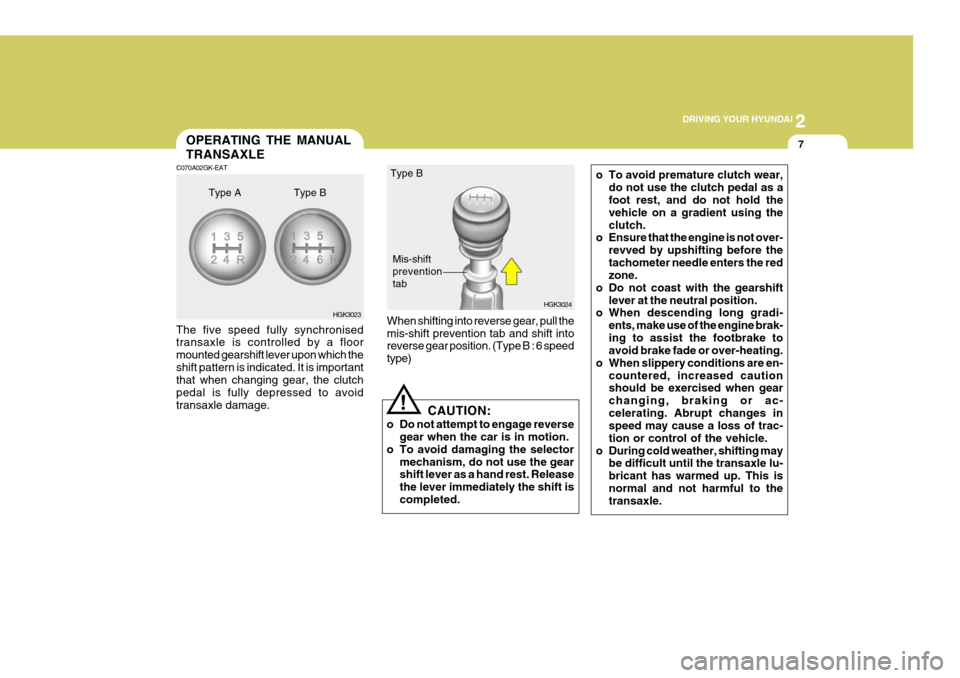
When shifting into reverse gear, pull the mis-shift prevention tab and shift into reverse gear position. (Type B : 6 speed type) HGK3024
Type B
Mis-shift preventiontab
OPERATING THE MANUAL TRANSAXLE
C070A02GK-EAT The five speed fully synchronised transaxle is controlled by a floor mounted gearshift lever upon which theshift pattern is indicated. It is important that when changing gear, the clutch pedal is fully depressed to avoidtransaxle damage. HGK3023
Type A Type B
CAUTION:
o Do not attempt to engage reverse gear when the car is in motion.
o To avoid damaging the selector mechanism, do not use the gear shift lever as a hand rest. Release the lever immediately the shift iscompleted. o To avoid premature clutch wear,
do not use the clutch pedal as a foot rest, and do not hold the vehicle on a gradient using theclutch.
o Ensure that the engine is not over-
revved by upshifting before thetachometer needle enters the red zone.
o Do not coast with the gearshift
lever at the neutral position.
o When descending long gradi-
ents, make use of the engine brak- ing to assist the footbrake to avoid brake fade or over-heating.
o When slippery conditions are en- countered, increased cautionshould be exercised when gear changing, braking or ac-celerating. Abrupt changes in speed may cause a loss of trac- tion or control of the vehicle.
o During cold weather, shifting may be difficult until the transaxle lu-bricant has warmed up. This isnormal and not harmful to the transaxle.
Page 301 of 407
2DRIVING YOUR HYUNDAI
8
o If you've come to a complete stopand it's hard to shift into 1st or R(Reverse), put the gearshift lever in N(Neutral) position and let upon the clutch. Press the clutch pedal back down, and then shift into 1st or R(Reverse) gear posi-tion.
o Do not use the gearshift lever as a
handrest during driving, as thiscan result in premature wear of the transaxle shift forks.
o Do not downshift more than 2 gears at once or when the engine isrunning at high speed (5,000 RPM or higher). Such downshifting maydamage the engine.
C070B01A-EAT Using the Clutch The clutch should be pressed all the way to the floor before shifting, thenreleased slowly. The clutch pedal should always be used after fully returning to the original position. Do not rest yourfoot on the clutch pedal whilst driving. This can cause unnecessary wear. Do not partially engage the clutch tohold the car on an incline. This causes unnecessary wear. Use the parking brake to hold the car onan incline. Do not operate the clutch pedal rapidly and repeatedly.
!WARNING:
o Avoid high cornering speeds.
o Do not make quick steering wheel movements, such as sharp lane changes or fast, sharp turns.
o Always wear your seat belts.
In a collision crash, an unbeltedperson is significantly more likely to die than a person wearing aseat belt.
o The risk of rollover is greatly in-
creased if you lose control of your vehicle at motorway speeds.
o Loss of control often occurs if two
or more wheels drop off the road-way and the driver oversteers to reenter the roadway.
o In the event your vehicle leaves the roadway, do not steer sharply.Instead, slow down before pullingback into the travel lanes.
o Never exceed posted speed limits.
!WARNING:
If your vehicle has a manual transaxle not equipped with a ignition lock switch, it may move and cause aserious accident when starting the engine without depressing the clutch pedal while the parking brake is re-leased and the shift never not in the N(Neutral) position.