radiator cap Hyundai Coupe 2008 User Guide
[x] Cancel search | Manufacturer: HYUNDAI, Model Year: 2008, Model line: Coupe, Model: Hyundai Coupe 2008Pages: 407, PDF Size: 11.03 MB
Page 215 of 407
6 DO-IT-YOURSELF MAINTENANCE
14
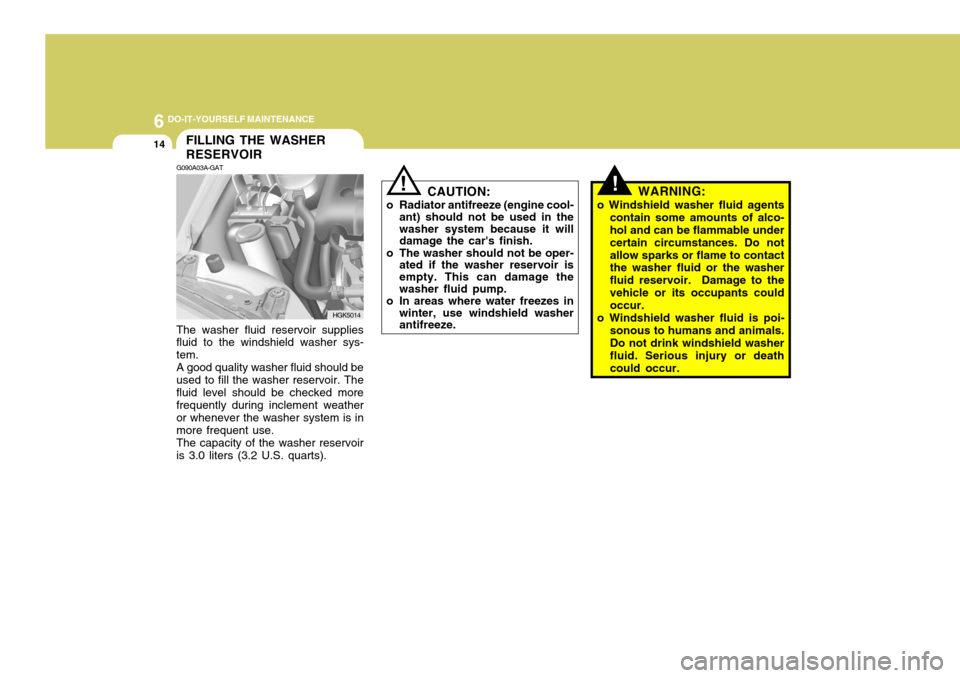
G090A03A-GAT The washer fluid reservoir supplies fluid to the windshield washer sys- tem.A good quality washer fluid should beused to fill the washer reservoir. Thefluid level should be checked more frequently during inclement weather or whenever the washer system is inmore frequent use.The capacity of the washer reservoiris 3.0 liters (3.2 U.S. quarts).FILLING THE WASHER RESERVOIR
HGK5014
!CAUTION:
o Radiator antifreeze (engine cool- ant) should not be used in the washer system because it will damage the car's finish.
o The washer should not be oper- ated if the washer reservoir is empty. This can damage the washer fluid pump.
o In areas where water freezes in winter, use windshield washerantifreeze.! WARNING:
o Windshield washer fluid agents contain some amounts of alco- hol and can be flammable under certain circumstances. Do notallow sparks or flame to contact the washer fluid or the washer fluid reservoir. Damage to thevehicle or its occupants could occur.
o Windshield washer fluid is poi- sonous to humans and animals.Do not drink windshield washer fluid. Serious injury or deathcould occur.
Page 219 of 407
6 DO-IT-YOURSELF MAINTENANCE
18
HGK5013
CHECKING THE CLUTCH FLUID
To add brake fluid, first wipe away any dirt then unscrew the fluid reservoircap. Slowly pour the recommended fluid into the reservoir. Do not overfill. Carefully replace the cap on the reser-voir and tighten. G130A01S-AAT
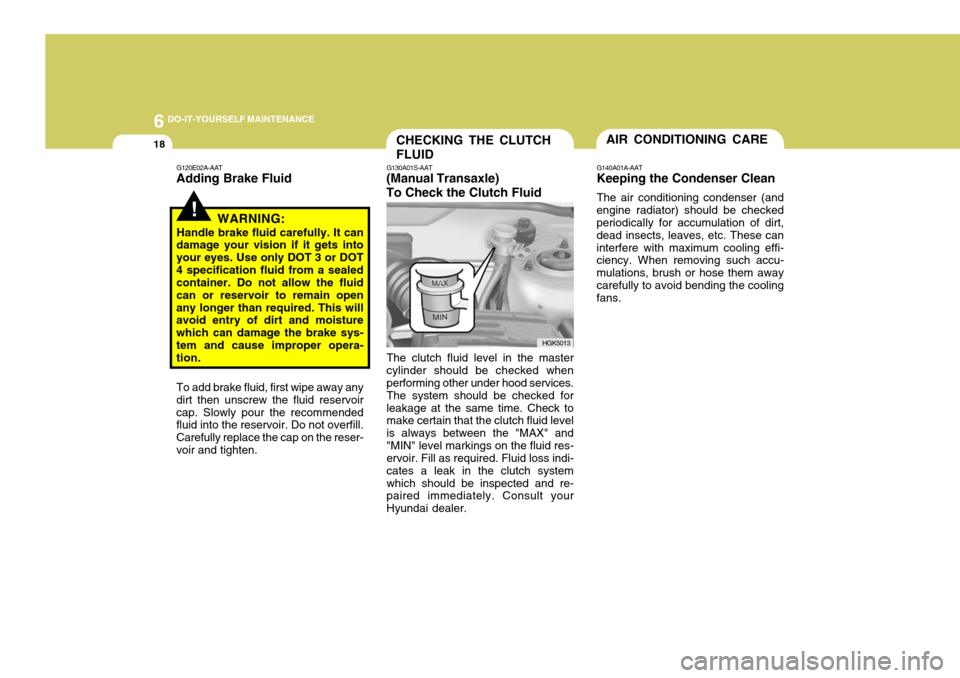
(Manual Transaxle) To Check the Clutch Fluid
!
G120E02A-AAT
Adding Brake Fluid
WARNING:
Handle brake fluid carefully. It can
damage your vision if it gets into your eyes. Use only DOT 3 or DOT4 specification fluid from a sealed container. Do not allow the fluid can or reservoir to remain openany longer than required. This will avoid entry of dirt and moisture which can damage the brake sys- tem and cause improper opera- tion. The clutch fluid level in the mastercylinder should be checked when performing other under hood services. The system should be checked forleakage at the same time. Check to make certain that the clutch fluid level is always between the "MAX" and"MIN" level markings on the fluid res- ervoir. Fill as required. Fluid loss indi- cates a leak in the clutch systemwhich should be inspected and re- paired immediately. Consult your Hyundai dealer.G140A01A-AAT
Keeping the Condenser Clean
The air conditioning condenser (and
engine radiator) should be checked periodically for accumulation of dirt, dead insects, leaves, etc. These caninterfere with maximum cooling effi- ciency. When removing such accu- mulations, brush or hose them awaycarefully to avoid bending the cooling fans. AIR CONDITIONING CARE
Page 323 of 407
3
IN CASE OF EMERGENCY
5
!
!WARNING:
Whilst the engine is running, keep hands and clothing away from mov- ing parts such as the fan and drive belts to prevent injury.
5. If the water pump drive belt is broken or coolant is leaking out, stop the engine immediately and call the near- est Hyundai authorised repairer forassistance.
WARNING:
Do not remove the radiator cap when the engine is hot since steam and boiling water may be ejected fromthe radiator resulting in burns or scalding.
!
6. If the cause of the overheating can- not be found, wait until the engine temperature has returned to normal. Then, if coolant has been lost, care- fully add coolant to the reservoir(page 6-10) to bring the fluid level in the reservoir up to the base of the radiator fill opening. Fill the coolantexpansion tank to the halfway mark. To ensure the correct water to cool- ant mix is obtained after top up,testing by an authorised repairer is required.
7. Proceed with caution until it is estab- lished that the engine is operatingnormally. If the engine overheats repeatedly, the advice of a Hyundaiauthorised repairer should be sought.
CAUTION:
Serious loss of coolant indicates there is a leak in the cooling system and this should be checked as soonas possible by a Hyundai authorised repairer.D040A01GK-EAT The following instructions for the tem- porary spare tyre should be observed:
1. Check inflation pressure as soon as practical after installing the spare tyre, and adjust to the specified pressure. The tyre pressure shouldbe periodically checked and main- tained at the specified pressure whilst the tyre is stored.
TEMPORARY SPARE TYRE
Tyre Size
Inflation Pressure T125/70 R16
420 kPa (60 psi)
Spare Tyre Pressure
2. The spare tyre should only be used temporarily and should be returned to the luggage compartment as soonas the original tyre can be repaired or replaced.
3. Continuous use at speeds of over 50 mph (80 km/h) is not recom-mended.
4. As the temporary spare tyre is spe- cifically designed for your car, itshould not be used on any other vehicle.
Page 351 of 407
6OWNER MAINTENANCE
2
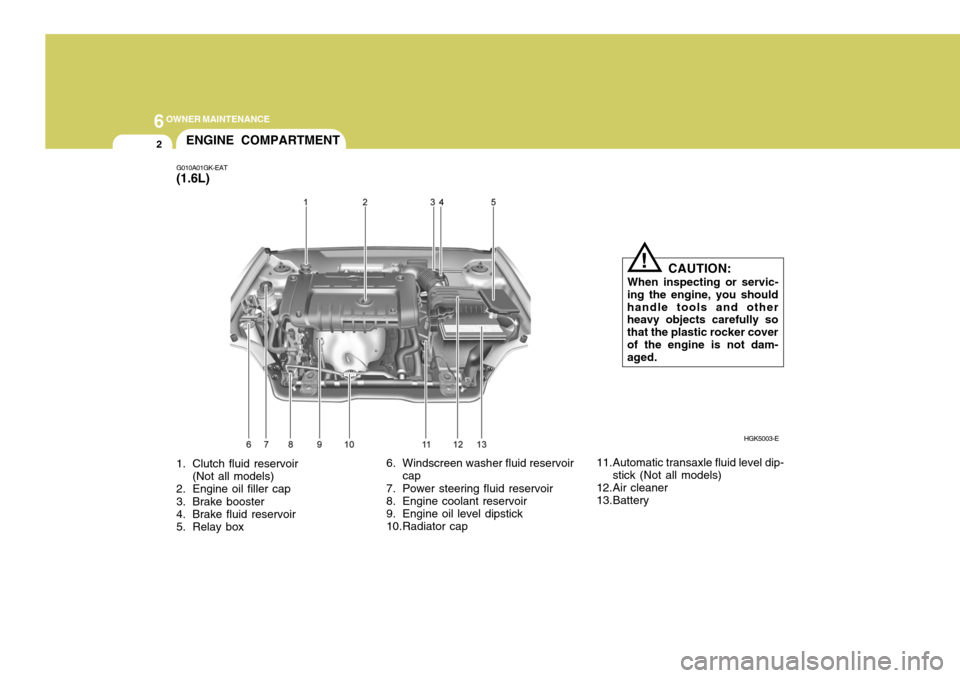
1. Clutch fluid reservoir
(Not all models)
2. Engine oil filler cap
3. Brake booster
4. Brake fluid reservoir
5. Relay box
G010A01GK-EAT (1.6L)
ENGINE COMPARTMENT
HGK5003-E
CAUTION:
When inspecting or servic-
ing the engine, you should handle tools and other heavy objects carefully so that the plastic rocker coverof the engine is not dam- aged.
!
6. Windscreen washer fluid reservoir cap
7. Power steering fluid reservoir
8. Engine coolant reservoir
9. Engine oil level dipstick
10.Radiator cap 11.Automatic transaxle fluid level dip-
stick (Not all models)
12.Air cleaner
13.Battery
Page 352 of 407
6
OWNER MAINTENANCE
3
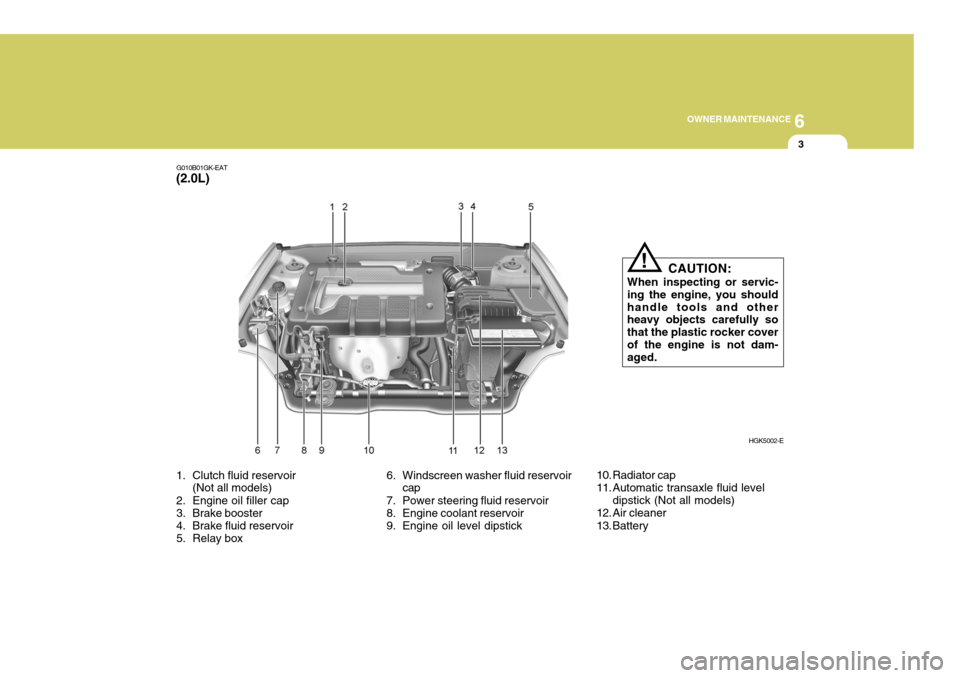
G010B01GK-EAT
(2.0L)
1. Clutch fluid reservoir (Not all models)
2. Engine oil filler cap
3. Brake booster
4. Brake fluid reservoir
5. Relay box 6. Windscreen washer fluid reservoir
cap
7. Power steering fluid reservoir
8. Engine coolant reservoir
9. Engine oil level dipstick 10. Radiator cap
11. Automatic transaxle fluid level
dipstick (Not all models)
12. Air cleaner
13. Battery CAUTION:
When inspecting or servic- ing the engine, you shouldhandle tools and other heavy objects carefully so that the plastic rocker coverof the engine is not dam- aged.
!
HGK5002-E
Page 353 of 407
6OWNER MAINTENANCE
4
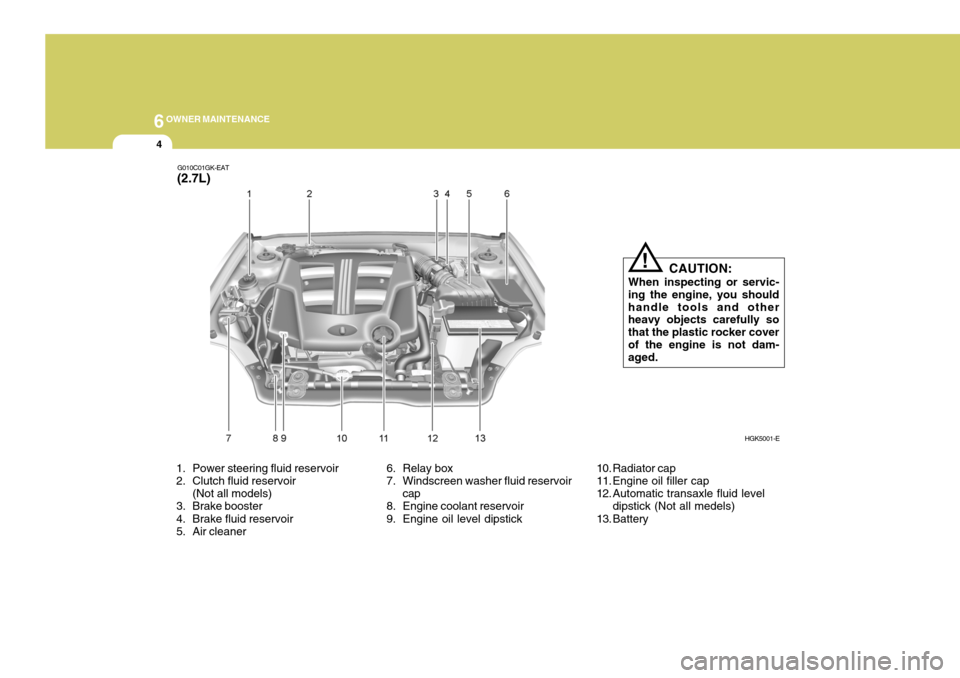
1. Power steering fluid reservoir
2. Clutch fluid reservoir(Not all models)
3. Brake booster
4. Brake fluid reservoir
5. Air cleaner 6. Relay box
7. Windscreen washer fluid reservoir
cap
8. Engine coolant reservoir
9. Engine oil level dipstick 10. Radiator cap
11. Engine oil filler cap
12. Automatic transaxle fluid level
dipstick (Not all medels)
13. Battery
G010C01GK-EAT
(2.7L)
HGK5001-E
CAUTION:
When inspecting or servic-ing the engine, you shouldhandle tools and other heavy objects carefully so that the plastic rocker coverof the engine is not dam- aged.
!
Page 356 of 407
6
OWNER MAINTENANCE
7
JMG030C2-E
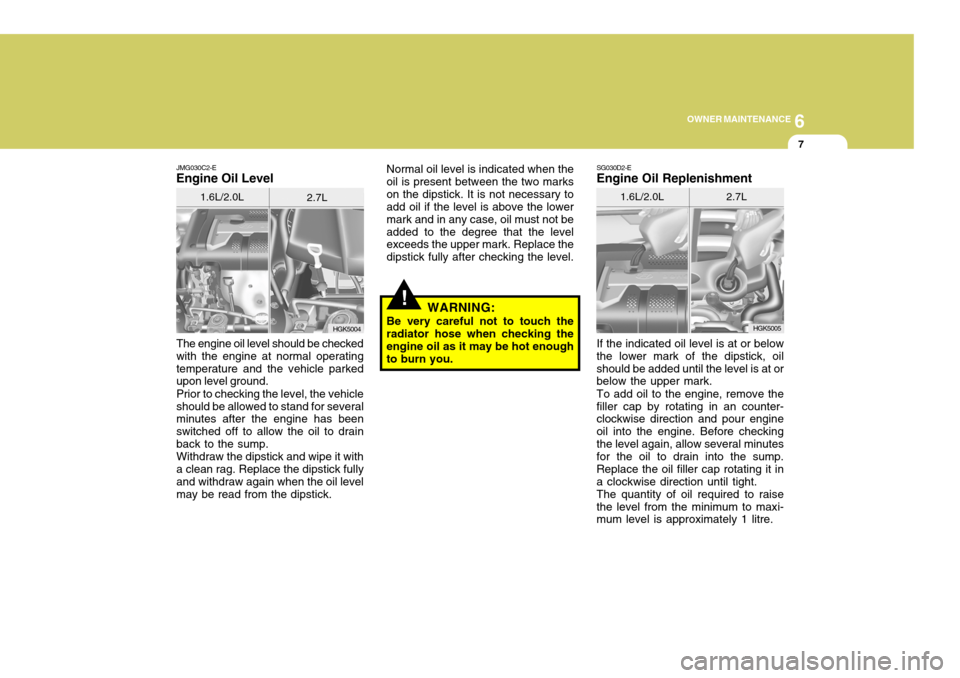
Engine Oil Level
The engine oil level should be checked with the engine at normal operatingtemperature and the vehicle parked upon level ground. Prior to checking the level, the vehicle should be allowed to stand for several minutes after the engine has been switched off to allow the oil to drainback to the sump.Withdraw the dipstick and wipe it witha clean rag. Replace the dipstick fully and withdraw again when the oil level may be read from the dipstick.
!
HGK5004
1.6L/2.0L
2.7LNormal oil level is indicated when the oil is present between the two markson the dipstick. It is not necessary to add oil if the level is above the lower mark and in any case, oil must not beadded to the degree that the level exceeds the upper mark. Replace the dipstick fully after checking the level.
WARNING:
Be very careful not to touch theradiator hose when checking the engine oil as it may be hot enough to burn you.HGK5005
SG030D2-E Engine Oil Replenishment If the indicated oil level is at or below the lower mark of the dipstick, oilshould be added until the level is at or below the upper mark. To add oil to the engine, remove the filler cap by rotating in an counter- clockwise direction and pour engine oil into the engine. Before checkingthe level again, allow several minutes for the oil to drain into the sump. Replace the oil filler cap rotating it ina clockwise direction until tight.The quantity of oil required to raisethe level from the minimum to maxi- mum level is approximately 1 litre. 1.6L/2.0L
2.7L
Page 358 of 407
6
OWNER MAINTENANCE
9
!
ENGINE COOLANT CHECKING AND REPLACING
SG050A1-E
WARNING:
Do not remove the radiator cap
when the engine is hot, since the system is pressurised and coolant may be ejected from the radiator resulting in scalding. NOTE: It is imperative that vehicles fitted with an air conditioning systemhave a coolant concentration of the recommended strength at all times. The use of the air condition-ing system when the cooling sys- tem is filled with water only will result in the heater matrix freezingand subsequently bursting.
SG050B1-E
Coolant recommendations
Only ethylene glycol based coolantwith a corrosion inhibitor suited to aluminium alloy engine components should be used in the cooling system.No further additives or inhibitors should be used. The coolant specific gravity should be checked as pre-scribed in the maintenance schedule to ensure adequate frost and corro- sion protection. In addition, the en-gine coolant must be replaced at the specified interval since the corrosion inhibitor properties deteriorate withtime.It is important to note that whilst anincrease in the concentration of anti freeze gives an increase in the level of frost protection, a solution which isin excess of 65% anti freeze will result in reduced frost protection and engine overheating. Therefore therecommended concentration of 50% should not be exceeded for general use. The use of methanol based anti freeze compounds may result in engine over- heating and will invalidate the vehiclewarranty.
Page 359 of 407
6OWNER MAINTENANCE
10
HGK4006
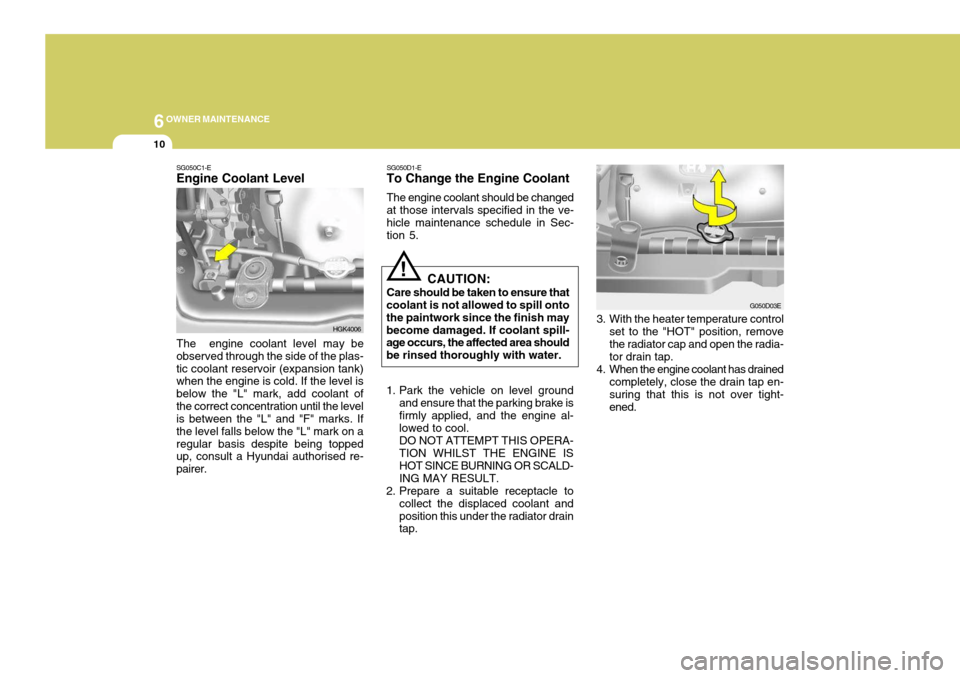
SG050C1-E Engine Coolant Level
The engine coolant level may be
observed through the side of the plas- tic coolant reservoir (expansion tank) when the engine is cold. If the level is below the "L" mark, add coolant ofthe correct concentration until the level is between the "L" and "F" marks. If the level falls below the "L" mark on aregular basis despite being topped up, consult a Hyundai authorised re- pairer. SG050D1-E To Change the Engine Coolant The engine coolant should be changed at those intervals specified in the ve- hicle maintenance schedule in Sec- tion 5.
3. With the heater temperature controlset to the "HOT" position, removethe radiator cap and open the radia- tor drain tap.
4. When the engine coolant has drained completely, close the drain tap en- suring that this is not over tight-ened. G050D03E
CAUTION:
Care should be taken to ensure that
coolant is not allowed to spill ontothe paintwork since the finish maybecome damaged. If coolant spill- age occurs, the affected area should be rinsed thoroughly with water.
!
1. Park the vehicle on level ground and ensure that the parking brake is firmly applied, and the engine al- lowed to cool. DO NOT ATTEMPT THIS OPERA- TION WHILST THE ENGINE IS HOT SINCE BURNING OR SCALD-ING MAY RESULT.
2. Prepare a suitable receptacle to
collect the displaced coolant andposition this under the radiator drain tap.
Page 360 of 407
6
OWNER MAINTENANCE
11CHANGING THE AIR CLEANER FILTER
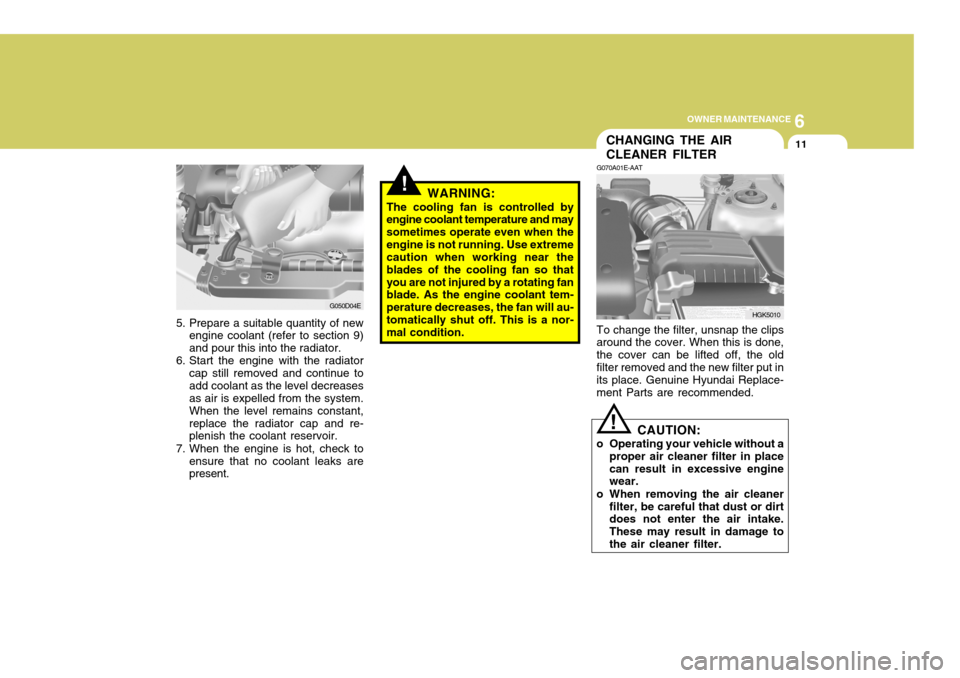
G070A01E-AAT To change the filter, unsnap the clips around the cover. When this is done, the cover can be lifted off, the oldfilter removed and the new filter put in its place. Genuine Hyundai Replace- ment Parts are recommended.
HGK5010
! CAUTION:
o Operating your vehicle without a proper air cleaner filter in place can result in excessive engine wear.
o When removing the air cleaner filter, be careful that dust or dirtdoes not enter the air intake. These may result in damage tothe air cleaner filter.
G050D04E
!WARNING:
The cooling fan is controlled by engine coolant temperature and may sometimes operate even when theengine is not running. Use extreme caution when working near the blades of the cooling fan so thatyou are not injured by a rotating fan blade. As the engine coolant tem- perature decreases, the fan will au-tomatically shut off. This is a nor- mal condition.
5. Prepare a suitable quantity of new
engine coolant (refer to section 9) and pour this into the radiator.
6. Start the engine with the radiator
cap still removed and continue toadd coolant as the level decreases as air is expelled from the system. When the level remains constant,replace the radiator cap and re- plenish the coolant reservoir.
7. When the engine is hot, check to ensure that no coolant leaks arepresent.