heating Hyundai Coupe 2008 Owner's Guide
[x] Cancel search | Manufacturer: HYUNDAI, Model Year: 2008, Model line: Coupe, Model: Hyundai Coupe 2008Pages: 407, PDF Size: 11.03 MB
Page 168 of 407

2
DRIVING YOUR HYUNDAI
25
CAUTION:
If overheating should occur when towing, (temperature gauge readsnear red zone), taking the following action may reduce or eliminate the problem.
1. Turn off the air conditioner.
2. Reduce highway speed.
3. Select a lower gear when going uphill.
4. While in stop and go traffic, place the gear selector in park or neu- tral and idle the engine at a higher speed.
!
Page 172 of 407
3 WHAT TO DO IN AN EMERGENCY
4
!
booster battery. Then attach the other end of that cable to a solid metal partof the engine away from the battery. Do not connect the cable to any moving part.
4. Start the engine in the car with the booster battery and let it run for afew minutes. This will help to as-sure that the booster battery is fully charged. During the jumping opera- tion, run the engine in this vehicle atabout 2000 rpm.
5. Start the engine in the car with the
discharged battery using the nor-mal starting procedure. After the engine starts, leave the jumper cables connected and let the enginerun at fast idle or about 2000 rpm for several minutes.
6. carefully remove the jumper cables in the reverse order of attachment.
If you do not know why your battery became discharged (because the lights were left on, etc.), have the charging system checked by your Hyundaidealer. D030A02A-AAT If your temperature gauge indicates overheating, you experience a loss of power, or hear loud pinging or knock- ing, the engine is probably too hot. Ifthis happens to you, you should:
1. Pull off the road and stop as soon as
it is safe to do so.
2. Place the gear selector lever in "P"
(automatic), or neutral (manual transaxle) and set the parking brake. If the air conditioning is on, turn it off.
3. If engine coolant is running out un- der the car or steam is coming outfrom the hood, stop the engine. Donot open the hood until the engine coolant has stopped running or the steaming has stopped. If there is novisible loss of engine coolant and no steam, leave the engine running and check to be sure the enginecooling fan is operating. If the fan is not running, turn the engine off.
IF THE ENGINE OVERHEATS
4. Check to see if the water pump drivebelt is missing. If it is not missing, check to see that it is tight. If the drive belt seems to be satisfactory, check for engine coolant leakingfrom the radiator, hoses or under the car. (If the air conditioning had been in use, it is normal for coldwater to be draining from it when you stop).
WARNING:
While the engine is running, keephair, hands, and clothing away from moving parts such as the fan anddrive belts to prevent injury.
5. If the water pump drive belt is broken or engine coolant is leaking out, stop the engine immediately and call thenearest Hyundai dealer for assis- tance.
Page 173 of 407
3
WHAT TO DO IN AN EMERGENCY
5
!
!
!WARNING:
Do not remove the radiator cap when the engine is hot. This can allow coolant to be blown out of the open- ing and cause serious burns.
6. If you cannot find the cause of the overheating, wait until the engine temperature has returned to nor- mal. Then, if the engine coolant has been lost, carefully add coolant tothe reservoir (page 6-10) to bring the fluid level in the reservoir up to the halfway mark.
7. Proceed with caution, keeping alert for further signs of overheating. Ifoverheating happens again, call aHyundai dealer for assistance.
CAUTION:
Serious loss of engine coolant indi-cates there is a leak in the cooling system and this should be checked as soon as possible by a Hyundaidealer. D040A01GK-GAT Temporary Spare Tire The following instructions for the tem- porary spare tire should be observed:
1. Check inflation pressure as soon as
practical after installing the spare tire, and adjust to the specified pres- sure. The tire pressure should be periodically checked and maintainedat the specified pressure while the tire is stored. 5. The temporary spare tire should not
be used on any other wheels, nor should standard tires, snow tires, wheel covers or trim rings be used with the temporary spare wheel. Ifsuch use is attempted, damage to these items or other car compo- nents may occur.
6. The temporary spare tire pressure should be checked once a monthwhile the tire is stored.
Tire Size
Inflation Pressure T125/70R 16
420 kPa (60 psi)
Spare Tire Pressure
2. The spare tire should only be used temporarily and should be returned to the luggage compartment as soon as the original tire can be repaired or replaced.
3. Continuous use at speeds of over 80 km/h (50 mph) is not recom-mended.
4. As the temporary spare tire is spe- cifically designed for your car, itshould not be used on any othervehicle. CAUTION:
o Do not use snow chains with your temporary spare tire.
o Do not use more than one tempo-
rary spare tire at a time.
SPARE TIRE
D040A01TG-AAT Full Size Spare Tire (If Installed) The following instructions for the FULL SIZE spare tire should be observed: Check inflation pressure as soon as practical after installing the spare tire,and adjust to the specified pressure.The tire pressure should be periodicallychecked and maintained at the speci-fied pressure while the tire is stored.
Page 206 of 407
6
DO-IT-YOURSELF MAINTENANCE
5
G020B01A-AAT
Vehicle Exterior
The following should be checked
monthly:
o Overall appearance and condition
o Wheel condition and wheel nut
torque
o Exhaust system condition
o Light condition and operation
o Windshield glass condition
o Wiper blade condition
o Paint condition and body corrosion
o Fluid leaks
o Door and hood lock condition
o Tire pressure and condition (in- cluding spare tire) G020C01A-AAT
Vehicle Interior
The following should be checked each time when the vehicle is driven:
o Lights operation
o Windshield wiper operation
o Horn operation
o Defroster, heating system opera- tion (and air conditioning, if installed)
o Steering operation and condition
o Mirror condition and operation
o Turn signal operation
o Accelerator pedal operation
o Brake operation, including parking
brake
o Manual transaxle operation, includ-
ing clutch operation
o Automatic transaxle operation, in- cluding "Park" mechanism opera-tion
o Seat control condition and opera-
tion
o Seat belt condition and operation
o Sunvisor operation
If you notice anything that does notoperate correctly or appears to be functioning incorrectly, inspect it care- fully and seek assistance from yourHyundai dealer if service is needed.
G020A01A-AAT
Engine Compartment
The following should be checked regu-larly:
o Engine oil level and condition
o Transaxle fluid level and condition
o Brake fluid level
o Clutch fluid level
o Engine coolant level
o Windshield washer fluid level
o Accessory drive belt condition
o Engine Coolant hose condition
o Fluid leaks (on or below compo- nents)
o Power steering fluid level
o Battery condition
o Air filter condition GENERAL CHECKS
Page 257 of 407

10
INDEX
3
Driving Economical driving .................................................. 2-16
Smooth corneri ng ..................................................... 2-17
Winter driving ........................................................... 2-17
E Electronic Stability Program (ESP) ............................2-13
Emissions Control Systems ........................................ 7-2 Engine Before starting the engine ........................................ 2-3
Changing the oil and filter ......................................... 6-6Compartment (1.6L, 2.0L, 2.7L) ................................ 6-2
Coolant ..................................................................... 6-9
Coolant temperature gauge ......................................1-50
If the engine overheats ............................................. 3-4
Number ..................................................................... 8-2
Oil ............................................................................. 6-6Oil consumption ........................................................ 6-8
Starting ..................................................................... 2-5
Engine Exhaust Can Be Dangerous ............................ 2-2
FFog Light .................................................................... 1-62
Front Seats Adjustable front seats .............................................. 1-13
Adjustable headrests ............................................... 1-14
Adjusting seat forward and rearward ........................ 1-13
Adjusting seatback angle ........................................ 1-14
Lumbar support control ............................................ 1-16
Seat cushion height adjustment .............................. 1-16Seat warmer
............................................................ 1-16
Fuel Capacity ................................................................... 9-2
Gauge ...................................................................... 1-49
Recommendations .................................................... 1-2
Fuel Filler Lid Remote release ....................................................... 1-76
Fuse Panel Description .............................................. 6-37
Fuses ......................................................................... 6-21
G
General Everyday Checks ..... ...................................... 6-5
Glove box ................................................................... 1-71
H Hazard Warning System ............................................. 1-62
Headlight Leveling Device S ystem .............................1-66
Heating and Air Conditioning Control Rotary type .............................................................. 1-87
Automatic type ........................................................ 1-96
High-mounted rear stoplight .. ......................................1-74
Hood Release ............................................................. 1-75
Horn ............................................................................ 1-80
I Ignition Switch ............................................................. 2-4
Immobilizer System ..................................................... 1-4
Instrument Cluster and Indicator Lights ...................... 1-42
Instrument Panel Light Control (Rheostat) .................. 1-64
Intermittent Wiper ....................................................... 1-61
Page 258 of 407

10INDEX
4
J Jump Starting .............................................................. 3-3
KKeys ............................................................................ 1-4
If you lose y our keys .............................................. 3-15
Positions ................................................................... 2-3
L
Light Bulb Replacement .............................................. 6-27
Lubrication Chart .......................................................... 9-4
Luggage Net ............................................................... 1-80
M Maintenance Intervals Explanation of scheduled maintenance items
................................................................................. 5-8
Maintenance under severe usage conditions ............ 5-7
Scheduled maintenance ............................................ 5-4
Service requirements ................................................ 5-2
Map Light .................................................................... 1-70
Mirros
Day-night inside rearview ......................................... 1-73
Outside rearview folding ............... ...........................1-72
Outsde rearview heating ....... ...................................1-72
Multi gauge ................................................................. 1-54
OOdometer .................................................................... 1-51PParking
Brake ............................................................. 1-73
Power Steering Fluid Level ......................................... 6-25
RRear Seats Before Folding the Rear Seats ................................ 1-18
Fold down ................................................................ 1-19
Rear seat entry ........................................................ 1-17
Rear Seat Positions ................................................ 1-18
Rear Window Defroster Switch ................................... 1-63
Rear Window Wiper and Washer Switch ....................1-61
SSeat Belts 3-Point type ............................................................. 1-23
Adjustable height ..................................................... 1-23
Adjusting your seat belt ........................................... 1-24
Care of seat belts .................................................... 1-22
Precautions .............................................................. 1-20
Pre-tentioner Seat Belt ............................................ 1-31
Spectacle C ase .......................................................... 1-70
Speedometer ............................................................... 1-50
Starting Pr ocedures..................................................... 2-5
Steering Wheel Tilt lever ............................................ 1-80
Stereo Radio Operation (H280, H265, H465)
........................................................ 1-107, 1-116, 1-121
Stereo Sound System .............................................. 1-105
Sun Visor .................................................................... 1-79
Sunroof ....................................................................... 1-67
Page 268 of 407
F9
CAUTION:
When installing a container of liquid air freshener inside the vehicle, do not place it near the instrument cluster nor on the instrument panel surface. If there is any leakage from the air freshener onto these areas (Instrument cluster, instrument panel or air ventilator), it may damage these parts. If the liquid from the air freshener does leak onto these areas, wash themwith water immediately.
!
1. Passenger's Air Bag (Not all models)
2. Rear Fog Light Switch
3. Outside Temperature Switch
4. Hazard Warning Switch
5. Digital Clock
6. Front Fog Light Switch
7. Windscreen Wiper/Washer Switch
8. Horn and Driver's Airbag
9. Ignition Switch
10. Multi-Function Light Switch
11. Glove Box
12. Cigar Lighter
13. Front Seat Warmer (Not all models)
14. Shift Lever
15. Parking Brake Lever
16. Ashtray
17. Heating/Air Conditioning Control Panel
18. Steering Wheel Tilt Lever
19. Bonnet Release Lever
20. Fuse and Relay Box
Page 270 of 407
1FEATURES OF YOUR HYUNDAI
82HEATING AND COOLING CONTROL
B710A02GK-EAT
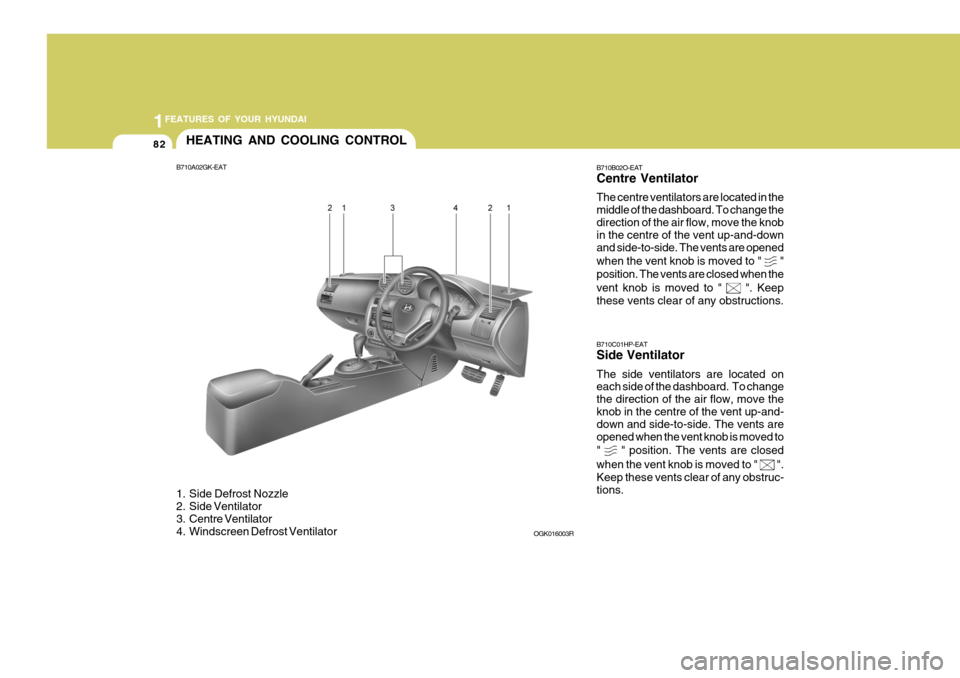
1. Side Defrost Nozzle
2. Side Ventilator
3. Centre Ventilator
4. Windscreen Defrost Ventilator OGK016003R
B710B02O-EAT Centre Ventilator The centre ventilators are located in the middle of the dashboard. To change thedirection of the air flow, move the knob in the centre of the vent up-and-down and side-to-side. The vents are opened when the vent knob is moved to "
"
position. The vents are closed when the vent knob is moved to "
". Keep
these vents clear of any obstructions. B710C01HP-EAT Side Ventilator The side ventilators are located on each side of the dashboard. To change the direction of the air flow, move theknob in the centre of the vent up-and- down and side-to-side. The vents are opened when the vent knob is moved to "
" position. The vents are closed
when the vent knob is moved to "
".
Keep these vents clear of any obstruc- tions.
Page 271 of 407
1
FEATURES OF YOUR HYUNDAI
83HEATING AND VENTILATION
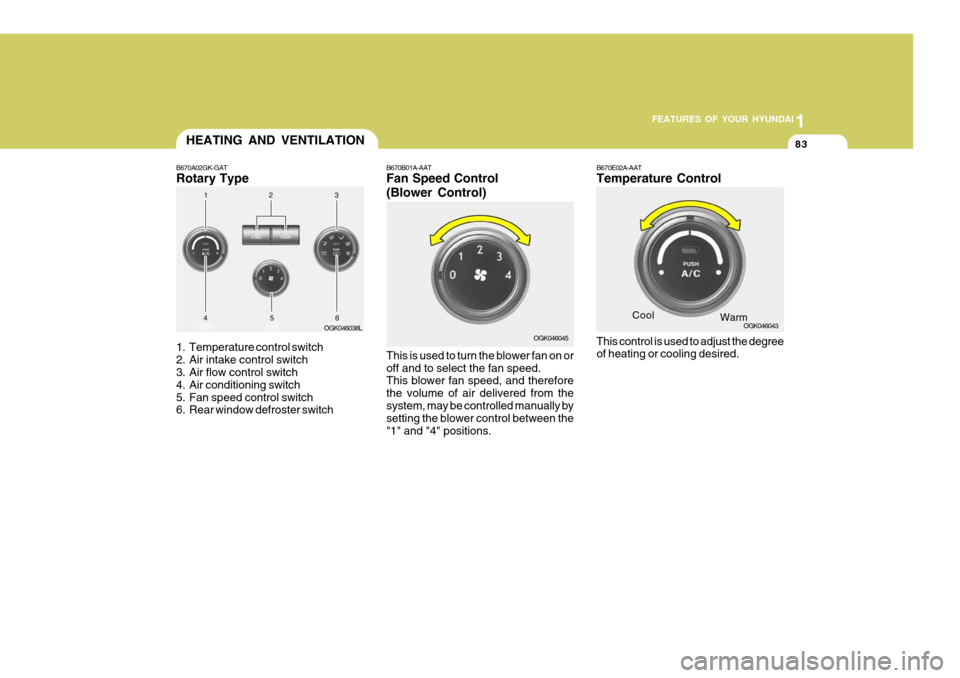
B670A02GK-GAT Rotary Type
1. Temperature control switch
2. Air intake control switch
3. Air flow control switch
4. Air conditioning switch
5. Fan speed control switch
6. Rear window defroster switch B670B01A-AAT Fan Speed Control (Blower Control) This is used to turn the blower fan on or off and to select the fan speed. This blower fan speed, and therefore the volume of air delivered from thesystem, may be controlled manually by setting the blower control between the "1" and "4" positions.B670E02A-AAT Temperature Control This control is used to adjust the degree of heating or cooling desired.
Cool
OGK046038L OGK046045 OGK046043
Warm
Page 272 of 407
1FEATURES OF YOUR HYUNDAI
84
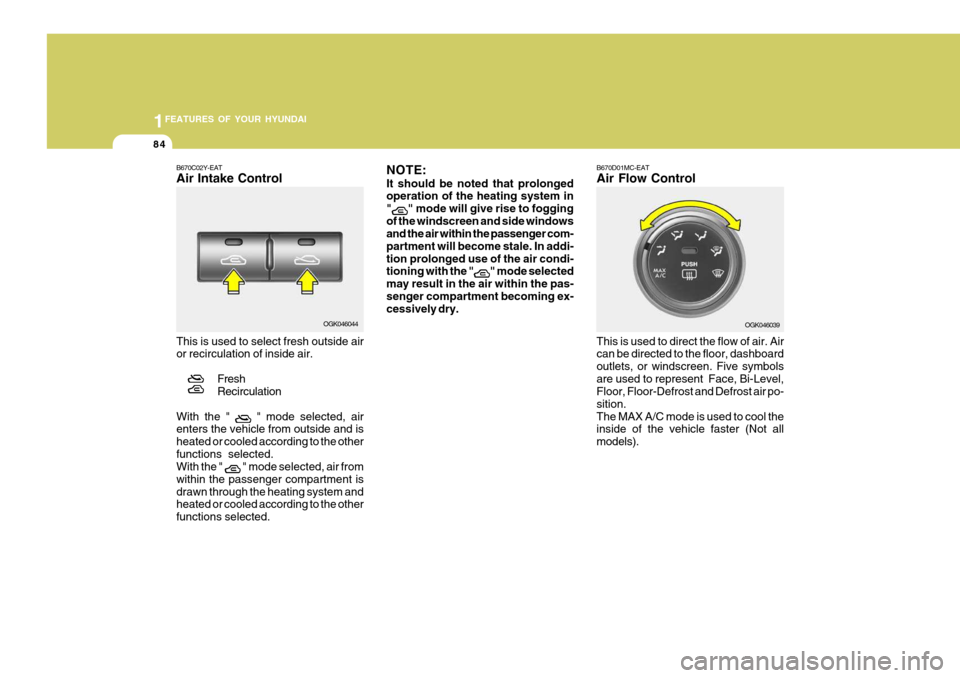
B670D01MC-EAT Air Flow Control This is used to direct the flow of air. Air can be directed to the floor, dashboard outlets, or windscreen. Five symbolsare used to represent Face, Bi-Level, Floor, Floor-Defrost and Defrost air po- sition.The MAX A/C mode is used to cool the inside of the vehicle faster (Not all models). OGK046039B670C02Y-EAT Air Intake Control This is used to select fresh outside air or recirculation of inside air.
FreshRecirculation
With the "
" mode selected, air
enters the vehicle from outside and is heated or cooled according to the otherfunctions selected. With the "
" mode selected, air from
within the passenger compartment is drawn through the heating system and heated or cooled according to the other functions selected. NOTE: It should be noted that prolonged operation of the heating system in "
" mode will give rise to fogging
of the windscreen and side windows and the air within the passenger com- partment will become stale. In addi-tion prolonged use of the air condi- tioning with the "
" mode selected
may result in the air within the pas- senger compartment becoming ex- cessively dry.
OGK046044