cooling Hyundai Coupe 2008 Owner's Guide
[x] Cancel search | Manufacturer: HYUNDAI, Model Year: 2008, Model line: Coupe, Model: Hyundai Coupe 2008Pages: 407, PDF Size: 11.03 MB
Page 281 of 407
1
FEATURES OF YOUR HYUNDAI
93
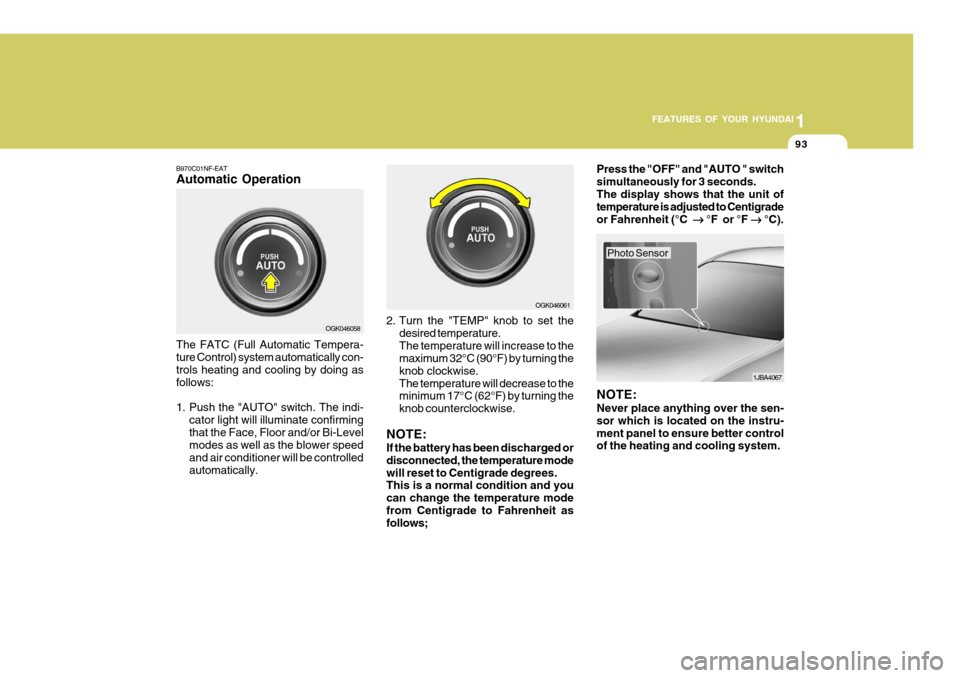
B970C01NF-EAT Automatic Operation The FATC (Full Automatic Tempera- ture Control) system automatically con- trols heating and cooling by doing as follows:
1. Push the "AUTO" switch. The indi-
cator light will illuminate confirming that the Face, Floor and/or Bi-Level modes as well as the blower speed and air conditioner will be controlledautomatically. 2. Turn the "TEMP" knob to set the
desired temperature.The temperature will increase to the maximum 32°C (90°F) by turning the knob clockwise.The temperature will decrease to the minimum 17°C (62°F) by turning the knob counterclockwise.
NOTE: If the battery has been discharged or disconnected, the temperature modewill reset to Centigrade degrees. This is a normal condition and you can change the temperature modefrom Centigrade to Fahrenheit as follows; Press the "OFF" and "AUTO " switch simultaneously for 3 seconds.The display shows that the unit of temperature is adjusted to Centigrade or Fahrenheit (°C
°F or °F
°C).
OGK046058 OGK046061
1JBA4067
NOTE: Never place anything over the sen- sor which is located on the instru-ment panel to ensure better control of the heating and cooling system.
Photo Sensor
Page 282 of 407
1FEATURES OF YOUR HYUNDAI
94
B980A01Y-AAT MANUAL OPERATION The heating and cooling system can be controlled manually as well by pushingbuttons other than the "AUTO" button. In this state, the system sequentially works according to the order of buttonsselected. The function of the buttons which are not selected will be controlled automati-cally. Press the "AUTO" button in order to convert to automatic control of the sys-tem.
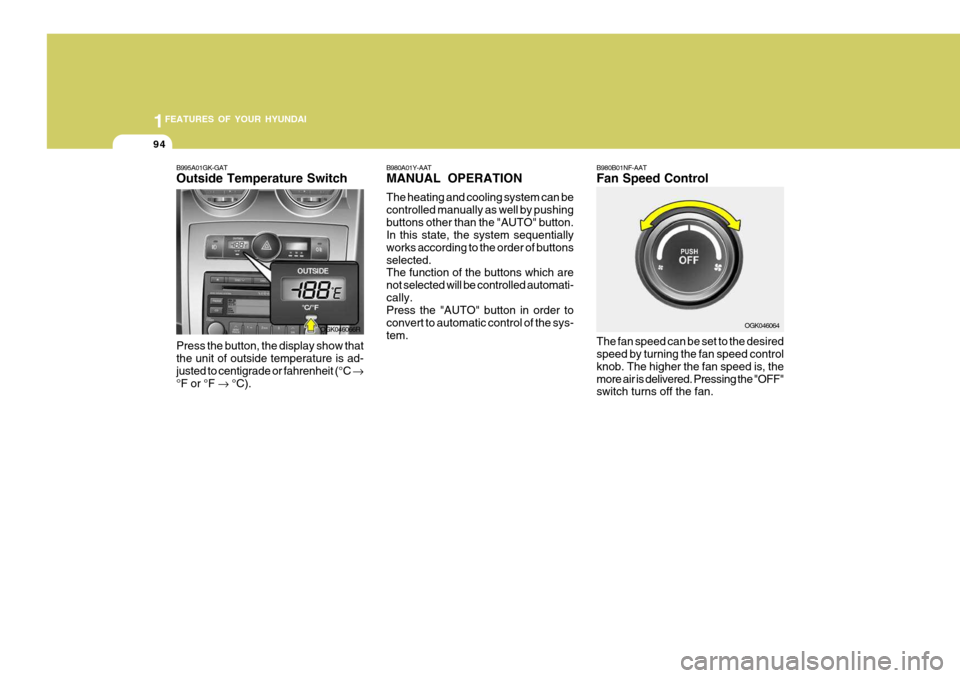
B995A01GK-GAT Outside Temperature Switch Press the button, the display show that the unit of outside temperature is ad- justed to centigrade or fahrenheit (°C
°F or °F °C). OGK046066RB980B01NF-AAT Fan Speed Control The fan speed can be set to the desired speed by turning the fan speed control knob. The higher the fan speed is, themore air is delivered. Pressing the "OFF" switch turns off the fan. OGK046064
Page 284 of 407
1FEATURES OF YOUR HYUNDAI
96
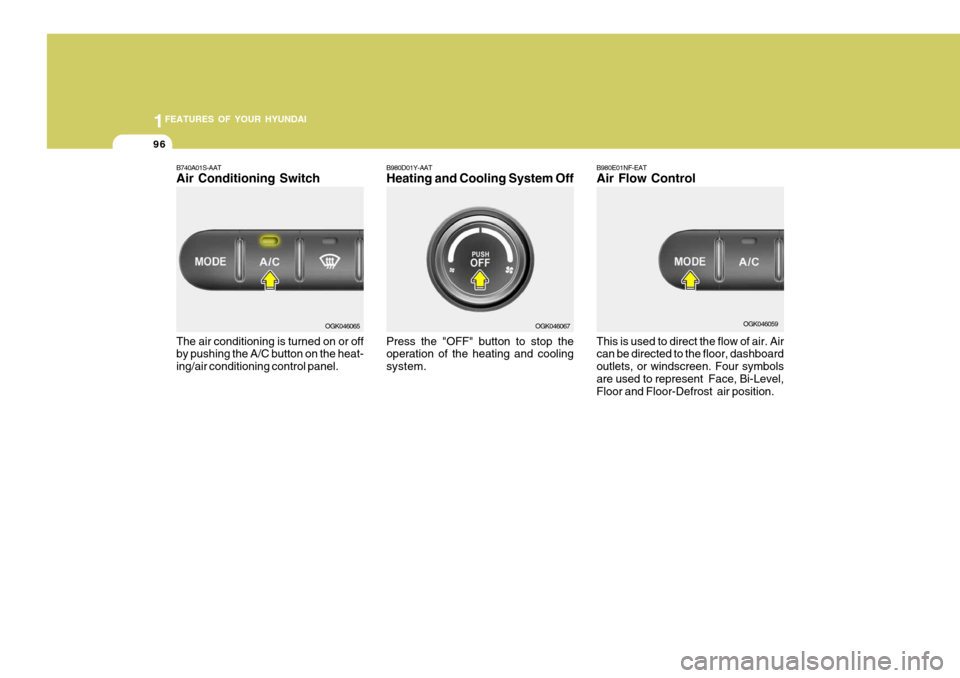
B980D01Y-AAT Heating and Cooling System Off B980E01NF-EATAir Flow Control This is used to direct the flow of air. Air can be directed to the floor, dashboard outlets, or windscreen. Four symbolsare used to represent Face, Bi-Level, Floor and Floor-Defrost air position.OGK046059B740A01S-AAT Air Conditioning Switch The air conditioning is turned on or off by pushing the A/C button on the heat- ing/air conditioning control panel.
OGK046065
Press the "OFF" button to stop the operation of the heating and cooling system.
OGK046067
Page 312 of 407
2
DRIVING YOUR HYUNDAI
19
ZC170C1-E Anti-freeze/Corrosion inhibitor The cooling system must always con- tain an Ethylene-Glycol based anti-freeze solution. The system is filled during manufacture with solution of the correct strength which should bechecked before the onset of winter and adjusted or changed as required. NOTE: The anti-freeze solution contains a corrosion inhibitor to prevent degra- dation of the aluminium castingscontained within the engine. There- fore, never, drain the system and refill with water only. In addition, anti-freeze solution must ALWAYS be used in vehicles fitted withair conditioning, to prevent the heater matrix from freezing and subsequently bursting with the refrigeration system inuse.WINTER MOTORING
DC170A1-E The onset of winter conditions subject motor vehicles to greater operating de- mands. Therefore, the following sug- gestions will assist in maintaining peakperformance and reliability during these periods: ZC170B1-E Electrical System Winter conditions impose severe de- mands upon vehicle electrical systems,particularly the charging circuit. The battery condition and performance along with the alternator performance anddrive belt condition should be checked prior to the onset of winter. ZC170D1-E Door Locks Should the door lock mechanism be- come frozen, a proprietary lock de-icershould be used. Alternatively, warming the door key may thaw the door lock. However, the key should be handledcarefully to avoid burning the fingers. Never attempt to thaw a frozen door lock using hot water, since the waterwill eventually freeze and compound the problem. NOTE: The proper temperature for using the immobiliser key is from -40°C to 80°C (-40°F to 176°F). If you heat theimmobiliser key over 80°C (176°F) to open the frozen lock, it may cause damage to the transponder in itshead.
Page 322 of 407
3 IN CASE OF EMERGENCY
4
7. Switch "ON" the main beam
headlamps before carefully remov- ing the jumper cables have been removed, switch "OFF" the main beam headlamps. SD040A2-E If the temperature gauge indicates overheating:
1. Pull off the road and stop as soon as
it is safe to do so.
2. Place the gear selector lever in "P"
(automatic), or neutral (manual transaxle) and set the parking brake. If the air conditioning is on, turn it off.
3. If coolant is running out under the car or steam is coming out fromunder the bonnet stop the engine. Do not open the bonnet until thecoolant has stopped running or the steaming has stopped. If there is no visible loss of coolant and no steam,leave the engine running and check to be sure the engine cooling fan is operating.If the fan is not running, turn the engine off.
4. Check to see if the water pump drive belt is broken. If it is not missing,check to see that it is tight. If the drive belt seems to be satisfactory,check for coolant leaking from the radiator, hoses or under the car. (If the air conditioning had been in use,it is normal for cold water to be draining from it).
IF THE ENGINE OVERHEATS
1. Ensure that the booster battery is 12 volt type. If the booster battery is installed in another vehicle, ensure that the two vehicles are not touch- ing.
2. Turn off all unnecessary electrical equipment in both vehicles.
3. Ensure that the engine of the ve- hicle providing the jump start is run- ning prior to connection of the jump cables.
4. Connect the red jump cable to the positive (+) terminal of the boosterbattery and the other end to thepositive (+) terminal of the dis- charged battery.
5. Attach the black jump cable to the negative (-) terminal of the boosterbattery, and the other end to a ground point within the engine compartmentof the vehicle with the flat battery. Do not connect to the negative battery terminal of the flat battery sincesparks may be generated with the subsequent risk of explosion.
6. Raise the booster vehicle engine speed to 2,000 r.p.m. and start theengine of the vehicle with the flat battery. CAUTION:
If the jump cables are incorrectlyinstalled, damage to the vehicle elec-trical system may occur, in particu- lar the electronic components such as the Fuel Injection system com- puter and the Automatic Transaxle computer. The battery must neverbe disconnected whilst the engine is running.
!
Page 323 of 407
3
IN CASE OF EMERGENCY
5
!
!WARNING:
Whilst the engine is running, keep hands and clothing away from mov- ing parts such as the fan and drive belts to prevent injury.
5. If the water pump drive belt is broken or coolant is leaking out, stop the engine immediately and call the near- est Hyundai authorised repairer forassistance.
WARNING:
Do not remove the radiator cap when the engine is hot since steam and boiling water may be ejected fromthe radiator resulting in burns or scalding.
!
6. If the cause of the overheating can- not be found, wait until the engine temperature has returned to normal. Then, if coolant has been lost, care- fully add coolant to the reservoir(page 6-10) to bring the fluid level in the reservoir up to the base of the radiator fill opening. Fill the coolantexpansion tank to the halfway mark. To ensure the correct water to cool- ant mix is obtained after top up,testing by an authorised repairer is required.
7. Proceed with caution until it is estab- lished that the engine is operatingnormally. If the engine overheats repeatedly, the advice of a Hyundaiauthorised repairer should be sought.
CAUTION:
Serious loss of coolant indicates there is a leak in the cooling system and this should be checked as soonas possible by a Hyundai authorised repairer.D040A01GK-EAT The following instructions for the tem- porary spare tyre should be observed:
1. Check inflation pressure as soon as practical after installing the spare tyre, and adjust to the specified pressure. The tyre pressure shouldbe periodically checked and main- tained at the specified pressure whilst the tyre is stored.
TEMPORARY SPARE TYRE
Tyre Size
Inflation Pressure T125/70 R16
420 kPa (60 psi)
Spare Tyre Pressure
2. The spare tyre should only be used temporarily and should be returned to the luggage compartment as soonas the original tyre can be repaired or replaced.
3. Continuous use at speeds of over 50 mph (80 km/h) is not recom-mended.
4. As the temporary spare tyre is spe- cifically designed for your car, itshould not be used on any other vehicle.
Page 344 of 407

5VEHICLE MAINTENANCE REQUIREMENTS
6
NO.1 2345 6 789
1011 12 1314151617 18 192021 DESCRIPTION
GENERAL MAINTENANCECOOLING SYSTEM COOLANT COOLANT SPECIFIC GRAVITYMANUAL TRANSAXLE OILAUTOMATIC TRANSAXLE FLUIDBRAKE PIPES, HOSES, AND CONNECTIONSBRAKE FLUID CLUTCH FLUID REAR BRAKE LININGS AND CYLINDERSBRAKE PADSSUSPENSION AND STEERING SYSTEMFRONT SUSPENSION BALL JOINTSCLIMATE CONTROL AIR FILTER (IN FRONT OF BLOWER UNIT) REAR WHEEL BEARINGS TYRE CONDITION AND PRESSURE (incl. Spare)LUBRICATE LOCKS AND HINGESCHECK ALL ELECTRICAL SYSTEMSROAD TESTCHECK ALL SYSTEMS WITH HI-SCAN CHECK 4 GAS DRIVE SHAFT & BOOT
F030C05GK-EAT R : Replace I : Inspect and, after inspection, clean, adjust, repair or replace if necessary
60 72
I I I
R
I
RR IIII
R I I IIIII I
50 60
I I IIIII I II
R
I I IIIII I
40 48
I I III
RR IIII
R I I IIIII I
30 36
I I IIIII I II
R I I IIIII I
20 24
I I III
RR IIII
R I I IIIII I
10 12
I I IIIII I II
R
I I IIIII I
MILES X 1000 MONTHS
NOTE : (1) FOR THE FIRST TIME, REPLACE THE COOLANT AT 62,500 MILES OR 60 MONTHS.
AFTER THAT, REPLACE IT EVERY 25,000 MILES OR 24 MONTHS.
* FOR YOUR CONVENIENCE, IT CAN BE REPLACED PRIOR TO IT'S INTERVAL WHEN YOU DO MAINTENANCE OF OTHER ITEMS. See Note (1)*
Page 347 of 407

5
VEHICLE MAINTENANCE REQUIREMENTS
9
6ZF060F2-A
o Crankcase ventilation hoses
Inspect the surface of hoses for evi- dence of heat and/or mechanical dam- age. Hard and brittle rubber, cracking, tears, cuts, abrasions, and excessiveswelling indicate deterioration. Particu- lar attention should be paid to examin- ing those hose surfaces nearest tohigh heat sources, such as the ex- haust manifold. Inspect the hose routing to assure that the hoses do not come in contact with any heat source, sharp edges or mov-ing component which might cause heat damage or mechanical wear. Inspect all hose connections, such as clampsand couplings, to make sure they are secure, and that no leaks are present. Hoses should be replaced immedi-ately if there is any evidence of dete- rioration or damage. 6ZF060H1-A
o Air cleaner filter
A Genuine Hyundai air cleaner filter is
recommended when the filter is re-placed.
6ZF060J1-A
o Spark plugs
Make sure to install new spark plugs
of the correct heat range.
F060N02E-AAT
o Valve clearance
Inspect excessive valve noise and/or
engine vibration and adjust if neces- sary. A qualified technician should perform the operation. 6ZF070B1-A
o Cooling system Check the cooling system part, such as radiator, coolant reservoir, hoses and connections for leakage and dam- age. Replace any damaged parts. 6ZF070C1-A
o Coolant The coolant should be changed at the intervals specified in the mainte-nance schedule. 6ZF070D1-A
o Manual transaxle oil Inspect the manual transaxle oil ac- cording to the maintenance schedule. NOTE: If the oil level is low, check for possible leaks before adding oil. Do not overfill.
Page 350 of 407
6
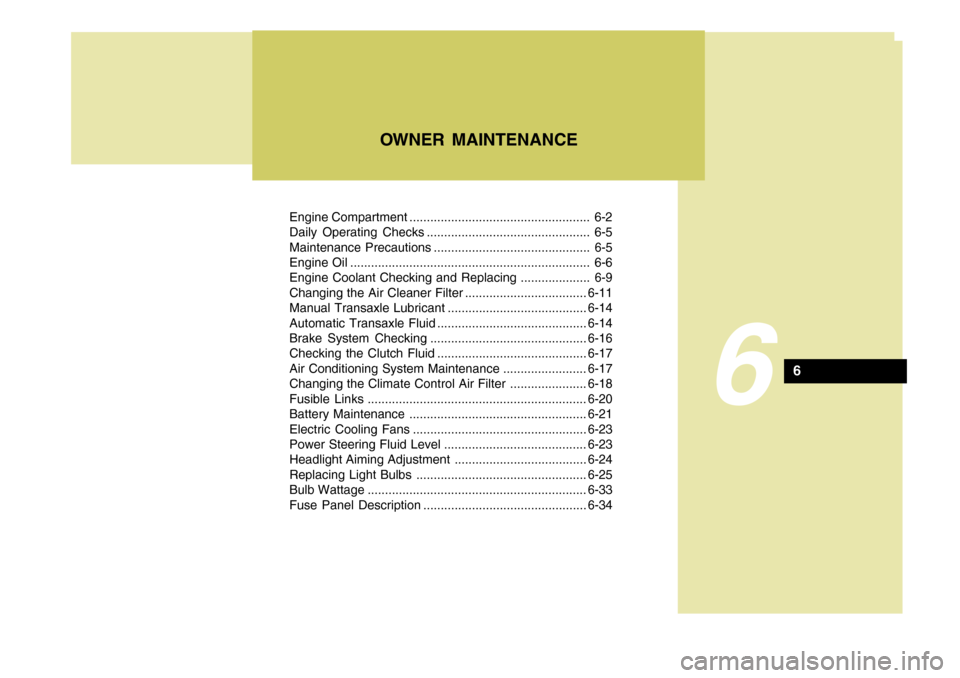
Engine Compartment .................................................... 6-2
Daily Operating Checks ............................................... 6-5
Maintenance Precautions ............................................. 6-5
Engine Oil ..................................................................... 6-6
Engine Coolant Checking and Replacing .................... 6-9
Changing the Air Cleaner Filter ...................................6-11
Manual Transaxle Lubricant .................... ....................6-14
Automatic Transaxle Fluid ........................................... 6-14
Brake System Checking ............................................. 6-16
Checking the Clutch Fluid ........................................... 6-17
Air Conditioning System Maintenance ........................ 6-17
Changing the Climate Control Air Filter .. ....................6-18
Fusible Links ............................................................... 6-20
Battery Mai ntenance ................................................... 6-21
Electric Cooling Fans .................................................. 6-23
Power Steering Fluid Level ......................................... 6-23
Headlight Aiming Adjustment ...................................... 6-24
Replacing Light Bulbs ................................................. 6-25
Bulb Wattage ............................................................... 6-33
Fuse Panel D escription ............................................... 6-34
OWNER MAINTENANCE
6
Page 354 of 407
6
OWNER MAINTENANCE
5
SG020B1-E The following items should be checked on a daily basis or whenever the vehicle is refuelled, whichever occurssooner.
o Engine oil level.
o Engine coolant level.
o Power steering fluid level.
o Brake fluid level.
o Windscreen washer fluid level.
o Battery condition.
o Tyre condition and pressures.
o Operation and cleanliness of all lighting equipment.
o Windscreen wiper and washer op-
eration.
o Horn operation.
o Warning lamp operation.
o Adjustment and cleanliness of mir- rors.
o Seat and seat belt adjustment and operation.
o Fluid leakage.
The vehicle must not be driven if the daily operating checks indicate that any item of equipment related to the safety or roadworthiness of the ve-hicle is not functioning correctly. DAILY OPERATING CHECKS
MAINTENANCE PRECAU- TIONS
!
G020D01TG-EAT Improper or incomplete service may result in problems. This section gives instructions only for the maintenanceitems that are easy to perform.Several procedures should be done byHyundai authorised repairer. NOTE: Improper owner maintenance dur- ing the warranty period may affectwarranty coverage.
WARNING:
o Performing maintenance work on a vehicle can be dangerous. You can be seriously injured whilst performing some maintenanceprocedures. If you lack sufficient knowledge and experience or the proper tools and equipment to dothe work, have it done by Hyundai authorised repairer.
o Working under the bonnet with the engine running is dangerous. It becomes even more dangerouswhen you wear jewellery or loose clothing. These can become en- tangled in moving parts and re-sult in injury. Therefore, if you must run the engine whilst work- ing under the bonnet, make cer-tain that you remove all jewellery (especially rings, bracelets, watches, and necklaces) and allneckties, scarves, and similar loose clothing before getting near the engine or cooling fans.