wheel Hyundai Coupe 2008 Owner's Guide
[x] Cancel search | Manufacturer: HYUNDAI, Model Year: 2008, Model line: Coupe, Model: Hyundai Coupe 2008Pages: 407, PDF Size: 11.03 MB
Page 201 of 407

5
VEHICLE MAINTENANCE REQUIREMENTS
11
F070M01A-AAT
o Steering Gear Box, Linkage &
Boots/Lower Arm Ball Joint
With the vehicle stopped and engine off, check for excessive free-play in the steering wheel. Check the linkage for bends or damage. Check the dustboots and ball joints for deterioration, cracks, or damage. Replace any dam- aged parts. F070N01A-AAT
o Power Steering Pump, Belt
and Hoses
Check the power steering pump and hoses for leakage and damage. Re- place any damaged or leaking partsimmediately. Inspect the power steer- ing belt for evidence of cuts, cracks, excessive wear, oiliness and propertension. Replace or adjust it if neces- sary. F070P01A-AAT
o Drive Shafts and Boots
Check the drive shafts, boots and
clamps for cracks, deterioration, ordamage. Replace any damaged parts and, if necessary, repack the grease.
F070Q01A-AAT
o Air Conditioning Refrigerant
Check the air conditioning lines and
connections for leakage and damage. Check air conditioning performance according to the relevant shop manualif necessary.
Page 206 of 407
6
DO-IT-YOURSELF MAINTENANCE
5
G020B01A-AAT
Vehicle Exterior
The following should be checked
monthly:
o Overall appearance and condition
o Wheel condition and wheel nut
torque
o Exhaust system condition
o Light condition and operation
o Windshield glass condition
o Wiper blade condition
o Paint condition and body corrosion
o Fluid leaks
o Door and hood lock condition
o Tire pressure and condition (in- cluding spare tire) G020C01A-AAT
Vehicle Interior
The following should be checked each time when the vehicle is driven:
o Lights operation
o Windshield wiper operation
o Horn operation
o Defroster, heating system opera- tion (and air conditioning, if installed)
o Steering operation and condition
o Mirror condition and operation
o Turn signal operation
o Accelerator pedal operation
o Brake operation, including parking
brake
o Manual transaxle operation, includ-
ing clutch operation
o Automatic transaxle operation, in- cluding "Park" mechanism opera-tion
o Seat control condition and opera-
tion
o Seat belt condition and operation
o Sunvisor operation
If you notice anything that does notoperate correctly or appears to be functioning incorrectly, inspect it care- fully and seek assistance from yourHyundai dealer if service is needed.
G020A01A-AAT
Engine Compartment
The following should be checked regu-larly:
o Engine oil level and condition
o Transaxle fluid level and condition
o Brake fluid level
o Clutch fluid level
o Engine coolant level
o Windshield washer fluid level
o Accessory drive belt condition
o Engine Coolant hose condition
o Fluid leaks (on or below compo- nents)
o Power steering fluid level
o Battery condition
o Air filter condition GENERAL CHECKS
Page 248 of 407
8CONSUMER INFORMATION
4
!
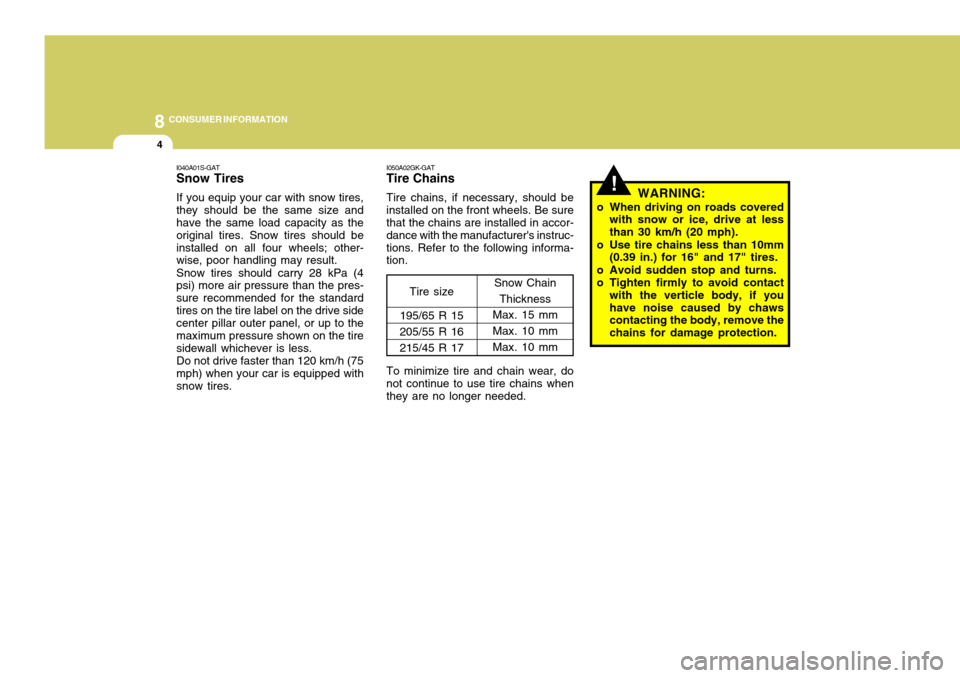
I050A02GK-GAT Tire Chains Tire chains, if necessary, should be installed on the front wheels. Be sure that the chains are installed in accor- dance with the manufacturer's instruc-tions. Refer to the following informa- tion. To minimize tire and chain wear, do not continue to use tire chains when they are no longer needed. WARNING:
o When driving on roads covered with snow or ice, drive at lessthan 30 km/h (20 mph).
o Use tire chains less than 10mm (0.39 in.) for 16" and 17" tires.
o Avoid sudden stop and turns.
o Tighten firmly to avoid contact with the verticle body, if youhave noise caused by chaws contacting the body, remove the chains for damage protection.
Tire size
195/65 R 15 205/55 R 16 215/45 R 17 Snow Chain
Thickness
Max. 15 mmMax. 10 mm Max. 10 mmI040A01S-GAT Snow Tires If you equip your car with snow tires, they should be the same size and have the same load capacity as the original tires. Snow tires should beinstalled on all four wheels; other- wise, poor handling may result. Snow tires should carry 28 kPa (4 psi) more air pressure than the pres- sure recommended for the standardtires on the tire label on the drive side center pillar outer panel, or up to the maximum pressure shown on the tiresidewall whichever is less.Do not drive faster than 120 km/h (75mph) when your car is equipped withsnow tires.
Page 249 of 407
8
CONSUMER INFORMATION
5
HGK5016
!
!
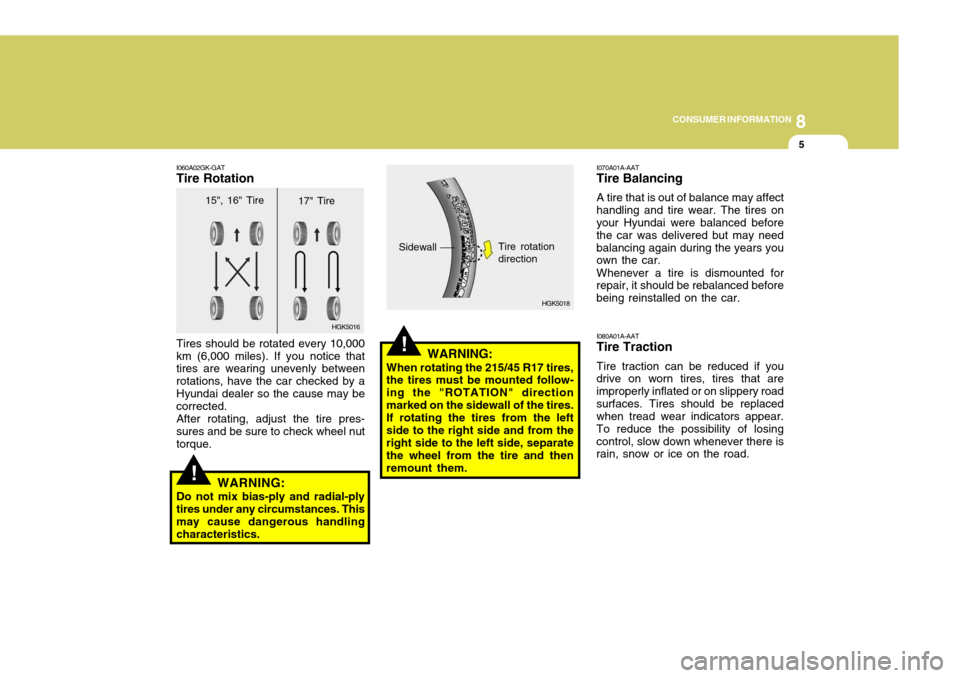
I060A02GK-GAT Tire Rotation Tires should be rotated every 10,000 km (6,000 miles). If you notice that tires are wearing unevenly between rotations, have the car checked by aHyundai dealer so the cause may be corrected. After rotating, adjust the tire pres- sures and be sure to check wheel nut torque. WARNING:
When rotating the 215/45 R17 tires, the tires must be mounted follow- ing the "ROTATION" directionmarked on the sidewall of the tires.If rotating the tires from the leftside to the right side and from theright side to the left side, separate the wheel from the tire and then remount them.
WARNING:
Do not mix bias-ply and radial-ply tires under any circumstances. This may cause dangerous handlingcharacteristics. 15", 16" Tire
Sidewall I070A01A-AAT
Tire Balancing
A tire that is out of balance may affect
handling and tire wear. The tires on your Hyundai were balanced before the car was delivered but may needbalancing again during the years you own the car.
Whenever a tire is dismounted for
repair, it should be rebalanced before being reinstalled on the car.
I080A01A-AAT
Tire Traction
Tire traction can be reduced if you
drive on worn tires, tires that areimproperly inflated or on slippery roadsurfaces. Tires should be replaced when tread wear indicators appear. To reduce the possibility of losingcontrol, slow down whenever there is rain, snow or ice on the road.
HGK5018
17" Tire
Tire rotation direction
Page 250 of 407
8CONSUMER INFORMATION
6
!WARNING:
o Driving on worn-out tires is dan- gerous! Worn-out tires can cause loss of braking effectiveness, steer-ing control and traction. When re- placing tires, never mix radial and bias-ply tires on the same car. Ifyou replace radial tires with bias- ply tires, they must be installed in sets of four.
o Using tires and wheels of other than the recommended sizes maycause unusual handling charac- teristics that may cause death, serious injury or property dam-age.
o Tires degrade over time, even when
they are not being used. Regard- less of the remaining tread, it is recommended that tires generallybe replaced after six (6) years of normal service. Heat caused by hot climates or frequent high load-ing conditions can accelerate the aging process. Failure to follow this warning can result in suddentire failure, which could lead to a loss of control and an accident involving serious injury or death. I100A01FC-GAT
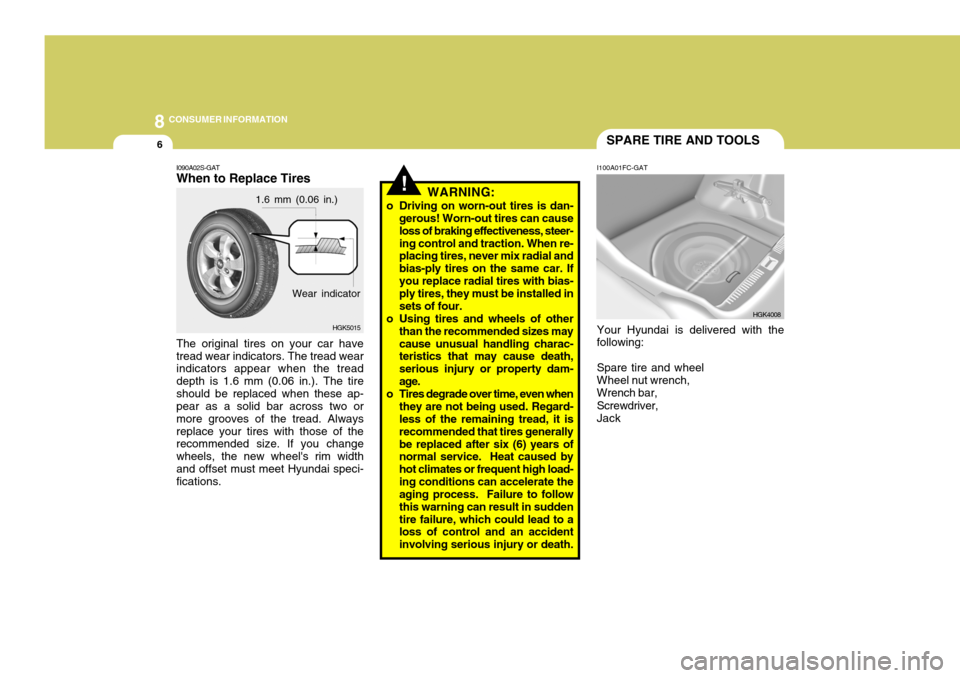
SPARE TIRE AND TOOLS
Your Hyundai is delivered with the following: Spare tire and wheel Wheel nut wrench, Wrench bar, Screwdriver, Jack HGK4008
I090A02S-GAT When to Replace Tires The original tires on your car have tread wear indicators. The tread wear indicators appear when the tread depth is 1.6 mm (0.06 in.). The tireshould be replaced when these ap- pear as a solid bar across two or more grooves of the tread. Alwaysreplace your tires with those of the recommended size. If you change wheels, the new wheel's rim widthand offset must meet Hyundai speci- fications. HGK5015
1.6 mm (0.06 in.)
Wear indicator
Page 252 of 407

9 VEHICLE SPECIFICATIONS
2
4395(173)
1760(69.3) 1330(52.4)2530(99.6) 1490(58.7) 1510(59.5)1500(59.1)
J010A02GK-GAT MEASUREMENT
Overall length Overall widthOverall height (unladen) Wheel base Wheel tread
195/65 R15 205/55 R16215/45 R17
Type Wheel free playRack stroke Oil pump type Rack and pinion0 ~ 30 mm (0 ~ 1.18 in.) 132 mm (5.20 in.)Vane type
J060A01F-AAT FUEL SYSTEM
J020A01GK-GATPOWER STEERING J030A02GK-GAT TIRE
Option
mm (in.)
Fuel tank
capacity Imp.gal
12
195/65 R15, 205/55 R16, 215/45 R17
J050A01GK-GAT BRAKE Dual hydraulic with brake booster Ventilated disc Solid disc Cable
TypeFront brake type Rear brake type Parking brake
US.gal
14.5Liter55
J035A02GK-GAT SPARE TIRE
Standard Option T125/70 R16 (Temporary)
Full size
Front RearFront Rear FrontRear
Page 258 of 407

10INDEX
4
J Jump Starting .............................................................. 3-3
KKeys ............................................................................ 1-4
If you lose y our keys .............................................. 3-15
Positions ................................................................... 2-3
L
Light Bulb Replacement .............................................. 6-27
Lubrication Chart .......................................................... 9-4
Luggage Net ............................................................... 1-80
M Maintenance Intervals Explanation of scheduled maintenance items
................................................................................. 5-8
Maintenance under severe usage conditions ............ 5-7
Scheduled maintenance ............................................ 5-4
Service requirements ................................................ 5-2
Map Light .................................................................... 1-70
Mirros
Day-night inside rearview ......................................... 1-73
Outside rearview folding ............... ...........................1-72
Outsde rearview heating ....... ...................................1-72
Multi gauge ................................................................. 1-54
OOdometer .................................................................... 1-51PParking
Brake ............................................................. 1-73
Power Steering Fluid Level ......................................... 6-25
RRear Seats Before Folding the Rear Seats ................................ 1-18
Fold down ................................................................ 1-19
Rear seat entry ........................................................ 1-17
Rear Seat Positions ................................................ 1-18
Rear Window Defroster Switch ................................... 1-63
Rear Window Wiper and Washer Switch ....................1-61
SSeat Belts 3-Point type ............................................................. 1-23
Adjustable height ..................................................... 1-23
Adjusting your seat belt ........................................... 1-24
Care of seat belts .................................................... 1-22
Precautions .............................................................. 1-20
Pre-tentioner Seat Belt ............................................ 1-31
Spectacle C ase .......................................................... 1-70
Speedometer ............................................................... 1-50
Starting Pr ocedures..................................................... 2-5
Steering Wheel Tilt lever ............................................ 1-80
Stereo Radio Operation (H280, H265, H465)
........................................................ 1-107, 1-116, 1-121
Stereo Sound System .............................................. 1-105
Sun Visor .................................................................... 1-79
Sunroof ....................................................................... 1-67
Page 268 of 407
F9
CAUTION:
When installing a container of liquid air freshener inside the vehicle, do not place it near the instrument cluster nor on the instrument panel surface. If there is any leakage from the air freshener onto these areas (Instrument cluster, instrument panel or air ventilator), it may damage these parts. If the liquid from the air freshener does leak onto these areas, wash themwith water immediately.
!
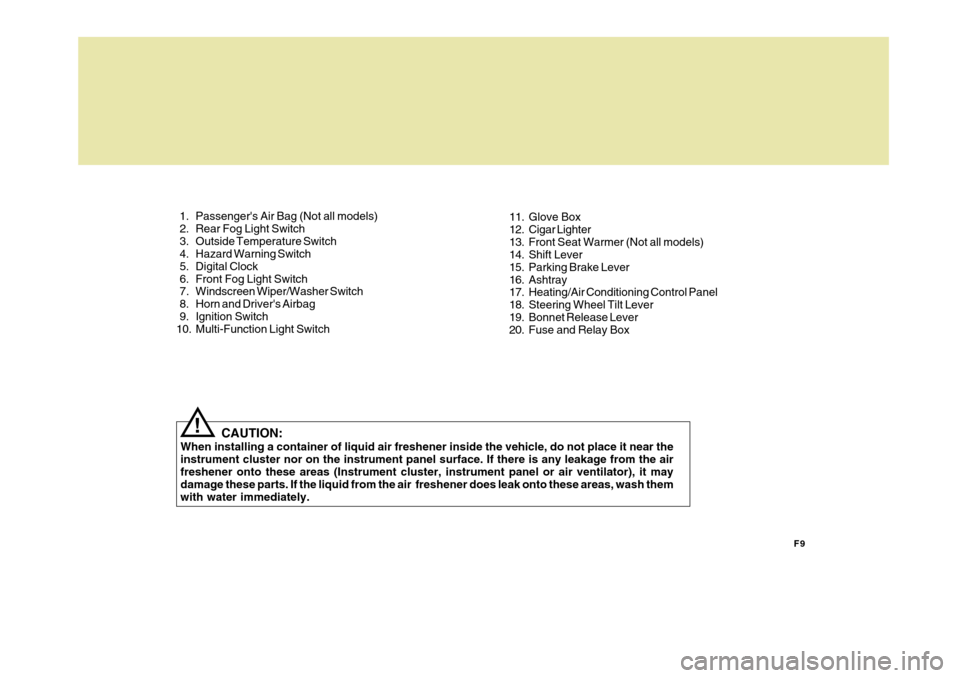
1. Passenger's Air Bag (Not all models)
2. Rear Fog Light Switch
3. Outside Temperature Switch
4. Hazard Warning Switch
5. Digital Clock
6. Front Fog Light Switch
7. Windscreen Wiper/Washer Switch
8. Horn and Driver's Airbag
9. Ignition Switch
10. Multi-Function Light Switch
11. Glove Box
12. Cigar Lighter
13. Front Seat Warmer (Not all models)
14. Shift Lever
15. Parking Brake Lever
16. Ashtray
17. Heating/Air Conditioning Control Panel
18. Steering Wheel Tilt Lever
19. Bonnet Release Lever
20. Fuse and Relay Box
Page 297 of 407
2DRIVING YOUR HYUNDAI
4KEY POSITIONS
!
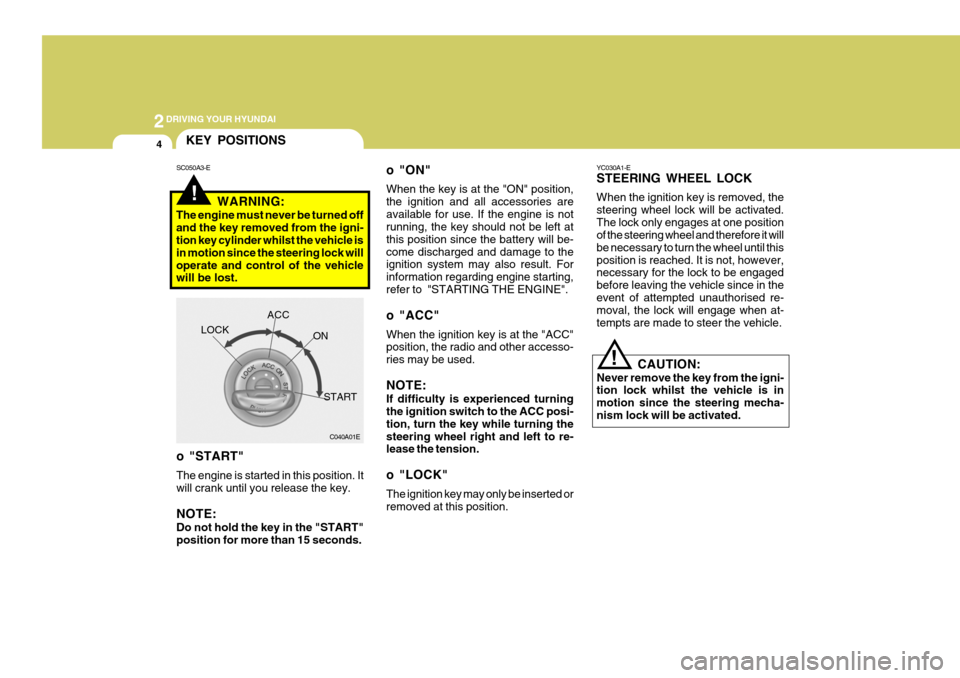
o "ON" When the key is at the "ON" position, the ignition and all accessories areavailable for use. If the engine is not running, the key should not be left at this position since the battery will be-come discharged and damage to the ignition system may also result. For information regarding engine starting,refer to "STARTING THE ENGINE".
o "ACC" When the ignition key is at the "ACC" position, the radio and other accesso- ries may be used. NOTE: If difficulty is experienced turning the ignition switch to the ACC posi- tion, turn the key while turning thesteering wheel right and left to re- lease the tension.
o "LOCK" The ignition key may only be inserted or removed at this position.
SC050A3-E
WARNING:
The engine must never be turned offand the key removed from the igni- tion key cylinder whilst the vehicle is in motion since the steering lock willoperate and control of the vehicle will be lost.
C040A01E
LOCK
ACC
ON
START
o "START" The engine is started in this position. It will crank until you release the key. NOTE: Do not hold the key in the "START" position for more than 15 seconds. YC030A1-E STEERING WHEEL LOCK When the ignition key is removed, the steering wheel lock will be activated.The lock only engages at one position of the steering wheel and therefore it will be necessary to turn the wheel until thisposition is reached. It is not, however, necessary for the lock to be engaged before leaving the vehicle since in theevent of attempted unauthorised re- moval, the lock will engage when at- tempts are made to steer the vehicle.
!
CAUTION:
Never remove the key from the igni- tion lock whilst the vehicle is in motion since the steering mecha-nism lock will be activated.
Page 301 of 407
2DRIVING YOUR HYUNDAI
8
o If you've come to a complete stopand it's hard to shift into 1st or R(Reverse), put the gearshift lever in N(Neutral) position and let upon the clutch. Press the clutch pedal back down, and then shift into 1st or R(Reverse) gear posi-tion.
o Do not use the gearshift lever as a
handrest during driving, as thiscan result in premature wear of the transaxle shift forks.
o Do not downshift more than 2 gears at once or when the engine isrunning at high speed (5,000 RPM or higher). Such downshifting maydamage the engine.
C070B01A-EAT Using the Clutch The clutch should be pressed all the way to the floor before shifting, thenreleased slowly. The clutch pedal should always be used after fully returning to the original position. Do not rest yourfoot on the clutch pedal whilst driving. This can cause unnecessary wear. Do not partially engage the clutch tohold the car on an incline. This causes unnecessary wear. Use the parking brake to hold the car onan incline. Do not operate the clutch pedal rapidly and repeatedly.
!WARNING:
o Avoid high cornering speeds.
o Do not make quick steering wheel movements, such as sharp lane changes or fast, sharp turns.
o Always wear your seat belts.
In a collision crash, an unbeltedperson is significantly more likely to die than a person wearing aseat belt.
o The risk of rollover is greatly in-
creased if you lose control of your vehicle at motorway speeds.
o Loss of control often occurs if two
or more wheels drop off the road-way and the driver oversteers to reenter the roadway.
o In the event your vehicle leaves the roadway, do not steer sharply.Instead, slow down before pullingback into the travel lanes.
o Never exceed posted speed limits.
!WARNING:
If your vehicle has a manual transaxle not equipped with a ignition lock switch, it may move and cause aserious accident when starting the engine without depressing the clutch pedal while the parking brake is re-leased and the shift never not in the N(Neutral) position.