lock Hyundai Coupe 2008 Manual Online
[x] Cancel search | Manufacturer: HYUNDAI, Model Year: 2008, Model line: Coupe, Model: Hyundai Coupe 2008Pages: 407, PDF Size: 11.03 MB
Page 308 of 407
2
DRIVING YOUR HYUNDAI
15
!WARNING:
ABS (ESP) will not prevent accidents due to improper or dangerous driv- ing manoeuvres. Even though ve- hicle control is improved duringemergency braking, always main- tain a safe distance between you and objects ahead. Vehicle speedsshould always be reduced during extreme road conditions. The braking distance for carsequipped with an anti-lock braking system (Electronic Stability Program) may be longer than for those without it, in the following road conditions. These roads should be driven atreduced speeds.
o Rough, gravel or snow-covered roads.
o With tyre chains installed.
o On roads where the road surface
is pitted or has different surface height.
The safety features of an ABS (ESP)equipped vehicle should not be tested by high speed driving or cornering.This could endanger the safety of yourself or others.
!
!
ELECTRONIC STABILITY PROGRAM (ESP)
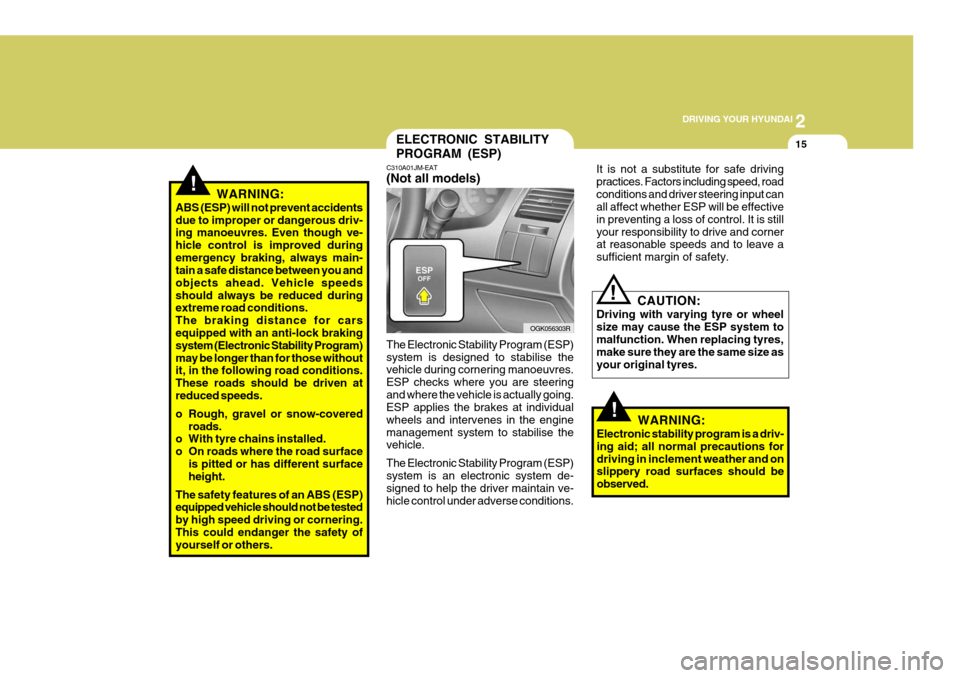
C310A01JM-EAT (Not all models) It is not a substitute for safe driving practices. Factors including speed, roadconditions and driver steering input can all affect whether ESP will be effective in preventing a loss of control. It is stillyour responsibility to drive and corner at reasonable speeds and to leave a sufficient margin of safety.
The Electronic Stability Program (ESP)system is designed to stabilise the vehicle during cornering manoeuvres. ESP checks where you are steeringand where the vehicle is actually going. ESP applies the brakes at individual wheels and intervenes in the enginemanagement system to stabilise the vehicle. The Electronic Stability Program (ESP) system is an electronic system de- signed to help the driver maintain ve-hicle control under adverse conditions.
OGK056303R CAUTION:
Driving with varying tyre or wheel size may cause the ESP system to malfunction. When replacing tyres, make sure they are the same size asyour original tyres.
WARNING:
Electronic stability program is a driv-ing aid; all normal precautions fordriving in inclement weather and on slippery road surfaces should be observed.
Page 310 of 407

2
DRIVING YOUR HYUNDAI
17
o Apply the parking brake only when the vehicle is at rest.
o Since the power assistance provided by the brake servo is derived from the engine, coasting with the engineturned off or towing of the vehicle with the engine turned off will result in greatly increased pedal pressuresbeing required to stop the vehicle.
o Do not hold the vehicle on an incline
with the accelerator pedal. This cancause the transmission to overheat. Always use the brake pedal or park- ing brake.
o Use caution when parking on a hill. Engage the parking brake and placethe gear selector lever in "P" (auto-matic transaxle) or in first or reverse gear (manual transaxle). If your car is facing downhill, turn the frontwheels into the curb to help keep the car from rolling. If your car is facing uphill, turn the front wheels awayfrom the curb to help keep the car from rolling. If there is no curb or if it is required by other conditions tokeep the car from rolling, block the wheels.DRIVING FOR ECONOMY
C140A02A-EAT You can save fuel and get more miles from your car if you follow these sug- gestions:
o Drive smoothly. Accelerate at a moderate rate. Don't make "jack- rabbit" starts or full-throttle shiftsand maintain a steady cruising speed. Don't race between stoplights. Try to adjust your speed to that of the othertraffic so you don't have to change speeds unnecessarily. Avoid heavy traffic whenever possible. Alwaysmaintain a safe distance from other vehicles so you can avoid unneces- sary braking. This also reduces brakewear.
o Drive at a moderate speed. The faster
you drive, the more fuel your caruses. Driving at a moderate speed, especially on the motorway, is one of the most effective ways to reducefuel consumption.
o Don't "ride" the brake or clutch pedal.
This can increase fuel consumptionand also increase wear on these components. In addition, driving with your foot resting on the brake pedalmay cause the brakes to overheat, which reduces their effectivenessand may lead to more serious conse-quences.
o Take care of your tyres. Keep them
inflated to the recommended pres-sure. Incorrect inflation, either too much or too little, results in unneces- sary tyre wear. Check the tyre pres-sures at least once a month.
o Be sure that the wheels are aligned
correctly. Improper alignment canresult from hitting curbs or driving too fast over irregular surfaces. Poor alignment causes faster tyre wearand may also result in other prob- lems as well as greater fuel con- sumption.
o Keep your car in good condition. For better fuel economy and reducedmaintenance costs, maintain yourcar in accordance with the mainte- nance schedule in Section 5. If you drive your car in severe conditions,more frequent maintenance is re- quired (see Section 5 for details).
Page 312 of 407

2
DRIVING YOUR HYUNDAI
19
ZC170C1-E Anti-freeze/Corrosion inhibitor The cooling system must always con- tain an Ethylene-Glycol based anti-freeze solution. The system is filled during manufacture with solution of the correct strength which should bechecked before the onset of winter and adjusted or changed as required. NOTE: The anti-freeze solution contains a corrosion inhibitor to prevent degra- dation of the aluminium castingscontained within the engine. There- fore, never, drain the system and refill with water only. In addition, anti-freeze solution must ALWAYS be used in vehicles fitted withair conditioning, to prevent the heater matrix from freezing and subsequently bursting with the refrigeration system inuse.WINTER MOTORING
DC170A1-E The onset of winter conditions subject motor vehicles to greater operating de- mands. Therefore, the following sug- gestions will assist in maintaining peakperformance and reliability during these periods: ZC170B1-E Electrical System Winter conditions impose severe de- mands upon vehicle electrical systems,particularly the charging circuit. The battery condition and performance along with the alternator performance anddrive belt condition should be checked prior to the onset of winter. ZC170D1-E Door Locks Should the door lock mechanism be- come frozen, a proprietary lock de-icershould be used. Alternatively, warming the door key may thaw the door lock. However, the key should be handledcarefully to avoid burning the fingers. Never attempt to thaw a frozen door lock using hot water, since the waterwill eventually freeze and compound the problem. NOTE: The proper temperature for using the immobiliser key is from -40°C to 80°C (-40°F to 176°F). If you heat theimmobiliser key over 80°C (176°F) to open the frozen lock, it may cause damage to the transponder in itshead.
Page 321 of 407
3
IN CASE OF EMERGENCY
3
!
!
D010D01A-EAT If Engine Stalls While Driving
1. Reduce your speed gradually, keep-
ing a straight line. Move cautiously off the road to a safe place.
2. Turn on your hazard lights.
3. Try to start the engine again. If your
vehicle will not start, contact a Hyundai authorised repairer or seek other qualified assistance. SD030A2-E
CAUTION:
Personal injury and damage to thevehicle may occur if jump startingis not performed correctly. If any doubt exists as to how this opera- tion should be performed, seek as-sistance from qualified personnel.
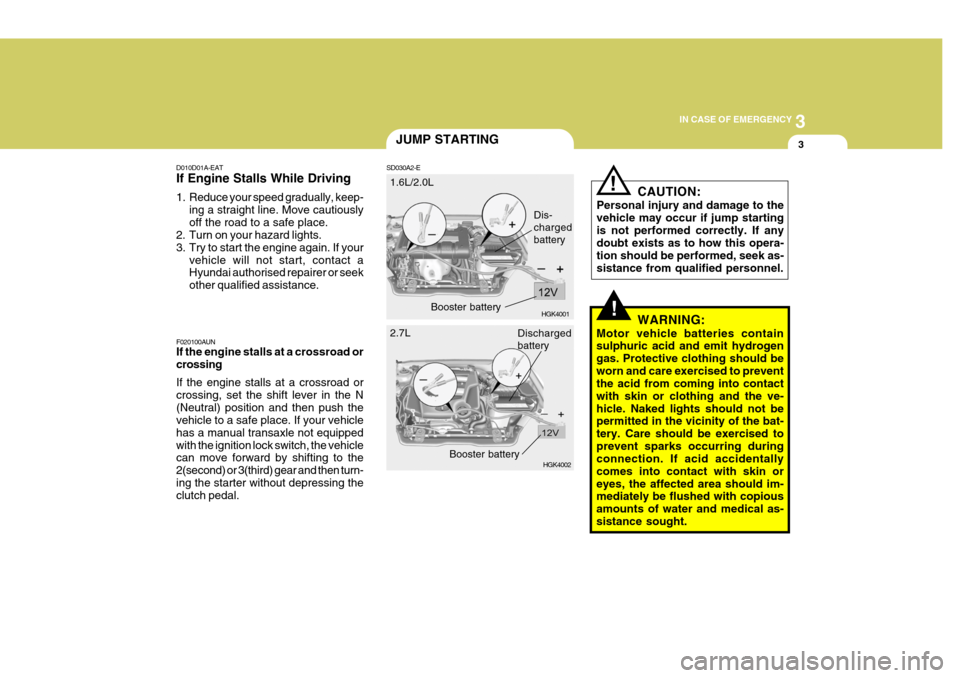
JUMP STARTING
WARNING:
Motor vehicle batteries contain sulphuric acid and emit hydrogen gas. Protective clothing should beworn and care exercised to prevent the acid from coming into contact with skin or clothing and the ve-hicle. Naked lights should not be permitted in the vicinity of the bat- tery. Care should be exercised toprevent sparks occurring during connection. If acid accidentally comes into contact with skin oreyes, the affected area should im- mediately be flushed with copious amounts of water and medical as-sistance sought.
1.6L/2.0L
HGK4001
HGK4002
Dis- chargedbattery
2.7L Booster battery
Discharged battery
Booster batteryF020100AUN If the engine stalls at a crossroad or crossing If the engine stalls at a crossroad or crossing, set the shift lever in the N(Neutral) position and then push the vehicle to a safe place. If your vehicle has a manual transaxle not equippedwith the ignition lock switch, the vehicle can move forward by shifting to the 2(second) or 3(third) gear and then turn-ing the starter without depressing the clutch pedal.
Page 325 of 407
3
IN CASE OF EMERGENCY
7
SD070A1-E CHANGING A FLAT TYRE
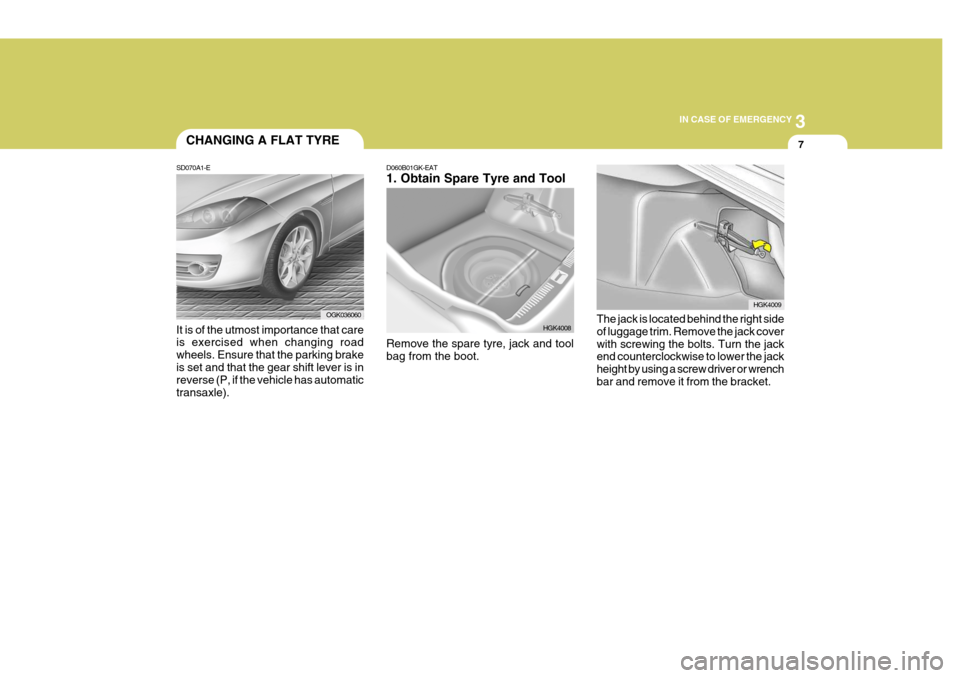
It is of the utmost importance that care is exercised when changing road wheels. Ensure that the parking brakeis set and that the gear shift lever is in reverse (P, if the vehicle has automatic transaxle).
OGK036060
D060B01GK-EAT 1. Obtain Spare Tyre and Tool Remove the spare tyre, jack and tool bag from the boot. HGK4008
HGK4009
The jack is located behind the right side of luggage trim. Remove the jack coverwith screwing the bolts. Turn the jack end counterclockwise to lower the jack height by using a screw driver or wrenchbar and remove it from the bracket.
Page 326 of 407
3 IN CASE OF EMERGENCY
8
HGK4013OGK036401
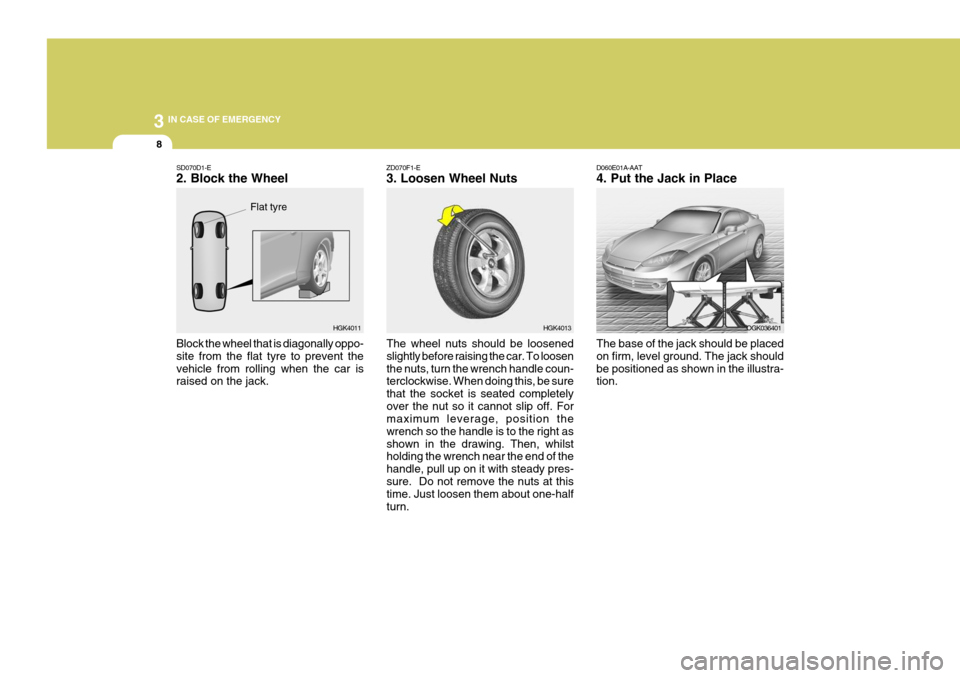
ZD070F1-E 3. Loosen Wheel Nuts
The wheel nuts should be loosened slightly before raising the car. To loosenthe nuts, turn the wrench handle coun- terclockwise. When doing this, be sure that the socket is seated completelyover the nut so it cannot slip off. For maximum leverage, position the wrench so the handle is to the right asshown in the drawing. Then, whilst holding the wrench near the end of the handle, pull up on it with steady pres-sure. Do not remove the nuts at this time. Just loosen them about one-half turn. D060E01A-AAT 4. Put the Jack in Place The base of the jack should be placed on firm, level ground. The jack shouldbe positioned as shown in the illustra- tion.
Flat tyre
SD070D1-E 2. Block the Wheel Block the wheel that is diagonally oppo- site from the flat tyre to prevent thevehicle from rolling when the car is raised on the jack. HGK4011
Page 328 of 407
3 IN CASE OF EMERGENCY
10
HGK4014
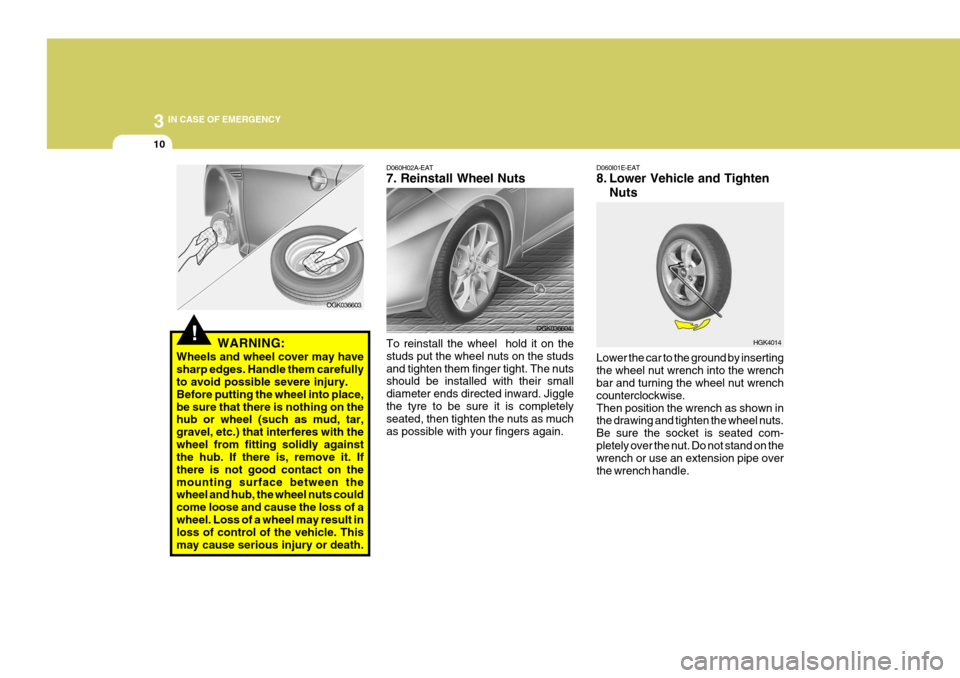
D060H02A-EAT 7. Reinstall Wheel Nuts To reinstall the wheel hold it on the studs put the wheel nuts on the studsand tighten them finger tight. The nuts should be installed with their small diameter ends directed inward. Jigglethe tyre to be sure it is completely seated, then tighten the nuts as much as possible with your fingers again. D060I01E-EAT
8. Lower Vehicle and Tighten
Nuts
Lower the car to the ground by inserting the wheel nut wrench into the wrench bar and turning the wheel nut wrench counterclockwise.Then position the wrench as shown in the drawing and tighten the wheel nuts. Be sure the socket is seated com-pletely over the nut. Do not stand on the wrench or use an extension pipe over the wrench handle.
OGK036604
!WARNING:
Wheels and wheel cover may have sharp edges. Handle them carefully to avoid possible severe injury. Before putting the wheel into place,be sure that there is nothing on the hub or wheel (such as mud, tar, gravel, etc.) that interferes with thewheel from fitting solidly against the hub. If there is, remove it. If there is not good contact on themounting surface between the wheel and hub, the wheel nuts could come loose and cause the loss of awheel. Loss of a wheel may result in loss of control of the vehicle. This may cause serious injury or death. OGK036603
Page 329 of 407
3
IN CASE OF EMERGENCY
11
Go around the wheel tightening every other nut until they are all tight. Thendouble-check each nut for tightness. After changing wheels, have a techni- cian tighten the wheel nuts to theirproper torque as soon as possible. Wheel nut tightening torque Steel wheel & aluminium alloy wheel: 90-110 Nm. (65-80 lb.ft)
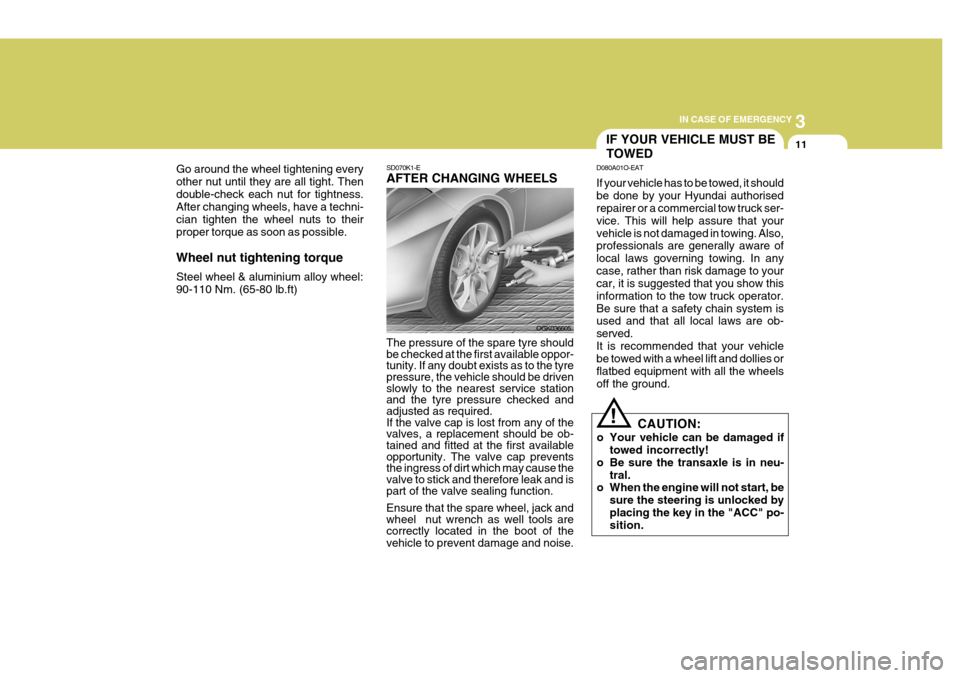
SD070K1-E AFTER CHANGING WHEELS The pressure of the spare tyre should be checked at the first available oppor-tunity. If any doubt exists as to the tyre pressure, the vehicle should be driven slowly to the nearest service stationand the tyre pressure checked and adjusted as required. If the valve cap is lost from any of thevalves, a replacement should be ob- tained and fitted at the first available opportunity. The valve cap preventsthe ingress of dirt which may cause the valve to stick and therefore leak and is part of the valve sealing function. Ensure that the spare wheel, jack and wheel nut wrench as well tools are correctly located in the boot of the vehicle to prevent damage and noise. OGK036605
IF YOUR VEHICLE MUST BE TOWED
D080A01O-EAT If your vehicle has to be towed, it should be done by your Hyundai authorised repairer or a commercial tow truck ser- vice. This will help assure that yourvehicle is not damaged in towing. Also, professionals are generally aware of local laws governing towing. In anycase, rather than risk damage to your car, it is suggested that you show this information to the tow truck operator.Be sure that a safety chain system is used and that all local laws are ob- served.It is recommended that your vehicle be towed with a wheel lift and dollies or flatbed equipment with all the wheelsoff the ground.
! CAUTION:
o Your vehicle can be damaged if towed incorrectly!
o Be sure the transaxle is in neu- tral.
o When the engine will not start, be
sure the steering is unlocked by placing the key in the "ACC" po- sition.
Page 330 of 407
3 IN CASE OF EMERGENCY
12
!
!
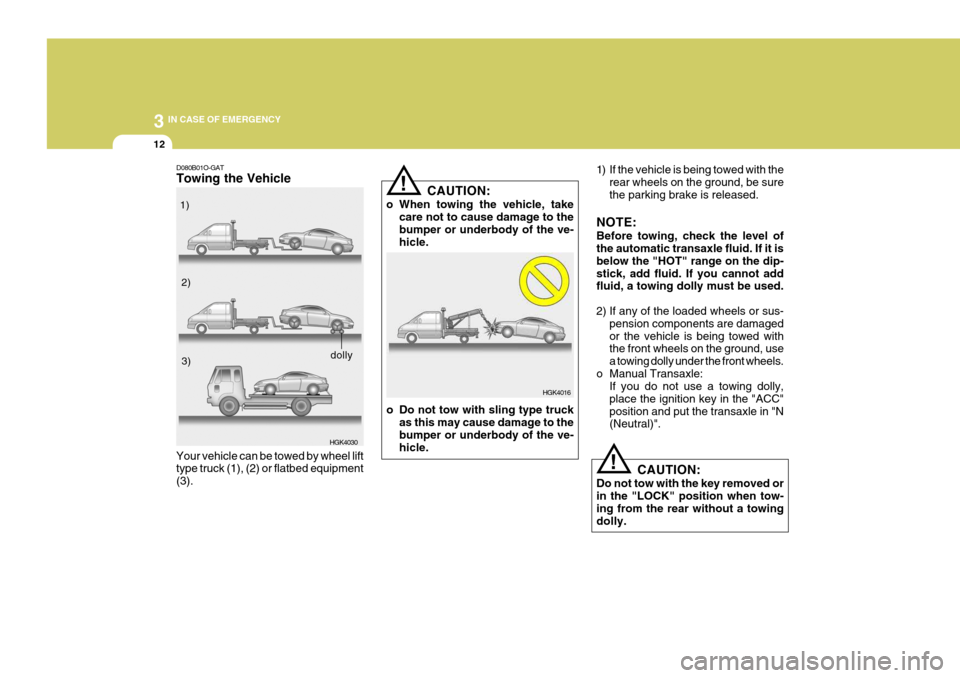
1) If the vehicle is being towed with the
rear wheels on the ground, be sure the parking brake is released.
NOTE: Before towing, check the level of the automatic transaxle fluid. If it is below the "HOT" range on the dip-stick, add fluid. If you cannot add fluid, a towing dolly must be used.
2) If any of the loaded wheels or sus- pension components are damaged or the vehicle is being towed with the front wheels on the ground, use a towing dolly under the front wheels.
o Manual Transaxle: If you do not use a towing dolly,place the ignition key in the "ACC"position and put the transaxle in "N (Neutral)".
CAUTION:
Do not tow with the key removed or in the "LOCK" position when tow- ing from the rear without a towing dolly.
CAUTION:
o When towing the vehicle, take care not to cause damage to the bumper or underbody of the ve- hicle.
o Do not tow with sling type truck as this may cause damage to thebumper or underbody of the ve-hicle. HGK4016
D080B01O-GAT Towing the Vehicle
HGK4030
Your vehicle can be towed by wheel lift type truck (1), (2) or flatbed equipment (3). 1)
2)
3)
dolly
Page 331 of 407
3
IN CASE OF EMERGENCY
13
HGK4017
!
o Automatic Transaxle:
Be sure to use a towing dolly under the front wheels.
CAUTION:
A vehicle with an automatic transaxleshould never be towed from the rear with the front wheels on the ground. This can cause serious damage tothe transaxle.
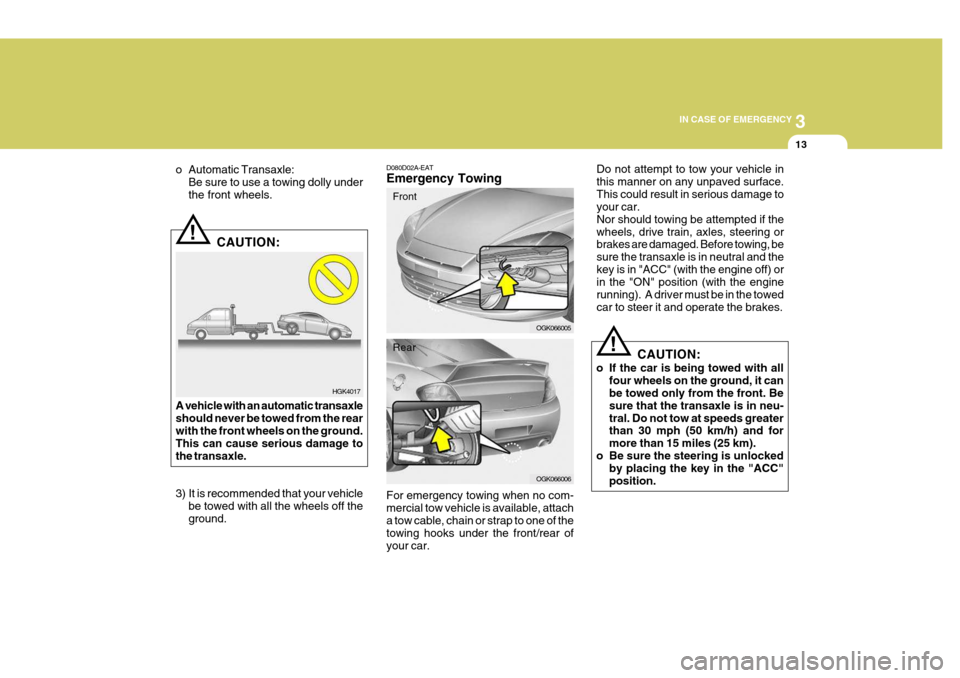
3) It is recommended that your vehicle be towed with all the wheels off the ground. D080D02A-EAT Emergency Towing For emergency towing when no com- mercial tow vehicle is available, attacha tow cable, chain or strap to one of the towing hooks under the front/rear of your car.
!
CAUTION:
o If the car is being towed with all four wheels on the ground, it can be towed only from the front. Be sure that the transaxle is in neu-tral. Do not tow at speeds greater than 30 mph (50 km/h) and for more than 15 miles (25 km).
o Be sure the steering is unlocked by placing the key in the "ACC"position.
OGK066005
Front
OGK066006
Rear Do not attempt to tow your vehicle in this manner on any unpaved surface.This could result in serious damage to your car. Nor should towing be attempted if thewheels, drive train, axles, steering or brakes are damaged. Before towing, be sure the transaxle is in neutral and thekey is in "ACC" (with the engine off) or in the "ON" position (with the engine running). A driver must be in the towedcar to steer it and operate the brakes.