flat tire HYUNDAI COUPE 2014 User Guide
[x] Cancel search | Manufacturer: HYUNDAI, Model Year: 2014, Model line: COUPE, Model: HYUNDAI COUPE 2014Pages: 546, PDF Size: 14.38 MB
Page 418 of 546
6-15
What to do in an emergency
6
Changing a tire with TPMS
If you have a flat tire, the low Tire
Pressure and Position telltales will
come on. We recommend that the
system be checked by an authorized
HYUNDAI dealer.
Each wheel is equipped with a tire
pressure sensor mounted inside the
tire behind the valve stem. You must
use TPMS specific wheels. It is rec-
ommended that you have your tires
serviced by an authorized HYUNDAI
dealer.
•The TPMS malfunction indica-
tor may blink for approximate-
ly 1 minute and then remain
continuously illuminated if
the vehicle is moving around
electric power supply cables
or radios transmitter such as
at police stations, government
and public offices, broadcast-
ing stations, military installa-
tions, airports, or transmitting
towers, etc. This can interfere
with normal operation of the
Tire Pressure Monitoring
System (TPMS).
•The TPMS malfunction indica-
tor may blink for approximate-
ly 1 minute and then remain
continuously illuminated if
snow chains are used or
some separate electronic
devices such as notebook
computer, mobile charger,
remote starter or navigation
etc., are used in the vehicle.
(Continued)
(Continued)
This can interfere with normal
operation of the Tire Pressure
Monitoring System (TPMS).CAUTION
NEVER use a puncture-repair-
ing agent to repair and/or inflate
a low pressure tire. The tire
sealant can damage the tire
pressure sensor. If used, you
will have to replace the tire
pressure sensor.
CAUTION
ProCarManuals.com
Page 419 of 546
6-16
What to do in an emergency
If you drive the vehicle for about 10
minutes at speeds above 25 km/h
after replacing the low pressure tire
with the spare tire, the below will
happen:
• The TPMS malfunction indicator
may blink for approximately 1
minute and then remain continu-
ously illuminated because the
TPMS sensor is not mounted on
the spare wheel.You may not be able identify a low
tire by simply looking at it. Always
use a good quality tire pressure
gauge to measure the tire's inflation
pressure. Please note that a tire that
is hot (from being driven) will have a
higher pressure measurement than a
tire that is cold (from sitting station-
ary for at least 3 hours and driven
less than 1.6 km (1 mile) during that
3 hour period).
Allow the tire to cool before measur-
ing the inflation pressure. Always be
sure the tire is cold before inflating to
the recommended pressure.
A cold tire means the vehicle has
been sitting for 3 hours and driven for
less than 1.6 km (1 mile) in that 3
hour period.TPMS
•The TPMS cannot alert you to
severe and sudden tire dam-
age caused by external fac-
tors such as nails or road
debris.
•If you feel any vehicle instabil-
ity, immediately take your foot
off the accelerator, apply the
brakes gradually and with
light force, and slowly move to
a safe position off the road.
WARNING
ProCarManuals.com
Page 421 of 546
6-18
What to do in an emergency
Jack and tools
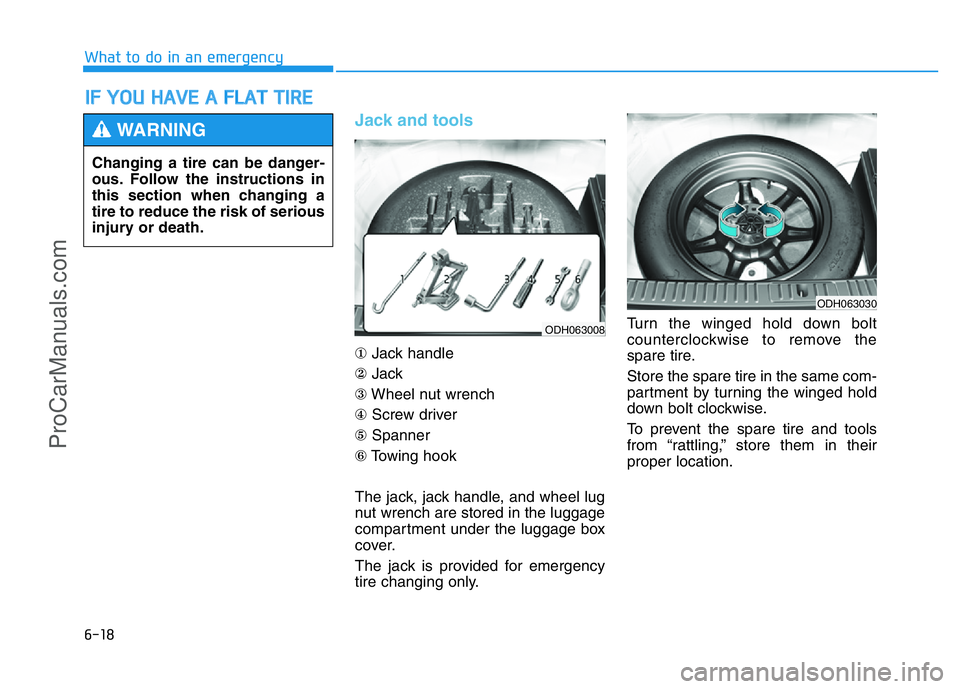
①Jack handle
②Jack
③Wheel nut wrench
④Screw driver
⑤Spanner
⑥Towing hook
The jack, jack handle, and wheel lug
nut wrench are stored in the luggage
compartment under the luggage box
cover.
The jack is provided for emergency
tire changing only.Turn the winged hold down bolt
counterclockwise to remove the
spare tire.
Store the spare tire in the same com-
partment by turning the winged hold
down bolt clockwise.
To prevent the spare tire and tools
from “rattling,” store them in their
proper location.
IF YOU HAVE A FLAT TIRE
Changing a tire can be danger-
ous. Follow the instructions in
this section when changing a
tire to reduce the risk of serious
injury or death.
WARNING
ODH063008
ODH063030
ProCarManuals.com
Page 424 of 546
6-21
What to do in an emergency
6
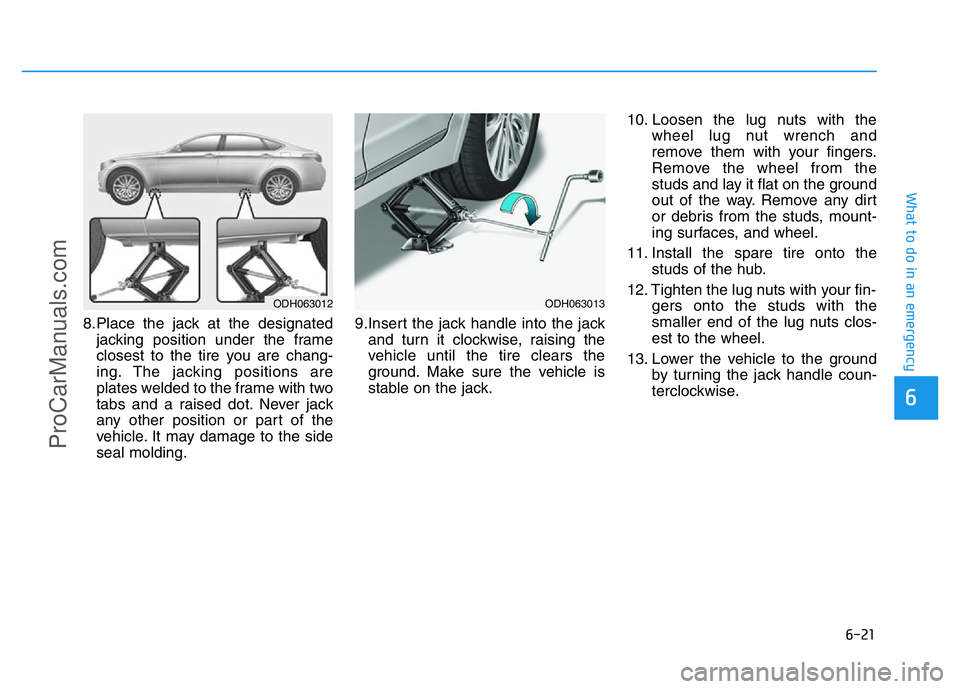
8.Place the jack at the designated
jacking position under the frame
closest to the tire you are chang-
ing. The jacking positions are
plates welded to the frame with two
tabs and a raised dot. Never jack
any other position or part of the
vehicle. It may damage to the side
seal molding.9.Insert the jack handle into the jack
and turn it clockwise, raising the
vehicle until the tire clears the
ground. Make sure the vehicle is
stable on the jack.10. Loosen the lug nuts with the
wheel lug nut wrench and
remove them with your fingers.
Remove the wheel from the
studs and lay it flat on the ground
out of the way. Remove any dirt
or debris from the studs, mount-
ing surfaces, and wheel.
11. Install the spare tire onto the
studs of the hub.
12. Tighten the lug nuts with your fin-
gers onto the studs with the
smaller end of the lug nuts clos-
est to the wheel.
13. Lower the vehicle to the ground
by turning the jack handle coun-
terclockwise.
ODH063013ODH063012
ProCarManuals.com
Page 425 of 546
6-22
What to do in an emergency
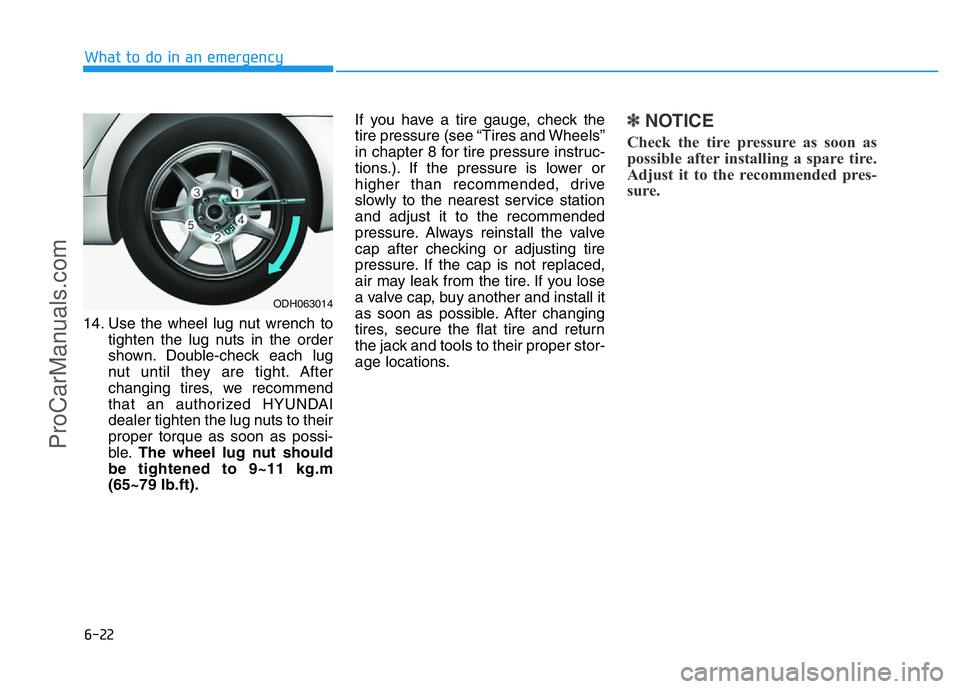
14. Use the wheel lug nut wrench to
tighten the lug nuts in the order
shown. Double-check each lug
nut until they are tight. After
changing tires, we recommend
that an authorized HYUNDAI
dealer tighten the lug nuts to their
proper torque as soon as possi-
ble.The wheel lug nut should
be tightened to 9~11 kg.m
(65~79 lb.ft).If you have a tire gauge, check the
tire pressure (see “Tires and Wheels”
in chapter 8 for tire pressure instruc-
tions.). If the pressure is lower or
higher than recommended, drive
slowly to the nearest service station
and adjust it to the recommended
pressure. Always reinstall the valve
cap after checking or adjusting tire
pressure. If the cap is not replaced,
air may leak from the tire. If you lose
a valve cap, buy another and install it
as soon as possible. After changing
tires, secure the flat tire and return
the jack and tools to their proper stor-
age locations.
✽NOTICE
Check the tire pressure as soon as
possible after installing a spare tire.
Adjust it to the recommended pres-
sure.
ODH063014
ProCarManuals.com
Page 427 of 546
6-24
When driving with the compact spare
tire mounted to your vehicle:
• Check the tire pressure after
installing the compact spare tire.
The compact spare tire should be
inflated to 420 kPa (60 psi).
• Do not take this vehicle through an
automatic car wash while the com-
pact spare tire is installed.
• Do not use the compact spare tire
on any other vehicle because this
tire has been designed especially
for your vehicle.
• The compact spare tire’s tread life
is shorter than a regular tire.
Inspect your compact spare tire
regularly and replace worn com-
pact spare tires with the same size
and design, mounted on the same
wheel.
• Do not use more than one compact
spare tire at a time.
• Do not tow a trailer while the com-
pact spare tire is installed.✽NOTICE
When the original tire and wheel are
repaired and reinstalled on the vehi-
cle, the lug nut torque must be set
correctly. The correct lug nut tight-
ening torque is 9-11 kg.m (65-79
lb.ft).
What to do in an emergency
To prevent damaging the com-
pact spare tire and your vehicle:
•Drive slowly enough for the
road conditions to avoid all
hazards, such as a potholes
or debris.
•Avoid driving over obstacles.
The compact spare tire diame-
ter is smaller than the diame-
ter of a conventional tire and
reduces the ground clearance
approximately 25 mm (1 inch).
•Do not use tire chains on the
compact spare tire. Because
of the smaller size, a tire chain
will not fit properly.
•Do not use the compact spare
tire on any other wheels, nor
should standard tires, snow
tires, wheel covers or trim
rings be used with the com-
pact spare wheel.
CAUTION
ProCarManuals.com
Page 436 of 546
6-33
What to do in an emergency
6
Tire pressure gauge
(if equipped)
Tires normally lose some air in day-
to-day use, and you may have to add
a air periodically and usually it is not
a sign of a leaking tire, but of normal
wear. Always check tire pressure
when the tires are cold because tire
pressure increases with tempera-
ture.To check the tire pressure, take the
following steps:
1.Unscrew the inflation valve cap
that is located on the rim of the tire.
2.Press and hold the gauge against
the tire valve. Some air will leak as
you begin and more will leak if you
don't press the gauge in firmly.
3.A firm non-leaking push will acti-
vate the gauge.
4.Read the tire pressure on the
gauge to see whether the tire pres-
sure is low or high.
5.Adjust the tire pressure to the
specified pressure. Refer to “Tires
and Wheels” in chapter 8.
6.Reinstall the inflation valve cap.
ProCarManuals.com
Page 437 of 546
7
Maintenance
7
Maintenance
Engine compartment .............................................7-3
Maintenance services ...........................................7-5
Owner's responsibility ......................................................7-5
Owner maintenance precautions ..................................7-5
Owner maintenance ...............................................7-7
Owner maintenance schedule ........................................7-7
Scheduled maintenance service ..........................7-9
Normal maintenance schedule .........................7-10, 7-16
Maintenance under severe usage
conditions...............................................................7-14, 7-20
Explanation of scheduled maintenance items..7-22
Engine oil ..............................................................7-26
Checking the engine oil level .......................................7-26
Changing the engine oil and filter ..............................7-27
Engine coolant......................................................7-28
Checking the coolant level ...........................................7-28
Changing the coolant .....................................................7-30
Brake fluid ............................................................7-31
Checking the brake fluid level .....................................7-31
Washer fluid .........................................................7-33
Checking the washer fluid level ..................................7-33
Parking brake .......................................................7-33
Checking the parking brake .........................................7-33
Air cleaner ............................................................7-34
Filter replacement ...........................................................7-34
Climate control air filter .....................................7-35
Filter inspection ...............................................................7-35
Filter replacement ...........................................................7-35
Wiper blades .........................................................7-36
Blade inspection ..............................................................7-36
Blade replacement ..........................................................7-36
Battery...................................................................7-38
For best battery service................................................7-38
Battery capacity label ....................................................7-40
Battery recharging .........................................................7-40
Reset items .......................................................................7-41
Tires and wheels ..................................................7-42
Tire care ............................................................................7-42
Recommended cold tire inflation pressures.............7-42
Checking tire inflation pressure ..................................7-44
Tire rotation .....................................................................7-45
Wheel alignment and tire balance ..............................7-46
Tire replacement .............................................................7-46
Wheel replacement ........................................................7-48
Tire traction ......................................................................7-48
Tire maintenance ...........................................................7-48
Tire sidewall labeling ......................................................7-48
Low aspect ratio tire ......................................................7-53
Fuses ......................................................................7-54
Fuse/Relay panel description ......................................7-59
7
ProCarManuals.com
Page 443 of 546
7-7
7
Maintenance
OWNER MAINTENANCE
The following lists are vehicle checks
and inspections that should be per-
formed at the frequencies indicated
to help ensure safe, dependable
operation of your vehicle.
If you have any question, we recom-
mend that you consult an authorized
HYUNDAI dealer.
These Owner Maintenance Checks
are generally not covered by war-
ranties and you may be charged for
labor, parts and lubricants used.Owner maintenance schedule
When you stop for fuel:
• Check the engine oil level.
• Check coolant level in coolant
reservoir.
• Check the windshield washer fluid
level.
• Look for low or under-inflated tires.
While operating your vehicle:
• Note any changes in the sound of
the exhaust or any smell of
exhaust fumes in the vehicle.
• Check for vibrations in the steering
wheel. Notice any increased steer-
ing effort or looseness in the steer-
ing wheel, or change in its straight-
ahead position.
• Notice if your vehicle constantly
turns slightly or “pulls” to one side
when traveling on smooth, level
road.
• When stopping, listen and check
for unusual sounds, pulling to one
side, increased brake pedal travel
or “hard-to-push” brake pedal.
• If any slipping or changes in the
operation of your transmission
occurs, check the transmission
fluid level.
• Check automatic transmission P
(Park) function.
• Check parking brake.
• Check for fluid leaks under your
vehicle (water dripping from the air
conditioning system during or after
use is normal). Be careful when checking your
engine coolant level when the
engine is hot. Scalding hot
coolant and steam may blow
out under pressure. This could
cause burns or other serious
injury.
WARNING
ProCarManuals.com
Page 444 of 546
7-8
Maintenance
At least monthly:
• Check coolant level in the engine
coolant reservoir.
• Check the operation of all exterior
lights, including the stop lamps,
turn signals and hazard warning
flashers.
• Check the inflation pressures of all
tires including the spare.
At least twice a year
(i.e., every Spring and Fall) :
• Check radiator, heater and air con-
ditioning hoses for leaks or dam-
age.
• Check windshield washer spray
and wiper operation. Clean wiper
blades with clean cloth dampened
with washer fluid.
• Check headlamp alignment.
• Check muffler, exhaust pipes,
shields and clamps.
• Check the lap/shoulder belts for
wear and function.
• Check for worn tires and loose
wheel lug nuts.
At least once a year :
• Clean body and door drain holes.
• Lubricate door hinges and checks,
and hood hinges.
• Lubricate door and hood locks and
latches.
• Lubricate door rubber weather-
strips.
• Check the air conditioning system.
• Inspect and lubricate automatic
transmission linkage and controls.
• Clean battery and terminals.
• Check the brake fluid level.
ProCarManuals.com